

Climate change and water management in the biblical city of Dan
Open accessThe DOI matches its Crossref record; 92 of the 92 references it cites were found in a registry or an index; none of the 47 sources its claims cite is checked for support yet.
Abstract
Past climate shifts in water-stressed areas show that stagnant water could be a health threat in the context of global change.
Overview
CoChat Summary
TL;DR
Pollen, archaeological, and hydrological reconstructions from a 675-cm core at Tel Dan show that repeated declines in freshwater input from Mount Hermon (~2150–1950 BCE, ~1050–840 BCE, ~550–350 BCE) coincided with low settlement intensity, oleiculture decline, and stagnant-water/marsh conditions. The authors argue that ancient water-management failure under climate stress created disease-prone marshes, offering a cautionary analogue for current water-stressed regions.
Key findings
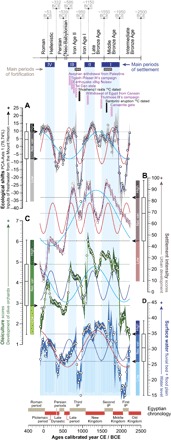
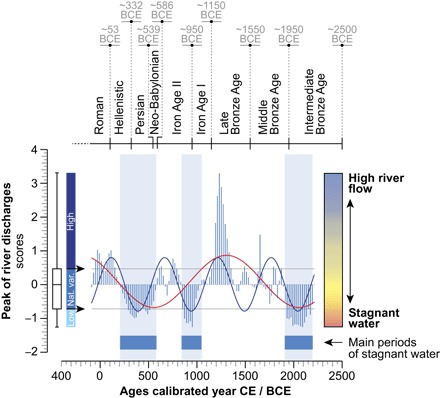
- Major ecological shifts from lower water inputs from Mount Hermon occurred at ~2150–1950 BCE, ~1050–840 BCE, and ~550–350 BCE; the area was never dry but probably evolved into a marsh zone, and the PCA-Axis1 ecological-shift curve shows a 550-year periodicity also seen in water level and discharge.
- Three phases of low settlement intensity and declining oleiculture (~2500–1950 BCE, ~1050–840 BCE, and after ~550 BCE) were chronologically correlated with the lowest freshwater inputs; low water-level phases (~2150–1950 BCE and ~1050–840 BCE) correlated with steep settlement decline, while from 1950 to 1050 BCE the surroundings appear to have been completely covered by water at least during seeding and growing seasons.
- From ~840 to 300 BCE, water inputs varied greatly, with a gradual decline initiated at ~700 BCE and peaking at ~350 BCE, probably affecting the population since ~650 BCE; this period also shows increased pasturing and agricultural indicators below Bronze Age scores.
- Reduced freshwater inputs desiccated wetlands flora and generated large areas of stagnant water, marshy borders, and brackish puddles; during low-density periods (~2500–1950 BCE, ~1050–850 BCE, and since ~550 BCE), populations were probably subjected to marsh-related disease, with conditions for malaria becoming optimal. The authors link this to modern concerns including the 2007–2010 Syrian drought and Rift Valley fever.
Methods
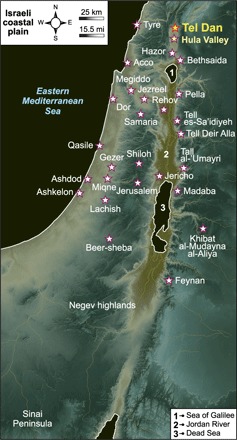
- A 675-cm continuous core (TD-1; 33°15′00.24″N, 35°39′13.18″E; +209 m mean sea level) was drilled on the alluvial fan of the Nahal Sion near Tel Dan; chronology used nine accelerator mass spectrometry 14C dates, calibrated with CALIB REV 7.1 and IntCal13, with an average resolution of 4 years/cm (2.5 mm/year), though a floating chronology exists between 250- and 150-cm depth.
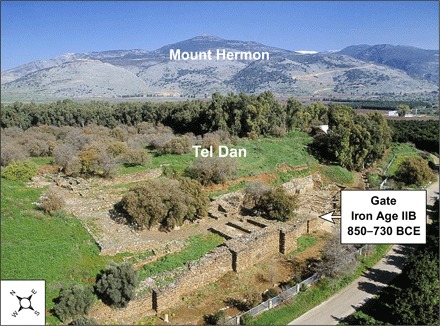
- Archaeological data come from more than 50 years (38 field campaigns) of excavation at Tel Dan since 1966; population and density estimates are based on measured habitation area from excavations and surveys.
- Pollen samples were prepared using standard clay-sample procedures; analyses in PAST version 2.17c included 20-year interpolation, cluster analysis, PCA, LOESS smoothing, sinusoidal regression, wavelet analysis with Morlet basis, spectral and REDFIT analyses, and cross-correlations at P = 0.05.
Limitations
- The paper states that the average chronological resolution may mask more intense weather events and closely sequenced extreme years, as well as temporal variability in alluvium and pollen deposition; from a single core this would be a heuristic interpolation rather than a chronologically reliable climate record, although recurring patterns in other eastern Mediterranean and western Asian cores allow the temporal dimension to be considered with some precision.
- The paper states that no written historical sources recount the role of water and the impact of regional shortages at ancient Dan, and that population/density estimates assume contemporaneity of occupation of architectural units based on homogeneity of material culture.
- Evident from the text: the malaria and water-borne-disease interpretation is inferential, built largely from modern Hula Valley conditions and historical records rather than direct ancient disease evidence at Tel Dan; the links between water supply, settlement decline, and disease rest on chronological correlation and analogical reasoning.
Model-written summary. Check it against the paper before relying on it.
Integrity signals
Registry
Cites
Statistics
Figures
Verification
Claims the paper makes
0 Valid · 0 Not valid · 17 Not checked · 38 Own results and interpretations
A result the paper reports from its own data — it cites no other source for it, so there is none to check. The quote shows it is in the paper.
In the paper
“Over time, two environmental zones, the Transition zone and the Chaparral/oak woodland zone (figs. S1 and S2), are significantly negatively correlated (Lag0 = −0.76, P = 0.05; fig. S3A)”
§ Climate change and water management in the biblical city of Dan > RESULTS > Ecological shifts
plainstates an association- Asserted: passes — The authors put it forward as true.
- Checkable: passes — It can be checked against evidence.
- Load-bearing: unclear — It is unclear whether the paper’s conclusions depend on it.
- Based: passes — The paper gives a reason why it holds.
A result the paper reports from its own data — it cites no other source for it, so there is none to check. The quote shows it is in the paper.
In the paper
“The drop in oleiculture, which started around 1100 BCE (Fig. 3C), may result not only from the decline of agricultural practices but also from a change in the phenology of the olive trees because of climate pressures.”
§ Climate change and water management in the biblical city of Dan > RESULTS > Settlement intensity and oleiculture
plain- Asserted: passes — The authors put it forward as true.
- Checkable: passes — It can be checked against evidence.
- Load-bearing: passes — The paper’s conclusions depend on it.
- Based: passes — The paper gives a reason why it holds.
A result the paper reports from its own data — it cites no other source for it, so there is none to check. The quote shows it is in the paper.
In the paper
“The wavelet analyses for the water level and discharges show a 550-year periodicity, similar to the one recorded by the PCA-Axis1 (fig. S6).”
§ Climate change and water management in the biblical city of Dan > RESULTS > Water discharge
plainstates an association- Asserted: passes — The authors put it forward as true.
- Checkable: passes — It can be checked against evidence.
- Load-bearing: unclear — It is unclear whether the paper’s conclusions depend on it.
- Based: passes — The paper gives a reason why it holds.
A result the paper reports from its own data — it cites no other source for it, so there is none to check. The quote shows it is in the paper.
In the paper
“a cross-correlation between the PCA-Axis1 scores and the cultivated species was performed (fig. S3B). A positive correlation centered on a null lag (Lag0 = −0.76, P = 0.05; fig. S3B)”
§ Climate change and water management in the biblical city of Dan > RESULTS > Ecological shifts
plainstates an association- Asserted: passes — The authors put it forward as true.
- Checkable: passes — It can be checked against evidence.
- Load-bearing: passes — The paper’s conclusions depend on it.
- Based: passes — The paper gives a reason why it holds.
A result the paper reports from its own data — it cites no other source for it, so there is none to check. The quote shows it is in the paper.
In the paper
“all pollen-based clusters (fig. S1) account for +0.787 of the variance of PCA-Axis1 (Fig. 3A)”
§ Climate change and water management in the biblical city of Dan > RESULTS > Ecological shifts
plainstates an association- Asserted: passes — The authors put it forward as true.
- Checkable: passes — It can be checked against evidence.
- Load-bearing: unclear — It is unclear whether the paper’s conclusions depend on it.
- Based: passes — The paper gives a reason why it holds.
27 more claims
Create a free account to see all 55 claims and to verify the 45 references still open.
- It may state two separate claims as one. 19
- Probably not a substantial claim. 5
Citations
Cites
The water footprint of humanity
Hoekstra, A. Y., & Mekonnen, M. M. (2012) · Proceedings of the National Academy of Sciences · doi:10.1073/pnas.1109936109 · Cited by 2,260
Climate change in the Fertile Crescent and implications of the recent Syrian drought
Kelley, C. P., Mohtadi, S., Cane, M. A., Seager, R., & Kushnir, Y. (2015) · Proceedings of the National Academy of Sciences · doi:10.1073/pnas.1421533112 · Cited by 1,379 · cited 1×
“This outcome was witnessed in modern Syria during the 3-year drought in 2007 to 2010, which resulted in widespread crop failure and amassmigration of farming communities to urban areas (22, 62).”
BackgroundCultural Responses to Climate Change During the Late Holocene
deMenocal, P. B. (2001) · Science · doi:10.1126/science.1059287 · Cited by 1,207
Climate change-induced migration and violent conflict
Reuveny, R. (2007) · Political Geography · doi:10.1016/j.polgeo.2007.05.001 · Cited by 1,005
Global assessment of trends in wetting and drying over land
Greve, P., Orlowsky, B., Mueller, B., Sheffield, J., Reichstein, M., & Seneviratne, S. I. (2014) · Nature Geoscience · doi:10.1038/ngeo2247 · Cited by 861
Old World megadroughts and pluvials during the Common Era
Cook, E. R., Seager, R., Kushnir, Y., Briffa, K. R., Büntgen, U., Frank, D., Krusic, P. J., Tegel, W., van der Schrier, G., Andreu-Hayles, L., et al. (2015) · Science Advances · doi:10.1126/sciadv.1500561 · Cited by 679
Evolutionary and Historical Aspects of the Burden of Malaria
Carter, R., & Mendis, K. N. (2002) · Clinical Microbiology Reviews · doi:10.1128/cmr.15.4.564-594.2002 · Cited by 663
Globalization of Water: Sharing the Planet's Freshwater Resources
Hoekstra, A. Y., & Chapagain, A. K. (2007) · Wiley eBooks · doi:10.1002/9780470696224 · Cited by 640
Trigo, R. M., Pozo‐Vázquez, D., Osborn, T. J., Castro‐Díez, Y., Gámiz‐Fortis, S., & Esteban‐Parra, M. J. (2004) · International Journal of Climatology · doi:10.1002/joc.1048 · Cited by 593
Cox, F. E. G. (2002) · Clinical Microbiology Reviews · doi:10.1128/cmr.15.4.595-612.2002 · Cited by 483
Research works printed but not linked: 19
- J. Pournelle, thesis, University of California-San Diego (2003).
- D. Ilan, in The Oxford Encyclopaedia of the Bible and Archaeology, D. M. Master, Ed. (Oxford University Press, 2013), pp. 245–254.
- E. Stern, Archaeology of the Land of the Bible, Volume II: The Assyrian, Babylonian, and Persian Periods (732–332 B.C.E.) (Doubleday Press, 2001).
- H. Weiss, in The Oxford Handbook of the Archaeology of the Levant c.8000-332 BCE, M. Steiner, A. E. Killebrew, Eds. (Oxford University Press, 2014), pp. 367–387.
- Y. Karmon, The Northern Hula Valley, its Natural and Cultural Landscape (The Magnes Press - Hebrew University, 1956).
- Agmon I., The Bedouin tribes of the Hula and Baysān Valleys at the end of the Ottoman rule. Cathedra 45, 87– 102 (1987).
- F. W James, P. E. McGovern, The Late Bronze Egyptian Garrison at Beth Shan: A Study of Levels VII and VIII (University of Pennsylvania Press, 1993).
- A. Mazar, in Egypt, Canaan and Israel: History, Imperialism, Ideology and Literature, S. Bar, D. Kahn, J.J. Shirley, Eds. (Proceedings-Conference 3–7 May 2009, University of Haifa, 2011), pp. 151–185.
- E. van den Brink, T.E. Levy, Egypt and the Levant, Interrelations from the 4th through the Early 3rd Millennium B.C.E. (Leicester Univ. Press, 2002).
- A. Biran, in Dan I: History of Excavation, the Neolithic Settlement, the Early Bronze Age Levels and the Middle Bronze Age Tombs, A. Biran, D. Ilan, R. Greenberg, Eds. (Annual of the Nelson Glueck School of Biblical Archaeology VI: Hebrew Union College, 1996), pp. 1–64.
- A. Biran, in Dan II. A Chronicle of the Excavations and the Late Bronze Age “Mycenaean Tomb”, A. Biran, D. Ilan, R. Greenberg Eds. (Annual of the Nelson Glueck School of Biblical Archaeology VI: Hebrew Union College, 2001), pp. 5–32.
- H. J. Bruins, J. van der Plicht, D. Ilan, E. Werker, in The Bible and Radiocarbon Dating: Archaeology, Text and Science, T.E. Levy, T. Higham, Eds. (Oxford Univ. Press, 2005), pp. 323–336.
- R. Greenberg, in Dan I: History of Excavation, the Neolithic Settlement, the Early Bronze Age Levels and the Middle Bronze Age Tombs, A. Biran, D. Ilan, R. Greenberg Eds. (Annual of the Nelson Glueck School of Biblical Archaeology VI: Hebrew Union College, 1996), pp. 83–160.
- D. Ilan, in The Archaeology of Society in the Holy Land, T. E. Levy, Ed. (Leicester University Press, 1995), pp. 297–319.
- D. Ilan, in The Archaeology of Death in the Ancient Near East, S. Campbell, A. Green, Eds. (Oxbow Press, 1995), pp. 117–139.
- D. Ilan, in Dan I: History of Excavation, the Neolithic Settlement, the Early Bronze Age Levels and the Middle Bronze Age Tombs, A. Biran, D. Ilan, R. Greenberg, Eds. (Annual of the Nelson Glueck School of Biblical Archaeology VI: Hebrew Union College, 1996), pp. 161–329.
- D. Ilan, in The Children of Israel: Archaeological Studies in Honor of Israel Finkelstein, A. Fantalkin, A. Yasur-Landau, Eds. (Brill, 2008), pp. 87–104.
- J. Greer, D. Fulton, P. Wapnish, in Dan IV: The Early Iron Age Levels, D. Ilan, Ed. (Annual of the Nelson Glueck School of Biblical Archaeology X: Hebrew Union College, 2017), in press.
- A. Mazar, H.J. Bruins, N. Panitz-Cohen, J. van der Plicht, in The Bible and Radiocarbon Dating: Archaeology, Text And Science, T.E. Levy, T. Higham, Eds. (Equinox, 2005), pp. 193–255.
Cited by
Walker, M., Head, M. J., Berkelhammer, M., Björck, S., Cheng, H., Cwynar, L., Fisher, D., Gkinis, V., Long, A., Lowe, J., et al. (2018) · Episodes · doi:10.18814/epiiugs/2018/018016 · Cited by 444
The 4.2 ka BP event in the Levant
Kaniewski, D., Marriner, N., Cheddadi, R., Guiot, J., & Van Campo, E. (2018) · Climate of the Past · doi:10.5194/cp-14-1529-2018 · Cited by 81
Self-citationThe Archaeology of the Bronze Age Levant
Greenberg, R. (2019) · doi:10.1017/9781316275993 · Cited by 110
Utida, G., Cruz, F. W., Santos, R. V., Sawakuchi, A. O., Wang, H., Pessenda, L. C. R., Novello, V. F., Vuille, M., Strauss, A. M., Borella, A. C., et al. (2020) · Quaternary Science Reviews · doi:10.1016/j.quascirev.2020.106655 · Cited by 94
van Bavel, B., Curtis, D. R., Hannaford, M., Moatsos, M., Roosen, J., & Soens, T. (2019) · Wiley Interdisciplinary Reviews Climate Change · doi:10.1002/wcc.611 · Cited by 81
Holocene landscape dynamics and long-term population trends in the Levant
Palmisano, A., Woodbridge, J., Roberts, C. N., Bevan, A., Fyfe, R., Shennan, S., Cheddadi, R., Greenberg, R., Kaniewski, D., Langgut, D., et al. (2019) · The Holocene · doi:10.1177/0959683619826642 · Cited by 61
Self-citationMarriner, N., Kaniewski, D., Pourkerman, M., & Devillers, B. (2022) · Earth-Science Reviews · doi:10.1016/j.earscirev.2022.103986 · Cited by 59
Self-citationRohling, E. J., Marino, G., Grant, K., Mayewski, P. A., & Weninger, B. (2019) · Quaternary Science Reviews · doi:10.1016/j.quascirev.2019.02.009 · Cited by 56
Kaniewski, D., Marriner, N., Bretschneider, J., Jans, G., Morhange, C., Cheddadi, R., Otto, T., Luce, F., & Campo, E. V. (2019) · Regional Environmental Change · doi:10.1007/s10113-018-01460-w · Cited by 53
Self-citationCold and dry outbreaks in the eastern Mediterranean 3200 years ago
Kaniewski, D., Marriner, N., Cheddadi, R., Morhange, C., Bretschneider, J., Jans, G., Otto, T., Luce, F., & Campo, E. V. (2019) · Geology · doi:10.1130/g46491.1 · Cited by 47
Self-citationYang, R., & Bing, X. (2022) · Atmosphere · doi:10.3390/atmos13020230 · Cited by 42
Hinz, M., Schirrmacher, J., Kneisel, J., Rinne, C., & Weinelt, M. S. (2019) · Journal of neolithic archaelogy · doi:10.12766/jna.2019.1 · Cited by 41
Olive production in the 21st century will be threatened by water stress and declining solar activity
Kaniewski, D., Marriner, N., Terral, J., Besnard, G., Tsitsou, L., Topsakal, J., Morhange, C., Otto, T., Luce, F., & Cheddadi, R. (2025) · Communications Earth & Environment · doi:10.1038/s43247-025-02256-7 · Cited by 35
Self-citationA Socio-Hydrological Perspective on the Economics of Water Resources Development and Management
Pande, S., Roobavannan, M., Kandasamy, J., Sivapalan, M., Hombing, D., Lyu, H., & Rietveld, L. C. (2020) · Oxford University Press eBooks · doi:10.1093/acrefore/9780199389414.013.657 · Cited by 33
A diagnostic framework to reveal future clean water scarcity in a changing climate
Tong, S., Xia, R., Chen, J., Li, W., Chen, Y., & Xu, C. (2024) · Journal of Hydrology Regional Studies · doi:10.1016/j.ejrh.2024.102040 · Cited by 22
Fonsêca, D. N., Corrêa, A. C. D. B., de Lira, D. R., Tavares, B. D. A. C., Torres, B. A., Gonçalves, R. B., & da Silva, W. F. (2024) · Geomorphology · doi:10.1016/j.geomorph.2024.109316 · Cited by 20
Baydoun, S. A., Hani, N., Zein, H. E., Zaidan, R., Ghanem, H., Mhanna, M., & Chalak, L. (2024) · Human Ecology · doi:10.1007/s10745-024-00488-3 · Cited by 13
Stock, F., Seyer, M., Symanczyk, A., Uncu, L., & Brückner, H. (2020) · Geoarchaeology · doi:10.1002/gea.21781 · Cited by 12
Lorenzón, M., Victoria, B. C., Itkin, E., & Fantalkin, A. (2023) · Geoarchaeology · doi:10.1002/gea.21977 · Cited by 9
Arora, P., Ali, S. N., Singh, P., Shekhar, M., Morthekai, P., Ghosh, R., & Maharana, P. (2024) · The Holocene · doi:10.1177/09596836241254480 · Cited by 8
The Intermediate Bronze Age: Entering the Orbit of Syria
Greenberg, R. (2019) · Cambridge University Press eBooks · doi:10.1017/9781316275993.005 · Cited by 5
Kaniewski, D., Marriner, N., Terral, J., Morhange, C., Chen, Z., Wang, Y., Otto, T., Luce, F., & Cheddadi, R. (2024) · Anthropocene · doi:10.1016/j.ancene.2024.100430 · Cited by 5
Self-citationNew definition for the subdivision of the Holocene Epoch and climate
Hirabayashi, S., & Yokoyama, Y. (2020) · The Quaternary Research (Daiyonki-Kenkyu) · doi:10.4116/jaqua.59.129 · Cited by 4
Climate and Environment in the Southern Levant, 1300–300 BCE
Langgut, D. (2026) · Cambridge University Press eBooks · doi:10.1017/9781009558341 · Cited by 3
Production–consumption–release of trace metal elements, the urban proxies of the palaeo-anthropocene
Delile, H., & Keenan‐Jones, D. (2024) · HAL · Cited by 3
Marriner, N., Morhange, C., Flaux, C., Carayon, N., & Kaniewski, D. (2023) · Encyclopedia of earth sciences series/Encyclopedia of earth sciences · doi:10.1007/978-3-030-44600-0_119-1 · Cited by 3
Self-citationUrbanism and Its Demise in the Early Bronze II and III
Greenberg, R. (2019) · Cambridge University Press eBooks · doi:10.1017/9781316275993.004 · Cited by 2
Cities, shocks, and persistence: new approaches to urban resilience in the past
Smith, M. E. (2026) · Global Sustainability · doi:10.1017/sus.2026.10063 · Cited by 2
Wagner–Durand, E. (2021) · Die Welt des Orients · doi:10.13109/wdor.2021.51.1.10 · Cited by 2
Villages, Manors and Integrated City-States of the Middle Bronze Age
Greenberg, R. (2019) · Cambridge University Press eBooks · doi:10.1017/9781316275993.006 · Cited by 1
Greenberg, R. (2019) · Cambridge University Press eBooks · doi:10.1017/9781316275993.002 · Cited by 1
12,000 years of climate-environment-society interactions on eastern Mediterranean olive trees
Kaniewski, D., Marriner, N., Terral, J., Besnard, G., Vuidel, G., Tsitsou, L., Topsakal, J., Baradel, D., Morhange, C., Otto, T., et al. (2026) · Quaternary Science Reviews · doi:10.1016/j.quascirev.2026.110182 · Cited by 1
Self-citationA Late Holocene Lecythidaceae wood record from Valle del Cauca, Colombia
Pérez-Lara, D. K., Martínez, C., Pizano, C., Jaramillo, C. A., & Vásquez, V. (2024) · Revista de la Academia Colombiana de Ciencias Exactas Físicas y Naturales · doi:10.18257/raccefyn.3085 · Cited by 1
Karmaksh, A. K., Sangwan, A., & Kumar, A. (2026) · Discover Environment · doi:10.1007/s44274-026-00837-7 · Cited by 1
Greenberg, R. (2019) · Cambridge University Press eBooks · doi:10.1017/9781316275993.010
Greenberg, R. (2019) · Cambridge University Press eBooks · doi:10.1017/9781316275993.001
Villages and the Growth of Social Power in the Early Bronze I
Greenberg, R. (2019) · Cambridge University Press eBooks · doi:10.1017/9781316275993.003
The Late Bronze Age: Under Egypt’s Heel
Greenberg, R. (2019) · Cambridge University Press eBooks · doi:10.1017/9781316275993.007
Greenberg, R. (2019) · Cambridge University Press eBooks · doi:10.1017/9781316275993.009
Conclusion: The Legacy of the Bronze Age Levant
Greenberg, R. (2019) · Cambridge University Press eBooks · doi:10.1017/9781316275993.008
Geoarchaeology and palaeoenvironments of the ancient pharaonic harbour of Khufu, Giza, Egypt
Younes, G. (2023) · theses.fr (ABES) · doi:10.70675/680901ebzcee0z413fzb456z9c1272480937
Weninger, B. (2026) · Documenta Praehistorica · doi:10.4312/dp.53.17
Refugees and Resettlement in the Early Iron Age Southern Levant
Brown, D. W. (2025) · eScholarship (California Digital Library)
Bowler, L. (2024) · CentAUR (University of Reading) · doi:10.48683/1926.00120386
A New Strategy for the Management of Waste Water Treatment Using Biomaterials
Ayat, A., Arris, S., Aissaoui, H., Abbaz, A., Boumezough, Y., Khechine, D., Khellaf, K., & Khayri, C. (2025) · World sustainability series · doi:10.1007/978-3-032-00098-9_72
Jose, A., Philips, D. S., & Nayagam, J. R. (2026) · Acta Innovations · doi:10.62441/actainnovations.v63i1s.1635
Westward dispersal and introduction of pistachio cultivation in the Near East
Kaniewski, D., Marriner, N., Terral, J., Besnard, G., Morhange, C., Baradel, D., Otto, T., Luce, F., Pourkerman, M., Gambin, B., et al. (2026) · Quaternary Science Reviews · doi:10.1016/j.quascirev.2026.110391
Self-citation
Metadata
- Authors
- Kaniewski, D., Marriner, N., Ilan, D., Morhange, C., Thareani, Y., & Van Campo, E.
- Affiliations
- Centre National de la Recherche Scientifique (FR)
- Hebrew Union College - Jewish Institute of Religion (US)
- Université Paul Sabatier–Toulouse 3, EcoLab (Laboratoire d’Ecologie Fonctionnelle et Environnement), Bâtiment 4R1, 118 Route de Narbonne, 31062 Toulouse cedex 9, France.
- Corresponding author
- Kaniewski, David
- Venue
- Science Advances
- Published
- 2017-11-03
- Volume
- 3
- Issue
- 11
- Pages
- e1700954-e1700954
- ISSN
- 2375-2548 (ISSN-L)
- PMC
- PMC5699899
- OpenAlex
- W2770049986
- Cited by
- 48
- References
- 91
- Citations by year
- 2026: 7 · 2025: 3 · 2024: 8 · 2023: 4 · 2022: 2 · 2021: 1 · 2020: 4 · 2019: 17 · 2018: 2
- FWCI
- 60.42
- Type
- journal article
- Language
- en
- Open access
- gold
- doi.org
- Licence
- cc-by-nc
- Locations
- Science Advances (publishedVersion, cc-by-nc)
- PubMed Central (publishedVersion, cc-by-nc)
- PubMed (publishedVersion)
- HAL (submittedVersion, other-oa)
- Funders
- Institut Universitaire de France (award319773, CLIMSORIENT)
- AMIDEX (award319774, GEOMED)
- The Université Paul Sabatier - Toulouse 3 (award342599, (University Funds))
- The Hebrew Union College - Jewish Institute of Religion (award342600, (College Funds))
- Topics
- Social Sciences › Arts and Humanities › History › Water management and technologies
- Social Sciences › Anthropology › Archaeology and Natural History
- Social Sciences › Archeology › Archaeology and ancient environmental studies
- Keywords
- climate change, water management, Tel Dan, biblical archaeology, drought, precipitation decrease, predation, urban abandonment, subsistence strategies, waterborne diseases, stagnant water, ancient Western Asia
About these checks
Registry, retraction, Cites and statistics results are computed, not judged, with one exception: a printed reference that no index lists is read once by a model before it counts as a citation error. Claims are extracted by a model and kept only when their quote appears verbatim in the text; each cited source is then checked, with a model’s help, for whether it says what the claim relies on. Those verdicts can be wrong — read the claim’s quote and the cited source before relying on one.
A language model drew the claims from the paper on 2026-11-27, under version 3 of the claim definition (model deepseek-v4.1-flash, prompt extract-v3).
A second model labelled each claim on 2026-11-27 (model jev-1.13-20260917, definition revision gold-guideline-v0.2).
Statistics and arithmetic are recomputed, not judged.
Confidence bands are shown only for fields calibrated on our annotated test set. None is calibrated yet, so no band is shown.
What counts as a claim ›How we measure confidence ›How we check this ›
Are you an author, or do you see a problem with this page? Request a review
Data sources
Bibliographic data: Semantic Scholar, OpenAlex, Crossref.
Contains information from the Semantic Scholar Academic Graph Datasets, made available under the ODC Attribution License (ODC-BY 1.0).
Semantic Scholar’s data is described in: Kinney, R., et al. (2023). The Semantic Scholar Open Data Platform. arXiv:2301.10140.
