

Microfibers in oceanic surface waters: A global characterization
Open accessThe DOI matches its Crossref record; 57 of the 57 references it cites were found in a registry or an index.
Abstract
Contrary to global production, most fibers floating in the ocean are not synthetic but natural fibers of animal or plant origin.
Overview
The claims and statistics of this paper haven’t been checked yet.
Free: it reads the open-access text and checks the first 5 claims that cite a source we can check. Create a free account to check every claim.
Integrity signals
Registry
Cites
Statistics
Figures



Verification
Claims the paper makes
The claims and statistics of this paper haven’t been checked yet.
Free: it reads the open-access text and checks the first 5 claims that cite a source we can check. Create a free account to check every claim.
Self-check
Percentages, sums and reported differences re-computed from the paper’s own numbers.
The self-check needs the paper’s full text.
Citations
Cites
Production, use, and fate of all plastics ever made
Geyer, R., Jambeck, J. R., & Law, K. L. (2017) · Science Advances · doi:10.1126/sciadv.1700782 · Cited by 18,606
Human Consumption of Microplastics
Cox, K. D., Covernton, G. A., Davies, H. L., Dower, J. F., Juanes, F., & Dudas, S. E. (2019) · Environmental Science & Technology · doi:10.1021/acs.est.9b01517 · Cited by 2,745 · cited 2×
“Given their abundance, it is not surprising that fibers have been detected in food (18), drinking water (28), and human lungs (29), as well as in the digestive tracts of many aquatic (30, 31) and terrestrial organisms (32).”
BackgroundAtmospheric transport and deposition of microplastics in a remote mountain catchment
Allen, S., Allen, D., Phoenix, V. R., Le Roux, G., Durántez Jiménez, P., Simonneau, A., Binet, S., & Galop, D. (2019) · Nature Geoscience · doi:10.1038/s41561-019-0335-5 · Cited by 2,319 · cited 5×
“Alternatively, smaller fibers may be most easily advected by long-range aerial transport, thus reaching the most remote areas of the planet (15).”
BackgroundResultInfluentialThe deep sea is a major sink for microplastic debris
Woodall, L. C., Sanchez-Vidal, A., Canals, M., Paterson, G. L. J., Coppock, R., Sleight, V., Calafat, A., Rogers, A. D., Narayanaswamy, B. E., & Thompson, R. C. (2014) · Royal Society Open Science · doi:10.1098/rsos.140317 · Cited by 1,946 · cited 4×
“This is in agreement with recent studies showing that cellulosic fibers account for more than 60–80% of all fibers in seafloor sediments (23, 24), marine organisms (30, 31), wastewater (38), fresh water (26, 27), ice cores (22), and airborne fiber populations (14, 39).”
BackgroundResultInfluentialA global inventory of small floating plastic debris
van Sebille, E., Wilcox, C., Lebreton, L., Maximenko, N., Hardesty, B. D., van Franeker, J. A., Eriksen, M., Siegel, D., Galgani, F., & Law, K. L. (2015) · Environmental Research Letters · doi:10.1088/1748-9326/10/12/124006 · Cited by 1,713
Napper, I. E., & Thompson, R. C. (2016) · Marine Pollution Bulletin · doi:10.1016/j.marpolbul.2016.09.025 · Cited by 1,679 · cited 3×
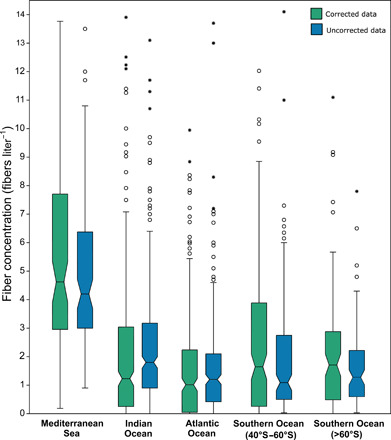
“Nevertheless, the longest fibers were found in the Mediterranean Sea, probably indicating recent inputs into the basin, being closer to pollution sources and more similar to the length of cotton and rayon fibers freshly released by laundering (10, 11).”
BackgroundResultA first overview of textile fibers, including microplastics, in indoor and outdoor environments
Dris, R., Gasperi, J., Mirande, C., Mandin, C., Guerrouache, M., Langlois, V., & Tassin, B. (2017) · Environmental Pollution · doi:10.1016/j.envpol.2016.12.013 · Cited by 1,604
Anthropogenic contamination of tap water, beer, and sea salt
Kosuth, M., Mason, S. A., & Wattenberg, E. V. (2018) · PLOS ONE · doi:10.1371/journal.pone.0194970 · Cited by 1,244 · cited 1×
“Given their abundance, it is not surprising that fibers have been detected in food (18), drinking water (28), and human lungs (29), as well as in the digestive tracts of many aquatic (30, 31) and terrestrial organisms (32).”
BackgroundGlobal warming releases microplastic legacy frozen in Arctic Sea ice
Obbard, R. W., Sadri, S., Wong, Y. Q., Khitun, A. A., Baker, I., & Thompson, R. C. (2014) · Earth's Future · doi:10.1002/2014ef000240 · Cited by 1,092 · cited 3×
“This is in agreement with recent studies showing that cellulosic fibers account for more than 60–80% of all fibers in seafloor sediments (23, 24), marine organisms (30, 31), wastewater (38), fresh water (26, 27), ice cores (22), and airborne fiber populations (14, 39).”
BackgroundResultPrimary microplastics in the oceans: A global evaluation of sources
Boucher, J., & Friot, D. (2017) · doi:10.2305/iucn.ch.2017.01.en · Cited by 1,023 · cited 3×
“Synthetic fibers, however, are generally smoother and brighter than cellulosic ones (55), and therefore, the bias should have been directed toward a preferential selection of synthetic fibers, rather than cellulosic ones.”
Background
Cited by
Risk assessment of microplastic particles
Koelmans, A. A., Redondo-Hasselerharm, P. E., Nor, N. H. M., de Ruijter, V. N., Mintenig, S. M., & Kooi, M. (2022) · Nature Reviews Materials · doi:10.1038/s41578-021-00411-y · Cited by 1,140
Constraining the atmospheric limb of the plastic cycle
Brahney, J., Mahowald, N., Prank, M., Cornwell, G., Klimont, Z., Matsui, H., & Prather, K. A. (2021) · Proceedings of the National Academy of Sciences · doi:10.1073/pnas.2020719118 · Cited by 575
Andrady, A. L., Barnes, P. W., Bornman, J. F., Gouin, T., Madronich, S., White, C. C., Zepp, R. G., & Jansen, M. A. K. (2022) · Science of The Total Environment · doi:10.1016/j.scitotenv.2022.158022 · Cited by 422
“%) of these fibers are cellulosic (Suaria et al., 2020).”
A review on microplastic emission from textile materials and its reduction techniques
Periyasamy, A. P., & Tehrani-Bagha, A. (2022) · Polymer Degradation and Stability · doi:10.1016/j.polymdegradstab.2022.109901 · Cited by 346
Li, H.-Z., Zhu, D., Lindhardt, J. H., Lin, S.-M., Ke, X., & Cui, L. (2021) · Environmental Science & Technology · doi:10.1021/acs.est.0c04849 · Cited by 315
Metadata
- Authors
- Suaria, G., Achtypi, A., Perold, V., Lee, J. R., Pierucci, A., Bornman, T. G., Aliani, S., & Ryan, P. G.
- Affiliations
- Istituto di Scienze Marine del Consiglio Nazionale delle Ricerche (IT)
- University of Cape Town (ZA)
- Monash University (AU)
- University of Cagliari (IT)
- South African Environmental Observation Network (ZA)
- Corresponding author
- Suaria, Giuseppe
- ORCID
- Venue
- Science Advances
- Published
- 2020-06-05
- Volume
- 6
- Issue
- 23
- Pages
- eaay8493-eaay8493
- ISSN
- 2375-2548 (ISSN-L)
- PMC
- PMC7274779
- OpenAlex
- W3033279253
- Cited by
- 528
- References
- 57
- Citations by year
- 2026: 79 · 2025: 100 · 2024: 101 · 2023: 79 · 2022: 83 · 2021: 74 · 2020: 12
- FWCI
- 15.32
- Type
- journal article
- Language
- en
- Open access
- gold
- doi.org
- Licence
- cc-by-nc
- Locations
- Science Advances (publishedVersion, cc-by-nc)
- PubMed Central (publishedVersion, cc-by-nc)
- PubMed (publishedVersion)
- Nelson Mandela University Research Repository (submittedVersion, cc-by-nc)
- HAL (submittedVersion)
- Funders
- Swiss Polar Institute
- Topics
- Physical Sciences › Environmental Science › Pollution › Microplastics and Plastic Pollution
- Physical Sciences › Environmental Science › Pollution › Pharmaceutical and Antibiotic Environmental Impacts
- Physical Sciences › Environmental Science › Pollution › Oil Spill Detection and Mitigation
- Keywords
- microfibers, marine surface waters, natural polymers, cellulose fibers, synthetic fibers, microplastics, fiber composition, marine plastic pollution
About these checks
Registry, retraction, Cites and statistics results are computed, not judged, with one exception: a printed reference that no index lists is read once by a model before it counts as a citation error. Claims are extracted by a model and kept only when their quote appears verbatim in the text; each cited source is then checked, with a model’s help, for whether it says what the claim relies on. Those verdicts can be wrong — read the claim’s quote and the cited source before relying on one.
Statistics and arithmetic are recomputed, not judged.
Confidence bands are shown only for fields calibrated on our annotated test set. None is calibrated yet, so no band is shown.
What counts as a claim ›How we measure confidence ›How we check this ›
Are you an author, or do you see a problem with this page? Request a review
How to cite
Cite CoChat for the checks on this page, and the paper for its own findings.
- This page
- CoChat. (2026). Citation check: Microfibers in oceanic surface waters: A global characterization. https://app.cochat.ai/papers/10.1126/sciadv.aay8493
- The paper
- Suaria, G., Achtypi, A., Perold, V., Lee, J. R., Pierucci, A., Bornman, T. G., Aliani, S., & Ryan, P. G. (2020). Microfibers in oceanic surface waters: A global characterization. Science Advances. https://doi.org/10.1126/sciadv.aay8493
Data sources
Bibliographic data: Semantic Scholar, OpenAlex, Crossref.
Contains information from the Semantic Scholar Academic Graph Datasets, made available under the ODC Attribution License (ODC-BY 1.0).
Semantic Scholar’s data is described in: Kinney, R., et al. (2023). The Semantic Scholar Open Data Platform. arXiv:2301.10140.
