

The DOI matches its Crossref record; 63 of the 63 references it cites were found in a registry or an index.
Conditionally pathogenic genetic variants of a hematopoietic disease-suppressing enhancer
Abstract
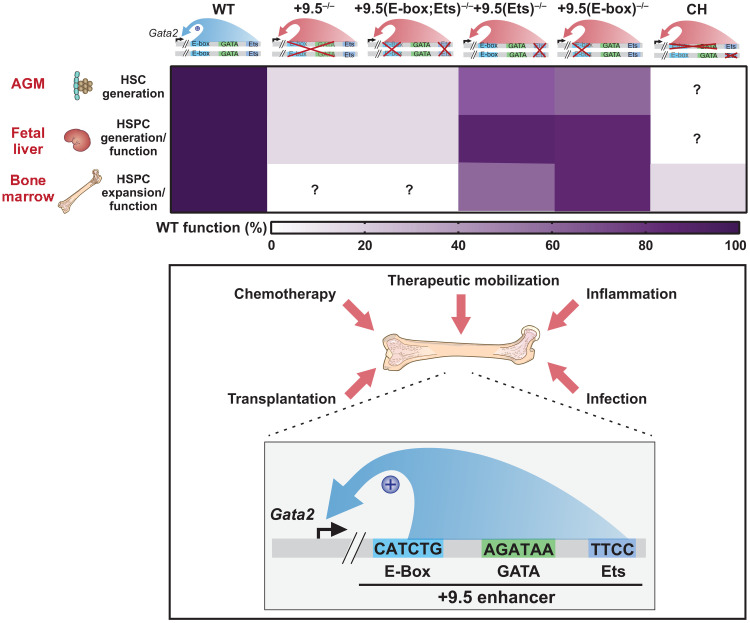
Noncoding genetic variants cause blood disease.
Overview
The claims and statistics of this paper haven’t been checked yet.
Run the check — free, no account needed. It reads the open-access text and checks the sources it cites.
Integrity signals
Registry
Cites
Statistics
Figures
Verification
Claims the paper makes
The claims and statistics of this paper haven’t been checked yet.
Run the check — free, no account needed. It reads the open-access text and checks the sources it cites.
Claims other papers make about this one
Each is checked against this paper’s own text: does it say what the citing paper says it does?
In the citing paper
“Inflammation has also been shown to synergise with genetic mouse models of human hematologic diseases to promote the emergence of clinically relevant features that do not manifest under standard laboratory conditions”
From Inflammatory exposure drives long-lived impairment of hematopoietic stem cell self-renewal activity and accelerated aging (2022) · cites this paper as Soukup et al., 2021
Self-check
Percentages, sums and reported differences re-computed from the paper’s own numbers.
The self-check needs the paper’s full text.
Citations
Cites
Richards, S., Aziz, N., Bale, S., Bick, D., Das, S., Gastier-Foster, J., Grody, W. W., Hegde, M., Lyon, E., Spector, E., et al. (2015) · Genetics in Medicine · doi:10.1038/gim.2015.30 · Cited by 32,594
ClinVar: improving access to variant interpretations and supporting evidence
Landrum, M. J., Lee, J. M., Benson, M., Brown, G. R., Chao, C., Chitipiralla, S., Gu, B., Hart, J., Hoffman, D., Jang, W., et al. (2018) · Nucleic Acids Research · doi:10.1093/nar/gkx1153 · Cited by 4,196
Expanded encyclopaedias of DNA elements in the human and mouse genomes
The ENCODE Project Consortium, Abascal, F., Acosta, R., Addleman, N. J., Adrian, J., Afzal, V., Ai, R., Aken, B., Akiyama, J. A., Jammal, O. A., et al. (2020) · Nature · doi:10.1038/s41586-020-2493-4 · Cited by 2,378
Self-citationStandards and Guidelines for the Interpretation and Reporting of Sequence Variants in Cancer
Li, M. M., Datto, M., Duncavage, E. J., Kulkarni, S., Lindeman, N. I., Roy, S., Tsimberidou, A. M., Vnencak-Jones, C. L., Wolff, D. J., Younes, A., et al. (2017) · The Journal of Molecular Diagnostics · doi:10.1016/j.jmoldx.2016.10.002 · Cited by 2,030
IFNα activates dormant haematopoietic stem cells in vivo
Essers, M. A. G., Offner, S., Blanco-Bose, W. E., Waibler, Z., Kalinke, U., Duchosal, M. A., & Trumpp, A. (2009) · Nature · doi:10.1038/nature07815 · Cited by 1,368
An early haematopoietic defect in mice lacking the transcription factor GATA-2
Tsai, F.-Y., Keller, G., Kuo, F. C., Weiss, M., Chen, J., Rosenblatt, M., Alt, F. W., & Orkin, S. H. (1994) · Nature · doi:10.1038/371221a0 · Cited by 1,237
GATA2 deficiency: a protean disorder of hematopoiesis, lymphatics, and immunity
Spinner, M. A., Sanchez, L. A., Hsu, A. P., Shaw, P. A., Zerbe, C. S., Calvo, K. R., Arthur, D. C., Gu, W., Gould, C. M., Brewer, C. C., et al. (2013) · Blood · doi:10.1182/blood-2013-07-515528 · Cited by 713
Exit from dormancy provokes DNA-damage-induced attrition in haematopoietic stem cells
Walter, D., Lier, A., Geiselhart, A., Thalheimer, F. B., Huntscha, S., Sobotta, M. C., Moehrle, B., Brocks, D., Bayindir, I., Kaschutnig, P., et al. (2015) · Nature · doi:10.1038/nature14131 · Cited by 619
Genomic and biochemical insights into the specificity of ETS transcription factors
Hollenhorst, P. C., McIntosh, L. P., & Graves, B. J. (2011) · Annual Review of Biochemistry · doi:10.1146/annurev.biochem.79.081507.103945 · Cited by 490
Włodarski, M. W., Hirabayashi, S., Pastor, V. M. L., Starý, J., Hasle, H., Masetti, R., Dworzak, M. N., Schmugge, M., van den Heuvel‐Eibrink, M. M., Ussowicz, M., et al. (2015) · Blood · doi:10.1182/blood-2015-09-669937 · Cited by 422
Cited by
Bogeska, R., Mikecin, A.-M., Kaschutnig, P., Fawaz, M., Büchler-Schäff, M., Le, D., Ganuza, M., Vollmer, A., Paffenholz, S. V., Asada, N., et al. (2022) · Cell Stem Cell · doi:10.1016/j.stem.2022.06.012 · Cited by 299
Metadata
- Authors
- Soukup, A. A., Matson, D. R., Liu, P., Johnson, K. D., & Bresnick, E. H.
- Affiliations
- Wisconsin Blood Cancer Research Institute, Department of Cell and Regenerative Biology, Wisconsin Institutes for Medical Research, University of Wisconsin School of Medicine and Public Health, Madison, WI, USA.
- University of Wisconsin Carbone Cancer Center, Department of Biostatistics and Medical Informatics, University of Wisconsin School of Medicine and Public Health, Madison, WI, USA.
- Venue
- Science Advances
- Published
- 2021-12-10
- Volume
- 7
- Issue
- 50
- ISSN
- 2375-2548
- PMC
- PMC8664263
- Cited by
- 15
- References
- 63
- Language
- en
About these checks
Registry, retraction, Cites and statistics results are computed, not judged, with one exception: a printed reference that no index lists is read once by a model before it counts as a citation error. Claims are extracted by a model and kept only when their quote appears verbatim in the text; each cited source is then checked, with a model’s help, for whether it says what the claim relies on. Those verdicts can be wrong — read the claim’s quote and the cited source before relying on one.
Statistics and arithmetic are recomputed, not judged.
Confidence bands are shown only for fields calibrated on our annotated test set. None is calibrated yet, so no band is shown.
What counts as a claim ›How we measure confidence ›How we check this ›
Are you an author, or do you see a problem with this page? Request a review
Data sources
Bibliographic data: Semantic Scholar, OpenAlex, Crossref.
Contains information from the Semantic Scholar Academic Graph Datasets, made available under the ODC Attribution License (ODC-BY 1.0).
Semantic Scholar’s data is described in: Kinney, R., et al. (2023). The Semantic Scholar Open Data Platform. arXiv:2301.10140.
