

Rapid marine oxygen variability: Driver of the Late Ordovician mass extinction
Open accessThe DOI matches its Crossref record; 70 of the 70 references it cites were found in a registry or an index; none of the 56 sources its claims cite is checked for support yet.
Abstract
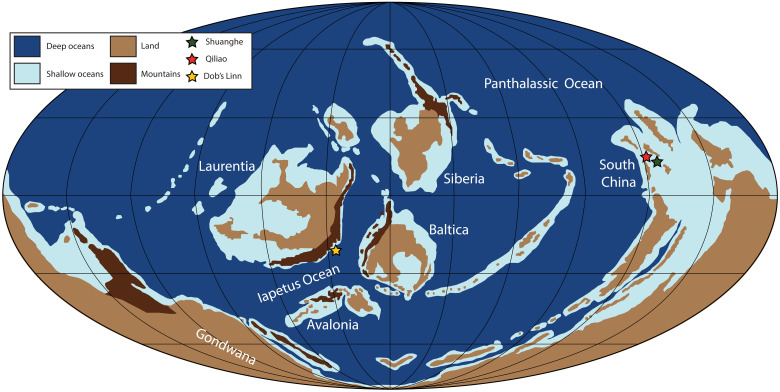
The timing and connections between global cooling, marine redox conditions, and biotic turnover are underconstrained for the Late Ordovician. The second most severe mass extinction occurred at the end of the Ordovician period, resulting in ~85% loss of marine species between two extinction pulses. As the only “Big 5” extinction that occurred during icehouse conditions, this interval is an important modern analog to constrain environmental feedbacks. We present a previously unexplored thallium isotope records from two paleobasins that record global marine redox conditions and document two distinct and rapid excursions suggesting vacillating (de)oxygenation. The strong temporal link between these perturbations and extinctions highlights the possibility that dynamic marine oxygen fluctuations, rather than persistent, stable global anoxia, played a major role in driving the extinction. This evidence for rapid oxygen changes leading to mass extinction has important implications for modern deoxygenation and biodiversity declines.
Overview
CoChat Summary
TL;DR
New thallium isotope records from South China and Scotland show two rapid, opposing marine redox excursions during the Late Ordovician mass extinction, indicating vacillating (de)oxygenation rather than persistent global anoxia. The authors argue these rapid oxygen fluctuations, alongside glacioeustatic habitat loss, were major drivers of the ~85% marine species loss.
Key findings
- Thallium isotope (ε205Tl) records from two paleobasins document two distinct and rapid excursions suggesting vacillating marine (de)oxygenation during the Late Ordovician mass extinction (LOME), rather than stable, persistent global anoxia.
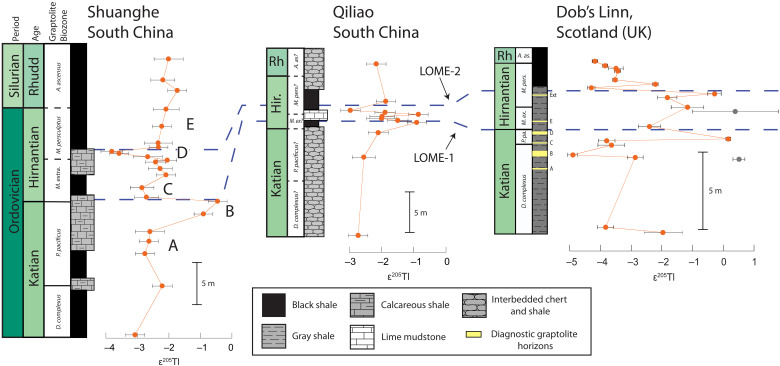
- Before the Katian-Hirnantian boundary, ε205Tl shifts from ~−3.0 to ~−1.0 over ca. ~900 ka, then returns to ~−3.0 in the earliest Hirnantian within ca. ~370 ka; in the mid-Hirnantian, ε205Tl decreases from ~−2.0 to ~−4.0 over ca. ~345 ka, and in the late Hirnantian increases to ~−2.0 over ca. ~150 ka.
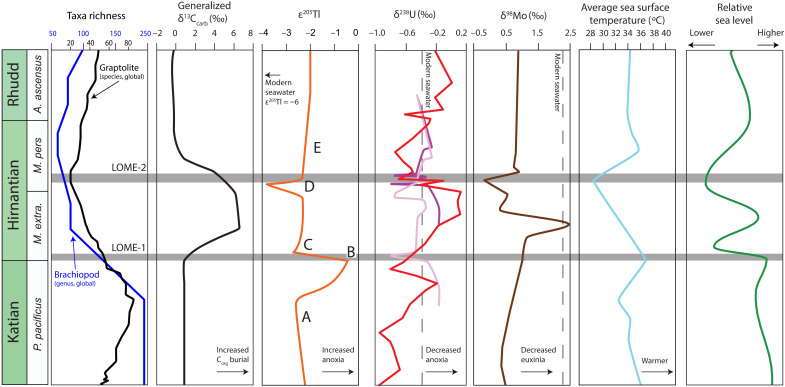
- These perturbations coincide with major marine biodiversity declines, the rising limb of the Hirnantian carbon isotope excursion, global sea-level fall/lowstand/rise, and the two classic LOME pulses.
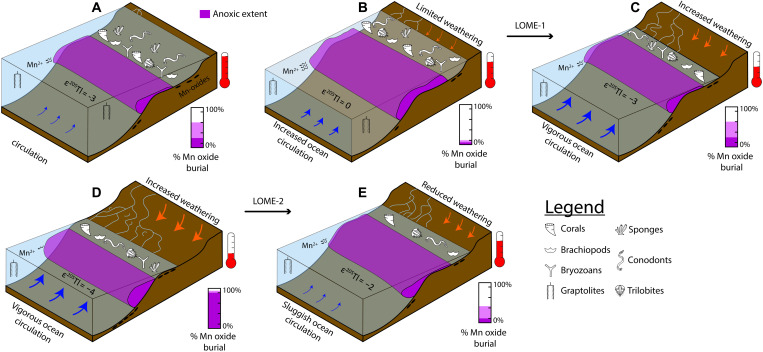
- The authors attribute the excursions to spatiotemporal changes in oxygen minimum zones and Mn oxide burial, with rapid redox fluctuations—including early Hirnantian oxygenation—acting as likely kill mechanisms; Tl’s short residence time (~18.5 ka vs. ~450 ka for U and Mo) allows capture of rapid redox shifts.
Methods
- Analyzed 60 samples for thallium isotopes from three Upper Ordovician–lower Silurian sections: Shuanghe and Qiliao (South China, Yangtze Shelf) and Dob’s Linn (Scotland, Laurentia), representing two paleobasins.
- Samples were leached with 2 M HNO3, purified via anion exchange, and analyzed by MC-ICP-MS at the National High Magnetic Field Laboratory; ε205Tl values are reported relative to NIST 997, with USGS shale SCo-1 = −3.0 ± 0.3 (2σ).
- Sample screening used iron speciation, Mn concentrations (<850 ppm where available), V/U/Mo, and TOC to constrain local paleoredox conditions; two Dob’s Linn samples with elevated Mn were excluded. Durations were calculated using GTS 2020 biozone ages and linear sedimentation rates.
Limitations
- Paper states: local early-stage diagenesis may explain small (<~0.5 epsilon unit) variability between sites; sample resolution varied due to local paleoredox and sedimentation rates; incomplete biozones may cause over/underestimation of sedimentation rates; Dob’s Linn experienced low-grade metamorphism, allowing possible minor geochemical alteration.
- Paper states: enhanced alteration of oceanic crust or weathering-derived Mn inputs could influence marine Tl isotopic compositions, though AOC is unlikely as the primary driver because it operates over multimillion-year timescales; an enlarged marine Mn reservoir could affect excursion magnitude/duration but not the general interpretations.
- Evident from text: the study relies on three sections from two paleobasins, lacks direct dissolved-oxygen measurements, and for the South China sections Mn concentrations were not previously analyzed, so local redox screening depended on iron speciation and trace-metal data.
Model-written summary. Check it against the paper before relying on it.
Integrity signals
Registry
Cites
Statistics
Figures
Verification
Claims the paper makes
0 Valid · 0 Not valid · 26 Not checked · 46 Own results and interpretations
A result the paper reports from its own data — it cites no other source for it, so there is none to check. The quote shows it is in the paper.
In the paper
“Subsequently, Tl isotopes return to values of −3.0 in the earliest Hirnantian within ca. ~370 ka (Fig. 2C).”
§ Rapid marine oxygen variability: Driver of the Late Ordovician mass extinction > RESULTS
plain- Asserted: passes — The authors put it forward as true.
- Checkable: passes — It can be checked against evidence.
- Load-bearing: unclear — It is unclear whether the paper’s conclusions depend on it.
- Based: passes — The paper gives a reason why it holds.
A result the paper reports from its own data — it cites no other source for it, so there is none to check. The quote shows it is in the paper.
In the paper
“Before the Katian-Hirnantian boundary, over a duration of ca. ~900 ka, Tl isotope values shift from initial late Katian values of ε205Tl = ~−3.0 to ~−1.0 (Fig. 2, A and B).”
§ Rapid marine oxygen variability: Driver of the Late Ordovician mass extinction > RESULTS
plain- Asserted: passes — The authors put it forward as true.
- Checkable: passes — It can be checked against evidence.
- Load-bearing: passes — The paper’s conclusions depend on it.
- Based: passes — The paper gives a reason why it holds.
A result the paper reports from its own data — it cites no other source for it, so there is none to check. The quote shows it is in the paper.
In the paper
“We present a previously unexplored thallium isotope records from two paleobasins that record global marine redox conditions and document two distinct and rapid excursions suggesting vacillating (de)oxygenation.”
§ Rapid marine oxygen variability: Driver of the Late Ordovician mass extinction > Abstract
hedgedstates an association- Asserted: passes — The authors put it forward as true.
- Checkable: passes — It can be checked against evidence.
- Load-bearing: passes — The paper’s conclusions depend on it.
- Based: passes — The paper gives a reason why it holds.
A result the paper reports from its own data — it cites no other source for it, so there is none to check. The quote shows it is in the paper.
In the paper
“Iron speciation from all sections (including Dob’s Linn) indicates pervasive anoxia, and only samples with FeHR/FeT values that indicate reducing bottom water conditions were considered for Tl isotopic analysis.”
§ Rapid marine oxygen variability: Driver of the Late Ordovician mass extinction > MATERIALS AND METHODS > Sample selection and screening
hedged- Asserted: passes — The authors put it forward as true.
- Checkable: passes — It can be checked against evidence.
- Load-bearing: passes — The paper’s conclusions depend on it.
- Based: passes — The paper gives a reason why it holds.
A check of a cited source is scheduled, or we don’t hold its full text yet; the claim is checked once it runs.
In the paper
“This was immediately followed by a widespread increase in reducing marine conditions (Fig. 3E) and sea level rise associated with the second LOME pulse (2, 14, 15, 18).”
§ Rapid marine oxygen variability: Driver of the Late Ordovician mass extinction > DISCUSSION > Rapid redox changes during the LOME
What the sources say
- Not checked yetcites [2] D. A. T. Harper, E. U. Hammarlund, C. M. Ø. Rasmussen, End Ordovician extinctions: A coincidence of causes. Gondw. Res. 25, 1294– 1307 (2014). source
A check is scheduled.
- Not checked yetcites [14] E. U. Hammarlund, T. W. Dahl, D. A. T. Harper, D. P. G. Bond, A. T. Nielsen, C. J. Bjerrum, N. H. Schovsbo, H. P. Schönlaub, J. A. Zalasiewicz, D. E. Canfield, A sulfidic driver for the end-Ordovician mass extinction. Earth Planet. Sci. Lett. 331-332, 128– 139 (2012). source
A check is scheduled.
- Not checked yetcites [15] C. Zou, Z. Qiu, S. W. Poulton, D. Dong, H. Wang, D. Chen, B. Lu, Z. Shi, H. Tao, Ocean euxinia and climate change “double whammy” drove the Late Ordovician mass extinction. Geology 46, 535– 538 (2018). source
A check is scheduled.
plainstates an association- Asserted: passes — The authors put it forward as true.
- Checkable: passes — It can be checked against evidence.
- Load-bearing: unclear — It is unclear whether the paper’s conclusions depend on it.
- Based: passes — The paper gives a reason why it holds.
- Not checked yet
40 more claims
Create a free account to see all 72 claims and to verify the 56 references still open.
- It may state two separate claims as one. 17
- Probably not a substantial claim. 11
Self-check
Percentages, sums and reported differences re-computed from the paper’s own numbers.
Each contradiction between two passages listed here was confirmed by an independent check.
Rated minor: it would not touch a result — a value no result rests on, a p-value that stays on the same side of the significance level, or a conflict that is clerical, resolved elsewhere in the paper, or outside its own findings.
In the paper
§ Rapid marine oxygen variability: Driver of the Late Ordovician mass extinction > DISCUSSION > Rapid redox changes during the LOME
“this second marine ventilation event in the mid-late Hirnantian (Fig. 3C)”
§ Rapid marine oxygen variability: Driver of the Late Ordovician mass extinction > DISCUSSION > Rapid redox changes during the LOME
“Another rapid shift (Fig. 3D) to lighter ε205Tl values, −2.0 to −4.0, records a transition from widespread reducing conditions to more oxic marine conditions in the mid-late Hirnantian.”
Citations
Cites
Trace metals as paleoredox and paleoproductivity proxies: An update
Tribovillard, N., Algeo, T. J., Lyons, T., & Riboulleau, A. (2006) · Chemical Geology · doi:10.1016/j.chemgeo.2006.02.012 · Cited by 4,201
Froelich, P. N., Klinkhammer, G. P., Bender, M. L., Luedtke, N. A., Heath, G. R., Cullen, D., Dauphin, P., Hammond, D., Hartman, B., & Maynard, V. (1979) · Geochimica et Cosmochimica Acta · doi:10.1016/0016-7037(79)90095-4 · Cited by 3,368
Ocean Deoxygenation in a Warming World
Keeling, R. F., Körtzinger, A., & Gruber, N. (2010) · Annual Review of Marine Science · doi:10.1146/annurev.marine.010908.163855 · Cited by 1,712 · cited 2×
“O2 contents have declined by at least 2% over the past 50 years, and models predict continued declines by as much as 7% over the next century (52, 69).”
BackgroundDecline in global oceanic oxygen content during the past five decades
Schmidtko, S., Stramma, L., & Visbeck, M. (2017) · Nature · doi:10.1038/nature21399 · Cited by 1,398
The geochemistry of redox sensitive trace metals in sediments
Morford, J. L., & Emerson, S. (1999) · Geochimica et Cosmochimica Acta · doi:10.1016/s0016-7037(99)00126-x · Cited by 1,215
Revised World maps and introduction
Scotese, C. R., & McKerrow, W. S. (1990) · Geological Society, London, Memoirs · doi:10.1144/gsl.mem.1990.012.01.01 · Cited by 1,118
High-precision timeline for Earth’s most severe extinction
Burgess, S. D., Bowring, S., & Shen, S.-Z. (2014) · Proceedings of the National Academy of Sciences · doi:10.1073/pnas.1317692111 · Cited by 732
Did Cooling Oceans Trigger Ordovician Biodiversification? Evidence from Conodont Thermometry
Trotter, J. A., Williams, I. S., Barnes, C. R., Lécuyer, C., & Nicoll, R. S. (2008) · Science · doi:10.1126/science.1155814 · Cited by 669 · cited 1×
“Before the LOME interval, the Katian was characterized by high sea level (39), warm average sea surface temperatures (SSTs) (12, 49), and generally high marine biodiversity until the late Katian when a major decline in biodiversity has been recorded (6, 8, 50).”
BackgroundGondwana from top to base in space and time
Torsvik, T. H., & Cocks, L. R. M. (2013) · Gondwana Research · doi:10.1016/j.gr.2013.06.012 · Cited by 660
Organic-matter-rich shales of China
Zou, C., Zhu, R., Chen, Z.-Q., Ogg, J. G., Wu, S., Dong, D., Qiu, Z., Wang, Y., Wang, L., Lin, S., et al. (2019) · Earth-Science Reviews · doi:10.1016/j.earscirev.2018.12.002 · Cited by 590
Research works printed but not linked: 5
- D. Wenzhe, thesis (2011).
- N. Haikuan, J. Zhijun, M. Xin, L. Zhongbao, L. Tuo, Y. Zhenheng, Graptolites zone and sedimentary characteristics of upper Ordovician Wufeng Formation-Lower Silurian Longmaxi formation in Sichuan basin and its adjacent areas. Acta Pet. Sin. 38, 160– 174 (2017).
- N. Haikuan, J. Zhijun, M. Xin, L. Zhongbao, L. Tup, Y. Zhenheng, Graptolites zone and sedimentary characteristics of Upper Ordovician Wefend Formation-Lower Silurian Longmaxi Formation in Sichuan Basin and its adjecent areas. Acta Pet. Sin. 38, 160– 174 (2017).
- M. C. Pope, J. B. Steffen, Widespread, prolonged Late Middle to Late Ordovician upwelling in North America: A proxy record of glaciation? Geology 31, 63– 66 (2003). · DOI · Paper page
- D. Goldman, P. M. Sadler, S. A. Leslie, The Ordovician Period (BV, 2020). · DOI · Paper page
Cited by
The Causes and Consequences of Ordovician Cooling
Bergmann, K., Macdonald, F. A., & Swanson‐Hysell, N. L. (2025) · Annual Review of Earth and Planetary Sciences · doi:10.1146/annurev-earth-040523-114630 · Cited by 30
Seawater signatures of Ordovician climate and environment
Young, S. A., Edwards, C. T., Ainsaar, L., Lindskog, A., & Saltzman, M. R. (2023) · Geological Society London Special Publications · doi:10.1144/sp532-2022-258 · Cited by 21
Self-citationYang, X., Yan, D., Wilson, D. J., von Strandmann, P. A. E. P., Liu, X., Liu, C., Tian, H., Liu, M., Zhang, L., Zhang, B., et al. (2024) · Geochimica et Cosmochimica Acta · doi:10.1016/j.gca.2024.12.010 · Cited by 20
Self-citationDynamic deep marine oxygenation during the Early and Middle Paleozoic
Ostrander, C. M., Clemente, J. N. R., Stockey, R., Strauss, J. V., Fraser, T. A., Nielsen, S. G., & Sperling, E. A. (2025) · Science Advances · doi:10.1126/sciadv.adw5878 · Cited by 17
Sun, Z., Zhao, F., Melchin, M. J., Fan, J., Zhang, B., Jin, X., Zhang, Z., Yang, S., Chen, Q., Deng, Y., et al. (2023) · Palaeogeography Palaeoclimatology Palaeoecology · doi:10.1016/j.palaeo.2023.111793 · Cited by 16
Metadata
- Authors
- Kozik, N. P., Young, S. A., Newby, S. M., Liu, M., Chen, D., Hammarlund, E. U., Bond, D. P. G., Them, T. R., & Owens, J. D.
- Affiliations
- Florida State University (US)
- Chinese Academy of Sciences (CN)
- Lund University (SE)
- University of Hull (GB)
- College of Charleston (US)
- Corresponding author
- Kozik, Nevin P.
- ORCID
- Venue
- Science Advances
- Published
- 2022-11-16
- Volume
- 8
- Issue
- 46
- Pages
- eabn8345-eabn8345
- ISSN
- 2375-2548 (ISSN-L)
- PMC
- PMC9674285
- OpenAlex
- W4309468427
- Cited by
- 54
- References
- 70
- Citations by year
- 2026: 22 · 2025: 15 · 2024: 11 · 2023: 6
- FWCI
- 4.59
- Type
- journal article
- Language
- en
- Open access
- gold
- doi.org
- Locations
- Science Advances (publishedVersion)
- Repository@Hull (Worktribe) (University of Hull) (publishedVersion, other-oa)
- PubMed Central (publishedVersion, cc-by)
- PubMed (publishedVersion)
- Repository@Hull (Worktribe) (University of Hull) (acceptedVersion, cc-by)
- Lund University Publications (Lund University) (submittedVersion)
- Funders
- National Science Foundation (DMR-1,644,779, 1644779, 1748635, 1157490)
- Geological Society of America
- National High Magnetic Field Laboratory (DMR-1157490, 1157490, DMR - 1644779, 1644779)
- National Natural Science Foundation of China (91755210)
- Vetenskapsrådet (2019-05254)
- American Chemical Society Petroleum Research Fund (57487-DNI1)
- Natural Environment Research Council (NE/J01799X/1)
- Division of Materials Research (1644779, DMR- 1644779, 11‐57490, DMR 1157490)
- High Magnetic Field Laboratory, Chinese Academy of Sciences
- State of Florida
- Topics
- Physical Sciences › Earth and Planetary Sciences › Paleontology › Paleontology and Stratigraphy of Fossils
- Physical Sciences › Earth and Planetary Sciences › Paleontology › Evolution and Paleontology Studies
- Physical Sciences › Earth and Planetary Sciences › Atmospheric Science › Geology and Paleoclimatology Research
- Keywords
- Late Ordovician mass extinction, marine redox conditions, thallium isotopes, deoxygenation, global cooling, biotic turnover, paleobasin, extinction pulses, environmental feedback
About these checks
Registry, retraction, Cites and statistics results are computed, not judged, with one exception: a printed reference that no index lists is read once by a model before it counts as a citation error. Claims are extracted by a model and kept only when their quote appears verbatim in the text; each cited source is then checked, with a model’s help, for whether it says what the claim relies on. Those verdicts can be wrong — read the claim’s quote and the cited source before relying on one.
A language model drew the claims from the paper on 2026-11-24, under version 3 of the claim definition (model deepseek-v4.1-flash, prompt extract-v3).
A second model labelled each claim on 2026-11-24 (model jev-1.13-20260917, definition revision gold-guideline-v0.2).
Statistics and arithmetic are recomputed, not judged.
Confidence bands are shown only for fields calibrated on our annotated test set. None is calibrated yet, so no band is shown.
What counts as a claim ›How we measure confidence ›How we check this ›
Are you an author, or do you see a problem with this page? Request a review
How to cite
Cite CoChat for the checks on this page, and the paper for its own findings.
- This page
- CoChat. (2026). Citation check: Rapid marine oxygen variability: Driver of the Late Ordovician mass extinction. https://app.cochat.ai/papers/10.1126/sciadv.abn8345
- The paper
- Kozik, N. P., Young, S. A., Newby, S. M., Liu, M., Chen, D., Hammarlund, E. U., Bond, D. P. G., Them, T. R., & Owens, J. D. (2022). Rapid marine oxygen variability: Driver of the Late Ordovician mass extinction. Science Advances. https://doi.org/10.1126/sciadv.abn8345
Data sources
Bibliographic data: Semantic Scholar, OpenAlex, Crossref.
Contains information from the Semantic Scholar Academic Graph Datasets, made available under the ODC Attribution License (ODC-BY 1.0).
Semantic Scholar’s data is described in: Kinney, R., et al. (2023). The Semantic Scholar Open Data Platform. arXiv:2301.10140.
