

The DOI matches its Crossref record; 35 of the 35 references it cites were found in a registry or an index.
Structural basis for flagellin-induced NAIP5 activation
Open accessPublished version of a preprint
Abstract
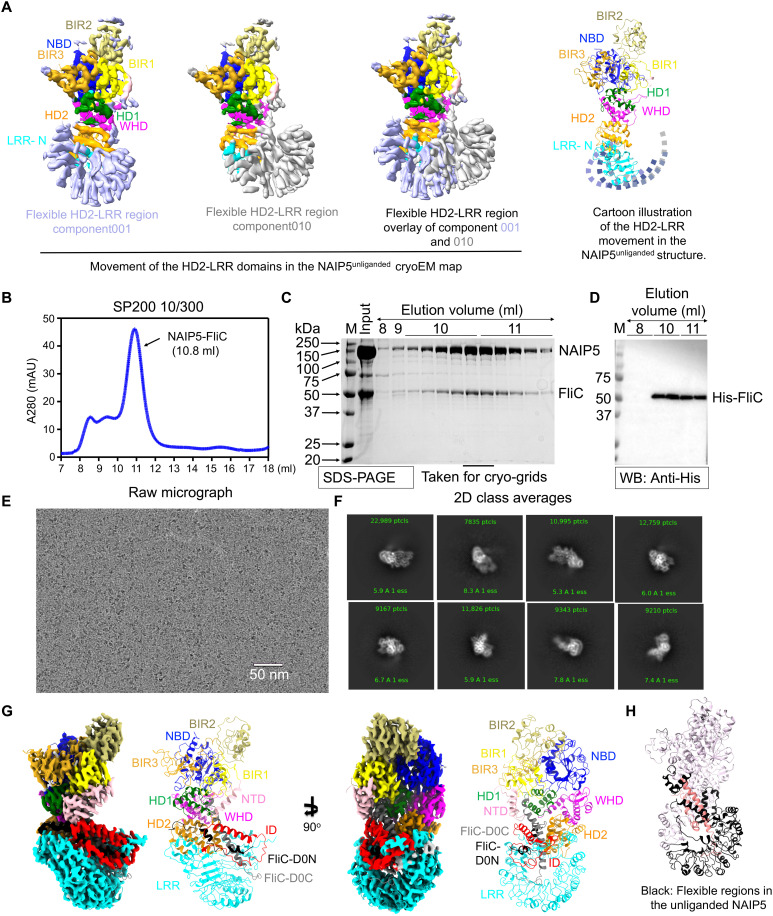
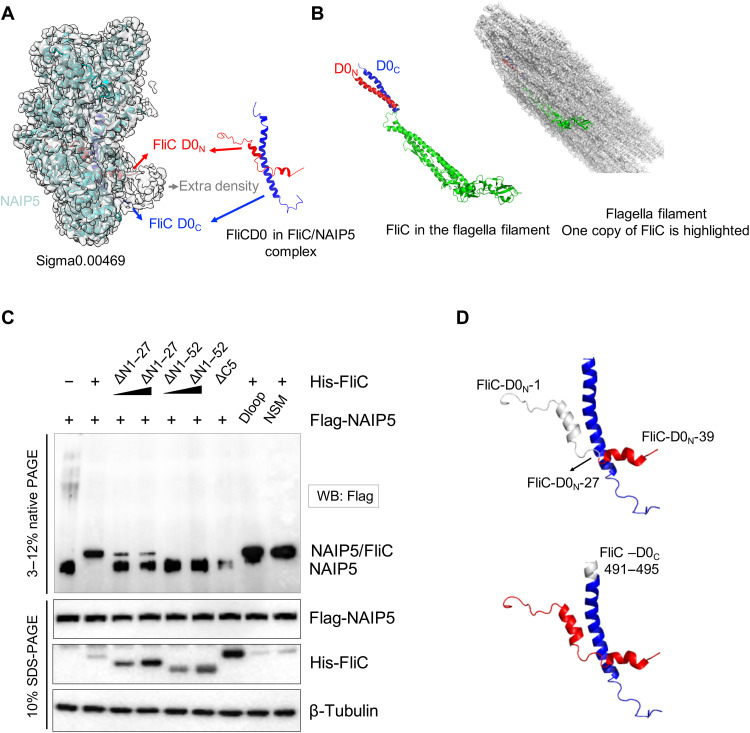
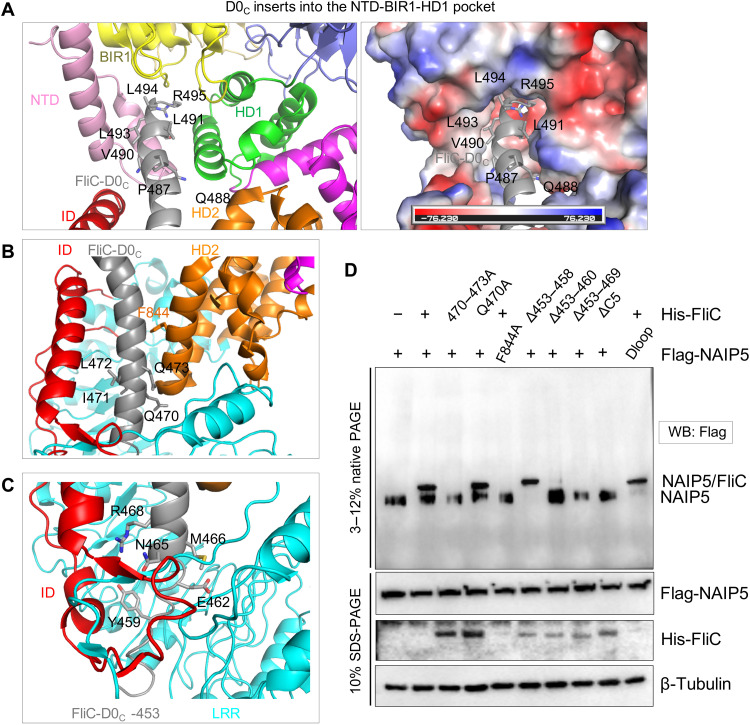
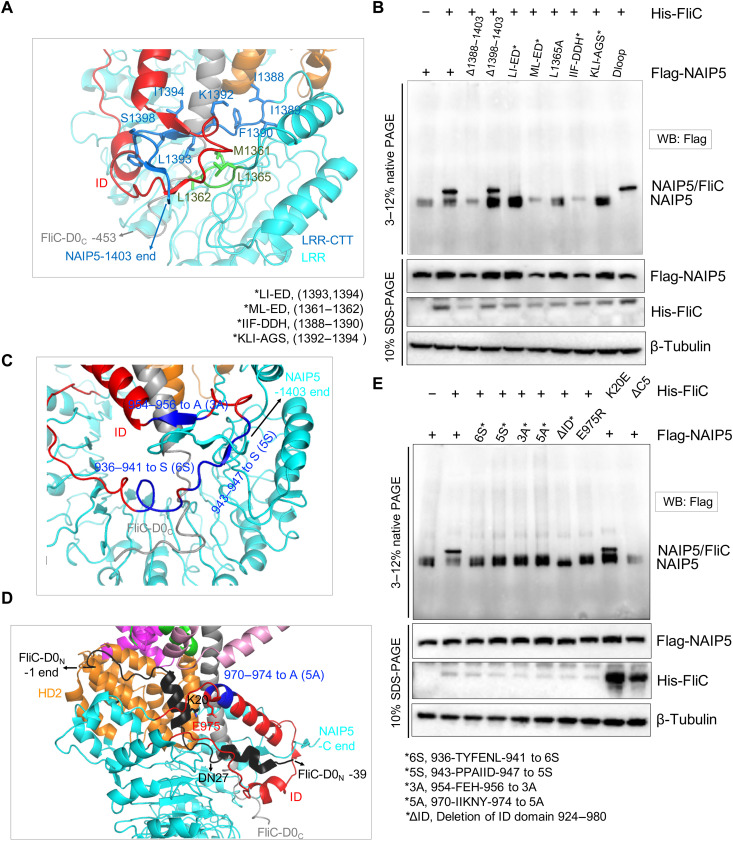
The NAIP (NLR family apoptosis inhibitory protein)/NLRC4 (NLR family CARD containing protein 4) inflammasome senses Gram-negative bacterial ligand. In the ligand-bound state, the winged helix domain of NAIP forms a steric clash with NLRC4 to open it up. However, how ligand binding activates NAIP is less clear. Here, we investigated the dynamics of the ligand-binding region of inactive NAIP5 and solved the cryo-EM structure of NAIP5 in complex with its specific ligand, FliC from flagellin, at 2.9-Å resolution. The structure revealed a “trap and lock” mechanism in FliC recognition, whereby FliC-D0 C is first trapped by the hydrophobic pocket of NAIP5, then locked in the binding site by ID (insertion domain) and C-terminal tail of NAIP5. The FliC-D0 N domain further inserts into ID to stabilize the complex. According to this mechanism, FliC triggers the conformational change of NAIP5 by bringing multiple flexible domains together.
Overview
The claims and statistics of this paper haven’t been checked yet.
Run the check — free, no account needed. It reads the open-access text and checks the sources it cites.
Integrity signals
Registry
Cites
Statistics
Figures
Verification
Claims the paper makes
The claims and statistics of this paper haven’t been checked yet.
Run the check — free, no account needed. It reads the open-access text and checks the sources it cites.
Self-check
Percentages, sums and reported differences re-computed from the paper’s own numbers.
The self-check needs the paper’s full text.
Citations
Cites
UCSF Chimera—A visualization system for exploratory research and analysis
Pettersen, E. F., Goddard, T. D., Huang, C. C., Couch, G. S., Greenblatt, D. M., Meng, E. C., & Ferrin, T. E. (2004) · Journal of Computational Chemistry · doi:10.1002/jcc.20084 · Cited by 45,828
Highly accurate protein structure prediction with AlphaFold
Jumper, J., Evans, R., Pritzel, A., Green, T., Figurnov, M., Ronneberger, O., Tunyasuvunakool, K., Bates, R., Žídek, A., Potapenko, A., et al. (2021) · Nature · doi:10.1038/s41586-021-03819-2 · Cited by 43,764
Features and development of Coot
Emsley, P., Lohkamp, B., Scott, W. G., & Cowtan, K. (2010) · Acta Crystallographica Section D Biological Crystallography · doi:10.1107/s0907444910007493 · Cited by 29,915
cryoSPARC: algorithms for rapid unsupervised cryo-EM structure determination
Punjani, A., Rubinstein, J. L., Fleet, D. J., & Brubaker, M. A. (2017) · Nature Methods · doi:10.1038/nmeth.4169 · Cited by 11,626
UCSF ChimeraX: Structure visualization for researchers, educators, and developers
Pettersen, E. F., Goddard, T. D., Huang, C. C., Meng, E. C., Couch, G. S., Croll, T. I., Morris, J. H., & Ferrin, T. E. (2021) · Protein Science · doi:10.1002/pro.3943 · Cited by 9,514
Cleavage of GSDMD by inflammatory caspases determines pyroptotic cell death
Shi, J., Zhao, Y., Wang, K., Shi, X., Wang, Y., Huang, H., Zhuang, Y., Cai, T., Wang, F., & Shao, F. (2015) · Nature · doi:10.1038/nature15514 · Cited by 6,659
RELION: Implementation of a Bayesian approach to cryo-EM structure determination
Scheres, S. H. W. (2012) · Journal of Structural Biology · doi:10.1016/j.jsb.2012.09.006 · Cited by 5,446
Caspase-11 cleaves gasdermin D for non-canonical inflammasome signalling
Kayagaki, N., Stowe, I. B., Lee, B. L., O’Rourke, K., Anderson, K., Warming, S., Cuellar, T., Haley, B., Roose-Girma, M., Phung, Q. T., et al. (2015) · Nature · doi:10.1038/nature15541 · Cited by 3,686
Real-space refinement in PHENIX for cryo-EM and crystallography
Afonine, P. V., Poon, B. K., Read, R. J., Sobolev, O. V., Terwilliger, T. C., Urzhumtsev, A., & Adams, P. D. (2018) · Acta Crystallographica Section D Structural Biology · doi:10.1107/s2059798318006551 · Cited by 3,281
DeepEMhancer: a deep learning solution for cryo-EM volume post-processing
Sanchez-Garcia, R., Gomez-Blanco, J., Cuervo, A., Carazo, J. M., Sorzano, C. O. S., & Vargas, J. (2021) · Communications Biology · doi:10.1038/s42003-021-02399-1 · Cited by 1,343
The NLRC4 inflammasome receptors for bacterial flagellin and type III secretion apparatus
Zhao, Y., Yang, J., Shi, J., Gong, Y., Lu, Q., Xu, H., Liu, L., & Shao, F. (2011) · Nature · doi:10.1038/nature10510 · Cited by 1,313
Innate immune recognition of bacterial ligands by NAIPs determines inflammasome specificity
Kofoed, E. M., & Vance, R. E. (2011) · Nature · doi:10.1038/nature10394 · Cited by 891
Analysis of Protein Stability and Ligand Interactions by Thermal Shift Assay
Huynh, K., & Partch, C. L. (2015) · Current Protocols in Protein Science · doi:10.1002/0471140864.ps2809s79 · Cited by 585
Mastronarde, D. N. (2003) · Microscopy and Microanalysis · doi:10.1017/s1431927603445911 · Cited by 547
Yang, J., Zhao, Y., Shi, J., & Shao, F. (2013) · Proceedings of the National Academy of Sciences · doi:10.1073/pnas.1306376110 · Cited by 414
Crystal Structure of NLRC4 Reveals Its Autoinhibition Mechanism
Hu, Z., Yan, C., Liu, P., Huang, Z., Ma, R., Zhang, C., Wang, R., Zhang, Y., Martinon, F., Miao, D., et al. (2013) · Science · doi:10.1126/science.1236381 · Cited by 414
Cryo-EM structure of the activated NAIP2-NLRC4 inflammasome reveals nucleated polymerization
Zhang, L., Chen, S., Ruan, J., Wu, J., Tong, A. B., Yin, Q., Li, Y., David, L., Lu, A., Wang, W. L., et al. (2015) · Science · doi:10.1126/science.aac5789 · Cited by 403
Self-citationPintilie, G. D., Zhang, J., Goddard, T. D., Chiu, W., & Gossard, D. C. (2010) · Journal of Structural Biology · doi:10.1016/j.jsb.2010.03.007 · Cited by 388
Structural and biochemical basis for induced self-propagation of NLRC4
Hu, Z., Zhou, Q., Zhang, C., Fan, S., Cheng, W., Zhao, Y., Shao, F., Wang, H., Sui, S., & Chai, J. (2015) · Science · doi:10.1126/science.aac5489 · Cited by 327
Ruiz, V. M. R., Ramirez, J., Naseer, N., Palacio, N. M., Siddarthan, I. J., Yan, B. M., Boyer, M. A., Pensinger, D. A., Sauer, J., & Shin, S. (2017) · Proceedings of the National Academy of Sciences · doi:10.1073/pnas.1710433114 · Cited by 207
Molecular basis of caspase-1 polymerization and its inhibition by a new capping mechanism
Lu, A. Z., Li, Y., Schmidt, F. I., Yin, Q., Chen, S., Fu, T., Tong, A., Ploegh, H. L., Mao, Y., & Wu, H. (2016) · Nature Structural & Molecular Biology · doi:10.1038/nsmb.3199 · Cited by 196
The structural basis of flagellin detection by NAIP5: A strategy to limit pathogen immune evasion
Tenthorey, J. L., Haloupek, N., López‐Blanco, J. R., Grob, P., Adamson, E., Hartenian, E., Lind, N. A., Bourgeois, N. M., Chacón, P., Nogales, E., et al. (2017) · Science · doi:10.1126/science.aao1140 · Cited by 192
Cutting Edge: Inflammasome Activation in Primary Human Macrophages Is Dependent on Flagellin
Kortmann, J., Brubaker, S. W., & Monack, D. M. (2015) · The Journal of Immunology · doi:10.4049/jimmunol.1403100 · Cited by 181
Halff, E. F., Diebolder, C. A., Versteeg, M., Schouten, A., Brondijk, T. H. C., & Huizinga, E. G. (2012) · Journal of Biological Chemistry · doi:10.1074/jbc.m112.393512 · Cited by 164
Structure, biochemical function, and signaling mechanism of plant NLRs
Wang, J., Song, W., & Chai, J. (2022) · Molecular Plant · doi:10.1016/j.molp.2022.11.011 · Cited by 138
Terminal regions of flagellin are disordered in solution
Vonderviszt, F., Kanto, S., Aizawa, S.-I., & Namba, K. (1989) · Journal of Molecular Biology · doi:10.1016/0022-2836(89)90176-9 · Cited by 137
Conformational change of flagellin for polymorphic supercoiling of the flagellar filament
Maki-Yonekura, S., Yonekura, K., & Namba, K. (2010) · Nature Structural & Molecular Biology · doi:10.1038/nsmb.1774 · Cited by 123
NAIP proteins are required for cytosolic detection of specific bacterial ligands in vivo
Rauch, I., Tenthorey, J. L., Doyle, R. N., Moussawi, K. A., Kang, J. J., Kang, C., Kazmierczak, B. I., & Vance, R. E. (2016) · The Journal of Experimental Medicine · doi:10.1084/jem.20151809 · Cited by 109
Structural basis for specific flagellin recognition by the NLR protein NAIP5
Yang, X., Yang, F., Wang, W., Lin, G., Hu, Z., Han, Z., Qi, Y., Zhang, L., Wang, J., Sui, S., et al. (2017) · Cell Research · doi:10.1038/cr.2017.148 · Cited by 74
Self-citationAizawa, S.-I., Vonderviszt, F., Ishima, R., & Akasaka, K. (1990) · Journal of Molecular Biology · doi:10.1016/0022-2836(90)90064-s · Cited by 72
Multi-body Refinement of Cryo-EM Images in RELION
Nakane, T., & Scheres, S. H. W. (2020) · Methods in molecular biology · doi:10.1007/978-1-0716-0966-8_7 · Cited by 65
Mechanism of NAIP—NLRC4 inflammasome activation revealed by cryo-EM structure of unliganded NAIP5
Paidimuddala, B., Cao, J., Nash, G., Xie, Q., Wu, H., & Zhang, L. (2023) · Nature Structural & Molecular Biology · doi:10.1038/s41594-022-00889-2 · Cited by 32
Self-citationThe structure of NLRP9 reveals a unique C‐terminal region with putative regulatory function
Kamitsukasa, Y., Nakano, K., Murakami, K., Hirata, K., Yamamoto, M., Shimizu, T., & Ohto, U. (2022) · FEBS Letters · doi:10.1002/1873-3468.14302 · Cited by 10
Structural mechanisms of inflammasome regulation revealed by cryo-EM studies
Cao, J., Nash, G., & Zhang, L. (2022) · Current Opinion in Structural Biology · doi:10.1016/j.sbi.2022.102390 · Cited by 8
Self-citationZhang, L., & Wu, H. (2018) · Cell Research · doi:10.1038/cr.2018.5 · Cited by 3
Self-citation
Metadata
- Authors
- Paidimuddala, B., Cao, J., & Zhang, L.
- Affiliations
- Oregon Health & Science University (US)
- Corresponding author
- Zhang, Liman
- Venue
- Science Advances
- Published
- 2023-12-08
- Volume
- 9
- Issue
- 49
- Pages
- eadi8539-eadi8539
- ISSN
- 2375-2548 (ISSN-L)
- PMC
- PMC10699770
- OpenAlex
- W4389371417
- Cited by
- 17
- References
- 35
- Citations by year
- 2026: 9 · 2025: 5 · 2024: 3
- FWCI
- 1.51
- Type
- journal article
- Language
- en
- Open access
- gold
- doi.org
- Licence
- cc-by-nc
- Locations
- Science Advances (publishedVersion, cc-by-nc)
- bioRxiv (Cold Spring Harbor Laboratory) (acceptedVersion, cc-by-nc-nd)
- PubMed Central (publishedVersion, cc-by-nc)
- PubMed (publishedVersion)
- OSTI OAI (U.S. Department of Energy Office of Scientific and Technical Information) (submittedVersion)
- PubMed Central (submittedVersion, cc-by-nc-nd)
- Funders
- U.S. Department of Energy (grid.436923.9, 436923.9)
- Oregon Health and Science University (grid.436923.9, 436923.9)
- National Institutes of Health
- Office of Science (grid.436923.9)
- National Institute of General Medical Sciences (U24GM129547)
- National Institute of Allergy and Infectious Diseases (R01AI165580)
- Biological and Environmental Research (grid.436923.9)
- Topics
- Life Sciences › Biochemistry, Genetics and Molecular Biology › Molecular Biology › Inflammasome and immune disorders
- Life Sciences › Immunology and Microbiology › Immunology › Immune Response and Inflammation
- Life Sciences › Immunology and Microbiology › Immunology › interferon and immune responses
- Keywords
- Naip5, NLRC4, inflammasome, flagellin, FliC, winged-helix domain, ligand binding, conformational change, cryo-EM structure, host-pathogen recognition, innate immunity
About these checks
Registry, retraction, Cites and statistics results are computed, not judged, with one exception: a printed reference that no index lists is read once by a model before it counts as a citation error. Claims are extracted by a model and kept only when their quote appears verbatim in the text; each cited source is then checked, with a model’s help, for whether it says what the claim relies on. Those verdicts can be wrong — read the claim’s quote and the cited source before relying on one.
Statistics and arithmetic are recomputed, not judged.
Confidence bands are shown only for fields calibrated on our annotated test set. None is calibrated yet, so no band is shown.
What counts as a claim ›How we measure confidence ›How we check this ›
Are you an author, or do you see a problem with this page? Request a review
Data sources
Bibliographic data: Semantic Scholar, OpenAlex, Crossref.
Contains information from the Semantic Scholar Academic Graph Datasets, made available under the ODC Attribution License (ODC-BY 1.0).
Semantic Scholar’s data is described in: Kinney, R., et al. (2023). The Semantic Scholar Open Data Platform. arXiv:2301.10140.
