

Evidence of scaling advantage for the quantum approximate optimization algorithm on a classically intractable problem
Open accessThe DOI matches its Crossref record; 88 of the 88 references it cites were found in a registry or an index; 23 of the 32 sources its claims cite were checked for support.
Abstract
The quantum approximate optimization algorithm (QAOA) is a leading candidate algorithm for solving optimization problems on quantum computers. However, the potential of QAOA to tackle classically intractable problems remains unclear. Here, we perform an extensive numerical investigation of QAOA on the low autocorrelation binary sequences (LABS) problem, which is classically intractable even for moderately sized instances. We perform noiseless simulations with up to 40 qubits and observe that the runtime of QAOA with fixed parameters scales better than branch-and-bound solvers, which are the state-of-the-art exact solvers for LABS. The combination of QAOA with quantum minimum finding gives the best empirical scaling of any algorithm for the LABS problem. We demonstrate experimental progress in executing QAOA for the LABS problem using an algorithm-specific error detection scheme on Quantinuum trapped-ion processors. Our results provide evidence for the utility of QAOA as an algorithmic component that enables quantum speedups.
Overview
CoChat Summary
TL;DR
This paper reports noiseless-simulation evidence that constant-depth QAOA scales better than the best-known classical solvers on the low autocorrelation binary sequences (LABS) problem, and that adding quantum minimum finding improves the scaling further. It also demonstrates a hardware step on Quantinuum trapped-ion processors, where symmetry-based error detection improved measured performance.
Key findings
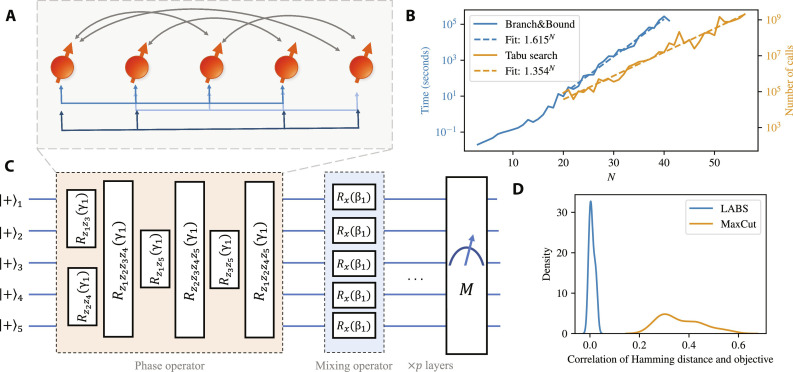
- In noiseless simulations, QAOA at depth \(p=12\) has time-to-solution (TTS) scaling of \(1.46^N\), and QAOA combined with quantum minimum finding (“QAOA+QMF”) scales as \(1.21^N\).
- The best-known classical heuristic benchmarked in the paper, Memetic Tabu, scales as \(1.35^N\) with a 95% confidence interval of \((1.33, 1.38)\); commercial branch-and-bound with an optimality stop rule scales as \(1.615^N\) for Gurobi with 95% CI \((1.571, 1.659)\).
- The paper reports \(R^2 > 0.94\) for the QAOA TTS fit when using only sizes \(N \ge 28\).
- On trapped-ion hardware, using up to three parity checks reduced the difference between experimental results and noiseless simulation by 54% on average and up to 65% for specific \(N\); in all cases, the optimal bitstring was found within the total sample, and in all but two cases within the postselected sample.
Methods
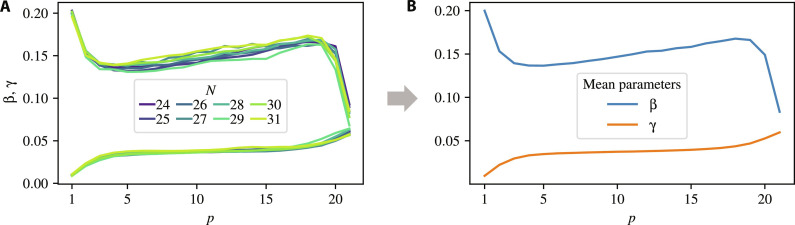
- The study targets the LABS problem, encoded as a diagonal Hamiltonian; QAOA is run with fixed parameters \((\beta,\gamma)\) chosen by optimizing small instances and then averaging/rescaling them for larger \(N\) (using \(24 \le N_j \le 31\), \(M=8\)).
- Numerical results come from exact noiseless simulations up to 40 qubits on the Polaris supercomputer; the main analysis fits exponential scaling of TTS versus problem size and compares it to branch-and-bound and Memetic Tabu.
- For the hardware study, the authors ran \(p=1\) QAOA circuits on Quantinuum H-series trapped-ion processors for instances up to \(N=18\), with an algorithm-specific symmetry-verification error-detection scheme using parity checks and postselection.
Limitations
- The paper states that the numerical scaling evidence is obtained only up to \(N \le 40\); it also notes that TTS can only be evaluated where the solution is known, which for LABS is up to 66 variables.
- The authors say the hardware experiments were limited to \(p=1\), and that implementing QAOA for LABS instances hard for classical solvers would likely require error correction; they estimate a two-qubit gate count of \(\approx 7.5 \times 10^5\) already at \(N=67\) and \(p=12\).
- Evident from the text: the main scaling claim is based on noiseless simulation with fixed, non-optimized parameters for larger instances, so the result is evidence from an idealized setting rather than a demonstrated end-to-end hardware speedup.
Model-written summary. Check it against the paper before relying on it.
Integrity signals
Registry
Cites
Statistics
Figures


Verification
Claims the paper makes
14 Valid · 7 Not valid · 1 Not checked · 36 Own results and interpretations
The cited sources that could be checked couldn’t confirm or dispute this claim.
In the paper
“A recent numerical study (13) of random 8-SAT with N ≤ 20 variables has shown that the time to solution (TTS) of QAOA with fixed parameters and constant depth grows as 1.23N.”
§ Evidence of scaling advantage for the quantum approximate optimization algorithm on a classically intractable problem > INTRODUCTION
What the sources say
- Could not verifycites [13] sourceExperimental — accuracy not yet measured
The quantum approximate optimization algorithm section reports fixed-depth QAOA results for self-avoiding walks, not random 8-SAT. Searches for 8-SAT, time to solution, and the 1.23^N scaling found no passage addressing the attributed result; the paper gives no page numbers in our copy. (LLM, conf=0.76)
plainstates an association- Asserted: passes — The authors put it forward as true.
- Checkable: passes — It can be checked against evidence.
- Load-bearing: passes — The paper’s conclusions depend on it.
- Based: passes — The paper gives a reason why it holds.
- Could not verify
The cited sources support only part of this claim — read each source’s verdict below.
In the paper
“First, the complexity of LABS grows rapidly, with optimal solutions known only for N ≤ 66 and the best heuristics producing approximate solutions of quality decaying with N for N200 (20, 21).”
§ Evidence of scaling advantage for the quantum approximate optimization algorithm on a classically intractable problem > INTRODUCTION
What the sources say
- Not matchedcites [20]
Couldn’t be matched to a paper in Crossref, so it can’t be checked.
- Supportedcites [21] source
In “What is known” (p. 2), the paper says its exact algorithms solved LABS up to N ≤ 66. “Results and Conclusions” (p. 11) confirms that the authors computed all maximum-merit-factor sequences through N = 66 and describes solving larger systems as future work. (LLM, conf=0.93)
plain- Asserted: passes — The authors put it forward as true.
- Checkable: passes — It can be checked against evidence.
- Load-bearing: passes — The paper’s conclusions depend on it.
- Based: passes — The paper gives a reason why it holds.
- Not matched
The cited sources support only part of this claim — read each source’s verdict below.
In the paper
“Second, the performance of classical solvers for LABS has been benchmarked (20, 21) in terms of the scaling of their TTS with problem size.”
§ Evidence of scaling advantage for the quantum approximate optimization algorithm on a classically intractable problem > INTRODUCTION
What the sources say
- Not matchedcites [20]
Couldn’t be matched to a paper in Crossref, so it can’t be checked.
- Supportedcites [21] source
Section 3.1 (pp. 6, 9) compares the running-time scaling of classical branch-and-bound approaches as LABS sequence length N increases. Section 4 (p. 11) also reports performance measurements across problem sizes, supporting the claim's description of benchmarking time to solution. (LLM, conf=0.90)
plainstates an association- Asserted: passes — The authors put it forward as true.
- Checkable: passes — It can be checked against evidence.
- Load-bearing: passes — The paper’s conclusions depend on it.
- Based: passes — The paper gives a reason why it holds.
- Not matched
The cited sources that could be checked couldn’t confirm or dispute this claim.
In the paper
“When QAOA is combined with amplitude amplification, the quantum TTS grows as 1.11N (13), whereas the best classical heuristic has TTS that grows as 1.25N (13).”
§ Evidence of scaling advantage for the quantum approximate optimization algorithm on a classically intractable problem > INTRODUCTION
What the sources say
- Could not verifycites [13] sourceExperimental — accuracy not yet measured
In “The quantum approximate optimization algorithm” (page unavailable), the paper compares QAOA with amplitude amplification for self-avoiding walks; it does not report their combined time to solution. Searches for random 8-SAT and the 1.11^N and 1.25^N scaling figures found no passage addressing those claims. (LLM, conf=0.76)
plainstates a cause- Asserted: passes — The authors put it forward as true.
- Checkable: passes — It can be checked against evidence.
- Load-bearing: passes — The paper’s conclusions depend on it.
- Based: passes — The paper gives a reason why it holds.
- Could not verify
The cited sources support only part of this claim — read each source’s verdict below.
In the paper
“First, the complexity of LABS grows rapidly, with optimal solutions known only for N ≤ 66 and the best heuristics producing approximate solutions of quality decaying with N for N200 (20, 21).”
§ Evidence of scaling advantage for the quantum approximate optimization algorithm on a classically intractable problem > INTRODUCTION
What the sources say
- Not matchedcites [20]
Couldn’t be matched to a paper in Crossref, so it can’t be checked.
- Supportedcites [21] source
Section 2, “What is known” (p. 3), reports a significant drop in the best-known merit factors for N > 200 and attributes it to sophisticated search heuristics failing on larger LABS problems. This supports the claim that heuristic solution quality declines beyond that size. (LLM, conf=0.94)
plainstates an association- Asserted: passes — The authors put it forward as true.
- Checkable: passes — It can be checked against evidence.
- Load-bearing: passes — The paper’s conclusions depend on it.
- Based: passes — The paper gives a reason why it holds.
- Not matched
32 more claims · 7 with their cited sources checked
Create a free account to see all 58 claims and every source verdict.
- Probably not a substantial claim. 6
- It may state two separate claims as one. 16
Claims other papers make about this one
Each is checked against this paper’s own text: does it say what the citing paper says it does?
The cited source says what the claim attributes to it.
In the citing paper
“Data for different solvers are collected up to different maximum problem sizes and are truncated appropriately to mitigate finite-size effects11,12.”
From Evidence of scaling advantage on an NP-complete problem with enhanced quantum solvers (2026) · cites this paper as [12]
The cited source says what the claim attributes to it.
In the citing paper
“Throughout this work, we adopt a fixed-parameter protocol to enhance the reliability of the scaling analysis11,12.”
From Evidence of scaling advantage on an NP-complete problem with enhanced quantum solvers (2026) · cites this paper as [12]
Citations
Cites
Glover, F., & Laguna, M. (1997) · doi:10.1007/978-1-4615-6089-0 · Cited by 3,001 · cited 1×
“…algorithm is used to find initializations for tabu search, a metaheuristic that augments local neighborhood search with a data structure (known as the tabu list) that filters possible local moves if the potential solutions have been recently visited or diversification rules are violated (48).”
MethodA Quantum Approximate Optimization Algorithm
Farhi, E., Goldstone, J., & Gutmann, S. (2014) · arXiv · doi:10.48550/arxiv.1411.4028 · Cited by 1,789
Quantum amplitude amplification and estimation
Brassard, G., Høyer, P., Mosca, M., & Tapp, A. (2002) · Contemporary Mathematics · doi:10.1090/conm/305/05215 · Cited by 1,680 · cited 1×
“(44)) .”
The BOBYQA algorithm for bound constrained optimization without derivatives
Powell, M. J. D. (2009) · Cited by 1,094
Zhou, L., Wang, S.-T., Choi, S., Pichler, H., & Lukin, M. D. (2020) · Physical Review X · doi:10.1103/physrevx.10.021067 · Cited by 913 · cited 2×
“While QAOA has been studied extensively (11–14), little is known about its potential to provide a scaling advantage over classical solvers.”
BackgroundSynthesis of low-peak-factor signals and binary sequences with low autocorrelation (Corresp.)
Schroeder, M. (1970) · IEEE Transactions on Information Theory · doi:10.1109/tit.1970.1054411 · Cited by 740 · cited 1×
“We study the scaling of QAOA TTS with the problem size on the Low Autocorrelation Binary Sequences (LABS) problem (15, 16), also known as the Bernasconi model in statistical physics (17, 18).”
MethodDemonstration of the trapped-ion quantum CCD computer architecture
Pino, J. M., Dreiling, J. M., Figgatt, C., Gaebler, J. P., Moses, S. A., Allman, M. S., Baldwin, C. H., Foss-Feig, M., Hayes, D., Mayer, K., et al. (2021) · Nature · doi:10.1038/s41586-021-03318-4 · Cited by 547 · cited 5×
“As a first step toward execution of QAOA for the LABS problem, we implement QAOA on Quantinuum trapped-ion quantum processors (26, 27) on problems with up to N = 18.”
BackgroundMethodInfluentialSelf-citationt|ket⟩: a retargetable compiler for NISQ devices
Sivarajah, S., Dilkes, S., Cowtan, A., Simmons, W., Edgington, A., & Duncan, R. (2021) · Quantum Science and Technology · doi:10.1088/2058-9565/ab8e92 · Cited by 475
A Race-Track Trapped-Ion Quantum Processor
Moses, S. A., Baldwin, C. H., Allman, M. S., Ancona, R., Ascarrunz, L., Barnes, C., Bartolotta, J., Bjork, B., Blanchard, P., Bohn, M., et al. (2023) · Physical Review X · doi:10.1103/physrevx.13.041052 · Cited by 391 · cited 6×
“As a first step toward execution of QAOA for the LABS problem, we implement QAOA on Quantinuum trapped-ion quantum processors (26, 27) on problems with up to N = 18.”
BackgroundMethodInfluentialSelf-citationA Quantum Algorithm for Finding the Minimum
Durr, C., & Hoyer, P. (1996) · arXiv · doi:10.48550/arxiv.quant-ph/9607014 · Cited by 359
Research works printed but not linked: 3
- J. Basso E. Farhi K. Marwaha B. Villalonga L. Zhou The quantum approximate optimization algorithm at high depth for MaxCut on large-girth regular graphs and the Sherrington–Kirkpatrick model in Proceedings of the Conference on the Theory of Quantum Computation Communication and Cryptography (Schloss Dagstuhl – Leibniz-Zentrum für Informatik 2022) pp. 7:1–7:21.
- G. F. M. Beenker, T. A. C. M. Claasen, P. W. C. Hermens, Binary sequences with a maximally flat amplitude spectrum. Philips J. Res. 40, 289–304 (1985).
- F. Brglez X. Y. Li M. F. Stallmann B. Militzer Reliable cost predictions for finding optimal solutions to labs problem: Evolutionary and alternative algorithms in Proceedings of The Fifth International Workshop on Frontiers in Evolutionary Algorithms (FEA’2003) under JCIS’2003 (2003).
Cited by
Challenges and opportunities in quantum optimization
Abbas, A., Ambainis, A., Augustino, B., Bärtschi, A., Buhrman, H., Coffrin, C., Cortiana, G., Dunjko, V., Egger, D. J., Elmegreen, B. G., et al. (2024) · Nature Reviews Physics · doi:10.1038/s42254-024-00770-9 · Cited by 201
“Still, combining Grover Search with other quantum or classical algorithms can lead to an overall quadratic speedup in specific cases 209 .”
Alexeev, Y., Amsler, M., Barroca, M. A., Bassini, S., Battelle, T., Camps, D., Casanova, D., Choi, Y. J., Chong, F. T., Chung, C., et al. (2024) · Future Generation Computer Systems · doi:10.1016/j.future.2024.04.060 · Cited by 191
Self-citationQuantum Optimization: Potential, Challenges, and the Path Forward
Abbas, A., (NNSA), U. N. N. S. A., Ambainis, A., Augustino, B., Bärtschi, A., Buhrman, H., Coffrin, C., Cortiana, G., Dunjko, V., Egger, D., et al. (2023) · OSTI OAI (U.S. Department of Energy Office of Scientific and Technical Information) · doi:10.2172/2229681 · Cited by 67
Constrained optimization via quantum Zeno dynamics
Herman, D., Shaydulin, R., Sun, Y., Chakrabarti, S., Hu, S., Minssen, P., Rattew, A. G., Yalovetzky, R., & Pistoia, M. (2023) · Communications Physics · doi:10.1038/s42005-023-01331-9 · Cited by 75
“While these algorithms are often discussed as promising approaches for noisy near-term devices [5, 6], many results supporting their potential are analytically derived or numerically demonstrated in the fault-tolerant regime [7–9].”
BackgroundSelf-citationQuantum-enhanced greedy combinatorial optimization solver
Dupont, M., Evert, B., Hodson, M. J., Sundar, B., Jeffrey, S., Yamaguchi, Y., Feng, D., Maciejewski, F. B., Hadfield, S., Alam, M. S., et al. (2023) · Science Advances · doi:10.1126/sciadv.adi0487 · Cited by 77
Montañez-Barrera, J. A., & Michielsen, K. (2025) · npj Quantum Information · doi:10.1038/s41534-025-01082-1 · Cited by 34
“26 where a scaling advantage is observed in a fi xed QAOA protocol for solving a classical intractable COP known as low autocorrelation binary sequences (LABS) and on k-SAT problems 27 .”
Certified randomness using a trapped-ion quantum processor
Liu, M., Shaydulin, R., Niroula, P., DeCross, M. P., Hung, S.-H., Kon, W. Y., Cervero-Martín, E., Chakraborty, K., Amer, O., Aaronson, S., et al. (2025) · Nature · doi:10.1038/s41586-025-08737-1 · Cited by 109
“Prime examples include factoring large integers [7], implicitly solving exponentially sized systems of linear equations [8], optimizing intractable problems [9], learning certain functions [10], and simulating large quantum many-body systems [11].”
Self-citationDemonstration of Weighted-Graph Optimization on a Rydberg-Atom Array Using Local Light Shifts
de Oliveira, A. G., Diamond-Hitchcock, E., Walker, D. M., Wells-Pestell, M. T., Pelegrí, G., Picken, C., Malcolm, G. P. A., Daley, A. J., Bass, J., & Pritchard, J. D. (2025) · PRX Quantum · doi:10.1103/prxquantum.6.010301 · Cited by 51
A feasibility-preserved quantum approximate solver for the Capacitated Vehicle Routing Problem
Xie, N., Lee, X., Cai, D., Saito, Y., Asai, N., & Lau, H. C. (2024) · Quantum Information Processing · doi:10.1007/s11128-024-04497-5 · Cited by 51
Scaling whole-chip QAOA for higher-order ising spin glass models on heavy-hex graphs
Pelofske, E., Bärtschi, A., Cincio, Ł., Golden, J. K., & Eidenbenz, S. (2024) · npj Quantum Information · doi:10.1038/s41534-024-00906-w · Cited by 66
“This technique, often referred to as parameter transfer or parameter concentration , has been shown to be effective, both analytically and numerically, for a number of different problem types [12, 22, 25–33 , 38 ].”
MethodNoise-Aware Distributed Quantum Approximate Optimization Algorithm on Near-Term Quantum Hardware
Chen, K., Xu, X., Burt, F., Liu, C.-Y., Yu, S., & Leung, K. K. (2024) · IEEE International Conference on Quantum Computing and Engineering (QCE) · doi:10.1109/qce60285.2024.10268 · Cited by 32
“…our enhancements are rigorously tested on two canonical quantum computing problems: the MaxCut problem [29], which maximizes the number of edges between partitions of a graph, and the Low Autocorre-lation Binary Sequences (LABS) problem [30], notable for its stringent autocorrelation requirements.”
Transfer learning of optimal QAOA parameters in combinatorial optimization
Montañez-Barrera, J. A., Willsch, D., & Michielsen, K. (2025) · Quantum Information Processing · doi:10.1007/s11128-025-04743-4 · Cited by 19
“Figure 6b shows that this observation also holds when transferring to the MaxCut problem, i.e., the best performance is obtained by TL from MaxCut to MaxCut (star) or again from BPP to MaxCut (triangle-right).”
Optimization by decoded quantum interferometry
Jordan, S. P., Shutty, N., Wootters, M. K., Zalcman, A., Schmidhuber, A., King, R., Isakov, S. V., Khattar, T., & Babbush, R. (2025) · Nature · doi:10.1038/s41586-025-09527-5 · Cited by 176
“As discussed in Supplementary Information section 13, achieving this using classical algorithms known to us has a prohibitive computational cost for p as small as 521.”
Maciejewski, F. B., Hadfield, S., Hall, B., Hodson, M. J., Dupont, M., Evert, B., Sud, J., Alam, M. S., Wang, Z., Jeffrey, S., et al. (2024) · Physical Review Applied · doi:10.1103/physrevapplied.22.044074 · Cited by 31
Bias-field digitized counterdiabatic quantum algorithm for higher-order binary optimization
Romero, S. V., Visuri, A.-M., Cadavid, A. G., Simen, A., Solano, E., & Hegade, N. N. (2025) · Communications Physics · doi:10.1038/s42005-025-02270-3 · Cited by 18
“Even though our work addresses problems with up to three-body terms, our method is equally applicable to higher-order optimization problems, including the LABS problem 17 , MAX k -SAT 52 , factorization 53 and protein folding 54,55 , among others.”
Prog-QAOA: Framework for resource-efficient quantum optimization through classical programs
Bakó, B., Glos, A., Salehi, Ö., & Zimborás, Z. (2025) · Quantum · doi:10.22331/q-2025-03-20-1663 · Cited by 44
“Further experimental results on QAOA are demonstrated in [34, 48].”
High-Round QAOA for MAX $k$-SAT on Trapped Ion NISQ Devices
Pelofske, E., Bärtschi, A., Golden, J., & Eidenbenz, S. (2023) · 2023 IEEE International Conference on Quantum Computing and Engineering (QCE) · doi:10.1109/qce57702.2023.00064 · Cited by 15
“How QAOA scales with respect to problem size and number of rounds [59], [64], how learn-able the optimal (or near optimal) QAOA parameters are in the presence of noise [56], and many other related questions are topics of interest for investigating problem-specific QAOA settings for potential advantageous quantum compu…”
BackgroundQuantum Artificial Intelligence Scalability in the NISQ Era: Pathways to Quantum Utility
Moreau, G. S., Pisani, L., Profir, M., Podda, C., Leoni, L., & Cao, G. (2025) · Advanced Quantum Technologies · doi:10.1002/qute.202400716 · Cited by 27
Performance analysis of multi-angle QAOA for $$p > 1$$
Gaidai, I., & Herrman, R. (2024) · Scientific Reports · doi:10.1038/s41598-024-69643-6 · Cited by 28
Grover-QAOA for 3-SAT: quadratic speedup, fair-sampling, and parameter clustering
Zhang, Z., Paredes, R., Sundar, B., Quiroga, D., Kyrillidis, A., Dueñas‐Osorio, L., Pagano, G., & Hazzard, K. R. A. (2024) · Quantum Science and Technology · doi:10.1088/2058-9565/ad895c · Cited by 36
Solving SAT by restricted spiking neural P systems with temporal division rules
Zhang, L., & Wu, T. (2026) · Theoretical Computer Science · doi:10.1016/j.tcs.2026.116009 · Cited by 12
Lyngfelt, I., & García-Álvarez, L. (2025) · Physical Review A · doi:10.1103/physreva.111.022418 · Cited by 22
Huynh, D. V., Dobre, O. A., & Duong, T. Q. (2024) · IEEE Communications Letters · doi:10.1109/lcomm.2024.3523421 · Cited by 10
“Studies, such as those in [9] and [10], have shown that QAOA can effectively navigate complex solution spaces, providing a feasible route for optimising problems that exceed the computational limits of classical algorithms.”
Improving Quantum Approximate Optimization by Noise-Directed Adaptive Remapping
Maciejewski, F. B., Biamonte, J., Hadfield, S., & Venturelli, D. (2025) · Quantum · doi:10.22331/q-2025-11-06-1906 · Cited by 10
“Proceed to step 1.”
Best‐Practice Reporting for Porous Materials Adsorption Data
Siderius, D. W., Evans, J. D., Iacomi, P., et al. (2025) · Angewandte Chemie International Edition · doi:10.1002/anie.202513606 · Cited by 9
Performance of quantum approximate optimization with quantum error detection
He, Z., Amaro, D., Shaydulin, R., & Pistoia, M. (2025) · Communications Physics · doi:10.1038/s42005-025-02136-8 · Cited by 49
“QAOAhas beenshowntoprovideaquantumalgorithmicspeedupoverstate-of-the-art solversforsomeproblems 34,35 , motivating its implementation on hardware.”
Self-citationHighly efficient encoding for job-shop scheduling problems and its application on quantum computers
Schmid, M., Braun, S., Sollacher, R., & Hartmann, M. J. (2024) · Quantum Science and Technology · doi:10.1088/2058-9565/ad9cba · Cited by 15
“First demonstrations of quantum algorithms for such tasks have recently been reported for various quantum hardware platforms [7, 11, 12, 18, 20] thus showing the potential of quantum effects in solving such problems [23].”
Tomesh, T., Allen, N., Dilley, D., & Saleem, Z. H. (2024) · Quantum · doi:10.22331/q-2024-10-04-1493 · Cited by 19
“For these applications, we consider tradeoffs at an algorithmic level, which exchange fewer quantum resources for additional classical computation.”
MethodZappin, J., Stalnaker, T., Chaparro, O., & Poshyvanyk, D. (2025) · ACM/IEEE International Conference on Software Engineering: Companion Proceedings (ICSE-Companion) · doi:10.1109/icse55347.2025.00137 · Cited by 21
“These quantum characteristics are what give quantum computers the ability to perform complex operations in tandem and potentially solve problems that are currently unsolvable by classical systems [36, 38, 39].”
Quantum Computing for Genomics: Conceptual Challenges and Practical Perspectives
Maurizio, A., & Mazzola, G. (2025) · PRX Life · doi:10.1103/h49j-bsc6 · Cited by 23
“It would also be interesting to discover if some genomics tasks admit a formulation as Low Autocorrelation Binary Sequence problems, given that there is some experimental evidence of a scaling advantage using QAOA[173].”
Pham, V., Huynh, D. V., Ak, E., Nguyen, L. D., Canberk, B., Dobre, O. A., & Duong, T. Q. (2025) · IEEE Internet of Things Journal · doi:10.1109/jiot.2025.3592874 · Cited by 6
“The advancement of quantum hardware and hybrid quantum-classical optimization methods presents significant potential for addressing medium-to large-scale optimization problems [8].”
Acharya, A., Yalovetzky, R., Minssen, P., Chakrabarti, S., Shaydulin, R., Raymond, R., Sun, Y., Herman, D., Andrist, R. S., Salton, G., et al. (2025) · Physical Review Research · doi:10.1103/physrevresearch.7.023142 · Cited by 21
Self-citationUtilizing modern computer architectures to solve mathematical optimization problems: A survey
Bernal, D. E., Laird, C. D., Lueg, L. R., Harwood, S. M., Trenev, D., & Venturelli, D. (2024) · Computers & Chemical Engineering · doi:10.1016/j.compchemeng.2024.108627 · Cited by 12
The Adjoint Is All You Need: Characterizing Barren Plateaus in Quantum AnsätzePreprint
Fontana, E., Herman, D., Chakrabarti, S., et al. (2023) · arXiv (Cornell University) · doi:10.48550/arxiv.2309.07902 · Cited by 6
“Unfortunately, the optimization of VQAs can be a computationally challenging task due to (1) exponentially many parameters being required to ensure convergence [13–17], and (2) exponentially many samples being required to estimate gradients, known as the barren plateau (BP) problem [18–21].”
BackgroundInfluentialSelf-citationShirai, T., & Togawa, N. (2025) · IEEE Transactions on Quantum Engineering · doi:10.1109/tqe.2025.3602404 · Cited by 15
“Although the QAOA has been extensively studied for un-constrained problems, such as the Max-Cut problem [5], [8], [9], [10], [11], [12], Grover’s unstructured search [13], and others [14], [15], [16], solving constrained COPs remains both practically important and challenging.”
Coalition of explainable artificial intelligence and quantum computing in precision medicine
Ray, S., Bhattacharya, P., Mattar, E. A., & Mukhopadhyay, A. (2025) · Computational and Structural Biotechnology Journal · doi:10.1016/j.csbj.2025.11.031 · Cited by 14
“Simulations and error-mitigation experiments extend to dozens of qubits and suggest candidate speed-up regimes, though real-world healthcare-cohort use is not yet published [48].”
Efficient quantum circuits based on the quantum natural gradient
Roy, A., Erramilli, S., & Konik, R. (2024) · Physical Review Research · doi:10.1103/physrevresearch.6.043083 · Cited by 13
Quantum Optimization Benchmarking Library - The Intractable Decathlon
Koch, T., Neira, D. E. B., Chen, Y., Cortiana, G., Egger, D. J., Heese, R., Hegade, N. N., Cadavid, A. G., Huang, R., Itoko, T., et al. (2025) · arXiv · doi:10.48550/arxiv.2504.03832 · Cited by 5
Harnessing Quantum Computing for Energy Materials: Opportunities and Challenges
Kim, S., Suh, I., Humble, T. S., Beck, T. L., lee, E., & Luo, T. (2026) · ACS Energy Letters · doi:10.1021/acsenergylett.5c04009 · Cited by 10
Yang, M., Gao, F., Dai, W., Huang, D., Gao, Q. Z., & Shuang, F. (2024) · Advanced Quantum Technologies · doi:10.1002/qute.202400286 · Cited by 8
Performance upper bound of a Grover-mixer quantum alternating operator ansatz
Xie, N., Xu, J., Chen, T., Lee, X., Saito, Y., Asai, N., & Cai, D. (2025) · Physical Review A · doi:10.1103/physreva.111.012401 · Cited by 16
Non-variational quantum random access optimization with alternating operator ansatz
He, Z., Raymond, R., Shaydulin, R., & Pistoia, M. (2025) · Scientific Reports · doi:10.1038/s41598-025-13543-w · Cited by 22
“…heuristics of QAOA have been successfully validated across various problems, including chemistry [27], the low-correlation binary sequence problem [3], the k-SAT problem [2], and the Sherrington-Kirkpatrick model [42], it is likely that these heuristics will perform well for QAOA-for-QRAO in…”
InfluentialSelf-citationAlexeev, Y., Amsler, M., Baity, P., Barroca, M. A., Bassini, S., Battelle, T., Camps, D., Casanova, D., Choi, Y. J., Chong, F. T., et al. (2023) · arXiv (Cornell University) · doi:10.48550/arxiv.2312.09733 · Cited by 4
Self-citationThreshold for Fault-tolerant Quantum Advantage with the Quantum Approximate Optimization Algorithm
Omanakuttan, S., He, Z., Zhang, Z., Hao, T., Babakhani, A., Boulebnane, S., Chakrabarti, S., Herman, D., Sullivan, J., Perlin, M. A., et al. (2025) · arXiv · doi:10.48550/arxiv.2504.01897 · Cited by 3
“The quantum approximate optimization algorithm (QAOA) [22–24] is a quantum heuristic for optimization that has recently been shown to provide a polynomial speedup over classical state-of-the-art for the Low Auto-correlation Binary Sequences [25] and random 8-SAT [1] problems.”
Self-citationVerifiable Quantum Homomorphic Encryption
Li, Q., Wang, Y., Chen, L., & Li, L. (2025) · IEEE Journal on Selected Areas in Communications · doi:10.1109/jsac.2025.3568057 · Cited by 5
“Recently, the advantages of quantum computation are gradually explored in some fields such as integer factorization [6], unsorted database search [7], and combinatorial optimization [8], [9].”
Detecting errors in a quantum network with Pauli checks
Gonzales, A., Dilley, D., Li, B., Jiang, L., & Saleem, Z. H. (2025) · Physical Review A · doi:10.1103/physreva.111.052629 · Cited by 8
The Quantum Optimization Benchmarking Library
Koch, T., Neira, D. E. B., Chen, Y., Cortiana, G., Egger, D. J., Heese, R., Hegade, N. N., Cadavid, A. G., Huang, R. S., Itoko, T., et al. (2026) · Nature Computational Science · doi:10.1038/s43588-026-00991-1 · Cited by 80
Wiest, M. C., & Puniani, A. S. (2025) · Computational and Structural Biotechnology Journal · doi:10.1016/j.csbj.2025.09.017 · Cited by 6
“These include quantum Markov chain algorithms [115,128], the short path algorithm [68], and the quantum approximate optimization algorithm (QAOA)[114,33,72].”
Universal resources for quantum approximate optimization algorithm and quantum annealing
Díez-Valle, P., Gómez-Ruiz, F. J., Porras, D., & García‐Ripoll, J. J. (2026) · Physical Review Research · doi:10.1103/hxv2-sbr7 · Cited by 12
Emulating QAOA via Graph Neural Networks
Zentilini, P., Corli, S., & Prati, E. (2024) · IEEE International Conference on Quantum Computing and Engineering (QCE) · doi:10.1109/qce60285.2024.10361 · Cited by 3
Variational Ground-State Quantum Adiabatic Theorem
Žunkovič, B., Torta, P., Pecci, G., Lami, G., & Collura, M. (2025) · Physical Review Letters · doi:10.1103/physrevlett.134.130601 · Cited by 14
QuCLEAR: Clifford Extraction and Absorption for Quantum Circuit Optimization
Liu, J., Gonzales, A., Huang, B., Saleem, Z. H., & Hovland, P. (2025) · IEEE International Symposium on High-Performance Computer Architecture (HPCA) · doi:10.1109/hpca61900.2025.00023 · Cited by 24
“Additionally, we evaluate the QAOA for solving LABS problems, which have recently demonstrated a scaling advantage over classical algorithms [47].”
Compiler Optimizations for QAOA
Zhu, Y., Zhou, Y., Cheng, J., Jin, Y., Li, B., Niu, S., & Liang, Z. (2024) · doi:10.1145/3676536.3697127 · Cited by 10
Joint Optimal Design for Speed and Routing in Maritime Logistics with Quantum Optimization
Pham, V., Huynh, D. V., McNiven, B. D. E., Canberk, B., Dobre, O. A., & Duong, T. Q. (2025) · International Conference on Quantum Communications, Networking, and Computing (QCNC) · doi:10.1109/qcnc64685.2025.00053 · Cited by 3
“The advancement of quantum hardware and hybrid quantum-classical optimization methods presents significant potential for addressing medium-to large-scale optimization problems [4].”
Hao, T., He, Z., Shaydulin, R., Larson, J. M., & Pistoia, M. (2025) · Physical Review Research · doi:10.1103/24gg-7p8z · Cited by 34
Self-citationOptimization via quantum preconditioning
Dupont, M., Oberoi, T., & Sundar, B. (2025) · Physical Review Applied · doi:10.1103/9prw-684p · Cited by 10
“Additionally, the QAOA can be used as a heuristic, where classical emulations support evidence of a scaling advantage for certain problems that is yet to be realized in practice [31, 32].”
Krüger, T., & Mauerer, W. (2025) · Quantum · doi:10.22331/q-2025-11-06-1903 · Cited by 8
“qaoa and variants of the algorithm have been subject of intensive research [5, 6, 13, 15, 21, 22, 25, 28, 32– 34, 37, 39, 41–43, 45, 49, 54–56, 59, 60, 64–67, 69, 73, 74, 76, 79–81, 85–87, 89–91, 93, 95, 96], as recently reviewed by Blekos et al. [19] or Zhou et al. [98].”
Simulations of Quantum Approximate Optimization Algorithm on HPC-QC Integrated Systems
Kim, S., & Suh, I. (2024) · IEEE International Conference on Quantum Computing and Engineering (QCE) · doi:10.1109/qce60285.2024.10357 · Cited by 3
“QAOA iteratively updates its variational parameters by leveraging both classical and quantum computing resources [2], [3].”
Quantum annealing with chaotic driver Hamiltonians
Schlömer, H., & Sachdev, S. (2025) · Annals of Physics · doi:10.1016/j.aop.2025.170042 · Cited by 5
Liu, J., 周, X. 旭. Z., 周, Z. 卓. Z., & Luo, L. (2025) · Chinese Physics B · doi:10.1088/1674-1056/adf4aa · Cited by 2
Iterative quantum optimization of spin glass problems with rapidly oscillating transverse fields
Barton, B., Sagal, J., Feeney, S., Grattan, G., Patnaik, P., Oganesyan, V., Carr, L. D., & Kapit, E. (2025) · Quantum Science and Technology · doi:10.1088/2058-9565/ae0f4d · Cited by 4
“…[10], and more exotic variations such as adaptive derivative assembled problem tailored (ADAPT)-QAOA [11], recursive QAOA [12], QAOA supplemented with amplitude amplification [13], and energy matching/population transfer algorithms [14, 15, 16, 17], have been proposed for spin glass optimization.”
Dehn, V., Zaefferer, M., Hellstern, G., Jayadevan, K., Reiter, F., & Wellens, T. (2026) · Physical Review A · doi:10.1103/l5r4-zcqv · Cited by 12
“Apart from the article [18] mentioned above, similar scaling advantages have recently been found also for Boolean satisfiability problems [19] and the low autocorrelation binary sequences (LABS) problem [20].”
Path Matters: Industrial Data Meet Quantum Optimization
Schmidbauer, L., Riofrío, C. A., Heinrich, F., Junk, V., Schwenk, U., Husslein, T., & Mauerer, W. (2025) · IEEE International Conference on Quantum Computing and Engineering (QCE) · doi:10.1109/qce65121.2025.00230 · Cited by 8
“In fact, few classes of problems are known to have guaranteed quantum advantage [9] and others show promising scaling [10].”
A Hybrid Quantum-Enhanced Sandwich Convolutional Neural Network for Medical Image Classification
Long, C., Li, S., Huang, M., Ye, X., & Sakurai, T. (2026) · Current Bioinformatics · doi:10.2174/0115748936418250251104114256 · Cited by 4
Khan, F., Sareen, A., Kumar, A. S., & Bhuvaneswari, M. (2026) · IEEE Access · doi:10.1109/access.2026.3659021 · Cited by 3
Constraint-aware quantum optimization via Hamming weight operators
Hao, Y., Ding, Q., Yuan, X., & Wang, X. (2026) · Science China Physics Mechanics and Astronomy · doi:10.1007/s11433-025-2895-4 · Cited by 6
CUAOA: A Novel CUDA-Accelerated Simulation Framework for the QAOA
Stein, J., Blenninger, J., Bucher, D., Eder, P. J., Çetiner, E., Zorn, M., & Linnhoff–Popien, C. (2024) · IEEE International Conference on Quantum Computing and Engineering (QCE) · doi:10.1109/qce60285.2024.10292 · Cited by 11
ProvideQ: A Quantum Optimization Toolbox
Eichhorn, D., Poser, N., Schweikart, M., & Schaefer, I. (2025) · IEEE International Conference on Quantum Software (QSW) · doi:10.1109/qsw67625.2025.00032 · Cited by 4
“Given these recent advancements, quantum algorithms such as QAOA [2] and VQE [3] could become competitive in solving optimization problems and outperform classical alternatives for specific use cases [4].”
Classical optimization with imaginary-time block encoding on quantum computers: The MaxCut problem
Zhong, D., Francis, A., & Rrapaj, E. (2025) · Physical Review A · doi:10.1103/gtq3-j37b · Cited by 7
“In addition to two-body interactions, QAOA has also been applied to four-body interactions, such as the low autocorrelation binary sequences (LABS) problem [8].”
Administration, U. A. S. F. H. R. A., Alexeev, Y., USDOE Office of Science (SC), Eidenbenz, S., Mezzacapo, A., & Pakin, S. (2023) · OSTI OAI (U.S. Department of Energy Office of Scientific and Technical Information) · doi:10.2172/2280557 · Cited by 3
Self-citationHybrid Gate-Based and Annealing Quantum Computing for Large-Size Ising ProblemsPreprint
Liu, C.-Y., & Goan, H. (2024) · Research Square · doi:10.21203/rs.3.rs-4707131/v1 · Cited by 23
Dual-step optimization for binary sequences with high merit factors
Pšeničnik, B., Mlinarič, R., Brest, J., & Boškovič, B. (2025) · Digital Signal Processing · doi:10.1016/j.dsp.2025.105316 · Cited by 6
“The quantum approximate optimization algorithm (QAOA) is proposed in [18] to tackle LABS for L ≤ 40 and the observed runtime of QAOA with fixed parameters scales better than state-of-the-art exact solvers.”
Near-Term Application Engineering Challenges in Emerging Superconducting Qudit Processors
Venturelli, D., Gustafson, E., Kürkçüog̃lu, D. M., & Zorzetti, S. (2025) · International Conference on Dependable Systems and Networks workshops · doi:10.1109/dsn-w65791.2025.00061 · Cited by 6
“Although the variational aspect makes proving utility difficult in general cases, evidence from numerics and theory is starting to appear for scaling advantages that have been long hypothesized [15], [16], even considering fault-tolerant overhead [16].”
Salp improved Northern Goshawk optimization algorithm and its application to robot path planning
Wu, C., Li, Q., Wang, Q., et al. (2025) · Cluster Computing · doi:10.1007/s10586-025-05500-z · Cited by 1
“For example, if the initialization distribution is uneven, its search ability may not be sufficient to find high-quality solutions [29]; Meanwhile, in the later stages of iteration, premature convergence may occur due to the loss of population diversity, resulting in the algo-rithm falling into local…”
Best‐Practice Reporting for Porous Materials Adsorption Data
Siderius, D. W., Evans, J. D., Iacomi, P., et al. (2025) · Angewandte Chemie · doi:10.1002/ange.202513606 · Cited by 1
Experimental Factoring Integers Using Fixed-Point-QAOA with a Trapped-Ion Quantum Processor
Zalivako, I. V., Chernyavskiy, A. Y., Nikolaeva, A. S., Borisenko, A. S., Semenin, N. V., Galstyan, K. P., Korolkov, A. E., Grebnev, S. V., Kiktenko, E. O., Khabarova, K. Y., et al. (2025) · Quantum Information and Computation · doi:10.2478/qic-2025-0021 · Cited by 4
Approximate quadratization of high-order Hamiltonians for combinatorial quantum optimization
Drăgoi, S., Baiardi, A., & Egger, D. J. (2026) · Physical Review Research · doi:10.1103/9rc4-vj11 · Cited by 9
Pelofske, E., Rams, M. M., Bärtschi, A., Czarnik, P., Braccia, P., Cincio, Ł., & Eidenbenz, S. (2026) · Physical Review Research · doi:10.1103/p2lg-z4kn · Cited by 8
Quantum Circuit Design for Decoded Quantum Interferometry
Patamawisut, N., Benchasattabuse, N., Hajdušek, M., & Meter, R. V. (2025) · IEEE International Conference on Quantum Computing and Engineering (QCE) · doi:10.1109/qce65121.2025.00041 · Cited by 18
“Despite promising numerical results for specific problems [7] [8] [9] [10], iterative versions of Grover’s algo-rithm [11] [12] [13] and its variants [14] [15]—designed as quantum brute-force searches—offer only a quadratic speedup.”
Solving Large-Scale QUBO with Transferred Parameters from Multilevel QAOA of Low Depth
Bach, B. G., Maciejewski, F. B., & Safro, I. (2025) · IEEE International Conference on Quantum Computing and Engineering (QCE) · doi:10.1109/qce65121.2025.00232 · Cited by 4
“Quantum Approximate Optimization [1] is a promising quantum algorithm candidate to tackle combinatorial optimizations [16], [17].”
Interactive Tool for Customizing Hydrogel Properties in Practical Applications
Negrete‐Gallego, R., Andreu, C. M., Pozuelo‐Campos, S., et al. (2025) · Advanced Intelligent Systems · doi:10.1002/aisy.202501071 · Cited by 1
Pornmaneerattanatri, S., Tsuji, M., Maheshwari, K., & Sato, M. (2026) · doi:10.1145/3784828.3786263 · Cited by 1
“The arrival of Deutsch’s algorithm [3] that energizes the field of quantum computing manifests that the quantum algorithm can outperform the classical computer for the first time, and we call this phenomenon the Quantum Advantage [10, 17].”
The convergence of quantum computing and machine learning
Khou, T., & Stuetzle, C. S. (2026) · Elsevier eBooks · doi:10.1016/b978-0-443-34193-9.00012-0 · Cited by 1
Quantum optimization with classical chaos
Gaye, M. A., Shehab, O., Titum, P., & Quiroz, G. (2026) · Quantum Science and Technology · doi:10.1088/2058-9565/ae59ad · Cited by 2
Power-Aware Orchestration for Geo-Distributed LLM Inference via Quantum Optimization
Zheng, X., Min, J., Luo, L., Yu, H., & Li, Z. (2026) · IEEE Transactions on Network Science and Engineering · doi:10.1109/tnse.2026.3704855 · Cited by 1
“Practically, we transform the ILP into a compact quadratic unconstrained binary optimization (QUBO) formulation, mapping it to an Ising Hamiltonian [20], [21].”
Brest, J., Popič, J., Herzog, J., & Boškovič, B. (2024) · IEEE Access · doi:10.1109/access.2024.3439229 · Cited by 2
“Recently, several algorithms were applied to solve this challenging optimization problem, for example, the quantum approximate optimization algorithm [10], the EMAS meta-heuristic with various local optimization techniques [11], etc.”
MethodDigitized counterdiabatic quantum optimization for bin packing problem
Xu, R., Romero, S. V., Tang, J., Ban, Y., & Chen, X. (2025) · EPJ Quantum Technology · doi:10.1140/epjqt/s40507-025-00402-w · Cited by 3
BVQC: A Backdoor-Style Watermarking Scheme for Variational Quantum Circuits
Chu, C., Jiang, L., & Chen, F. (2025) · IEEE International Conference on Quantum Computing and Engineering (QCE) · doi:10.1109/qce65121.2025.00081 · Cited by 3
Anonymous, Kulikov, D. A., Bantysh, B. I., Bogdanov, Y. I., Fedorov, A. K., & Kiktenko, E. O. (2026) · Physical Review A · doi:10.1103/x32d-wx13 · Cited by 7
Evidence of scaling advantage on an NP-complete problem with enhanced quantum solvers
Lu, Q., Wei, S., Li, K., Gao, P., Yan, B., Zheng, M., Zhang, H., Zeng, J., & Long, G.-L. (2026) · Nature Computational Science · doi:10.1038/s43588-026-01007-8 · Cited by 1
“Notably, two previous studies have investigated the scaling advantages of QAOA for the Boolean satisfiability problem 11 and the low autocorrelation binary sequences problem 12 .”
Hybrid Classical-Quantum Simulation of MaxCut using QAOA-in-QAOA
Esposito, A., & Danzig, T. (2024) · IEEE International Symposium on Parallel & Distributed Processing, Workshops and Phd Forum · doi:10.1109/ipdpsw63119.2024.00180 · Cited by 9
“This method can also be leveraged using QAOA 2 to get a good global solution for very large problems in a reasonable time.”
MethodHe, Z., Kemper, A. F., & Freericks, J. K. (2026) · APL Quantum · doi:10.1063/5.0293153
“The quantum approximate optimization algorithm [35, 36] is a simple to implement yet powerful protocol [20, 37, 38], which involves p layers, with each layer corresponding to the application of a mixing Hamiltonian ˆ H B (weighted by the angle β j ) and a problem Hamiltonian ˆ H A (weighted by the…”
Qubit-efficient quantum combinatorial-optimization solver
Sundar, B., & Dupont, M. (2026) · Physical Review Applied · doi:10.1103/s5jv-jh24 · Cited by 9
Bode, T., Ramesh, K., & Stollenwerk, T. (2025) · Physical Review A · doi:10.1103/physreva.111.032411
Quantum optimization techniques and applications
Lee, E., & Kim, S. (2025) · Advances in computers · doi:10.1016/bs.adcom.2025.06.001 · Cited by 1
iSwitch: QEC on Demand via In-Situ Encoding of Bare Qubits for Ion Trap Architectures
Yin, K., Fang, X., Chen, Z., Hayes, D., Kaur, E., Nejabati, R., Häffner, H., Campbell, W. C., Hudson, E. R., Palsberg, J., et al. (2026) · International Conference on Architectural Support for Programming Languages and Operating Systems (ASPLOS) · doi:10.1145/3779212.3790177 · Cited by 14
“Recent studies provide growing evidence that higher-accuracy VQAs, equipped with FT execution, can outperform classical heuristics by achieving better scaling and more accurate approximations to ground-state energies [56], [57], [58], [59], [60], [61].”
Venturelli, F. A., Das, S., & Caruso, F. (2025) · Physical Review A · doi:10.1103/cjjm-87gl · Cited by 6
Post-Variational Ground State Estimation via QPE-Based Quantum Imaginary Time Evolution
Bauer, N. M., & Siopsis, G. (2025) · IEEE International Conference on Quantum Computing and Engineering (QCE) · doi:10.1109/qce65121.2025.10473 · Cited by 3
“There is also evidence for heuristic algorithms, such as the quantum approximate optimization algorithm (QAOA), to obtain scaling advantage on problems such as combinatorial optimization [2].”
Quantum Approximate Optimization Algorithm on Different Qubit Systems
Kim, S., Suh, I., Pérez, E. A. C., Landfield, R., Sandoval, M., Cunningham, J., Beck, T. L., Nelson-Quillin, H., & Stump, E. (2025) · IEEE International Conference on Quantum Computing and Engineering (QCE) · doi:10.1109/qce65121.2025.10436
“DOE will provide public access to these results of federally sponsored research in accordance with the DOE Public Access Plan (http://energy.gov/downloads/doe-public-access-plan). for tackling complex optimization problems [3], [4].”
Jiang, L., Zhang, C., & Chen, F. (2025) · IEEE International Conference on Quantum Computing and Engineering (QCE) · doi:10.1109/qce65121.2025.00167 · Cited by 9
Metadata
- Authors
- Shaydulin, R., Li, C., Chakrabarti, S., DeCross, M., Herman, D., Kumar, N., Larson, J., Lykov, D., Minssen, P., Sun, Y., Alexeev, Y., Dreiling, J. M., Gaebler, J. P., Gatterman, T. M., Gerber, J. A., Gilmore, K., Gresh, D., Hewitt, N., Horst, C. V., Hu, S., Johansen, J., Matheny, M., Mengle, T., Mills, M., Moses, S. A., Neyenhuis, B., Siegfried, P., Yalovetzky, R., & Pistoia, M.
- Affiliations
- JPMorgan Chase & Co (United States) (US)
- Quantinuum (United States) (US)
- Argonne National Laboratory (US)
- Corresponding author
- Shaydulin, Ruslan
- ORCID
- Shaydulin, Ruslan
- Li, Changhao
- Chakrabarti, Shouvanik
- DeCross, Matthew
- Herman, Dylan
- Kumar, Niraj
- Larson, Jeffrey
- Lykov, Danylo
- Minssen, Pierre
- Sun, Yue
- Alexeev, Yuri
- Dreiling, Joan M.
- Gaebler, John P.
- Gatterman, Thomas M.
- Gerber, Justin A.
- Gilmore, Kevin
- Hewitt, Nathan
- Horst, Chandler V.
- Hu, Shaohan
- Matheny, Mitchell
- Mills, Michael
- Moses, Steven A.
- Neyenhuis, Brian
- Siegfried, Peter
- Yalovetzky, Romina
- Pistoia, Marco
- Venue
- Science Advances
- Published
- 2024-05-31
- Volume
- 10
- Issue
- 22
- Pages
- eadm6761-eadm6761
- ISSN
- 2375-2548 (ISSN-L)
- PMC
- PMC11135426
- OpenAlex
- W4399118343
- Cited by
- 120
- References
- 85
- Citations by year
- 2026: 32 · 2025: 58 · 2024: 23
- FWCI
- 16.61
- Type
- journal article
- Language
- en
- Open access
- gold
- doi.org
- Licence
- cc-by
- Locations
- Science Advances (publishedVersion, cc-by)
- PubMed Central (publishedVersion, cc-by)
- PubMed (publishedVersion)
- arXiv (Cornell University) (submittedVersion)
- OSTI OAI (U.S. Department of Energy Office of Scientific and Technical Information) (submittedVersion)
- arXiv (Cornell University)
- Funders
- U.S. Department of Energy (DE‐ AC02‐06CH11357, AC02‐06CH11357, 06CH11357, DE-AC02-)
- Office of Science (AC02‐06CH11357, DE-AC02, 06CH11357, DE-AC02-06CH11357)
- Advanced Scientific Computing Research (DE-AC02-06CH11357)
- Argonne National Laboratory
- Topics
- Physical Sciences › Computer Science › Artificial Intelligence › Quantum Computing Algorithms and Architecture
- Physical Sciences › Physics and Astronomy › Atomic and Molecular Physics, and Optics › Quantum Information and Cryptography
- Physical Sciences › Physics and Astronomy › Atomic and Molecular Physics, and Optics › Quantum many-body systems
- Keywords
- quantum approximate optimization algorithm, low autocorrelation binary sequences, quantum advantage, branch and bound comparison, error detection, trapped-ion quantum computer
About these checks
Registry, retraction, Cites and statistics results are computed, not judged, with one exception: a printed reference that no index lists is read once by a model before it counts as a citation error. Claims are extracted by a model and kept only when their quote appears verbatim in the text; each cited source is then checked, with a model’s help, for whether it says what the claim relies on. Those verdicts can be wrong — read the claim’s quote and the cited source before relying on one.
The claim verdicts this report counts are experimental: their accuracy is not yet measured.
A language model drew the claims from the paper on 2026-10-10, under version 3 of the claim definition (model deepseek-v4.1-flash, prompt extract-v3).
A second model labelled each claim on 2026-10-10 (model jev-1.13-20260917, definition revision gold-guideline-v0.2).
Cited sources are checked with a language model’s help (gpt-6-sol).
Statistics and arithmetic are recomputed, not judged.
Confidence bands are shown only for fields calibrated on our annotated test set. None is calibrated yet, so no band is shown.
What counts as a claim ›How we measure confidence ›How we check this ›
Are you an author, or do you see a problem with this page? Request a review
Data sources
Bibliographic data: Semantic Scholar, OpenAlex, Crossref.
Contains information from the Semantic Scholar Academic Graph Datasets, made available under the ODC Attribution License (ODC-BY 1.0).
Semantic Scholar’s data is described in: Kinney, R., et al. (2023). The Semantic Scholar Open Data Platform. arXiv:2301.10140.
