

Input-driven dynamics for robust memory retrieval in Hopfield networks
Open accessThe DOI matches its Crossref record; 47 of the 47 references it cites were found in a registry or an index; 1 of the 9 sources its claims cite were checked for support.
Abstract
The Hopfield model provides a mathematical framework for understanding the mechanisms of memory storage and retrieval in the human brain. This model has inspired decades of research on learning and retrieval dynamics, capacity estimates, and sequential transitions among memories. Notably, the role of external inputs has been largely underexplored, from their effects on neural dynamics to how they facilitate effective memory retrieval. To bridge this gap, we propose a dynamical system framework in which the external input directly influences the neural synapses and shapes the energy landscape of the Hopfield model. This plasticity-based mechanism provides a clear energetic interpretation of the memory retrieval process and proves effective at correctly classifying mixed inputs. Furthermore, we integrate this model within the framework of modern Hopfield architectures to elucidate how current and past information are combined during the retrieval process. Last, we embed both the classic and the proposed model in an environment disrupted by noise and compare their robustness during memory retrieval.
Overview
CoChat Summary
## TL;DR
This paper proposes an input-driven plasticity (IDP) variant of the Hopfield model in which external input directly modulates synapses, reshaping the energy landscape to support more robust memory retrieval. The authors show analytically and in simulations that the model can suppress mixed-input ambiguity, create a “confusion state” when inputs are too weakly informative, and be more resilient to noise than the classic Hopfield model.
## Key findings
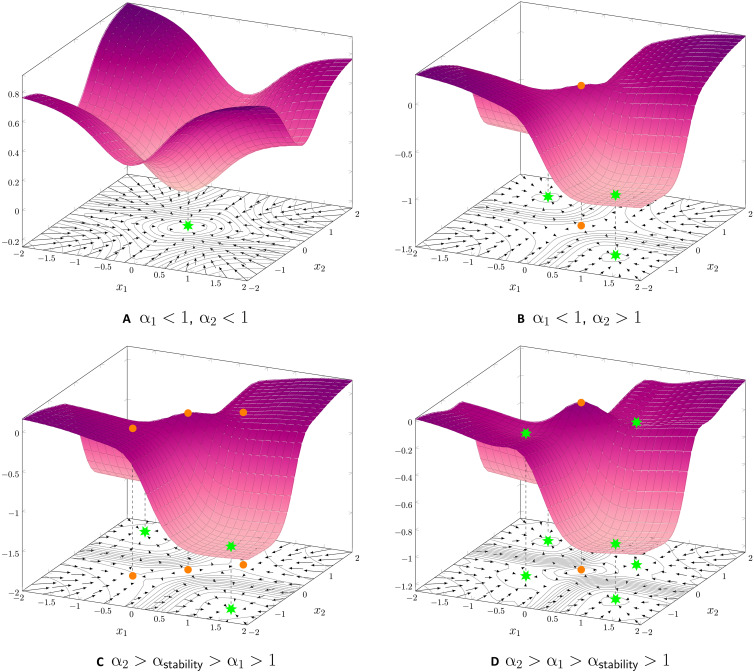
- In the IDP model, a retrievable memory \(x_\mu=\gamma_\mu \xi^\mu\) exists only if its saliency weight satisfies \(\alpha_\mu > \alpha_{\text{existence}} = 1\); stability requires the stronger condition \(\alpha_\mu > \alpha_{\text{stability}}\) (with \(\alpha_{\text{stability}} > 1\)).
- The paper states that the modified energy landscape ranks memories by saliency: if \(\alpha_\nu < \alpha_\mu\), then \(E(x_\mu;W(u)) < E(x_\nu;W(u))\), so stronger input components create deeper minima.
- For inputs that are well mixed and satisfy \(\alpha_\mu < 1\) for all memories, the IDP dynamics converge to the origin, which the authors call a “confusion state.”
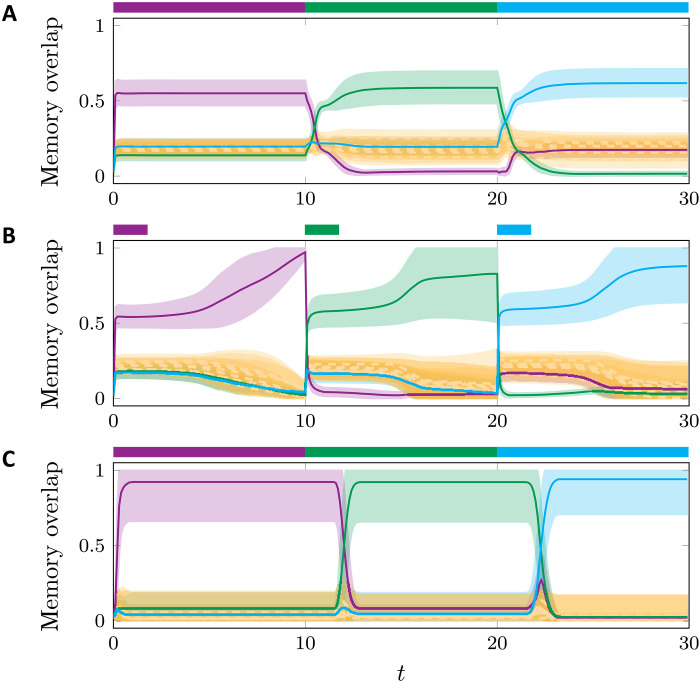
- In noise simulations, the classic Hopfield model is reported to fail under moderate noise: at \(\sigma=1\), overlaps remain at chance level, and larger \(\sigma\) leads to total retrieval failure; by contrast, the IDP model shows correct sequential retrieval even at relatively high noise and performs best at an intermediate value, \(\sigma=2\), for retrieval timing.
## Methods
- The paper develops a continuous-time Hopfield framework with input-modulated synapses: \( \dot{x}(t) = -x(t) + W(u(t))\Psi(x(t)) \), where \(W(u(t))\) depends on saliency weights \(\alpha_\mu(t) = [\xi_\mu^\top u(t)]^2\).
- Simulations for Figs. 2 and 5 use networks of \(N=1024\) neurons, Euler-Maruyama integration, and activation \(\psi(x_i)=\tanh(5x_i)\); inputs are piecewise constant and constructed as mixtures \(u=\sum_\mu \omega_\mu \xi^\mu\) with dominant weights sampled from \(U[7,10]\) and non-dominant weights from \(U[2,5]\) over intervals of length 10.
- The analysis combines energy-function arguments, existence/stability thresholds for equilibria, and stochastic dynamics with additive Brownian noise \( \sigma dB(t) \) to compare classic and IDP Hopfield behavior.
## Limitations
- The paper explicitly notes that a full theoretical investigation of the biologically plausible firing-rate version of the IDP model is future work, and that empirical validation of input-dependent associative memory models is still needed.
- It also states that a complete characterization of learning dynamics, including long-term memory formation and short-term modulation of saliency weights, remains open.
- Evident from the text: the simulations use ad hoc piecewise-constant inputs constructed for experimental control, so the reported robustness results are tied to a stylized setup rather than naturalistic input streams.
Model-written summary. Check it against the paper before relying on it.
Integrity signals
Registry
Cites
Statistics
Figures



Verification
Claims the paper makes
1 Valid · 4 Not valid · 4 Not checked · 34 Own results and interpretations
The cited sources support only part of this claim — read each source’s verdict below.
In the paper
“our model admits a simple representation as a modern Hopfield network (7, 10)”
§ Input-driven dynamics for robust memory retrieval in Hopfield networks > INTRODUCTION
What the sources say
- Supportedcites [7] D. Krotov, J. Hopfield, Large associative memory problem in neurobiology and machine learning. arXiv:2008.06996 (2020). source
Section 3.2 (pp. 6–7) derives the energy function and update rule for a modern Hopfield network, supporting the citation as a reference for that representation. The statement that the citing authors’ own IDP model admits such a representation is their application of the framework, not a finding attributed to this source. (LLM, conf=0.84)
- Not matchedcites [10] H. Ramsauer, B. Schäfl, J. Lehner, P. Seidl, M. Widrich, T. Adler, L. Gruber, M. Holzleitner, M. Pavlović, G. K. Sandve, V. Greiff, D. Kreil, M. Kopp, G. Klambauer, J. Brandstetter, S. Hochreiter, “Hopfield networks is all you need” in International Conference on Learning Representations (ICLR, 2021), pp. 1–95.
Couldn’t be matched to a paper in Crossref, so it can’t be checked.
plain- Asserted: passes — The authors put it forward as true.
- Checkable: passes — It can be checked against evidence.
- Load-bearing: passes — The paper’s conclusions depend on it.
- Based: passes — The paper gives a reason why it holds.
- Supported
The paper states this without a source or data behind it here, so there is nothing to check it against. The quote shows it is in the paper.
In the paper
“the addition of noise reveals the advantageous integration of past and present information by our model, thereby reducing misclassification errors induced by inconsistent or “glitchy” inputs.”
§ Input-driven dynamics for robust memory retrieval in Hopfield networks > INTRODUCTION
plainstates a cause- Asserted: passes — The authors put it forward as true.
- Checkable: passes — It can be checked against evidence.
- Load-bearing: passes — The paper’s conclusions depend on it.
- Based: unclear — It is unclear why the paper says it holds.
A result the paper reports from its own data — it cites no other source for it, so there is none to check. The quote shows it is in the paper.
In the paper
“As observable from Fig. 5B, relatively high amplitude noise (σ=4) favors the consecutive retrieval of different memories even when the inputs are highly mixed.”
§ Input-driven dynamics for robust memory retrieval in Hopfield networks > RESULTS > IDP induces resiliency to noise
plainstates a cause- Asserted: passes — The authors put it forward as true.
- Checkable: passes — It can be checked against evidence.
- Load-bearing: passes — The paper’s conclusions depend on it.
- Based: passes — The paper gives a reason why it holds.
- Rests on an assumption not shown here.
A result the paper states — it cites no source for it, so there is none to check. The quote shows it is in the paper.
In the paper
“As previously presented, memories exist (are retrievable) only if their respective saliency weights in the input are at least unitary.”
§ Input-driven dynamics for robust memory retrieval in Hopfield networks > RESULTS > The IDP Hopfield model
plainstates a cause- Asserted: passes — The authors put it forward as true.
- Checkable: passes — It can be checked against evidence.
- Load-bearing: passes — The paper’s conclusions depend on it.
- Based: passes — The paper gives a reason why it holds.
- Rests on 2 assumptions not shown here.
A result the paper states — it cites no source for it, so there is none to check. The quote shows it is in the paper.
In the paper
“If multiple retrievable memories exist under the current input, then there exists a stability threshold αstability>1 such that each memory xμ is stable if and only if αμ>αstability.”
§ Input-driven dynamics for robust memory retrieval in Hopfield networks > RESULTS > The IDP Hopfield model
plainstates an association- Asserted: passes — The authors put it forward as true.
- Checkable: passes — It can be checked against evidence.
- Load-bearing: passes — The paper’s conclusions depend on it.
- Based: passes — The paper gives a reason why it holds.
- Rests on 2 assumptions not shown here.
23 more claims
Create a free account to see all 43 claims and every source verdict.
- It may state two separate claims as one. 10
- The quote only partly states this claim. 1
- Probably not a substantial claim. 5
Citations
Cites
Neural networks and physical systems with emergent collective computational abilities.
Hopfield, J. J. (1982) · Proceedings of the National Academy of Sciences · doi:10.1073/pnas.79.8.2554 · Cited by 19,270 · cited 6×
“Hopfield networks are a fundamental tool in the study of high level, distributed memories retrieval [Hopfield, 1982].”
InfluentialHorn, R. A., & Johnson, C. R. (1985) · Cambridge University Press eBooks · doi:10.1017/cbo9780511810817 · Cited by 10,280
Hopfield, J. J. (1984) · Proceedings of the National Academy of Sciences · doi:10.1073/pnas.81.10.3088 · Cited by 6,918 · cited 5×
“The original model has then been expanded to the continuous setting [Hopfield, 1984] with the inclusion of external inputs from the environment, according to the following equation The introduction of an external input conflicts with the previous definition of prototypical memories as stable…”
InfluentialHorn, R. A., & Johnson, C. R. (2012) · doi:10.1017/cbo9781139020411 · Cited by 4,642
Modeling Brain Function: The World of Attractor Neural Networks
Amit, D. J. (1989) · Cambridge University Press eBooks · doi:10.1017/cbo9780511623257 · Cited by 2,227
Continual Learning Through Synaptic Intelligence
Zenke, F., Poole, B., & Ganguli, S. (2017) · arXiv · doi:10.48550/arxiv.1703.04200 · Cited by 1,784
The Variational Formulation of the Fokker--Planck Equation
Jordan, R., Kinderlehrer, D., & Otto, F. (1998) · SIAM Journal on Mathematical Analysis · doi:10.1137/s0036141096303359 · Cited by 1,603
Pattern separation in the hippocampus
Yassa, M. A., & Stark, C. E. L. (2011) · Trends in Neurosciences · doi:10.1016/j.tins.2011.06.006 · Cited by 1,544 · cited 1×
“As proposed in [Treves and Rolls, 1992], attractor dynamics may be a key component of hippocampal functioning, where the signal relayed by cortical areas is sparsified and orthogonalized in the CA3-CA1 regions [Yassa and Stark, 2011, Rolls, 2013].”
Neuronal Dynamics: From Single Neurons to Networks and Models of Cognition
Gerstner, W., Kistler, W. M., Naud, R., & Paninski, L. (2014) · doi:10.1017/cbo9781107447615 · Cited by 1,515 · cited 3×
“Instead, the fixation on the previous recall is broken when the same error is presented for t ∈ [15 , 20] . the fact that prototypical memories can be selected as sparse 0 - 1 vectors, capturing realistic low firing rate activity [Gerstner et al., 2014, Sec.”
Synaptic theory of working memory
Mongillo, G., Barak, O., & Tsodyks, M. (2008) · Science · doi:10.1126/science.1150769 · Cited by 1,253 · cited 1×
“Unlike Hopfield’s foundational works [Hopfield, 1982, 1984] based upon a static synaptic matrix, we build on insights from [Blumenfeld et al., 2006, Mongillo et al., 2008] to introduce elementary dynamics into the synaptic structure.”
Statistical mechanics of neural networks near saturation
Amit, D. J., Gutfreund, H., & Sompolinsky, H. (1987) · Annals of Physics · doi:10.1016/0003-4916(87)90092-3 · Cited by 849
Treves, A., & Rolls, E. T. (1992) · Hippocampus · doi:10.1002/hipo.450020209 · Cited by 707 · cited 1×
“As proposed in [Treves and Rolls, 1992], attractor dynamics may be a key component of hippocampal functioning, where the signal relayed by cortical areas is sparsified and orthogonalized in the CA3-CA1 regions [Yassa and Stark, 2011, Rolls, 2013].”
A selective review of selective attention research from the past century
Driver, J. (2001) · British Journal of Psychology · doi:10.1348/000712601162103 · Cited by 658 · cited 2×
“In the SI we numerically show that (21) and the stationary density of (17) exhibit a similar shape.”
Stochastic Differential Equations: Theory and Applications
Baxendale, P. H., & Lototsky, S. V. (2007) · Interdisciplinary mathematical sciences · doi:10.1142/6453 · Cited by 605
The mechanisms for pattern completion and pattern separation in the hippocampus
Rolls, E. T. (2013) · Frontiers in Systems Neuroscience · doi:10.3389/fnsys.2013.00074 · Cited by 545 · cited 1×
“As proposed in [Treves and Rolls, 1992], attractor dynamics may be a key component of hippocampal functioning, where the signal relayed by cortical areas is sparsified and orthogonalized in the CA3-CA1 regions [Yassa and Stark, 2011, Rolls, 2013].”
Lesort, T., Lomonaco, V., Stoian, A., Maltoni, D., Filliat, D., & Díaz-Rodríguez, N. (2020) · Information Fusion · doi:10.1016/j.inffus.2019.12.004 · Cited by 506 · cited 2×
“The successful combination of these two elements epitomizes the ultimate aspiration of continual learning [Lesort et al., 2020, Kudithipudi et al., 2022], an emergent ML paradigm that seeks to meaningfully integrate present and past data and yields the potential for great technological advancement.”
Embracing Change: Continual Learning in Deep Neural Networks
Hadsell, R., Rao, D., Rusu, A. A., & Pascanu, R. (2020) · Trends in Cognitive Sciences · doi:10.1016/j.tics.2020.09.004 · Cited by 467 · cited 2×
“…of these limitations, we advocate for a paradigm shift from a two-step mechanism, akin to a standard algorithmic approach, to a input-driven dynamic mechanism, aligned with the principles of online algorithms and continual learning [Zenke et al., 2017, Hadsell et al., 2020, Lesort et al., 2020].”
Set-Theoretic Methods in Control
Blanchini, F., & Miani, S. (2015) · Systems & Control: Foundations & Applications · doi:10.1007/978-3-319-17933-9 · Cited by 335 · cited 1×
“Notice that Γ i : R → (0 , 1) , ∀ i = 1 , . . . and 2015 , N , and for our particular choice of initial conditions we have by Nagumo’s theorem [Blanchini Miani, ] that the firing rate dynamics are confined in the hyper-interval [0 , 1] N .”
Information storage in neural networks with low levels of activity
Amit, D. J., Gutfreund, H., & Sompolinsky, H. (1987) · Physical Review A · doi:10.1103/physreva.35.2293 · Cited by 329 · cited 2×
“…the 80s, the words “Associative Memory Network" have closely echoed with “Hopfield Network" [Hopfield, 1982, 1984], and a plethora of subsequent works have endeavored to provide a detailed picture of the properties of such networks [Amit et al., 1987a, Crisanti et al., 1986, Treves and Amit, 1988].”
Stochastic Processes and Applications: Diffusion Processes, the Fokker-Planck and Langevin Equations
Pavliotis, G. A. (2014) · Texts in Applied Mathematics · doi:10.1007/978-1-4939-1323-7 · Cited by 256
Computational principles of synaptic memory consolidation
Benna, M. K., & Fusi, S. (2016) · Nature Neuroscience · doi:10.1038/nn.4401 · Cited by 238 · cited 1×
“Notably, there is already ample evidence [Benna and Fusi, 2016] that heterogeneity in functional features and timescales may be the biological solution to the problems of catastrophic forgetting and adaptive learning.”
Biological underpinnings for lifelong learning machines
Kudithipudi, D., Aguilar-Simon, M., Babb, J., Bazhenov, M., Blackiston, D., Bongard, J., Brna, A. P., Chakravarthi Raja, S., Cheney, N., Clune, J., et al. (2022) · Nature Machine Intelligence · doi:10.1038/s42256-022-00452-0 · Cited by 236 · cited 1×
“The successful combination of these two elements epitomizes the ultimate aspiration of continual learning [Lesort et al., 2020, Kudithipudi et al., 2022], an emergent ML paradigm that seeks to meaningfully integrate present and past data and yields the potential for great technological advancement.”
On a Model of Associative Memory with Huge Storage Capacity
Demircigil, M., Heusel, J., Löwe, M., Upgang, S., & Vermet, F. (2017) · Journal of Statistical Physics · doi:10.1007/s10955-017-1806-y · Cited by 136 · cited 1×
“…2016] and to multi-layered architectures [Krotov and Hopfield, 2020, Chaudhry et al., 2023], thus endowing the model with both a significantly improved capacity [Demircigil et al., 2017] and a direct bridge to state-of-the-art transformer models and their attention mechanism [Hubert et al., 2021].”
Numerical Solution of Stochastic Differential Equations (Peter E. Kloeden and Eckhard Platen)
Gelbrich, M., & Römisch, W. (1995) · SIAM Review · doi:10.1137/1037073 · Cited by 128 · cited 1×
“, The evolution of the trajectory is then computed using the Euler-Maruyama method [Gelbrich and Römisch 1995] as where δt = 0 .”
Stable and Rapid Recurrent Processing in Realistic Autoassociative Memories
Battaglia, F. P., & Treves, A. (1998) · Neural Computation · doi:10.1162/089976698300017827 · Cited by 103 · cited 1×
“A possible solution is to clamp the input [Battaglia and Treves, 1998] for a brief time interval δt as an external driver for the dynamics, then un-clamp it and let the dynamics naturally evolve, namely where 1 S ( t ) is the characteristic function associated to any subset S of the real numbers…”
Nonequilibrium landscape theory of neural networks
Yan, H., Zhao, L., Hu, L., Wang, X., Wang, E., & Wang, J. (2013) · Proceedings of the National Academy of Sciences · doi:10.1073/pnas.1310692110 · Cited by 102 · cited 1×
“It is well known [Yan et al., 2013, Brinkman et al., 2022, Moss and McClintock, 1989] that the probability density function (P.D.F.) P ( t, x ) associated to (17) evolves according to the parabolic Fokker-Planck P.D.E. (F.P.E.) Given the close dependence of the drift term F ( x ) = D Ψ − 1 ( x ) ∇…”
Saturation Level of the Hopfield Model for Neural Network
Crisanti, A., Amit, D. J., & Gutfreund, H. (1986) · Europhysics Letters (EPL) · doi:10.1209/0295-5075/2/4/012 · Cited by 97 · cited 1×
“…the 80s, the words “Associative Memory Network" have closely echoed with “Hopfield Network" [Hopfield, 1982, 1984], and a plethora of subsequent works have endeavored to provide a detailed picture of the properties of such networks [Amit et al., 1987a, Crisanti et al., 1986, Treves and Amit, 1988].”
Metastable states in asymmetrically diluted Hopfield networks
Treves, A., & Amit, D. J. (1988) · Journal of Physics A Mathematical and General · doi:10.1088/0305-4470/21/14/016 · Cited by 80 · cited 1×
“…the 80s, the words “Associative Memory Network" have closely echoed with “Hopfield Network" [Hopfield, 1982, 1984], and a plethora of subsequent works have endeavored to provide a detailed picture of the properties of such networks [Amit et al., 1987a, Crisanti et al., 1986, Treves and Amit, 1988].”
Dynamics of Memory Representations in Networks with Novelty-Facilitated Synaptic Plasticity
Blumenfeld, B., Preminger, S., Sagi, D., & Tsodyks, M. (2006) · Neuron · doi:10.1016/j.neuron.2006.08.016 · Cited by 79 · cited 2×
“The new IDP Hopfield model is defined as ) where for a generic input u ( t ) the novel input modulated synaptic matrix is where we call the α µ ( t ) := ξ µ u ( t ) saliency weights in accordance with previous literature [Blumenfeld et al., 2006, Tang et al., 2010].”
Free energy and the Fokker-Planck equation
Jordan, R. W., Kinderlehrer, D. S., & Otto, F. (1997) · Physica D Nonlinear Phenomena · doi:10.1016/s0167-2789(97)00093-6 · Cited by 69
Neuron–astrocyte associative memory
Kozachkov, L., Slotine, J.-J. E., & Krotov, D. (2025) · Proceedings of the National Academy of Sciences · doi:10.1073/pnas.2417788122 · Cited by 68
Large Associative Memory Problem in Neurobiology and Machine Learning
Krotov, D., & Hopfield, J. (2020) · arXiv · doi:10.48550/arxiv.2008.06996 · Cited by 67
Metastable dynamics of neural circuits and networks
Brinkman, B. A. W., Yan, H., Maffei, A., Park, I. M., Fontanini, A., Wang, J., & La Camera, G. (2022) · Applied Physics Reviews · doi:10.1063/5.0062603 · Cited by 64 · cited 1×
“It is well known [Yan et al., 2013, Brinkman et al., 2022, Moss and McClintock, 1989] that the probability density function (P.D.F.) P ( t, x ) associated to (17) evolves according to the parabolic Fokker-Planck P.D.E. (F.P.E.) Given the close dependence of the drift term F ( x ) = D Ψ − 1 ( x ) ∇…”
Wong, E. (1991) · Algorithmica · doi:10.1007/bf01759054 · Cited by 58 · cited 2×
“To further strengthen the link between energy and stationary densities, we observe that the stochastic model (17) is similar to the known diffusion state machine [Wong, 1991], which admits the clean energy-dependent stationary P.D.F.”
Building transformers from neurons and astrocytes
(2023) · doi:10.1073/pnas.2219150120 · Cited by 57 · cited 1×
“Moreover, the new framework has paved the way for new hypotheses on how neurons and astrocytes could interact [Kozachkov et al., 2023], at the functional level, to support cognitive processes.”
Cortical free-association dynamics: Distinct phases of a latching network
Russo, E., & Treves, A. (2012) · Physical Review E · doi:10.1103/physreve.85.051920 · Cited by 57 · cited 2×
“In addition, simple attractor models provide a viable tool to study global cortical dynamics in the brain [Russo and Treves, 2012, Naim et al., 2018], by partitioning the surface in interacting patches of cortex each idealized by Hopfield like networks.”
When shared concept cells support associations: Theory of overlapping memory engrams
Gastaldi, C., Schwalger, T., Falco, E. D., Quiroga, R. Q., & Wulfram Gerstner, B. (2021) · PLoS Computational Biology · doi:10.1371/journal.pcbi.1009691 · Cited by 39
Memory Dynamics in Attractor Networks with Saliency Weights
Tang, H., Li, H., & Yan, R. (2010) · Neural Computation · doi:10.1162/neco.2010.07-09-1050 · Cited by 34 · cited 1×
“The new IDP Hopfield model is defined as ) where for a generic input u ( t ) the novel input modulated synaptic matrix is where we call the α µ ( t ) := ξ µ u ( t ) saliency weights in accordance with previous literature [Blumenfeld et al., 2006, Tang et al., 2010].”
Reducing a cortical network to a Potts model yields storage capacity estimates
Naim, M., Boboeva, V., Kang, C. J., & Treves, A. (2018) · Journal of Statistical Mechanics Theory and Experiment · doi:10.1088/1742-5468/aab683 · Cited by 26 · cited 1×
“In addition, simple attractor models provide a viable tool to study global cortical dynamics in the brain [Russo and Treves, 2012, Naim et al., 2018], by partitioning the surface in interacting patches of cortex each idealized by Hopfield like networks.”
Robust Retrieval of Dynamic Sequences through Interaction Modulation
Herron, L., Sartori, P., & Xue, B. (2023) · PRX Life · doi:10.1103/prxlife.1.023012 · Cited by 20 · cited 1×
“In this context, the dynamics and distribution of the saliency weights reflect some previous association among prototypical memories, and confine the network activity to limit cycles.”
Thermodynamic Formalism of Neural Computing
Petritis, D. (1996) · Nonlinear phenomena and complex systems · doi:10.1007/978-94-017-1323-8_3 · Cited by 18
(2007) · Interdisciplinary mathematical sciences · doi:10.1142/9789812770639 · Cited by 14
Hypercubic structures in orthogonal Hopfield models
Horn, D., & Weyers, J. (1987) · Physical Review A · doi:10.1103/physreva.36.4968 · Cited by 7
Neuron-Astrocyte Associative MemoryPreprint
Kozachkov, L., Slotine, J.-J. E., & Krotov, D. (2023) · arXiv (Cornell University) · doi:10.48550/arxiv.2311.08135
Dense Associative Memory for Pattern Recognition
Krotov, D., & Hopfield, J. J. (2016) · arXiv · doi:10.48550/arxiv.1606.01164
Pavliotis, G. A. (2014) · Texts in Applied Mathematics · doi:10.1007/978-1-4939-1323-7_2
Chaudhry, H., Zavatone-Veth, J., Krotov, D., & Pehlevan, C. (2023) · Advances in Neural Information Processing Systems 36 · doi:10.52202/075280-2365
Research works printed but not linked: 5
- H. Ramsauer B. Schäfl J. Lehner P. Seidl M. Widrich T. Adler L. Gruber M. Holzleitner M. Pavlović G. K. Sandve V. Greiff D. Kreil M. Kopp G. Klambauer J. Brandstetter S. Hochreiter “Hopfield networks is all you need” in International Conference on Learning Representations (ICLR 2021) pp. 1–95.
- P. Dayan L. F. Abbott Theoretical Neuroscience: Computational and Mathematical Modeling of Neural Systems (MIT Press 2005).
- F. Moss P. McClintock Noise in Nonlinear Dynamical Systems (Cambridge Univ. Press 2012).
- A. Karuvally T. Sejnowski H. T. Siegelmann “General sequential episodic memory model” in International Conference on Machine Learning (PMLR 2023) pp. 15900–15910.
- H. Khalil Nonlinear Systems (Prentice Hall 2002).
Cited by
Integrative Ni 1 –P x Catalytic Pairs for Low‐Concentration CO 2 Electroreduction
Shi, X., Liang, X., Liu, L., Hu, F., Liu, Y., Jin, Y., Yang, Y. L., Zhao, T., Wang, P., Ding, J., et al. (2025) · Angewandte Chemie International Edition · doi:10.1002/anie.202518003 · Cited by 22
Dynamical mechanisms of astrocyte-neuron coupling for the integration of short- and long-term memory
Yin, L., Yu, Y., & Wang, Q. (2026) · Nonlinear Dynamics · doi:10.1007/s11071-025-11931-5 · Cited by 14
Photonic Neural Networks: Principles, Progress, and Prospects Toward Streaming Processes
Cong, G., & Namiki, S. (2025) · Journal of Lightwave Technology · doi:10.1109/jlt.2025.3641650 · Cited by 3
“The Hopfield network is featured by an associative memory effect, like the brain memory storage, which can be utilized for signal processing and feature retrieval using input-driven dynamics [170].”
Integrative Ni 1 –P x Catalytic Pairs for Low‐Concentration CO 2 Electroreduction
Shi, X., Liang, X., Liu, L., Hu, F., Liu, Y., Jin, Y., Yang, Y. L., Zhao, T., Wang, P., Ding, J., et al. (2025) · Angewandte Chemie · doi:10.1002/ange.202518003 · Cited by 2
Shao, J., & Li, Z. (2026) · Cognitive Neurodynamics · doi:10.1007/s11571-026-10544-x
“In contrast to single-neuron dynamical models, the HNN emphasizes global interactions among neuronal populations and their convergent behavior (Gosti et al. 2024, Betteti et al. 2025).”
Metadata
- Authors
- Betteti, S., Baggio, G., Bullo, F., & Zampieri, S.
- Affiliations
- University of Padua (IT)
- University of California, Santa Barbara (US)
- Corresponding author
- Betteti, Simone
- Baggio, Giacomo
- Bullo, Francesco
- Zampieri, Sandro
- Venue
- Science Advances
- Published
- 2025-04-25
- Volume
- 11
- Issue
- 17
- Pages
- eadu6991-eadu6991
- ISSN
- 2375-2548 (ISSN-L)
- PMC
- PMC12017325
- OpenAlex
- W4409723675
- Cited by
- 12
- References
- 43
- Citations by year
- 2026: 7 · 2025: 5
- FWCI
- 4.81
- Type
- journal article
- Language
- en
- Open access
- gold
- doi.org
- Licence
- cc-by-nc
- Locations
- Science Advances (publishedVersion, cc-by-nc)
- PubMed Central (publishedVersion, cc-by-nc)
- PubMed (publishedVersion)
- arXiv (Cornell University) (submittedVersion, cc-by)
- Padua Research Archive (University of Padova) (submittedVersion, cc-by-nc)
- arXiv (Cornell University) (cc-by)
- Funders
- Air Force Office of Scientific Research (FA9550-, #FA9550-21-1-0203, -21-1-)
- Topics
- Physical Sciences › Computer Science › Artificial Intelligence › Neural Networks and Applications
- Life Sciences › Neuroscience › Cognitive Neuroscience › Neural dynamics and brain function
- Life Sciences › Neuroscience › Cognitive Neuroscience › Memory and Neural Mechanisms
- Keywords
- Hopfield neural network, memory retrieval, external inputs, synaptic plasticity, energy landscape, neural dynamics, memory storage, noise robustness, associative memory
About these checks
Registry, retraction, Cites and statistics results are computed, not judged, with one exception: a printed reference that no index lists is read once by a model before it counts as a citation error. Claims are extracted by a model and kept only when their quote appears verbatim in the text; each cited source is then checked, with a model’s help, for whether it says what the claim relies on. Those verdicts can be wrong — read the claim’s quote and the cited source before relying on one.
A language model drew the claims from the paper on 2026-10-10, under version 3 of the claim definition (model deepseek-v4.1-flash, prompt extract-v3).
A second model labelled each claim on 2026-10-10 (model jev-1.13-20260917, definition revision gold-guideline-v0.2).
Cited sources are checked with a language model’s help (gpt-6-sol).
Statistics and arithmetic are recomputed, not judged.
Confidence bands are shown only for fields calibrated on our annotated test set. None is calibrated yet, so no band is shown.
What counts as a claim ›How we measure confidence ›How we check this ›
Are you an author, or do you see a problem with this page? Request a review
Data sources
Bibliographic data: Semantic Scholar, OpenAlex, Crossref.
Contains information from the Semantic Scholar Academic Graph Datasets, made available under the ODC Attribution License (ODC-BY 1.0).
Semantic Scholar’s data is described in: Kinney, R., et al. (2023). The Semantic Scholar Open Data Platform. arXiv:2301.10140.
