

The DOI matches its Crossref record; 29 of the 29 references it cites were found in a registry or an index; 1 of the 33 sources its claims cite were checked for support.
Lubrication at Physiological Pressures by Polyzwitterionic Brushes
Abstract
The very low sliding friction at natural synovial joints, which have friction coefficients of mu < 0.002 at pressures up to 5 megapascals or more, has to date not been attained in any human-made joints or between model surfaces in aqueous environments. We found that surfaces in water bearing polyzwitterionic brushes that were polymerized directly from the surface can have mu values as low as 0.0004 at pressures as high as 7.5 megapascals. This extreme lubrication is attributed primarily to the strong hydration of the phosphorylcholine-like monomers that make up the robustly attached brushes, and may have relevance to a wide range of human-made aqueous lubrication situations.
Overview
CoChat Summary
TL;DR
This paper shows that grafted polyzwitterionic pMPC brushes on mica achieve extremely low friction in water, with coefficients as low as 0.00043 and remaining low up to 7.5 MPa. The authors attribute this to strongly hydrated phosphorylcholine-like monomers in robustly attached brushes, which makes the system a synthetic analog of physiological lubrication.
Key findings
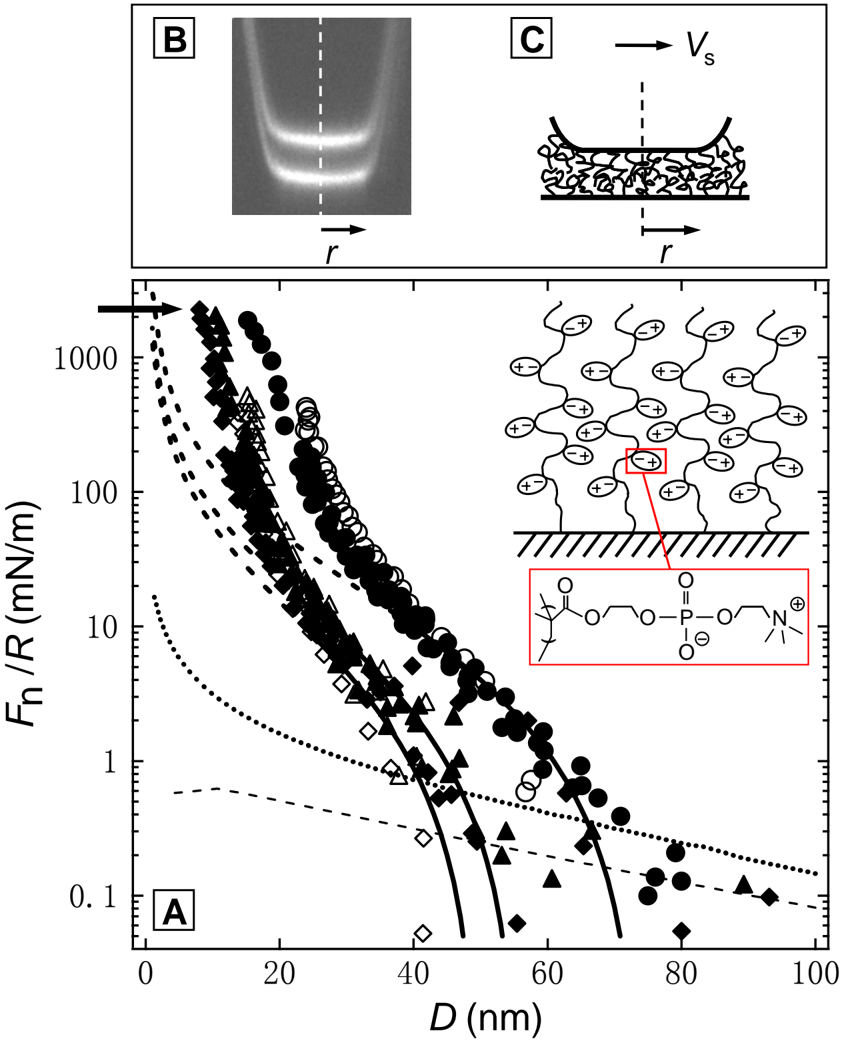
- In pure water, pMPC-brush-coated mica surfaces reached a friction coefficient of µ = 0.00043 ± 0.0001 over mean pressures in the range 2–7.5 MPa.
- In salt solutions, friction remained low but increased slightly: µ = 0.001 ± 0.0004 in 0.01 M NaNO3 and µ = 0.0026 - 0.001 + 0.0005 in 0.1 M NaNO3.
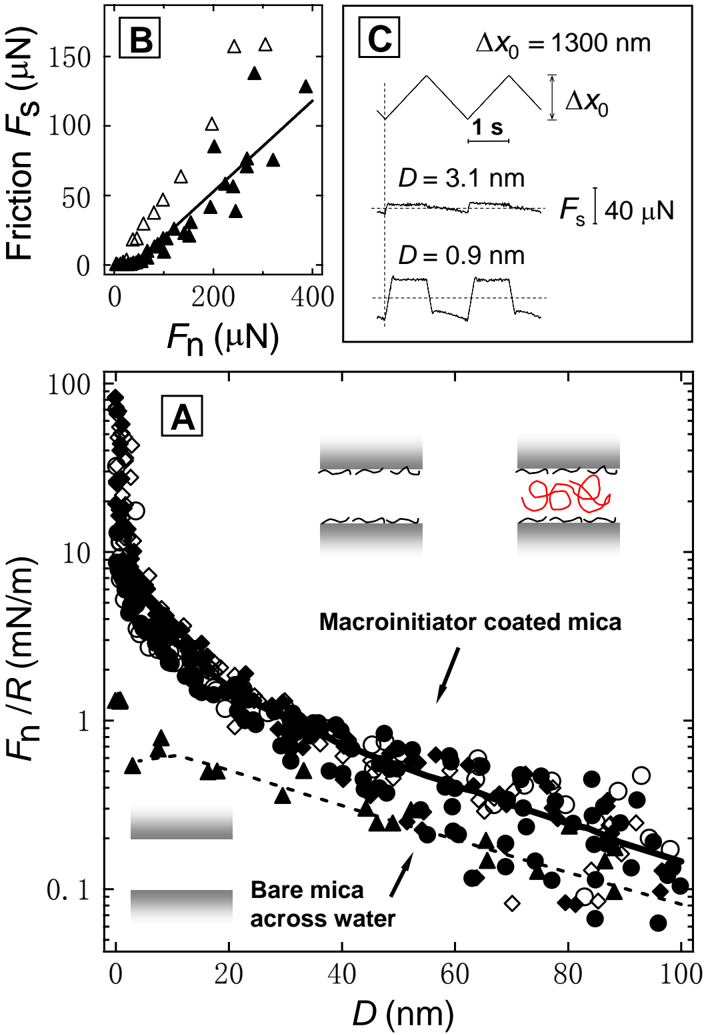
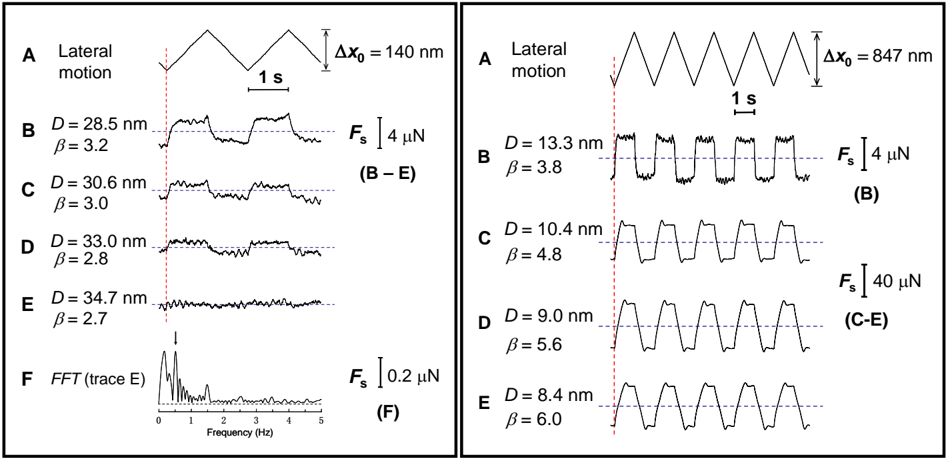
- Shear forces stayed very weak, “within the noise level” of the surface force balance, up to mean contact pressures of about 2–2.5 MPa, and no detectable wear was observed over the studied range.
- The paper states that the brushes bind about 15–25 or more water molecules per monomer and that this strong hydration is the primary mechanism for the low friction.
Methods
- Polymer brushes of poly[2-(methacryloyloxy)ethyl phosphorylcholine] (pMPC) were grown from macroinitiator-coated mica sheets mounted on cylindrical lenses for surface force balance (SFB) measurements.
- The authors measured normal force vs. separation and shear force vs. separation / sliding velocity between opposing mica surfaces, comparing bare mica, macroinitiator-coated mica, and pMPC-brush-coated mica.
- Experiments were performed in pure water and in aqueous NaNO3 solutions up to about 0.1 M; analysis included friction coefficient from the slope of Fs vs Fn and interpretation using brush hydration and interpenetration/self-regulation ideas.
Limitations
- The paper itself notes that the system is a synthetic mica-based model and “does not have a clear analog at the cartilage surface,” so direct biological generalization is limited.
- It states that cartilage is softer and much rougher than mica, so the experiments may not capture the full complexity of joint lubrication; this is an evident limitation of the model system.
- The paper does not report long-term in vivo durability or real-device performance beyond the measured laboratory conditions; this is evident from the text because the study is confined to SFB measurements on mica in aqueous media.
Model-written summary. Check it against the paper before relying on it.
Integrity signals
Registry
Cites
Statistics
Figures

Verification
Claims the paper makes
1 Valid · 0 Not valid · 17 Not checked · 22 Own results and interpretations
The cited sources support only part of this claim — read each source’s verdict below.
In the paper
“The highest normal loads Fn applied are some 2 or more orders of magnitude higher than in earlier brush studies( 4, 5 ) using the SFB.”
What the sources say
- Not matchedcites [4] 4. J. Klein, E. Kumacheva, D. Mahalu, D. Perahia, L. Fetters, Nature 370 , 634 (1994).
Couldn’t be matched to a paper in Crossref, so it can’t be checked.
- Supportedcites [5] 5. U. Raviv et al. , Nature 425 , 163 (2003). source
The paper identifies its experiments as an SFB study of polymer brushes: the Fig. 1 description labels the SFB configuration, and the Fig. 2 description reports measurements on PE brushes under increasing normal loads (section labelled Abstract; page unavailable). The citation identifies an earlier brush study using the SFB; the two-orders-of-magnitude comparison concerns loads in the citing authors’ own study. (LLM, conf=0.88)
plainstates an association- Asserted: passes — The authors put it forward as true.
- Checkable: passes — It can be checked against evidence.
- Load-bearing: passes — The paper’s conclusions depend on it.
- Based: passes — The paper gives a reason why it holds.
- Not matched
A result the paper reports from its own data — it cites no other source for it, so there is none to check. The quote shows it is in the paper.
In the paper
“the friction coefficient µ - taken as the slope of the F s vs F n plot - is in the range of values µ ≈ (1.5±1).10 -3 up to the highest mean contact pressures applied, P ≈ 7.5 MPa”
plain- Asserted: passes — The authors put it forward as true.
- Checkable: passes — It can be checked against evidence.
- Load-bearing: passes — The paper’s conclusions depend on it.
- Based: passes — The paper gives a reason why it holds.
A result the paper reports from its own data — it cites no other source for it, so there is none to check. The quote shows it is in the paper.
In the paper
“within the scatter there is little systematic difference between these two brushes.”
plain- Asserted: passes — The authors put it forward as true.
- Checkable: passes — It can be checked against evidence.
- Load-bearing: unclear — It is unclear whether the paper’s conclusions depend on it.
- Based: passes — The paper gives a reason why it holds.
A result the paper reports from its own data — it cites no other source for it, so there is none to check. The quote shows it is in the paper.
In the paper
“The values of µ , though remaining very low, are seen to increase slightly within this range as the salt concentration increases.”
plainstates a cause- Asserted: passes — The authors put it forward as true.
- Checkable: passes — It can be checked against evidence.
- Load-bearing: unclear — It is unclear whether the paper’s conclusions depend on it.
- Based: passes — The paper gives a reason why it holds.
A result the paper reports from its own data — it cites no other source for it, so there is none to check. The quote shows it is in the paper.
In the paper
“We find that surfaces bearing grafted-from polyzwitterionic brushes in water can have µ values down to 0.0004 at pressures up to 7.5 MPa.”
- Also stated in: § References: · plain
“Pure water a | 0.00043±0.0001”
plainstates an association- Asserted: passes — The authors put it forward as true.
- Checkable: passes — It can be checked against evidence.
- Load-bearing: passes — The paper’s conclusions depend on it.
- Based: passes — The paper gives a reason why it holds.
- Also stated in: § References: · plain
20 more claims
Create a free account to see all 40 claims and to verify the 2 references still open.
- It may state two separate claims as one. 11
- Probably not a substantial claim. 6
- The quote only partly states this claim. 1
Claims other papers make about this one
Each is checked against this paper’s own text: does it say what the citing paper says it does?
The source backs part of the claim, not all of it — or backs it for a different population, condition or comparison.
In the citing paper
“This is because in all relevant studies to date, including refs 4-11, the measured friction may have been dominated by other dissipation pathways, such as polymer chains disentangling past each other 10,11 or distortion of sheared liposomes 9 .”
From Origins of hydration lubrication (2015) · cites this paper as [10]
Experimental — accuracy not yet measuredThe cited source says what the claim attributes to it.
In the citing paper
“Chen et al. [80] measured the friction coefficients between sliding surfaces bearing such brushes [43]. The results are summarized in Fig. 12, which shows that the friction coefficients in pure water remain as low as 0.0004 even at pressures as high as ca. 8 MPa (80 atm).”
From Hydration lubrication (2013) · cites this paper as [43]
The cited source says what the claim attributes to it.
In the citing paper
“Such grafted-from brushes are not only much more robust with respect to being torn off the surfaces, but in addition, and very importantly, each of the monomers on the pMPC chains had the structure of a phosphocholine group (as indicated in the insets to Fig. 11 and also Fig. 12).”
From Hydration lubrication (2013) · cites this paper as [43]
The cited source says what the claim attributes to it.
In the citing paper
“At physiologically high salt concentrations up to 0.1 M salt, the friction coefficient with the pMPC brushes was found [43] to increase slightly (to around 0.001 - 0.002):”
From Hydration lubrication (2013) · cites this paper as [43]
The cited source says what the claim attributes to it.
In the citing paper
“Figure 11 shows the normal force profiles F n ( D ) between two pMPC-brush-bearing surfaces, where at the highest loads the pressure across the contact area is ca. 80 atm (~ 8 MPa).”
From Hydration lubrication (2013) · cites this paper as [43]
1 more claim about this paper
Create a free account to see every claim other papers make about this one.
Citations
Cites
(1999) · Choice Reviews Online · doi:10.5860/choice.37-0940 · Cited by 14,314
Lubrication by charged polymers
Raviv, U., Giasson, S., Kampf, N., Gohy, J.-F., Jérôme, R., & Klein, J. (2003) · Nature · doi:10.1038/nature01970 · Cited by 910
Self-citationINTERACTIONS BETWEEN NEUTRAL PHOSPHOLIPID BILAYER MEMBRANES
LIS, L. J., MCALISTER, M., FULLER, N., RAND, R. P., & PARSEGIAN, V. A. (1982) · Biophysical Journal · doi:10.1016/s0006-3495(21)00385-4 · Cited by 758
Fluidity of Bound Hydration Layers
Raviv, U., & Klein, J. (2002) · Science · doi:10.1126/science.1074481 · Cited by 721
Self-citationReduction of frictional forces between solid surfaces bearing polymer brushes
Klein, J., Kumacheva, E., Mahalu, D., Perahia, D., & Fetters, L. J. (1994) · Nature · doi:10.1038/370634a0 · Cited by 615
Self-citationMoro, T., Takatori, Y., Ishihara, K., Konno, T., Takigawa, Y., Matsushita, T., Chung, U.-I., Nakamura, K., & Kawaguchi, H. (2004) · Nature Materials · doi:10.1038/nmat1233 · Cited by 572
Pabst, G., Rappolt, M., Amenitsch, H., & Laggner, P. (2000) · Physical Review E · doi:10.1103/physreve.62.4000 · Cited by 523
Klein, J., & Kumacheva, E. (1998) · The Journal of Chemical Physics · doi:10.1063/1.476114 · Cited by 496
Self-citationNagle, J. F., Zhang, R., Tristram-Nagle, S., Sun, W., Petrache, H. I., & Suter, R. M. (1996) · Biophysical Journal · doi:10.1016/s0006-3495(96)79701-1 · Cited by 472
Boundary lubrication under water
Briscoe, W. H., Titmuss, S., Tiberg, F., Thomas, R. K., McGillivray, D. J., & Klein, J. (2006) · Nature · doi:10.1038/nature05196 · Cited by 370
Self-citation
Research works printed but not linked: 5
- C. W. McCutchen, Fed. Proc.25, 1061 (1966).
- E. A. Disalvoet al., J. Argent. Chem. Soc.92, 1 (2004).
- G. Pabst, M. Rappolt, H. Amenitsch, P. Laggner, Phys. Rev. E Stat. Phys. Plasmas Fluids Relat. Interdiscip. Topics62, 4000 (2000).
- M. Rappolt, G. Pabst, H. Amenitsch, P. Laggner, Colloids Surf. A Physicochem. Eng. Asp.183-185, 171 (2001).
- B. A. Hills, G. D. Jay, J. Rheumatol.29, 200 (2002).
Cited by
Macromolecular Engineering by Atom Transfer Radical Polymerization
Matyjaszewski, K., & Tsarevsky, N. V. (2014) · Journal of the American Chemical Society · doi:10.1021/ja408069v · Cited by 1,159
Zwitteration: Coating Surfaces with Zwitterionic Functionality to Reduce Nonspecific Adsorption
Schlenoff, J. B. (2014) · Langmuir · doi:10.1021/la500057j · Cited by 951
Li, Q., Wen, C., Yang, J., Zhou, X., Zhu, Y., Zheng, J., Cheng, G., Bai, J., Xu, T., Ji, J., et al. (2022) · Chemical Reviews · doi:10.1021/acs.chemrev.2c00344 · Cited by 790
Krishnamoorthy, M., Hakobyan, S., Ramstedt, M., & Gautrot, J. E. (2014) · Chemical Reviews · doi:10.1021/cr500252u · Cited by 604
Klein, J. (2013) · Friction · doi:10.1007/s40544-013-0001-7 · Cited by 567
“Nature 444: 191−194 (2006) [43] Chen M, Briscoe W H, Armes S P, Klein J.”
BackgroundMethodInfluentialSelf-citation
Metadata
- Authors
- Chen, M., Briscoe, W. H., Armes, S. P., & Klein, J.
- Affiliations
- University of Oxford (GB)
- Corresponding author
- Chen, Meng
- Briscoe, Wuge H.
- Klein, Jacob
- Venue
- Science
- Published
- 2009-03-27
- Volume
- 323
- Issue
- 5922
- Pages
- 1698-1701
- ISSN
- 0036-8075 (ISSN-L)
- 1095-9203
- OpenAlex
- W1996073717
- Cited by
- 704
- References
- 29
- Citations by year
- 2026: 19 · 2025: 43 · 2024: 40 · 2023: 40 · 2022: 40 · 2021: 48 · 2020: 34 · 2019: 59 · 2018: 44 · 2017: 38 · 2016: 50 · 2015: 37 · 2014: 49 · 2013: 35 · 2012: 48
- FWCI
- 19.94
- Type
- journal article
- Language
- en
- Open access
- closed
- Locations
- Science (publishedVersion)
- PubMed (publishedVersion)
- Bristol Research (University of Bristol) (publishedVersion)
- White Rose Research Online (University of Leeds, The University of Sheffield, University of York) (acceptedVersion)
- Explore Bristol Research (submittedVersion)
- Funders
- Engineering and Physical Sciences Research Council (EP/C535421/1)
- Topics
- Physical Sciences › Materials Science › Surfaces, Coatings and Films › Polymer Surface Interaction Studies
- Physical Sciences › Engineering › Mechanical Engineering › Lubricants and Their Additives
- Physical Sciences › Engineering › Mechanical Engineering › Tribology and Lubrication Engineering
- Keywords
- aqueous lubrication, synovial joints, phosphorylcholine, polymer hydration, surface-initiated polymerization, high-pressure lubrication, biomimetic lubrication
- MeSH terms
- Aluminum Silicates, Cartilage, Articular, Humans, Ions, Joints, Lubrication, Methacrylates, Phosphorylcholine, Polymers, Pressure, Synovial Fluid, Water, Friction, Biomimetic Materials
About these checks
Registry, retraction, Cites and statistics results are computed, not judged, with one exception: a printed reference that no index lists is read once by a model before it counts as a citation error. Claims are extracted by a model and kept only when their quote appears verbatim in the text; each cited source is then checked, with a model’s help, for whether it says what the claim relies on. Those verdicts can be wrong — read the claim’s quote and the cited source before relying on one.
A language model drew the claims from the paper on 2026-10-10, under version 3 of the claim definition (model deepseek-v4.1-flash, prompt extract-v3).
A second model labelled each claim on 2026-10-10 (model jev-1.13-20260917, definition revision gold-guideline-v0.2).
Cited sources are checked with a language model’s help (gpt-6-sol).
Statistics and arithmetic are recomputed, not judged.
Confidence bands are shown only for fields calibrated on our annotated test set. None is calibrated yet, so no band is shown.
What counts as a claim ›How we measure confidence ›How we check this ›
Are you an author, or do you see a problem with this page? Request a review
How to cite
Cite CoChat for the checks on this page, and the paper for its own findings.
- This page
- CoChat. (2026). Citation check: Lubrication at Physiological Pressures by Polyzwitterionic Brushes. https://app.cochat.ai/papers/10.1126/science.1169399
- The paper
- Chen, M., Briscoe, W. H., Armes, S. P., & Klein, J. (2009). Lubrication at Physiological Pressures by Polyzwitterionic Brushes. Science. https://doi.org/10.1126/science.1169399
Data sources
Bibliographic data: Semantic Scholar, OpenAlex, Crossref.
Contains information from the Semantic Scholar Academic Graph Datasets, made available under the ODC Attribution License (ODC-BY 1.0).
Semantic Scholar’s data is described in: Kinney, R., et al. (2023). The Semantic Scholar Open Data Platform. arXiv:2301.10140.
