

Lubrication at Physiological Pressures by Polyzwitterionic Brushes
The DOI matches its Crossref record; 29 of the 29 references it cites were found in a registry or an index; 1 of the 33 sources its claims cite were checked for support.
Abstract
The very low sliding friction at natural synovial joints, which have friction coefficients of mu < 0.002 at pressures up to 5 megapascals or more, has to date not been attained in any human-made joints or between model surfaces in aqueous environments. We found that surfaces in water bearing polyzwitterionic brushes that were polymerized directly from the surface can have mu values as low as 0.0004 at pressures as high as 7.5 megapascals. This extreme lubrication is attributed primarily to the strong hydration of the phosphorylcholine-like monomers that make up the robustly attached brushes, and may have relevance to a wide range of human-made aqueous lubrication situations.
Overview
CoChat Summary
TL;DR
This paper shows that grafted polyzwitterionic pMPC brushes on mica achieve extremely low friction in water, with coefficients as low as 0.00043 and remaining low up to 7.5 MPa. The authors attribute this to strongly hydrated phosphorylcholine-like monomers in robustly attached brushes, which makes the system a synthetic analog of physiological lubrication.
Key findings
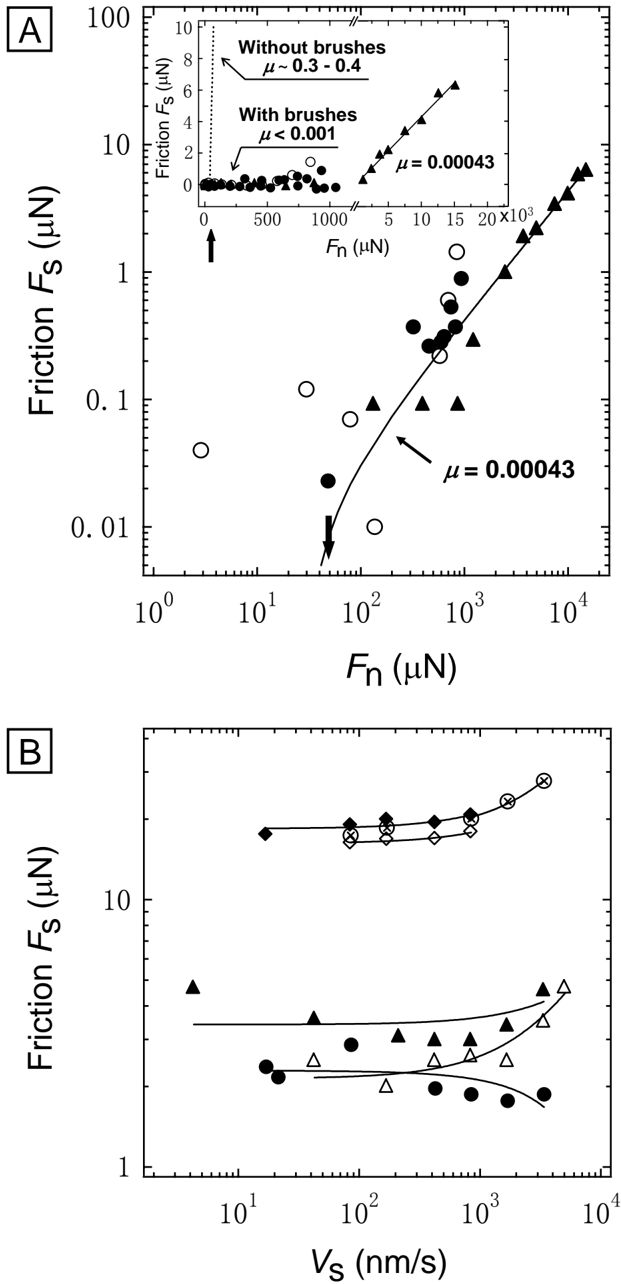
- In pure water, pMPC-brush-coated mica surfaces reached a friction coefficient of µ = 0.00043 ± 0.0001 over mean pressures in the range 2–7.5 MPa.
- In salt solutions, friction remained low but increased slightly: µ = 0.001 ± 0.0004 in 0.01 M NaNO3 and µ = 0.0026 - 0.001 + 0.0005 in 0.1 M NaNO3.
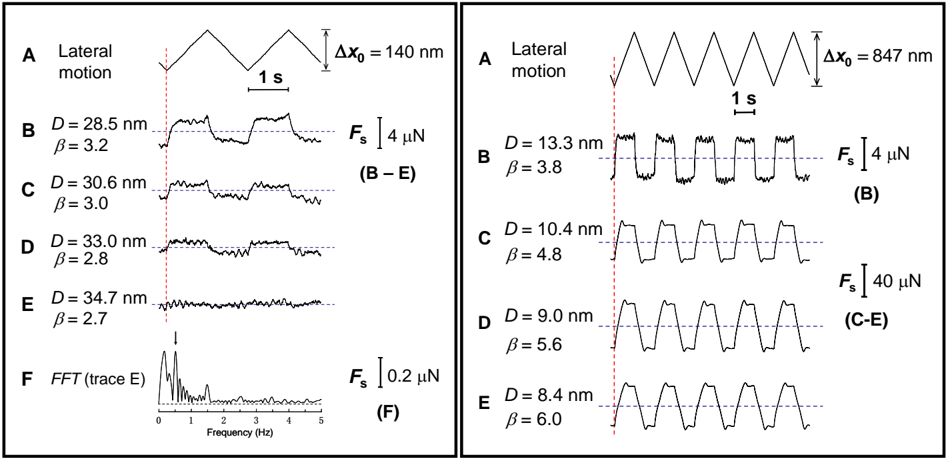
- Shear forces stayed very weak, “within the noise level” of the surface force balance, up to mean contact pressures of about 2–2.5 MPa, and no detectable wear was observed over the studied range.
- The paper states that the brushes bind about 15–25 or more water molecules per monomer and that this strong hydration is the primary mechanism for the low friction.
Methods
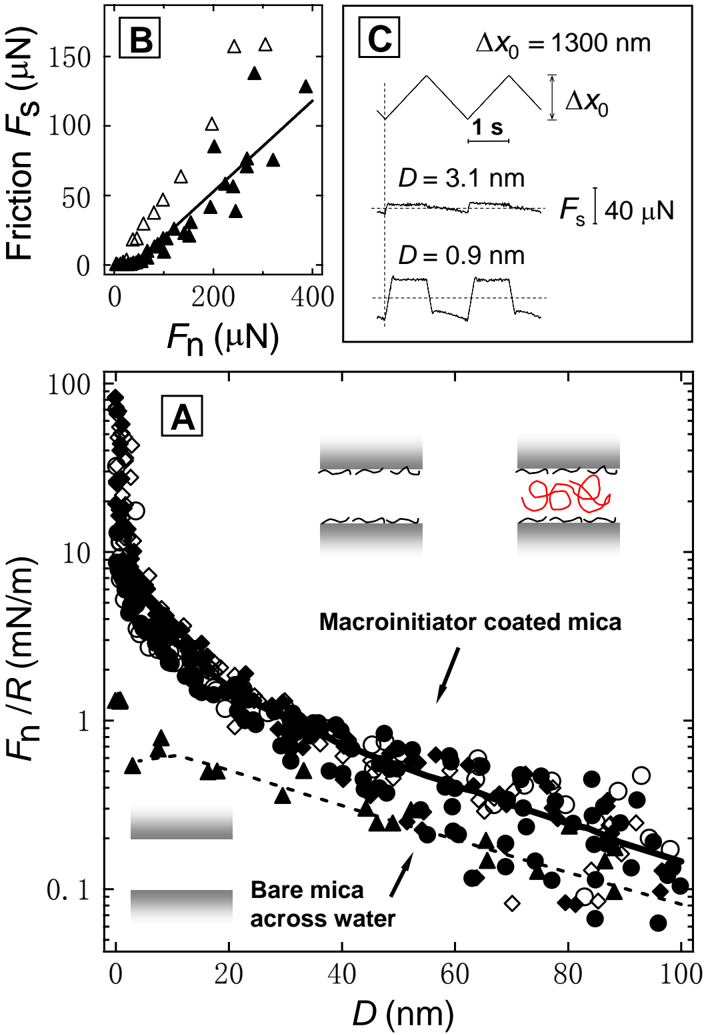
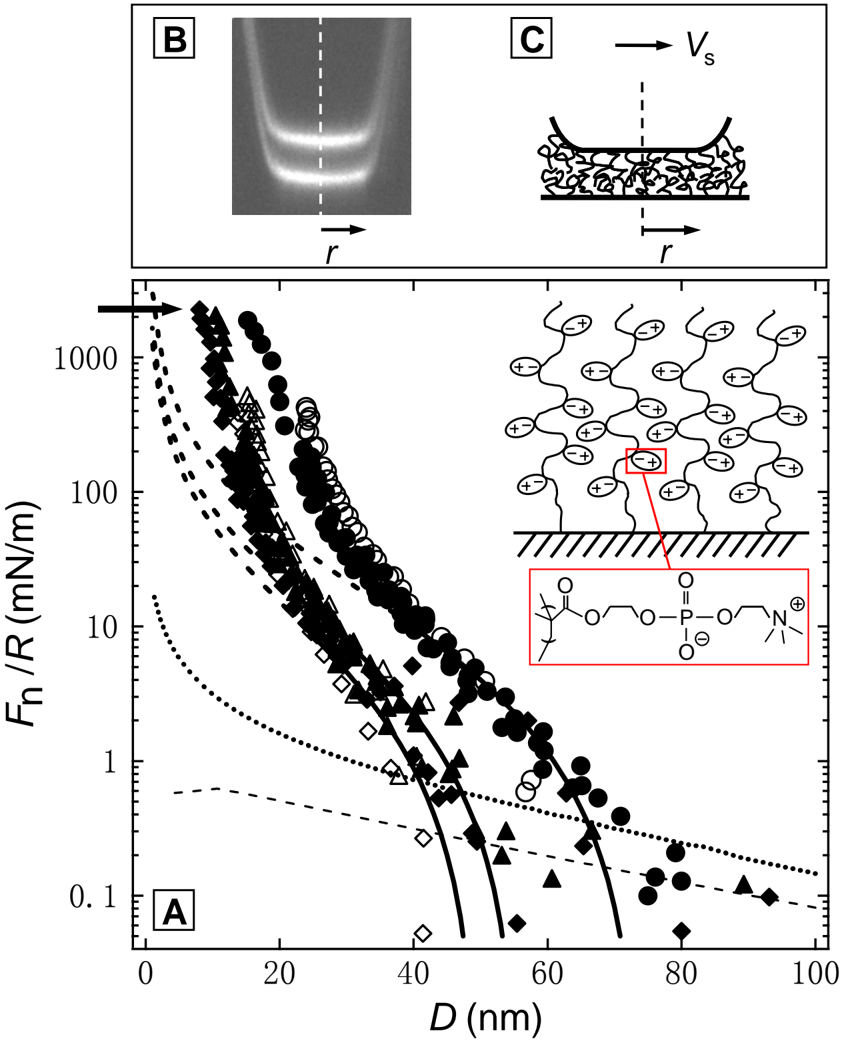
- Polymer brushes of poly[2-(methacryloyloxy)ethyl phosphorylcholine] (pMPC) were grown from macroinitiator-coated mica sheets mounted on cylindrical lenses for surface force balance (SFB) measurements.
- The authors measured normal force vs. separation and shear force vs. separation / sliding velocity between opposing mica surfaces, comparing bare mica, macroinitiator-coated mica, and pMPC-brush-coated mica.
- Experiments were performed in pure water and in aqueous NaNO3 solutions up to about 0.1 M; analysis included friction coefficient from the slope of Fs vs Fn and interpretation using brush hydration and interpenetration/self-regulation ideas.
Limitations
- The paper itself notes that the system is a synthetic mica-based model and “does not have a clear analog at the cartilage surface,” so direct biological generalization is limited.
- It states that cartilage is softer and much rougher than mica, so the experiments may not capture the full complexity of joint lubrication; this is an evident limitation of the model system.
- The paper does not report long-term in vivo durability or real-device performance beyond the measured laboratory conditions; this is evident from the text because the study is confined to SFB measurements on mica in aqueous media.
Model-written summary. Check it against the paper before relying on it.
Integrity signals
Registry
Cites
Statistics
Figures
Verification
Claims the paper makes
1 Valid · 0 Not valid · 17 Not checked · 22 Own results and interpretations
The cited sources support only part of this claim — read each source’s verdict below.
In the paper
“The highest normal loads Fn applied are some 2 or more orders of magnitude higher than in earlier brush studies( 4, 5 ) using the SFB.”
What the sources say
- Not matchedcites [4] 4. J. Klein, E. Kumacheva, D. Mahalu, D. Perahia, L. Fetters, Nature 370 , 634 (1994).
Its entry has no title and year that we can search by.
- Supportedcites [5] 5. U. Raviv et al. , Nature 425 , 163 (2003). source
The paper identifies its experiments as an SFB study of polymer brushes: the Fig. 1 description labels the SFB configuration, and the Fig. 2 description reports measurements on PE brushes under increasing normal loads (section labelled Abstract; page unavailable). The citation identifies an earlier brush study using the SFB; the two-orders-of-magnitude comparison concerns loads in the citing authors’ own study. (LLM, conf=0.88)
plainstates an association- Asserted: passes — The authors put it forward as true.
- Checkable: passes — It can be checked against evidence.
- Load-bearing: passes — The paper’s conclusions depend on it.
- Based: passes — The paper gives a reason why it holds.
- Not matched
A result the paper reports from its own data — it cites no other source for it, so there is none to check. The quote shows it is in the paper.
In the paper
“the friction coefficient µ - taken as the slope of the F s vs F n plot - is in the range of values µ ≈ (1.5±1).10 -3 up to the highest mean contact pressures applied, P ≈ 7.5 MPa”
plain- Asserted: passes — The authors put it forward as true.
- Checkable: passes — It can be checked against evidence.
- Load-bearing: passes — The paper’s conclusions depend on it.
- Based: passes — The paper gives a reason why it holds.
A result the paper reports from its own data — it cites no other source for it, so there is none to check. The quote shows it is in the paper.
In the paper
“within the scatter there is little systematic difference between these two brushes.”
plain- Asserted: passes — The authors put it forward as true.
- Checkable: passes — It can be checked against evidence.
- Load-bearing: unclear — It is unclear whether the paper’s conclusions depend on it.
- Based: passes — The paper gives a reason why it holds.
A result the paper reports from its own data — it cites no other source for it, so there is none to check. The quote shows it is in the paper.
In the paper
“The values of µ , though remaining very low, are seen to increase slightly within this range as the salt concentration increases.”
plainstates a cause- Asserted: passes — The authors put it forward as true.
- Checkable: passes — It can be checked against evidence.
- Load-bearing: unclear — It is unclear whether the paper’s conclusions depend on it.
- Based: passes — The paper gives a reason why it holds.
A result the paper reports from its own data — it cites no other source for it, so there is none to check. The quote shows it is in the paper.
In the paper
“We find that surfaces bearing grafted-from polyzwitterionic brushes in water can have µ values down to 0.0004 at pressures up to 7.5 MPa.”
- Also stated in: § References: · plain
“Pure water a | 0.00043±0.0001”
plainstates an association- Asserted: passes — The authors put it forward as true.
- Checkable: passes — It can be checked against evidence.
- Load-bearing: passes — The paper’s conclusions depend on it.
- Based: passes — The paper gives a reason why it holds.
- Also stated in: § References: · plain
20 more claims
Create a free account to see all 40 claims and to verify the 2 references still open.
- It may state two separate claims as one. 11
- Probably not a substantial claim. 6
- The quote only partly states this claim. 1
Claims other papers make about this one
Each is checked against this paper’s own text: does it say what the citing paper says it does?
The source backs part of the claim, not all of it — or backs it for a different population, condition or comparison.
In the citing paper
“This is because in all relevant studies to date, including refs 4-11, the measured friction may have been dominated by other dissipation pathways, such as polymer chains disentangling past each other 10,11 or distortion of sheared liposomes 9 .”
From Origins of hydration lubrication (2015) · cites this paper as [10]
Experimental — accuracy not yet measuredThe cited source says what the claim attributes to it.
In the citing paper
“Chen et al. [80] measured the friction coefficients between sliding surfaces bearing such brushes [43]. The results are summarized in Fig. 12, which shows that the friction coefficients in pure water remain as low as 0.0004 even at pressures as high as ca. 8 MPa (80 atm).”
From Hydration lubrication (2013) · cites this paper as [43]
The cited source says what the claim attributes to it.
In the citing paper
“Such grafted-from brushes are not only much more robust with respect to being torn off the surfaces, but in addition, and very importantly, each of the monomers on the pMPC chains had the structure of a phosphocholine group (as indicated in the insets to Fig. 11 and also Fig. 12).”
From Hydration lubrication (2013) · cites this paper as [43]
The cited source says what the claim attributes to it.
In the citing paper
“At physiologically high salt concentrations up to 0.1 M salt, the friction coefficient with the pMPC brushes was found [43] to increase slightly (to around 0.001 - 0.002):”
From Hydration lubrication (2013) · cites this paper as [43]
The cited source says what the claim attributes to it.
In the citing paper
“Figure 11 shows the normal force profiles F n ( D ) between two pMPC-brush-bearing surfaces, where at the highest loads the pressure across the contact area is ca. 80 atm (~ 8 MPa).”
From Hydration lubrication (2013) · cites this paper as [43]
1 more claim about this paper
Create a free account to see every claim other papers make about this one.
Citations
Cites
(1999) · Choice Reviews Online · doi:10.5860/choice.37-0940 · Cited by 14,314
Lubrication by charged polymers
Raviv, U., Giasson, S., Kampf, N., Gohy, J.-F., Jérôme, R., & Klein, J. (2003) · Nature · doi:10.1038/nature01970 · Cited by 910
Self-citationINTERACTIONS BETWEEN NEUTRAL PHOSPHOLIPID BILAYER MEMBRANES
LIS, L. J., MCALISTER, M., FULLER, N., RAND, R. P., & PARSEGIAN, V. A. (1982) · Biophysical Journal · doi:10.1016/s0006-3495(21)00385-4 · Cited by 758
Fluidity of Bound Hydration Layers
Raviv, U., & Klein, J. (2002) · Science · doi:10.1126/science.1074481 · Cited by 721
Self-citationReduction of frictional forces between solid surfaces bearing polymer brushes
Klein, J., Kumacheva, E., Mahalu, D., Perahia, D., & Fetters, L. J. (1994) · Nature · doi:10.1038/370634a0 · Cited by 615
Self-citationMoro, T., Takatori, Y., Ishihara, K., Konno, T., Takigawa, Y., Matsushita, T., Chung, U.-I., Nakamura, K., & Kawaguchi, H. (2004) · Nature Materials · doi:10.1038/nmat1233 · Cited by 572
Pabst, G., Rappolt, M., Amenitsch, H., & Laggner, P. (2000) · Physical Review E · doi:10.1103/physreve.62.4000 · Cited by 523
Klein, J., & Kumacheva, E. (1998) · The Journal of Chemical Physics · doi:10.1063/1.476114 · Cited by 496
Self-citationNagle, J. F., Zhang, R., Tristram-Nagle, S., Sun, W., Petrache, H. I., & Suter, R. M. (1996) · Biophysical Journal · doi:10.1016/s0006-3495(96)79701-1 · Cited by 472
Boundary lubrication under water
Briscoe, W. H., Titmuss, S., Tiberg, F., Thomas, R. K., McGillivray, D. J., & Klein, J. (2006) · Nature · doi:10.1038/nature05196 · Cited by 370
Self-citation
Research works printed but not linked: 5
- 1. C. W. McCutchen, Fed. Proc. 25 , 1061 (1966).
- 18. E. A. Disalvo et al. , J. Argent. Chem. Soc. 92 , 1 (2004).
- 20. G. Pabst, M. Rappolt, H. Amenitsch, P. Laggner, Phys. Rev. E 62 , 4000 (2000).
- 26. M. Rappolt, G. Pabst, H. Amenitsch, P. Laggner, Colloids and Surfaces APhysicochemical and Engineering Aspects 183-185 , 171 (2001).
- 29. B. A. Hills, G. D. Jay, J. Rheumatology 29 , 200 (2002).
Cited by
Macromolecular Engineering by Atom Transfer Radical Polymerization
Matyjaszewski, K., & Tsarevsky, N. V. (2014) · Journal of the American Chemical Society · doi:10.1021/ja408069v · Cited by 1,159
Zwitteration: Coating Surfaces with Zwitterionic Functionality to Reduce Nonspecific Adsorption
Schlenoff, J. B. (2014) · Langmuir · doi:10.1021/la500057j · Cited by 951
Li, Q., Wen, C., Yang, J., Zhou, X., Zhu, Y., Zheng, J., Cheng, G., Bai, J., Xu, T., Ji, J., et al. (2022) · Chemical Reviews · doi:10.1021/acs.chemrev.2c00344 · Cited by 790
Krishnamoorthy, M., Hakobyan, S., Ramstedt, M., & Gautrot, J. E. (2014) · Chemical Reviews · doi:10.1021/cr500252u · Cited by 604
Klein, J. (2013) · Friction · doi:10.1007/s40544-013-0001-7 · Cited by 567
“Nature 444: 191−194 (2006) [43] Chen M, Briscoe W H, Armes S P, Klein J.”
BackgroundMethodInfluentialSelf-citationMimicking biological functionality with polymers for biomedical applications
Green, J. J., & Elisseeff, J. H. (2016) · Nature · doi:10.1038/nature21005 · Cited by 495
Recent Progress in Cartilage Lubrication
Lin, W., & Klein, J. (2021) · Advanced Materials · doi:10.1002/adma.202005513 · Cited by 446
Self-citationStructures and Synthesis of Zwitterionic Polymers
Laschewsky, A. (2014) · Polymers · doi:10.3390/polym6051544 · Cited by 440
“In an extension of this reasoning, much interest has focused on polyzwitterions for mimicking cell membranes [29–32] and for preparing tailored surfaces, as they can confer excellent lubrication [33–35] and excellent resistance to (bio)fouling to various materials [27,28,36–41].”
BackgroundMethodLubrication of Articular Cartilage
Jahn, S., Seror, J., & Klein, J. (2016) · Annual Review of Biomedical Engineering · doi:10.1146/annurev-bioeng-081514-123305 · Cited by 406
Self-citationOrigins of hydration lubrication
Ma, L., Gaisinskaya-Kipnis, A., Kampf, N., & Klein, J. (2015) · Nature Communications · doi:10.1038/ncomms7060 · Cited by 390
Self-citationZhu, Y., Zhang, F., Wang, D., Pei, X. F., Zhang, W., & Jin, J. (2013) · Journal of Materials Chemistry A · doi:10.1039/c3ta01598j · Cited by 361
Bioinspired Bottle-Brush Polymer Exhibits Low Friction and Amontons-like Behavior
Banquy, X., Burdyńska, J., Lee, D. W., Matyjaszewski, K., & Israelachvili, J. (2014) · Journal of the American Chemical Society · doi:10.1021/ja501770y · Cited by 299
Luo, J., Liu, M., & Ma, L. (2021) · Nano Energy · doi:10.1016/j.nanoen.2021.106092 · Cited by 295
Superlubricity of carbon nanostructures
Chen, X., & Li, J. (2020) · Carbon · doi:10.1016/j.carbon.2019.11.077 · Cited by 264
Kinetics of Atom Transfer Radical Polymerization
Krys, P., & Matyjaszewski, K. (2017) · European Polymer Journal · doi:10.1016/j.eurpolymj.2017.02.034 · Cited by 271
Singh, A., Corvelli, M., Unterman, S. A., Wepasnick, K. A., McDonnell, P., & Elisseeff, J. H. (2014) · Nature Materials · doi:10.1038/nmat4048 · Cited by 238
Superlubricity Behavior with Phosphoric Acid–Water Network Induced by Rubbing
Li, J., Zhang, C., & Luo, J. (2011) · Langmuir · doi:10.1021/la201535x · Cited by 239
Molecular mechanisms of aqueous boundary lubrication by mucinous glycoproteins
Coles, J. M., Chang, D. P., & Zauscher, S. (2010) · Current Opinion in Colloid & Interface Science · doi:10.1016/j.cocis.2010.07.002 · Cited by 234
Kim, S., Yoo, H. Y., Huang, J., Lee, Y., Park, S., Park, Y., Jin, S., Jung, Y. M., Zeng, H., Hwang, D. S., et al. (2017) · ACS Nano · doi:10.1021/acsnano.7b01370 · Cited by 232
Revolutionary advances in 2‐methacryloyloxyethyl phosphorylcholine polymers as biomaterials
Ishihara, K. (2019) · Journal of Biomedical Materials Research Part A · doi:10.1002/jbm.a.36635 · Cited by 230
Rong, M., Liu, H., Scaraggi, M., Bai, Y., Bao, L., Ma, S., Ma, Z., Cai, M., Dini, D., & Zhou, F. (2020) · Advanced Functional Materials · doi:10.1002/adfm.202004062 · Cited by 229
Hydration Lubrication in Biomedical Applications: From Cartilage to Hydrogels
Lin, W., & Klein, J. (2022) · Accounts of Materials Research · doi:10.1021/accountsmr.1c00219 · Cited by 212
Self-citationMultivalent counterions diminish the lubricity of polyelectrolyte brushes
Yu, J., Jackson, N. E., Xu, X., Morgenstern, Y., Kaufman, Y., Ruths, M., de Pablo, J. J., & Tirrell, M. (2018) · Science · doi:10.1126/science.aar5877 · Cited by 207
Han, T., Zhang, S., & Zhang, C. (2022) · Friction · doi:10.1007/s40544-021-0586-1 · Cited by 206
“Biomaterials 34(22): 5465–5475 (2013) [89] Chen M, Briscoe W H, Armes S P, Klein J.”
Macroscale Superlubricity Enabled by Hydrated Alkali Metal Ions
Han, T., Zhang, C., & Luo, J. (2018) · Langmuir · doi:10.1021/acs.langmuir.8b01722 · Cited by 204
Dramatically Tuning Friction Using Responsive Polyelectrolyte Brushes
Wei, Q., Cai, M., Zhou, F., & Liu, W. (2013) · Macromolecules · doi:10.1021/ma401537j · Cited by 204
Friction and energy dissipation mechanisms in adsorbed molecules and molecularly thin films
Krim, J. (2012) · Advances in Physics · doi:10.1080/00018732.2012.706401 · Cited by 201
“There have been some discrepancies in the SFA literature concerning the properties of liquids confined below a few nanometer or less [240–245], but the origin of the discrepancies is now known to be contaminated by Pt nanoparticles [246,247].”
BackgroundInfluentialEmerging superlubricity: A review of the state of the art and perspectives on future research
Baykara, M. Z., Vazirisereshk, M. R., & Martini, A. (2018) · Applied Physics Reviews · doi:10.1063/1.5051445 · Cited by 195
Brushing up functional materials
Ma, S., Zhang, X., Yu, B., & Zhou, F. (2019) · NPG Asia Materials · doi:10.1038/s41427-019-0121-2 · Cited by 199
Tuning ice nucleation with counterions on polyelectrolyte brush surfaces
He, Z., Xie, W. J., Liu, Z., Liu, G., Wang, Z., Gao, Y. Q., & Wang, J. (2016) · Science Advances · doi:10.1126/sciadv.1600345 · Cited by 195
“Furthermore, the embedded counterions in the PB can provide a unique microenvironment and have been used as carriers for proteins and microreactors to fabricate nanoparticles with high catalytic activity (39, 40).”
Zwitterionic Poly(amino acid methacrylate) Brushes
Alswieleh, A. M., Cheng, N., Canton, I., Ustbas, B., Xue, X., Ladmiral, V., Xia, S., Ducker, R. E., El Zubir, O., Cartron, M. L., et al. (2014) · Journal of the American Chemical Society · doi:10.1021/ja503400r · Cited by 186
Self-citationHydration Lubrication: The Macromolecular Domain
Jahn, S., & Klein, J. (2015) · Macromolecules · doi:10.1021/acs.macromol.5b00327 · Cited by 187
Self-citationSalt-Responsive Zwitterionic Polymer Brushes with Tunable Friction and Antifouling Properties
Yang, J., Chen, H., Xiao, S., Shen, M., Chen, F., Fan, P., Zhong, M., & Zheng, J. (2015) · Langmuir · doi:10.1021/acs.langmuir.5b02119 · Cited by 183
Tribological properties of hydrophilic polymer brushes under wet conditions
Kobayashi, M., & Takahara, A. (2010) · The Chemical Record · doi:10.1002/tcr.201000001 · Cited by 182
Nitric Oxide Nanomotor Driving Exosomes-Loaded Microneedles for Achilles Tendinopathy Healing
Liu, A., Wang, Q., Zhao, Z., Wu, R., Wang, M., Li, J., Sun, K., Sun, Z., Lv, Z., Xu, J., et al. (2021) · ACS Nano · doi:10.1021/acsnano.1c03177 · Cited by 178
Goldberg, R., Schroeder, A., Silbert, G., Turjeman, K., Barenholz, Y., & Klein, J. (2011) · Advanced Materials · doi:10.1002/adma.201101053 · Cited by 179
Self-citationSuperlubricity of Black Phosphorus as Lubricant Additive
Wang, W., Xie, G., & Luo, J. (2018) · ACS Applied Materials & Interfaces · doi:10.1021/acsami.8b14730 · Cited by 167
Polymer Adhesion: Seeking New Solutions for an Old Problem
Raos, G., & Zappone, B. (2021) · Macromolecules · doi:10.1021/acs.macromol.1c01182 · Cited by 171
Electrochemically Induced Surface‐Initiated Atom‐Transfer Radical Polymerization
Li, B., Yu, B., Huck, W. T. S., Zhou, F., & Liu, W. (2012) · Angewandte Chemie International Edition · doi:10.1002/anie.201201533 · Cited by 171
Superlubricity Achieved with Mixtures of Acids and Glycerol
Li, J., Zhang, C., Ma, L., Liu, Y., & Luo, J. (2013) · Langmuir · doi:10.1021/la3046115 · Cited by 164
Polymer-brush lubrication: a review of recent theoretical advances
Kreer, T. (2016) · Soft Matter · doi:10.1039/c5sm02919h · Cited by 175
Seror, J., Merkher, Y., Kampf, N., Collinson, L., Day, A. J., Maroudas, A., & Klein, J. (2011) · Biomacromolecules · doi:10.1021/bm2004912 · Cited by 159
Self-citationKang, T., Banquy, X., Heo, J., Lim, C., Lynd, N. A., Lundberg, P., Oh, D. X., Lee, H.-K., Hong, Y., Hwang, D. S., et al. (2016) · ACS Nano · doi:10.1021/acsnano.5b06066 · Cited by 163
“3 was converted to a thiol (5) via a thiol–ene coupling reaction with ethanedithiol (4).”
Kobayashi, M., Terayama, Y., Kikuchi, M., & Takahara, A. (2013) · Soft Matter · doi:10.1039/c3sm27700c · Cited by 159
Song, J., Winkeljann, B., & Lieleg, O. (2020) · Advanced Materials Interfaces · doi:10.1002/admi.202000850 · Cited by 168
Cartilage matrix-inspired biomimetic superlubricated nanospheres for treatment of osteoarthritis
Chen, H., Sun, T., Yan, Y., Ji, X., Sun, Y., Zhao, X., Qi, J., Cui, W., Deng, L., & Zhang, H. (2020) · Biomaterials · doi:10.1016/j.biomaterials.2020.119931 · Cited by 155
Effect of Carbon Spacer Length on Zwitterionic Carboxybetaines
Shao, Q., & Jiang, S. (2013) · The Journal of Physical Chemistry B · doi:10.1021/jp3094534 · Cited by 151
Dédinaité, A. (2012) · Soft Matter · doi:10.1039/c1sm06335a · Cited by 150
Recent Advances in Zwitterionic Hydrogels: Preparation, Property, and Biomedical Application
Liu, S., Tang, J., Ji, F., Lin, W., & Chen, S. (2022) · Gels · doi:10.3390/gels8010046 · Cited by 158
“Methacrylated phosphobetaine (MPC)-based copolymers reduce the slide friction substantially due to the high lubricity of MPC units, which have become a major method to synthesis lubricated hydrogels [77].”
MethodPolymer-Modified Liposomes for Drug Delivery: From Fundamentals to Applications
Cao, Y., Dong, X., & Chen, X. (2022) · Pharmaceutics · doi:10.3390/pharmaceutics14040778 · Cited by 157
Polymer-based lubricating materials for functional hydration lubrication
Liu, G., Yang, F., Zhao, N., Chen, Z., Shi, J., & Zhou, F. (2021) · Chemical Engineering Journal · doi:10.1016/j.cej.2021.132324 · Cited by 144
A low friction, biphasic and boundary lubricating hydrogel for cartilage replacement
Milner, P. E., Parkes, M., Puetzer, J. L., Chapman, R., Stevens, M. M., Cann, P. M., & Jeffers, J. R. T. (2017) · Acta Biomaterialia · doi:10.1016/j.actbio.2017.11.002 · Cited by 140
Li, D., Wei, Q., Wu, C., Zhang, X., Xue, Q., Zheng, T., & Cao, M. (2020) · Advances in Colloid and Interface Science · doi:10.1016/j.cis.2020.102141 · Cited by 138
Peng, L., Zhang, R., Wang, X., Cai, M., Yang, J. F., Yu, B., & Zhou, F. (2016) · ACS Macro Letters · doi:10.1021/acsmacrolett.6b00674 · Cited by 134
Critical update on 2‐methacryloyloxyethyl phosphorylcholine (MPC) polymer science
Goda, T., Ishihara, K., & Miyahara, Y. (2015) · Journal of Applied Polymer Science · doi:10.1002/app.41766 · Cited by 135
A Universal Strategy for Constructing Robust and Antifouling Cellulose Nanocrystal Coating
Yang, W., Pan, M., Zhang, J., Zhang, L., Lin, F., Liu, X., Huang, C., Chen, X., Wang, J., Yan, B., et al. (2021) · Advanced Functional Materials · doi:10.1002/adfm.202109989 · Cited by 133
Highly lubricated polymer interfaces for advanced artificial hip joints through biomimetic design
Ishihara, K. (2015) · Polymer Journal · doi:10.1038/pj.2015.45 · Cited by 126
Functional biomaterials for cartilage regeneration
Ge, Z., Li, C., Heng, B. C., Cao, G., & Yang, Z. (2012) · Journal of Biomedical Materials Research Part A · doi:10.1002/jbm.a.34147 · Cited by 138
Xiao, S., Zhang, Y., Shen, M., Chen, F., Fan, P., Zhong, M., Ren, B., Yang, J., & Zheng, J. (2017) · Langmuir · doi:10.1021/acs.langmuir.7b03667 · Cited by 121
“Langmuir the Acs Journal of Surfaces & Colloids 2014, 30 (18), 5152-61.”
BackgroundMa, S., Scaraggi, M., Wang, D., Wang, X., Liang, Y., Liu, W., Dini, D., & Zhou, F. (2015) · Advanced Functional Materials · doi:10.1002/adfm.201503681 · Cited by 123
Poisson–Boltzmann Theory of pH-Sensitive (Annealing) Polyelectrolyte Brush
Zhulina, E. B., & Borisov, O. V. (2011) · Langmuir · doi:10.1021/la201456a · Cited by 119
Modulating Mucin Hydration and Lubrication by Deglycosylation and Polyethylene Glycol Binding
Crouzier, T., Boettcher, K., Geonnotti, A. R., Kavanaugh, N. L., Hirsch, J. B., Ribbeck, K., & Lieleg, O. (2015) · Advanced Materials Interfaces · doi:10.1002/admi.201500308 · Cited by 127
Polyzwitterionic brushes: Extreme lubrication by design
Chen, M., Briscoe, W. H., Armes, S. P., Cohen, H., & Klein, J. (2011) · European Polymer Journal · doi:10.1016/j.eurpolymj.2010.10.007 · Cited by 116
Self-citationStructure of Polyelectrolyte Brushes in the Presence of Multivalent Counterions
Yu, J., Mao, J., Yuan, G., Satija, S., Jiang, Z., Chen, W., & Tirrell, M. (2016) · Macromolecules · doi:10.1021/acs.macromol.6b01064 · Cited by 115
Li, A., Benetti, E. M., Tranchida, D., Clasohm, J. N., Schönherr, H., & Spencer, N. D. (2011) · Macromolecules · doi:10.1021/ma2006443 · Cited by 113
Origins of extreme boundary lubrication by phosphatidylcholine liposomes
Sorkin, R., Kampf, N., Dror, Y., Shimoni, E., & Klein, J. E. (2013) · Biomaterials · doi:10.1016/j.biomaterials.2013.03.098 · Cited by 115
Self-citationHydration lubrication: exploring a new paradigm
Gaisinskaya, A., Ma, L., Silbert, G., Sorkin, R., Tairy, O., Goldberg, R., Kampf, N., & Klein, J. (2012) · Faraday Discussions · doi:10.1039/c2fd00127f · Cited by 109
Self-citationStatus of surface modification techniques for artificial hip implants
Ghosh, S., & Abanteriba, S. (2016) · Science and Technology of Advanced Materials · doi:10.1080/14686996.2016.1240575 · Cited by 108
Driving Polymer Brushes from Synthesis to Functioning
Wang, R., Wei, Q., Sheng, W., Yu, B., Zhou, F., & Li, B. (2023) · Angewandte Chemie International Edition · doi:10.1002/anie.202219312 · Cited by 153
Narupai, B., Page, Z. A., Treat, N. J., McGrath, A. J., Pester, C. W., Discekici, E. H., Dolinski, N. D., Meyers, G. F., de Alaniz, J. R., & Hawker, C. J. (2018) · Angewandte Chemie International Edition · doi:10.1002/anie.201805534 · Cited by 107
Zhao, W., Wang, H., Wang, H., Han, Y., Zheng, Z., Liu, X., Feng, B., & Zhang, H. (2021) · Nanoscale · doi:10.1039/d0nr08887k · Cited by 101
Investigation of the difference in liquid superlubricity between water- and oil-based lubricants
Li, J., Zhang, C., Deng, M., & Luo, J. (2015) · RSC Advances · doi:10.1039/c5ra10834a · Cited by 101
Kyomoto, M., Moro, T., Saiga, K., Hashimoto, M., Ito, H., Kawaguchi, H., Takatori, Y., & Ishihara, K. (2012) · Biomaterials · doi:10.1016/j.biomaterials.2012.03.028 · Cited by 98
“The secondary mechanism is attributed to a repulsion of proteinmolecules by the positively charged inorganic ions of the polyelectrolyte layer in a synovial fluid, which may reduce the adhesive interaction or interpenetration between opposing CoeCreMo alloy surfaces or adsorbed protein films on the CoeCreMo alloy [8,4…”
BackgroundInoue, Y., & Ishihara, K. (2010) · Colloids and Surfaces B Biointerfaces · doi:10.1016/j.colsurfb.2010.07.030 · Cited by 103
Effect of Salt on Phosphorylcholine-based Zwitterionic Polymer Brushes
Zhang, Z. J., Moxey, M., Alswieleh, A. M., Morse, A. J., Lewis, A. L., Geoghegan, M., & Leggett, G. J. (2016) · Langmuir · doi:10.1021/acs.langmuir.6b00763 · Cited by 108
Hydration Force between Mica Surfaces in Aqueous KCl Electrolyte Solution
Leng, Y. (2012) · Langmuir · doi:10.1021/la204603y · Cited by 98
Eisele, N. B., Andersson, F. I., Frey, S., & Richter, R. P. (2012) · Biomacromolecules · doi:10.1021/bm300577s · Cited by 100
Liu, G., Cai, M., Zhou, F., & Liu, W. (2014) · The Journal of Physical Chemistry B · doi:10.1021/jp500074g · Cited by 97
Bioinspired polymers for lubrication and wear resistance
Adibnia, V., Mirbagheri, M., Faivre, J., Robert, J., Jeungjun, L., Matyjaszewski, K. A., Lee, D. W., & Banquy, X. (2020) · Progress in Polymer Science · doi:10.1016/j.progpolymsci.2020.101298 · Cited by 98
Zheng, Y., Yang, J., Liang, J., Xu, X., Cui, W., Deng, L., & Zhang, H. (2019) · Biomacromolecules · doi:10.1021/acs.biomac.9b00964 · Cited by 97
Solvent-induced immiscibility of polymer brushes eliminates dissipation channels
de Beer, S., Kutnyánszky, E., Schön, P. M., Vancso, G. J., & Müser, M. H. (2014) · Nature Communications · doi:10.1038/ncomms4781 · Cited by 99
Polyelectrolyte brushes: a novel stable lubrication system in aqueous conditions
Kobayashi, M., Terada, M., & Takahara, A. (2012) · Faraday Discussions · doi:10.1039/c2fd00123c · Cited by 93
Origins of Superlubricity Promoted by Hydrated Multivalent Ions
Han, T., Zhang, C., Li, J., Yuan, S., Chen, X., Zhang, J., & Luo, J. (2019) · The Journal of Physical Chemistry Letters · doi:10.1021/acs.jpclett.9b03098 · Cited by 95
Tairy, O., Kampf, N., Driver, M. J., Armes, S. P., & Klein, J. E. (2014) · Macromolecules · doi:10.1021/ma5019439 · Cited by 96
Self-citationKyomoto, M., Moro, T., Saiga, K., Miyaji, F., Kawaguchi, H., Takatori, Y., Nakamura, K., & Ishihara, K. (2009) · Biomaterials · doi:10.1016/j.biomaterials.2009.09.083 · Cited by 91
Seror, J., Merkher, Y., Kampf, N., Collinson, L., Day, A. J., Maroudas, A., & Klein, J. (2012) · Biomacromolecules · doi:10.1021/bm301283f · Cited by 89
Self-citationSuperlubricity of Zwitterionic Bottlebrush Polymers in the Presence of Multivalent Ions
Adibnia, V., Olszewski, M., Crescenzo, G. D., Matyjaszewski, K. A., & Banquy, X. (2020) · Journal of the American Chemical Society · doi:10.1021/jacs.0c07215 · Cited by 89
Recent Advances in Bioinspired Gel Surfaces with Superwettability and Special Adhesion
Zhang, P., Zhao, C., Zhao, T., Liu, M., & Jiang, L. (2019) · Advanced Science · doi:10.1002/advs.201900996 · Cited by 85
Paripovic, D., & Klok, H. (2011) · Macromolecular Chemistry and Physics · doi:10.1002/macp.201000729 · Cited by 89
Terayama, Y., Kikuchi, M., Kobayashi, M., & Takahara, A. (2010) · Macromolecules · doi:10.1021/ma102223y · Cited by 89
Wang, H., Liu, Y., Liu, W., Liu, Y., Wang, K., Li, J., Ma, T., Eryilmaz, O. L., Shi, Y., Erdemir, A., et al. (2019) · ACS Applied Materials & Interfaces · doi:10.1021/acsami.9b03014 · Cited by 88
Zhang, Z. J., Morse, A. J., Armes, S. P., Lewis, A. L., Geoghegan, M., & Leggett, G. J. (2011) · Langmuir · doi:10.1021/la1043848 · Cited by 92
Self-citationSoft/Hard-Coupled Amphiphilic Polymer Nanospheres for Water Lubrication
Li, Z., Ma, S., Zhang, G., Wang, D., & Zhou, F. (2018) · ACS Applied Materials & Interfaces · doi:10.1021/acsami.8b00405 · Cited by 80
Chen, X., Lawrence, J., Parelkar, S. S., & Emrick, T. S. (2012) · Macromolecules · doi:10.1021/ma301288m · Cited by 86
Phase transitions in nanoconfined fluids: The evidence from simulation and theory
Cummings, P. T., Docherty, H., Iacovella, C. R., & Singh, J. K. (2010) · AIChE Journal · doi:10.1002/aic.12226 · Cited by 83
Tribology in Nature: Inspirations for Advanced Lubrication Materials
Qin, C., Yang, H., Lü, Y., Li, B., Ma, S., Ma, Y., & Zhou, F. (2025) · Advanced Materials · doi:10.1002/adma.202420626 · Cited by 114
Control of surface forces through hydrated boundary layers
Lin, W., & Klein, J. E. (2019) · Current Opinion in Colloid & Interface Science · doi:10.1016/j.cocis.2019.10.001 · Cited by 90
Self-citationParallel Scanning Near-Field Photolithography: The Snomipede
Haq, E. U., Liu, Z., Zhang, Y., et al. (2010) · Nano Letters · doi:10.1021/nl1018782 · Cited by 83
Self-citationPolymer brushes for electrochemical biosensors
Welch, M., Rastogi, A., & Ober, C. K. (2010) · Soft Matter · doi:10.1039/c0sm00035c · Cited by 83
Surface-Initiated Atom Transfer Radical Polymerization
Khabibullin, A., Mastan, E., Matyjaszewski, K. A., & Zhu, S. (2015) · Advances in polymer science · doi:10.1007/12_2015_311 · Cited by 107
“PMPC has also been grafted onto a surface to improve the surface lubrication properties [160–162], because some applications, such as biological surfaces in artificial joints, require extremely low friction properties.”
Background
Metadata
- Authors
- Chen, M., Briscoe, W. H., Armes, S. P., & Klein, J.
- Affiliations
- University of Oxford (GB)
- Corresponding author
- Chen, Meng
- Briscoe, Wuge H.
- Klein, Jacob
- Venue
- Science
- Published
- 2009-03-27
- Volume
- 323
- Issue
- 5922
- Pages
- 1698-1701
- ISSN
- 0036-8075 (ISSN-L)
- 1095-9203
- OpenAlex
- W1996073717
- Cited by
- 704
- References
- 29
- Citations by year
- 2026: 19 · 2025: 43 · 2024: 40 · 2023: 40 · 2022: 40 · 2021: 48 · 2020: 34 · 2019: 59 · 2018: 44 · 2017: 38 · 2016: 50 · 2015: 37 · 2014: 49 · 2013: 35 · 2012: 48
- FWCI
- 19.94
- Type
- journal article
- Language
- en
- Open access
- closed
- Locations
- Science (publishedVersion)
- PubMed (publishedVersion)
- Bristol Research (University of Bristol) (publishedVersion)
- White Rose Research Online (University of Leeds, The University of Sheffield, University of York) (acceptedVersion)
- Explore Bristol Research (submittedVersion)
- Funders
- Engineering and Physical Sciences Research Council (EP/C535421/1)
- Topics
- Physical Sciences › Materials Science › Surfaces, Coatings and Films › Polymer Surface Interaction Studies
- Physical Sciences › Engineering › Mechanical Engineering › Lubricants and Their Additives
- Physical Sciences › Engineering › Mechanical Engineering › Tribology and Lubrication Engineering
- Keywords
- aqueous lubrication, synovial joints, phosphorylcholine, polymer hydration, surface-initiated polymerization, high-pressure lubrication, biomimetic lubrication
- MeSH terms
- Aluminum Silicates, Cartilage, Articular, Humans, Ions, Joints, Lubrication, Methacrylates, Phosphorylcholine, Polymers, Pressure, Synovial Fluid, Water, Friction, Biomimetic Materials
About these checks
Registry, retraction, Cites and statistics results are computed, not judged, with one exception: a printed reference that no index lists is read once by a model before it counts as a citation error. Claims are extracted by a model and kept only when their quote appears verbatim in the text; each cited source is then checked, with a model’s help, for whether it says what the claim relies on. Those verdicts can be wrong — read the claim’s quote and the cited source before relying on one.
A language model drew the claims from the paper on 2026-10-10, under version 3 of the claim definition (model deepseek-v4.1-flash, prompt extract-v3).
A second model labelled each claim on 2026-10-10 (model jev-1.13-20260917, definition revision gold-guideline-v0.2).
Cited sources are checked with a language model’s help (gpt-6-sol).
Statistics and arithmetic are recomputed, not judged.
Confidence bands are shown only for fields calibrated on our annotated test set. None is calibrated yet, so no band is shown.
What counts as a claim ›How we measure confidence ›How we check this ›
Are you an author, or do you see a problem with this page? Request a review
Data sources
Bibliographic data: Semantic Scholar, OpenAlex, Crossref.
Contains information from the Semantic Scholar Academic Graph Datasets, made available under the ODC Attribution License (ODC-BY 1.0).
Semantic Scholar’s data is described in: Kinney, R., et al. (2023). The Semantic Scholar Open Data Platform. arXiv:2301.10140.
