

Beyond-classical computation in quantum simulation
Open accessThe DOI matches its Crossref record; 164 of the 164 references it cites were found in a registry or an index; 76 of the 96 sources its claims cite were checked for support.
Abstract
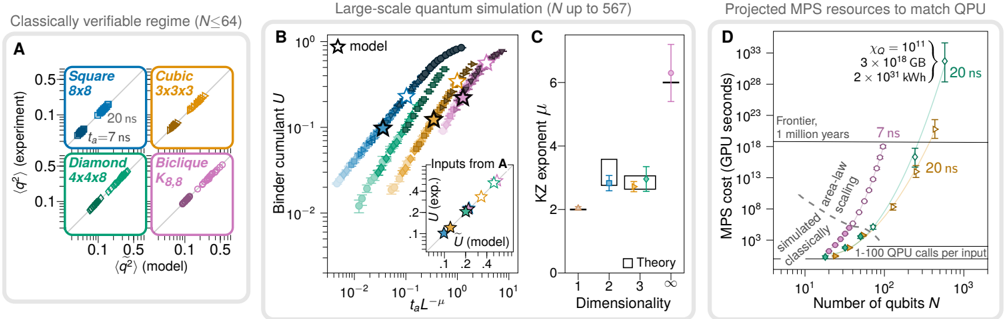
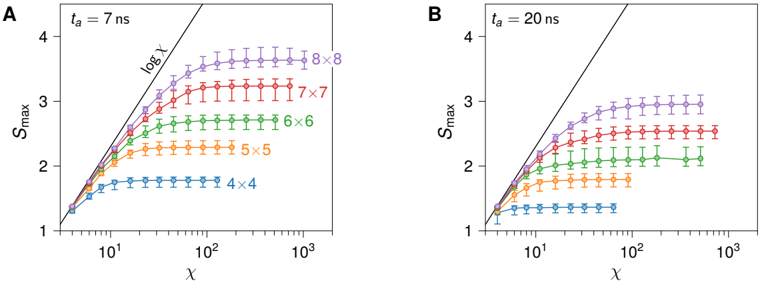
Quantum computers hold the promise of solving certain problems that lie beyond the reach of conventional computers. However, establishing this capability, especially for impactful and meaningful problems, remains a central challenge. Here, we show that superconducting quantum annealing processors can rapidly generate samples in close agreement with solutions of the Schrödinger equation. We demonstrate area-law scaling of entanglement in the model quench dynamics of two-, three-, and infinite-dimensional spin glasses, supporting the observed stretched-exponential scaling of effort for matrix-product-state approaches. We show that several leading approximate methods based on tensor networks and neural networks cannot achieve the same accuracy as the quantum annealer within a reasonable time frame. Thus, quantum annealers can answer questions of practical importance that may remain out of reach for classical computation.
Overview
CoChat Summary
TL;DR
Superconducting quantum annealing processors rapidly generate samples from quenched transverse-field Ising spin glasses in close agreement with Schrödinger-equation solutions, with area-law entanglement scaling and critical exponents matching independent estimates. Leading tensor-network and neural-network classical methods cannot match QPU accuracy within a reasonable time frame, supporting beyond-classical quantum simulation for these problems.
Key findings
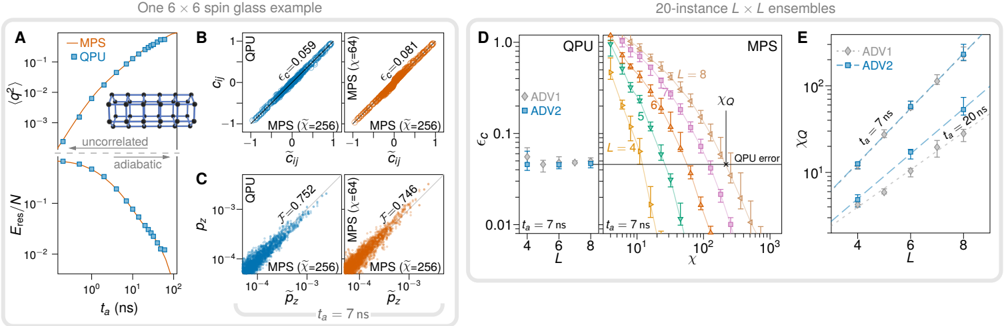
- Two D-Wave quantum annealing processors, ADV1 and ADV2, produced consistent samples for 2D, 3D, and infinite-dimensional spin-glass quenches; for the largest MPS ground truths, the spin-glass order parameter ⟨q²⟩ had a median deviation of only 1% between quantum and classical simulation.
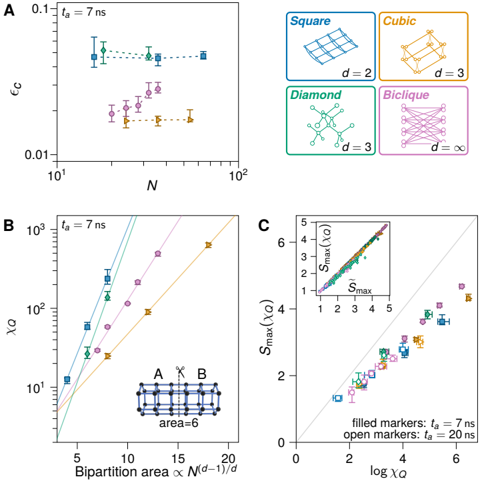
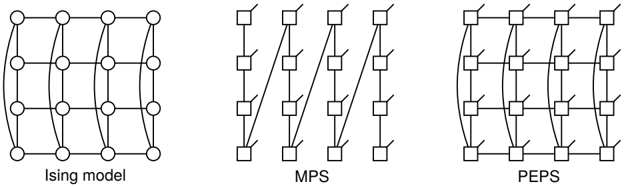
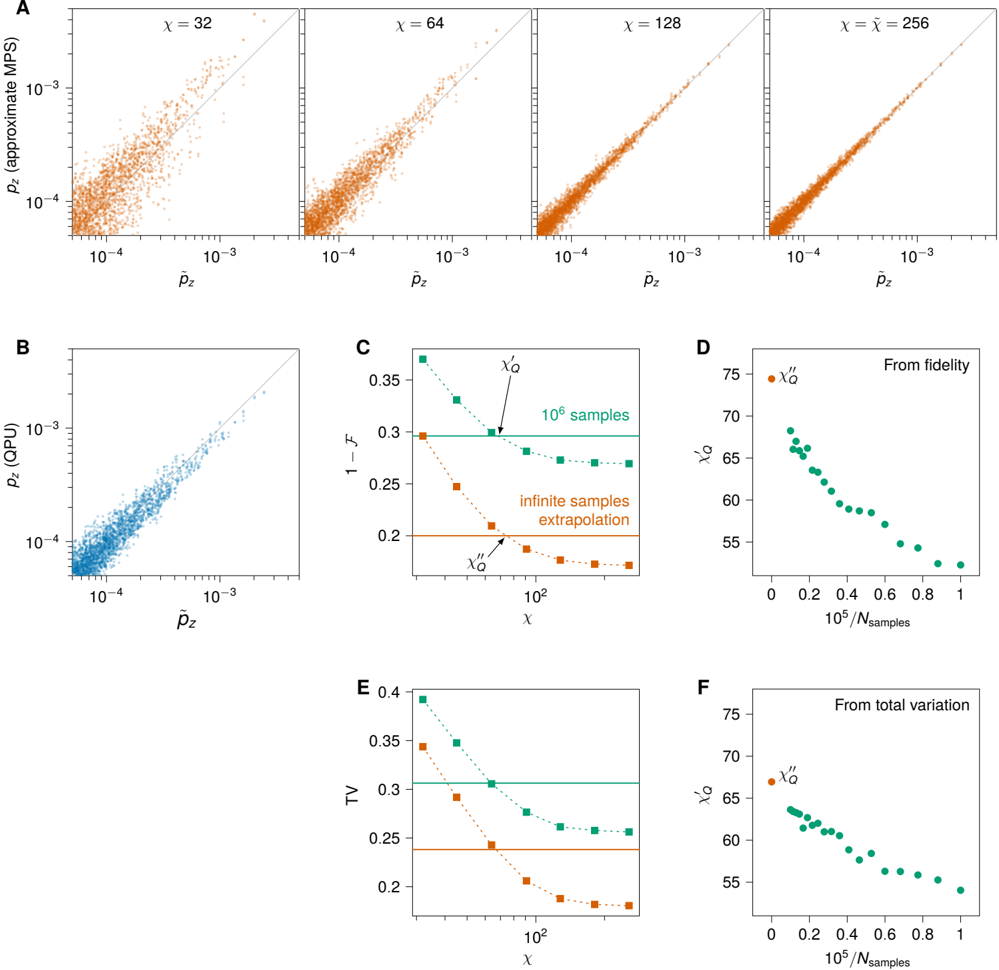
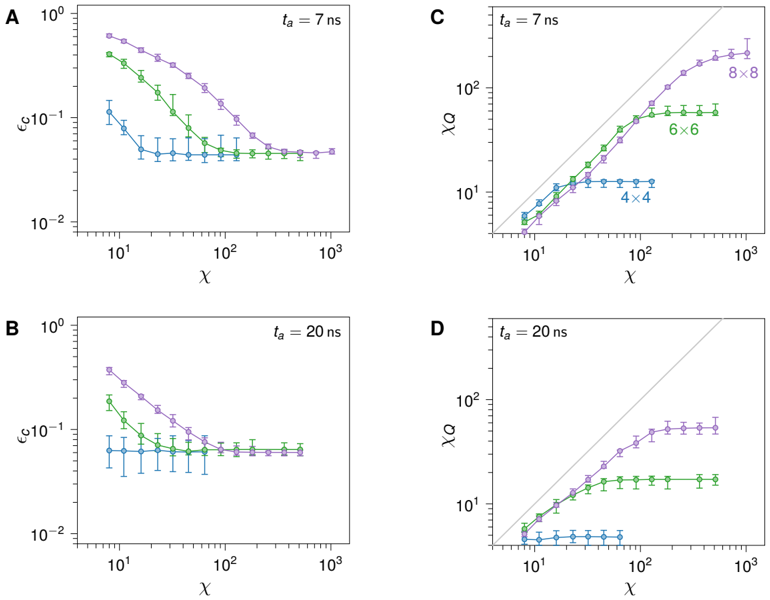
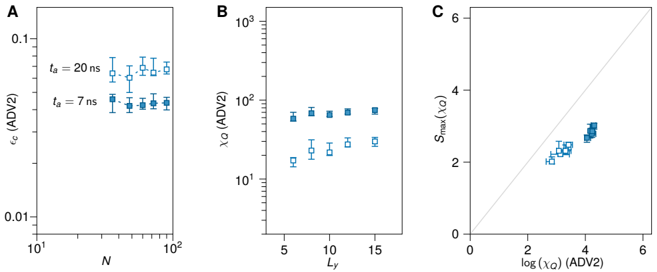
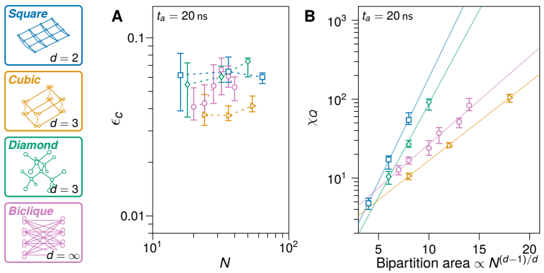
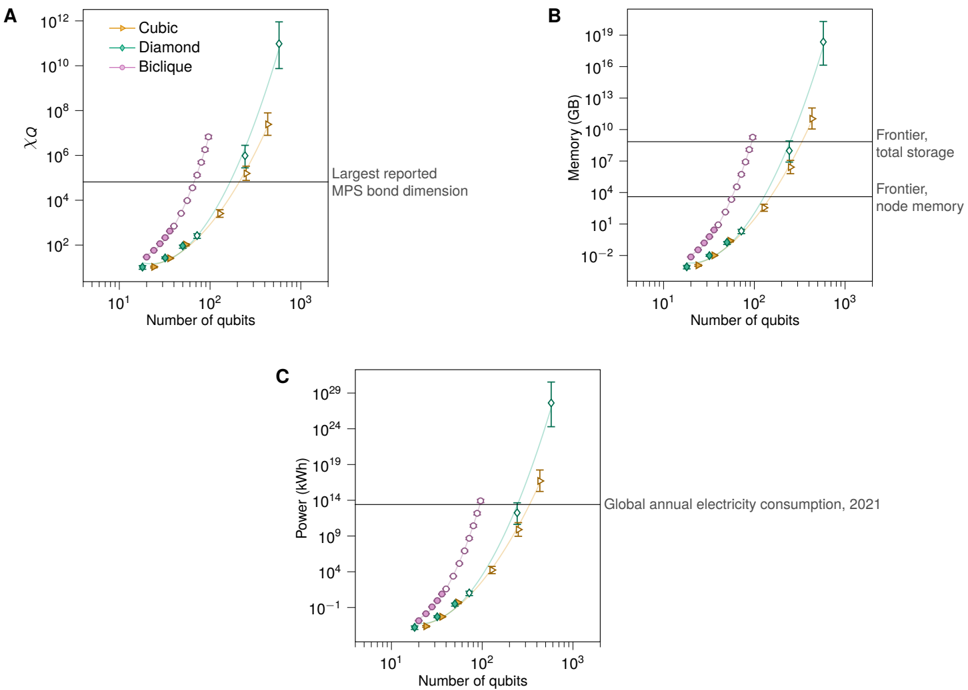
- MPS required a QPU-equivalent bond dimension χ_Q that grew exponentially with bipartition area, consistent with area-law entanglement scaling; for 3D or biclique lattices the estimated requirement was χ_Q ≃ 10⁷, and for diamond lattices χ_Q ≃ 10¹¹.
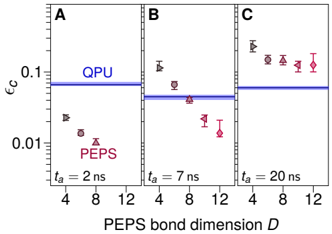
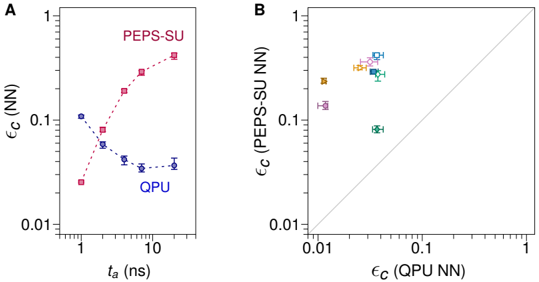
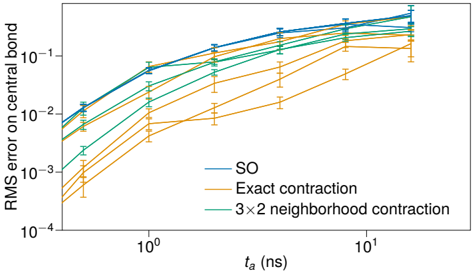
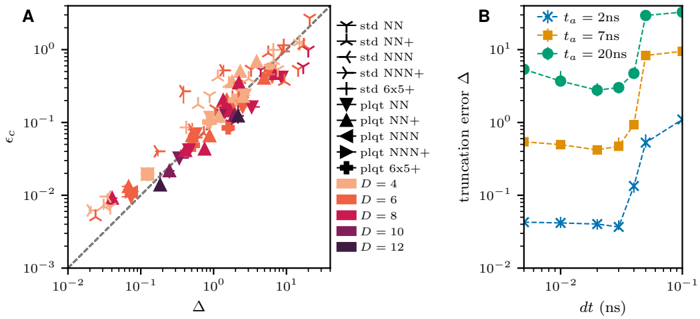
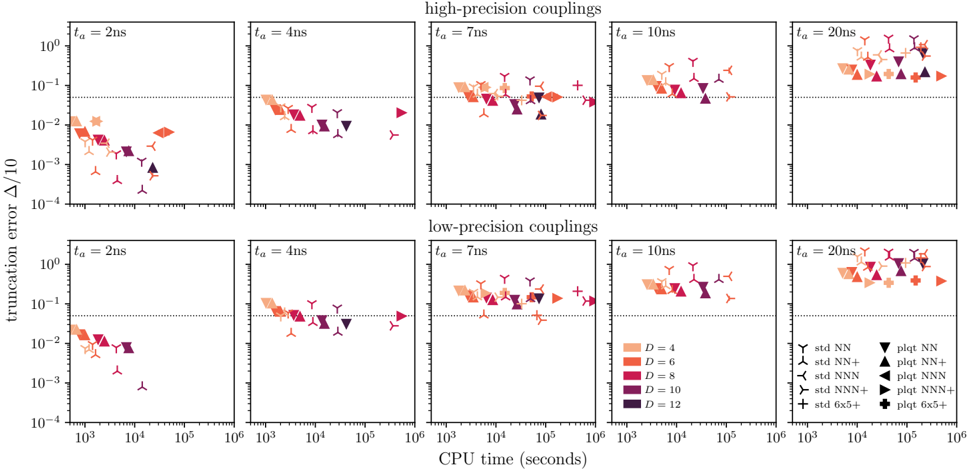
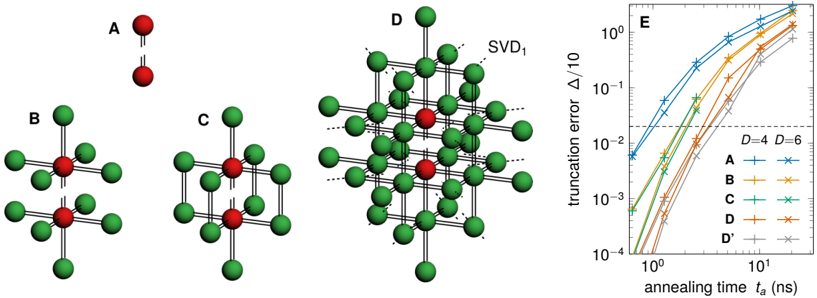
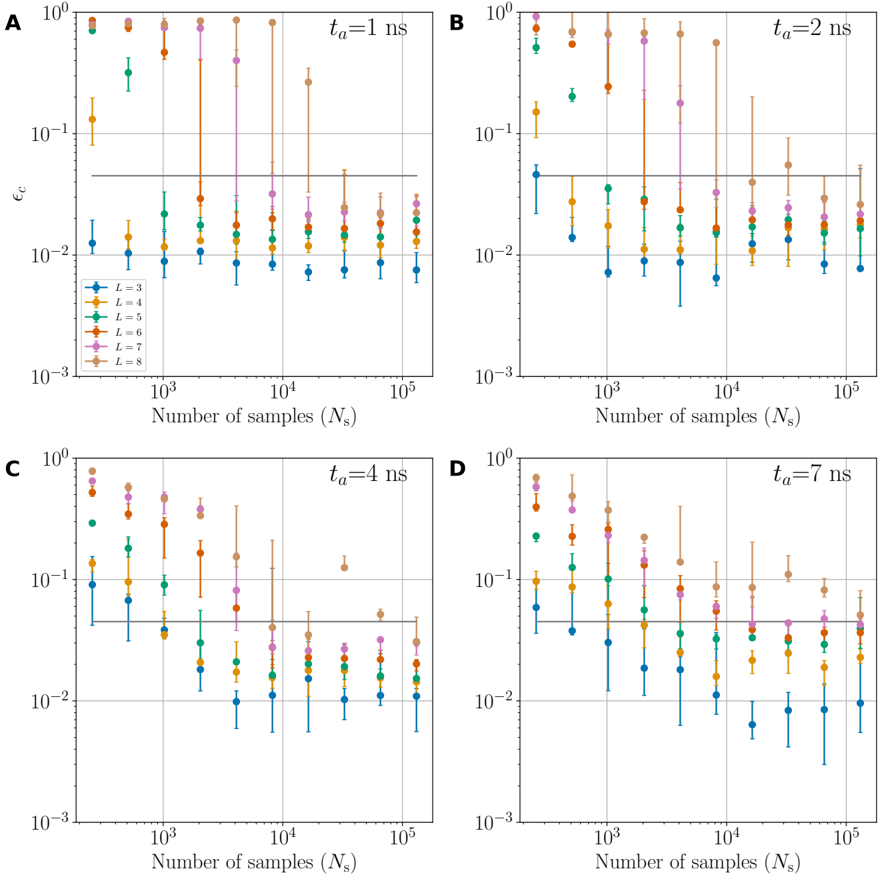
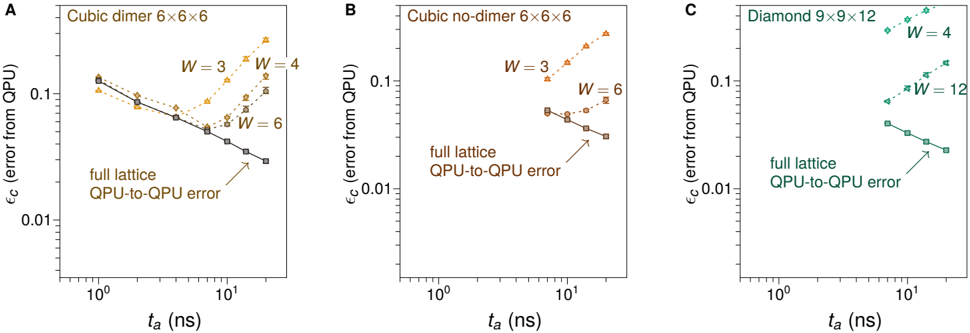
- PEPS and NQS methods failed to match QPU accuracy even on modest 2D problems at slower quenches: PEPS easily beat QPU error at t_a = 2 ns but at 20 ns all PEPS experiments had higher error than QPU, and NQS could not produce acceptable accuracy beyond the shortest time scales and smallest models.
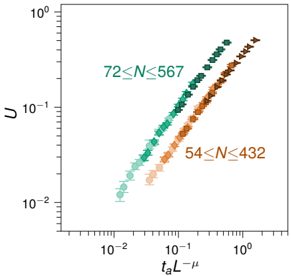
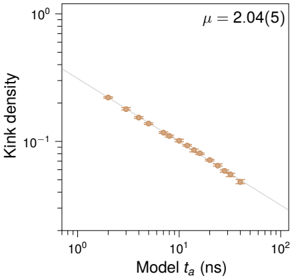
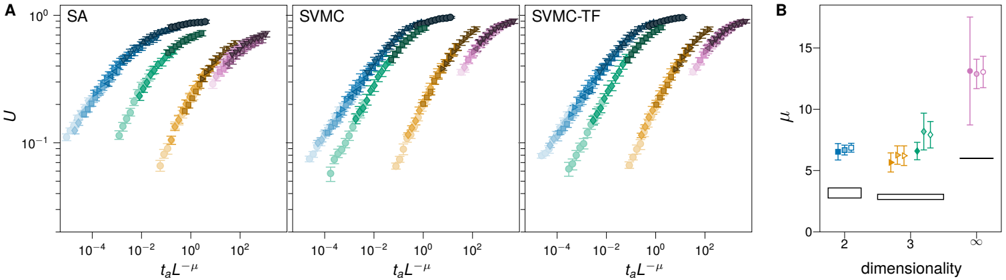
- Extrapolated MPS resource estimates indicated that matching QPU quality on the largest problems would take millions of years on the Frontier supercomputer per input, exceed its 700 PB storage, and exceed annual global electricity consumption; extracted KZ exponents, e.g. square 2.83(24), cubic 2.72(16), and biclique 6.3(9), agreed with previous estimates and theory.
Methods
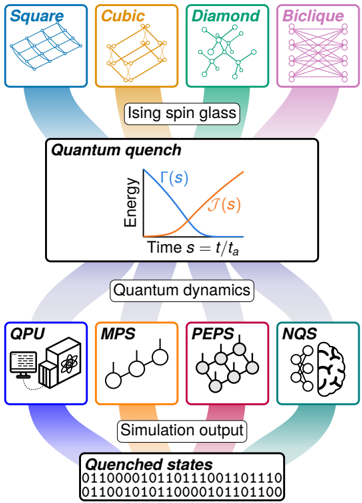
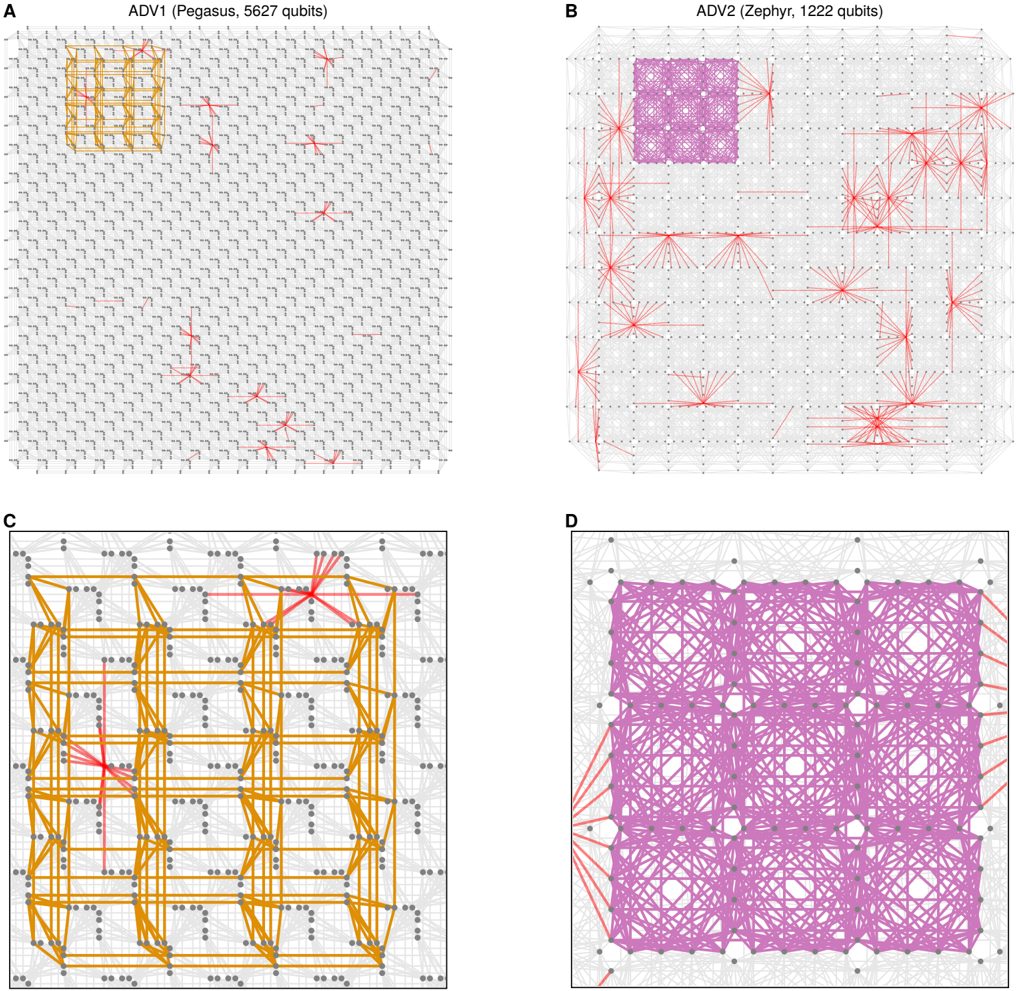
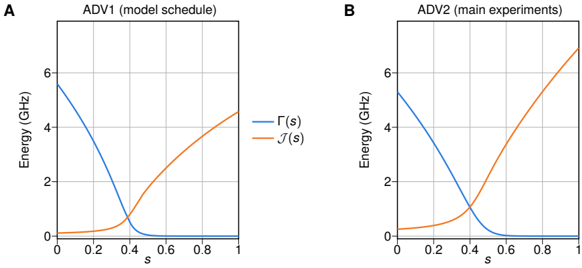
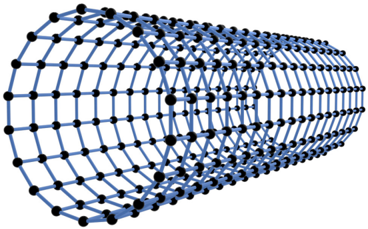
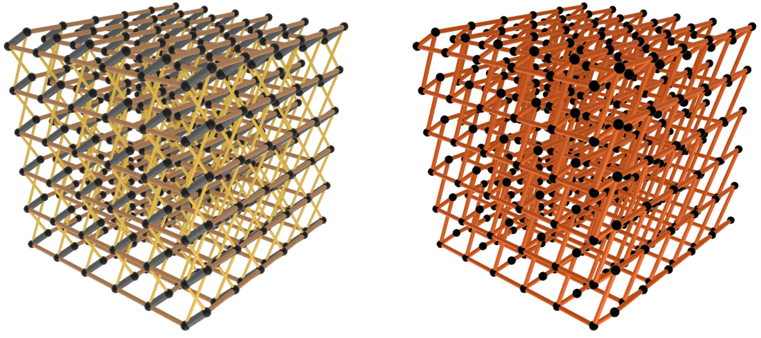
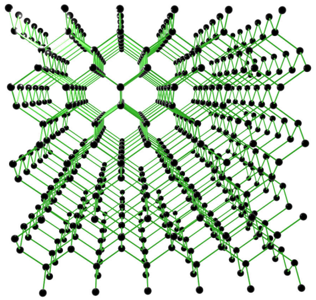
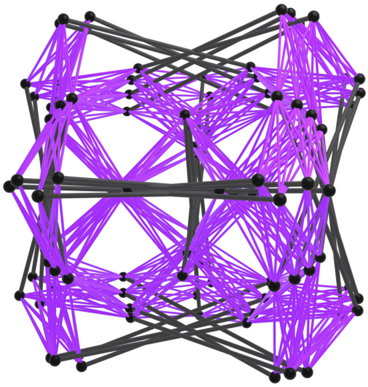
- The task was to sample from the post-quench state of a time-dependent transverse-field Ising model, H(t) = Γ(t/t_a)H_D + J(t/t_a)H_P, on square, cubic dimer, diamond, and biclique topologies, using two D-Wave processors: ADV1 (5627 qubits) and ADV2 (1222 qubits), both at 12 mK, with each QPU generating at least 1000 samples per second.
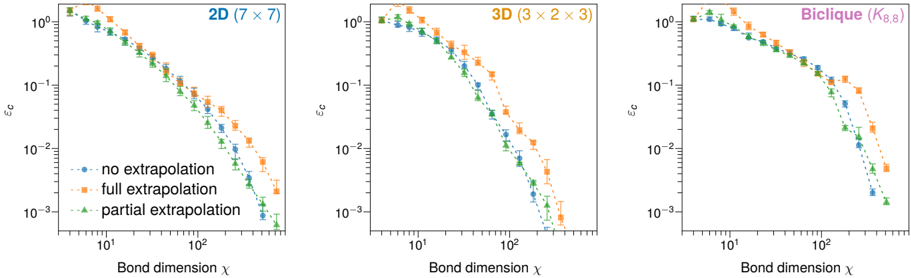
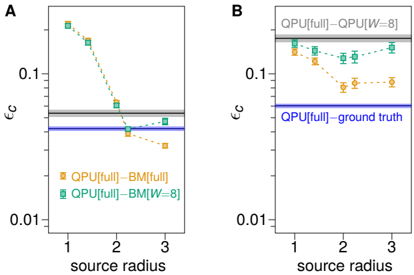
- QPU results were compared with classical approximations to the time-dependent Schrödinger equation: MPS and PEPS tensor networks and NQS simulations; ground truths for small systems came from well-converged MPS simulations on Summit and Frontier, using metrics including correlation error ε_c, classical fidelity F, and QPU-equivalent bond dimension χ_Q.
- Calibration refinements included flux offsets, anneal offsets, embedding and automorphism averaging, with up to 200 parallel embeddings; the largest diamond input was (12,12,16) with 567 of 576 qubits operable.
Limitations
- The paper states that direct, nonuniversal verification against ground truth is only possible at small scales; beyond the classically simulable regime, validation relies on universal quantum critical scaling and dynamic finite-size scaling collapse.
- The paper notes that its resource extrapolation applies to MPS, the only method that matched QPU quality for all considered quench times, and is not an intrinsic lower bound for all classical methods; PEPS and NQS failed at smaller sizes.
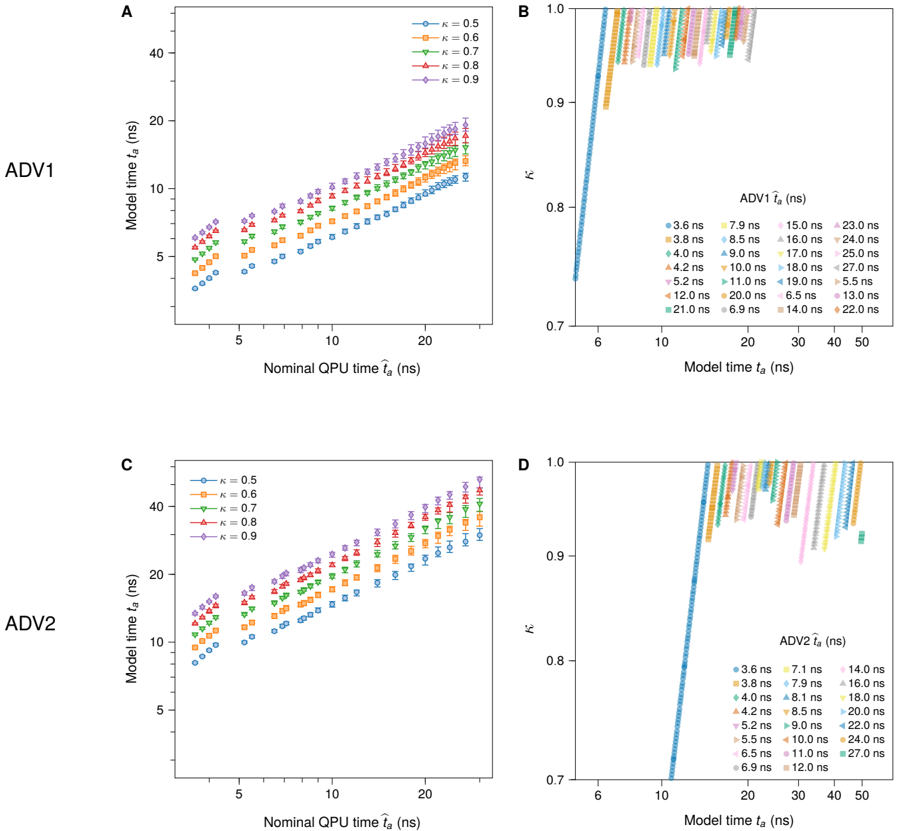
- The paper states that the QPUs were calibrated for the operational regime t_a > 500 ns, while the model quench times studied here required refined time mapping and synchronization corrections; future availability of t_a < 500 ns would make that calibration section unnecessary. The largest diamond lattice permitted 9 defects out of 576 qubits, expected to have no significant impact on algorithmic complexity.
Model-written summary. Check it against the paper before relying on it.
Integrity signals
Registry
Cites
Statistics
Figures

Verification
Claims the paper makes
53 Valid · 24 Not valid · 17 Not checked · 357 Own results and interpretations
The cited sources support only part of this claim — read each source’s verdict below.
In the paper
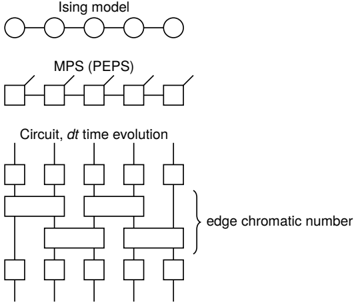
“Time-evolving an MPS with χ = 1 with the time-dependent variational principle (TDVP, see next subsection for more details) is ill-defined, as many of the long-range interactions are lost during the projection step and the resulting time evolution would be wrong 51,76,77 .”
§ Beyond-classical computation in quantum simulation > 1. Initial state preparation
What the sources say
- Could not verifycites [51] 51. J. Haegeman, C. Lubich, I. Oseledets, B. Vandereycken, and F. Verstraete, Unifying time evolution and opti- mization with matrix product states, Phys. Rev. B 94, 165116 (2016). sourceExperimental — accuracy not yet measured
Section III discusses approximate bond truncation and reports that MPS can give wrong results at Clifford points, but it does not address TDVP evolution of an MPS with χ = 1 or interactions lost during a projection step. Searches for TDVP and the claimed projection mechanism found no passage addressing that point. (LLM, conf=0.72)
- Partly supportedcites [76] 76. J. Haegeman, J. I. Cirac, T. J. Osborne, I. Pižorn, H. Verschelde, and F. Verstraete, Time-dependent vari- ational principle for quantum lattices, Physical Review Letters 107, 1 (2011). sourceExperimental — accuracy not yet measured
The discussion accompanying Fig. 1 describes TDVP as projecting the time-evolution direction onto the MPS tangent plane, supporting the reference to a projection step. Our copy does not say that bond dimension χ = 1 makes TDVP ill-defined, that long-range interactions are lost in that case, or that the resulting evolution is wrong; it instead describes the projection as the best approximation within the chosen manifold. (LLM, conf=0.82)
- Partly supportedcites [77] 77. S. Paeckel, T. Köhler, A. Swoboda, S. R. Manmana, U. Schollwöck, and C. Hubig, Time-evolution meth- ods for matrix-product states, Annals of Physics 411, 167998 (2019). sourceExperimental — accuracy not yet measured
Section 6.2.2 (p. 49) says TDVP projection error can be particularly severe at small bond dimension, and §8.3.3 (p. 72) reports projection problems for product initial states. But the paper does not say that evolving every χ = 1 MPS with TDVP is ill-defined or that long-range interactions are necessarily lost: it says two-site TDVP has no projection error for nearest-neighbor Hamiltonians. The claim overgeneralizes a problem that depends on the interaction and TDVP variant. (LLM, conf=0.88)
plainstates a cause- Asserted: passes — The authors put it forward as true.
- Checkable: passes — It can be checked against evidence.
- Load-bearing: passes — The paper’s conclusions depend on it.
- Based: passes — The paper gives a reason why it holds.
- Could not verify
The cited sources support only part of this claim — read each source’s verdict below.
In the paper
“Such MPS states naturally encode the area law of entanglement 75 : ground states of gapped Hamiltonians of N qubits can be approximated to arbitrarily high precision with an MPS of bond dimension χ, which does not grow with the size of the system.”
§ Beyond-classical computation in quantum simulation > A. Matrix Product States (MPS)
What the sources say
- Partly supportedcites [75] 75. M. B. Hastings, An area law for one-dimensional quan- tum systems, Journal of statistical mechanics: theory and experiment 2007, P08024 (2007). sourceExperimental — accuracy not yet measured
The Matrix Product States section (p. 5) constructs an MPS approximation for a gapped ground state under finite-range and finite-strength assumptions. But the approximation estimate on p. 4 scales with chain length N at a given bond dimension, so the paper does not establish arbitrarily high precision at a bond dimension independent of N. Its theorem also assumes a unique ground state (p. 1). (LLM, conf=0.88)
plain- Asserted: passes — The authors put it forward as true.
- Checkable: passes — It can be checked against evidence.
- Load-bearing: unclear — It is unclear whether the paper’s conclusions depend on it.
- Based: passes — The paper gives a reason why it holds.
- Partly supported
Every source the paper cites for this claim was checked and supports it.
In the paper
“The nonequilibrium quantum dynamics studied here are responsible for a scaling advantage over classical dynamics in optimization 25 .”
§ Beyond-classical computation in quantum simulation > SUMMARY AND CONCLUSIONS
What the sources say
- Supportedcites [25] 25. A. D. King, J. Raymond, T. Lanting, R. Harris, A. Zucca, et al., Quantum critical dynamics in a 5,000- qubit programmable spin glass, Nature 617, 61 (2023). source
The Outlook (p. 5) says the measured quantum-critical dynamics give quantum annealing a dynamical advantage over simulated annealing and simulated quantum annealing in the spin-glass setting. It also reports an experimentally demonstrated scaling advantage in approaching the ground-state energy. (LLM, conf=0.91)
plainstates a cause- Asserted: passes — The authors put it forward as true.
- Checkable: passes — It can be checked against evidence.
- Load-bearing: passes — The paper’s conclusions depend on it.
- Based: passes — The paper gives a reason why it holds.
- Supported
The cited sources support only part of this claim — read each source’s verdict below.
In the paper
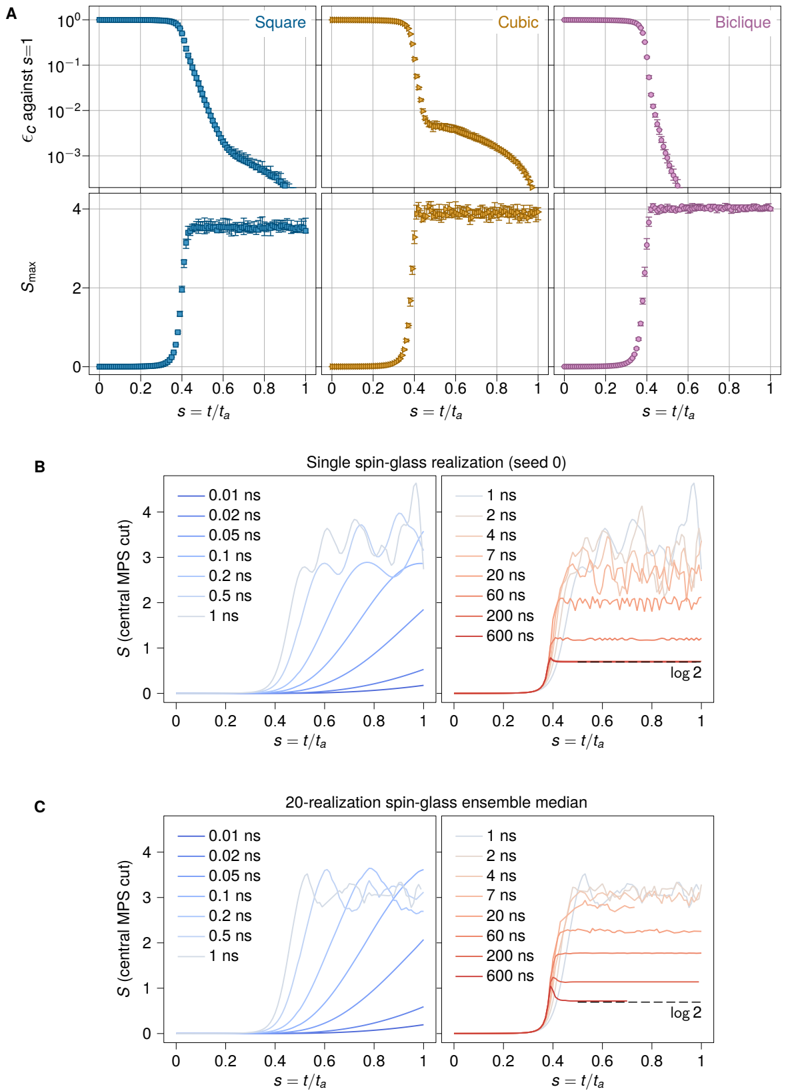
“As discussed in Section V, and in agreement with previous observations 31 , we show that quenched quantum dynamics deviating from the ground state also show area-law scaling.”
§ Beyond-classical computation in quantum simulation > A. Matrix Product States (MPS)
What the sources say
- Partly supportedcites [31] 31. E. Canovi, E. Ercolessi, P. Naldesi, L. Taddia, and D. Vodola, Dynamics of entanglement entropy and en- tanglement spectrum crossing a quantum phase transi- tion, Physical Review B 89, 104303 (2014). sourceExperimental — accuracy not yet measured
In §F.1 (Entanglement entropy; page unavailable), the paper reports that entropy curves for different system sizes are practically coincident at small quench times, consistent with size-independent scaling in that regime. Its discussion of fast sweeps (§D; page unavailable) describes dynamics that depart from the instantaneous ground state. It does not establish area-law scaling for quenched dynamics generally, as the claim implies. (LLM, conf=0.78)
plainstates an association- Asserted: passes — The authors put it forward as true.
- Checkable: passes — It can be checked against evidence.
- Load-bearing: unclear — It is unclear whether the paper’s conclusions depend on it.
- Based: passes — The paper gives a reason why it holds.
- Partly supported
The cited sources support only part of this claim — read each source’s verdict below.
In the paper
“Moreover, as the size of the tensors is exponential in d, this methodology quickly becomes impractical, with extreme restrictions on feasible simulations even in three dimensions 54 .”
§ Beyond-classical computation in quantum simulation > CLASSICAL SIMULATION TECHNIQUES
What the sources say
- Partly supportedcites [54] 54. P. C. G. Vlaar and P. Corboz, Simulation of three-dimensional quantum systems with projected entangled-pair states, Phys. Rev. B 103, 205137 (2021). sourceExperimental — accuracy not yet measured
The iPEPS ansatz section describes six D-dimensional auxiliary indices for a 3D tensor, and the Introduction says the additional legs increase computational cost. Section III reports that a large-cluster contraction typically is feasible only at D = 2. But the paper does not characterize 3D iPEPS as generally impractical: its Summary presents a practical method at reasonable cost. It also uses d for the local physical-index dimension, not spatial dimension. (LLM, conf=0.87)
plainstates a cause- Asserted: passes — The authors put it forward as true.
- Checkable: passes — It can be checked against evidence.
- Load-bearing: passes — The paper’s conclusions depend on it.
- Based: passes — The paper gives a reason why it holds.
- Partly supported
243 more claims · 20 with their cited sources checked
Create a free account to see all 451 claims and every source verdict.
- Probably not a substantial claim. 96
- It may state two separate claims as one. 125
- Borderline: one of the tests for a substantial claim is unclear. 2
- The quote only partly states this claim. 2
Self-check
Percentages, sums and reported differences re-computed from the paper’s own numbers.
Rated minor: it would not touch a result — a value no result rests on, a p-value that stays on the same side of the significance level, or a conflict that is clerical, resolved elsewhere in the paper, or outside its own findings.
In the paper
“µ = z + 1/ν = 2.46(17) + 0.71(24) = 3.27( 41)”
§ Beyond-classical computation in quantum simulation > Additional information
Reported 3.27 · recomputed 3.17
Citations
Cites
Optimization by Simulated Annealing
Kirkpatrick, S., Gelatt, C. D., & Vecchi, M. P. (1983) · Science · doi:10.1126/science.220.4598.671 · Cited by 45,134
Gelman, A., Carlin, J. B., Stern, H. S., & Rubin, D. B. (2003) · doi:10.1201/9780429258480 · Cited by 27,276
Inference from iterative simulation using multiple sequences
Gelman, A., & Rubin, D. B. (1992) · Statistical Science · doi:10.1214/ss/1177011136 · Cited by 16,627
Quantum supremacy using a programmable superconducting processor
Arute, F., Arya, K., Babbush, R., Bacon, D., Bardin, J. C., Barends, R., Biswas, R., Boixo, S., Brandao, F. G. S. L., Buell, D. A., et al. (2019) · Nature · doi:10.1038/s41586-019-1666-5 · Cited by 7,720
Density matrix formulation for quantum renormalization groups
White, S. R. (1992) · Physical Review Letters · doi:10.1103/physrevlett.69.2863 · Cited by 7,702
The density-matrix renormalization group in the age of matrix product states
Schollwöck, U. (2011) · Annals of Physics · doi:10.1016/j.aop.2010.09.012 · Cited by 4,818
Biamonte, J., Wittek, P., Pancotti, N., Rebentrost, P., Wiebe, N., & Lloyd, S. (2017) · Nature · doi:10.1038/nature23474 · Cited by 4,779
Topology of cosmic domains and strings
Kibble, T. W. B. (1976) · Journal of Physics A: Mathematical and General · doi:10.1088/0305-4470/9/8/029 · Cited by 4,545
Entanglement in many-body systems
Amico, L., Fazio, R., Osterloh, A., & Vedral, V. (2008) · Reviews of Modern Physics · doi:10.1103/revmodphys.80.517 · Cited by 3,745
Sachdev, S. (2000) · Cambridge University Press eBooks · doi:10.1017/cbo9780511622540 · Cited by 3,408
Research works printed but not linked: 1
- W. H. Press S. A. Teukolsky W. T. Vetterling B. P. Flannery Numerical Recipes in C: The Art of Scientific Computing (Cambridge Univ. Press ed. 2 1992).
Cited by
Quantum dynamics in Krylov space: Methods and applications
Nandy, P., Matsoukas-Roubeas, A. S., Martínez-Azcona, P., Dymarsky, A. Y., & del Campo, A. (2025) · Physics Reports · doi:10.1016/j.physrep.2025.05.001 · Cited by 340
Observation of constructive interference at the edge of quantum ergodicity
Collaborators, G. Q. A. A., Abanin, D. A., Acharya, R., Beni, L. A., Aigeldinger, G., Ajoy, A., Alcaraz, R., Aleǐner, I. L., Andersen, T. I., Ansmann, M., et al. (2025) · Nature · doi:10.1038/s41586-025-09526-6 · Cited by 195
Scaling Advantage in Approximate Optimization with Quantum Annealing
Munoz-Bauza, H., & Lidar, D. A. (2025) · Physical Review Letters · doi:10.1103/physrevlett.134.160601 · Cited by 97
Rams, M., Wojtowicz, G., Sinha, A., & Hasik, J. (2025) · SciPost Physics Codebases · doi:10.21468/scipostphyscodeb.52 · Cited by 16
Self-citationBias-field digitized counterdiabatic quantum algorithm for higher-order binary optimization
Romero, S. V., Visuri, A.-M., Cadavid, A. G., Simen, A., Solano, E., & Hegade, N. N. (2025) · Communications Physics · doi:10.1038/s42005-025-02270-3 · Cited by 18
“Nonequilibrium states resulting from global parameter quenches are expected to follow a volume law, though recent quantum simulationsofparamagnetic-to-spin-glassquenchdynamicsexhibitedarea-lawscaling 34 .”
Programmable optoelectronic Ising machine for optimization of real-world problems
Hu, Z., Ren, Y., Meng, Y., Wang, T. J., JIANG, Y., Wei, M., Xiao, Y., Li, Z., & Li, M. (2026) · Light Science & Applications · doi:10.1038/s41377-025-02100-9 · Cited by 24
Quantum quench dynamics of geometrically frustrated Ising models
Ali, A., Xu, H., Bernoudy, W., Nocera, A., King, A. D., & Banerjee, A. (2024) · Nature Communications · doi:10.1038/s41467-024-54701-4 · Cited by 20
Self-citationSpin-glass dynamics: Experiment, theory, and simulation
Dahlberg, E. D., Pemartín, I. G.-A., Marinari, E., Parisi, G., Ricci‐Tersenghi, F., Martin-Mayor, V., Moreno-Gordo, J., Orbach, R., Paga, I., Ruiz-Lorenzo, J. J., et al. (2025) · Reviews of Modern Physics · doi:10.1103/ctp2-zwyr · Cited by 33
Grand Challenge of Quantum Applications
Babbush, R., King, R., Boixo, S., Huggins, W. J., Khattar, T., Low, G. H., McClean, J. R., O’Brien, T. E., & Rubin, N. C. (2026) · PRX Quantum · doi:10.1103/6r9l-lynr · Cited by 70
Park, G., Gray, J., & Chan, G. K. (2025) · Physical review. B./Physical review. B · doi:10.1103/7jzt-xhn6 · Cited by 36
Variational Quantum Computing for Quantum Simulation: Principles, Implementations, and Challenges
Galvão, L. Q., de Souza, A. B. M., Moret, M. A., & Cruz, C. (2025) · Brazilian Journal of Physics · doi:10.1007/s13538-025-01946-z · Cited by 11
Dynamics of disordered quantum systems with two- and three-dimensional tensor networks
Tindall, J., Mello, A. F., Fishman, M., Stoudenmire, E. M., & Sels, D. (2026) · Science · doi:10.1126/science.adx2728 · Cited by 100
Nonequilibrium critical dynamics with emergent supersymmetry
Zeng, Z., Yu, Y.-K., Li, Z., & Yin, S. (2025) · Physical review. B./Physical review. B · doi:10.1103/qtwr-8kth · Cited by 10
Quantifying Quantum Computational Advantage on a Processor of Ultracold Atoms
Zheng, Y.-G., Shen, Y.-C., Zhang, W.-Y., Luo, A., Liu, Y., He, M.-G., Zhang, H., Wan, L., Wang, H.-Y., Zhu, Z., et al. (2026) · Physical Review X · doi:10.1103/5mqb-3by1 · Cited by 10
Grabarits, A., Balducci, F., & del Campo, A. (2025) · Physical Review A · doi:10.1103/physreva.111.042207 · Cited by 8
Quantum computing for faster enzyme discovery and engineering
Damborský, J., Kouba, P., Šivic, J., Vasina, M., Bednář, D., & Mazurenko, S. (2025) · Nature Catalysis · doi:10.1038/s41929-025-01410-w · Cited by 11
Quantum Computing for Genomics: Conceptual Challenges and Practical Perspectives
Maurizio, A., & Mazzola, G. (2025) · PRX Life · doi:10.1103/h49j-bsc6 · Cited by 23
Prethermalization by random multipolar driving on a 78-qubit processor
Liu, Z.-H., Liu, Y., Liang, G.-H., Deng, C.-L., Chen, K., Shi, Y., Li, T.-M., Zhang, L. M., Chen, B., Fang, C.-P., et al. (2026) · Nature · doi:10.1038/s41586-025-09977-x · Cited by 45
Unraveling reverse annealing: A study of D-Wave quantum annealers
Mehta, V., Raedt, H. A. D., Michielsen, K. F. L., & Jin, F. (2025) · Physical Review A · doi:10.1103/vfxh-gjgy · Cited by 12
Dziubyna, A. M., Śmierzchalski, T., Gardas, B., Rams, M. M., & Mohseni, M. (2025) · Physical Review Applied · doi:10.1103/physrevapplied.23.054049 · Cited by 11
Self-citationComputing n -Time Correlation Functions without Ancilla Qubits
Wang, X., Xiong, L., Cai, X., & Yuan, X. (2025) · Physical Review Letters · doi:10.1103/z126-zdqj · Cited by 15
Quantum Computing for Transport Network Optimization
Ju, J., Liu, Z., Bai, Y., Wang, Y., Gao, Q., Ma, Y., Zheng, C., & Wen, K. (2025) · Entropy · doi:10.3390/e27090953 · Cited by 8
Synchrotron Radiation for Quantum Technology
Rader, O., Pascarelli, S., Attenkofer, K., Makarova, A. A., Holldack, K., Roßnagel, K., Temst, K., Kourousias, G., Carretta, S., Biscari, C., et al. (2025) · Advanced Functional Materials · doi:10.1002/adfm.202501043 · Cited by 6
Exploring the thermodynamics of disordered materials with quantum computing
Camino, B., Buckeridge, J., Chancellor, N., Catlow, C. R. A., Ferrari, A. M., Warburton, P. A., Sokol, A. A., & Woodley, S. M. (2025) · Science Advances · doi:10.1126/sciadv.adt7156 · Cited by 8
Uotila, V. (2025) · Frontiers in Computer Science · doi:10.3389/fcomp.2025.1649354 · Cited by 13
Understanding the physics of D-Wave annealers: From Schrödinger to Lindblad to Markovian dynamics
Mehta, V., Raedt, H. A. D., Michielsen, K. F. L., & Jin, F. (2025) · Physical Review A · doi:10.1103/3yk8-qn64 · Cited by 8
Harnessing Quantum Computing for Energy Materials: Opportunities and Challenges
Kim, S., Suh, I., Humble, T. S., Beck, T. L., lee, E., & Luo, T. (2026) · ACS Energy Letters · doi:10.1021/acsenergylett.5c04009 · Cited by 10
A GHZ-Based Protocol for the Dining Information Brokers Problem
Andronikos, T., Bitsakos, C., Nikas, K., Goumas, G., & Koziris, N. (2025) · Future Internet · doi:10.3390/fi17090408 · Cited by 4
Josephson “flying qubit” revival: Flux-based control optimization
Bastrakova, M. V., Pashin, D. S., Pikunov, P. V., Soloviev, I. I., Schegolev, A. E., & Klenov, N. V. (2025) · Chaos Solitons & Fractals · doi:10.1016/j.chaos.2025.116353 · Cited by 4
Benchmarking Quantum Annealers with Near-Optimal Minor-Embedded Instances
Gilbert, V., Rodriguez, J., & Louise, S. (2024) · IEEE International Conference on Quantum Computing and Engineering (QCE) · doi:10.1109/qce60285.2024.00068 · Cited by 8
Hardware-Efficient Quantum Phase Estimation via Local Control
Schiffer, B. F., Wild, D. S., Maskara, N., Lukin, M. D., & Cirac, J. I. (2025) · PRX Quantum · doi:10.1103/zlp8-rz9n · Cited by 15
Distributed-HISQ: A Distributed Quantum Control Architecture
Zhao, Y., Zhao, K., Zhou, P., Liu, D., Luo, T., Zheng, Y., Luo, P., Hu, S., Lin, J., Guo, C., et al. (2025) · IEEE/ACM International Symposium on Microarchitecture (MICRO) · doi:10.1145/3725843.3756048 · Cited by 9
Statistical physics for artificial neural networks
Pei, Z. (2026) · Applied Physics Reviews · doi:10.1063/5.0302112 · Cited by 7
Report on reproducibility in condensed matter physics
Akrap, A., Bordelon, D., Chatterjee, S., Dahlberg, E. D., Devaty, R. P., Frolov, S., Gould, C., Greene, L. H., Guchhait, S., Hamlin, J. J., et al. (2026) · Physical review. B./Physical review. B · doi:10.1103/27h6-yghn · Cited by 8
Digitized counterdiabatic quantum critical dynamics
Visuri, A.-M., Cadavid, A. G., Bhargava, B. A., Romero, S. V., Grabarits, A., Chandarana, P., Solano, E., del Campo, A., & Hegade, N. N. (2026) · npj Quantum Information · doi:10.1038/s41534-026-01208-z · Cited by 28
Quantum annealing for CAD-based disassembly sequence optimization
Azucena, J., & Prioli, J. P. J. (2025) · The International Journal of Advanced Manufacturing Technology · doi:10.1007/s00170-025-17182-3 · Cited by 3
Fighting Exponentially Small Gaps by Counterdiabatic Driving
Grabarits, A., Balducci, F., & del Campo, A. (2026) · PRX Quantum · doi:10.1103/tgzt-dy3h · Cited by 17
Deleplanque, S., Armas, L. F. P., & Creemers, S. (2025) · Journal of Heuristics · doi:10.1007/s10732-025-09564-3 · Cited by 3
Quantum-inspired dynamical models on quantum and classical annealers
Hanussek, P., Pawłowski, J., Mzaouali, Z., & Gardas, B. (2026) · Physical Review Applied · doi:10.1103/rrf3-jm5m · Cited by 6
Schulz, S., Willsch, D., & Michielsen, K. F. L. (2025) · Quantum · doi:10.22331/q-2025-10-29-1898 · Cited by 9
Blockchain with proof of quantum work
Amin, M. H. S., Raymond, J., Kinn, D., Miller, G., Hamze, F., Hamer, K., Pasvolsky, J., Bernoudy, W., King, A. D., & Kortas, S. (2026) · Physical Review A · doi:10.1103/m9jd-z9my · Cited by 9
Self-citationMultipartite entanglement measures based on the thermodynamic framework
Bai, C., & Luo, Y. (2025) · Physical Review A · doi:10.1103/rg65-sh1f · Cited by 2
Sokolov, I., & Dziarmaga, J. (2025) · Physical review. B./Physical review. B · doi:10.1103/wkys-cd39 · Cited by 5
Self-citationConditioned quantum-assisted deep generative surrogate for particle-calorimeter interactions
Toledo-Marín, J. Q., Gonzalez, S., Jia, H., Lu, I., Sogutlu, D., Singh, A., Gay, C., Paquet, E., Melko, R. G., Fox, G., et al. (2025) · npj Quantum Information · doi:10.1038/s41534-025-01040-x · Cited by 13
Self-citationZhang, Y., Sinha, A., Rams, M. M., & Dziarmaga, J. (2026) · Physical review. B./Physical review. B · doi:10.1103/6pcg-qq4p · Cited by 7
Self-citationMatsuta, T., & Furue, R. (2025) · PLoS ONE · doi:10.1371/journal.pone.0326303 · Cited by 6
Quasi-Combinatorial Microgrid Energy Optimization Using Secure Affine-Based Blind Quantum Computing
Han, X., Li, Z., Xu, Y., Fang, X., Wang, C., & Shahidehpour, M. (2026) · IEEE Transactions on Smart Grid · doi:10.1109/tsg.2026.3651247 · Cited by 1
Quantum sequel of neural network training
Zhang, H., & Kamenev, A. (2025) · Communications Physics · doi:10.1038/s42005-025-02384-8 · Cited by 7
Quantum computing for radiation therapy optimization
Rahimi, R., Saitoh, A., Modiri, A., Nakano, Y., Okada, K. N., Tsukano, S., Zhang, B., Fujii, K., Kitagawa, M., & Sawant, A. R. (2026) · Medical Physics · doi:10.1002/mp.70269 · Cited by 4
Benchmarking a heuristic Floquet adiabatic algorithm for the Max-Cut problem
Granet, E., & Dreyer, H. (2025) · Scientific Reports · doi:10.1038/s41598-025-13923-2 · Cited by 6
Yang, S., Bao, Y., Humianto, E., Prabhakar, A. K., & Yang, H. (2026) · Nature Communications · doi:10.1038/s41467-026-71128-1 · Cited by 4
Quantum computing for astrophysics and cosmology: Results from the INAF activities
Bulgarelli, A. A., Burigana, C., Cappelli, L., Cardone, V. F., Cavuoti, S., Farsian, F., Graziotti, I., Macaluso, A., Meneghetti, M., Murante, G., et al. (2026) · Astronomy and Computing · doi:10.1016/j.ascom.2026.101108 · Cited by 4
Lee, H., Kim, J. P., & Kim, S. (2026) · Advanced Electronic Materials · doi:10.1002/aelm.202500682 · Cited by 3
Seismic Wave Propagation Simulation With Quantum Computing
Wen, X., & Wang, Y. (2025) · Journal of Geophysical Research Machine Learning and Computation · doi:10.1029/2024jh000473 · Cited by 4
Quantum Emulator Benchmarking Made Easy
Leonteva, A. O., Outteryck, M., & Masella, G. (2026) · Communications in computer and information science · doi:10.1007/978-3-032-13852-1_28 · Cited by 2
Artificial intelligence for representing and characterizing quantum systems
Du, Y., Zhu, Y., Zhang, Y., Hsieh, M.-H., Rebentrost, P., Gao, W., You, Y., Eisert, J., Chiribella, G., Tao, D., et al. (2026) · Nature Reviews Physics · doi:10.1038/s42254-026-00962-5 · Cited by 21
Nonperturbative decay of bipartite discrete time crystals
Fernandes, L., Tindall, J., & Sels, D. (2025) · Physical review. B./Physical review. B · doi:10.1103/physrevb.111.l100304 · Cited by 3
Exploring the Boundaries of Modern Quantum Annealers with RNA Structure Prediction
Andrews, B., Abraham, J., Fox, D. M., & Radja, A. (2026) · The Journal of Physical Chemistry B · doi:10.1021/acs.jpcb.5c07902 · Cited by 1
Variational determination of penalty parameters in quantum annealing
Qin, J.-Q., Yunlong, Y., & Wang, X. (2025) · Quantum Science and Technology · doi:10.1088/2058-9565/ae30a2 · Cited by 1
Toward quantum scaling advantage in approximate optimization
Pawłowski, J., Tarasiuk, P., Tuziemski, J., Pawela, Ł., & Gardas, B. (2026) · Physical Review Applied · doi:10.1103/qcws-8kgm · Cited by 12
Symmetry-enhanced counterdiabatic quantum algorithm for qudits
Bottarelli, A., de Andoin, M. G., Chandarana, P., Paul, K., Chen, X., Sanz, M., & Hauke, P. (2025) · Physical Review Research · doi:10.1103/6ldg-3w1f · Cited by 7
Li, S., Zhang, Y., Lee, A., Zhu, Z. Q., Zeng, L., Wang, P., Gao, L., Wu, D., & Zhao, W. S. (2026) · Nature Electronics · doi:10.1038/s41928-026-01700-6 · Cited by 3
Vovrosh, J., Julià-Farré, S., Krinitsin, W., Kaicher, M., Hayes, F. J., Gottlob, E., Kshetrimayum, A., Bidzhiev, K., Jäger, S. B., Schmitt, M., et al. (2026) · Physical Review Research · doi:10.1103/x4gs-g63p · Cited by 20
Family of two-parameter multipartite entanglement measures
Luo, Y., Guo, Z., Meng, F., & Bai, C. (2025) · Physical Review A · doi:10.1103/7gg9-klc4 · Cited by 1
Fukushima, K., Ohno, H., & Fukushima, Y. (2026) · Process Safety and Environmental Protection · doi:10.1016/j.cherd.2026.06.032 · Cited by 1
Bayocboc, F. A., Dziarmaga, J., Rams, M. M., & Zurek, W. H. (2025) · Physical review. B./Physical review. B · doi:10.1103/physrevb.111.l100406 · Cited by 5
Self-citationSubsampling factorization machine annealing
Hama, Y., & Kadowaki, T. (2025) · Physical Review Research · doi:10.1103/qgpq-6dmr · Cited by 4
A Toolbox to Understand the Physics of Quantum Data Management
Mauerer, W., & Schönberger, M. (2026) · Workshop on Quantum Computing and Quantum-Inspired Technology for Data-Intensive Systems and Applications (Q-Data) · doi:10.1145/3811628.3811835 · Cited by 2
Lieb-Robinson correlation function for long disordered transverse-field Ising chains
Mahoney, B. J., & Lent, C. S. (2026) · Physical Review Research · doi:10.1103/xd68-dpwm
Spin glass dynamics on complex hardware topologies: A bond-correlated percolation approach
Gómez, V., Téllez, G., & Gómez-Ruiz, F. J. (2026) · Physical Review Research · doi:10.1103/t6rh-7mnl
Practical Scalability of LuGo: Benchmarking the HHL Algorithm Using an Enhanced QPE Algorithm
Lu, C., Meena, M. G., Georgiadou, A., Gottiparthi, K. C., Sandoval, M., Pérez, E. A. C., Lin, P. T., Suh, I., Kim, S., & Baroni, A. (2025) · IEEE International Conference on Quantum Computing and Engineering (QCE) · doi:10.1109/qce65121.2025.00029 · Cited by 1
Purba, G. F. R., Narottama, B., Khosravirad, S. R., Cotton, S. L., & Duong, T. Q. (2025) · Asilomar Conference on Signals, Systems and Computers (ACSSC) · doi:10.1109/ieeeconf67917.2025.11443867
DAG-Aware Gate Fusion for Efficient State-Vector Quantum-Circuit Simulation
Li, S., Wang, Z.-A., & Fan, H. (2026) · IEEE Transactions on Quantum Engineering · doi:10.1109/tqe.2026.3705783
Quantum Markov chain Monte Carlo method with programmable quantum simulators
D'Arcangelo, M., Javanmard, Y., & Pearson, N. (2026) · Physical Review A · doi:10.1103/7y57-1x19
Boltzmann sampling of frustrated J 1 − J 2 Ising models with programmable quantum annealers
Anonymous (2026) · Physical Review Research · doi:10.1103/2xc3-815x · Cited by 1
Quantum annealing–based black-box optimization for aerodynamic shape design
Kuya, Y., & Tanaka, R. (2026) · Aerospace Science and Technology · doi:10.1016/j.ast.2026.112976
Quantitative Analysis of the Effectiveness of Mid-anneal Measurement in Quantum Annealing
Takahashi, K., & Tanaka, S. (2026) · Journal of the Physical Society of Japan · doi:10.7566/jpsj.95.034002 · Cited by 1
Fresh ‘quantum advantage’ claim made by computing firm D-Wave
Castelvecchi, D. (2025) · Nature · doi:10.1038/d41586-025-00765-1 · Cited by 3
Quantum Machine Learning: Where Are We and What Is Next?
Farhani, Y. (2025) · doi:10.1145/3764923.3777403 · Cited by 1
Preparation of the single-spinon wave function on a quantum computer
Faílde, D., Gómez, A., & Fernández-Rossier, J. (2026) · Physical Review Research · doi:10.1103/qlsh-5pdm · Cited by 1
A Heuristic for Graph Coloring Based on the Ising Model
Bihani, O., & Žerovnik, J. (2025) · Mathematics · doi:10.3390/math13182976 · Cited by 2
Quantum coherence and counterdiabatic quantum computing
Huerta-Ruiz, J. R., Araya, M., Tancara, D., Solano, E., Barraza, N., & Albarrán-Arriagada, F. (2025) · New Journal of Physics · doi:10.1088/1367-2630/adf991
Average-computation benchmarking for local expectation values in digital quantum devices
Baccari, F., Kos, P., & Styliaris, G. (2026) · Physical Review Research · doi:10.1103/zn6p-c8w2 · Cited by 3
Fan, T., Liu, F., Zhang, C., Zhu, X., Liu, F., Qi, X., Shu, G., Xu, J., Yao, J., Yuan, B., et al. (2026) · Physical Review Applied · doi:10.1103/rp4w-3n7l
Self-citationData-driven, multi-objective QUBO-based optimization for multi-phase alloy design
Plehn, T., Barragán-Yani, D., Breitbarth, E., Requena, G., & Melching, D. (2026) · Digital Discovery · doi:10.1039/d6dd00126b · Cited by 1
A topical review on time-independent perturbation theory in one-dimensional quantum systems
Lavagna, L., Carillo, S., & Panella, M. (2025) · Physica Scripta · doi:10.1088/1402-4896/ae0a8f
Perspective on measurements and modeling of Earth’s climate
Coppa, G., & Massano, L. T. T. (2026) · Measurement Science and Technology · doi:10.1088/1361-6501/ae5c28
Quantum annealing and condensed matter physics
Kendon, V. M., & Chancellor, N. (2026) · Journal of Physics Condensed Matter · doi:10.1088/1361-648x/ae5906 · Cited by 5
Montes, J., Borondo, F., & Carlo, G. G. (2026) · Physical Review A · doi:10.1103/pwz2-yg3f
Quantum Adiabatic Generation of Human-Like Passwords
Mücke, S., Heese, R., Gerlach, T., Biesner, D., Lee, L. K., & Piatkowski, N. (2025) · IEEE International Conference on Quantum Computing and Engineering (QCE) · doi:10.1109/qce65121.2025.00169
Digital Payments in Firm Networks: Theory of Adoption and Quantum AlgorithmPreprint
Priazhkina, S., Palmer, S. J., Martín-Ramiro, P., Orús, R., Mugel, S., & Skavysh, V. (2025) · SSRN Electronic Journal · doi:10.2139/ssrn.5393545 · Cited by 2
Q‐LEAP: Millisecond Hyperdimensional Optimization for Full‐Spectrum Optical Metamaterials
Guo, Z., Wu, Y., Guo, Y., & Ju, S. (2026) · Advanced Science · doi:10.1002/advs.78032
Metadata
- Authors
- King, A. D., Nocera, A., Rams, M. M., Dziarmaga, J., Wiersema, R., Bernoudy, W., Raymond, J., Kaushal, N., Heinsdorf, N., Harris, R., Boothby, K., Altomare, F., Asad, M., Berkley, A. J., Boschnak, M., Chern, K., Christiani, H., Cibere, S., Connor, J., Dehn, M. H., Deshpande, R., Ejtemaee, S., Farre, P., Hamer, K., Hoskinson, E., Huang, S., Johnson, M. W., Kortas, S., Ladizinsky, E., Lanting, T., Lai, T., Li, R., MacDonald, A. J. R., Marsden, G., McGeoch, C. C., Molavi, R., Oh, T., Neufeld, R., Norouzpour, M., Pasvolsky, J., Poitras, P., Poulin-Lamarre, G., Prescott, T., Reis, M., Rich, C., Samani, M., Sheldan, B., Smirnov, A., Sterpka, E., Trullas Clavera, B., Tsai, N., Volkmann, M., Whiticar, A. M., Whittaker, J. D., Wilkinson, W., Yao, J., Yi, T. J., Sandvik, A. W., Alvarez, G., Melko, R. G., Carrasquilla, J., Franz, M., & Amin, M. H.
- Affiliations
- D-Wave Systems (Canada) (CA)
- University of British Columbia (CA)
- Jagiellonian University (PL)
- University of Waterloo (CA)
- D-Wave Quantum Inc., Burnaby, British Columbia, Canada.
- Boston University (US)
- Oak Ridge National Laboratory (US)
- Corresponding author
- King, Andrew D.
- Amin, Mohammad H.
- ORCID
- Nocera, Alberto
- Rams, Marek M.
- Dziarmaga, Jacek
- Wiersema, Roeland
- Bernoudy, William
- Raymond, Jack
- Kaushal, Nitin
- Heinsdorf, Niclas
- Boothby, Kelly
- Altomare, Fabio
- Asad, Mohsen
- Berkley, Andrew J.
- Dehn, Martin H.
- Ejtemaee, Sara
- Hamer, Kelsey
- Huang, Shuiyuan
- Johnson, Mark W.
- Kortas, Samuel
- Lanting, Trevor
- McGeoch, Catherine C.
- Pasvolsky, Joel
- Poitras, Patrick
- Poulin-Lamarre, Gabriel
- Rich, Chris
- Samani, Mohammad
- Smirnov, Anatoly
- Whiticar, Alexander M.
- Whittaker, Jed D.
- Yao, Jason
- Sandvik, Anders W.
- Melko, Roger G.
- Carrasquilla, Juan
- Franz, Marcel
- Amin, Mohammad H.
- Venue
- Science
- Published
- 2025-04-11
- Volume
- 388
- Issue
- 6743
- Pages
- 199-204
- ISSN
- 0036-8075 (ISSN-L)
- 1095-9203
- OpenAlex
- W4408363016
- Semantic Scholar
- 5e366c3d19bc65cd9fc23e377aeea68f7b5b92b2
- Cited by
- 138
- References
- 160
- Citations by year
- 2026: 64 · 2025: 69
- FWCI
- 52.93
- Type
- journal article
- Language
- en
- Open access
- green
- arxiv.org
- Locations
- Science (publishedVersion)
- PubMed (publishedVersion)
- arXiv (Cornell University) (submittedVersion)
- Homo Politicus (Academy of Humanities and Economics in Lodz) (submittedVersion, cc-by-nc-nd)
- arXiv (Cornell University)
- Funders
- U.S. Department of Energy (AC05-00OR22725, DE--AC05--00OR22725, DE-AC05?, 00OR22725)
- Canadian Institute for Advanced Research
- Government of Canada (DE-AC05-00OR22725)
- Canada First Research Excellence Fund
- Institut Périmètre de physique théorique
- Office of Science (DEAC05- 00OR22725, AC05-00OR22725)
- Natural Sciences and Engineering Research Council of Canada (DE-AC05-00OR22725)
- Topics
- Physical Sciences › Computer Science › Artificial Intelligence › Quantum Computing Algorithms and Architecture
- Physical Sciences › Physics and Astronomy › Atomic and Molecular Physics, and Optics › Quantum many-body systems
- Physical Sciences › Physics and Astronomy › Atomic and Molecular Physics, and Optics › Quantum Information and Cryptography
- Keywords
- quantum annealing, superconducting quantum processors, quantum advantage, Schrödinger equation, spin glass, quench dynamics, entanglement scaling, area law, matrix product states, tensor networks, artificial neural networks, quantum simulation
About these checks
Registry, retraction, Cites and statistics results are computed, not judged, with one exception: a printed reference that no index lists is read once by a model before it counts as a citation error. Claims are extracted by a model and kept only when their quote appears verbatim in the text; each cited source is then checked, with a model’s help, for whether it says what the claim relies on. Those verdicts can be wrong — read the claim’s quote and the cited source before relying on one.
The claim verdicts this report counts are experimental: their accuracy is not yet measured.
A language model drew the claims from the paper on 2026-09-29, under version 3 of the claim definition (model deepseek-v4.1-flash, prompt extract-v3).
A second model labelled each claim on 2026-09-29 (model jev-1.13-20260917, definition revision gold-guideline-v0.2).
Cited sources are checked with a language model’s help (gpt-6-sol).
Statistics and arithmetic are recomputed, not judged.
Confidence bands are shown only for fields calibrated on our annotated test set. None is calibrated yet, so no band is shown.
What counts as a claim ›How we measure confidence ›How we check this ›
Are you an author, or do you see a problem with this page? Request a review
Data sources
Bibliographic data: Semantic Scholar, OpenAlex, Crossref.
Contains information from the Semantic Scholar Academic Graph Datasets, made available under the ODC Attribution License (ODC-BY 1.0).
Semantic Scholar’s data is described in: Kinney, R., et al. (2023). The Semantic Scholar Open Data Platform. arXiv:2301.10140.
