

The DOI matches its Crossref record; 163 of the 163 references it cites were found in a registry or an index; 76 of the 96 sources its claims cite were checked for support.
Beyond-classical computation in quantum simulation
Open accessAbstract
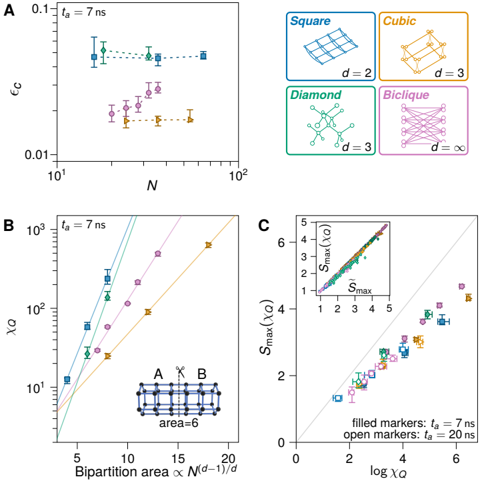
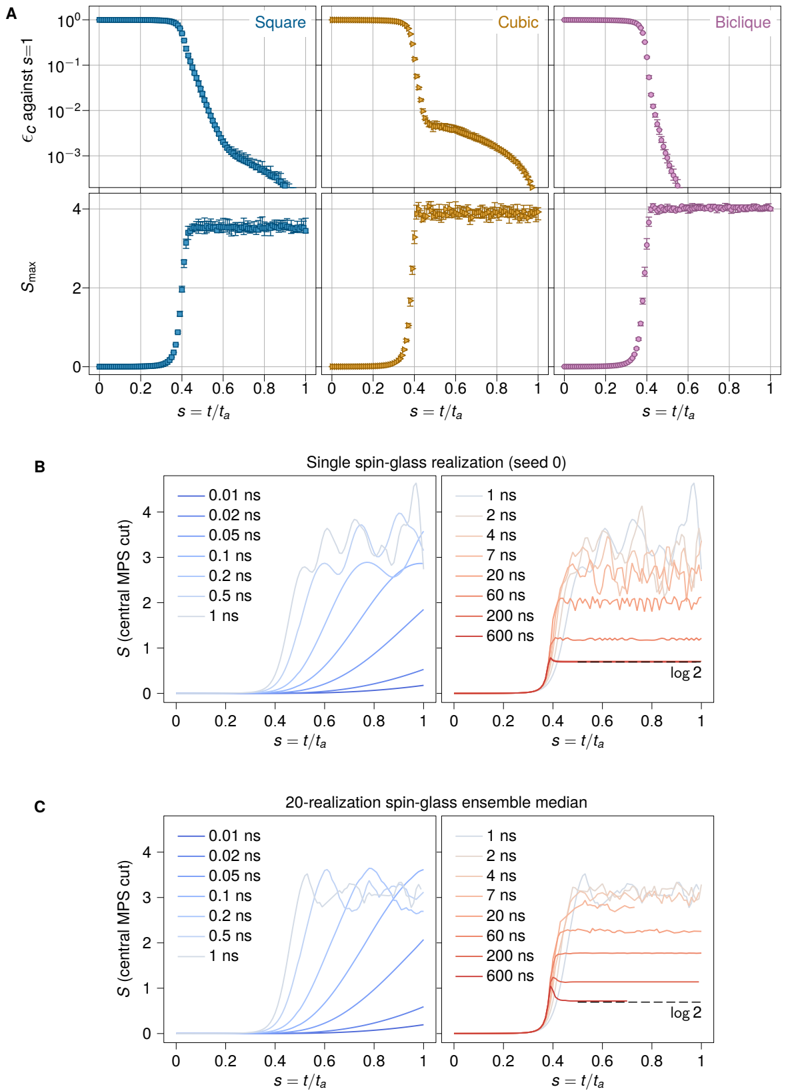
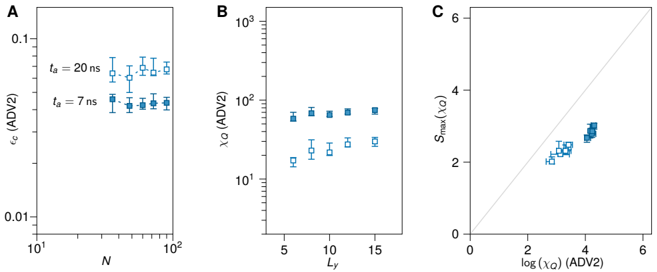
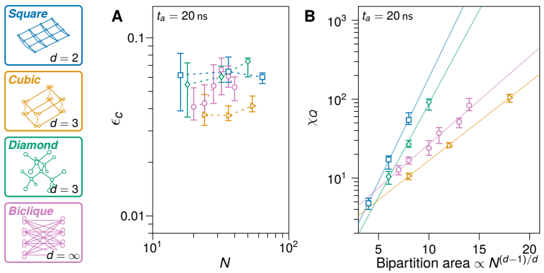
Quantum computers hold the promise of solving certain problems that lie beyond the reach of conventional computers. However, establishing this capability, especially for impactful and meaningful problems, remains a central challenge. Here, we show that superconducting quantum annealing processors can rapidly generate samples in close agreement with solutions of the Schrödinger equation. We demonstrate area-law scaling of entanglement in the model quench dynamics of two-, three-, and infinite-dimensional spin glasses, supporting the observed stretched-exponential scaling of effort for matrix-product-state approaches. We show that several leading approximate methods based on tensor networks and neural networks cannot achieve the same accuracy as the quantum annealer within a reasonable time frame. Thus, quantum annealers can answer questions of practical importance that may remain out of reach for classical computation.
Overview
CoChat Summary
TL;DR
Superconducting quantum annealing processors rapidly generate samples from quenched transverse-field Ising spin glasses in close agreement with Schrödinger-equation solutions, with area-law entanglement scaling and critical exponents matching independent estimates. Leading tensor-network and neural-network classical methods cannot match QPU accuracy within a reasonable time frame, supporting beyond-classical quantum simulation for these problems.
Key findings
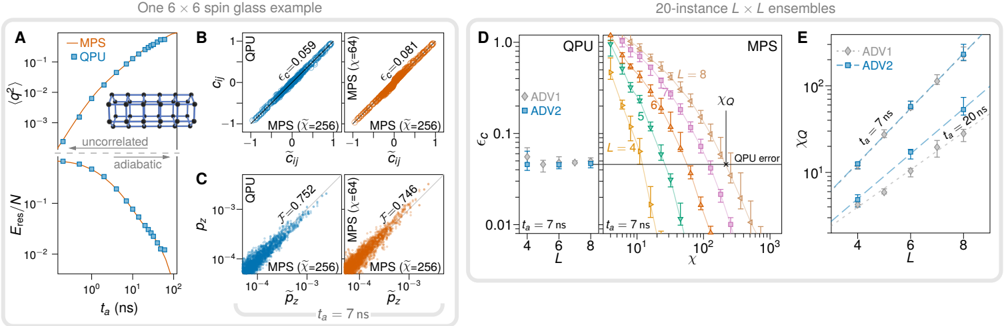
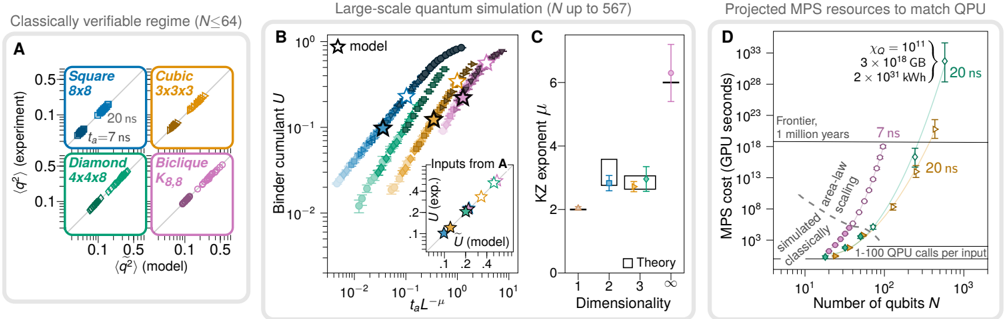
- Two D-Wave quantum annealing processors, ADV1 and ADV2, produced consistent samples for 2D, 3D, and infinite-dimensional spin-glass quenches; for the largest MPS ground truths, the spin-glass order parameter ⟨q²⟩ had a median deviation of only 1% between quantum and classical simulation.
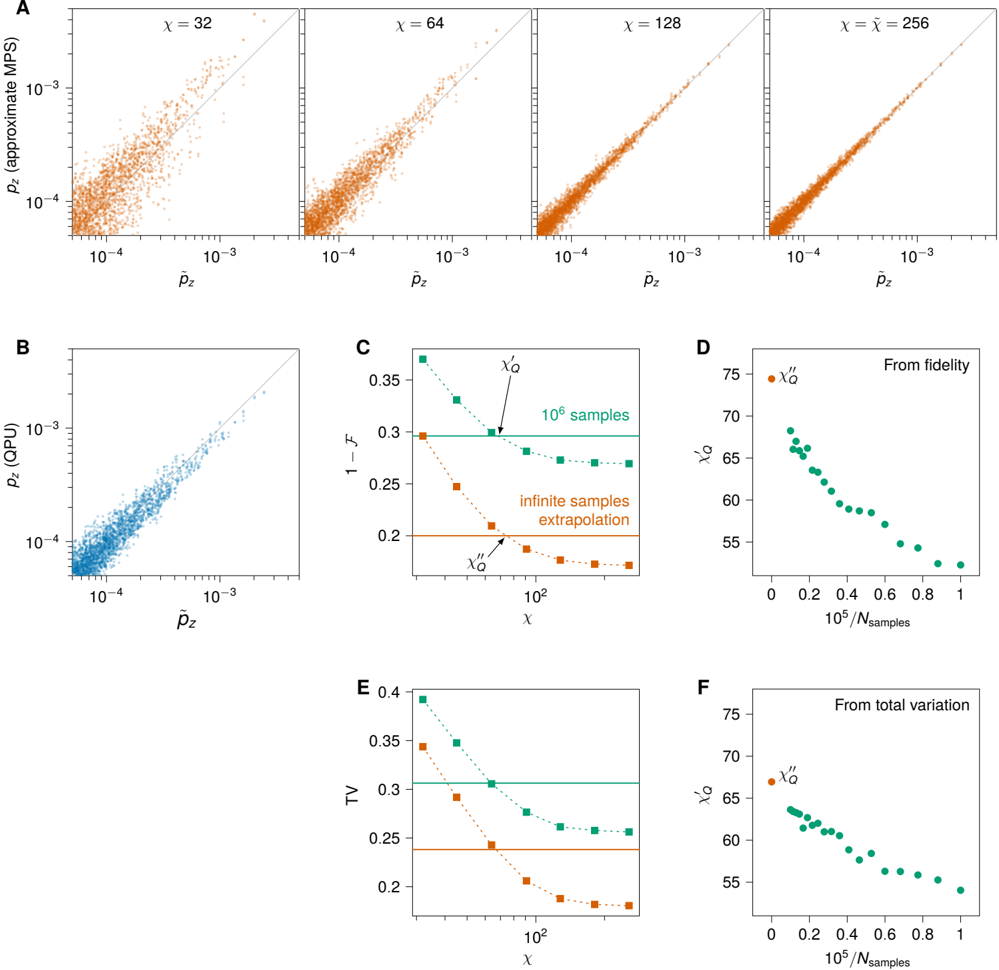
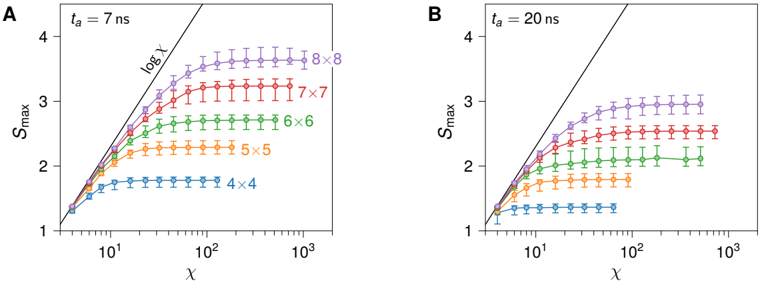
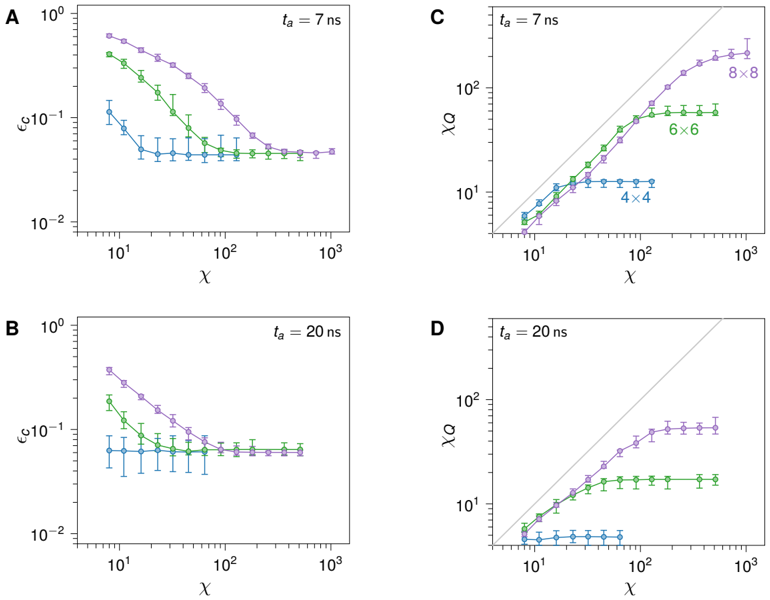
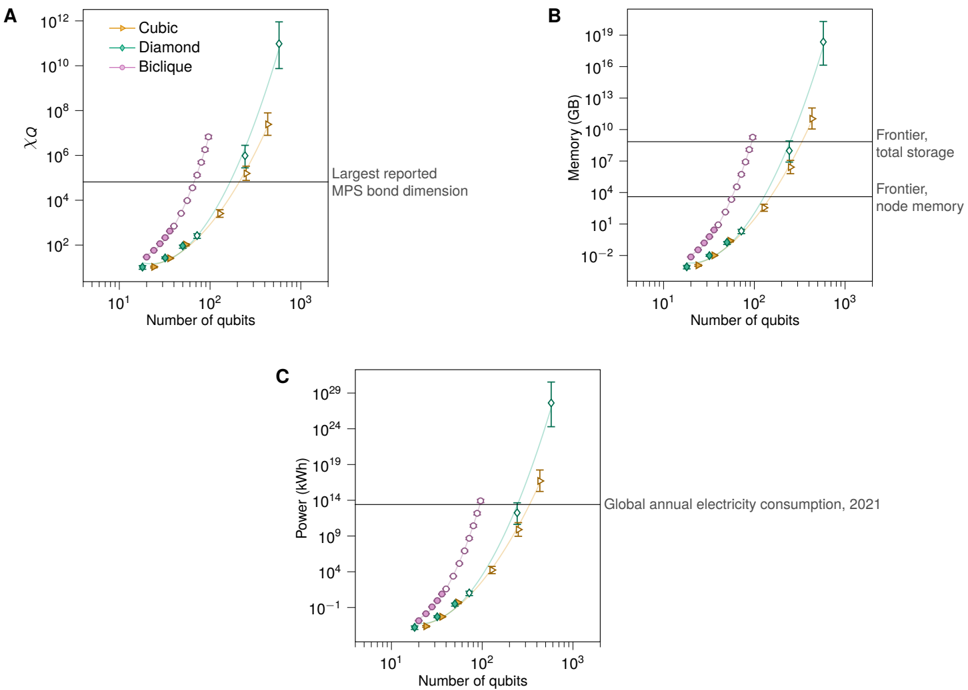
- MPS required a QPU-equivalent bond dimension χ_Q that grew exponentially with bipartition area, consistent with area-law entanglement scaling; for 3D or biclique lattices the estimated requirement was χ_Q ≃ 10⁷, and for diamond lattices χ_Q ≃ 10¹¹.
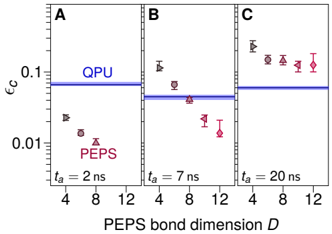
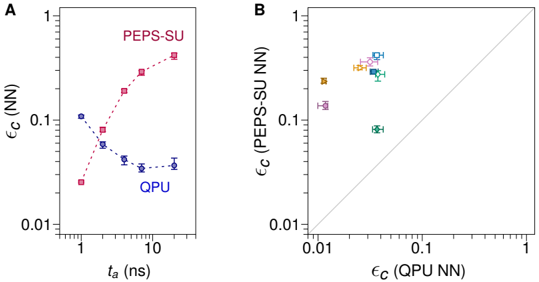
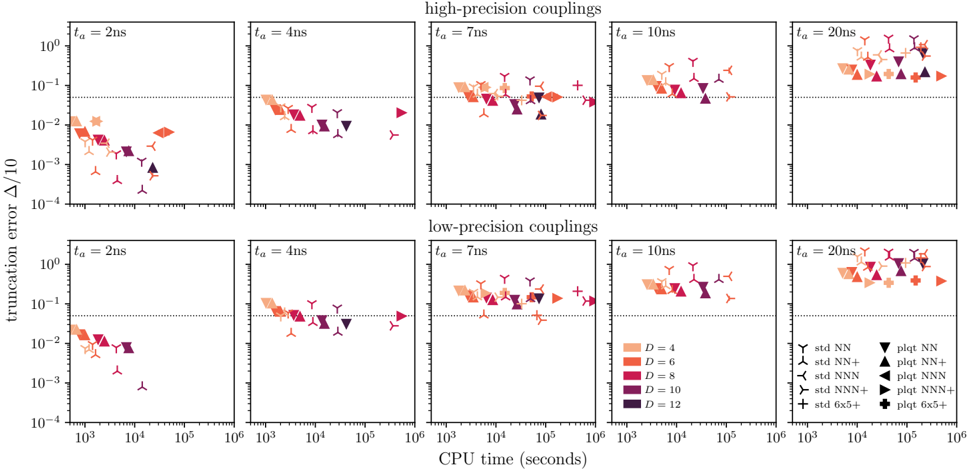
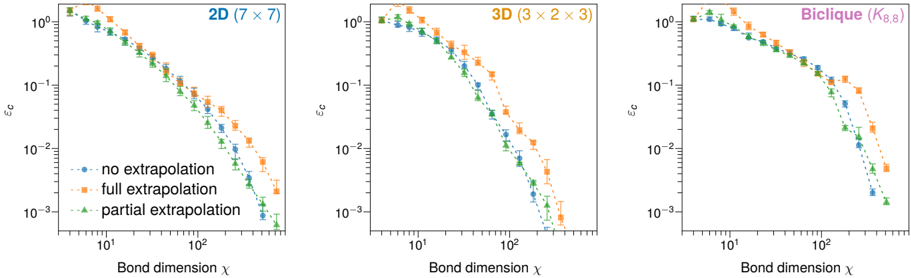
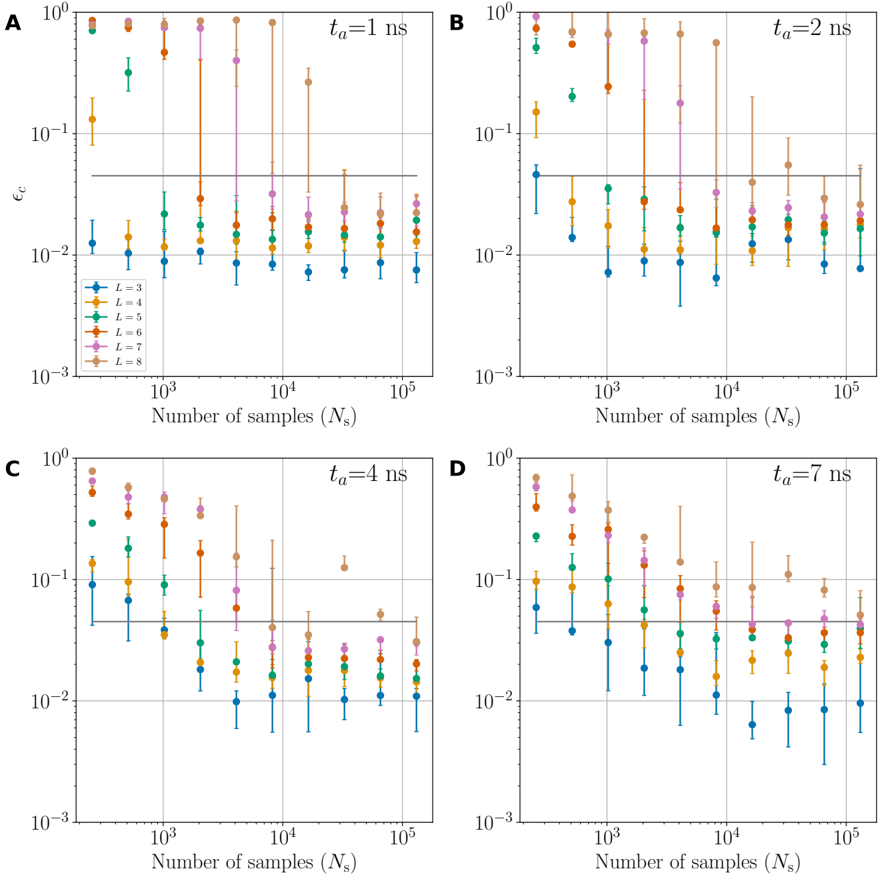
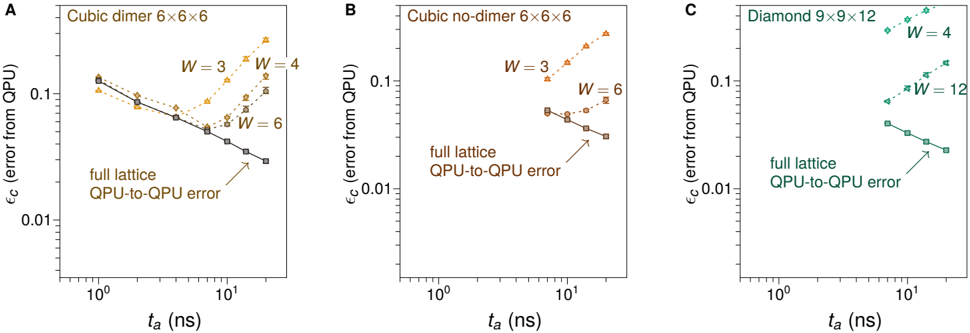
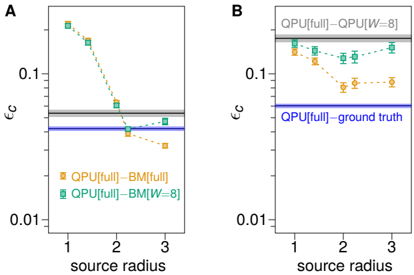
- PEPS and NQS methods failed to match QPU accuracy even on modest 2D problems at slower quenches: PEPS easily beat QPU error at t_a = 2 ns but at 20 ns all PEPS experiments had higher error than QPU, and NQS could not produce acceptable accuracy beyond the shortest time scales and smallest models.
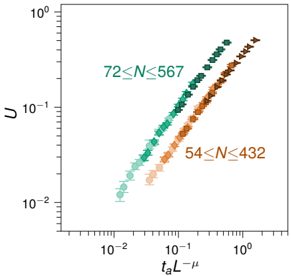
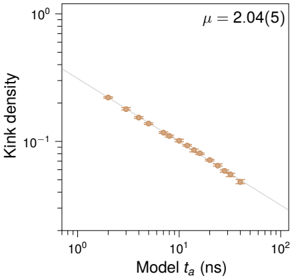
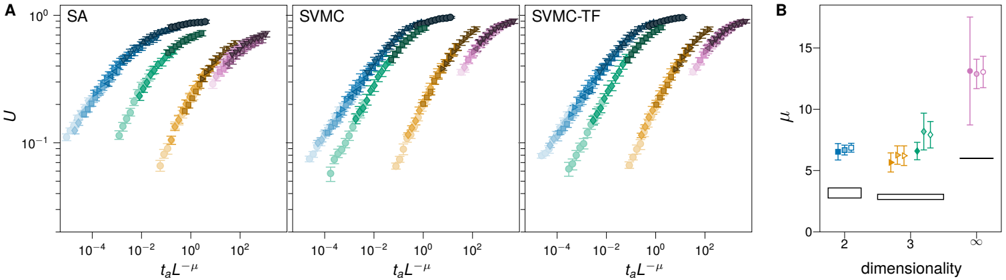
- Extrapolated MPS resource estimates indicated that matching QPU quality on the largest problems would take millions of years on the Frontier supercomputer per input, exceed its 700 PB storage, and exceed annual global electricity consumption; extracted KZ exponents, e.g. square 2.83(24), cubic 2.72(16), and biclique 6.3(9), agreed with previous estimates and theory.
Methods
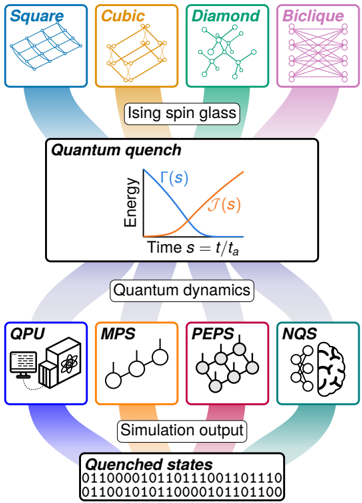
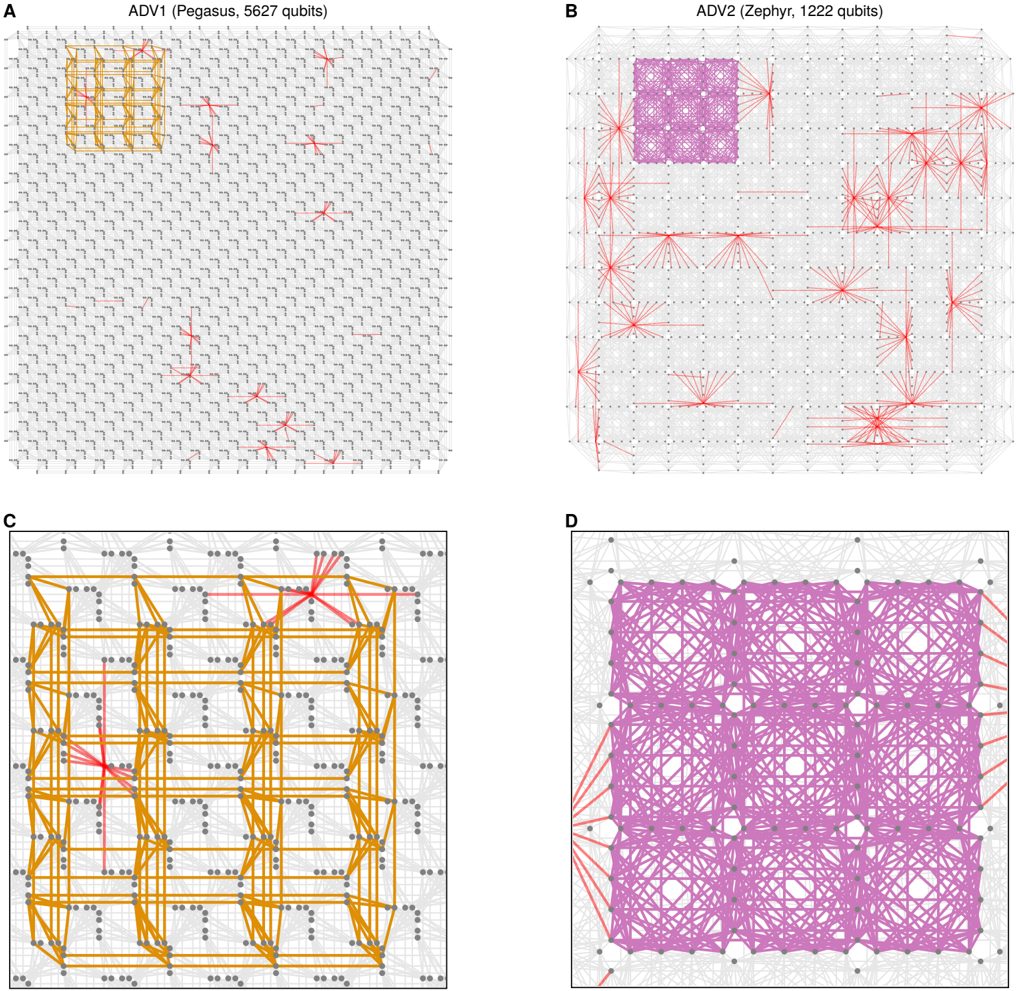
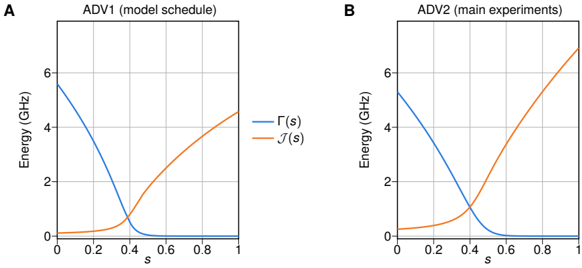
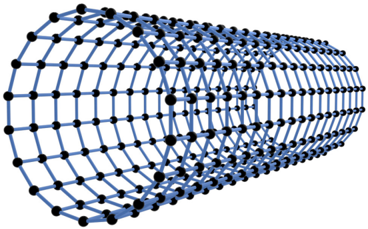
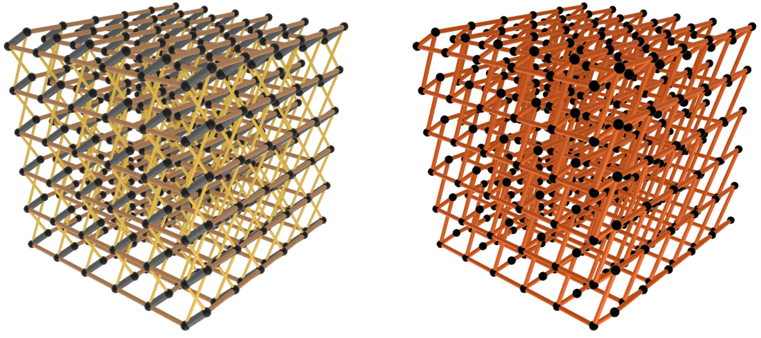
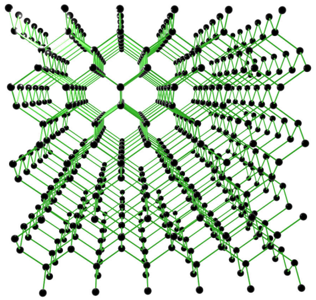
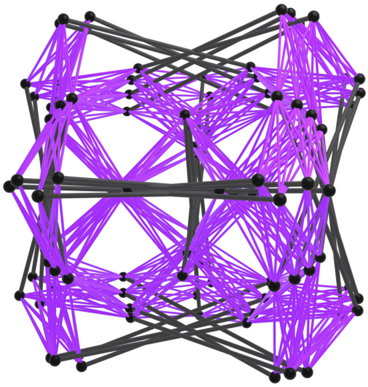
- The task was to sample from the post-quench state of a time-dependent transverse-field Ising model, H(t) = Γ(t/t_a)H_D + J(t/t_a)H_P, on square, cubic dimer, diamond, and biclique topologies, using two D-Wave processors: ADV1 (5627 qubits) and ADV2 (1222 qubits), both at 12 mK, with each QPU generating at least 1000 samples per second.
- QPU results were compared with classical approximations to the time-dependent Schrödinger equation: MPS and PEPS tensor networks and NQS simulations; ground truths for small systems came from well-converged MPS simulations on Summit and Frontier, using metrics including correlation error ε_c, classical fidelity F, and QPU-equivalent bond dimension χ_Q.
- Calibration refinements included flux offsets, anneal offsets, embedding and automorphism averaging, with up to 200 parallel embeddings; the largest diamond input was (12,12,16) with 567 of 576 qubits operable.
Limitations
- The paper states that direct, nonuniversal verification against ground truth is only possible at small scales; beyond the classically simulable regime, validation relies on universal quantum critical scaling and dynamic finite-size scaling collapse.
- The paper notes that its resource extrapolation applies to MPS, the only method that matched QPU quality for all considered quench times, and is not an intrinsic lower bound for all classical methods; PEPS and NQS failed at smaller sizes.
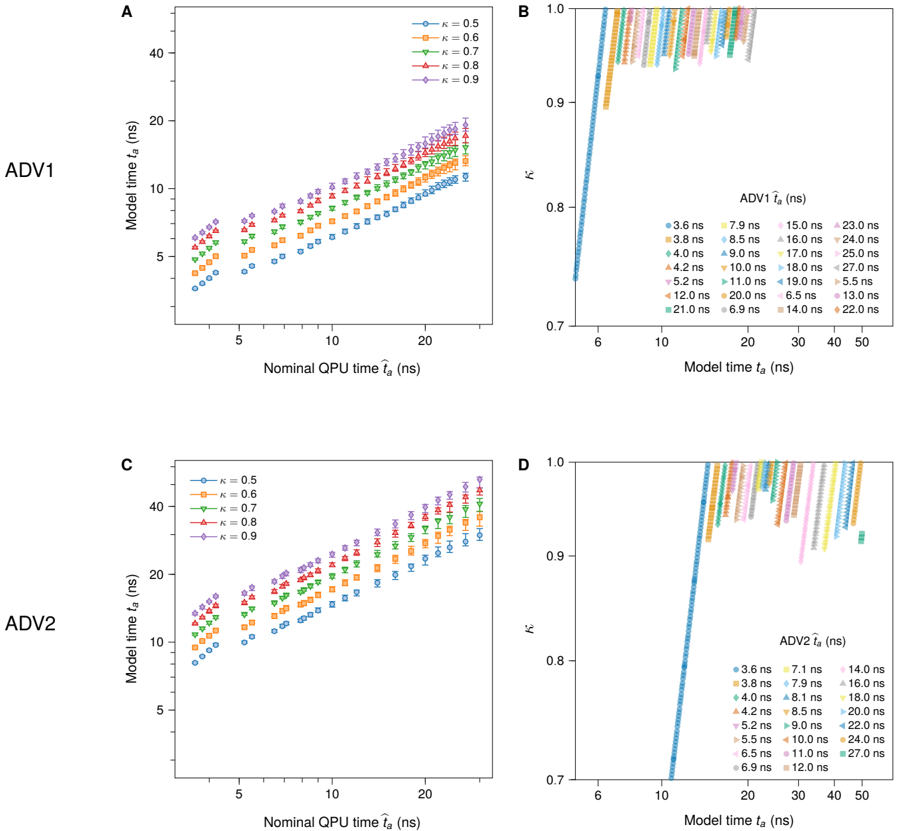
- The paper states that the QPUs were calibrated for the operational regime t_a > 500 ns, while the model quench times studied here required refined time mapping and synchronization corrections; future availability of t_a < 500 ns would make that calibration section unnecessary. The largest diamond lattice permitted 9 defects out of 576 qubits, expected to have no significant impact on algorithmic complexity.
Model-written summary. Check it against the paper before relying on it.
Integrity signals
Registry
Cites
Statistics
Figures
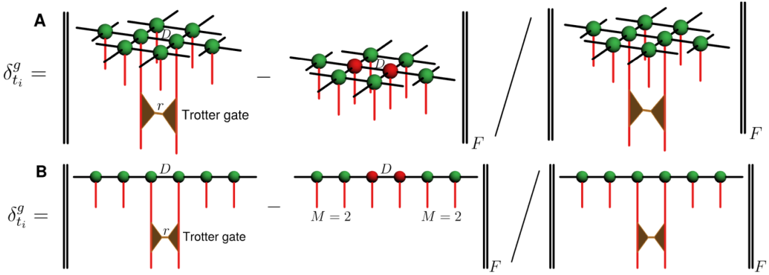
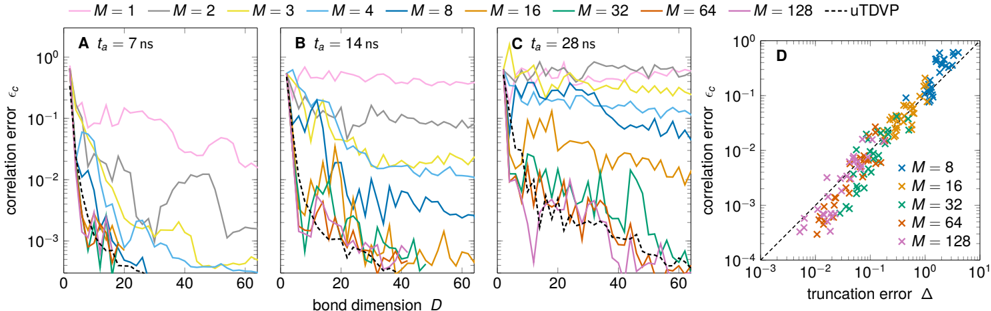
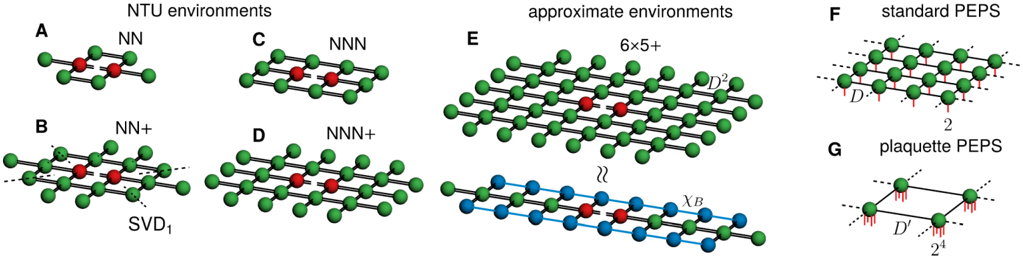
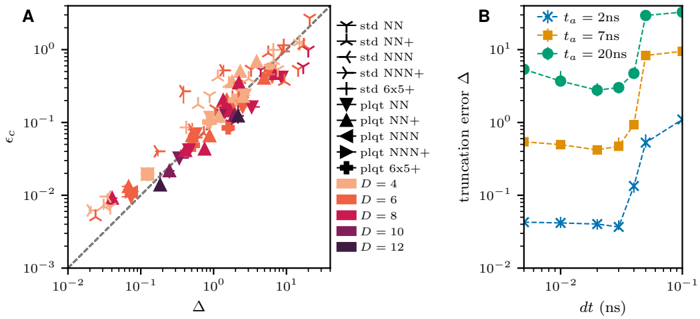

Verification
Claims the paper makes
53 Valid · 24 Not valid · 17 Not checked · 357 Own results and interpretations
The cited sources support only part of this claim — read each source’s verdict below.
In the paper
“Time-evolving an MPS with χ = 1 with the time-dependent variational principle (TDVP, see next subsection for more details) is ill-defined, as many of the long-range interactions are lost during the projection step and the resulting time evolution would be wrong 51,76,77 .”
§ Beyond-classical computation in quantum simulation > 1. Initial state preparation
What the sources say
- Could not verifycites [51] 51. J. Haegeman, C. Lubich, I. Oseledets, B. Vandereycken, and F. Verstraete, Unifying time evolution and opti- mization with matrix product states, Phys. Rev. B 94, 165116 (2016). sourceExperimental — accuracy not yet measured
Section III discusses approximate bond truncation and reports that MPS can give wrong results at Clifford points, but it does not address TDVP evolution of an MPS with χ = 1 or interactions lost during a projection step. Searches for TDVP and the claimed projection mechanism found no passage addressing that point. (LLM, conf=0.72)
- Partly supportedcites [76] 76. J. Haegeman, J. I. Cirac, T. J. Osborne, I. Pižorn, H. Verschelde, and F. Verstraete, Time-dependent vari- ational principle for quantum lattices, Physical Review Letters 107, 1 (2011). sourceExperimental — accuracy not yet measured
The discussion accompanying Fig. 1 describes TDVP as projecting the time-evolution direction onto the MPS tangent plane, supporting the reference to a projection step. Our copy does not say that bond dimension χ = 1 makes TDVP ill-defined, that long-range interactions are lost in that case, or that the resulting evolution is wrong; it instead describes the projection as the best approximation within the chosen manifold. (LLM, conf=0.82)
- Partly supportedcites [77] 77. S. Paeckel, T. Köhler, A. Swoboda, S. R. Manmana, U. Schollwöck, and C. Hubig, Time-evolution meth- ods for matrix-product states, Annals of Physics 411, 167998 (2019). sourceExperimental — accuracy not yet measured
Section 6.2.2 (p. 49) says TDVP projection error can be particularly severe at small bond dimension, and §8.3.3 (p. 72) reports projection problems for product initial states. But the paper does not say that evolving every χ = 1 MPS with TDVP is ill-defined or that long-range interactions are necessarily lost: it says two-site TDVP has no projection error for nearest-neighbor Hamiltonians. The claim overgeneralizes a problem that depends on the interaction and TDVP variant. (LLM, conf=0.88)
plainstates a cause- Asserted: passes — The authors put it forward as true.
- Checkable: passes — It can be checked against evidence.
- Load-bearing: passes — The paper’s conclusions depend on it.
- Based: passes — The paper gives a reason why it holds.
- Could not verify
The cited sources support only part of this claim — read each source’s verdict below.
In the paper
“Such MPS states naturally encode the area law of entanglement 75 : ground states of gapped Hamiltonians of N qubits can be approximated to arbitrarily high precision with an MPS of bond dimension χ, which does not grow with the size of the system.”
§ Beyond-classical computation in quantum simulation > A. Matrix Product States (MPS)
What the sources say
- Partly supportedcites [75] 75. M. B. Hastings, An area law for one-dimensional quan- tum systems, Journal of statistical mechanics: theory and experiment 2007, P08024 (2007). sourceExperimental — accuracy not yet measured
The Matrix Product States section (p. 5) constructs an MPS approximation for a gapped ground state under finite-range and finite-strength assumptions. But the approximation estimate on p. 4 scales with chain length N at a given bond dimension, so the paper does not establish arbitrarily high precision at a bond dimension independent of N. Its theorem also assumes a unique ground state (p. 1). (LLM, conf=0.88)
plain- Asserted: passes — The authors put it forward as true.
- Checkable: passes — It can be checked against evidence.
- Load-bearing: unclear — It is unclear whether the paper’s conclusions depend on it.
- Based: passes — The paper gives a reason why it holds.
- Partly supported
Every source the paper cites for this claim was checked and supports it.
In the paper
“The nonequilibrium quantum dynamics studied here are responsible for a scaling advantage over classical dynamics in optimization 25 .”
§ Beyond-classical computation in quantum simulation > SUMMARY AND CONCLUSIONS
What the sources say
- Supportedcites [25] 25. A. D. King, J. Raymond, T. Lanting, R. Harris, A. Zucca, et al., Quantum critical dynamics in a 5,000- qubit programmable spin glass, Nature 617, 61 (2023). source
The Outlook (p. 5) says the measured quantum-critical dynamics give quantum annealing a dynamical advantage over simulated annealing and simulated quantum annealing in the spin-glass setting. It also reports an experimentally demonstrated scaling advantage in approaching the ground-state energy. (LLM, conf=0.91)
plainstates a cause- Asserted: passes — The authors put it forward as true.
- Checkable: passes — It can be checked against evidence.
- Load-bearing: passes — The paper’s conclusions depend on it.
- Based: passes — The paper gives a reason why it holds.
- Supported
The cited sources support only part of this claim — read each source’s verdict below.
In the paper
“As discussed in Section V, and in agreement with previous observations 31 , we show that quenched quantum dynamics deviating from the ground state also show area-law scaling.”
§ Beyond-classical computation in quantum simulation > A. Matrix Product States (MPS)
What the sources say
- Partly supportedcites [31] 31. E. Canovi, E. Ercolessi, P. Naldesi, L. Taddia, and D. Vodola, Dynamics of entanglement entropy and en- tanglement spectrum crossing a quantum phase transi- tion, Physical Review B 89, 104303 (2014). sourceExperimental — accuracy not yet measured
In §F.1 (Entanglement entropy; page unavailable), the paper reports that entropy curves for different system sizes are practically coincident at small quench times, consistent with size-independent scaling in that regime. Its discussion of fast sweeps (§D; page unavailable) describes dynamics that depart from the instantaneous ground state. It does not establish area-law scaling for quenched dynamics generally, as the claim implies. (LLM, conf=0.78)
plainstates an association- Asserted: passes — The authors put it forward as true.
- Checkable: passes — It can be checked against evidence.
- Load-bearing: unclear — It is unclear whether the paper’s conclusions depend on it.
- Based: passes — The paper gives a reason why it holds.
- Partly supported
The cited sources support only part of this claim — read each source’s verdict below.
In the paper
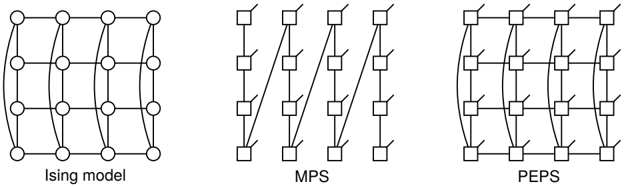
“Moreover, as the size of the tensors is exponential in d, this methodology quickly becomes impractical, with extreme restrictions on feasible simulations even in three dimensions 54 .”
§ Beyond-classical computation in quantum simulation > CLASSICAL SIMULATION TECHNIQUES
What the sources say
- Partly supportedcites [54] 54. P. C. G. Vlaar and P. Corboz, Simulation of three-dimensional quantum systems with projected entangled-pair states, Phys. Rev. B 103, 205137 (2021). sourceExperimental — accuracy not yet measured
The iPEPS ansatz section describes six D-dimensional auxiliary indices for a 3D tensor, and the Introduction says the additional legs increase computational cost. Section III reports that a large-cluster contraction typically is feasible only at D = 2. But the paper does not characterize 3D iPEPS as generally impractical: its Summary presents a practical method at reasonable cost. It also uses d for the local physical-index dimension, not spatial dimension. (LLM, conf=0.87)
plainstates a cause- Asserted: passes — The authors put it forward as true.
- Checkable: passes — It can be checked against evidence.
- Load-bearing: passes — The paper’s conclusions depend on it.
- Based: passes — The paper gives a reason why it holds.
- Partly supported
243 more claims · 20 with their cited sources checked
Create a free account to see all 451 claims and every source verdict.
- Probably not a substantial claim. 96
- It may state two separate claims as one. 125
- Borderline: one of the tests for a substantial claim is unclear. 2
- The quote only partly states this claim. 2
Self-check
Percentages, sums and reported differences re-computed from the paper’s own numbers.
Rated minor: it would not touch a result — a value no result rests on, a p-value that stays on the same side of the significance level, or a conflict that is clerical, resolved elsewhere in the paper, or outside its own findings.
In the paper
“µ = z + 1/ν = 2.46(17) + 0.71(24) = 3.27( 41)”
§ Beyond-classical computation in quantum simulation > Additional information
Reported 3.27 · recomputed 3.17
Citations
Cites
Optimization by Simulated Annealing
Kirkpatrick, S., Gelatt, C. D., & Vecchi, M. P. (1983) · Science · doi:10.1126/science.220.4598.671 · Cited by 45,134
Gelman, A., Carlin, J. B., Stern, H. S., & Rubin, D. B. (2003) · doi:10.1201/9780429258480 · Cited by 27,276
Inference from iterative simulation using multiple sequences
Gelman, A., & Rubin, D. B. (1992) · Statistical Science · doi:10.1214/ss/1177011136 · Cited by 16,627
Quantum supremacy using a programmable superconducting processor
Arute, F., Arya, K., Babbush, R., Bacon, D., Bardin, J. C., Barends, R., Biswas, R., Boixo, S., Brandao, F. G. S. L., Buell, D. A., et al. (2019) · Nature · doi:10.1038/s41586-019-1666-5 · Cited by 7,720
Density matrix formulation for quantum renormalization groups
White, S. R. (1992) · Physical Review Letters · doi:10.1103/physrevlett.69.2863 · Cited by 7,702
The density-matrix renormalization group in the age of matrix product states
Schollwöck, U. (2011) · Annals of Physics · doi:10.1016/j.aop.2010.09.012 · Cited by 4,818
Biamonte, J., Wittek, P., Pancotti, N., Rebentrost, P., Wiebe, N., & Lloyd, S. (2017) · Nature · doi:10.1038/nature23474 · Cited by 4,779
Topology of cosmic domains and strings
Kibble, T. W. B. (1976) · Journal of Physics A: Mathematical and General · doi:10.1088/0305-4470/9/8/029 · Cited by 4,545
Entanglement in many-body systems
Amico, L., Fazio, R., Osterloh, A., & Vedral, V. (2008) · Reviews of Modern Physics · doi:10.1103/revmodphys.80.517 · Cited by 3,745
Sachdev, S. (2000) · Cambridge University Press eBooks · doi:10.1017/cbo9780511622540 · Cited by 3,408
Entanglement entropy and quantum field theory
Calabrese, P., & Cardy, J. (2004) · Journal of Statistical Mechanics: Theory and Experiment · doi:10.1088/1742-5468/2004/06/p06002 · Cited by 3,275
Entanglement Entropy and Quantum Field Theory
Calabrese, P., & Cardy, J. (2004) · arXiv · doi:10.48550/arxiv.hep-th/0405152 · Cited by 3,275
Density-matrix algorithms for quantum renormalization groups
White, S. R. (1993) · Physical Review B · doi:10.1103/physrevb.48.10345 · Cited by 3,244
Colloquium : Area laws for the entanglement entropy
Eisert, J., Cramer, M., & Plenio, M. B. (2010) · Reviews of Modern Physics · doi:10.1103/revmodphys.82.277 · Cited by 2,873
Sachdev, S. (2011) · doi:10.1017/cbo9780511973765 · Cited by 2,842
Natural Gradient Works Efficiently in Learning
Amari, S.-I. (1998) · Neural Computation · doi:10.1162/089976698300017746 · Cited by 2,681
Colloquium: Nonequilibrium dynamics of closed interacting quantum systems
Polkovnikov, A., Sengupta, K., Silva, A., & Vengalattore, M. (2011) · Reviews of Modern Physics · doi:10.1103/revmodphys.83.863 · Cited by 2,562
Efficient Classical Simulation of Slightly Entangled Quantum Computations
Vidal, G. (2003) · Physical Review Letters · doi:10.1103/physrevlett.91.147902 · Cited by 2,368
Quantum annealing in the transverse Ising model
Kadowaki, T., & Nishimori, H. (1998) · Physical Review E · doi:10.1103/physreve.58.5355 · Cited by 2,339
Orús, R. (2014) · Annals of Physics · doi:10.1016/j.aop.2014.06.013 · Cited by 2,255
Solving the quantum many-body problem with artificial neural networks
Carleo, G., & Troyer, M. (2017) · Science · doi:10.1126/science.aag2302 · Cited by 2,215
Cosmological experiments in superfluid helium?
Zurek, W. H. (1985) · Nature · doi:10.1038/317505a0 · Cited by 1,894
Verstraete, F., Murg, V., & Cirac, J. I. (2008) · Advances in Physics · doi:10.1080/14789940801912366 · Cited by 1,762
Finitely correlated states on quantum spin chains
Fannes, M., Nachtergaele, B., & Werner, R. F. (1992) · Communications in Mathematical Physics · doi:10.1007/bf02099178 · Cited by 1,422
Evolution of entanglement entropy in one-dimensional systems
Calabrese, P., & Cardy, J. (2005) · Journal of Statistical Mechanics: Theory and Experiment · doi:10.1088/1742-5468/2005/04/p04010 · Cited by 1,295
Time Dependence of Correlation Functions Following a Quantum Quench
Calabrese, P., & Cardy, J. (2006) · Physical Review Letters · doi:10.1103/physrevlett.96.136801 · Cited by 1,190
Characterizing quantum supremacy in near-term devices
Boixo, S., Isakov, S. V., Smelyanskiy, V. N., Babbush, R., Ding, N., Jiang, Z., Bremner, M. J., Martinis, J. M., & Neven, H. (2018) · Nature Physics · doi:10.1038/s41567-018-0124-x · Cited by 1,175
An area law for one-dimensional quantum systems
Hastings, M. B. (2007) · Journal of Statistical Mechanics: Theory and Experiment · doi:10.1088/1742-5468/2007/08/p08024 · Cited by 1,131
Vidal, G. (2007) · Physical Review Letters · doi:10.1103/physrevlett.99.220405 · Cited by 1,122
Quantum computational advantage with a programmable photonic processor
Madsen, L. S., Laudenbach, F., Askarani, M. F., Rortais, F., Vincent, T., Bulmer, J. F. F., Miatto, F. M., Neuhaus, L., Helt, L. G., Collins, M. J., et al. (2022) · Nature · doi:10.1038/s41586-022-04725-x · Cited by 1,101
The ITensor Software Library for Tensor Network Calculations
Fishman, M., White, S., & Stoudenmire, E. M. (2022) · SciPost Physics Codebases · doi:10.21468/scipostphyscodeb.4 · Cited by 1,084
Strong Quantum Computational Advantage Using a Superconducting Quantum Processor
Wu, Y., Bao, W.-S., Cao, S., Chen, F., Chen, M.-C., Chen, X., Chung, T.-H., Deng, H., Du, Y., Fan, D., et al. (2021) · Physical Review Letters · doi:10.1103/physrevlett.127.180501 · Cited by 1,059
Evidence for the utility of quantum computing before fault tolerance
Kim, Y., Eddins, A., Anand, S., Wei, K. X., van den Berg, E., Rosenblatt, S., Nayfeh, H., Wu, Y., Zaletel, M., Temme, K., et al. (2023) · Nature · doi:10.1038/s41586-023-06096-3 · Cited by 1,050
Quantum phases of matter on a 256-atom programmable quantum simulator
Ebadi, S., Wang, T. T., Levine, H., Keesling, A., Semeghini, G., Omran, A., Bluvstein, D., Samajdar, R., Pichler, H., Ho, W. W., et al. (2021) · Nature · doi:10.1038/s41586-021-03582-4 · Cited by 995
Quantum Phases of Matter on a 256-Atom Programmable Quantum Simulator
Ebadi, S., Wang, T. T., Levine, H., Keesling, A., Semeghini, G., Omran, A., Bluvstein, D., Samajdar, R., Pichler, H., Ho, W. W., et al. (2020) · arXiv · doi:10.48550/arxiv.2012.12281 · Cited by 995
Time-Dependent Variational Principle for Quantum Lattices
Haegeman, J., Cirac, J. I., Osborne, T. J., Pižorn, I., Verschelde, H., & Verstraete, F. (2011) · Physical Review Letters · doi:10.1103/physrevlett.107.070601 · Cited by 865
Hamiltonian Simulation by Qubitization
Low, G. H., & Chuang, I. L. (2019) · Quantum · doi:10.22331/q-2019-07-12-163 · Cited by 854
Unifying time evolution and optimization with matrix product states
Haegeman, J., Lubich, C., Oseledets, I., Vandereycken, B., & Verstraete, F. (2016) · Physical Review B · doi:10.1103/physrevb.94.165116 · Cited by 804
Matrix product states and projected entangled pair states: Concepts, symmetries, theorems
Cirac, J. I., Pérez-García, D., Schuch, N., & Verstraete, F. (2021) · Reviews of Modern Physics · doi:10.1103/revmodphys.93.045003 · Cited by 769
Time-evolution methods for matrix-product states
Paeckel, S., Köhler, T., Swoboda, A., Manmana, S. R., Schollwöck, U., & Hubig, C. (2019) · Annals of Physics · doi:10.1016/j.aop.2019.167998 · Cited by 768
Quantum phases of matter on a 256-atom programmable quantum simulator
Ebadi, S., Wang, T. T., Levine, H., Keesling, A., Semeghini, G., Omran, A., Bluvstein, D., Samajdar, R., Pichler, H., Ho, W. W., et al. (2020) · RePEc: Research Papers in Economics · Cited by 765
Dynamics of a quantum phase transition and relaxation to a steady state
Dziarmaga, J. (2010) · Advances in Physics · doi:10.1080/00018732.2010.514702 · Cited by 717
Self-citationHamiltonian Simulation by Qubitization
Low, G. H., & Chuang, I. L. (2019) · DSpace@MIT (Massachusetts Institute of Technology) · Cited by 714
Colloquium : Quantum annealing and analog quantum computation
Das, A., & Chakrabarti, B. K. (2008) · Reviews of Modern Physics · doi:10.1103/revmodphys.80.1061 · Cited by 700
Quantum simulation of 2D antiferromagnets with hundreds of Rydberg atoms
Scholl, P., Schuler, M., Williams, H. J., Eberharter, A. A., Barredo, D., Schymik, K.-N., Lienhard, V., Henry, L.-P., Lang, T. C., Lahaye, T., et al. (2021) · Nature · doi:10.1038/s41586-021-03585-1 · Cited by 688
Defining and detecting quantum speedup
Rønnow, T. F., Wang, Z., Job, J., Boixo, S., Isakov, S. V., Wecker, D., Martinis, J. M., Lidar, D. A., & Troyer, M. (2014) · Science · doi:10.1126/science.1252319 · Cited by 601
Criticality, the Area Law, and the Computational Power of Projected Entangled Pair States
Verstraete, F., Wolf, M. M., Perez-Garcia, D., & Cirac, J. I. (2006) · Physical Review Letters · doi:10.1103/physrevlett.96.220601 · Cited by 580
Classical simulation of quantum many-body systems with a tree tensor network
Shi, Y.-Y., Duan, L.-M., & Vidal, G. (2006) · Physical Review A · doi:10.1103/physreva.74.022320 · Cited by 577
Quantum Kibble–Zurek mechanism and critical dynamics on a programmable Rydberg simulator
Keesling, A., Omran, A., Levine, H., Bernien, H., Pichler, H., Choi, S., Samajdar, R., Schwartz, S., Silvi, P., Sachdev, S., et al. (2019) · Nature · doi:10.1038/s41586-019-1070-1 · Cited by 534
Quantum Monte Carlo Approaches for Correlated Systems
Becca, F., & Sorella, S. (2017) · doi:10.1017/9781316417041 · Cited by 523
Quantum Annealing of a Disordered Magnet
Brooke, J., Bitko, D., F., T., Rosenbaum, & Aeppli, G. (1999) · Science · doi:10.1126/science.284.5415.779 · Cited by 518
Renormalization algorithms for Quantum-Many Body Systems in two and higher dimensions
Verstraete, F., & Cirac, J. I. (2004) · arXiv (Cornell University) · doi:10.48550/arxiv.cond-mat/0407066 · Cited by 475
Simulating Quantum Computation by Contracting Tensor Networks
Markov, I. L., & Shi, Y. (2008) · SIAM Journal on Computing · doi:10.1137/050644756 · Cited by 472
Accurate Determination of Tensor Network State of Quantum Lattice Models in Two Dimensions
Jiang, H. C., Weng, Z. Y., & Xiang, T. (2008) · Physical Review Letters · doi:10.1103/physrevlett.101.090603 · Cited by 464
Studying Two-Dimensional Systems with the Density Matrix Renormalization Group
Stoudenmire, E. M., & White, S. R. (2012) · Annual Review of Condensed Matter Physics · doi:10.1146/annurev-conmatphys-020911-125018 · Cited by 451
Phase-Programmable Gaussian Boson Sampling Using Stimulated Squeezed Light
Zhong, H.-S., Deng, Y.-H., Qin, J., Wang, H., Chen, M.-C., Peng, L.-C., Luo, Y.-H., Wu, D., Gong, S.-Q., Su, H., et al. (2021) · Physical Review Letters · doi:10.1103/physrevlett.127.180502 · Cited by 434
Quantum optimization of maximum independent set using Rydberg atom arrays
Ebadi, S., Keesling, A., Cain, M., Wang, T. T., Levine, H., Bluvstein, D., Semeghini, G., Omran, A., Liu, J.-G., Samajdar, R., et al. (2022) · Science · doi:10.1126/science.abo6587 · Cited by 430
Universality of phase transition dynamics: Topological defects from symmetry breaking
del Campo, A., & Zurek, W. H. (2014) · International Journal of Modern Physics A · doi:10.1142/s0217751x1430018x · Cited by 364
Phase transitions in random circuit sampling
Morvan, A., Villalonga, B., Mi, X., Mandrà, S., Bengtsson, A., Klimov, P. V., Chen, Z., Hong, S., Erickson, C., Drozdov, I., et al. (2024) · Nature · doi:10.1038/s41586-024-07998-6 · Cited by 352
Computational complexity of projected entangled pair states
Schuch, N., Wolf, M. M., Verstraete, F., & Cirac, J. I. (2007) · Physical Review Letters · doi:10.1103/physrevlett.98.140506 · Cited by 313
Quantum computing and the entanglement frontier
Preskill, J. (2012) · arXiv · doi:10.48550/arxiv.1203.5813 · Cited by 308
Leveraging Secondary Storage to Simulate Deep 54-qubit Sycamore CircuitsPreprint
Pednault, E., Gunnels, J. A., Nannicini, G., Lior Horesh, C., & Wisnieff, R. (2019) · arXiv (Cornell University) · doi:10.48550/arxiv.1910.09534 · Cited by 295
Experimental signature of programmable quantum annealing
Boixo, S., Albash, T., Spedalieri, F. M., Chancellor, N., & Lidar, D. A. (2013) · Nature Communications · doi:10.1038/ncomms3067 · Cited by 293
Solving the Sampling Problem of the Sycamore Quantum Circuits
Pan, F. P., Chen, K., & Zhang, P. (2022) · Physical Review Letters · doi:10.1103/physrevlett.129.090502 · Cited by 283
Recurrent neural network wave functions
Hibat-Allah, M., Ganahl, M., Hayward, L. E., Melko, R. G., & Carrasquilla, J. (2020) · Physical Review Research · doi:10.1103/physrevresearch.2.023358 · Cited by 274
Self-citationPhase transitions in a programmable quantum spin glass simulator
Harris, R., Sato, Y., Berkley, A. J., Reis, M., Altomare, F., Amin, M. H., Boothby, K., Bunyk, P., Deng, C., Enderud, C., et al. (2018) · Science · doi:10.1126/science.aat2025 · Cited by 259
Self-citationA Polynomial-Time Classical Algorithm for Noisy Random Circuit Sampling
Aharonov, D., Gao, X., Landau, Z. A., Liu, Y., & Vazirani, U. V. (2023) · ACM Symposium on Theory of Computing (STOC) · doi:10.1145/3564246.3585234 · Cited by 252
Differentiable Programming Tensor Networks
Liao, H.-J., Liu, J.-G., Wang, L., & Xiang, T. (2019) · Physical Review X · doi:10.1103/physrevx.9.031041 · Cited by 251
Simulating strongly correlated quantum systems with tree tensor networks
Murg, V., Verstraete, F., Legeza, Ö., & Noack, R. M. (2010) · Physical Review B · doi:10.1103/physrevb.82.205105 · Cited by 245
Quantum critical dynamics in a 5,000-qubit programmable spin glass
King, A. D., Raymond, J., Lanting, T., Harris, R., Zucca, A., Altomare, F., Berkley, A. J., Boothby, K., Ejtemaee, S., Enderud, C., et al. (2023) · Nature · doi:10.1038/s41586-023-05867-2 · Cited by 242
Self-citationTangent-space methods for uniform matrix product states
Vanderstraeten, L., Haegeman, J., & Verstraete, F. (2019) · SciPost Physics Lecture Notes · doi:10.21468/scipostphyslectnotes.7 · Cited by 233
Quantum Many-Body Dynamics in Two Dimensions with Artificial Neural Networks
Schmitt, M., & Heyl, M. (2020) · Physical Review Letters · doi:10.1103/physrevlett.125.100503 · Cited by 221
Coherent quantum annealing in a programmable 2,000 qubit Ising chain
King, A. D., Suzuki, S., Raymond, J., Zucca, A., Lanting, T., Altomare, F., Berkley, A. J., Ejtemaee, S., Hoskinson, E., Huang, S., et al. (2022) · Nature Physics · doi:10.1038/s41567-022-01741-6 · Cited by 213
Self-citationLocalization and Glassy Dynamics Of Many-Body Quantum Systems
Carleo, G., Becca, F., Schiró, M., & Fabrizio, M. (2012) · Scientific Reports · doi:10.1038/srep00243 · Cited by 211
Quantum Optimization of Fully Connected Spin Glasses
Venturelli, D., Mandrà, S., Knysh, S., O’Gorman, B., Biswas, R., & Smelyanskiy, V. (2015) · Physical Review X · doi:10.1103/physrevx.5.031040 · Cited by 209
Algorithms for finite projected entangled pair states
Lubasch, M., Cirac, J. I., & Bañuls, M.-C. (2014) · Physical Review B · doi:10.1103/physrevb.90.064425 · Cited by 205
Time-dependent variational principle with ancillary Krylov subspace
Yang, M., & White, S. R. (2020) · Physical review. B./Physical review. B · doi:10.1103/physrevb.102.094315 · Cited by 193
Quantum sampling problems, BosonSampling and quantum supremacy
Lund, A. P., Bremner, M. J., & Ralph, T. C. (2017) · npj Quantum Information · doi:10.1038/s41534-017-0018-2 · Cited by 183
Cincio, L., Dziarmaga, J., Rams, M. M., & Zurek, W. H. (2007) · Physical Review A · doi:10.1103/physreva.75.052321 · Cited by 182
Self-citationExperimental demonstration of a robust and scalable flux qubit
Harris, R., Johansson, J., Berkley, A. J., Johnson, M. W., Lanting, T., Han, S., Bunyk, P., Ladizinsky, E., Oh, T., Perminov, I., et al. (2010) · Physical Review B · doi:10.1103/physrevb.81.134510 · Cited by 177
Self-citationTensor Network Contractions: Methods and Applications to Quantum Many-Body Systems
Ran, S.-J., Tirrito, E., Peng, C., Chen, X., Tagliacozzo, L., Su, G., & Lewenstein, M. (2020) · Lecture Notes in Physics · doi:10.1007/978-3-030-34489-4 · Cited by 176
Quantum variational autoencoder
Khoshaman, A., Vinci, W., Denis, B., Andriyash, E., Sadeghi, H., & Amin, M. H. (2018) · Quantum Science and Technology · doi:10.1088/2058-9565/aada1f · Cited by 167
Self-citationZero-temperature quantum phase transition of a two-dimensional Ising spin glass
Rieger, H., & Young, A. P. (1994) · Physical Review Letters · doi:10.1103/physrevlett.72.4141 · Cited by 165
Landau theory of quantum spin glasses of rotors and Ising spins
Read, N., Sachdev, S., & Ye, J. (1995) · Physical Review B · doi:10.1103/physrevb.52.384 · Cited by 165
Tensor Product Variational Formulation for Quantum SystemsPreprint
Nishio, Y., Maeshima, N., Gendiar, A., & Nishino, T. (2004) · arXiv (Cornell University) · doi:10.48550/arxiv.cond-mat/0401115 · Cited by 160
Coherent and dissipative dynamics at quantum phase transitions
Rossini, D., & Vicari, E. (2021) · Physics Reports · doi:10.1016/j.physrep.2021.08.003 · Cited by 158
Efficient Tensor Network Simulation of IBM’s Eagle Kicked Ising Experiment
Tindall, J., Fishman, M., Stoudenmire, E. M., & Sels, D. (2024) · PRX Quantum · doi:10.1103/prxquantum.5.010308 · Cited by 152
Quantum critical behavior of a three-dimensional Ising spin glass in a transverse magnetic field
Guo, M., Bhatt, R. N., & Huse, D. A. (1994) · Physical Review Letters · doi:10.1103/physrevlett.72.4137 · Cited by 152
Consistency tests of classical and quantum models for a quantum annealer
Albash, T., Vinci, W., Mishra, A., Warburton, P. A., & Lidar, D. A. (2015) · Physical Review A · doi:10.1103/physreva.91.042314 · Cited by 151
Bando, Y., Susa, Y., Oshiyama, H., Shibata, N., Ohzeki, M., Gómez-Ruiz, F. J., Lidar, D. A., Suzuki, S., del Campo, A., & Nishimori, H. (2020) · Physical Review Research · doi:10.1103/physrevresearch.2.033369 · Cited by 151
Isometric Tensor Network States in Two Dimensions
Zaletel, M. P., & Pollmann, F. (2020) · Physical Review Letters · doi:10.1103/physrevlett.124.037201 · Cited by 138
NetKet 3: Machine Learning Toolbox for Many-Body Quantum Systems
Vicentini, F., Hofmann, D., Szabó, A., Wu, D., Roth, C., Giuliani, C., Pescia, G., Nys, J., Vargas-Calderón, V., Astrakhantsev, N., et al. (2022) · SciPost Physics Codebases · doi:10.21468/scipostphyscodeb.7 · Cited by 135
Next-Generation Topology of D-Wave Quantum Processors
Boothby, K., Bunyk, P., Raymond, J., & Roy, A. (2020) · arXiv · doi:10.48550/arxiv.2003.00133 · Cited by 125
Self-citationKumar, S., & Majumdar, P. (2006) · The European Physical Journal B · doi:10.1140/epjb/e2006-00173-2 · Cited by 112
An efficient quantum algorithm for the time evolution of parameterized circuits
Barison, S., Vicentini, F., & Carleo, G. (2021) · Quantum · doi:10.22331/q-2021-07-28-512 · Cited by 110
Geometry of variational methods: dynamics of closed quantum systems
Hackl, L., Guaita, T., Shi, T., Haegeman, J., Demler, E., & Cirac, J. I. (2020) · SciPost Physics · doi:10.21468/scipostphys.9.4.048 · Cited by 110
Bertinshaw, J., Kim, Y. K., Khaliullin, G., & Kim, B. J. (2018) · Annual Review of Condensed Matter Physics · doi:10.1146/annurev-conmatphys-031218-013113 · Cited by 100
Quantum phase transition dynamics in the two-dimensional transverse-field Ising model
Schmitt, M., Rams, M. M., Dziarmaga, J., Heyl, M., & Zurek, W. H. (2022) · Science Advances · doi:10.1126/sciadv.abl6850 · Cited by 99
Self-citationAlbash, T., Rønnow, T. F., Troyer, M., & Lidar, D. A. (2015) · The European Physical Journal Special Topics · doi:10.1140/epjst/e2015-02346-0 · Cited by 96
A simple linear algebra identity to optimize large-scale neural network quantum states
Rende, R., Viteritti, L. L., Bardone, L., Becca, F., & Goldt, S. (2024) · Communications Physics · doi:10.1038/s42005-024-01732-4 · Cited by 93
Scaling and Diabatic Effects in Quantum Annealing with a D-Wave Device
Weinberg, P., Tylutki, M., Rönkkö, J., Westerholm, J., Åström, J. A., Manninen, P., Törmä, P., & Sandvik, A. W. (2020) · Physical Review Letters · doi:10.1103/physrevlett.124.090502 · Cited by 92
Self-citationAlvarez, G. (2009) · Computer Physics Communications · doi:10.1016/j.cpc.2009.02.016 · Cited by 90
Begušić, T., Gray, J., & Chan, G. K.-L. (2024) · Science Advances · doi:10.1126/sciadv.adk4321 · Cited by 89
Gauge fixing, canonical forms, and optimal truncations in tensor networks with closed loops
Evenbly, G. (2018) · Physical review. B./Physical review. B · doi:10.1103/physrevb.98.085155 · Cited by 89
How "Quantum" is the D-Wave Machine?
Shin, S. W., Smith, G., Smolin, J. A., & Vazirani, U. (2014) · arXiv · doi:10.48550/arxiv.1401.7087 · Cited by 89
Effective quantum volume, fidelity and computational cost of noisy quantum processing experiments
Kechedzhi, K., Isakov, S. V., Mandrà, S., Villalonga, B., Mi, X., Boixo, S., & Smelyanskiy, V. (2023) · Future Generation Computer Systems · doi:10.1016/j.future.2023.12.002 · Cited by 87
Group Convolutional Neural Networks Improve Quantum State AccuracyPreprint
Roth, C., & MacDonald, A. H. (2021) · arXiv (Cornell University) · doi:10.48550/arxiv.2104.05085 · Cited by 87
Self-citationQuenches near Ising quantum criticality as a challenge for artificial neural networks
Czischek, S., Gärttner, M., & Gasenzer, T. (2018) · Physical Review B · doi:10.1103/physrevb.98.024311 · Cited by 85
Boundaries of quantum supremacy via random circuit sampling
Zlokapa, A., Villalonga, B., Boixo, S., & Lidar, D. A. (2023) · npj Quantum Information · doi:10.1038/s41534-023-00703-x · Cited by 83
Dynamics of entanglement entropy and entanglement spectrum crossing a quantum phase transition
Canovi, E., Ercolessi, E., Naldesi, P., Taddia, L., & Vodola, D. (2014) · Physical Review B · doi:10.1103/physrevb.89.104303 · Cited by 82
Classical signature of quantum annealing
Smolin, J. A., & Smith, G. (2014) · Frontiers in Physics · doi:10.3389/fphy.2014.00052 · Cited by 79
Variational benchmarks for quantum many-body problems
Wu, D., Rossi, R., Vicentini, F., Astrakhantsev, N., Becca, F., Cao, X., Carrasquilla, J., Ferrari, F., Georges, A., Hibat-Allah, M., et al. (2024) · Science · doi:10.1126/science.adg9774 · Cited by 79
Self-citationClassical variational simulation of the Quantum Approximate Optimization Algorithm
Medvidović, M., & Carleo, G. (2021) · npj Quantum Information · doi:10.1038/s41534-021-00440-z · Cited by 79
Efficient quantum state tomography with convolutional neural networks
Schmale, T., Reh, M., & Gärttner, M. (2022) · npj Quantum Information · doi:10.1038/s41534-022-00621-4 · Cited by 76
Entropy Estimates from Insufficient Samplings
Grassberger, P. (2003) · arXiv · doi:10.48550/arxiv.physics/0307138 · Cited by 74
Variational Monte Carlo with large patched transformers
Sprague, K., & Czischek, S. (2024) · Communications Physics · doi:10.1038/s42005-024-01584-y · Cited by 73
Benchmarking highly entangled states on a 60-atom analogue quantum simulator
Shaw, A. L., Chen, Z., Choi, J., Mark, D. K., Scholl, P., Finkelstein, R., Elben, A., Choi, S., & Endres, M. (2024) · Nature · doi:10.1038/s41586-024-07173-x · Cited by 64
Efficient tensor network simulation of IBM's largest quantum processors
Patra, S., Jahromi, S. S., Singh, S., & Orús, R. (2024) · Physical Review Research · doi:10.1103/physrevresearch.6.013326 · Cited by 63
Classical benchmarking of zero noise extrapolation beyond the exactly-verifiable regimePreprint
Anand, S., Temme, K., Kandala, A., & Zaletel, M. P. (2023) · arXiv (Cornell University) · doi:10.48550/arxiv.2306.17839 · Cited by 63
Time-Dependent Variational Principle with Controlled Bond Expansion for Matrix Product States
Li, J.-W., Gleis, A., & von Delft, J. (2024) · Physical Review Letters · doi:10.1103/physrevlett.133.026401 · Cited by 62
Contracting projected entangled pair states is average-case hard
Haferkamp, J., Hangleiter, D., Eisert, J., & Gluza, M. (2020) · Physical Review Research · doi:10.1103/physrevresearch.2.013010 · Cited by 62
Matrix Product States and Projected Entangled Pair States: Concepts, Symmetries, and TheoremsPreprint
Cirac, I., Pérez-Garcı́a, D., Schuch, N., & Verstraete, F. (2020) · arXiv (Cornell University) · doi:10.48550/arxiv.2011.12127 · Cited by 59
McCreesh, C., Prosser, P., & Trimble, J. (2020) · Lecture Notes in Computer Science · doi:10.1007/978-3-030-51372-6_19 · Cited by 57
Simulation of time evolution with multiscale entanglement renormalization ansatz
Rizzi, M., Montangero, S., & Vidal, G. (2008) · Physical Review A · doi:10.1103/physreva.77.052328 · Cited by 56
Boundaries of quantum supremacy via random circuit sampling
Zlokapa, A., Boixo, S., & Lidar, D. (2020) · arXiv · doi:10.48550/arxiv.2005.02464 · Cited by 55
Area laws and efficient descriptions of quantum many-body states
Ge, Y., & Eisert, J. (2016) · New Journal of Physics · doi:10.1088/1367-2630/18/8/083026 · Cited by 53
Emergence of Gapless Quantum Spin Liquid from Deconfined Quantum Critical Point
Liu, W.-Y., Hasik, J., Gong, S.-S., Poilblanc, D., Chen, W.-Q., & Gu, Z.-C. (2022) · Physical Review X · doi:10.1103/physrevx.12.031039 · Cited by 53
Probabilistic simulation of quantum circuits using a deep-learning architecture
Carrasquilla, J., Luo, D., Pérez, F., Milsted, A., Clark, B. K., Volkovs, M., & Aolita, L. (2021) · Physical Review A · doi:10.1103/physreva.104.032610 · Cited by 53
Self-citationUnbiasing time-dependent Variational Monte Carlo by projected quantum evolution
Sinibaldi, A., Giuliani, C., Carleo, G., & Vicentini, F. (2023) · Quantum · doi:10.22331/q-2023-10-10-1131 · Cited by 51
Hilbert curve vs Hilbert space: exploiting fractal 2D covering to increase tensor network efficiency
Cataldi, G., Abedi, A., Magnifico, G., Notarnicola, S., Pozza, N. D., Giovannetti, V., & Montangero, S. (2021) · Quantum · doi:10.22331/q-2021-09-29-556 · Cited by 45
Hibat-Allah, M., Melko, R. G., & Carrasquilla, J. (2022) · arXiv (Cornell University) · doi:10.48550/arxiv.2207.14314 · Cited by 42
Self-citationParallel time-dependent variational principle algorithm for matrix product states
Secular, P., Gourianov, N., Lubasch, M., Dolgov, S., Clark, S. R., & Jaksch, D. (2020) · Physical Review B · doi:10.1103/physrevb.101.235123 · Cited by 40
Time evolution of an infinite projected entangled pair state: Neighborhood tensor update
Dziarmaga, J. (2021) · Physical Review B · doi:10.1103/physrevb.104.094411 · Cited by 38
Self-citationSimulation of three-dimensional quantum systems with projected entangled-pair states
Vlaar, P. C. G., & Corboz, P. (2021) · Physical Review B · doi:10.1103/physrevb.103.205137 · Cited by 38
Direct sampling of projected entangled-pair states
Vieijra, T., Haegeman, J., Verstraete, F., & Vanderstraeten, L. (2021) · Physical Review B · doi:10.1103/physrevb.104.235141 · Cited by 37
Density Matrix Renormalization Group with Tensor Processing Units
Ganahl, M., Beall, J., Hauru, M., Lewis, A. G. M., Wojno, T., Yoo, J. H., Zou, Y., & Vidal, G. (2023) · PRX Quantum · doi:10.1103/prxquantum.4.010317 · Cited by 37
Spoofing Cross-Entropy Measure in Boson Sampling
Oh, C., Jiang, L., & Fefferman, B. (2023) · Physical Review Letters · doi:10.1103/physrevlett.131.010401 · Cited by 37
Dynamics with autoregressive neural quantum states: Application to critical quench dynamics
Donatella, K., Denis, Z., Le Boité, A., & Ciuti, C. (2023) · Physical Review A · doi:10.1103/physreva.108.022210 · Cited by 36
The quantum transition of the two-dimensional Ising spin glass
Bernaschi, M., González-Adalid Pemartín, I., Martín-Mayor, V., & Parisi, G. (2024) · Nature · doi:10.1038/s41586-024-07647-y · Cited by 35
Phase diagram of the quantum Ising model on a triangular lattice under external field
Liao, Y. D., Li, H., Yan, Z., Wei, H., Li, W., Qi, Y., & Meng, Z. Y. (2021) · Physical review. B./Physical review. B · doi:10.1103/physrevb.103.104416 · Cited by 33
UNIVERSALITY OF PHASE TRANSITION DYNAMICS: TOPOLOGICAL DEFECTS FROM SYMMETRY BREAKING
del Campo, A., & Zurek, W. H. (2014) · Symmetry and Fundamental Physics: Tom Kibble at 80 · doi:10.1142/9789814583060_0002 · Cited by 31
Comparing Relaxation Mechanisms in Quantum and Classical Transverse-Field Annealing
Albash, T., & Marshall, J. (2021) · Physical Review Applied · doi:10.1103/physrevapplied.15.014029 · Cited by 30
Parameterization of Tensor Network Contraction
O’Gorman, B. (2019) · DROPS (Schloss Dagstuhl – Leibniz Center for Informatics) · doi:10.4230/lipics.tqc.2019.10 · Cited by 29
Investigating topological order using recurrent neural networks
Hibat-Allah, M., Melko, R. G., & Carrasquilla, J. (2023) · Physical Review B · doi:10.1103/physrevb.108.075152 · Cited by 27
Self-citationTensor networks contraction and the belief propagation algorithm
Alkabetz, R., & Arad, I. (2021) · Physical Review Research · doi:10.1103/physrevresearch.3.023073 · Cited by 27
Universal dynamic scaling in three-dimensional Ising spin glasses
Liu, C.-W., Polkovnikov, A., Sandvik, A. W., & Young, A. P. (2015) · Physical Review E · doi:10.1103/physreve.92.022128 · Cited by 25
Self-citationPhase-Programmable Gaussian Boson Sampling Using Stimulated Squeezed Light
Zhong, H.-S., Deng, Y.-H., Qin, J., Wang, H., Chen, M.-C., Peng, L.-C., Luo, Y.-H., Wu, D., Gong, S.-Q., Su, H., et al. (2022) · Optica Advanced Photonics Congress · doi:10.1364/iprsn.2022.itu3b.1 · Cited by 25
Real time evolution with neural-network quantum states
Gutiérrez, I. L., & Mendl, C. B. (2022) · Quantum · doi:10.22331/q-2022-01-20-627 · Cited by 20
(2018) · doi:10.1016/j.jctb.2018.03.007 · Cited by 19
Dziarmaga, J., & Mazur, J. M. (2023) · Physical review. B./Physical review. B · doi:10.1103/physrevb.107.144510 · Cited by 18
Self-citationNeural network approach to quasiparticle dispersions in doped antiferromagnets
Lange, H., Döschl, F., Carrasquilla, J., & Bohrdt, A. (2024) · Communications Physics · doi:10.1038/s42005-024-01678-7 · Cited by 18
Self-citationRams, M., Wojtowicz, G., Sinha, A., & Hasik, J. (2025) · SciPost Physics Codebases · doi:10.21468/scipostphyscodeb.52 · Cited by 16
Self-citationMinimum Trotterization Formulas for a Time-Dependent Hamiltonian
Ikeda, T. N., Abrar, A., Chuang, I. L., & Sugiura, S. (2023) · Quantum · doi:10.22331/q-2023-11-06-1168 · Cited by 14
Dissipative mean-field theory of IBM utility experimentPreprint
Torre, E. G. D., & Roses, M. M. (2023) · arXiv (Cornell University) · doi:10.48550/arxiv.2308.01339 · Cited by 14
Fast time evolution of matrix product states using the QR decomposition
Unfried, J., Hauschild, J., & Pollmann, F. (2023) · Physical Review B · doi:10.1103/physrevb.107.155133 · Cited by 13
Impact of conditional modelling for a universal autoregressive quantum state
Bortone, M., Rath, Y., & Booth, G. H. (2024) · Quantum · doi:10.22331/q-2024-02-08-1245 · Cited by 12
Tutorial: calibration refinement in quantum annealing
Chern, K., Boothby, K., Raymond, J., Farré, P., & King, A. D. (2023) · Frontiers in Computer Science · doi:10.3389/fcomp.2023.1238988 · Cited by 11
Self-citationMachine learning toolbox for quantum many body physics
Vicentini, F. (2021) · Nature Reviews Physics · doi:10.1038/s42254-021-00285-7 · Cited by 8
Landau theory of quantum spin glasses of rotors and Ising spins
Read, N., & Sachdev, S. (1996) · Nuclear Physics B - Proceedings Supplements · doi:10.1016/0920-5632(95)00613-3 · Cited by 5
Simulation of IBM's kicked Ising experiment with Projected Entangled Pair Operator
Liao, H.-J., Wang, K., Zhou, Z.-S., Zhang, P., & Xiang, T. (2023) · arXiv · doi:10.48550/arxiv.2308.03082 · Cited by 4
Cost of Emulating a Small Quantum Annealing Problem in the Circuit-Model
Gonzalez-Conde, J., Morrell, Z., Vuffray, M., Albash, T., & Coffrin, C. (2024) · arXiv · doi:10.48550/arxiv.2402.17667 · Cited by 3
Simple versus nonsimple loops on random regular graphs
Dozier, B., & Sapir, J. (2024) · Journal of Graph Theory · doi:10.1002/jgt.23056 · Cited by 1
Rams, M. M., Wójtowicz, G., Sinha, A., & Hašík, J. (2025) · Zurich Open Repository and Archive (University of Zurich) · doi:10.5167/uzh-283572
Self-citation
Research works printed but not linked: 1
- W. H. Press S. A. Teukolsky W. T. Vetterling B. P. Flannery Numerical Recipes in C: The Art of Scientific Computing (Cambridge Univ. Press ed. 2 1992).
Cited by
Quantum dynamics in Krylov space: Methods and applications
Nandy, P., Matsoukas-Roubeas, A. S., Martínez-Azcona, P., Dymarsky, A. Y., & del Campo, A. (2025) · Physics Reports · doi:10.1016/j.physrep.2025.05.001 · Cited by 340
Observation of constructive interference at the edge of quantum ergodicity
Collaborators, G. Q. A. A., Abanin, D. A., Acharya, R., Beni, L. A., Aigeldinger, G., Ajoy, A., Alcaraz, R., Aleǐner, I. L., Andersen, T. I., Ansmann, M., et al. (2025) · Nature · doi:10.1038/s41586-025-09526-6 · Cited by 195
Scaling Advantage in Approximate Optimization with Quantum Annealing
Munoz-Bauza, H., & Lidar, D. A. (2025) · Physical Review Letters · doi:10.1103/physrevlett.134.160601 · Cited by 97
Rams, M., Wojtowicz, G., Sinha, A., & Hasik, J. (2025) · SciPost Physics Codebases · doi:10.21468/scipostphyscodeb.52 · Cited by 16
Self-citationBias-field digitized counterdiabatic quantum algorithm for higher-order binary optimization
Romero, S. V., Visuri, A.-M., Cadavid, A. G., Simen, A., Solano, E., & Hegade, N. N. (2025) · Communications Physics · doi:10.1038/s42005-025-02270-3 · Cited by 18
“Nonequilibrium states resulting from global parameter quenches are expected to follow a volume law, though recent quantum simulationsofparamagnetic-to-spin-glassquenchdynamicsexhibitedarea-lawscaling 34 .”
Metadata
- Authors
- King, A. D., Nocera, A., Rams, M. M., Dziarmaga, J., Wiersema, R., Bernoudy, W., Raymond, J., Kaushal, N., Heinsdorf, N., Harris, R., Boothby, K., Altomare, F., Asad, M., Berkley, A. J., Boschnak, M., Chern, K., Christiani, H., Cibere, S., Connor, J., Dehn, M. H., Deshpande, R., Ejtemaee, S., Farre, P., Hamer, K., Hoskinson, E., Huang, S., Johnson, M. W., Kortas, S., Ladizinsky, E., Lanting, T., Lai, T., Li, R., MacDonald, A. J. R., Marsden, G., McGeoch, C. C., Molavi, R., Oh, T., Neufeld, R., Norouzpour, M., Pasvolsky, J., Poitras, P., Poulin-Lamarre, G., Prescott, T., Reis, M., Rich, C., Samani, M., Sheldan, B., Smirnov, A., Sterpka, E., Trullas Clavera, B., Tsai, N., Volkmann, M., Whiticar, A. M., Whittaker, J. D., Wilkinson, W., Yao, J., Yi, T. J., Sandvik, A. W., Alvarez, G., Melko, R. G., Carrasquilla, J., Franz, M., & Amin, M. H.
- Affiliations
- D-Wave Systems (Canada) (CA)
- University of British Columbia (CA)
- Jagiellonian University (PL)
- University of Waterloo (CA)
- D-Wave Quantum Inc., Burnaby, British Columbia, Canada.
- Boston University (US)
- Oak Ridge National Laboratory (US)
- Corresponding author
- King, Andrew D.
- Amin, Mohammad H.
- ORCID
- Nocera, Alberto
- Rams, Marek M.
- Dziarmaga, Jacek
- Wiersema, Roeland
- Bernoudy, William
- Raymond, Jack
- Kaushal, Nitin
- Heinsdorf, Niclas
- Boothby, Kelly
- Altomare, Fabio
- Asad, Mohsen
- Berkley, Andrew J.
- Dehn, Martin H.
- Ejtemaee, Sara
- Hamer, Kelsey
- Huang, Shuiyuan
- Johnson, Mark W.
- Kortas, Samuel
- Lanting, Trevor
- McGeoch, Catherine C.
- Pasvolsky, Joel
- Poitras, Patrick
- Poulin-Lamarre, Gabriel
- Rich, Chris
- Samani, Mohammad
- Smirnov, Anatoly
- Whiticar, Alexander M.
- Whittaker, Jed D.
- Yao, Jason
- Sandvik, Anders W.
- Melko, Roger G.
- Carrasquilla, Juan
- Franz, Marcel
- Amin, Mohammad H.
- Venue
- Science
- Published
- 2025-04-11
- Volume
- 388
- Issue
- 6743
- Pages
- 199-204
- ISSN
- 0036-8075 (ISSN-L)
- 1095-9203
- OpenAlex
- W4408363016
- Semantic Scholar
- 5e366c3d19bc65cd9fc23e377aeea68f7b5b92b2
- Cited by
- 138
- References
- 160
- Citations by year
- 2026: 64 · 2025: 69
- FWCI
- 52.93
- Type
- journal article
- Language
- en
- Open access
- green
- arxiv.org
- Locations
- Science (publishedVersion)
- PubMed (publishedVersion)
- arXiv (Cornell University) (submittedVersion)
- Homo Politicus (Academy of Humanities and Economics in Lodz) (submittedVersion, cc-by-nc-nd)
- arXiv (Cornell University)
- Funders
- U.S. Department of Energy (AC05-00OR22725, DE--AC05--00OR22725, DE-AC05?, 00OR22725)
- Canadian Institute for Advanced Research
- Government of Canada (DE-AC05-00OR22725)
- Canada First Research Excellence Fund
- Institut Périmètre de physique théorique
- Office of Science (DEAC05- 00OR22725, AC05-00OR22725)
- Natural Sciences and Engineering Research Council of Canada (DE-AC05-00OR22725)
- Topics
- Physical Sciences › Computer Science › Artificial Intelligence › Quantum Computing Algorithms and Architecture
- Physical Sciences › Physics and Astronomy › Atomic and Molecular Physics, and Optics › Quantum many-body systems
- Physical Sciences › Physics and Astronomy › Atomic and Molecular Physics, and Optics › Quantum Information and Cryptography
- Keywords
- quantum annealing, superconducting quantum processors, quantum advantage, Schrödinger equation, spin glass, quench dynamics, entanglement scaling, area law, matrix product states, tensor networks, artificial neural networks, quantum simulation
About these checks
Registry, retraction, Cites and statistics results are computed, not judged, with one exception: a printed reference that no index lists is read once by a model before it counts as a citation error. Claims are extracted by a model and kept only when their quote appears verbatim in the text; each cited source is then checked, with a model’s help, for whether it says what the claim relies on. Those verdicts can be wrong — read the claim’s quote and the cited source before relying on one.
The claim verdicts this report counts are experimental: their accuracy is not yet measured.
A language model drew the claims from the paper on 2026-09-29, under version 3 of the claim definition (model deepseek-v4.1-flash, prompt extract-v3).
A second model labelled each claim on 2026-09-29 (model jev-1.13-20260917, definition revision gold-guideline-v0.2).
Cited sources are checked with a language model’s help (gpt-6-sol).
Statistics and arithmetic are recomputed, not judged.
Confidence bands are shown only for fields calibrated on our annotated test set. None is calibrated yet, so no band is shown.
What counts as a claim ›How we measure confidence ›How we check this ›
Are you an author, or do you see a problem with this page? Request a review
Data sources
Bibliographic data: Semantic Scholar, OpenAlex, Crossref.
Contains information from the Semantic Scholar Academic Graph Datasets, made available under the ODC Attribution License (ODC-BY 1.0).
Semantic Scholar’s data is described in: Kinney, R., et al. (2023). The Semantic Scholar Open Data Platform. arXiv:2301.10140.
