

Safety and Pharmacokinetics of CD101 IV, a Novel Echinocandin, in Healthy Adults
Open accessThe DOI matches its Crossref record; 36 of the 36 references it cites were found in a registry or an index.
Abstract
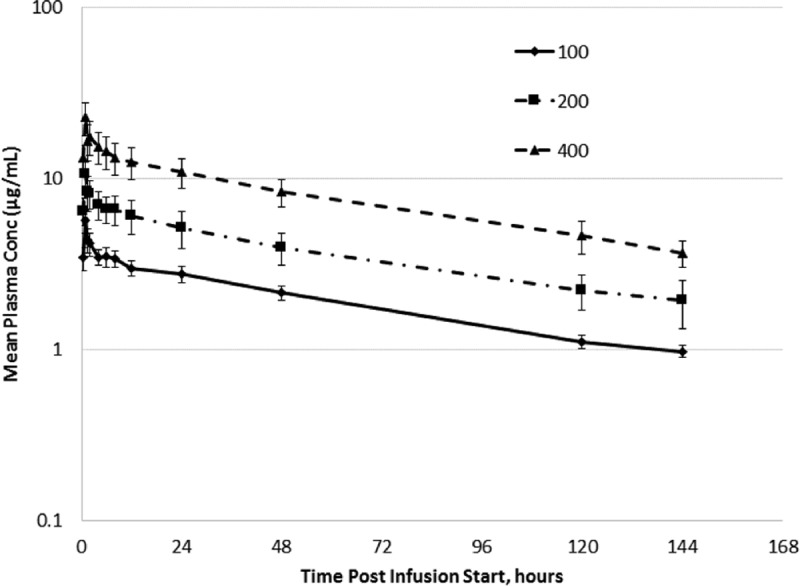
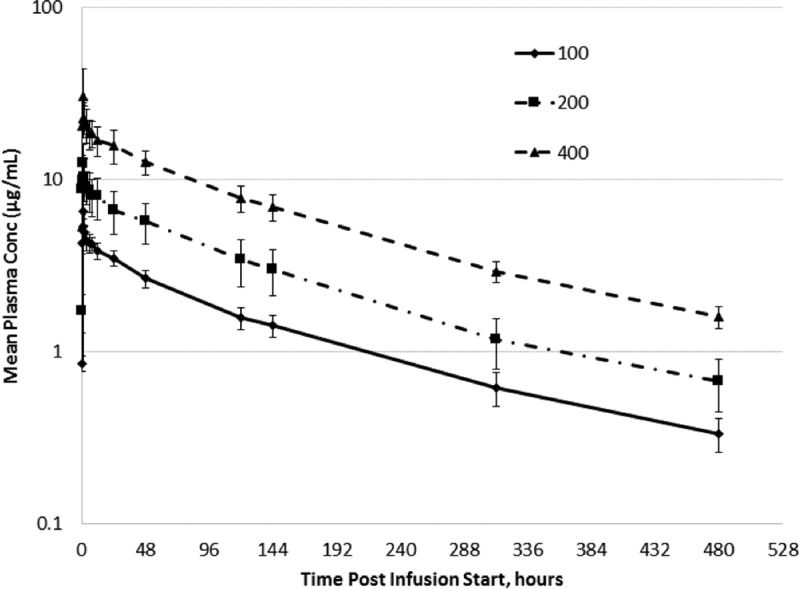
CD101 IV is a novel echinocandin with distinctive pharmacokinetic properties that is being developed as a once-weekly treatment for candidemia and invasive candidiasis. CD101 has potent in vitro activity and in vivo efficacy against a broad range of Candida and Aspergillus species. The primary objective of two randomized, double-blind, placebo-controlled, dose-escalation studies in healthy adults was to determine the safety and tolerability of CD101 IV. Sequential cohorts of 8 subjects ( n = 6, active; n = 2, placebo) were administered single (50, 100, 200, 400 mg) or multiple once-weekly (100 mg given once weekly for two weeks [×2], 200 mg ×2, 400 mg ×3) doses of CD101 IV infused over 1 h. There were no deaths, serious adverse events (SAEs), severe adverse events (AEs), or withdrawals from the study due to an AE. The majority of AEs were mild, and all completely resolved. There was a higher incidence of total AEs and mild transient infusion reactions in the 400-mg ×3 dose group. There were no clinically meaningful trends in postbaseline laboratory abnormalities and no safety issues related to electrocardiograms, vital signs, or physical exams. CD101 showed dose-proportional plasma exposures, minor accumulation (30% to 55%), low apparent clearance (<0.28 liter/h), long half-life ( t 1/2 ) (>80 h), and minimal urine excretion. CD101 IV was safe and well tolerated at single and multiple doses of up to 400 mg given once weekly for 3 weeks and exhibited a long t 1/2 , minimal accumulation over several weeks, negligible renal excretion, and high plasma exposures enabling once-weekly dosing.
Overview
The claims and statistics of this paper haven’t been checked yet.
Free: it reads the open-access text and checks the first 5 claims that cite a source we can check. Create a free account to check every claim.
Integrity signals
Registry
Cites
Statistics
Figures
Verification
Claims the paper makes
The claims and statistics of this paper haven’t been checked yet.
Free: it reads the open-access text and checks the first 5 claims that cite a source we can check. Create a free account to check every claim.
Claims other papers make about this one
Each is checked against this paper’s own text: does it say what the citing paper says it does?
The source backs part of the claim, not all of it — or backs it for a different population, condition or comparison.
In the citing paper
“It is highly soluble in aqueous systems and has a half-life of over 130 h in humans, compared to 24, 9–11, 10–17 h half-lives of anidulafungin, caspofungin, and micafungin, respectively (Kofla and Ruhnke, 2011; Sandison et al., 2017).”
From Fungal Cell Wall: Emerging Antifungals and Drug Resistance. (2019) · cites this paper as Sandison et al., 2017
Experimental — accuracy not yet measured
Self-check
Percentages, sums and reported differences re-computed from the paper’s own numbers.
The self-check needs the paper’s full text.
Citations
Cites
Wisplinghoff, H., Bischoff, T., Tallent, S. M., Seifert, H., Wenzel, R. P., & Edmond, M. B. (2004) · Clinical Infectious Diseases · doi:10.1086/421946 · Cited by 4,496
Multistate point-prevalence survey of health care-associated infections
Magill, S. S., Edwards, J. R., Bamberg, W., Beldavs, Z. G., Dumyati, G., Kainer, M. A., Lynfield, R., Maloney, M., McAllister-Hollod, L., Nadle, J., et al. (2014) · New England Journal of Medicine · doi:10.1056/nejmoa1306801 · Cited by 3,931
Craig, W. A. (1998) · Clinical Infectious Diseases · doi:10.1086/516284 · Cited by 2,908
Pappas, P. G., Kauffman, C. A., Andes, D. R., Clancy, C. J., Marr, K. A., Ostrosky-Zeichner, L., Reboli, A. C., Schuster, M. G., Vazquez, J. A., Walsh, T. J., et al. (2016) · Clinical Infectious Diseases · doi:10.1093/cid/civ1194 · Cited by 1,298
Morrell, M., Fraser, V. J., & Kollef, M. H. (2005) · Antimicrobial Agents and Chemotherapy · doi:10.1128/aac.49.9.3640-3645.2005 · Cited by 1,286
Garey, K. W., Rege, M., Pai, M. P., Mingo, D. E., Suda, K. J., Turpin, R. S., & Bearden, D. T. (2006) · Clinical Infectious Diseases · doi:10.1086/504810 · Cited by 1,171
Antifungal drug resistance: mechanisms, epidemiology, and consequences for treatment
Pfaller, M. A. (2012) · The American Journal of Medicine · doi:10.1016/j.amjmed.2011.11.001 · Cited by 903
Epidemiology of Invasive Mycoses in North America
Pfaller, M. A., & Diekema, D. J. (2010) · Critical Reviews in Microbiology · doi:10.3109/10408410903241444 · Cited by 901 · cited 2×
“5) 699 (97) 696 (97) 969 (98) 790 (98) Abnormal—not clinically significant 19 (4) 0 16 (3) 5 (1) 18 (3) 21 (3) 24 (3) 21 (2) 20 (3)”
Alexander, B. D., Johnson, M. D., Pfeiffer, C. D., Jiménez-Ortigosa, C., Catania, J., Booker, R., Castanheira, M., Messer, S. A., Perlin, D. S., & Pfaller, M. A. (2013) · Clinical Infectious Diseases · doi:10.1093/cid/cit136 · Cited by 778 · cited 2×
“Hematologyc Normal 78 (87) 80 (99) 89 (99) 88 (98) 115 (96) 136 (94) 137 (95) 198 (100) 159 (98) Abnormal—not clinically significant 12 (13) 2 (2) 1 (1) 2 (2) 5 (4) 8 (6) 7 (5) 0 3 (2)”
BackgroundCorrelation of Antimicrobial Pharmacokinetic Parameters with Therapeutic Efficacy in an Animal Model
Vogelman, B., Gudmundsson, S., Leggett, J., Turnidge, J., Ebert, S., & Craig, W. A. (1988) · The Journal of Infectious Diseases · doi:10.1093/infdis/158.4.831 · Cited by 720 · cited 1×
“All TEAEs 3 (50) 0 3 (50) 1 (17) 5 (63) 3 (50) 2 (33) 4 (67) 2 (33) Abdominal distension 0 0 0 0 0 0 0 1 (17) 0 Abdominal pain 0 0 1 (17) 0 0 0 0 1 (17) 0 Abdominal pain lower 0 0 0 0 1 (13) 0 0 0 0 Alopecia 0 0 0 0 0 0 0 1 (17) 0 Aphthous stomatitis 0 0 1 (17) 0 0 0 0 1 (17) 0 Arthralgia 0 0 0 0 2 (25) 0 0 0 0 Arthro…”
Research works printed but not linked: 1
- Pfizer Roerig. 11 2013 Eraxis (anidulafungin) (package insert). Pfizer Roerig, New York, NY http://labeling.pfizer.com/showlabeling.aspx?id=566 Accessed 19 October 2016.
Cited by
Antifungal resistance: current trends and future strategies to combat
Wiederhold, N. (2017) · Infection and Drug Resistance · doi:10.2147/idr.s124918 · Cited by 468
The Antifungal Pipeline: Fosmanogepix, Ibrexafungerp, Olorofim, Opelconazole, and Rezafungin
Hoenigl, M., Sprute, R., Egger, M., Arastehfar, A., Cornely, O. A., Krause, R., Lass-Flörl, C., Prattes, J., Spec, A., Thompson, G. R., et al. (2021) · Drugs · doi:10.1007/s40265-021-01611-0 · Cited by 467
“Renal clearance plays a minor role in the excretion of rezafungin with fractions excreted < 1% at all dose concentrations [190].”
BackgroundInfluentialHusain, S., & Camargo, J. F. (2019) · Clinical Transplantation · doi:10.1111/ctr.13544 · Cited by 302
Echinocandins – structure, mechanism of action and use in antifungal therapy
Szymański, M., Chmielewska, S., Czyżewska, U., Malinowska, M., & Tylicki, A. (2022) · Journal of Enzyme Inhibition and Medicinal Chemistry · doi:10.1080/14756366.2022.2050224 · Cited by 270
Aspiring Antifungals: Review of Current Antifungal Pipeline Developments
Gintjee, T., Donnelley, M., & Thompson, G. (2020) · Journal of Fungi · doi:10.3390/jof6010028 · Cited by 225
“Dose-proportional pharmacokinetics have been demonstrated with little interpatient variability and a favorable safety profile [14].”
Background
Metadata
- Authors
- Sandison, T., Ong, V., Lee, J., & Thye, D.
- Affiliations
- Cidara Therapeutics (United States) (US)
- Corresponding author
- Sandison, Taylor
- Venue
- Antimicrobial Agents and Chemotherapy
- Publisher
- American Society for Microbiology
- Published
- 2017-02
- Volume
- 61
- Issue
- 2
- ISSN
- 0066-4804 (ISSN-L)
- 1098-6596
- PMC
- PMC5278714
- OpenAlex
- W2560804544
- Cited by
- 161
- References
- 36
- Citations by year
- 2026: 13 · 2025: 17 · 2024: 20 · 2023: 13 · 2022: 16 · 2021: 17 · 2020: 22 · 2019: 14 · 2018: 11 · 2017: 16
- FWCI
- 12.93
- Type
- journal article
- Language
- en
- Open access
- hybrid
- doi.org
- Licence
- cc-by
- creativecommons.org/licenses/by/4.0/ (vor)
- journals.asm.org/non-commercial-tdm-license (tdm)
- Locations
- Antimicrobial Agents and Chemotherapy (publishedVersion, cc-by)
- PubMed Central (publishedVersion, cc-by)
- PubMed (publishedVersion)
- Topics
- Health Sciences › Medicine › Infectious Diseases › Antifungal resistance and susceptibility
- Health Sciences › Medicine › Pharmacology (medical) › Antibiotics Pharmacokinetics and Efficacy
- Health Sciences › Medicine › Pediatrics, Perinatology and Child Health › Pharmaceutical studies and practices
- Keywords
- CD101, echinocandins, candidemia, invasive candidiasis, pharmacokinetics, safety and tolerability, weekly dosing, Candida, Aspergillus, dose escalation, infusion reactions, drug accumulation, renal excretion
- MeSH terms
- Adult, Drug Administration Schedule, Female, Humans, Male, Middle Aged, Echinocandins, Healthy Volunteers
About these checks
Registry, retraction, Cites and statistics results are computed, not judged, with one exception: a printed reference that no index lists is read once by a model before it counts as a citation error. Claims are extracted by a model and kept only when their quote appears verbatim in the text; each cited source is then checked, with a model’s help, for whether it says what the claim relies on. Those verdicts can be wrong — read the claim’s quote and the cited source before relying on one.
Statistics and arithmetic are recomputed, not judged.
Confidence bands are shown only for fields calibrated on our annotated test set. None is calibrated yet, so no band is shown.
What counts as a claim ›How we measure confidence ›How we check this ›
Are you an author, or do you see a problem with this page? Request a review
How to cite
Cite CoChat for the checks on this page, and the paper for its own findings.
- This page
- CoChat. (2026). Citation check: Safety and Pharmacokinetics of CD101 IV, a Novel Echinocandin, in Healthy Adults. https://app.cochat.ai/papers/10.1128/aac.01627-16
- The paper
- Sandison, T., Ong, V., Lee, J., & Thye, D. (2017). Safety and Pharmacokinetics of CD101 IV, a Novel Echinocandin, in Healthy Adults. Antimicrobial Agents and Chemotherapy. https://doi.org/10.1128/aac.01627-16
Data sources
Bibliographic data: Semantic Scholar, OpenAlex, Crossref.
Contains information from the Semantic Scholar Academic Graph Datasets, made available under the ODC Attribution License (ODC-BY 1.0).
Semantic Scholar’s data is described in: Kinney, R., et al. (2023). The Semantic Scholar Open Data Platform. arXiv:2301.10140.
