

Using generative AI for interview simulations to enhance student research skills in biology education
Open accessThe DOI matches its Crossref record; 12 of the 12 references it cites were found in a registry or an index; 2 of the 12 sources its claims cite were checked for support.
Abstract
The Longevity Games Interview Simulator provides an innovative approach to preparing students for real-world research interactions by leveraging the capabilities of large language models (LLMs) like OpenAI’s GPT-4o and Claude-3.7. This paper outlines the development and demonstrates the benefits of the simulator, designed to mimic interviews with older adults to enhance students’ interviewing skills, empathy, and cultural competence. Key outcomes included preparing students for real-world interactions with interview subjects, improving their ability to identify and properly document protected health information (PHI), gaining experience in asking relevant follow-up questions, and directing conversations to achieve interview goals. The simulator used generative AI models to create realistic interview scenarios based on demographic data from Rochester, NY. Components of the simulator included a student interview-question selection and creation portion, an interview-guide worksheet, a post-simulation quiz on the materials, and a reflective exercise focusing on information gathering and ethical considerations regarding PHI. This tool was designed for the Science of Aging course’s CURE (Course-Based Undergraduate Research Experience) to provide students with practical, repeatable interview practice. A small pilot study with senior nursing students indicated that the simulator improved students’ confidence, preparedness, and understanding of ethical considerations. This paper also discusses how the simulator has potential for adaptation across educational contexts and encourages educators to develop their own custom interview simulations.
Overview
CoChat Summary
TL;DR
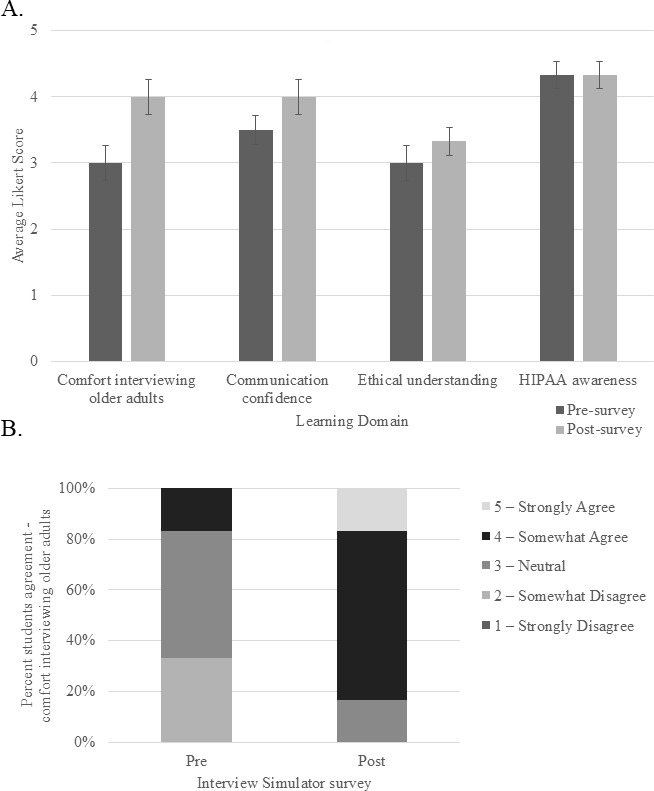
The paper describes the Longevity Games Interview Simulator, a generative-AI Custom GPT/DALL-E 3 tool for practicing interviews with simulated older adults in a biology CURE. A six-student nursing pilot found improved interview comfort (median 3.0–4.0, P = 0.030) and generally positive perceptions, while other measures were not statistically significant.
Key findings
- In a pilot with six senior nursing students, interview comfort improved from a median of 3.0 to 4.0 (P = 0.030, Wilcoxon signed-rank test); communication confidence (P = 0.083) and ethical understanding (P = 0.157) did not reach significance.
- Five of six students felt the simulator helped improve their interviewing skills, and four recommended it be used earlier in the nursing curriculum.
- Students valued the low-pressure environment; some found AI responses overly polished but still useful, and students with prior geriatric care experience reported smaller shifts.
- The simulator was designed to prepare students for real-world interactions, improve identification and documentation of protected health information (PHI), and give practice asking relevant follow-up questions and directing conversations toward interview goals.
Methods
- The Longevity Games Interview Simulator (LGIS) was built with a Custom GPT and DALL·E 3, generating realistic older adult profiles and portraits based on Rochester, NY demographics; it included student question selection/creation, an interview-guide worksheet, a post-simulation quiz, and a reflective exercise on information gathering and PHI ethics.
- Because BIOL 206 was not offered in 2024–2025, the pilot was conducted with six senior-level nursing students preparing to enter geriatric clinical rotations; they completed pre- and post-simulation surveys on comfort, confidence, and ethical/legal awareness, including HIPAA, using Likert-scale and open-ended questions.
- Analysis compared pre- and post-simulation Likert scores, reported medians and P values, and used the Wilcoxon signed-rank test; qualitative feedback was also collected.
Limitations
- The paper states that this was a small pilot study with six senior nursing students, not the intended BIOL 206 population; some students found responses overly polished and suggested realism improvements, and students with prior geriatric experience reported smaller shifts. The paper also refers readers to Appendix S9 for limitations and lessons learned, which is not included in the provided text.
- Evident from the text: there was no control or comparison group, outcomes relied on self-reported pre/post surveys, and the study assessed short-term perceptions rather than actual interview performance with real older adults.
- Evident from the text: the small sample and nursing-student pilot limit generalizability to broader biology or undergraduate populations.
Model-written summary. Check it against the paper before relying on it.
Integrity signals
Registry
Cites
Statistics
Figures
Verification
Claims the paper makes
2 Valid · 0 Not valid · 3 Not checked · 20 Own results and interpretations
A result the paper states — it cites no source for it, so there is none to check. The quote shows it is in the paper.
In the paper
“The simulator also introduced students to key ethical considerations, including HIPAA compliance, through interactive reflection and guided questioning.”
§ Using generative AI for interview simulations to enhance student research skills in biology education > CONCLUSION
plainstates a cause- Asserted: passes — The authors put it forward as true.
- Checkable: passes — It can be checked against evidence.
- Load-bearing: passes — The paper’s conclusions depend on it.
- Based: passes — The paper gives a reason why it holds.
A result the paper reports from its own data — it cites no other source for it, so there is none to check. The quote shows it is in the paper.
In the paper
“Participants noted that the guided format and opportunity to reflect on ethical challenges made the tool particularly helpful as preparation for real patient interactions.”
§ Using generative AI for interview simulations to enhance student research skills in biology education > CONCLUSION
plainn = 6- Asserted: passes — The authors put it forward as true.
- Checkable: passes — It can be checked against evidence.
- Load-bearing: passes — The paper’s conclusions depend on it.
- Based: passes — The paper gives a reason why it holds.
A result the paper reports from its own data — it cites no other source for it, so there is none to check. The quote shows it is in the paper.
In the paper
“Five out of six students felt the simulator helped improve their interviewing skills, and four recommended it be used earlier in the nursing curriculum for maximum benefit.”
§ Using generative AI for interview simulations to enhance student research skills in biology education > CONCLUSION
plainstates a causen = 6- Asserted: passes — The authors put it forward as true.
- Checkable: passes — It can be checked against evidence.
- Load-bearing: passes — The paper’s conclusions depend on it.
- Based: passes — The paper gives a reason why it holds.
A result the paper reports from its own data — it cites no other source for it, so there is none to check. The quote shows it is in the paper.
In the paper
“Five out of six students felt the simulator helped improve their interviewing skills, and four recommended it be used earlier in the nursing curriculum for maximum benefit.”
§ Using generative AI for interview simulations to enhance student research skills in biology education > CONCLUSION
plainn = 6- Asserted: passes — The authors put it forward as true.
- Checkable: passes — It can be checked against evidence.
- Load-bearing: passes — The paper’s conclusions depend on it.
- Based: passes — The paper gives a reason why it holds.
A result the paper reports from its own data — it cites no other source for it, so there is none to check. The quote shows it is in the paper.
In the paper
“A small pilot study with senior nursing students indicated that the simulator improved students’ confidence, preparedness, and understanding of ethical considerations.”
- Also stated in: § INTRODUCTION · plain
“In a small pilot study with senior nursing students about to enter a geriatric clinical rotation, the simulator supported growth in confidence, ethical awareness, and comfort discussing age-related topics.”
- Also stated in: § CONCLUSION · hedged
“Communication confidence and awareness of ethical issues also showed modest gains (insignificant P > 0.05).”
§ Using generative AI for interview simulations to enhance student research skills in biology education > Abstract
plainstates a cause- Asserted: passes — The authors put it forward as true.
- Checkable: passes — It can be checked against evidence.
- Load-bearing: passes — The paper’s conclusions depend on it.
- Based: passes — The paper gives a reason why it holds.
- Also stated in: § INTRODUCTION · plain
8 more claims
Create a free account to see all 25 claims and to verify the 2 references still open.
- Probably not a substantial claim. 6
- It may state two separate claims as one. 7
- The quote only partly states this claim. 2
Citations
Cites
(1983) · Cited by 33,192
Radianti, J., Majchrzak, T. A., Fromm, J., & Wohlgenannt, I. (2020) · Computers & Education · doi:10.1016/j.compedu.2019.103778 · Cited by 3,585 · cited 1×
“Beyond the Longevity Games , practical simulations benefit students by preparing students for practical experiences (17–19).”
The effect of games and simulations on higher education: a systematic literature review
Vlachopoulos, D., & Makri, A. (2017) · International Journal of Educational Technology in Higher Education · doi:10.1186/s41239-017-0062-1 · Cited by 776
Evaluating Clinical Simulations for Learning Procedural Skills: A Theory-Based Approach
Kneebone, R. (2005) · Academic Medicine · doi:10.1097/00001888-200506000-00006 · Cited by 423 · cited 1×
“Classroom role-play helps, but lacks the distinctiveness of real conversations (5).”
Artificial Intelligence: Definition and Background
Sheikh, H., Prins, C., & Schrijvers, E. (2023) · Research for Policy · doi:10.1007/978-3-031-21448-6_2 · Cited by 389
Popkewitz, T. S. (1998) · American Educational Research Journal · doi:10.3102/00028312035004535 · Cited by 175
Rao, D., & Stupans, I. (2012) · Innovations in Education and Teaching International · doi:10.1080/14703297.2012.728879 · Cited by 172 · cited 1×
“Beyond the Longevity Games , practical simulations benefit students by preparing students for practical experiences (17–19).”
Enhancing Student Experiential Learning With Structured Interviews
Cornell, R. M., Johnson, C. B., & Schwartz, W. C. (2013) · Journal of Education for Business · doi:10.1080/08832323.2012.659296 · Cited by 49
Chua, I. S., Bogetz, A. L., Bhansali, P., Long, M., Holbreich, R., Kind, T., Ottolini, M., Park, Y. S., Lineberry, M., & Hirshfield, L. E. (2019) · Academic Medicine · doi:10.1097/acm.0000000000002914 · Cited by 10
First-year students as interviewers: Uncovering what it means to be an engineer
Courter, S. S., & Anderson, K. J. B. (2009) · 2009 39th IEEE Frontiers in Education Conference · doi:10.1109/fie.2009.5350568 · Cited by 6 · cited 1×
“B iology education often emphasizes coursework and labs, but real-world interac tions build empathy and deepen student understanding of research subjects (1–4).”
Davis, B. D., Flannery, M., Lowe, M., & Payne, J. S. (2014) · Journal of Microbiology & Biology Education · doi:10.1128/jmbe.v15i1.640 · Cited by 2 · cited 1×
“B iology education often emphasizes coursework and labs, but real-world interac tions build empathy and deepen student understanding of research subjects (1–4).”
Editorial: The Admission Officer
Fogarty, R. S. (1999) · The Antioch Review · doi:10.2307/4613776 · Cited by 1
Cited by
Madleňák, R., Madleňáková, L., Cvacho, V., & Gachulinec, D. (2026) · Education Sciences · doi:10.3390/educsci16040555 · Cited by 18
Yan, X., Wang, Z., Chen, O., & Guo, Y. (2026) · Nurse Education Today · doi:10.1016/j.nedt.2026.107217 · Cited by 4
Using artificial intelligence as a mindtool to foster critical thinking in biology education
Mawn, M. V., & Washington, J. M. (2026) · Journal of Microbiology and Biology Education · doi:10.1128/jmbe.00048-26 · Cited by 4
HireSense: A Scalable Domain-Specific AI Interviewer Using LLMs and RAG
Shukla, K., Chauhan, R., Ali, M., et al. (2026) · International Conference on Innovative Practices in Technology and Management (ICIPTM) · doi:10.1109/iciptm69057.2026.11466117
“…and interface design play a key role in building trust among candidates participating in an automated video interview process, while Millen [8] focuses on how generative AI (Artificial Intelligence) simulated interviews can help provide similar experiences for students who are being…”
Ciubotariu, I. I., & Bosch, G. (2026) · Journal of Microbiology and Biology Education · doi:10.1128/jmbe.00044-26
Metadata
- Authors
- Millen, J. I.
- Affiliations
- St. John Fisher University (US)
- Corresponding author
- Millen, Jonathan I.
- ORCID
- Millen, Jonathan I.
- Venue
- Journal of Microbiology & Biology Education
- Publisher
- American Society for Microbiology
- Published
- 2025-08-21
- Volume
- 26
- Issue
- 2
- Pages
- e0012225-e0012225
- ISSN
- 1935-7877 (ISSN-L)
- 1935-7885
- PMC
- PMC12369313
- OpenAlex
- W4412557558
- Cited by
- 8
- References
- 12
- Citations by year
- 2026: 7 · 2025: 1
- FWCI
- 5.15
- Type
- journal article
- Language
- en
- Open access
- gold
- doi.org
- Licence
- cc-by-nc-nd
- creativecommons.org/licenses/by-nc-nd/4.0/ (vor)
- journals.asm.org/non-commercial-tdm-license (tdm)
- Locations
- Journal of Microbiology and Biology Education (publishedVersion, cc-by-nc-nd)
- PubMed Central (publishedVersion, cc-by-nc-nd)
- PubMed (publishedVersion)
- DOAJ (DOAJ: Directory of Open Access Journals) (submittedVersion, cc-by-sa)
- Topics
- Social Sciences › Education › Simulation-Based Education in Healthcare
- Social Sciences › Education › Artificial Intelligence in Education
- Social Sciences › Education › Innovative Teaching Methodologies in Social Sciences
- Keywords
- job interview simulation, generative AI, large language models, interview skills, research skills, biology education, older adults, protected health information, research ethics, empathy, cultural competence, course-based undergraduate research experiences, nursing students, aging research, reflective practice
About these checks
Registry, retraction, Cites and statistics results are computed, not judged, with one exception: a printed reference that no index lists is read once by a model before it counts as a citation error. Claims are extracted by a model and kept only when their quote appears verbatim in the text; each cited source is then checked, with a model’s help, for whether it says what the claim relies on. Those verdicts can be wrong — read the claim’s quote and the cited source before relying on one.
The claim verdicts this report counts are experimental: their accuracy is not yet measured.
A language model drew the claims from the paper on 2026-10-10, under version 3 of the claim definition (model deepseek-v4.1-flash, prompt extract-v3).
A second model labelled each claim on 2026-10-10 (model jev-1.13-20260917, definition revision gold-guideline-v0.2).
Statistics and arithmetic are recomputed, not judged.
Confidence bands are shown only for fields calibrated on our annotated test set. None is calibrated yet, so no band is shown.
What counts as a claim ›How we measure confidence ›How we check this ›
Are you an author, or do you see a problem with this page? Request a review
Data sources
Bibliographic data: Semantic Scholar, OpenAlex, Crossref.
Contains information from the Semantic Scholar Academic Graph Datasets, made available under the ODC Attribution License (ODC-BY 1.0).
Semantic Scholar’s data is described in: Kinney, R., et al. (2023). The Semantic Scholar Open Data Platform. arXiv:2301.10140.
