

Volatile Compounds Emitted by Pseudomonas aeruginosa Stimulate Growth of the Fungal Pathogen Aspergillus fumigatus
Open accessThe DOI matches its Crossref record; 22 of the 22 references it cites were found in a registry or an index.
Abstract
Chronic lung infections with opportunistic bacterial and fungal pathogens are a major cause of morbidity and mortality especially in patients with cystic fibrosis. Pseudomonas aeruginosa is the most frequently colonizing bacterium in these patients, and it is often found in association with the filamentous fungus Aspergillus fumigatus . P. aeruginosa is known to inhibit the growth of A. fumigatus in situations of direct contact, suggesting the existence of interspecies communication that may influence disease outcome. Our study shows that the lung pathogens P. aeruginosa and A. fumigatus can interact at a distance via volatile-mediated communication and expands our understanding of interspecific signaling in microbial communities. IMPORTANCE Microbiota studies have shown that pathogens cannot be studied individually anymore and that the establishment and progression of a specific disease are due not to a single microbial species but are the result of the activity of many species living together. To date, the interaction between members of the human microbiota has been analyzed in situations of direct contact or liquid-mediated contact between organisms. This study showed unexpectedly that human opportunistic pathogens can interact at a distance after sensing volatiles emitted by another microbial species. This finding will open a new research avenue for the understanding of microbial communities.
Overview
The claims and statistics of this paper haven’t been checked yet.
Free: it reads the open-access text and checks the first 5 claims that cite a source we can check. Create a free account to check every claim.
Integrity signals
Registry
Cites
Statistics
Figures
Verification
Claims the paper makes
The claims and statistics of this paper haven’t been checked yet.
Free: it reads the open-access text and checks the first 5 claims that cite a source we can check. Create a free account to check every claim.
Claims other papers make about this one
Each is checked against this paper’s own text: does it say what the citing paper says it does?
The source backs part of the claim, not all of it — or backs it for a different population, condition or comparison.
In the citing paper
“A. fumigatus also has mastered how to compete with the myriad of soil bacteria and how to use microbial metabolites as nutritional inputs (585).”
From Aspergillus fumigatus and Aspergillosis in 2019 (2019) · cites this paper as [585]
Experimental — accuracy not yet measuredThe cited source says what the claim attributes to it.
In the citing paper
“P. aeruginosa stimulates the growth of Aspergillus fumigatus through sensing volatile metabolites at a distance130.”
From The microbiota of the respiratory tract: gatekeeper to respiratory health (2017) · cites this paper as [130]
In the citing paper
“P. aeruginosa produces volatile chemicals (VOCs) that stimulate A. fumigatus growth (585)”
From Aspergillus fumigatus and Aspergillosis in 2019 (2019) · cites this paper as [585]
In the citing paper
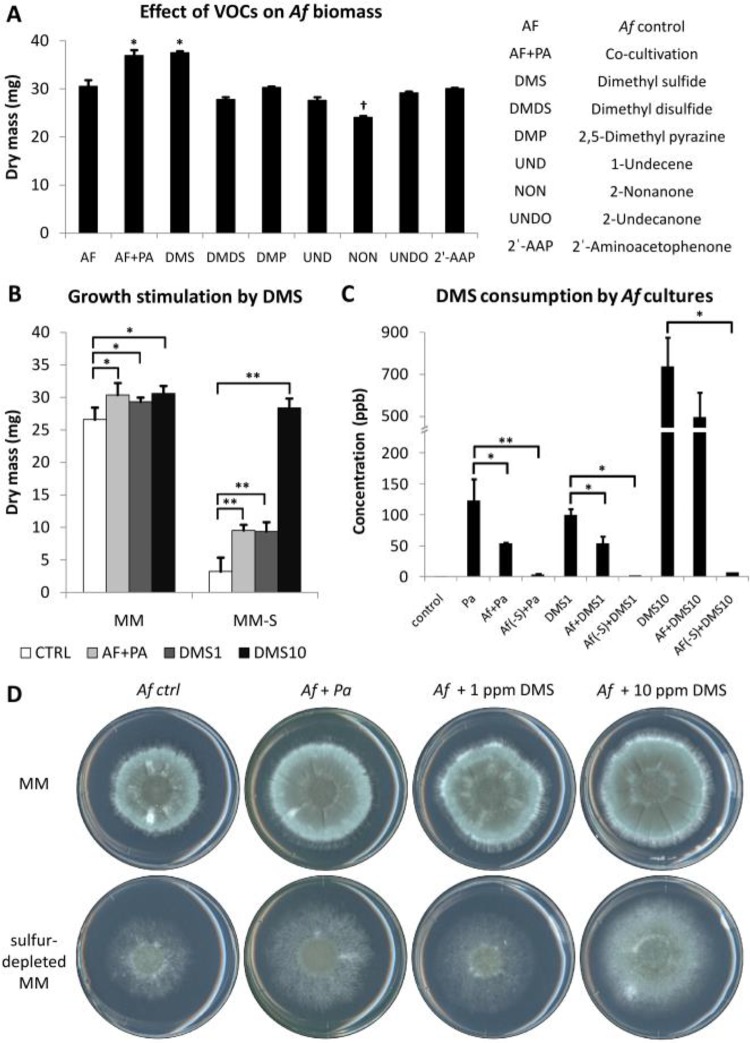
“At physiological concentrations, the bacterial dimethyl sulfoxide (DMS) significantly augmented the growth of A. fumigatus, and this effect was amplified when the fungus was grown under sulfur starvation.”
From Aspergillus fumigatus and Aspergillosis in 2019 (2019) · cites this paper as [585]
Self-check
Percentages, sums and reported differences re-computed from the paper’s own numbers.
The self-check needs the paper’s full text.
Citations
Cites
The induction and repression of nitrate reductase in the fungus Aspergillus nidulans
Cove, D. J. (1966) · Biochimica et Biophysica Acta (BBA) - Enzymology and Biological Oxidation · doi:10.1016/s0926-6593(66)80120-0 · Cited by 1,038 · cited 1×
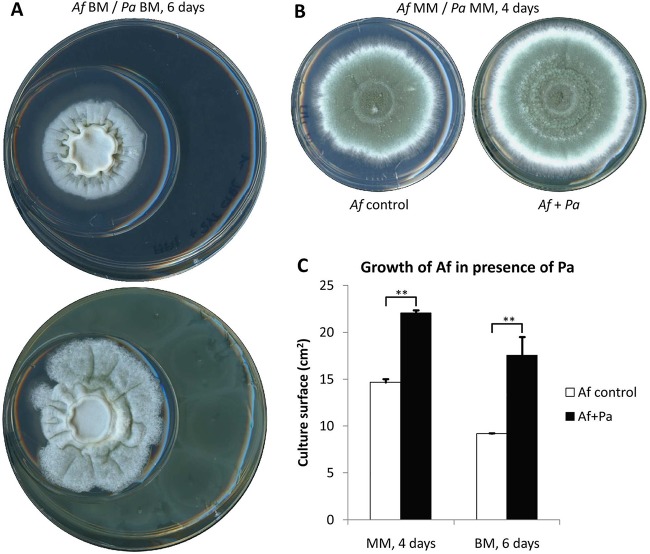
“Two defined media were used: minimal medium (MM) (9), which supports rapid radial growth, and Brian medium (BM) (10), which supports slower growth.”
MethodFrey-Klett, P., Burlinson, P., Deveau, A., Barret, M., Tarkka, M., & Sarniguet, A. (2011) · Microbiology and Molecular Biology Reviews · doi:10.1128/mmbr.00020-11 · Cited by 913
Medically important bacterial-fungal interactions
Peleg, A. Y., Hogan, D. A., & Mylonakis, E. (2010) · Nature Reviews Microbiology · doi:10.1038/nrmicro2313 · Cited by 619
Volatile antimicrobials from Muscodor crispans, a novel endophytic fungus
Mitchell, A. M., Strobel, G. A., Moore, E., Robison, R., & Sears, J. (2010) · Microbiology · doi:10.1099/mic.0.032540-0 · Cited by 484
Volatile affairs in microbial interactions
Schmidt, R., Cordovez, V., de Boer, W., Raaijmakers, J., & Garbeva, P. (2015) · The ISME Journal · doi:10.1038/ismej.2015.42 · Cited by 481 · cited 1×
“The importance of VOCs in ecology has been underestimated for a long time, but recent and ongoing work emphasizes the role of microbial communication via the gas phase (3, 4).”
BackgroundVolatile antimicrobials from Muscodor albus, a novel endophytic fungus
Strobel, G. A., Sears, J., Dirkse, E., & Markworth, C. (2001) · Microbiology · doi:10.1099/00221287-147-11-2943 · Cited by 475 · cited 2×
“Aspergillus fumigatus was inhibited by volatile antimicrobials from an endophytic fungus (8).”
BackgroundMethodVolatiles of bacterial antagonists inhibit mycelial growth of the plant pathogen Rhizoctonia solani
Kai, M., Effmert, U., Berg, G., & Piechulla, B. (2007) · Archives of Microbiology · doi:10.1007/s00203-006-0199-0 · Cited by 428
Amin, R., Dupuis, A., Aaron, S. D., & Ratjen, F. (2010) · Chest · doi:10.1378/chest.09-1103 · Cited by 376 · cited 1×
“aeruginosa and a more rapid decline in lung functionality (19, 20).”
BackgroundFungal volatile organic compounds and their role in ecosystems
Hung, R., Lee, S., & Bennett, J. W. (2015) · Applied Microbiology and Biotechnology · doi:10.1007/s00253-015-6494-4 · Cited by 275 · cited 1×
“The importance of VOCs in ecology has been underestimated for a long time, but recent and ongoing work emphasizes the role of microbial communication via the gas phase (3, 4).”
BackgroundProduction of Bioactive Volatiles by Different Burkholderia ambifaria Strains
Groenhagen, U., Baumgartner, R., Bailly, A., Gardiner, A., Eberl, L., Schulz, S., & Weisskopf, L. (2013) · Journal of Chemical Ecology · doi:10.1007/s10886-013-0315-y · Cited by 258 · cited 1×
“For these experiments, the organisms were grown on modified minimal medium (6) with 20 mM glutamine instead of ammonium tartrate as the nitrogen source or on Brian’s broth (7).”
Method
Cited by
Aspergillus fumigatus and Aspergillosis in 2019
Latgé, J.-P., & Chamilos, G. (2019) · Clinical Microbiology Reviews · doi:10.1128/cmr.00140-18 · Cited by 1,400
Self-citationThe microbiota of the respiratory tract: gatekeeper to respiratory health
Man, W. H., de Steenhuijsen Piters, W. A. A., & Bogaert, D. (2017) · Nature Reviews Microbiology · doi:10.1038/nrmicro.2017.14 · Cited by 1,384
“Furthermore, P. aeruginosa stimulates the growth of Aspergillus fumigatus through sensing volatile metabolites at a distance 130 .”
BackgroundBacterial–fungal interactions: ecology, mechanisms and challenges
Deveau, A., Bonito, G., Uehling, J., Paoletti, M., Becker, M., Bindschedler, S., Hacquard, S., Hervé, V., Labbé, J., Lastovetsky, O. A., et al. (2018) · FEMS Microbiology Reviews · doi:10.1093/femsre/fuy008 · Cited by 794
Microbial volatile organic compounds in intra-kingdom and inter-kingdom interactions
Weisskopf, L., Schulz, S., & Garbeva, P. (2021) · Nature Reviews Microbiology · doi:10.1038/s41579-020-00508-1 · Cited by 509
Aspergillus fumigatus morphology and dynamic host interactions
van de Veerdonk, F. L., Gresnigt, M. S., Romani, L., Netea, M. G., & Latgé, J.-P. (2017) · Nature Reviews Microbiology · doi:10.1038/nrmicro.2017.90 · Cited by 490
Self-citation
Metadata
- Authors
- Briard, B., Heddergott, C., & Latgé, J.-P.
- Affiliations
- Institut Pasteur (FR)
- Corresponding author
- Latgé, Jean-Paul
- Venue
- mBio
- Publisher
- American Society for Microbiology
- Published
- 2016-05-04
- Volume
- 7
- Issue
- 2
- Pages
- e00219-e00219
- ISSN
- 2150-7511 (ISSN-L)
- 2161-2129
- PMC
- PMC4807360
- OpenAlex
- W2300302598
- Cited by
- 153
- References
- 22
- Citations by year
- 2026: 9 · 2025: 13 · 2024: 9 · 2023: 16 · 2022: 21 · 2021: 16 · 2020: 18 · 2019: 22 · 2018: 10 · 2017: 14 · 2016: 4
- FWCI
- 8.66
- Type
- journal article
- Language
- en
- Open access
- gold
- doi.org
- Licence
- cc-by
- creativecommons.org/licenses/by/4.0/ (vor)
- journals.asm.org/non-commercial-tdm-license (tdm)
- Locations
- mBio (publishedVersion, cc-by)
- PubMed Central (publishedVersion, cc-by)
- PubMed (publishedVersion)
- DOAJ (DOAJ: Directory of Open Access Journals) (submittedVersion)
- DOAJ (DOAJ: Directory of Open Access Journals) (submittedVersion, cc-by-sa)
- Funders
- Norsk Romsenter
- Topics
- Life Sciences › Biochemistry, Genetics and Molecular Biology › Molecular Biology › Bacterial biofilms and quorum sensing
- Life Sciences › Agricultural and Biological Sciences › Plant Science › Plant-Microbe Interactions and Immunity
- Health Sciences › Medicine › Infectious Diseases › Antifungal resistance and susceptibility
- Keywords
- Pseudomonas aeruginosa, Aspergillus fumigatus, volatile organic compounds, interspecies communication, fungal-bacterial interactions, cystic fibrosis, microbial communities, fungal growth stimulation
- MeSH terms
- Aspergillus fumigatus, Growth Substances, Pseudomonas aeruginosa, Volatile Organic Compounds, Microbial Interactions
About these checks
Registry, retraction, Cites and statistics results are computed, not judged, with one exception: a printed reference that no index lists is read once by a model before it counts as a citation error. Claims are extracted by a model and kept only when their quote appears verbatim in the text; each cited source is then checked, with a model’s help, for whether it says what the claim relies on. Those verdicts can be wrong — read the claim’s quote and the cited source before relying on one.
Statistics and arithmetic are recomputed, not judged.
Confidence bands are shown only for fields calibrated on our annotated test set. None is calibrated yet, so no band is shown.
What counts as a claim ›How we measure confidence ›How we check this ›
Are you an author, or do you see a problem with this page? Request a review
How to cite
Cite CoChat for the checks on this page, and the paper for its own findings.
- This page
- CoChat. (2026). Citation check: Volatile Compounds Emitted by Pseudomonas aeruginosa Stimulate Growth of the Fungal Pathogen Aspergillus fumigatus. https://app.cochat.ai/papers/10.1128/mbio.00219-16
- The paper
- Briard, B., Heddergott, C., & Latgé, J.-P. (2016). Volatile Compounds Emitted by Pseudomonas aeruginosa Stimulate Growth of the Fungal Pathogen Aspergillus fumigatus. mBio. https://doi.org/10.1128/mbio.00219-16
Data sources
Bibliographic data: Semantic Scholar, OpenAlex, Crossref.
Contains information from the Semantic Scholar Academic Graph Datasets, made available under the ODC Attribution License (ODC-BY 1.0).
Semantic Scholar’s data is described in: Kinney, R., et al. (2023). The Semantic Scholar Open Data Platform. arXiv:2301.10140.
