

Microbial Communities of the Upper Respiratory Tract and Otitis Media in Children
Open accessThe DOI matches its Crossref record; 54 of the 54 references it cites were found in a registry or an index.
Abstract
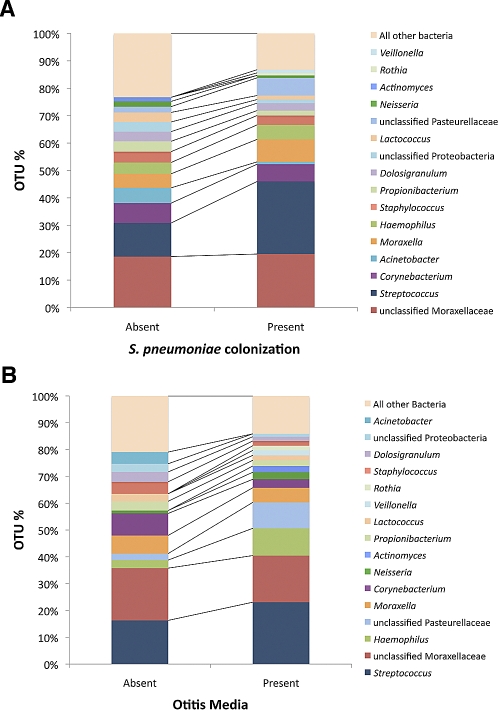
Streptococcus pneumoniae asymptomatically colonizes the upper respiratory tract of children and is a frequent cause of otitis media. Patterns of microbial colonization likely influence S. pneumoniae colonization and otitis media susceptibility. This study compared microbial communities in children with and without otitis media. Nasal swabs and clinical and demographic data were collected in a cross-sectional study of Philadelphia, PA, children (6 to 78 months) ( n = 108) during the 2008-2009 winter respiratory virus season. Swabs were cultured for S. pneumoniae . DNA was extracted from the swabs; 16S rRNA gene hypervariable regions (V1 and V2) were PCR amplified and sequenced by Roche/454 Life Sciences pyrosequencing. Microbial communities were described using the Shannon diversity and evenness indices. Principal component analysis (PCA) was used to group microbial community taxa into four factors representing correlated taxa. Of 108 children, 47 (44%) were colonized by S. pneumoniae , and 25 (23%) were diagnosed with otitis media. Microbial communities with S. pneumoniae were significantly less diverse and less even. Two PCA factors were associated with a decreased risk of pneumococcal colonization and otitis media, as follows: one factor included potentially protective flora ( Corynebacterium and Dolosigranulum ), and the other factor included Propionibacterium , Lactococcus , and Staphylococcus . The remaining two PCA factors were associated with an increased risk of otitis media. One factor included Haemophilus , and the final factor included Actinomyces , Rothia , Neisseria , and Veillonella . Generally, these taxa are not considered otitis media pathogens but may be important in the causal pathway. Increased understanding of upper respiratory tract microbial communities will contribute to the development of otitis media treatment and prevention strategies. IMPORTANCE Otitis media (middle ear infection) is the most common reason for pediatric sick visits in the United States. Streptococcus pneumoniae is a leading otitis media pathogen. S. pneumoniae must colonize the upper respiratory tract and compete with a complex community of nonpathogenic bacteria before infecting the middle ear. We compared microbial communities in the upper respiratory tract of children who had otitis media and those who did not. Members of the normal flora, i.e., Corynebacterium and Dolosigranulum , were protective for S. pneumoniae colonization and otitis media. As expected, the genera Haemophilus was associated with otitis media. Surprisingly, Actinomyces , Rothia , Neisseria , and Veillonella were associated with an increased risk of otitis media. These bacteria are not otitis media pathogens but may be associated with antibiotic use or involved in the causal pathway to disease. Increased understanding of upper respiratory tract microbial communities will lead to new ways to prevent middle ear infections, including probiotics.
Overview
The claims and statistics of this paper haven’t been checked yet.
Free: it reads the open-access text and checks the first 5 claims that cite a source we can check. Create a free account to check every claim.
Integrity signals
Registry
Cites
Statistics
Figures
Verification
Claims the paper makes
The claims and statistics of this paper haven’t been checked yet.
Free: it reads the open-access text and checks the first 5 claims that cite a source we can check. Create a free account to check every claim.
Claims other papers make about this one
Each is checked against this paper’s own text: does it say what the citing paper says it does?
The source backs part of the claim, not all of it — or backs it for a different population, condition or comparison.
In the citing paper
“Potential keystone species in the URT microbiota are Dolosigranulum spp. and Corynebacterium spp., as they have been strongly associated with respiratory health and the exclusion of potential pathogens, most notably Streptococcus pneumoniae, in several epidemiological and mechanistic studies21,29,68,69.”
From The microbiota of the respiratory tract: gatekeeper to respiratory health (2017) · cites this paper as [69]
Experimental — accuracy not yet measuredThe cited source says what the claim attributes to it.
In the citing paper
“the frequent co-occurrence of Corynebacterium spp. and Dolosigranulum spp. in the nasopharynx20,22,69, in which Dolosigranulum spp. might be responsible for the acidification of the local environment, which, in turn, may facilitate the expansion of Corynebacterium spp.; however, a direct interaction between these species cannot be ruled out.”
From The microbiota of the respiratory tract: gatekeeper to respiratory health (2017) · cites this paper as [69]
Self-check
Percentages, sums and reported differences re-computed from the paper’s own numbers.
The self-check needs the paper’s full text.
Citations
Cites
Naïve Bayesian Classifier for Rapid Assignment of rRNA Sequences into the New Bacterial Taxonomy
Wang, Q., Garrity, G. M., Tiedje, J. M., & Cole, J. R. (2007) · Applied and Environmental Microbiology · doi:10.1128/aem.00062-07 · Cited by 19,885 · cited 3×
“calculate the Shannon diversity and evenness indices (25, 26, 52, 53).”
BackgroundMethodGreengenes, a Chimera-Checked 16S rRNA Gene Database and Workbench Compatible with ARB
DeSantis, T. Z., Hugenholtz, P., Larsen, N., Rojas, M., Brodie, E. L., Keller, K., Huber, T., Dalevi, D., Hu, P., & Andersen, G. L. (2006) · Applied and Environmental Microbiology · doi:10.1128/aem.03006-05 · Cited by 10,891
Human gut microbes associated with obesity
Ley, R. E., Turnbaugh, P. J., Klein, S., & Gordon, J. I. (2006) · Nature · doi:10.1038/4441022a · Cited by 8,785
The Ribosomal Database Project: improved alignments and new tools for rRNA analysis
Cole, J. R., Wang, Q., Cardenas, E., Fish, J., Chai, B., Farris, R. J., Kulam-Syed-Mohideen, A. S., McGarrell, D. M., Marsh, T., Garrity, G. M., et al. (2009) · Nucleic Acids Research · doi:10.1093/nar/gkn879 · Cited by 4,762 · cited 1×
“calculate the Shannon diversity and evenness indices (25, 26, 52, 53).”
MethodMicrobial diversity in the deep sea and the underexplored “rare biosphere”
Sogin, M. L., Morrison, H. G., Huber, J. A., Welch, D. M., Huse, S. M., Neal, P. R., Arrieta, J. M., & Herndl, G. J. (2006) · Proceedings of the National Academy of Sciences · doi:10.1073/pnas.0605127103 · Cited by 3,701 · cited 1×
“calculate the Shannon diversity and evenness indices (25, 26, 52, 53).”
MethodBacterial Community Variation in Human Body Habitats Across Space and Time
Costello, E. K., Lauber, C. L., Hamady, M., Fierer, N., Gordon, J. I., & Knight, R. (2009) · Science · doi:10.1126/science.1177486 · Cited by 3,231 · cited 1×
“In our bodies, bacterial cells outnumber human cells (20, 21), and a majority of the bacteria that colonize and infect humans are not routinely cultured or cannot be cultured (22).”
BackgroundMICROBIAL ECOLOGY OF THE GASTROINTESTINAL TRACT
Savage, D. C. (1977) · Annual Review of Microbiology · doi:10.1146/annurev.mi.31.100177.000543 · Cited by 2,436 · cited 1×
“In our bodies, bacterial cells outnumber human cells (20, 21), and a majority of the bacteria that colonize and infect humans are not routinely cultured or cannot be cultured (22).”
BackgroundDethlefsen, L., Huse, S., Sogin, M. L., & Relman, D. A. (2008) · PLoS Biology · doi:10.1371/journal.pbio.0060280 · Cited by 2,361 · cited 1×
“calculate the Shannon diversity and evenness indices (25, 26, 52, 53).”
MethodStreptococcus pneumoniae colonisation: the key to pneumococcal disease
Bogaert, D., de Groot, R., & Hermans, P. (2004) · The Lancet Infectious Diseases · doi:10.1016/s1473-3099(04)00938-7 · Cited by 1,929
Ironing out the wrinkles in the rare biosphere through improved OTU clustering
Huse, S. M., Welch, D. M., Morrison, H. G., & Sogin, M. L. (2010) · Environmental Microbiology · doi:10.1111/j.1462-2920.2010.02193.x · Cited by 1,346 · cited 1×
“Average-linkage clustering may yield more accurate estimates of diversity with regard to identifying rare microbiota in short amplicon (60-bp) data sets (32, 33).”
Background
Cited by
Items 201–225 of 225
Epidemiology and pathogenesis of Moraxella catarrhalis colonization and infection
Verhaegh, S. J. C. (2011) · RePub (Erasmus University Rotterdam) · Cited by 2
Maricic, N. (2016) · Deep Blue (University of Michigan) · Cited by 1
Ramos, S. F., Brugger, S. D., Escapa, I. F., Skeete, C. A., Cotton, S. L., Eslami, S. M., Gao, W., Bomar, L., Tran, T. H., Jones, D. S., et al. (2021) · bioRxiv (Cold Spring Harbor Laboratory) · doi:10.1101/2021.04.16.440249 · Cited by 1
The role of Alloiococcus otitidis in otitis media
Ashhurst-Smith, C. (2011) · Figshare
Stämpfli, M. R., & Shen, P. (2017) · Barcelona Respiratory Network · doi:10.23866/brnrev:2017-m0049
Yadav, M., & Bhambi, M. (2021) · Elsevier eBooks · doi:10.1016/b978-0-12-819265-8.00078-4
Microbiome in Asthma-COPD Overlap (ACO)
Muralidar, S., Gopal, G., & Ambi, S. V. (2022) · Springer eBooks · doi:10.1007/978-981-16-8957-4_7
Spinler, J. K. (2014) · Springer eBooks · doi:10.1007/978-1-4614-6418-1_444-2
Shen, P., & Stämpfli, M. R. (2017) · Barcelona Respiratory Network · doi:10.24875/brn.m17000016
Shen, P., & Stämpfli, M. R. (2017) · Barcelona Respiratory Network · doi:10.23866/brnrev:2017-0049
Skin-Gut-Breast Microbiota Axes
Drago, L. (2021) · MDPI eBooks · doi:10.3390/books978-3-0365-0899-3
Analysis of nasopharyngeal microbiome patterns in Zambian infants with fatal acute febrile illnessPreprint
Odom-Mabey, A. R., McClintock, J., Gill, C. J., Pieciak, R. C., Ismail, A., MacLeod, W., Johnson, W. E., & Lapidot, R. (2023) · bioRxiv (Cold Spring Harbor Laboratory) · doi:10.1101/2023.09.27.559805
A Fatal Infection Caused by Dolosigranulum Pigrum in a Patient with Lung Cancer: A Case Report
Bracci, S., Capua, B. D., Centro di Eccellenza Oncologia Radioterapica e Medica e Radiologia, F. I. T., Zinicola, T., Bellieni, A., Giordano, R., Bertolini, R., Nicolì, A., Colloca, G. A., Gambacorta, M. A., et al. (2023) · Austin Journal of Clinical Case Reports · doi:10.26420/austinjclincaserep.2023.1288
Claassen-Weitz, S., Xia, Y., Workman, L., Hannan, L., Gardner‐Lubbe, S., Mwaikono, K. S., Mounaud, S. H., Nierman, W. C., Africa, S. D., Patel, F., et al. (2024) · Research Square · doi:10.21203/rs.3.rs-4605876/v1
“…of LRTI with Haemophilus and a negative association with Corynebacterium and Dolosigranulum via 16S rRNA gene amplicon sequencing are strikingly similar to those observed in children with upper or lower respiratory infection in the United States [15], Australia [16], Europe [17] and Botswana [18].”
ResultThe Impact of the Microbiome in Chronic Rhinosinusitis with Nasal Polyps
Jimenez, J. E., Ramaswamy, U., Patel, V. A., & Lee, S. E. (2024) · Springer eBooks · doi:10.1007/978-3-031-33199-2_13
Udayan, S., & Naik, A. S. (2024) · Elsevier eBooks · doi:10.1016/b978-0-323-90144-4.00004-5
Cisneros, M., Blanco-Fuertes, M., Lluansí, A., Brotons, P., Henares, D., Pérez-Argüello, A., González-Comino, G., Ciruela, P., Mira, Á., & Muñoz‐Almagro, C. (2025) · bioRxiv (Cold Spring Harbor Laboratory) · doi:10.1101/2025.01.10.632320
Odom-Mabey, A. R., Anderson, J., Gill, C. J., Pieciak, R. C., Ismail, A., MacLeod, W., Johnson, W. E., & Lapidot, R. (2025) · The Journal of Infectious Diseases · doi:10.1093/infdis/jiaf292 · Cited by 1
Chen, B., Wang, J., Mei, X., Zhou, Z., & Cao, Q. (2025) · Research Square · doi:10.21203/rs.3.rs-6754780/v1
Pei, X., Yu, M., Wang, Y., Zong, S., Qi, F., & Wang, K. (2025) · Frontiers in Immunology · doi:10.3389/fimmu.2025.1636782 · Cited by 1
Li, J., Xu, S., Gu, Q., Sun, X., Zhao, Y., Zhang, P., Li, Y., Zhao, Y., & Zhang, L. (2025) · MedComm · doi:10.1002/mco2.70550 · Cited by 1
“In contrast, in studies of acute otitis media associated with upper respiratory infections, Lactococcus was associated with a reduced risk of pneumococcal colonization and otitis media [ 35 ].”
Claassen-Weitz, S., Gardner‐Lubbe, S., Xia, Y., Mwaikono, K. S., Mounaud, S. H., Nierman, W. C., Workman, L., Zar, H. J., & Nicol, M. P. (2024) · UWA Profiles and Research Repository (UWA) · doi:10.6084/m9.figshare.26594033
Caetta, A., Aasen, D. M., Adamczyk, P., Yuan, H., Grindle, C. R., Schoem, S. R., Zhou, Y., Roberts, D. S., & Hughes, A. (2026) · International Journal of Pediatric Otorhinolaryngology · doi:10.1016/j.ijporl.2026.112798
Panagiotidi, K., Markidis, A., Karamatzanis, I., Almomani, M., Omirou, R., & Kosmidou, P. (2026) · Cureus · doi:10.7759/cureus.109921 · Cited by 1
“In the study by Laufer et al. [13], the alteration of microbiome balance preceded the onset of otitis media, supporting the idea that changes in the microbial community may have predictive value.”
Influential
Metadata
- Authors
- Laufer, A. S., Metlay, J. P., Gent, J. F., Fennie, K. P., Kong, Y., & Pettigrew, M. M.
- Affiliations
- Yale School of Public Health, Yale University School of Medicine, New Haven, Connecticut, USA
- University of Pennsylvania (US)
- Yale University (US)
- W. M. Keck Foundation (US)
- Venue
- mBio
- Publisher
- American Society for Microbiology
- Published
- 2011-03
- Volume
- 2
- Issue
- 1
- Pages
- e00245-10
- ISSN
- 2150-7511 (ISSN-L)
- 2161-2129
- PMC
- PMC3031303
- OpenAlex
- W2055912129
- Cited by
- 224
- References
- 54
- Citations by year
- 2026: 6 · 2025: 15 · 2024: 11 · 2023: 17 · 2022: 16 · 2021: 20 · 2020: 18 · 2019: 15 · 2018: 12 · 2017: 28 · 2016: 17 · 2015: 14 · 2014: 13 · 2013: 11 · 2012: 8
- FWCI
- 8.40
- Type
- journal article
- Language
- en
- Open access
- gold
- doi.org
- Licence
- cc-by-nc-sa
- creativecommons.org/licenses/by-nc-sa/3.0/ (vor)
- journals.asm.org/non-commercial-tdm-license (tdm)
- Locations
- mBio (publishedVersion, cc-by-nc-sa)
- PubMed Central (publishedVersion, cc-by-nc-sa)
- PubMed (publishedVersion)
- DOAJ (DOAJ: Directory of Open Access Journals) (submittedVersion, cc-by-sa)
- Funders
- U.S. Public Health Service (R01 A1068043, K24 073957)
- National Institute of Allergy and Infectious Diseases (R01AI068043, R21AI078189, R01 A1068043)
- Topics
- Health Sciences › Medicine › Epidemiology › Pneumonia and Respiratory Infections
- Health Sciences › Medicine › Otorhinolaryngology › Ear Surgery and Otitis Media
- Life Sciences › Immunology and Microbiology › Microbiology › Microbial infections and disease research
- Keywords
- otitis media, Streptococcus pneumoniae, pneumococcal carriage, upper respiratory tract microbiota, nasal microbiota, children, Corynebacterium, Dolosigranulum, Haemophilus, Neisseria, Veillonella, bacterial diversity, otitis media prevention, 16S rRNA gene sequencing, pyrosequencing
- MeSH terms
- Bacteria, Child, Child, Preschool, Cross-Sectional Studies, Female, Humans, Infant, Infant, Newborn, Male, Molecular Sequence Data, Nose, Otitis Media, Phylogeny, Streptococcus pneumoniae
About these checks
Registry, retraction, Cites and statistics results are computed, not judged, with one exception: a printed reference that no index lists is read once by a model before it counts as a citation error. Claims are extracted by a model and kept only when their quote appears verbatim in the text; each cited source is then checked, with a model’s help, for whether it says what the claim relies on. Those verdicts can be wrong — read the claim’s quote and the cited source before relying on one.
Statistics and arithmetic are recomputed, not judged.
Confidence bands are shown only for fields calibrated on our annotated test set. None is calibrated yet, so no band is shown.
What counts as a claim ›How we measure confidence ›How we check this ›
Are you an author, or do you see a problem with this page? Request a review
Data sources
Bibliographic data: Semantic Scholar, OpenAlex, Crossref.
Contains information from the Semantic Scholar Academic Graph Datasets, made available under the ODC Attribution License (ODC-BY 1.0).
Semantic Scholar’s data is described in: Kinney, R., et al. (2023). The Semantic Scholar Open Data Platform. arXiv:2301.10140.
