

Microbial Communities of the Upper Respiratory Tract and Otitis Media in Children
Open accessThe DOI matches its Crossref record; 54 of the 54 references it cites were found in a registry or an index.
Abstract
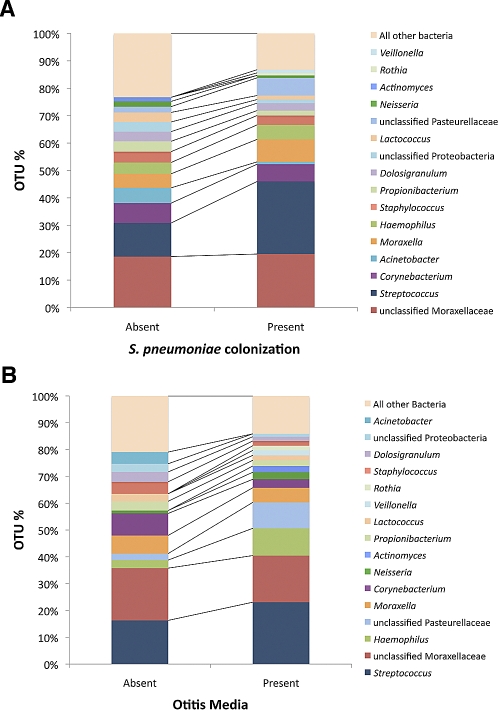
Streptococcus pneumoniae asymptomatically colonizes the upper respiratory tract of children and is a frequent cause of otitis media. Patterns of microbial colonization likely influence S. pneumoniae colonization and otitis media susceptibility. This study compared microbial communities in children with and without otitis media. Nasal swabs and clinical and demographic data were collected in a cross-sectional study of Philadelphia, PA, children (6 to 78 months) ( n = 108) during the 2008-2009 winter respiratory virus season. Swabs were cultured for S. pneumoniae . DNA was extracted from the swabs; 16S rRNA gene hypervariable regions (V1 and V2) were PCR amplified and sequenced by Roche/454 Life Sciences pyrosequencing. Microbial communities were described using the Shannon diversity and evenness indices. Principal component analysis (PCA) was used to group microbial community taxa into four factors representing correlated taxa. Of 108 children, 47 (44%) were colonized by S. pneumoniae , and 25 (23%) were diagnosed with otitis media. Microbial communities with S. pneumoniae were significantly less diverse and less even. Two PCA factors were associated with a decreased risk of pneumococcal colonization and otitis media, as follows: one factor included potentially protective flora ( Corynebacterium and Dolosigranulum ), and the other factor included Propionibacterium , Lactococcus , and Staphylococcus . The remaining two PCA factors were associated with an increased risk of otitis media. One factor included Haemophilus , and the final factor included Actinomyces , Rothia , Neisseria , and Veillonella . Generally, these taxa are not considered otitis media pathogens but may be important in the causal pathway. Increased understanding of upper respiratory tract microbial communities will contribute to the development of otitis media treatment and prevention strategies. IMPORTANCE Otitis media (middle ear infection) is the most common reason for pediatric sick visits in the United States. Streptococcus pneumoniae is a leading otitis media pathogen. S. pneumoniae must colonize the upper respiratory tract and compete with a complex community of nonpathogenic bacteria before infecting the middle ear. We compared microbial communities in the upper respiratory tract of children who had otitis media and those who did not. Members of the normal flora, i.e., Corynebacterium and Dolosigranulum , were protective for S. pneumoniae colonization and otitis media. As expected, the genera Haemophilus was associated with otitis media. Surprisingly, Actinomyces , Rothia , Neisseria , and Veillonella were associated with an increased risk of otitis media. These bacteria are not otitis media pathogens but may be associated with antibiotic use or involved in the causal pathway to disease. Increased understanding of upper respiratory tract microbial communities will lead to new ways to prevent middle ear infections, including probiotics.
Overview
The claims and statistics of this paper haven’t been checked yet.
Free: it reads the open-access text and checks the first 5 claims that cite a source we can check. Create a free account to check every claim.
Integrity signals
Registry
Cites
Statistics
Figures
Verification
Claims the paper makes
The claims and statistics of this paper haven’t been checked yet.
Free: it reads the open-access text and checks the first 5 claims that cite a source we can check. Create a free account to check every claim.
Claims other papers make about this one
Each is checked against this paper’s own text: does it say what the citing paper says it does?
The source backs part of the claim, not all of it — or backs it for a different population, condition or comparison.
In the citing paper
“Potential keystone species in the URT microbiota are Dolosigranulum spp. and Corynebacterium spp., as they have been strongly associated with respiratory health and the exclusion of potential pathogens, most notably Streptococcus pneumoniae, in several epidemiological and mechanistic studies21,29,68,69.”
From The microbiota of the respiratory tract: gatekeeper to respiratory health (2017) · cites this paper as [69]
Experimental — accuracy not yet measuredThe cited source says what the claim attributes to it.
In the citing paper
“the frequent co-occurrence of Corynebacterium spp. and Dolosigranulum spp. in the nasopharynx20,22,69, in which Dolosigranulum spp. might be responsible for the acidification of the local environment, which, in turn, may facilitate the expansion of Corynebacterium spp.; however, a direct interaction between these species cannot be ruled out.”
From The microbiota of the respiratory tract: gatekeeper to respiratory health (2017) · cites this paper as [69]
Self-check
Percentages, sums and reported differences re-computed from the paper’s own numbers.
The self-check needs the paper’s full text.
Citations
Cites
Naïve Bayesian Classifier for Rapid Assignment of rRNA Sequences into the New Bacterial Taxonomy
Wang, Q., Garrity, G. M., Tiedje, J. M., & Cole, J. R. (2007) · Applied and Environmental Microbiology · doi:10.1128/aem.00062-07 · Cited by 19,885 · cited 3×
“calculate the Shannon diversity and evenness indices (25, 26, 52, 53).”
BackgroundMethodGreengenes, a Chimera-Checked 16S rRNA Gene Database and Workbench Compatible with ARB
DeSantis, T. Z., Hugenholtz, P., Larsen, N., Rojas, M., Brodie, E. L., Keller, K., Huber, T., Dalevi, D., Hu, P., & Andersen, G. L. (2006) · Applied and Environmental Microbiology · doi:10.1128/aem.03006-05 · Cited by 10,891
Human gut microbes associated with obesity
Ley, R. E., Turnbaugh, P. J., Klein, S., & Gordon, J. I. (2006) · Nature · doi:10.1038/4441022a · Cited by 8,785
The Ribosomal Database Project: improved alignments and new tools for rRNA analysis
Cole, J. R., Wang, Q., Cardenas, E., Fish, J., Chai, B., Farris, R. J., Kulam-Syed-Mohideen, A. S., McGarrell, D. M., Marsh, T., Garrity, G. M., et al. (2009) · Nucleic Acids Research · doi:10.1093/nar/gkn879 · Cited by 4,762 · cited 1×
“calculate the Shannon diversity and evenness indices (25, 26, 52, 53).”
MethodMicrobial diversity in the deep sea and the underexplored “rare biosphere”
Sogin, M. L., Morrison, H. G., Huber, J. A., Welch, D. M., Huse, S. M., Neal, P. R., Arrieta, J. M., & Herndl, G. J. (2006) · Proceedings of the National Academy of Sciences · doi:10.1073/pnas.0605127103 · Cited by 3,701 · cited 1×
“calculate the Shannon diversity and evenness indices (25, 26, 52, 53).”
MethodBacterial Community Variation in Human Body Habitats Across Space and Time
Costello, E. K., Lauber, C. L., Hamady, M., Fierer, N., Gordon, J. I., & Knight, R. (2009) · Science · doi:10.1126/science.1177486 · Cited by 3,231 · cited 1×
“In our bodies, bacterial cells outnumber human cells (20, 21), and a majority of the bacteria that colonize and infect humans are not routinely cultured or cannot be cultured (22).”
BackgroundMICROBIAL ECOLOGY OF THE GASTROINTESTINAL TRACT
Savage, D. C. (1977) · Annual Review of Microbiology · doi:10.1146/annurev.mi.31.100177.000543 · Cited by 2,436 · cited 1×
“In our bodies, bacterial cells outnumber human cells (20, 21), and a majority of the bacteria that colonize and infect humans are not routinely cultured or cannot be cultured (22).”
BackgroundDethlefsen, L., Huse, S., Sogin, M. L., & Relman, D. A. (2008) · PLoS Biology · doi:10.1371/journal.pbio.0060280 · Cited by 2,361 · cited 1×
“calculate the Shannon diversity and evenness indices (25, 26, 52, 53).”
MethodStreptococcus pneumoniae colonisation: the key to pneumococcal disease
Bogaert, D., de Groot, R., & Hermans, P. (2004) · The Lancet Infectious Diseases · doi:10.1016/s1473-3099(04)00938-7 · Cited by 1,929
Ironing out the wrinkles in the rare biosphere through improved OTU clustering
Huse, S. M., Welch, D. M., Morrison, H. G., & Sogin, M. L. (2010) · Environmental Microbiology · doi:10.1111/j.1462-2920.2010.02193.x · Cited by 1,346 · cited 1×
“Average-linkage clustering may yield more accurate estimates of diversity with regard to identifying rare microbiota in short amplicon (60-bp) data sets (32, 33).”
Background
Cited by
The microbiota of the respiratory tract: gatekeeper to respiratory health
Man, W. H., de Steenhuijsen Piters, W. A. A., & Bogaert, D. (2017) · Nature Reviews Microbiology · doi:10.1038/nrmicro.2017.14 · Cited by 1,384
Human commensals producing a novel antibiotic impair pathogen colonization
Zipperer, A., Konnerth, M. C., Laux, C., Berscheid, A., Janek, D., Weidenmaier, C., Burian, M., Schilling, N. A., Slavetinsky, C., Marschal, M., et al. (2016) · Nature · doi:10.1038/nature18634 · Cited by 938
Polymicrobial Interactions: Impact on Pathogenesis and Human Disease
Peters, B. M., Jabra-Rizk, M. A., O'May, G. A., Costerton, J. W., & Shirtliff, M. E. (2012) · Clinical Microbiology Reviews · doi:10.1128/cmr.00013-11 · Cited by 712
“In fact, the increased use of culture-independent techniques suggests a very diverse microbial etiology of OM pathogenesis (114).”
BackgroundEscapa, I. F., Chen, T., Huang, Y., Gajare, P., Dewhirst, F. E., & Lemon, K. P. (2018) · mSystems · doi:10.1128/msystems.00187-18 · Cited by 590
Bomar, L., Brugger, S. D., Yost, B. H., Davies, S. S., & Lemon, K. P. (2016) · mBio · doi:10.1128/mbio.01725-15 · Cited by 332
Bosch, A. A. T. M., Piters, W. A. A. D. S., van Houten, M. A., Chu, M. L. J. N., Biesbroek, G., Kool, J., Pernet, P., de Groot, P.-K. C. M., Eijkemans, M. J. C., Keijser, B. J. F., et al. (2017) · American Journal of Respiratory and Critical Care Medicine · doi:10.1164/rccm.201703-0554oc · Cited by 325
“Our data, in line with others, show that prolonged abundance of Corynebacterium and Dolosigranulum spp. are linked to healthy microbiota development and microbiota stability (10, 17, 20, 26), and are related to breastfeeding and vaginal delivery (4, 8, 27).”
The role of the local microbial ecosystem in respiratory health and disease
de Steenhuijsen Piters, W. A. A., Sanders, E. A. M., & Bogaert, D. (2015) · Philosophical Transactions of the Royal Society B: Biological Sciences · doi:10.1098/rstb.2014.0294 · Cited by 283
Multifaceted Interfaces of Bacterial Competition
Stubbendieck, R. M., & Straight, P. D. (2016) · Journal of Bacteriology · doi:10.1128/jb.00275-16 · Cited by 248
“in the nasal cavity is often inversely correlated with pathogenic Streptococcus pneumoniae (58).”
BackgroundDysbiosis of upper respiratory tract microbiota in elderly pneumonia patients
de Steenhuijsen Piters, W. A. A., Huijskens, E. G. W., Wyllie, A. L., Biesbroek, G., van den Bergh, M. R., Veenhoven, R. H., Wang, X., Trzciński, K., Bonten, M. J., Rossen, J. W. A., et al. (2016) · The ISME Journal · doi:10.1038/ismej.2015.99 · Cited by 235
“Furthermore, the presence and density of Rothia in the URT has been linked to an increased risk of otitis media in children (OR 1.35; 1.03 – 1.77; Laufer et al. , 2011), also suggesting a potential role for this bacterium in the pathogenesis of respiratory infections in general.”
InfluentialMan, W. H., van Houten, M. A., Mérelle, M. E., Vlieger, A. M., Chu, M. L. J. N., Jansen, N. J. G., Sanders, E. A. M., & Bogaert, D. (2019) · The Lancet Respiratory Medicine · doi:10.1016/s2213-2600(18)30449-1 · Cited by 214
Parsons, B. N., Ijaz, U. Z., D’Amore, R., Burkitt, M. D., Eccles, R., Lenzi, L., Duckworth, C. A., Moore, A. R., Tiszlavicz, L., Varro, A., et al. (2017) · PLOS Pathogens · doi:10.1371/journal.ppat.1006653 · Cited by 210
Mechanisms of synergy in polymicrobial infections
Murray, J. L., Connell, J. L., Stacy, A., Turner, K. H., & Whiteley, M. (2014) · Journal of Microbiology · doi:10.1007/s12275-014-4067-3 · Cited by 199
Camarinha‐Silva, A., Jáuregui, R., Chaves‐Moreno, D., Oxley, A. P. A., Schaumburg, F., Becker, K., Wos‐Oxley, M. L., & Pieper, D. H. (2014) · Environmental Microbiology · doi:10.1111/1462-2920.12362 · Cited by 195
“more abundant in Pygmy children analyzed here compared to the American children 350 analyzed by Laufer et al. (2011) and Oh et al. (2012). Contrasting results were also found between Laufer et al. (2011) and Oh et al. (2012), where Laufer et al. (2011)”
ResultInfluentialPettigrew, M. M., Laufer, A. S., Gent, J. F., Kong, Y., Fennie, K. P., & Metlay, J. P. (2012) · Applied and Environmental Microbiology · doi:10.1128/aem.01051-12 · Cited by 183
“Several hundred different bacterial taxa can potentially colonize the upper respiratory tract of a single individual (1, 38, 40); the majority of these bacterial taxa are not routinely cultured or studied.”
Self-citationHasegawa, K., Mansbach, J. M., Ajami, N. J., Espinola, J. A., Henke, D. M., Petrosino, J. F., Piedra, P. A., Shaw, C. A., Sullivan, A. F., & Camargo, C. A. (2016) · European Respiratory Journal · doi:10.1183/13993003.00152-2016 · Cited by 177
Boutin, S., Graeber, S. Y., Weitnauer, M., Panitz, J., Stahl, M., Clausznitzer, D., Kaderali, L., Einarsson, G., Tunney, M. M., Elborn, J. S., et al. (2015) · PLOS ONE · doi:10.1371/journal.pone.0116029 · Cited by 164
Mostafa, H. H., Fissel, J. A., Fanelli, B., Bergman, Y., Gniazdowski, V., Dadlani, M., Carroll, K. C., Colwell, R. R., & Simner, P. J. (2020) · mBio · doi:10.1128/mbio.01969-20 · Cited by 164
Lappan, R., Imbrogno, K., Sikazwe, C., Anderson, D., Mok, D., Coates, H., Vijayasekaran, S., Bumbak, P., Blyth, C. C., Jamieson, S. E., et al. (2018) · BMC Microbiology · doi:10.1186/s12866-018-1154-3 · Cited by 162
“We also observed a positive correlation between Corynebacterium and Dolosigranulum which has been previously reported [67].”
ResultInfluence of bacterial interactions on pneumococcal colonization of the nasopharynx
Shak, J. R., Vidal, J. E., & Klugman, K. P. (2012) · Trends in Microbiology · doi:10.1016/j.tim.2012.11.005 · Cited by 181
“The first microbiome studies to analyze 16S rRNA sequences have revealed high inter-individual variability in nasopharyngeal communities, as well as possible correlations with season [55,56].”
BackgroundDolosigranulum pigrum Cooperation and Competition in Human Nasal Microbiota
Brugger, S. D., Eslami, S. M., Pettigrew, M. M., Escapa, I. F., Henke, M. T., Kong, Y., & Lemon, K. P. (2020) · mSphere · doi:10.1128/msphere.00852-20 · Cited by 154
“In the nostrils of 99 children ages 6 to 78 months (26), Corynebacterium pseudodiphtheriticum exhibited increased differential relative abundance in the presence of D.”
InfluentialSelf-citationBoeck, I. D., Wittouck, S., Wuyts, S., Oerlemans, E. F. M., van den Broek, M. F. L., Vandenheuvel, D., Vanderveken, O. M., & Lebeer, S. (2017) · Frontiers in Microbiology · doi:10.3389/fmicb.2017.02372 · Cited by 157
“The same study suggested that Moraxella- or Dolosigranulum/Corynebacterium-dominated bacterial profiles might be beneficial for respiratory health, which was also suggested before (Laufer et al., 2011).”
BackgroundResultBacterial microbiota of the nasal passages across the span of human life
Bomar, L., Brugger, S. D., & Lemon, K. P. (2017) · Current Opinion in Microbiology · doi:10.1016/j.mib.2017.10.023 · Cited by 148
Commensal–Pathogen Interactions along the Human Nasal Passages
Brugger, S. D., Bomar, L., & Lemon, K. P. (2016) · PLoS Pathogens · doi:10.1371/journal.ppat.1005633 · Cited by 146
Pyrosequencing analysis of the human microbiota of healthy Chinese undergraduates
Ling, Z., Liu, X., Luo, Y., Yuan, L., Nelson, K. E., Wang, Y., Xiang, C., & Li, L. (2013) · BMC Genomics · doi:10.1186/1471-2164-14-390 · Cited by 127
“, Corynebacterium, Dolosigranulum, Staphylococcus, Lactococcus, and Propionibacterium, are protective against Streptococcus pneumoniae colonization and otitis media [49].”
BackgroundBacterial-Host Interactions: Physiology and Pathophysiology of Respiratory Infection
Håkansson, A., Orihuela, C. J., & Bogaert, D. (2018) · Physiological Reviews · doi:10.1152/physrev.00040.2016 · Cited by 142
Lactobacilli Have a Niche in the Human Nose
Boeck, I. D., van den Broek, M. F. L., Allonsius, C. N., Spacova, I., Wittouck, S., Martens, K., Wuyts, S., Cauwenberghs, E., Jokicevic, K., Vandenheuvel, D., et al. (2020) · Cell Reports · doi:10.1016/j.celrep.2020.107674 · Cited by 127
“Dolosigranulum, a member of the Carnobacteriaceae and the LAB, has been linked to healthy respiratory conditions based on several microbiome studies (Biesbroek et al., 2014; De Boeck et al., 2019; Laufer et al., 2011).”
BackgroundDynamics of the nasal microbiota in infancy: A prospective cohort study
Mika, M., Mack, I., Korten, I., Qi, W., Aebi, S., Frey, U., Latzin, P., & Hilty, M. (2015) · Journal of Allergy and Clinical Immunology · doi:10.1016/j.jaci.2014.12.1909 · Cited by 118
“The nasopharynx was described as an ecologic reservoir consisting of a broad variety of commensal bacteria and potential pathogens.(10) Recent studies revealed a complex and highly variable nasopharyngeal microbiota in children,(11,12) which undergoes significant changes during disease, exposure to”
BackgroundMethodBacterial biogeography of adult airways in atopic asthma
Durack, J., Huang, Y. J., Nariya, S., Christian, L. S., Ansel, K. M., Beigelman, A., Castro, M., Dyer, A., Israel, E., Kraft, M., et al. (2018) · Microbiome · doi:10.1186/s40168-018-0487-3 · Cited by 130
Chronic Rhinosinusitis: Potential Role of Microbial Dysbiosis and Recommendations for Sampling Sites
Copeland, E., Leonard, K., Carney, R. L., Kong, J. S., Forer, M., Naidoo, Y., Oliver, B. G. G., Seymour, J. R., Woodcock, S., Burke, C., et al. (2018) · Frontiers in Cellular and Infection Microbiology · doi:10.3389/fcimb.2018.00057 · Cited by 117
“…have been reported in other areas of the upper airways, correlated with a decreased risk of Streptococcus pneumoniae colonization in the upper airways (Pettigrew et al., 2012) and acute ear infections in children that had no reported antibiotic use for the previous 6 months (Laufer et al., 2011).”
BackgroundNasopharyngeal Microbiota in Infants With Acute Otitis Media
Hilty, M., Qi, W., Brugger, S. D., Frei, L., Agyeman, P., Frey, P. M., Aebi, S., & Mühlemann, K. (2012) · The Journal of Infectious Diseases · doi:10.1093/infdis/jis024 · Cited by 106
“This finding is in line with previous reports using culture- and nonculture- based methods to examine the respiratory tract microbiota [16, 23].”
BackgroundResultPettigrew, M. M., Gent, J. F., Kong, Y., Halpin, A. L., Pineles, L. L., Harris, A. D., & Johnson, J. K. (2018) · Clinical Infectious Diseases · doi:10.1093/cid/ciy936 · Cited by 111
Self-citationThe respiratory microbiome and susceptibility to influenza virus infection
Lee, K. H., Gordon, A., Shedden, K., Kuan, G., Ng, S., Balmaseda, Á., & Foxman, B. (2019) · PLoS ONE · doi:10.1371/journal.pone.0207898 · Cited by 119
Rosen, R., Hu, L., Amirault, J., Khatwa, U., Ward, D. V., & Onderdonk, A. (2015) · The Journal of Pediatrics · doi:10.1016/j.jpeds.2014.12.067 · Cited by 105
Seven-Valent Pneumococcal Conjugate Vaccine and Nasopharyngeal Microbiota in Healthy Children
Biesbroek, G., Wang, X., Keijser, B. J. F., Eijkemans, R. M. J., Trzciński, K., Rots, N. Y., Veenhoven, R. H., Sanders, E. A. M., & Bogaert, D. (2014) · Emerging Infectious Diseases · doi:10.3201/eid2002.131220 · Cited by 104
“(31) reported negative associations between S.”
BackgroundThe Microbiome of the Nose—Friend or Foe?
Dimitri‐Pinheiro, S., Soares, R. A., & Barata, P. (2020) · Allergy & Rhinology · doi:10.1177/2152656720911605 · Cited by 116
“On the other hand, colonization with Corynebacterium and Dolosigranulum and Propionibacterium, Lactococcus, and Staphylococcus was associated with a decreased risk of pneumococcal colonization and OM.(56) Recently, Lappan et al.”
BackgroundInfluentialChanges in Gastric and Lung Microflora With Acid Suppression
Rosen, R., Amirault, J. P., Liu, H., Mitchell, P. D., Hu, L., Khatwa, U., & Onderdonk, A. B. (2014) · Archives of Pediatrics and Adolescent Medicine · doi:10.1001/jamapediatrics.2014.696 · Cited by 109
Chonmaitree, T., Jennings, K., Golovko, G., Khanipov, K., Pimenova, M., Patel, J. A., McCormick, D. P., Loeffelholz, M. J., & Fofanov, Y. (2017) · PLoS ONE · doi:10.1371/journal.pone.0180630 · Cited by 114
“In other studies, nasopharyngeal bacterial commensals were studied mainly in children > 6 months of age, and the samples were often collected during disease state [19, 20, 31] .”
BackgroundBiofilm formation in Streptococcus pneumoniae
Domenech, M., García, E., & Moscoso, M. (2011) · Microbial Biotechnology · doi:10.1111/j.1751-7915.2011.00294.x · Cited by 116
“pneumoniae, Haemophilus influenzae or Moraxella catarrhalis (Murphy et al., 2009; Laufer et al., 2011).”
BackgroundImpact of nasopharyngeal microbiota on the development of respiratory tract diseases
Esposito, S., & Principi, N. (2017) · European Journal of Clinical Microbiology & Infectious Diseases · doi:10.1007/s10096-017-3076-7 · Cited by 90
“Because it was demonstrated long ago that these bacteria could inhibit proliferation of AOM pathogens in vitro [31], it was supposed that recurrences could, at least in part, depend on the impairment of respiratory microbiota.”
InfluentialCommensal bacteria in the upper respiratory tract regulate susceptibility to infection
Clark, S. E. (2020) · Current Opinion in Immunology · doi:10.1016/j.coi.2020.03.010 · Cited by 94
Characterization of the upper and lower respiratory tract microbiota in Piedmontese calves
Nicola, I., Cerutti, F., Grego, E., Bertone, I., Gianella, P., D’Angelo, A., Peletto, S., & Bellino, C. (2017) · Microbiome · doi:10.1186/s40168-017-0372-5 · Cited by 105
“In children, it has been correlated with a reduced risk of developing otitis media and respiratory disease [39, 54].”
BackgroundCaputo, M., Zoch-Lesniak, B., Karch, A., Vital, M., Meyer, F., Klawonn, F., Baillot, A., Pieper, D. H., & Mikolajczyk, R. (2019) · BMC Microbiology · doi:10.1186/s12866-018-1372-8 · Cited by 83
Piters, W. A. A. D. S., Jochems, S. P., Mitsi, E., Rylance, J., Pojar, S., Nikolaou, E., German, E. L., Holloway, M., Carniel, B. F., Chu, M. L. J. N., et al. (2019) · Nature Communications · doi:10.1038/s41467-019-10814-9 · Cited by 85
Antibiotics and specialized metabolites from the human microbiota
Mousa, W. K., Athar, B., Merwin, N. J., & Magarvey, N. A. (2017) · Natural Product Reports · doi:10.1039/c7np00021a · Cited by 87
The adult nasopharyngeal microbiome as a determinant of pneumococcal acquisition
Cremers, A. J. H., Zomer, A., Gritzfeld, J. F., Ferwerda, G., van Hijum, S. A. F. T., Ferreira, D. M., Shak, J. R., Klugman, K. P., Boekhorst, J., Timmerman, H. M., et al. (2014) · Microbiome · doi:10.1186/2049-2618-2-44 · Cited by 92
“Whereas pneumococcal carriage in children has previously been associated with a high level of Streptococci in the nasopharynx and a low diverse concurrent microbiome [25,33], in our adult volunteers, natural pneumococcal carriage was associated with low proportions of streptococcal reads next to normally diverse and p…”
BackgroundAnterior Nares Diversity and Pathobionts Represent Sinus Microbiome in Chronic Rhinosinusitis
Boeck, I. D., Wittouck, S., Martens, K., Claes, J., Jorissen, M., Steelant, B., van den Broek, M. F. L., Seys, S., Hellings, P. W., Vanderveken, O. M., et al. (2019) · mSphere · doi:10.1128/msphere.00532-19 · Cited by 87
“Previous studies on the URT microbiome in children have investigated the potential protective effects of Dolosigranulum for respiratory health (39, 40).”
BackgroundLu, H., Li, A., Zhang, T., Ren, Z., He, K., Zhang, H., Yang, J., Luo, Q., Zhou, K., Chen, C., et al. (2017) · Emerging Microbes & Infections · doi:10.1038/emi.2017.101 · Cited by 85
Nasopharyngeal microbial interactions in the era of pneumococcal conjugate vaccination
Dunne, E. M., Smith‐Vaughan, H., Robins-Browne, R. M., Mulholland, K., & Satzke, C. (2013) · Vaccine · doi:10.1016/j.vaccine.2013.03.024 · Cited by 91
Nasopharyngeal Bacterial Interactions in Children
Xu, Q., Almudervar, A., Casey, J. R., & Pichichero, M. E. (2012) · Emerging infectious diseases · doi:10.3201/eid1811.111904 · Cited by 85
“Interactions between bacteria can alter the composition of a microbial community and affect incidence of disease (4).”
BackgroundInfluentialBacterial involvement in otitis media with effusion
Daniel, M., Imtiaz-Umer, S., Fergie, N., Birchall, J. P., & Bayston, R. (2012) · International Journal of Pediatric Otorhinolaryngology · doi:10.1016/j.ijporl.2012.06.013 · Cited by 87
“Veillonella is a Gram-negative anaerobe that inhabits the mouth and upper respiratory tract, forms biofilms [48] and has previously been found in middle ear disease [49,50].”
BackgroundLuna, P. N., Hasegawa, K., Ajami, N. J., Espinola, J. A., Henke, D., Petrosino, J. F., Piedra, P. A., Sullivan, A. F., Camargo, C. A., Shaw, C. A., et al. (2018) · Microbiome · doi:10.1186/s40168-017-0385-0 · Cited by 76
“As a result, multiple studies in this young population have been conducted on the microbiome using nasal swabs (NSs) or nasal brush specimens, which are easier to collect and less invasive than samples from deeper within the airway [3, 6, 7, 13, 14].”
BackgroundAssociation of Antibiotics, Airway Microbiome, and Inflammation in Infants with Cystic Fibrosis
Pittman, J. E., Wylie, K. M., Akers, K. T., Storch, G. A., Hatch, J., Quante, J., Frayman, K. B., Clarke, N., Davis, M., Stick, S. M., et al. (2017) · Annals of the American Thoracic Society · doi:10.1513/annalsats.201702-121oc · Cited by 74
Kakizaki, E., Ogura, Y., Kozawa, S., Nishida, S., Uchiyama, T., Hayashi, T., & Yukawa, N. (2012) · Forensic Science International · doi:10.1016/j.forsciint.2012.02.010 · Cited by 65
“Among the bacteria detected by 454-pyosequencing analysis, the following genera can inhabit the human body during life: Sphingomonas (vagina [13,14]), Burkholderia (oral cavity [15] and vagina [13]), Neisseria (skin [16], nasal cavity [17] and oral cavity [18]), Ralstonia (gastrointestinal tract [19]), Acinetobacter (…”
The Nasopharyngeal Microbiota of Children With Respiratory Infections in Botswana
Kelly, M. S., Surette, M. G., Smieja, M., Pernica, J. M., Rossi, L., Luinstra, K., Steenhoff, A. P., Feemster, K. A., Goldfarb, D. A., Arscott‐Mills, T., et al. (2017) · The Pediatric Infectious Disease Journal · doi:10.1097/inf.0000000000001607 · Cited by 63
Coleman, A., WOOD, A. G., Bialasiewicz, S., Ware, R. S., Marsh, R. L., & Cervin, A. (2018) · Microbiome · doi:10.1186/s40168-018-0577-2 · Cited by 67
Hurst, J. H., McCumber, A. W., Aquino, J. N., Rodriguez, J., Heston, S. M., Lugo, D. J., Rotta, A. T., Turner, N., Pfeiffer, T. S., Gurley, T. C., et al. (2022) · Clinical Infectious Diseases · doi:10.1093/cid/ciac184 · Cited by 66
The nasopharyngeal microbiota in feedlot cattle and its role in respiratory health
Timsit, E., Holman, D. B., Hallewell, J., & Alexander, T. W. (2016) · Animal Frontiers · doi:10.2527/af.2016-0022 · Cited by 58
Jiang, T., Mandal, R. K., Wideman, R. F., Jr., Khatiwara, A., Pevzner, I. Y., & Kwon, Y. M. (2015) · PLoS ONE · doi:10.1371/journal.pone.0124403 · Cited by 57
The human microbiota: novel targets for hospital-acquired infections and antibiotic resistance
Pettigrew, M. M., Johnson, J. K., & Harris, A. D. (2016) · Annals of Epidemiology · doi:10.1016/j.annepidem.2016.02.007 · Cited by 62
Self-citationLactic acid bacteria as probiotics for the nose?
Boeck, I. D., Spacova, I., Vanderveken, O. M., & Lebeer, S. (2021) · Microbial Biotechnology · doi:10.1111/1751-7915.13759 · Cited by 55
Treerat, P., Redanz, U., Redanz, S., Giacaman, R. A., Merritt, J. L., & Kreth, J. (2020) · The ISME Journal · doi:10.1038/s41396-020-0598-2 · Cited by 61
Moyano, R. O., Tonetti, F. R., Tomokiyo, M., Kanmani, P., Vizoso-Pinto, M. G., Kim, H., Quilodrán-Vega, S., Melnikov, V. G., Alvarez, S., Takahashi, H., et al. (2020) · Microorganisms · doi:10.3390/microorganisms8050727 · Cited by 56
“…that a certain microorganism must gather to be considered a probiotic [8]. the Lactobacillus and Bifidobacterium species) have made it possible to define a series of characteristics The most important property for a probiotic candidate is to provide a benefit to the host that is scientifically”
BackgroundMarazzato, M., Zicari, A. M., Aleandri, M., Conte, A. L., Longhi, C., Vitanza, L., Bolognino, V., Zagaglia, C., Castro, G. D., Brindisi, G., et al. (2020) · Frontiers in Cellular and Infection Microbiology · doi:10.3389/fcimb.2020.00458 · Cited by 59
“In particular, synergistic correlations have been previously observed between Corynebacterium and Dolosigranulum (Laufer et al., 2011).”
BackgroundInfluentialBergenfelz, C., & Håkansson, A. (2017) · Current Otorhinolaryngology Reports · doi:10.1007/s40136-017-0152-6 · Cited by 63
Bacterial microbiome in the nose of healthy cats and in cats with nasal disease
Dorn, E. S., Treß, B., Suchodolski, J. S., Nisar, T., Ravindran, P., Weber, K., Hartmann, K., & Schulz, B. S. (2017) · PLoS ONE · doi:10.1371/journal.pone.0180299 · Cited by 61
Association of sputum microbiota profiles with severity of community-acquired pneumonia in children
Pettigrew, M. M., Gent, J. F., Kong, Y., Wade, M., Gansebom, S., Bramley, A. M., Jain, S., Arnold, S. L. R., & McCullers, J. A. (2016) · BMC Infectious Diseases · doi:10.1186/s12879-016-1670-4 · Cited by 52
“The command line RDP classifier tool was used for taxonomic assignment [30].”
BackgroundMethodInfluentialSelf-citationInsights into the role of the respiratory tract microbiome in defense against bacterial pneumonia
Drigot, Z., & Clark, S. E. (2024) · Current Opinion in Microbiology · doi:10.1016/j.mib.2024.102428 · Cited by 55
Banu, M. A., Rathman, A., Patel, K. S., Souweidane, M. M., Anand, V. K., Greenfield, J. P., & Schwartz, T. H. (2013) · Operative Neurosurgery · doi:10.1227/neu.0000000000000252 · Cited by 47
Horn, K. J., Vivar, A. C. J., Arenas, V., Andani, S., Janoff, E. N., & Clark, S. E. (2022) · Frontiers in Microbiology · doi:10.3389/fmicb.2021.804935 · Cited by 58
Translating Recent Microbiome Insights in Otitis Media into Probiotic Strategies
van den Broek, M. F. L., Boeck, I. D., Kiekens, F., Boudewyns, A. N., Vanderveken, O. M., & Lebeer, S. (2019) · Clinical Microbiology Reviews · doi:10.1128/cmr.00010-18 · Cited by 50
“The lactic acid genus Dolosigranulum, for example, is increasingly suggested to be a protective bacterial taxon (41, 59, 280).”
BackgroundMethodFriend or Foe: Interbacterial Competition in the Nasal Cavity
Hardy, B. L., & Merrell, D. S. (2020) · Journal of Bacteriology · doi:10.1128/jb.00480-20 · Cited by 46
“pigrum and some Corynebacterium species are present (60).”
BackgroundDixon, D. (2015) · Children · doi:10.3390/children2030289 · Cited by 44
“Conversely formula fed infants had decreased Staphylococcus, and Prevotella and Veillonella, anaerobic bacteria, recently associated with an increased risk of otitis media [95].”
BackgroundEffects of nasopharyngeal microbiota in respiratory infections and allergies
Kang, H. M., & Kang, J. H. (2021) · Korean Journal of Pediatrics · doi:10.3345/cep.2020.01452 · Cited by 50
The upper respiratory tract microbiome of indigenous Orang Asli in north-eastern Peninsular Malaysia
Cleary, D. W., Morris, D. E., Anderson, R. A., Jones, J., Alattraqchi, A. G., Rahman, N. I. A., Ismail, S. B., Razali, M. S., Amin, R. M., Aziz, A. A., et al. (2021) · npj Biofilms and Microbiomes · doi:10.1038/s41522-020-00173-5 · Cited by 42
Sakai, F., Talekar, S. J., Klugman, K. P., Vidal, J. E., & for the Investigators Group (2013) · PLoS ONE · doi:10.1371/journal.pone.0067147 · Cited by 44
“These species are found in the healthy human nasopharynx (Table 2) [7,41].”
BackgroundNasal microbial composition and chronic otitis media with effusion: A case-control study
Walker, R. E., Walker, C. G., Camargo, C. A., Bartley, J., Flint, D., Thompson, J., & Mitchell, E. A. (2019) · PLoS ONE · doi:10.1371/journal.pone.0212473 · Cited by 41
Pérez‐Losada, M., Graham, R. J., Coquillette, M., Jafarey, A., Castro‐Nallar, E., Aira, M., Freishtat, R. J., & Mansbach, J. M. (2017) · PLoS ONE · doi:10.1371/journal.pone.0182520 · Cited by 43
“Furthermore, Corynebacterium dominance in the nasopharynx has also been associated with a reduced incidence of otitis media [59].”
BackgroundLin, W., Kuo, Y., Chen, C., Huang, Y.-F., Hsu, C., Lin, J., Liu, C., Chen, J., Hsia, K.-C., & Ho, H.-H. (2021) · Current Microbiology · doi:10.1007/s00284-021-02569-8 · Cited by 44
“It has been reported that key species of the microbiota limited the growth of pathogenic Streptococcus pneumonia [17].”
BackgroundLappan, R. J., Jamieson, S. E., & Peacock, C. S. (2020) · Frontiers in Cellular and Infection Microbiology · doi:10.3389/fcimb.2020.00051 · Cited by 40
“In 16S rRNA studies that did not use GreenGenes, Alloiococcus, and Turicella were not reported in the nasopharynx of children with OM ( Laufer et al., 2011; Pettigrew et al., 2012; Jervis-Bardy et al., 2015).”
BackgroundKelly, M. S., Plunkett, C. H., Yu, Y., Aquino, J. N., Patel, S. M., Hurst, J. H., Young, R. R., Smieja, M., Steenhoff, A. P., Arscott‐Mills, T., et al. (2021) · The ISME Journal · doi:10.1038/s41396-021-01108-4 · Cited by 41
Community-acquired rhinovirus infection is associated with changes in the airway microbiome
Kloepfer, K. M., Sarsani, V. K., Poroyko, V., Lee, W. M., Pappas, T. E., Kang, T., Grindle, K. A., Bochkov, Y. A., Janga, S. C., Lemanske, R. F., et al. (2017) · Journal of Allergy and Clinical Immunology · doi:10.1016/j.jaci.2017.01.038 · Cited by 36
Codevelopment of Microbiota and Innate Immunity and the Risk for Group B Streptococcal Disease
Kolter, J., & Henneke, P. (2017) · Frontiers in Immunology · doi:10.3389/fimmu.2017.01497 · Cited by 44
“Another example is the observation that Corynebacterium and Dolosigranulum in the upper respiratory tract are protective against colonization with Streptococcus pneumonia, which causes otitis media in infants after colonization of the airways (91).”
ResultThe Dynamics of Respiratory Microbiota during Mechanical Ventilation in Patients with Pneumonia
Woo, S., Park, S.-Y., Kim, Y., Jeon, J. P., Lee, J. J., & Hong, J. Y. (2020) · Journal of Clinical Medicine · doi:10.3390/jcm9030638 · Cited by 41
“suggested a role for Rothia in the pathogenesis of respiratory infection [19,20].”
BackgroundThe respiratory microbiota during health and disease: a paediatric perspective
Koppena, I. J. N., Boscha, A. A. T. M., Sandersa, E. A. M., van Houtenb, M. A., & Bogaert, D. (2015) · Pneumonia · doi:10.15172/pneu.2015.6/656 · Cited by 46
“catarrhalis is also associated with lower levels of microbial biodiversity in the upper respiratory tract [35,39,49].”
BackgroundNesbitt, H., Burke, C., & Haghi, M. (2021) · Frontiers in Microbiology · doi:10.3389/fmicb.2021.713703 · Cited by 42
Stubbendieck, R. M., Dissanayake, E., Burnham, P. M., Zelasko, S. E., Temkin, M. I., Wisdorf, S. S., Vrtis, R. F., Gern, J. E., & Currie, C. R. (2023) · mBio · doi:10.1128/mbio.00464-23 · Cited by 37
“The relative abundances we observed were similar to what has been reported for other 16S rRNA gene amplicon sequencing studies of the anterior nares, nasal cavity, and nasopharynx (60 – 62).”
Jacobs, D. M., Ochs‐Balcom, H. M., Zhao, J., Murphy, T. F., & Sethi, S. (2018) · Journal of Clinical Microbiology · doi:10.1128/jcm.00330-18 · Cited by 34
The Nasal Mutualist Dolosigranulum pigrum AMBR11 Supports Homeostasis via Multiple Mechanisms
Boeck, I. D., Wittouck, S., Martens, K., Spacova, I., Cauwenberghs, E., Allonsius, C. N., Jörissen, J., Wuyts, S., Beeck, W. V., Dillen, J., et al. (2021) · iScience · doi:10.1016/j.isci.2021.102978 · Cited by 38
“The current knowledge on the URT microbiome is mainly based on association studies mapping the occurrence and relative abundance of different bacterial taxa by using culture-independent methods (Gan et al., 2021; Hasegawa et al., 2016; Lappan et al., 2018; Laufer et al., 2011).”
Ramos, S. F., Brugger, S. D., Escapa, I. F., Skeete, C. A., Cotton, S. L., Eslami, S. M., Gao, W., Bomar, L., Tran, T. H., Jones, D. S., et al. (2021) · mSystems · doi:10.1128/msystems.00425-21 · Cited by 38
“present in pediatric nasal microbiota when Streptococcus pneumoniae is absent (1, 8).”
Early-Life Lung and Gut Microbiota Development and Respiratory Syncytial Virus Infection
Yagi, K., Asai, N., Huffnagle, G. B., Lukacs, N. W., & Fonseca, W. (2022) · Frontiers in Immunology · doi:10.3389/fimmu.2022.877771 · Cited by 40
“org 3 The upper respiratory tract has been recognized as the first line of defense, the main port of entry, and the reservoir for the respiratory microbiome (41, 42).”
BackgroundMurrah, K. A., Pang, B., Richardson, S., Perez, A. C., Reimche, J. L., King, L. B., Wren, J. T., & Swords, W. E. (2014) · Pathogens and Disease · doi:10.1093/femspd/ftu011 · Cited by 31
“Nonencapsulated S. pneumoniae and NTHi induce polymicrobial OM The majority of cases of OM are polymicrobial in nature (Jacoby et al. 2007; Laufer et al. 2011).”
BackgroundReiss-Mandel, A., & Regev‐Yochay, G. (2016) · Human Vaccines & Immunotherapeutics · doi:10.1080/21645515.2015.1081321 · Cited by 40
“Metagenomic analyses showed the presence of a highly diverse nasopharyngeal microbiome including up to 2042 observed operational taxonomic units and as many as 1,219,310 observed unique sequences.(4,43,44) Considering the vast diversity in the nasal microbiome with which the two pathogens interact, the relationship be…”
BackgroundUpper Respiratory Tract Microbiome and Otitis Media Intertalk: Lessons from the Literature
Folino, F., Ruggiero, L., Capaccio, P., Coro, I., Aliberti, S., Drago, L., Marchisio, P., & Torretta, S. (2020) · Journal of Clinical Medicine · doi:10.3390/jcm9092845 · Cited by 36
“pneumoniae, highlighting the correlation between a higher biodiversity and better outcomes [20].”
BackgroundCleary, D. W., & Clarke, S. C. (2017) · Emerging Topics in Life Sciences · doi:10.1042/etls20170041 · Cited by 33
Boelsen, L. K., Dunne, E. M., Mika, M., Eggers, S., Nguyen, C. D., Ratu, F. T., Russell, F. M., Mulholland, K., Hilty, M., & Satzke, C. (2019) · Microbiome · doi:10.1186/s40168-019-0716-4 · Cited by 31
“and Corynebacterium have been associated with a decreased risk of otitis media [44] as well as decreased episodes of respiratory tract infections [45, 48].”
BackgroundResultDolosigranulum pigrum: A promising nasal probiotic candidate
Stubbendieck, R. M., Hurst, J. H., & Kelly, M. S. (2024) · PLoS Pathogens · doi:10.1371/journal.ppat.1011955 · Cited by 34
“Laufer, 2011 [20] Children ( 7 y) Nasal swab # abundance in acute otitis media # abundance with Streptococcus pneumoniae carriage Liu, 2015 [24] Adults ( > 18 y) Nasal swab # abundance with Staphylococcus aureus carriage Escapa, 2018 [27] Adults (18– protection from infections by respiratory…”
BackgroundNasopharyngeal Bacterial Carriage in the Conjugate Vaccine Era with a Focus on Pneumococci
Devine, V. T., Jefferies, J. M., Clarke, S. C., & Faust, S. N. (2015) · Journal of Immunology Research · doi:10.1155/2015/394368 · Cited by 29
Airway microbiota and acute respiratory infection in children
Hasegawa, K., & Camargo, C. A. (2015) · Expert Review of Clinical Immunology · doi:10.1586/1744666x.2015.1045417 · Cited by 31
“, Corynebacterium, Dolosigranulum) is associated not only with breastfeeding but also with a lower frequency of acute otitis media and parental-reported ARI [19,20].”
BackgroundCharacterization of a Multipeptide Lantibiotic Locus in Streptococcus pneumoniae
Maricic, N., Anderson, E. S., Opipari, A. E., Yu, E. A., & Dawid, S. R. (2016) · mBio · doi:10.1128/mbio.01656-15 · Cited by 28
P. aeruginosa interactions with other microbes in biofilms during co-infection
Oliveira, M., Cunha, E. S., Tavares, L. M., & Serrano, I. D. (2023) · AIMS Microbiology · doi:10.3934/microbiol.2023032 · Cited by 33
“Bacteria shift from colonizers to invaders causing infection, often as polymicrobial biofilms, when there is either an epithelial rupture or immune dysfunction [97].”
Background
Metadata
- Authors
- Laufer, A. S., Metlay, J. P., Gent, J. F., Fennie, K. P., Kong, Y., & Pettigrew, M. M.
- Affiliations
- Yale School of Public Health, Yale University School of Medicine, New Haven, Connecticut, USA
- University of Pennsylvania (US)
- Yale University (US)
- W. M. Keck Foundation (US)
- Venue
- mBio
- Publisher
- American Society for Microbiology
- Published
- 2011-03
- Volume
- 2
- Issue
- 1
- Pages
- e00245-10
- ISSN
- 2150-7511 (ISSN-L)
- 2161-2129
- PMC
- PMC3031303
- OpenAlex
- W2055912129
- Cited by
- 224
- References
- 54
- Citations by year
- 2026: 6 · 2025: 15 · 2024: 11 · 2023: 17 · 2022: 16 · 2021: 20 · 2020: 18 · 2019: 15 · 2018: 12 · 2017: 28 · 2016: 17 · 2015: 14 · 2014: 13 · 2013: 11 · 2012: 8
- FWCI
- 8.40
- Type
- journal article
- Language
- en
- Open access
- gold
- doi.org
- Licence
- cc-by-nc-sa
- creativecommons.org/licenses/by-nc-sa/3.0/ (vor)
- journals.asm.org/non-commercial-tdm-license (tdm)
- Locations
- mBio (publishedVersion, cc-by-nc-sa)
- PubMed Central (publishedVersion, cc-by-nc-sa)
- PubMed (publishedVersion)
- DOAJ (DOAJ: Directory of Open Access Journals) (submittedVersion, cc-by-sa)
- Funders
- U.S. Public Health Service (R01 A1068043, K24 073957)
- National Institute of Allergy and Infectious Diseases (R01AI068043, R21AI078189, R01 A1068043)
- Topics
- Health Sciences › Medicine › Epidemiology › Pneumonia and Respiratory Infections
- Health Sciences › Medicine › Otorhinolaryngology › Ear Surgery and Otitis Media
- Life Sciences › Immunology and Microbiology › Microbiology › Microbial infections and disease research
- Keywords
- otitis media, Streptococcus pneumoniae, pneumococcal carriage, upper respiratory tract microbiota, nasal microbiota, children, Corynebacterium, Dolosigranulum, Haemophilus, Neisseria, Veillonella, bacterial diversity, otitis media prevention, 16S rRNA gene sequencing, pyrosequencing
- MeSH terms
- Bacteria, Child, Child, Preschool, Cross-Sectional Studies, Female, Humans, Infant, Infant, Newborn, Male, Molecular Sequence Data, Nose, Otitis Media, Phylogeny, Streptococcus pneumoniae
About these checks
Registry, retraction, Cites and statistics results are computed, not judged, with one exception: a printed reference that no index lists is read once by a model before it counts as a citation error. Claims are extracted by a model and kept only when their quote appears verbatim in the text; each cited source is then checked, with a model’s help, for whether it says what the claim relies on. Those verdicts can be wrong — read the claim’s quote and the cited source before relying on one.
Statistics and arithmetic are recomputed, not judged.
Confidence bands are shown only for fields calibrated on our annotated test set. None is calibrated yet, so no band is shown.
What counts as a claim ›How we measure confidence ›How we check this ›
Are you an author, or do you see a problem with this page? Request a review
Data sources
Bibliographic data: Semantic Scholar, OpenAlex, Crossref.
Contains information from the Semantic Scholar Academic Graph Datasets, made available under the ODC Attribution License (ODC-BY 1.0).
Semantic Scholar’s data is described in: Kinney, R., et al. (2023). The Semantic Scholar Open Data Platform. arXiv:2301.10140.
