

Biogeochemical Forces Shape the Composition and Physiology of Polymicrobial Communities in the Cystic Fibrosis Lung
Open accessThe DOI matches its Crossref record; 97 of the 97 references it cites were found in a registry or an index.
Abstract
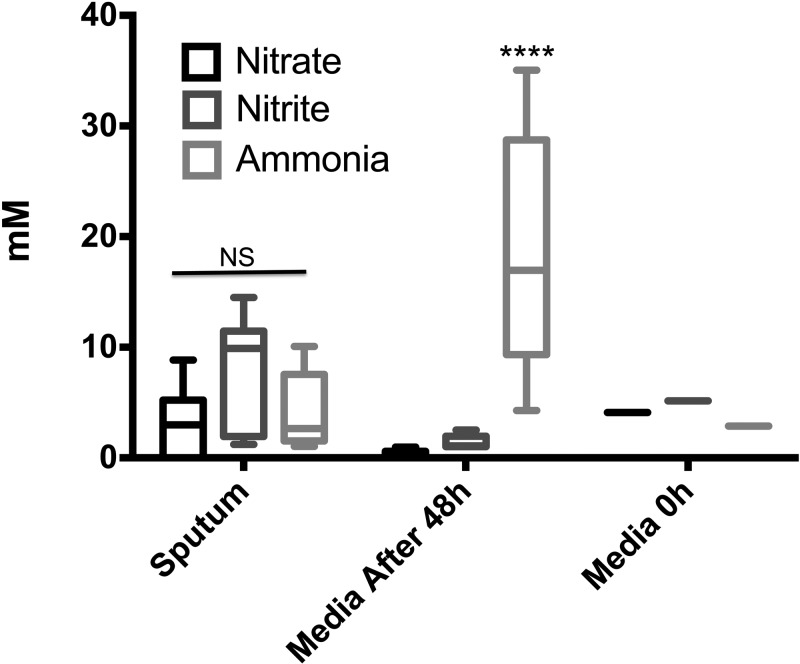
The cystic fibrosis (CF) lung contains thick mucus colonized by opportunistic pathogens which adapt to the CF lung environment over decades. The difficulty associated with sampling airways has impeded a thorough examination of the biochemical microhabitats these pathogens are exposed to. An indirect approach is to study the responses of microbial communities to these microhabitats, facilitated by high-throughput sequencing of microbial DNA and RNA from sputum samples. Microbial metagenomes and metatranscriptomes were sequenced from multiple CF patients, and the reads were assigned taxonomy and function through sequence homology to NCBI and the Kyoto Encyclopedia of Genes and Genomes (KEGG) database hierarchies. For a comparison, saliva microbial metagenomes from the Human Microbiome Project (HMP) were also analyzed. These analyses identified that functions encoded and expressed by CF microbes were significantly enriched for amino acid catabolism, folate biosynthesis, and lipoic acid biosynthesis. The data indicate that the community uses oxidative phosphorylation as a major energy source but that terminal electron acceptors were diverse. Nitrate reduction was the most abundant anaerobic respiratory pathway, and genes for nitrate reductase were largely assigned to Pseudomonas and Rothia. Although many reductive pathways of the nitrogen cycle were present, the cycle was incomplete, because the oxidative pathways were absent. Due to the abundant amino acid catabolism and incomplete nitrogen cycle, the CF microbial community appears to accumulate ammonia. This finding was verified experimentally using a CF bronchiole culture model system. The data also revealed abundant sensing and transport of iron, ammonium, zinc, and other metals along with a low-oxygen environment. This study reveals the core biochemistry and physiology of the CF microbiome. IMPORTANCE The cystic fibrosis (CF) microbial community is complex and adapts to the environmental conditions of the lung over the lifetime of a CF patient. This analysis illustrates the core functions of the CF microbial community in the context of CF lung biochemistry. There are many studies of the metabolism and physiology of individual microbes within the CF lung, but none that collectively analyze data from the whole microbiome. Understanding the core metabolism of microbes that inhabit the CF lung can provide new targets for novel therapies. The fundamental processes that CF pathogens rely on for survival may represent an Achilles heel for this pathogenic community. Novel therapies that are designed to disrupt understudied survival strategies of the CF microbial community may succeed against otherwise untreatable or antibiotic-resistant microbes.
Overview
The claims and statistics of this paper haven’t been checked yet.
Free: it reads the open-access text and checks the first 5 claims that cite a source we can check. Create a free account to check every claim.
Integrity signals
Registry
Cites
Statistics
Figures
Verification
Claims the paper makes
The claims and statistics of this paper haven’t been checked yet.
Free: it reads the open-access text and checks the first 5 claims that cite a source we can check. Create a free account to check every claim.
Claims other papers make about this one
Each is checked against this paper’s own text: does it say what the citing paper says it does?
The cited source says what the claim attributes to it.
In the citing paper
“Interestingly, an increase in iron and iron-related proteins is found in the lungs of CF patients (Hunter et al., 2013; Quinn et al., 2014).”
From Iron at the Centre of Candida albicans Interactions (2018) · cites this paper as Quinn et al., 2014
Self-check
Percentages, sums and reported differences re-computed from the paper’s own numbers.
The self-check needs the paper’s full text.
Citations
Cites
1 retracted
Hunter, R. C., Klepac-Ceraj, V., Lorenzi, M. M., Grotzinger, H., Martin, T. R., & Newman, D. K. (2012) · American Journal of Respiratory Cell and Molecular Biology · doi:10.1165/rcmb.2012-0088oc · Cited by 168 · cited 4×
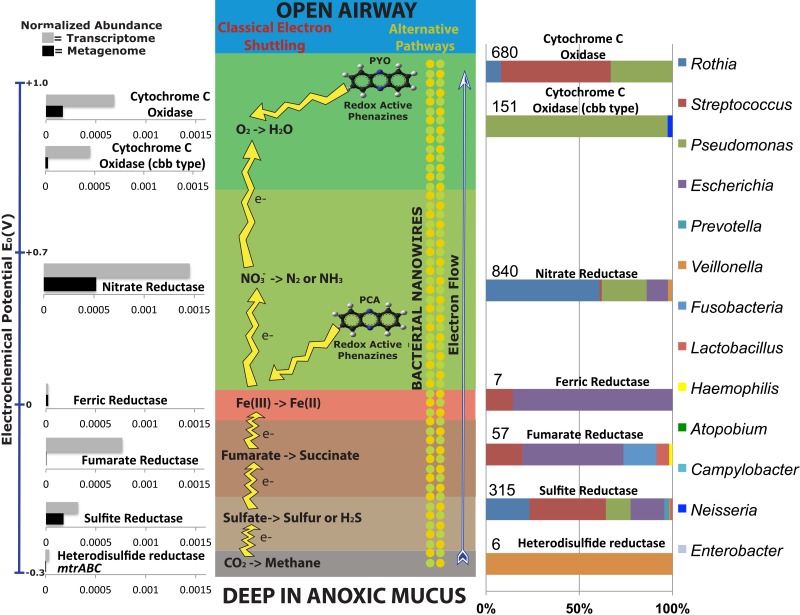
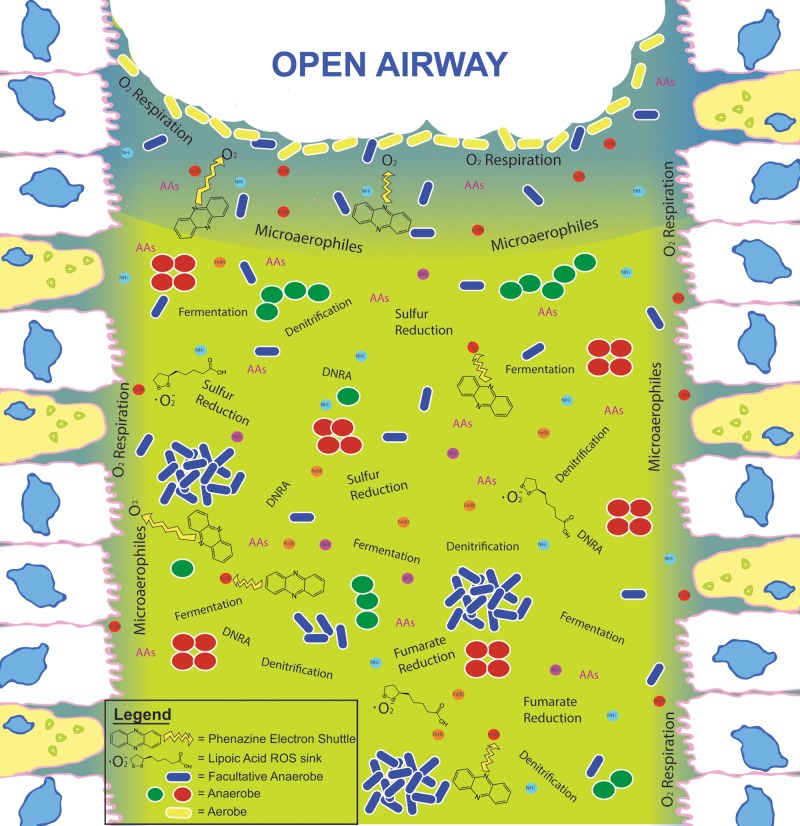
“Phenazines and nanowires are included as alternative electron shuttles (14, 71).”
BackgroundInfluentialRetractedStructure, function and diversity of the healthy human microbiome
The Human Microbiome Project Consortium (2012) · Nature · doi:10.1038/nature11234 · Cited by 11,726
Neutrophil Extracellular Traps Kill Bacteria
Brinkmann, V., Reichard, U., Goosmann, C., Fauler, B., Uhlemann, Y., Weiss, D. S., Weinrauch, Y., & Zychlinsky, A. (2004) · Science · doi:10.1126/science.1092385 · Cited by 10,268 · cited 1×
“Nucleotide metabolism may reflect the abundance of free DNA in CF sputum (41), which is believed to come from neutrophil extracellular traps (42, 43) and bacterial biofilms (44).”
BackgroundQuality control and preprocessing of metagenomic datasets
Schmieder, R., & Edwards, R. (2011) · Bioinformatics · doi:10.1093/bioinformatics/btr026 · Cited by 5,072
A Rapid, Simple Spectrophotometric Method for Simultaneous Detection of Nitrate and Nitrite
Miranda, K. M., Espey, M. G., & Wink, D. A. (2001) · Nitric Oxide · doi:10.1006/niox.2000.0319 · Cited by 3,860 · cited 1×
“nitrite levels were measured using the Greiss reagent (89), and ammonia”
MethodThe Microbial Engines That Drive Earth's Biogeochemical Cycles
Falkowski, P. G., Fenchel, T., & Delong, E. F. (2008) · Science · doi:10.1126/science.1153213 · Cited by 3,379 · cited 3×
“Reduction of nitrogen oxide species (NOx) is one of the most energetically favorable pathways of anaerobic respiration in the microbial world (63).”
BackgroundInfluentialExtracellular DNA Required for Bacterial Biofilm Formation
Whitchurch, C. B., Tolker-Nielsen, T., Ragas, P. C., & Mattick, J. S. (2002) · Science · doi:10.1126/science.295.5559.1487 · Cited by 2,203 · cited 1×
“Nucleotide metabolism may reflect the abundance of free DNA in CF sputum (41), which is believed to come from neutrophil extracellular traps (42, 43) and bacterial biofilms (44).”
BackgroundGorby, Y. A., Yanina, S., McLean, J. S., Rosso, K. M., Moyles, D., Dohnalkova, A., Beveridge, T. J., Chang, I. S., Kim, B. H., Kim, K. S., et al. (2006) · Proceedings of the National Academy of Sciences · doi:10.1073/pnas.0604517103 · Cited by 1,749 · cited 1×
“, bacterial appendages that can serve as nanowires (69) (Fig.”
BackgroundEstablishment of infection: lessons from a versatile opportunist
Lyczak, J. B., Cannon, C. L., & Pier, G. B. (2000) · Microbes and Infection · doi:10.1016/s1286-4579(00)01259-4 · Cited by 1,341
Topographical Continuity of Bacterial Populations in the Healthy Human Respiratory Tract
Charlson, E. S., Bittinger, K., Haas, A. R., Fitzgerald, A. S., Frank, I., Yadav, A., Bushman, F. D., & Collman, R. G. (2011) · American Journal of Respiratory and Critical Care Medicine · doi:10.1164/rccm.201104-0655oc · Cited by 1,144 · cited 1×
“Furthermore, healthy human sputum samples are primarily saliva, as healthy lungs have little mucus and sputum, and saliva contains large amounts of some of the same microbes that are in CF sputum (40, 90, 91).”
Background
Cited by
Items 101–123 of 123
Baby’s First Microbes: The Microbiome of Human Milk
Collado, M. C., Gueimonde, M., Ruíz, L., Aparicio, M., Castro, I., & Rodríguez, J. M. (2019) · Springer eBooks · doi:10.1007/978-3-030-28737-5_1 · Cited by 5
Microbial Metabolites in Cystic Fibrosis: A Target for Future Therapy?
Widder, S., & Knapp, S. (2019) · American Journal of Respiratory Cell and Molecular Biology · doi:10.1165/rcmb.2019-0081ed · Cited by 3
“and Haemophilus in anoxic sputum (7), and can provide a competitive advantage for cross-feeders in the microbial community.”
Variations of Nitrate-reducing Activity in Oral Rothia mucilaginosa
(2015) · Journal of oral tissue engineering · doi:10.11223/jarde.13.18 · Cited by 2
Transposon insertion in Rothia dentocariosa
Liu, B., Mashimo, C., Nambu, T., Maruyama, H., & Okinaga, T. (2024) · Journal of Oral Biosciences · doi:10.1016/j.job.2024.04.006 · Cited by 2
How Does Biological Sex Impact Mucosal Bacterial Infection? Mucosal Defenses and Bacterial Detection
Finn, L. R., & Ingersoll, M. A. (2026) · Immunological Reviews · doi:10.1111/imr.70112 · Cited by 2
Molloy, S. (2014) · Nature Reviews Microbiology · doi:10.1038/nrmicro3268 · Cited by 2
Progress Towards Next-Generation Therapeutics for Cystic Fibrosis
O′Neil, D. A., & Fraser-Pitt, D. J. (2014) · Future Medicinal Chemistry · doi:10.4155/fmc.14.67 · Cited by 2
Next-generation microbial drugs developed from microbiome's natural products
Bhattarai, K., Bhattarai, K., & Baral, B. (2021) · Advances in genetics · doi:10.1016/bs.adgen.2021.08.007 · Cited by 2
The Guild Model of CF Airway Microbial Ecology
Dunham, S. J. B., Willkeen, G. A., Darby, B., Corley, J. M., Hahn, A., Klapper, I., Bean, H. D., Caverly, L. J., Thornton, C. S., Christian Martin, H., et al. (2026) · mBio · doi:10.1128/mbio.03668-25 · Cited by 1
Self-citationMicrobiome of the Unified Airway
Gitomer, S. A., & Ramakrishnan, V. R. (2020) · Springer eBooks · doi:10.1007/978-3-030-50330-7_1 · Cited by 1
Statistical methods for functional metagenomic analysis based on next-generation sequencing data
Pookhao, N. (2014) · UA Campus Repository (The University of Arizona)
Soret, P. (2019) · theses.fr (ABES) · doi:10.70675/3d1d11b0ze32dz48a6z82cbzc6c30b6eb833
Lung Diseases: Chronic Respiratory Infections
Blasi, F. (2018) · MDPI eBooks · doi:10.3390/books978-3-03897-339-3 · Cited by 2
Complex ecological approach to cystic fibrosis respiratory infections
Alekseev, D. V., Lyamin, A. V., & Kaiumov, K. A. (2023) · Novel Research in Microbiology Journal · doi:10.21608/nrmj.2023.327188
Coffey, M. J. (2020) · UNSWorks (UNSW Sydney) · doi:10.26190/unsworks/21821
Microbial Ecology of the CF Lung
Willkeen, G. A. (2024) · eScholarship (California Digital Library) · Cited by 1
Cystic fibrosis microbiology: Optimizing molecular diagnostic approaches
Aseeri, A. (2024) · ORCA Online Research @Cardiff (Cardiff University)
Carlson-Jones, J. A. P., Goddard, T. R., Papudeshi, B. N., Mallawaarachchi, V., Whiteson, K., Warner, M. S., Morton, J. M., Jersmann, H. P. A., & Edwards, R. A. (2026) · Clinical Microbiology Reviews · doi:10.1128/cmr.00352-25 · Cited by 1
Self-citationCanto-Encalada, G., Hajama, H., Saldivar, A., Ademikanra, A. F., Willkeen, G. A., Segall, A. M., & Zúñiga, C. (2026) · Research Square · doi:10.21203/rs.3.rs-10656614/v1
Metadata
- Authors
- Quinn, R. A., Lim, Y. W., Maughan, H., Conrad, D., Rohwer, F., & Whiteson, K. L.
- Affiliations
- San Diego State University (US)
- Ronin Institute (US)
- University of California San Diego (US)
- Venue
- mBio
- Publisher
- American Society for Microbiology
- Published
- 2014-05
- Volume
- 5
- Issue
- 2
- Pages
- e00956-13
- ISSN
- 2150-7511 (ISSN-L)
- 2161-2129
- PMC
- PMC3967525
- OpenAlex
- W1997791706
- Cited by
- 115
- References
- 97
- Citations by year
- 2026: 3 · 2025: 2 · 2024: 6 · 2023: 4 · 2022: 6 · 2021: 14 · 2020: 8 · 2019: 18 · 2018: 5 · 2017: 14 · 2016: 16 · 2015: 12 · 2014: 7
- FWCI
- 13.11
- Type
- journal article
- Language
- en
- Open access
- gold
- doi.org
- Licence
- cc-by-nc-sa
- creativecommons.org/licenses/by-nc-sa/3.0/ (vor)
- journals.asm.org/non-commercial-tdm-license (tdm)
- Locations
- mBio (publishedVersion, cc-by-nc-sa)
- Europe PMC (PubMed Central) (publishedVersion, cc-by-nc-sa)
- PubMed Central (publishedVersion, cc-by-nc-sa)
- PubMed (publishedVersion)
- DOAJ (DOAJ: Directory of Open Access Journals) (submittedVersion, cc-by-sa)
- eScholarship (California Digital Library) (submittedVersion)
- Funders
- Cystic Fibrosis Foundation
- National Institutes of Health
- National Institute of General Medical Sciences (R01GM095384)
- Topics
- Health Sciences › Medicine › Pulmonary and Respiratory Medicine › Cystic Fibrosis Research Advances
- Life Sciences › Biochemistry, Genetics and Molecular Biology › Molecular Biology › Bacterial biofilms and quorum sensing
- Health Sciences › Medicine › Microbiology (medical) › Infections and bacterial resistance
- Keywords
- polymicrobial communities, opportunistic pathogens, metagenomics, metatranscriptomics, amino acid catabolism, folate biosynthesis, lipoic acid biosynthesis, oxidative phosphorylation, nitrate reduction, ammonia accumulation, Pseudomonas, Rothia, antibiotic resistance
- MeSH terms
- Bacterial Infections, Cystic Fibrosis, Humans, Lung, Sputum, Metabolic Networks and Pathways, Metagenome, Biota, High-Throughput Nucleotide Sequencing, Transcriptome
About these checks
Registry, retraction, Cites and statistics results are computed, not judged, with one exception: a printed reference that no index lists is read once by a model before it counts as a citation error. Claims are extracted by a model and kept only when their quote appears verbatim in the text; each cited source is then checked, with a model’s help, for whether it says what the claim relies on. Those verdicts can be wrong — read the claim’s quote and the cited source before relying on one.
Statistics and arithmetic are recomputed, not judged.
Confidence bands are shown only for fields calibrated on our annotated test set. None is calibrated yet, so no band is shown.
What counts as a claim ›How we measure confidence ›How we check this ›
Are you an author, or do you see a problem with this page? Request a review
Data sources
Bibliographic data: Semantic Scholar, OpenAlex, Crossref.
Contains information from the Semantic Scholar Academic Graph Datasets, made available under the ODC Attribution License (ODC-BY 1.0).
Semantic Scholar’s data is described in: Kinney, R., et al. (2023). The Semantic Scholar Open Data Platform. arXiv:2301.10140.
