

Magnesium Sensing Regulates Intestinal Colonization of Enterohemorrhagic Escherichia coli O157:H7
Open accessThe DOI matches its Crossref record; 46 of the 46 references it cites were found in a registry or an index.
Abstract
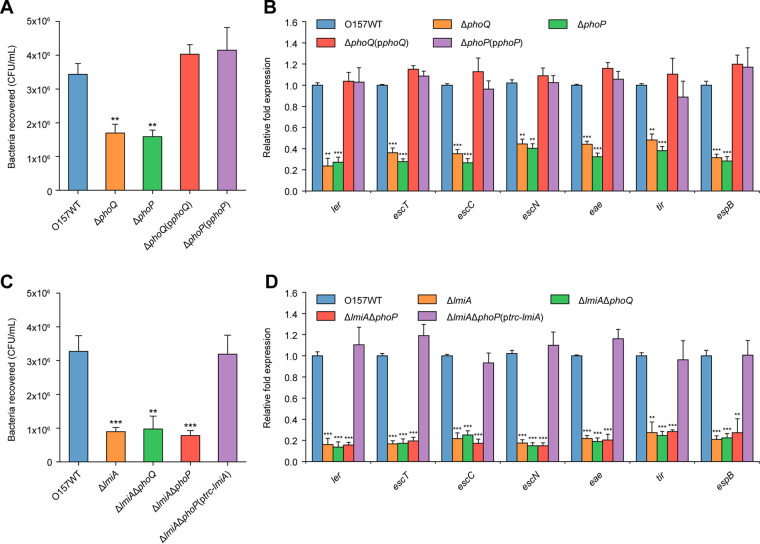
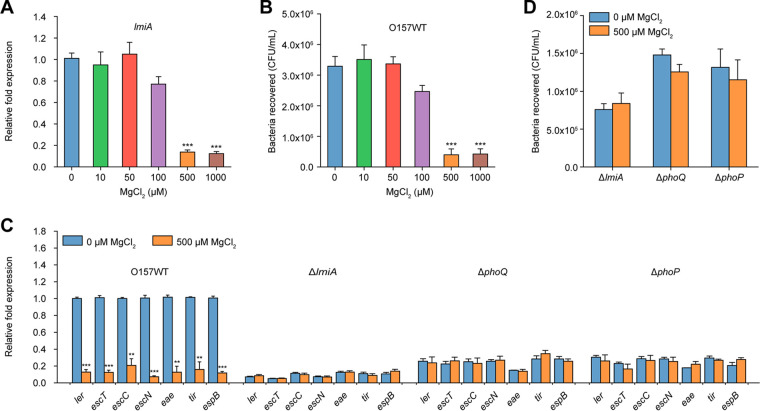
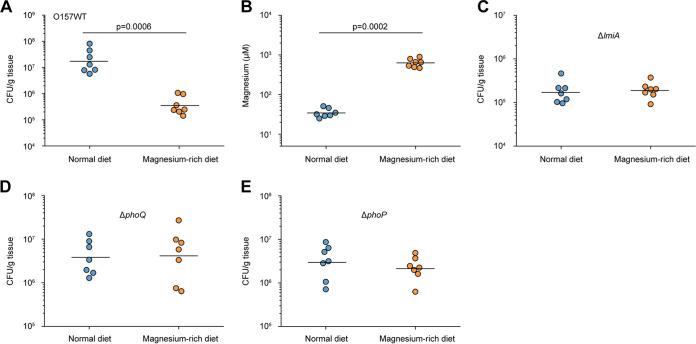
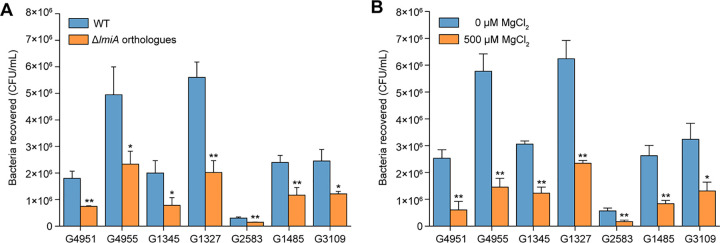
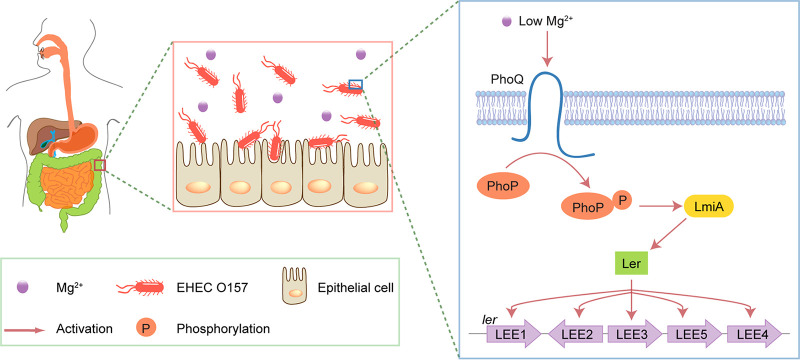
Sensing specific gut metabolites is an important strategy for inducing crucial virulence programs by enterohemorrhagic Escherichia coli (EHEC) O157:H7 during colonization and infection. Here, we identified a virulence-regulating pathway wherein the PhoQ/PhoP two-component regulatory system signals to the O island 119-encoded low magnesium-induced regulator A (LmiA), which, in turn, activates locus of enterocyte effacement (LEE) genes to promote EHEC O157:H7 adherence in the low-magnesium conditions of the large intestine. This regulatory pathway is widely present in a range of EHEC and enteropathogenic E. coli (EPEC) serotypes. Disruption of this pathway significantly decreased EHEC O157:H7 adherence in the mouse intestinal tract. Moreover, mice fed a magnesium-rich diet showed significantly reduced EHEC O157:H7 adherence in vivo , indicating that magnesium may help in preventing EHEC and EPEC infection in humans.
Overview
The claims and statistics of this paper haven’t been checked yet.
Free: it reads the open-access text and checks the first 5 claims that cite a source we can check. Create a free account to check every claim.
Integrity signals
Registry
Cites
Statistics
Figures
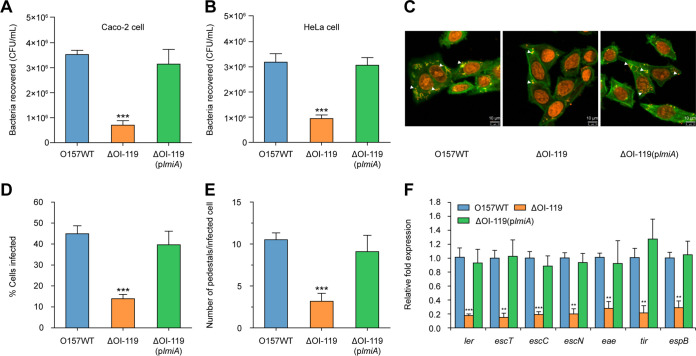
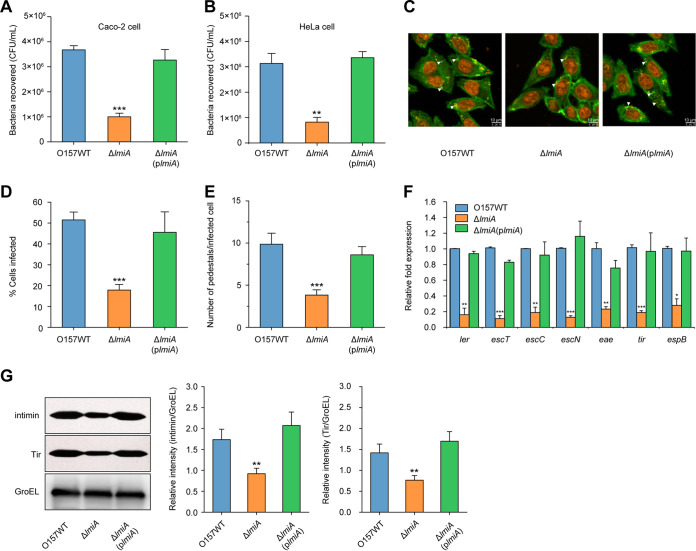
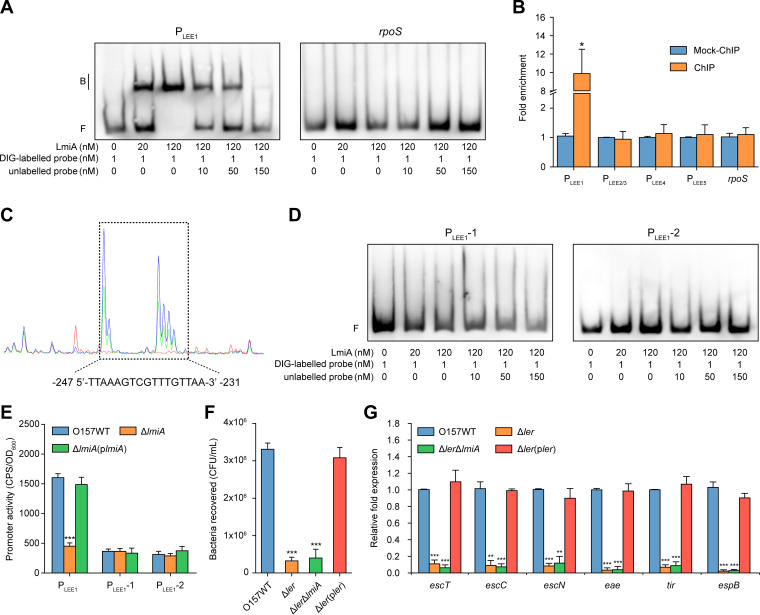
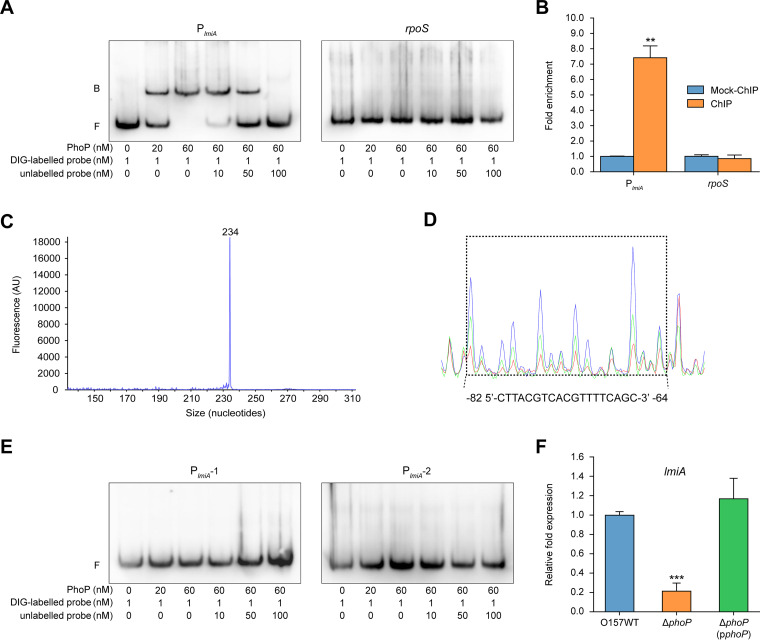
Verification
Claims the paper makes
The claims and statistics of this paper haven’t been checked yet.
Free: it reads the open-access text and checks the first 5 claims that cite a source we can check. Create a free account to check every claim.
Self-check
Percentages, sums and reported differences re-computed from the paper’s own numbers.
The self-check needs the paper’s full text.
Citations
Cites
Analysis of Relative Gene Expression Data Using Real-Time Quantitative PCR and the 2−ΔΔCT Method
Livak, K. J., & Schmittgen, T. D. (2001) · Methods · doi:10.1006/meth.2001.1262 · Cited by 180,860 · cited 2×
“Relative enrichment was calculated as fold change using the ΔΔCT method (40).”
MethodOne-step inactivation of chromosomal genes in Escherichia coli K-12 using PCR products
Datsenko, K. A., & Wanner, B. L. (2000) · Proceedings of the National Academy of Sciences · doi:10.1073/pnas.120163297 · Cited by 14,782 · cited 1×
“Mutant strains were generated by the Red recombinase system (38).”
MethodFood-Related Illness and Death in the United States
Mead, P. S., Slutsker, L., Dietz, V., McCaig, L. F., Bresee, J. S., Shapiro, C., Griffin, P. M., & Tauxe, R. V. (1999) · Emerging Infectious Diseases · doi:10.3201/eid0505.990502 · Cited by 7,235 · cited 2×
“Outbreak surveillance data from the CDC reported that EHEC O157 alone results in more than 73,000 illnesses, 2,200 hospitalizations, and 60 deaths annually in the United States (37).”
BackgroundDefensins: antimicrobial peptides of innate immunity
Ganz, T. (2003) · Nature Reviews Immunology · doi:10.1038/nri1180 · Cited by 3,066 · cited 1×
“In addition, cationic antimicrobial peptides are mainly produced and secreted by Paneth cells within the crypts of the small intestine, and only a limited number of antimicrobial peptides exist in the large intestine (35, 36).”
BackgroundGenome sequence of enterohaemorrhagic Escherichia coli O157:H7
Perna, N. T., Plunkett, G., Burland, V., Mau, B., Glasner, J. D., Rose, D. J., Mayhew, G. F., Evans, P. S., Gregor, J., Kirkpatrick, H. A., et al. (2001) · Nature · doi:10.1038/35054089 · Cited by 2,055
Epidemiology of Escherichia coli O157:H7 Outbreaks, United States, 1982–2002
Rangel, J. M., Sparling, P. H., Crowe, C., Griffin, P. M., & Swerdlow, D. L. (2005) · Emerging Infectious Diseases · doi:10.3201/eid1104.040739 · Cited by 1,263
Paneth cells, antimicrobial peptides and maintenance of intestinal homeostasis
Bevins, C. L., & Salzman, N. H. (2011) · Nature Reviews Microbiology · doi:10.1038/nrmicro2546 · Cited by 1,238 · cited 1×
“In addition, cationic antimicrobial peptides are mainly produced and secreted by Paneth cells within the crypts of the small intestine, and only a limited number of antimicrobial peptides exist in the large intestine (35, 36).”
BackgroundMg2+ as an Extracellular Signal: Environmental Regulation of Salmonella Virulence
Véscovi, E. G., Soncini, F. C., & Groisman, E. A. (1996) · Cell · doi:10.1016/s0092-8674(00)81003-x · Cited by 841
Enterohaemorrhagic Escherichia coli: emerging issues on virulence and modes of transmission
Caprioli, A., Morabito, S., Brug�re, H., & Oswald, E. (2005) · Veterinary Research · doi:10.1051/vetres:2005002 · Cited by 668 · cited 1×
“One important characteristic of EHEC O157 virulence is its ability to form attaching and effacing (A/E) lesions on epithelial cells (2, 3).”
BackgroundA Brief Overview of Escherichia coli O157:H7 and Its Plasmid O157
Lim, J. Y., Yoon, J., & Hovde, C. J. (2010) · Journal of Microbiology and Biotechnology · doi:10.4014/jmb.0908.08007 · Cited by 597 · cited 3×
“One important characteristic of EHEC O157 virulence is its ability to form attaching and effacing (A/E) lesions on epithelial cells (2, 3).”
Background
Cited by
Nutritional immunity: the battle for nutrient metals at the host–pathogen interface
Murdoch, C. C., & Skaar, E. P. (2022) · Nature Reviews Microbiology · doi:10.1038/s41579-022-00745-6 · Cited by 701
Groisman, E. A., Duprey, A., & Choi, J. (2021) · Microbiology and Molecular Biology Reviews · doi:10.1128/mmbr.00176-20 · Cited by 165
Oral magnesium prevents acetaminophen-induced acute liver injury by modulating microbial metabolism
Li, D., Chen, Y., Wan, M., Mei, F., Wang, F., Gu, P., Zhang, X., Wei, R., Zeng, Y., Zheng, H., et al. (2023) · Cell Host & Microbe · doi:10.1016/j.chom.2023.11.006 · Cited by 86
Self-citationRegulation of flagellar motility and biosynthesis in enterohemorrhagic Escherichia coli O157:H7
Sun, H., Wang, M., Liu, Y., Wu, P., Yao, T., Yang, W., Yang, Q., Yan, J., & Yang, B. (2022) · Gut Microbes · doi:10.1080/19490976.2022.2110822 · Cited by 80
Self-citationChowdhury, R., Bitar, P. D. P., Keresztes, I., Condo, A. M., & Altier, C. (2021) · PLoS Pathogens · doi:10.1371/journal.ppat.1009357 · Cited by 38
Metadata
- Authors
- Liu, Y., Han, R., Wang, J., Yang, P., Wang, F., & Yang, B.
- Affiliations
- Nankai University (CN)
- TEDA Institute of Biological Sciences and Biotechnology, Nankai University, TEDA, Tianjin, People’s Republic of China
- Corresponding author
- Yang, Bin
- Venue
- mBio
- Publisher
- American Society for Microbiology
- Published
- 2020-12-22
- Volume
- 11
- Issue
- 6
- ISSN
- 2150-7511 (ISSN-L)
- 2161-2129
- PMC
- PMC7667037
- OpenAlex
- W3101715380
- Cited by
- 40
- References
- 46
- Citations by year
- 2026: 2 · 2025: 6 · 2024: 7 · 2023: 9 · 2022: 8 · 2021: 8
- FWCI
- 3.85
- Type
- journal article
- Language
- en
- Open access
- gold
- doi.org
- Licence
- cc-by
- creativecommons.org/licenses/by/4.0/ (vor)
- journals.asm.org/non-commercial-tdm-license (tdm)
- Locations
- mBio (publishedVersion, cc-by)
- PubMed Central (publishedVersion, cc-by)
- PubMed (publishedVersion)
- DOAJ (DOAJ: Directory of Open Access Journals) (submittedVersion, cc-by-sa)
- Funders
- Natural Science Foundation of Tianjin City (20JCQNJC11700, 17JCQNJC09300)
- National Natural Science Foundation of China (31800125, 31530083)
- Topics
- Life Sciences › Immunology and Microbiology › Microbiology › Escherichia coli research studies
- Life Sciences › Biochemistry, Genetics and Molecular Biology › Genetics › Bacterial Genetics and Biotechnology
- Life Sciences › Immunology and Microbiology › Microbiology › Enterobacteriaceae and Cronobacter Research
- Keywords
- Escherichia coli O157:H7, magnesium sensing, locus of enterocyte effacement, bacterial adhesion, intestinal colonization, enteropathogenic Escherichia coli, gut microbiota metabolites, virulence regulation
- MeSH terms
- Animals, Bacterial Adhesion, Escherichia coli Infections, Female, Humans, Intestines, Magnesium, Virulence, Gene Expression Regulation, Bacterial, Escherichia coli O157, Escherichia coli Proteins, Mice
About these checks
Registry, retraction, Cites and statistics results are computed, not judged, with one exception: a printed reference that no index lists is read once by a model before it counts as a citation error. Claims are extracted by a model and kept only when their quote appears verbatim in the text; each cited source is then checked, with a model’s help, for whether it says what the claim relies on. Those verdicts can be wrong — read the claim’s quote and the cited source before relying on one.
Statistics and arithmetic are recomputed, not judged.
Confidence bands are shown only for fields calibrated on our annotated test set. None is calibrated yet, so no band is shown.
What counts as a claim ›How we measure confidence ›How we check this ›
Are you an author, or do you see a problem with this page? Request a review
Data sources
Bibliographic data: Semantic Scholar, OpenAlex, Crossref.
Contains information from the Semantic Scholar Academic Graph Datasets, made available under the ODC Attribution License (ODC-BY 1.0).
Semantic Scholar’s data is described in: Kinney, R., et al. (2023). The Semantic Scholar Open Data Platform. arXiv:2301.10140.
