Cited by 28

The DOI matches its Crossref record; 1 of the 1 references it cites were found in a registry or an index.

Unexpected Mechanism of Biodegradation and Defluorination of 2,2-Difluoro-1,3-Benzodioxole by Pseudomonas putida F1

Bygd, Madison D., Aukema, Kelly G., Richman, Jack E., Wackett, Lawrence P.·2021·mBio

Abstract

There are more than 9,000 polyfluorinated compounds developed for commercial use, some negatively impacting human health, and they are generally considered to be resistant to biodegradation. Only a limited number of studies have identified microbes with enzymes sufficiently reactive to defluorinate difluoromethylene carbon groups.

Overview

The claims and statistics of this paper haven’t been checked yet.

Run the check — free, no account needed. It reads the open-access text and checks the sources it cites.

A few free checks a day · papers already verified open instantly · results are public

Integrity signals

Registry

Crossref · 10.1128/mbio.03001-21

Cites

1 of 1 references verified0 citation errors · 0 not checkable

Statistics

Figures

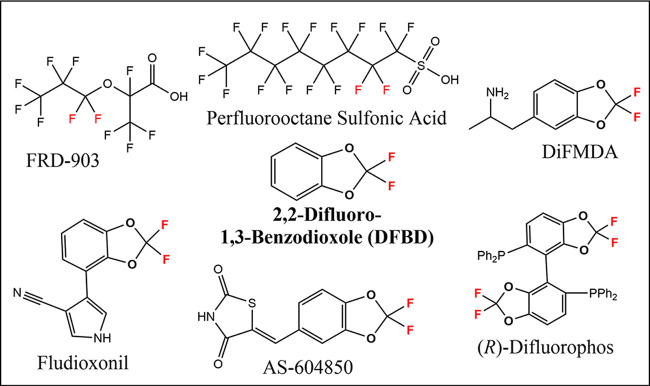
FIG 1 Examples of commercially relevant polyfluorinated compounds. The center compound in bold is 2,2-difluro-1,3-benzodioxole (DFBD). Compounds containing the DFBD moiety shown are the experimental drug DiFMDA (difluoromethylenedioxyamphetamine), the fungicide fludioxonil, the anticancer agent AS-604850, and the reagent for enantioselective synthesis (R)-difluorophos.
FIG 1 Examples of commercially relevant polyfluorinated compounds. The center compound in bold is 2,2-difluro-1,3-benzodioxole (DFBD). Compounds containing the DFBD moiety shown are the experimental drug DiFMDA (difluoromethylenedioxyamphetamine), the fungicide fludioxonil, the anticancer agent AS-604850, and the reagent for enantioselective synthesis (R)-difluorophos.CC BY · PubMed Central
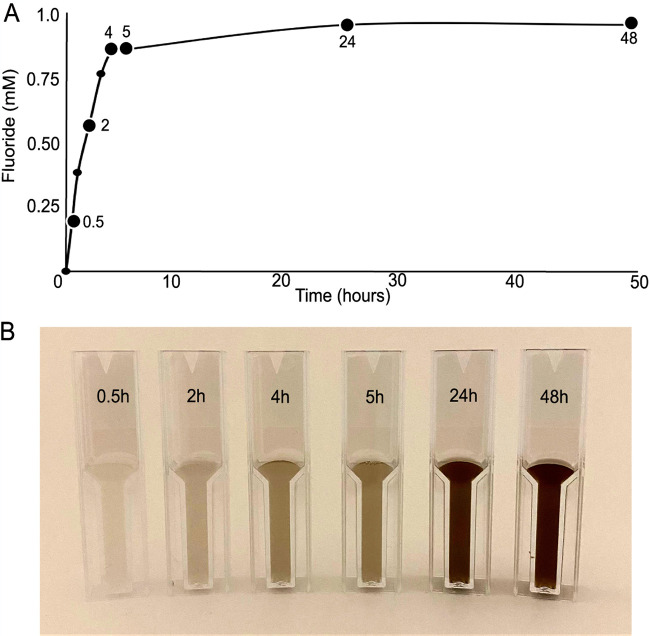
FIG 2 Fluoride release (A) and color change (B) in medium of a culture of Pseudomonas putida F1 incubated with DFBD with shaking over 48 h. P. putida F1 was grown with toluene as the carbon source, which induces the toluene catabolic pathway, and then the culture was switched to DFBD. For fluoride measurements, cells were removed, and the supernatant liquid was analyzed for fluoride, using an ion-specific electrode, as shown in panel A. Aliquots of the culture were taken at the times indicated and stored frozen, and then all were directly photographed, as shown in panel B.
FIG 2 Fluoride release (A) and color change (B) in medium of a culture of Pseudomonas putida F1 incubated with DFBD with shaking over 48 h. P. putida F1 was grown with toluene as the carbon source, which induces the toluene catabolic pathway, and then the culture was switched to DFBD. For fluoride measurements, cells were removed, and the supernatant liquid was analyzed for fluoride, using an ion-specific electrode, as shown in panel A. Aliquots of the culture were taken at the times indicated and stored frozen, and then all were directly photographed, as shown in panel B.CC BY · PubMed Central
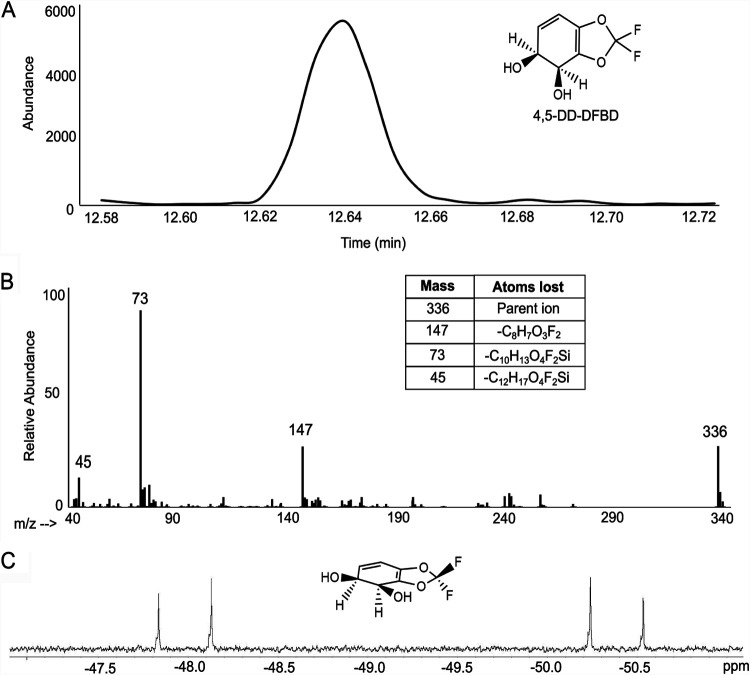
FIG 3 Toluene dioxygenase oxidation of DFBD to a cis-dihydrodiol. Analytical demonstration of 4,5-cis-dihydroxy-dihydro-2,2-difluoro-1,3-benzodioxole (4,5-DD-DFBD) by GC, MS, and NMR. The structure of the compound is shown in the upper right of panel A. The material analyzed by GC and MS was derivatized as detailed in Materials and Methods. While the data are consistent with a cis-dihydrodiol, the absolute stereochemistry has not been determined, and that shown is consistent with dihydrodiols produced by toluene dioxygenase. (A) Gas chromatograph of the extracted product derivatized with trimethylsilane. (B) Mass spectrum of the compound represented by the 12.64-min peak. The parent compound has an m/z of 336, and the m/z = 337,338 envelope is consistent with 1.1% natural abundance of 13C and a compound containing 13 carbon atoms. The disilyl fragment with an m/z of 147 is characteristic of compounds with two adjacent derivatized hydroxyl groups. (C) 19F-NMR spectrum at 400 MHz of 4,5-DD-DFBD. The two coupled doublets are consistent with two fluorines on differentiated faces, in this case arising from the cis configuration of the hydroxyl groups. The 3-dimensional depiction of 4,5-DD-DFBD illustrates the asymmetry imposed by the cis-dihydroxylation of DFBD.
FIG 3 Toluene dioxygenase oxidation of DFBD to a cis-dihydrodiol. Analytical demonstration of 4,5-cis-dihydroxy-dihydro-2,2-difluoro-1,3-benzodioxole (4,5-DD-DFBD) by GC, MS, and NMR. The structure of the compound is shown in the upper right of panel A. The material analyzed by GC and MS was derivatized as detailed in Materials and Methods. While the data are consistent with a cis-dihydrodiol, the absolute stereochemistry has not been determined, and that shown is consistent with dihydrodiols produced by toluene dioxygenase. (A) Gas chromatograph of the extracted product derivatized with trimethylsilane. (B) Mass spectrum of the compound represented by the 12.64-min peak. The parent compound has an m/z of 336, and the m/z = 337,338 envelope is consistent with 1.1% natural abundance of 13C and a compound containing 13 carbon atoms. The disilyl fragment with an m/z of 147 is characteristic of compounds with two adjacent derivatized hydroxyl groups. (C) 19F-NMR spectrum at 400 MHz of 4,5-DD-DFBD. The two coupled doublets are consistent with two fluorines on differentiated faces, in this case arising from the cis configuration of the hydroxyl groups. The 3-dimensional depiction of 4,5-DD-DFBD illustrates the asymmetry imposed by the cis-dihydroxylation of DFBD.CC BY · PubMed Central
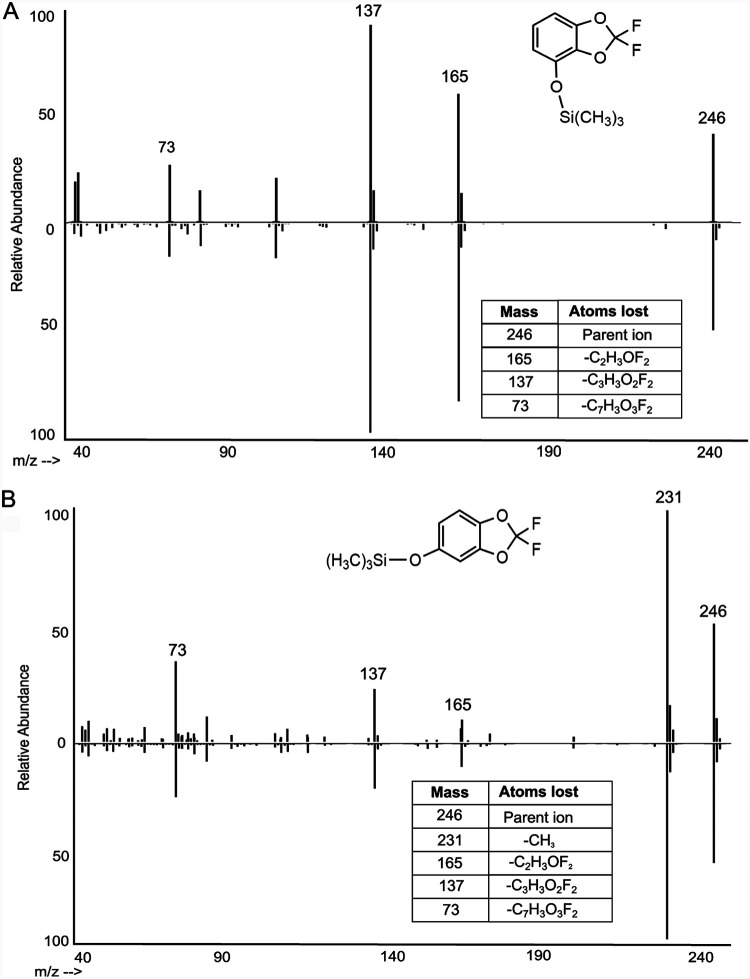
FIG 4 Comparison of dihydrodiol dehydration products from E. coli pDTG601a with synthetic standards following derivatization and mass spectrometry. (A) Mass spectra of trimethylsilane (TMS)-derivatized metabolite from cell cultures incubated with DFBD (top) and standard DFBD-4-ol (bottom). (B) Mass spectra of TMS-derivatized metabolite from cell cultures incubated with DFBD (top) and standard DFBD-5-ol (bottom).
FIG 4 Comparison of dihydrodiol dehydration products from E. coli pDTG601a with synthetic standards following derivatization and mass spectrometry. (A) Mass spectra of trimethylsilane (TMS)-derivatized metabolite from cell cultures incubated with DFBD (top) and standard DFBD-4-ol (bottom). (B) Mass spectra of TMS-derivatized metabolite from cell cultures incubated with DFBD (top) and standard DFBD-5-ol (bottom).CC BY · PubMed Central
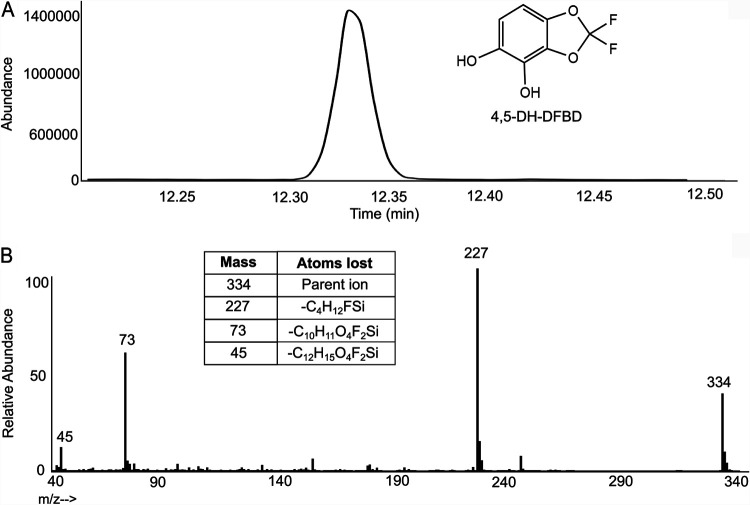
FIG 5 Extracted product derived from E. coli (pDTG602) expressing toluene dioxygenase and toluene dihydrodiol dehydrogenase. (A) Gas chromatogram of the compound identified as TMS-derivatized 4,5-dihydroxy-DFBD. (B) Mass spectrum of TMS-derivatized 4,5-dihydroxy-DFBD. The parent compound shows an m/z of 334.
FIG 5 Extracted product derived from E. coli (pDTG602) expressing toluene dioxygenase and toluene dihydrodiol dehydrogenase. (A) Gas chromatogram of the compound identified as TMS-derivatized 4,5-dihydroxy-DFBD. (B) Mass spectrum of TMS-derivatized 4,5-dihydroxy-DFBD. The parent compound shows an m/z of 334.CC BY · PubMed Central
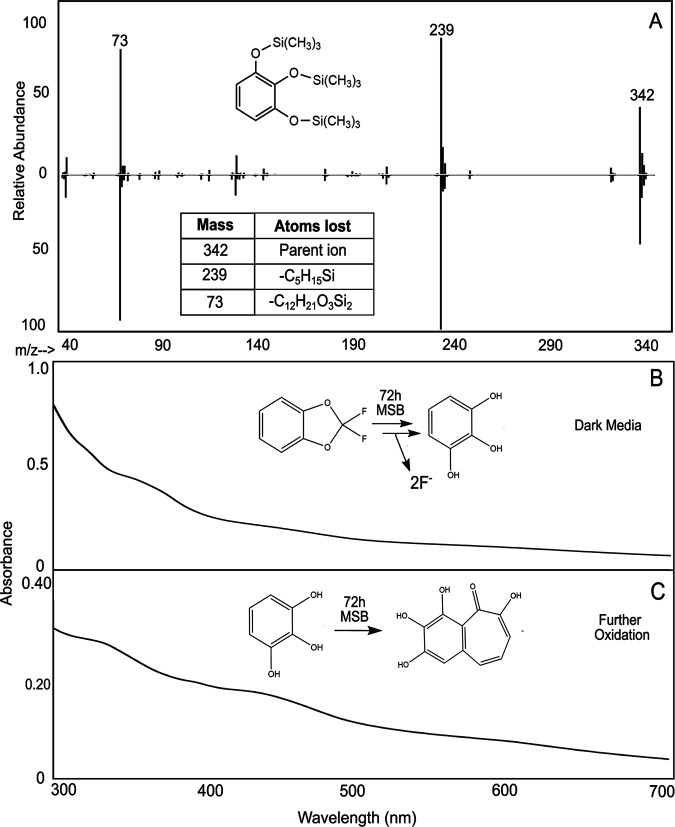
FIG 6 Evidence for the defluorinated aromatic product, pyrogallol, or 1,2,3-benzenetriol. (A) Mass spectrometry fragmentation pattern of derivatized 1,2,3-benzenetriol found in cell cultures from E. coli pDTG601a (top) compared to standard derivatized 1,2,3-benzenetriol (bottom). (B) UV-vis spectrum of E. coli pDTG601a cell culture supernatant after incubation with DFBD for 72 h. (C) UV-vis spectrum of standard 1,2,3-benzenetriol in MSB medium after 72 h. Time course data are shown in Fig. S10.
FIG 6 Evidence for the defluorinated aromatic product, pyrogallol, or 1,2,3-benzenetriol. (A) Mass spectrometry fragmentation pattern of derivatized 1,2,3-benzenetriol found in cell cultures from E. coli pDTG601a (top) compared to standard derivatized 1,2,3-benzenetriol (bottom). (B) UV-vis spectrum of E. coli pDTG601a cell culture supernatant after incubation with DFBD for 72 h. (C) UV-vis spectrum of standard 1,2,3-benzenetriol in MSB medium after 72 h. Time course data are shown in Fig. S10.CC BY · PubMed Central
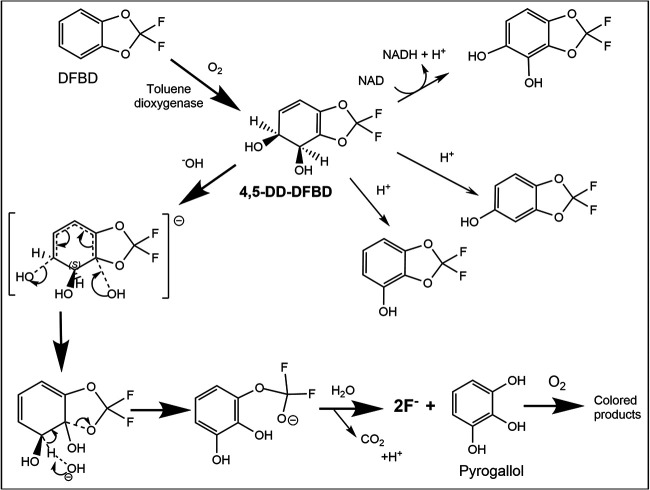
FIG 7 Scheme showing 2,2-difluoro-1,3-benzodioxole (DFBD) oxidation by toluene dioxygenase to 4,5-dihyro-dihydroxy-DFBD (4,5-DD-DFBD) and subsequent reactions producing fluoride ion and dark medium. The major path is highlighted by darker arrows. The three intermediates between 4,5-DD-DFBD and fluoride plus pyrogallol are expected to have a very short lifetime, cannot be demonstrated directly, and represent a proposed mechanism for fluoride and medium darkening. The minor products on the upper right are stable and were demonstrated in this work, as was pyrogallol and the pathway for color formation.
FIG 7 Scheme showing 2,2-difluoro-1,3-benzodioxole (DFBD) oxidation by toluene dioxygenase to 4,5-dihyro-dihydroxy-DFBD (4,5-DD-DFBD) and subsequent reactions producing fluoride ion and dark medium. The major path is highlighted by darker arrows. The three intermediates between 4,5-DD-DFBD and fluoride plus pyrogallol are expected to have a very short lifetime, cannot be demonstrated directly, and represent a proposed mechanism for fluoride and medium darkening. The minor products on the upper right are stable and were demonstrated in this work, as was pyrogallol and the pathway for color formation.CC BY · PubMed Central

Verification

Claims the paper makes

The claims and statistics of this paper haven’t been checked yet.

Run the check — free, no account needed. It reads the open-access text and checks the sources it cites.

A few free checks a day · papers already verified open instantly · results are public

Claims other papers make about this one

Each is checked against this paper’s own text: does it say what the citing paper says it does?

Self-check

Percentages, sums and reported differences re-computed from the paper’s own numbers.

The self-check needs the paper’s full text.

Citations

Cites

Show all 1 references

Research works printed but not linked: 56

  1. 10.1038/s41370-018-0094-1 · DOI · Paper page
  2. 10.1021/es961007c · DOI · Paper page
  3. 10.1039/np9941100123 · DOI
  4. 10.1016/S0045-6535(03)00191-7 · DOI · Paper page
  5. 10.1016/S0022-1139(01)00375-X · DOI
  6. 10.1039/b711844a · DOI
  7. 10.1021/acs.est.1c00353 · DOI · Paper page
  8. 10.1007/s00253-016-7304-3 · DOI
  9. 10.1126/science.1131943 · DOI
  10. 10.1021/acs.joc.0c01729 · DOI
  11. 10.1002/etc.1928 · DOI
  12. 10.1016/j.jhazmat.2020.122545 · DOI
  13. 10.1021/acs.est.0c04483 · DOI · Paper page
  14. 10.1039/c9cs00740g · DOI
  15. 10.1021/acs.est.0c04029 · DOI · Paper page
  16. 10.1128/aem.55.2.330-334.1989 · DOI · Paper page
  17. 10.1023/A:1008391906885 · DOI · Paper page
  18. 10.1128/AEM.00171-09 · DOI
  19. 10.1021/bi00479a013 · DOI · Paper page
  20. 10.1021/acs.estlett.1c00511 · DOI · Paper page
  21. 10.1016/S0021-9258(18)97236-4 · DOI · Paper page
  22. 10.1016/j.nbt.2017.08.005 · DOI · Paper page
  23. 10.1128/jb.175.20.6403-6410.1993 · DOI
  24. 10.1007/BF00248970 · DOI
  25. 10.1093/nar/gkn861 · DOI
  26. 10.1093/nar/gkv1227 · DOI
  27. 10.1002/1097-0290(20000820)69:4<385::AID-BIT5>3.0.CO;2-Q · DOI
  28. 10.1128/aem.54.6.1498-1503.1988 · DOI
  29. 10.1016/j.mimet.2012.09.017 · DOI
  30. 10.1111/j.1574-6941.1997.tb00387.x · DOI
  31. 10.3109/10242428808998177 · DOI
  32. 10.1007/BF00170050 · DOI
  33. 10.1021/bi00404a041 · DOI
  34. 10.1002/kin.550210609 · DOI
  35. 10.1007/s11010-014-2284-z · DOI
  36. 10.1271/bbb1961.49.659 · DOI
  37. 10.2323/jgam.41.165 · DOI
  38. 10.1016/j.freeradbiomed.2019.03.031 · DOI
  39. 10.1016/j.bbrc.2005.08.222 · DOI
  40. 10.1016/S0141-0229(02)00129-1 · DOI
  41. 10.1128/JB.180.5.1194-1199.1998 · DOI
  42. 10.1128/JB.182.6.1641-1649.2000 · DOI
  43. 10.1039/b608417f · DOI
  44. 10.1021/acs.est.6b04345 · DOI
  45. 10.1021/acs.jcim.6b00469 · DOI
  46. 10.1099/00221287-43-2-159 · DOI
  47. 10.1021/bi00851a003 · DOI
  48. 10.1016/S0022-2836(05)80360-2 · DOI · Paper page
  49. 10.1038/nmeth.3176 · DOI · Paper page
  50. 10.1111/1758-2229.12182 · DOI
  51. 10.1021/bi00847a031 · DOI
  52. 10.1042/bj0910251 · DOI
  53. 10.1128/jb.176.8.2158-2164.1994 · DOI
  54. 10.1128/aem.56.5.1279-1285.1990 · DOI
  55. 10.1038/sj.jim.2900715 · DOI
  56. 10.1128/jb.171.3.1725-1732.1989 · DOI

Cited by

Sorted by citations

Metadata

Authors
Bygd, M. D., Aukema, K. G., Richman, J. E., & Wackett, L. P.
Affiliations
  • Microbial Engineering, University of Minnesota, St. Paul, Minnesota, USA
  • Biochemistry, Molecular Biology and Biophysics, University of Minnesota, St. Paul, Minnesota, USA
Venue
mBio
Published
2021-12-21
Volume
12
Issue
6
ISSN
2150-7511
Cited by
28
References
1
Language
en
Funders
MnDRIVE Industry and the Environment

About these checks

Registry, retraction, Cites and statistics results are computed, not judged, with one exception: a printed reference that no index lists is read once by a model before it counts as a citation error. Claims are extracted by a model and kept only when their quote appears verbatim in the text; each cited source is then checked, with a model’s help, for whether it says what the claim relies on. Those verdicts can be wrong — read the claim’s quote and the cited source before relying on one.

Statistics and arithmetic are recomputed, not judged.

Confidence bands are shown only for fields calibrated on our annotated test set. None is calibrated yet, so no band is shown.

What counts as a claim ›How we measure confidence ›How we check this ›

Are you an author, or do you see a problem with this page? Request a review