

The impact of PACS on clinician work practices in the intensive care unit: a systematic review of the literature
Open accessThe DOI matches its Crossref record; 73 of the 74 references it cites were found in a registry or an index.
Abstract
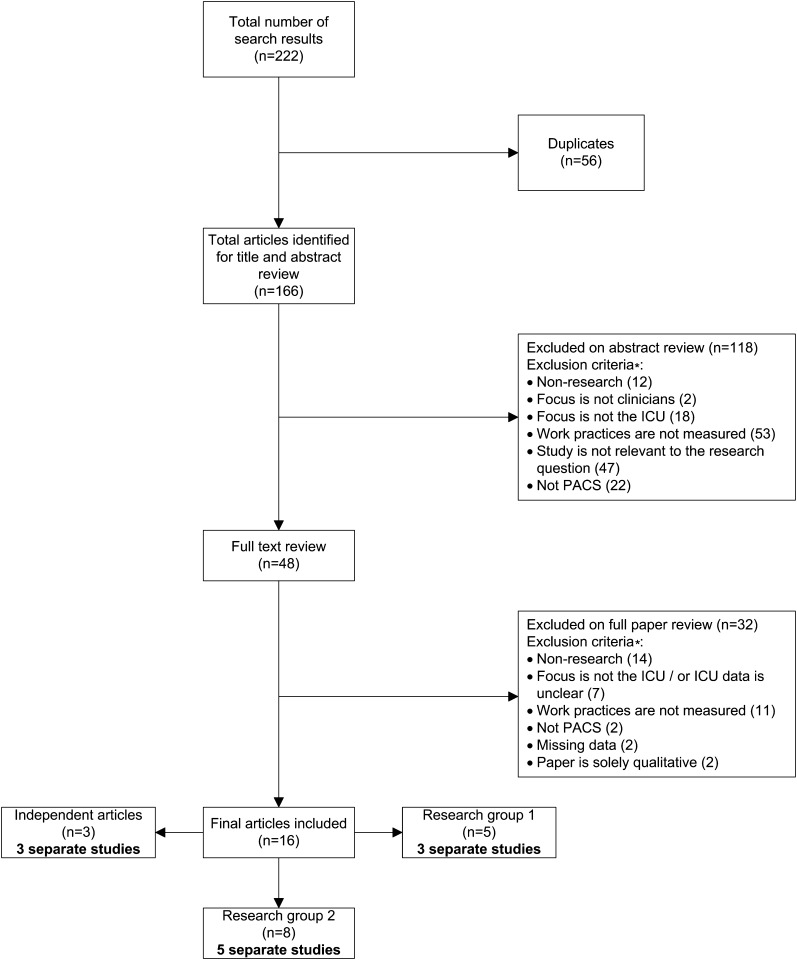
OBJECTIVE: To assess evidence of the impact of Picture Archiving and Communication Systems (PACS) on clinicians' work practices in the intensive care unit (ICU). METHODS: We searched Medline, Pre-Medline, CINAHL, Embase, and the SPIE Digital Library databases for English-language publications between 1980 and September 2010 using Medical Subject Headings terms and keywords. RESULTS: Eleven studies from the USA and UK were included. All studies measured aspects of time associated with the introduction of PACS, namely the availability of images, the time a physician took to review an image, and changes in viewing patterns. Seven studies examined the impact on clinical decision-making, with the majority measuring the time to image-based clinical action. The effect of PACS on communication modes was reported in five studies. DISCUSSION: PACS can impact on clinician work practices in three main areas. Most of the evidence suggests an improvement in the efficiency of work practices. Quick image availability can impact on work associated with clinical decision-making, although the results were inconsistent. PACS can change communication practices, particularly between the ICU and radiology; however, the evidence base is insufficient to draw firm conclusions in this area. CONCLUSION: The potential for PACS to impact positively on clinician work practices in the ICU and improve patient care is great. However, the evidence base is limited and does not reflect aspects of contemporary PACS technology. Performance measures developed in previous studies remain relevant, with much left to investigate to understand how PACS can support new and improved ways of delivering care in the intensive care setting.
Overview
The claims and statistics of this paper haven’t been checked yet.
Free: it reads the open-access text and checks the first 5 claims that cite a source we can check. Create a free account to check every claim.
Integrity signals
Registry
Cites
Statistics
Figures
Verification
Claims the paper makes
The claims and statistics of this paper haven’t been checked yet.
Free: it reads the open-access text and checks the first 5 claims that cite a source we can check. Create a free account to check every claim.
Self-check
Percentages, sums and reported differences re-computed from the paper’s own numbers.
The self-check needs the paper’s full text.
Citations
Cites
The Impact of eHealth on the Quality and Safety of Health Care: A Systematic Overview
Black, A. D., Car, J., Pagliari, C., Anandan, C., Cresswell, K., Bokun, T., McKinstry, B., Procter, R., Majeed, A., & Sheikh, A. (2011) · PLoS Medicine · doi:10.1371/journal.pmed.1000387 · Cited by 1,442
Global priorities for patient safety research
Bates, D. W., Larizgoitia, I., Prasopa-Plaizier, N., Jha, A. K., & on behalf of the Research Priority Setting Working Group of the WHO World Alliance for Patient Safety (2009) · BMJ · doi:10.1136/bmj.b1775 · Cited by 257
ZIMMERMAN, J. E., SHORTELL, S. M., ROUSSEAU, D. M., DUFFY, J., GILLIES, R. R., KNAUS, W. A., DEVERS, K., WAGNER, D. P., & DRAPER, E. A. (1993) · Critical Care Medicine · doi:10.1097/00003246-199310000-00010 · Cited by 256
Communication skills and error in the intensive care unit
Reader, T. W., Flin, R., & Cuthbertson, B. H. (2007) · Current Opinion in Critical Care · doi:10.1097/mcc.0b013e3282f1bb0e · Cited by 211
PACS: A Guide to the Digital Revolution
Dreyer, K. J., Thrall, J. H., Hirschorn, D. S., & Mehta, A. L. (2006) · Springer eBooks · doi:10.1007/0-387-31070-3 · Cited by 125
VANDEWETERING, R., & Batenburg, R. S. (2008) · International Journal of Medical Informatics · doi:10.1016/j.ijmedinf.2008.06.010 · Cited by 106
Radiology in the Intensive Care Unit (Part I)
Trotman‐Dickenson, B. (2003) · Journal of Intensive Care Medicine · doi:10.1177/0885066603251897 · Cited by 94
Effect of a digital imaging network on physician behavior in an intensive care unit.
Simone, D., Kundel, H. L., Arenson, R. L., Seshadri, S., Brikman, I., Khalsa, S. S., Davey, M. J., & Brisbon, N. E. (1988) · Radiology · doi:10.1148/radiology.169.1.3420281 · Cited by 91
Mador, R. L., & Shaw, N. T. (2009) · International Journal of Medical Informatics · doi:10.1016/j.ijmedinf.2009.01.002 · Cited by 90
Nitrosi, A., Borasi, G., Nicoli, F., Modigliani, G., Botti, A., Bertolini, M., & Notari, P. (2007) · Journal of Imaging Informatics in Medicine · doi:10.1007/s10278-007-9006-y · Cited by 89
Research works printed but not linked: 3
- Wiley G The prophet motive: how PACS was developed and sold. Imaging Economics 2005 http://www.imagingeconomics.com/issues/articles/2005-05_01.asp (accessed 12 Jan 2012).
- Findlay G The filmless ICU: introduction of computed radiology and PACS. Care of the Critically Ill 2000; 16: 180– 3
- Carey B kundel ML Shile PE In situ evaluation of physician encounters with a PACS workstation in an MICU. Appl Radiol 1993; 22: 31– 4
Cited by
Carboni, C., Wehrens, R., van der Veen, R., & de Bont, A. (2021) · Social Science & Medicine · doi:10.1016/j.socscimed.2021.114572 · Cited by 70
A Foundation for Enterprise Imaging: HIMSS-SIIM Collaborative White Paper
Roth, C. J., Lannum, L. M., & Persons, K. R. (2016) · Journal of Imaging Informatics in Medicine · doi:10.1007/s10278-016-9882-0 · Cited by 57
“Widely distributing images in the EHR improves communication between providers because relevant images toward making a diagnosis are not siloed away from providers needing them [38].”
BackgroundQuality of radiologists’ communication with other clinicians—As experienced by radiologists
Fatahi, N., Krupić, F., & Hellström, M. (2015) · Patient Education and Counseling · doi:10.1016/j.pec.2015.02.009 · Cited by 53
Olisemeke, B., Chen, Y., Hemming, K., & Girling, A. J. (2014) · Journal of Imaging Informatics in Medicine · doi:10.1007/s10278-014-9706-z · Cited by 39
“[158].”
Qualitative review of usability problems in health information systems for radiology
Dias, C. R., Pereira, M. R., & Freire, A. P. (2017) · Journal of Biomedical Informatics · doi:10.1016/j.jbi.2017.10.004 · Cited by 35
The electronic health record as a catalyst for quality improvement in patient care
Payne, T. H. (2016) · Heart · doi:10.1136/heartjnl-2015-308724 · Cited by 25
Jabin, M. S. R., Magrabi, F., Hibbert, P., Schultz, T., Bessen, T., & Runciman, W. (2019) · 2019 IEEE International Conference on Imaging Systems and Techniques (IST) · doi:10.1109/ist48021.2019.9010426 · Cited by 23
“HIT breaks down the physical and time barriers associated with traditional film-based image retrieval, distribution and display, and has revolutionised many of the commercial aspects of healthcare facilities [10].”
BackgroundYousefinezhadi, T., Nobari, F. A. J., Behzadi, A., & Arab, M. (2016) · Global Journal of Health Science · doi:10.5539/gjhs.v8n9p207 · Cited by 22
Plumb, J., Hains, I. M., Parr, M. J., Milliss, D., HERKES, R. G., & Westbrook, J. I. (2017) · International Journal of Medical Informatics · doi:10.1016/j.ijmedinf.2017.04.004 · Cited by 22
Self-citationBuabbas, A. J., Al-Shamali, D. A., Sharma, P., Haidar, S., & Al-Shawaf, H. M. H. (2016) · JMIR Medical Informatics · doi:10.2196/medinform.5703 · Cited by 18
“The most widely used form of PACS evaluation concerns its impact on users [4,11,12].”
BackgroundArora, D., & Mehta, Y. B. (2014) · Journal of Anaesthesiology Clinical Pharmacology · doi:10.4103/0970-9185.137306 · Cited by 17
“PACS has a number of advantages over conventional films such as time saving, reliability of the system, space saving, economy in consumables and personnel, efficiency of data management, accessibility of images and teaching benefits.[3] The PACS used in our ICU is occupying very little space that consists of a process…”
MethodJabin, S. R., Schultz, T., Hibbert, P. D., Mandel, C., & Runciman, W. B. (2016) · The JBI Database of Systematic Reviews and Implementation Reports · doi:10.11124/jbisrir-2016-003078 · Cited by 17
Kato-Lin, Y.-C., Krishnamurti, L., Padman, R., & Seltman, H. J. (2014) · International Journal of Medical Informatics · doi:10.1016/j.ijmedinf.2014.08.003 · Cited by 16
“[9] I.”
BackgroundWenderott, K., Gambashidze, N., & Weigl, M. (2022) · JMIR Research Protocols · doi:10.2196/40485 · Cited by 14
“Regarding our key concepts extracted from the conceptual model of workflow integration [7], there is substantial heterogeneity of applicable terms in the literature; for example, time to complete tasks is a collective term for measures such as physician’s reading times [13] or time undertaken to review an image [56].”
BackgroundThe retention duration of digital images in picture archiving and communication systems
Behnam, F., Khajouei, R., & Ahmadian, L. (2024) · Heliyon · doi:10.1016/j.heliyon.2024.e27847 · Cited by 14
“…PACS has focused on assessing its effectiveness and impact on the workflow of medical professionals, such as physicians and other medical staff [38 – 41]. additionally, the study by Wetering and Batenburg in 2018 [42] examined the maturation and adaptability of PACS within the hospital setting.”
BackgroundJabin, M. S. R. (2026) · Frontiers in Digital Health · doi:10.3389/fdgth.2026.1785086 · Cited by 10
“Patient-and clinician-facing accounts of unintended consequences in digital health repeatedly show that increased burden, loss of continuity, and fragmented information can persist without being recognised as “safety events” until a tipping point is reached (6, 45, 46).”
Georgiou, A., Lymer, S. J., Hordern, A., Ridley, L. J., Westbrook, J. I., & Prgomet, M. (2015) · Applied Clinical Informatics · doi:10.4338/aci-2015-01-ra-0014 · Cited by 10
“PACS is seen as a means to streamline the exchange of information between the Medical Imaging Department and hospital physicians, contributing to improved decision making and quality of patient care [4].”
BackgroundSelf-citationCronin, S., Kane, B. T., & Doherty, G. J. (2021) · Journal of Imaging Informatics in Medicine · doi:10.1007/s10278-021-00446-1 · Cited by 9
“The extent of PACS integration will impact the level at which it is used, as well as how it is incorporated into clinical practice, which is essential to realizing the potential benefits of PACS [8][9].”
Backgroundde Bucourt, M., Seithe, T., Busse, R., Rief, M., Doyscher, R., Albrecht, L., Rathke, H. G., Jonczyk, M., Poschmann, R., Tepe, H., et al. (2015) · Der Radiologe · doi:10.1007/s00117-015-2858-0 · Cited by 9
Montazeri, M., & Khajouei, R. (2022) · Radiology Research and Practice · doi:10.1155/2022/4306714 · Cited by 7
“…of the PACS improves physicians’ efficiency and communication between the ICU and the radiology department. reason is that electronic communication processes have changed the image viewing patterns and reduced physicians’ visits to the radiology department to view radiology images [28].”
BackgroundResultKlobuka, A. J., Lee, J., Buranosky, R. A., & Heller, M. T. (2018) · Current Problems in Diagnostic Radiology · doi:10.1067/j.cpradiol.2018.02.005 · Cited by 7
Albrecht, L., Busse, R., Tepe, H., Poschmann, R., Teichgräber, U. K.-M., Hamm, B., & de Bucourt, M. (2013) · Der Radiologe · doi:10.1007/s00117-013-2537-y · Cited by 7
Buddrus, U., Kutza, J.-O., Thye, J., Esdar, M., Hübner, U. H., & Liebe, J.-D. (2026) · Frontiers in Digital Health · doi:10.3389/fdgth.2026.1755598 · Cited by 7
Understanding the Relationship of the Human Bacteriome with COVID-19 Severity and Recovery
Zafar, H., & Saier, M. H. (2023) · Cells · doi:10.3390/cells12091213 · Cited by 6
Intracranial Hemorrhage Detection and Category Classification Using Attention Aware Pure Convnets
Agarwal, S., & Sinha, N. (2023) · IEEE International Symposium on Biomedical Imaging (ISBI) · doi:10.1109/isbi53787.2023.10230517 · Cited by 5
“[15] Isla M Hains, Andrew Georgiou, and Johanna I Westbrook, “The impact of PACS on clinician work practices in the intensive care unit: a systematic review of the literature,” J Am Med Inform Assoc, vol. 19, no. 4, pp. 506–513, Feb. 2012.”
MethodInfluentialSchooley, B. L., Hikmet, N., & Atılgan, E. (2016) · International Conference on Computational Science and Computational Intelligence (CSCI) · doi:10.1109/csci.2016.0016 · Cited by 4
“They have also been demonstrated in different care settings and for different practitioner types including for radiologists [3], orthopedic surgery [27], cardiology [28], [29], in the intensive care unit [30], to other care providers across a hospital [20] and the broader care continuum [31].”
BackgroundAkalın, Ç., Sasanı, H., & Ekmen, N. (2020) · Cureus · doi:10.7759/cureus.9773 · Cited by 4
Tshalibe, P., Adrigwe, J., & Lucas, S. (2023) · South African Journal of Radiology · doi:10.4102/sajr.v27i1.2578 · Cited by 4
Murtinger, M., Zech, M. H., Spitzer, D., & Zech, N. H. (2014) · PubMed Central · Cited by 3
Development of an Electronic Medical Image Archiving System for Health Care in NigeriaPreprint
Olaniyi, M., Omotosho, A., Robert, J., & Oke, A. (2015) · arXiv (Cornell University) · doi:10.48550/arxiv.1503.08163 · Cited by 3
Ruhuma, E., Makumbi, F. E., & Nabukenya, J. (2021) · Health Informatics Journal · doi:10.1177/14604582211043153 · Cited by 3
“8 Digital imaging is key in emergency care such as treatment of acute cases, since it allows quick access to diagnostic information that is essential for making clinical decisions 9,10 and observes the Digital Imaging and Communication in Medicine (DICOM) standard.”
BackgroundModifying Clinicians Use of PACS Imaging
Chandratilleke, M., & Honeybul, S. (2013) · Journal of Imaging Informatics in Medicine · doi:10.1007/s10278-013-9608-5 · Cited by 2
“[1,3,4,6–8,18,19] In addition, overall clinical outcome relates to many factors other than radiological investigations in what is often multifactorial healthcare”
BackgroundClinician Acceptance and Adoption of PACS in Radiology Services: An Exploratory Study
Alhur, A. (2024) · Indonesian Journal of Information Systems · doi:10.24002/ijis.v7i1.7614 · Cited by 1
Kelkay, J. M., Negatu, A. A., Molla, R. A., Beri, H. M., Tefera, A. M., & Wubneh, H. D. (2024) · SAGE Open Medicine · doi:10.1177/20503121241259615 · Cited by 1
“1,3,6 Consequently, the services’ quality is not at its highest possible standard, and patients confront many problems during their treatment process which makes them unsatisfied with the healthcare sys-tem.”
BackgroundSeithe, T., Busse, R., Rief, M., Doyscher, R., Albrecht, L., Rathke, H. G., Jonczyk, M., Poschmann, R., Tepe, H., Hamm, B., et al. (2015) · Der Radiologe · doi:10.1007/s00117-015-2864-2
Arcabouço para recuperação de imagens por conteúdo visando à percepção do usuário
Bugatti, P. H. (2012) · Digital Library of Theses and Dissertations (Universidade de São Paulo) · doi:10.11606/t.55.2012.tde-25012013-153055 · Cited by 1
Olisemeke, B. (2017) · University of Birmingham Institutional Research Archive (University of Birmingham)
Al-Kahtani, N. K., Al-Dhaif, E., Alsaihtati, N., Farid, K., & AlKhater, S. A. (2021) · Journal of Multidisciplinary Healthcare · doi:10.2147/jmdh.s296828
Imaging the respiratory system in the critically ill
Goodman, L. R. (2016) · doi:10.1093/med/9780199600830.003.0078
Hiệp, P. V., Giang, C. T., Hưng, N. Q., & Kim, P. Q. (2025) · Journal of 108 - Clinical Medicine and Phamarcy · doi:10.52389/ydls.v20i0.2788
Metadata
- Authors
- Hains, I. M., Georgiou, A., & Westbrook, J. I.
- Affiliations
- UNSW Sydney (AU)
- Corresponding author
- Hains, Isla M
- Venue
- Journal of the American Medical Informatics Association
- Publisher
- Oxford University Press (OUP)
- Published
- 2012-02-09
- Volume
- 19
- Issue
- 4
- Pages
- 506-513
- ISSN
- 1067-5027 (ISSN-L)
- 1527-974X
- PMC
- PMC3384105
- OpenAlex
- W2155465956
- Cited by
- 39
- References
- 74
- Citations by year
- 2026: 2 · 2024: 3 · 2023: 3 · 2022: 2 · 2021: 4 · 2020: 1 · 2019: 1 · 2018: 1 · 2017: 3 · 2016: 7 · 2015: 5 · 2014: 4 · 2013: 2 · 2012: 1
- FWCI
- 0.64
- Type
- journal article
- Language
- en
- Open access
- hybrid
- doi.org
- Licence
- cc-by-nc-nd
- Locations
- Journal of the American Medical Informatics Association (publishedVersion, cc-by-nc-nd)
- Europe PMC (PubMed Central) (publishedVersion, cc-by-nc)
- PubMed Central (publishedVersion, cc-by-nc)
- PubMed (publishedVersion)
- Funders
- Australian Research Council (LP0989144)
- Topics
- Health Sciences › Health Professions › Health Information Management › Electronic Health Records Systems
- Health Sciences › Medicine › Radiology, Nuclear Medicine and Imaging › Radiology practices and education
- Health Sciences › Medicine › Health Informatics › Artificial Intelligence in Healthcare and Education
- Keywords
- PACS, intensive care unit, clinical decision-making, image availability, work efficiency, health information technology
- MeSH terms
- Communication, Decision Making, Efficiency, Humans, Intensive Care Units, Interprofessional Relations, Practice Patterns, Physicians', Radiology Information Systems, Technology Assessment, Biomedical, Time Factors, Outcome Assessment, Health Care
About these checks
Registry, retraction, Cites and statistics results are computed, not judged, with one exception: a printed reference that no index lists is read once by a model before it counts as a citation error. Claims are extracted by a model and kept only when their quote appears verbatim in the text; each cited source is then checked, with a model’s help, for whether it says what the claim relies on. Those verdicts can be wrong — read the claim’s quote and the cited source before relying on one.
Statistics and arithmetic are recomputed, not judged.
Confidence bands are shown only for fields calibrated on our annotated test set. None is calibrated yet, so no band is shown.
What counts as a claim ›How we measure confidence ›How we check this ›
Are you an author, or do you see a problem with this page? Request a review
Data sources
Bibliographic data: Semantic Scholar, OpenAlex, Crossref.
Contains information from the Semantic Scholar Academic Graph Datasets, made available under the ODC Attribution License (ODC-BY 1.0).
Semantic Scholar’s data is described in: Kinney, R., et al. (2023). The Semantic Scholar Open Data Platform. arXiv:2301.10140.
