

Ethnic and sex differences in skeletal maturation among the Birth to Twenty cohort in South Africa
Open accessThe DOI matches its Crossref record; 31 of the 32 references it cites were found in a registry or an index.
Abstract
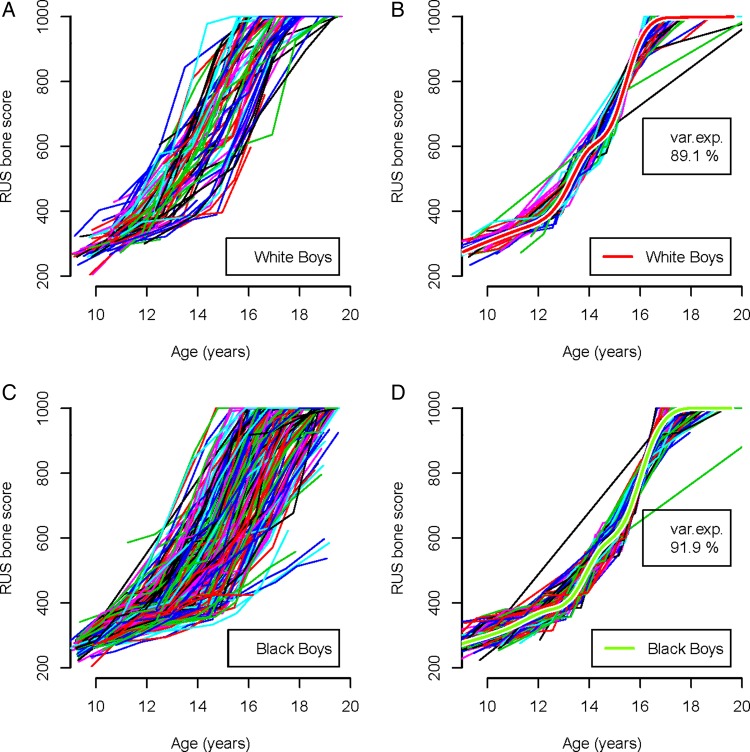
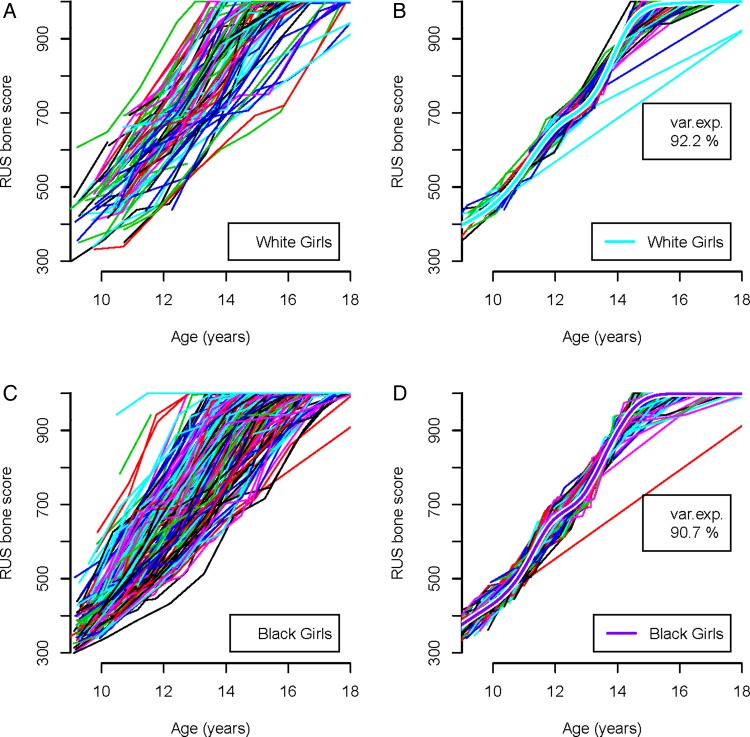
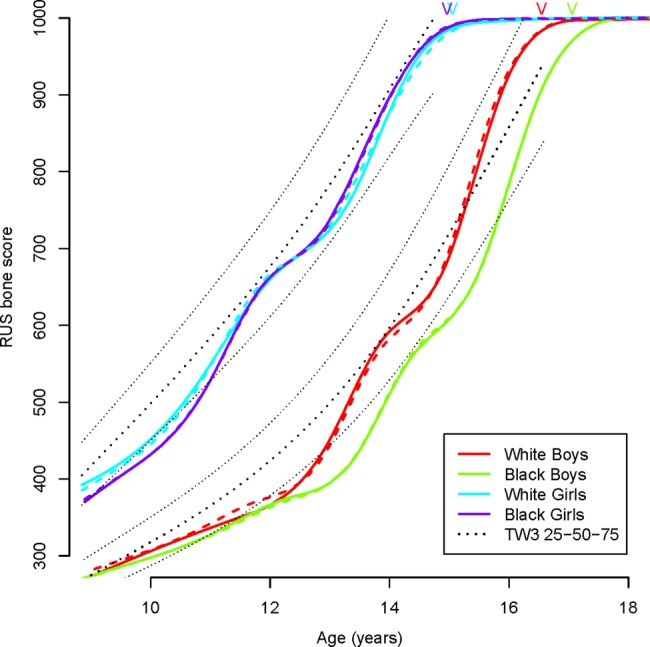
AIM: To examine ethnic and sex differences in the pattern of skeletal maturity from adolescence to adulthood using a novel longitudinal analysis technique (SuperImposition by Translation And Rotation (SITAR)). SETTING: Johannesburg, South Africa. PARTICIPANTS: 607 boys and girls of black as well as white ethnicity from the Birth to Twenty bone health study, assessed annually from 9 to 20 years of age. OUTCOME MEASURE: Bone maturity scores (Tanner-Whitehouse III radius, ulna, and short bones (TW3 RUS)) assessed longitudinally from hand-wrist radiographs were used to produce individual and mean growth curves of bone maturity and analysed by the SITAR method. RESULTS: The longitudinal analysis showed that black boys matured later by 7.0 SE 1.6 months (p<0.0001) but at the same rate as white boys, whereas black girls matured at the same age but at a faster rate than white girls (by 8.7% SE 2.6%, p=0.0007). The mean curves for bone maturity score consistently showed a midpubertal double kink, contrasting with the quadratic shape of the commonly used reference centile curves for bone maturity (TW3). CONCLUSIONS: Skeletal maturity was reached 1.9 years earlier in girls than boys, and the pattern of maturation differed between the sexes. Within girls, there were no ethnic differences in the pattern or timing of skeletal maturity. Within boys, however, skeletal maturity was delayed by 7 months in black compared with white ethnicity. Skeletal maturation, therefore, varies differentially by sex and ethnicity. The delayed maturity of black boys, but not black girls, supports the hypothesis that boys have greater sensitivity to environmental constraints than girls.
Overview
The claims and statistics of this paper haven’t been checked yet.
Free: it reads the open-access text and checks the first 5 claims that cite a source we can check. Create a free account to check every claim.
Integrity signals
Registry
Cites
Statistics
Figures
Verification
Claims the paper makes
The claims and statistics of this paper haven’t been checked yet.
Free: it reads the open-access text and checks the first 5 claims that cite a source we can check. Create a free account to check every claim.
Claims other papers make about this one
Each is checked against this paper’s own text: does it say what the citing paper says it does?
In the citing paper
“Since bone structure and bone mass vary with sex and age34–36”
From Osteocyte transcriptome mapping identifies a molecular landscape controlling skeletal homeostasis and susceptibility to skeletal disease (2021) · cites this paper as [35]
Self-check
Percentages, sums and reported differences re-computed from the paper’s own numbers.
The self-check needs the paper’s full text.
Citations
Cites
Estimating the Dimension of a Model
Schwarz, G. (1978) · The Annals of Statistics · doi:10.1214/aos/1176344136 · Cited by 47,033
Variations in pattern of pubertal changes in girls
Marshall, W. A., & Tanner, J. M. (1969) · Archives of Disease in Childhood · doi:10.1136/adc.44.235.291 · Cited by 5,963
Variations in the pattern of pubertal changes in boys
Marshall, W. A., & Tanner, J. M. (1970) · Archives of Disease in Childhood · doi:10.1136/adc.45.239.13 · Cited by 5,147
The Diagnosis of Polycystic Ovary Syndrome during Adolescence
Witchel, S. F., Oberfield, S., Rosenfield, R. L., Codner, E., Bonny, A., Ibáñez, L., Pena, A., Horikawa, R., Gomez-Lobo, V., Joel, D., et al. (2015) · Hormone Research in Paediatrics · doi:10.1159/000375530 · Cited by 3,113
Tanner, J. M., Whitehouse, R. H., & Takaishi, M. (1966) · Archives of Disease in Childhood · doi:10.1136/adc.41.220.613 · Cited by 2,553
Worldwide Variation in Human Growth
Eveleth, P. B., & Tanner, J. M. (1991) · Cambridge University Press eBooks · doi:10.1017/cbo9780511629105 · Cited by 1,442
Assessment of Skeletal Maturity and Prediction of Adult Height (TW2 Method)
(1976) · Archives of Disease in Childhood · doi:10.1136/adc.51.6.488 · Cited by 1,413
Tanner, J. M., Whitehouse, R. H., & Takaishi, M. (1966) · Archives of Disease in Childhood · doi:10.1136/adc.41.219.454 · Cited by 1,345
Worldwide Variation in Human Growth
Buckler, J. M. H. (1991) · Archives of Disease in Childhood · doi:10.1136/adc.66.7.910-a · Cited by 813
Carty, H. (2002) · The Journal of Bone and Joint Surgery. British volume · doi:10.1302/0301-620x.84b2.0840310c · Cited by 474
Research works printed but not linked: 2
- Pathmanathan G Raghaven P Bone age based linear growth and weight of underprivileged North-West Indian children compared with their well-off North-West Indian peers. J Anat Soc India 2006; 55: 34– 42.
- Merrell M The relationship of individual growth to average growth. Hum Biol 1931; 3: 37– 70.
Cited by
Biological maturation of youth athletes: assessment and implications
Malina, R. M., Rogol, A. D., Cumming, S. P., Coelho e Silva, M. J., & Figueiredo, A. J. (2015) · British Journal of Sports Medicine · doi:10.1136/bjsports-2015-094623 · Cited by 733
“Ethnic variation in skeletal maturation requires consideration,[37-40] but identifying ethnicity may not be permitted in some countries.”
Association Between Linear Growth and Bone Accrual in a Diverse Cohort of Children and Adolescents
McCormack, S. E., Cousminer, D. L., Chesi, A., Mitchell, J. A., Roy, S. M., Kalkwarf, H. J., Lappe, J. M., Gilsanz, V., Oberfield, S. E., Shepherd, J. A., et al. (2017) · JAMA Pediatrics · doi:10.1001/jamapediatrics.2017.1769 · Cited by 164
Youlten, S. E., Kemp, J. P., Logan, J. G., Ghirardello, E. J., Sergio, C. M., Dack, M. R. G., Guilfoyle, S. E., Leitch, V. D., Butterfield, N. C., Komla-Ebri, D., et al. (2021) · Nature Communications · doi:10.1038/s41467-021-22517-1 · Cited by 133
Cone beam computed tomography evaluation of midpalatal suture maturation in adults
Angelieri, F., Franchi, L., Cevidanes, L., Gonçalves, J. R., Nieri, M., Wolford, L. M., & McNamara, J. A. (2017) · International Journal of Oral and Maxillofacial Surgery · doi:10.1016/j.ijom.2017.06.021 · Cited by 83
Valdivia, L. M. J., Malpartida‐Carrillo, V., Rodríguez-Cárdenas, Y. A., da Silveira, H. L. D., & Arriola‐Guillén, L. E. (2019) · Progress in Orthodontics · doi:10.1186/s40510-019-0291-z · Cited by 72
Metadata
- Authors
- Cole, T. J., Rousham, E. K., Hawley, N. L., Cameron, N., Norris, S. A., & Pettifor, J. M.
- Affiliations
- University College London (GB)
- Loughborough University (GB)
- University of the Witwatersrand (ZA)
- Corresponding author
- Rousham, Emily K
- Venue
- Archives of Disease in Childhood
- Publisher
- BMJ
- Published
- 2014-11-19
- Volume
- 100
- Issue
- 2
- Pages
- 138-143
- ISSN
- 0003-9888 (ISSN-L)
- 1468-2044
- PMC
- PMC4316919
- OpenAlex
- W2119127096
- Cited by
- 100
- References
- 32
- Citations by year
- 2026: 10 · 2025: 7 · 2024: 8 · 2023: 7 · 2022: 6 · 2021: 7 · 2020: 12 · 2019: 10 · 2018: 9 · 2017: 11 · 2016: 8 · 2015: 5
- FWCI
- 53.87
- Type
- journal article
- Language
- en
- Open access
- hybrid
- doi.org
- Licence
- cc-by
- Locations
- Archives of Disease in Childhood (publishedVersion, cc-by)
- Europe PMC (PubMed Central) (publishedVersion, cc-by)
- PubMed Central (publishedVersion, cc-by)
- PubMed (publishedVersion)
- Loughborough University Institutional Repository (Loughborough University) (submittedVersion, cc-by)
- UCL Discovery (University College London) (submittedVersion)
- Loughborough University Research Repository (Loughborough University) (submittedVersion, cc-by)
- Funders
- Wellcome Trust
- National Institute for Health and Care Research (NF-SI-0513-10012)
- National Research Foundation
- South African Medical Research Council
- Medical Research Council (MR/M012069/1, MR/J004839/1)
- Topics
- Social Sciences › Arts and Humanities › Archeology (arts and humanities) › Forensic Anthropology and Bioarchaeology Studies
- Health Sciences › Medicine › Orthopedics and Sports Medicine › Bone health and osteoporosis research
- Health Sciences › Medicine › Reproductive Medicine › Hypothalamic control of reproductive hormones
- Keywords
- skeletal maturation, bone age, ethnic differences, sex differences, puberty timing, sitar, hand-wrist radiographs, growth curves, Black and White children
- MeSH terms
- Adolescent, Adult, Bone Development, Child, Ethnicity, Female, Humans, Longitudinal Studies, Male, Radiography, Sex Factors, South Africa, Wrist, Hand Bones, Young Adult, Growth Charts
About these checks
Registry, retraction, Cites and statistics results are computed, not judged, with one exception: a printed reference that no index lists is read once by a model before it counts as a citation error. Claims are extracted by a model and kept only when their quote appears verbatim in the text; each cited source is then checked, with a model’s help, for whether it says what the claim relies on. Those verdicts can be wrong — read the claim’s quote and the cited source before relying on one.
Statistics and arithmetic are recomputed, not judged.
Confidence bands are shown only for fields calibrated on our annotated test set. None is calibrated yet, so no band is shown.
What counts as a claim ›How we measure confidence ›How we check this ›
Are you an author, or do you see a problem with this page? Request a review
How to cite
Cite CoChat for the checks on this page, and the paper for its own findings.
- This page
- CoChat. (2026). Citation check: Ethnic and sex differences in skeletal maturation among the Birth to Twenty cohort in South Africa. https://app.cochat.ai/papers/10.1136/archdischild-2014-306399
- The paper
- Cole, T. J., Rousham, E. K., Hawley, N. L., Cameron, N., Norris, S. A., & Pettifor, J. M. (2015). Ethnic and sex differences in skeletal maturation among the Birth to Twenty cohort in South Africa. Archives of Disease in Childhood. https://doi.org/10.1136/archdischild-2014-306399
Data sources
Bibliographic data: Semantic Scholar, OpenAlex, Crossref.
Contains information from the Semantic Scholar Academic Graph Datasets, made available under the ODC Attribution License (ODC-BY 1.0).
Semantic Scholar’s data is described in: Kinney, R., et al. (2023). The Semantic Scholar Open Data Platform. arXiv:2301.10140.
