

Effect of Risk Mitigation Guidance for opioid and stimulant dispensations on mortality and acute care visits during dual public health emergencies: retrospective cohort study
Open accessThe DOI matches its Crossref record; 40 of the 40 references it cites were found in a registry or an index.
Abstract
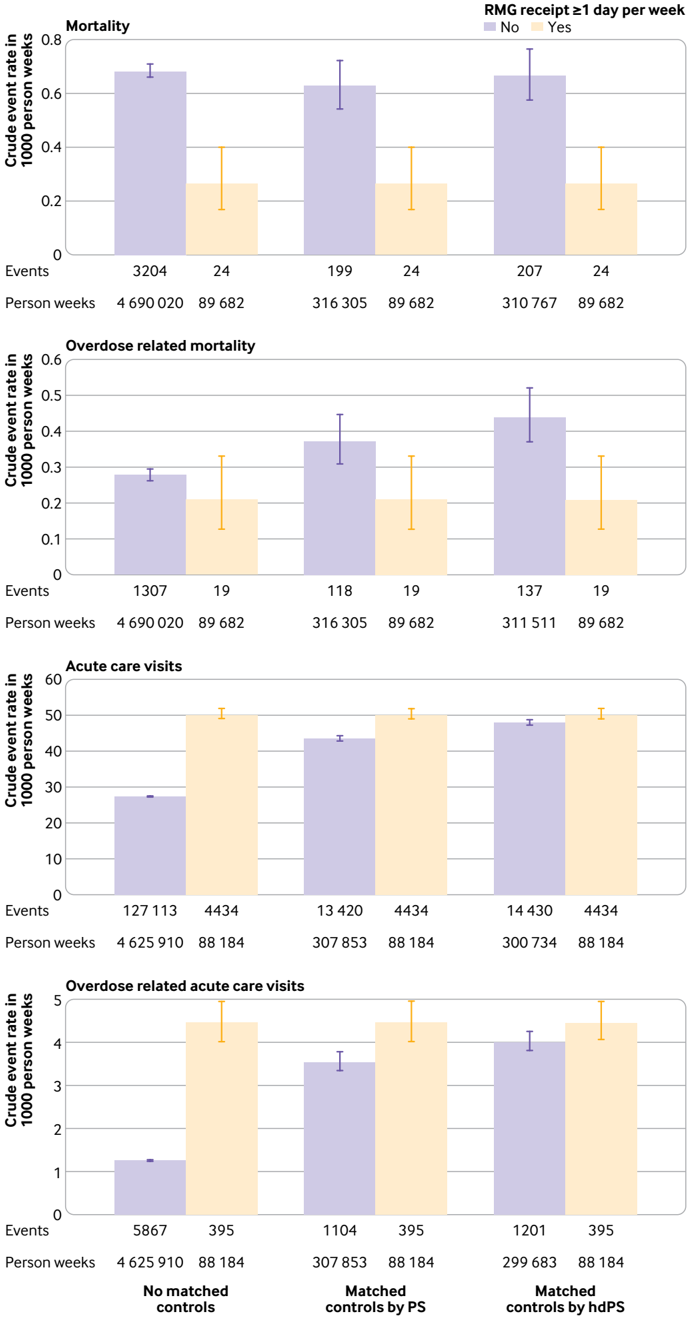
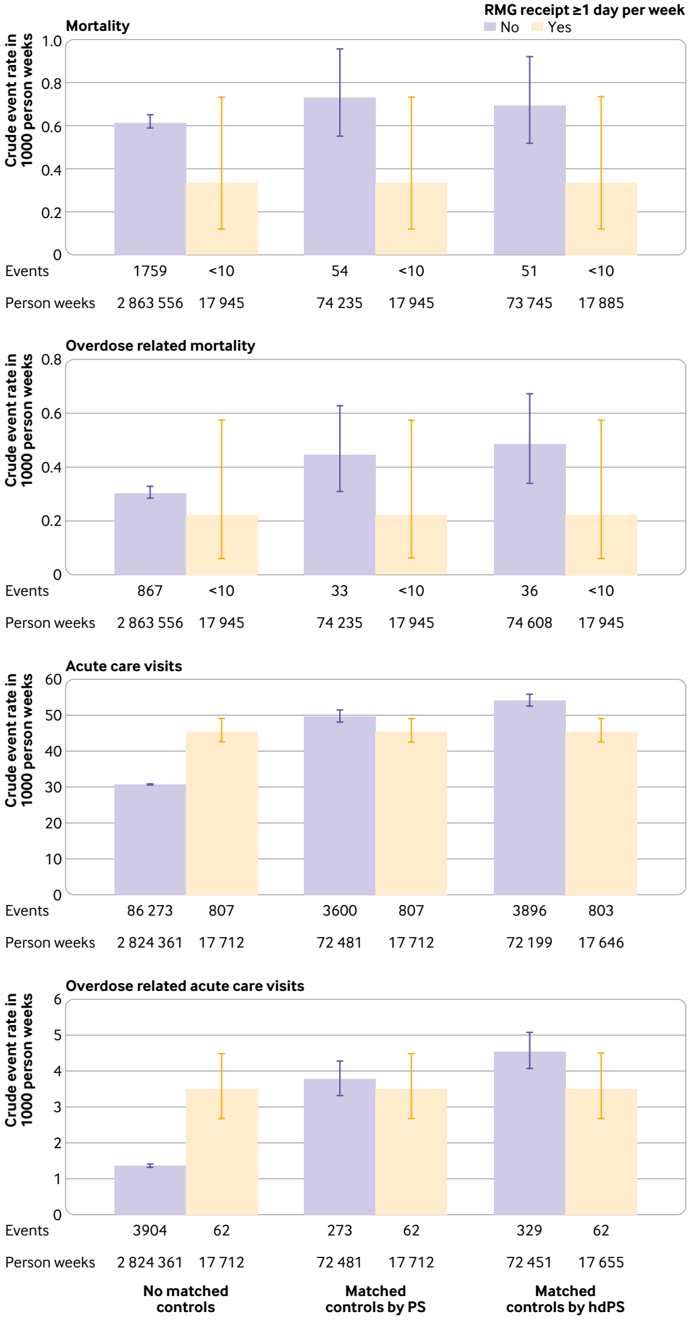
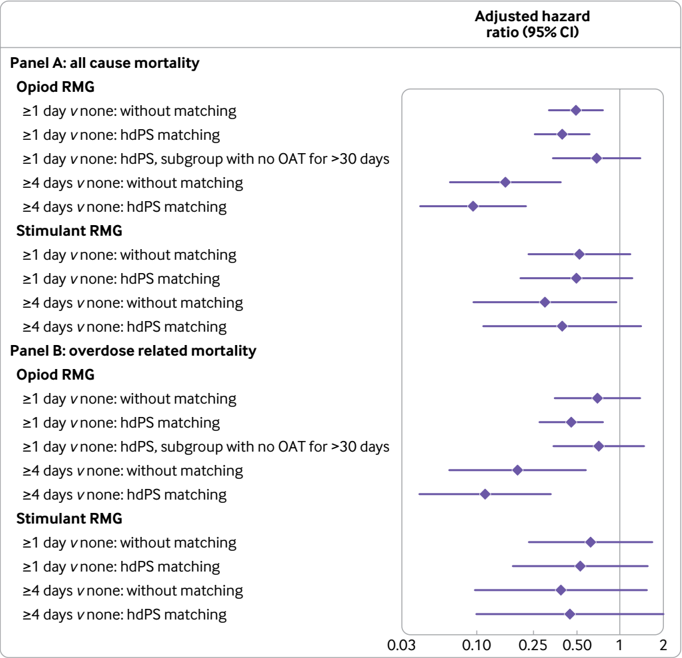
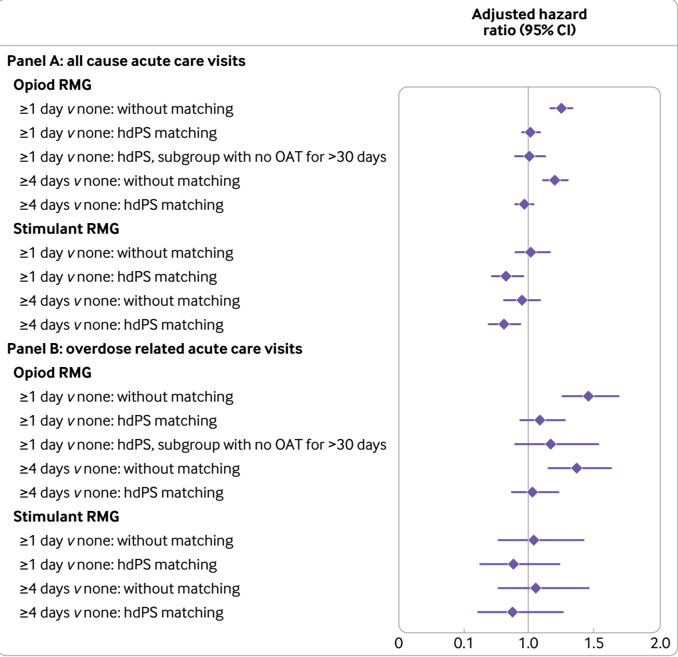
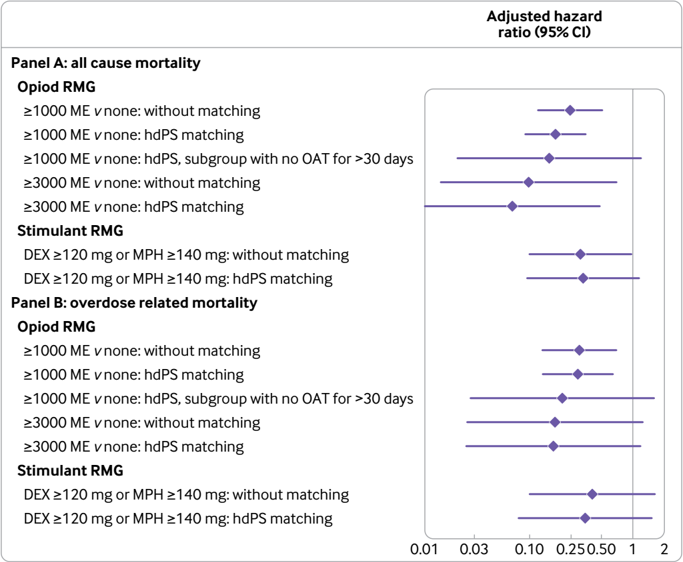
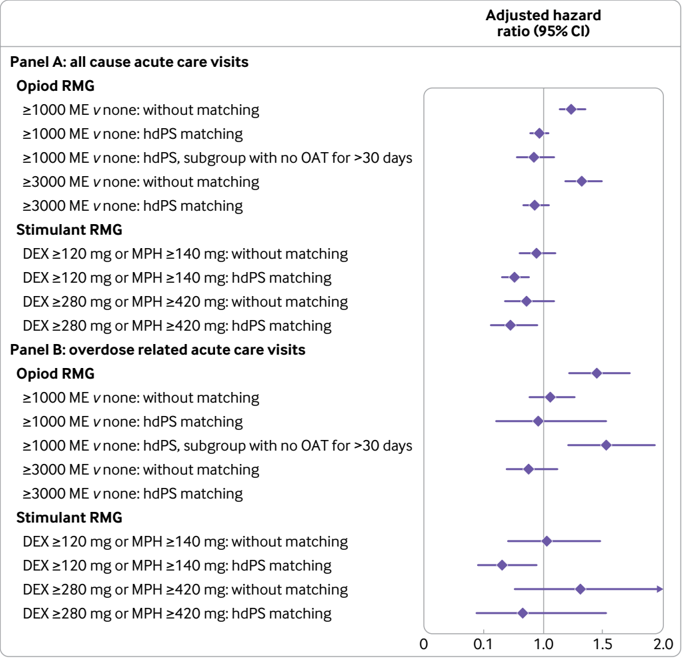
Objective: To determine the effect of opioid and stimulant Risk Mitigation Guidance (RMG) dispensations on mortality and acute care visits during the dual public health emergencies of overdose and covid-19. Design: Population based retrospective cohort study. Setting: British Columbia, Canada. Participants: 5882 people with opioid or stimulant use disorder who received RMG prescriptions for opioids (n=5356) and/or stimulants (n=1061) (535 received both) from 27 March 2020 to 31 August 2021. Main outcome measures: All cause and overdose specific mortality and acute care visits in the week after RMG opioid or stimulant dispensation. RMG recipients were matched 1:1 with controls through use of high dimensional propensity score matching. Marginal structural models, executed on weekly time steps, were used to measure the effect of dispensations on outcomes. Results: RMG opioid dispensations of one day or more were associated with reduced all cause mortality (adjusted hazard ratio 0.39, 95% confidence interval 0.25 to 0.60) and overdose related mortality (0.45, 0.27 to 0.75) in the subsequent week. Dispensations of RMG stimulants (≥1 days) were not significantly associated with reduced all cause mortality (adjusted hazard ratio 0.50, 0.20 to 1.23) or overdose related mortality (0.53, 0.18 to 1.56). The protective effect of RMG opioid dispensations increased with the number of days the medications were dispensed in a given week. People who received four or more days of RMG opioid dispensations had reduced all cause mortality (adjusted hazard ratio 0.09, 0.04 to 0.21) and overdose related mortality (0.11, 0.04 to 0.32) compared with the control group. Opioid RMG dispensations did not significantly modify the odds of all cause or overdose related acute care visits. Dispensations of RMG stimulants were associated with a significant decrease in the odds of acute care visits for any cause but did not affect the odds of overdose related acute care visits. Conclusions: RMG opioid dispensations were associated with reduced overdose related and all cause mortality among a sample of people with opioid use disorder. Pharmaceutical alternatives to the illegal drug supply are promising interventions to reduce mortality in people with opioid use disorder.
Overview
The claims and statistics of this paper haven’t been checked yet.
Free: it reads the open-access text and checks the first 5 claims that cite a source we can check. Create a free account to check every claim.
Integrity signals
Registry
Cites
Statistics
Figures
Verification
Claims the paper makes
The claims and statistics of this paper haven’t been checked yet.
Free: it reads the open-access text and checks the first 5 claims that cite a source we can check. Create a free account to check every claim.
Claims other papers make about this one
Each is checked against this paper’s own text: does it say what the citing paper says it does?
The cited source says what the claim attributes to it.
In the citing paper
“The finding of an increase in opioid hospitalizations and no significant change in opioid-related deaths during the safer supply period differ from the reduction in opioid overdose deaths reported by Slaunwhite et al.8”
From Safer Opioid Supply, Subsequent Drug Decriminalization, and Opioid Overdoses (2025) · cites this paper as Slaunwhite et al.8
Self-check
Percentages, sums and reported differences re-computed from the paper’s own numbers.
The self-check needs the paper’s full text.
Citations
Cites
von Elm, E., Altman, D. G., Egger, M., Pocock, S. J., Gøtzsche, P. C., Vandenbroucke, J. P., & Initiative, F. T. S. (2007) · Annals of Internal Medicine · doi:10.7326/0003-4819-147-8-200710160-00010 · Cited by 17,796
Austin, P. C. (2009) · Statistics in Medicine · doi:10.1002/sim.3697 · Cited by 6,758 · cited 1×
“29 We used an SAS macro version 2 (available at www.drugepi.org) for high dimensional propensity score covariate selection and matching.”
MethodMarginal Structural Models and Causal Inference in Epidemiology
Robins, J. M., Hernán, M. Á., & Brumback, B. (2000) · Epidemiology · doi:10.1097/00001648-200009000-00011 · Cited by 5,581 · cited 1×
“Similarly, we estimated censoring weights 31 Follow-up was censored at incarceration, RMG initiation (if selected for the unexposed group), or administrative loss to follow-up (or death in the analysis on the acute care visit outcome).”
MethodAustin, P. C. (2011) · Pharmaceutical Statistics · doi:10.1002/pst.433 · Cited by 3,949 · cited 1×
“28 We assessed the distributions of covariates before and after matching by the high dimensional propensity score by using standardised mean differences between the exposed and unexposed groups.”
MethodHernán, M. Á., Brumback, B., & Robins, J. M. (2000) · Epidemiology · doi:10.1097/00001648-200009000-00012 · Cited by 1,782 · cited 1×
“30 To control for time varying confounding in the time varying exposure and outcome relation after baseline, we estimated time varying inverse probability weights to create a pseudo-population in which the exposure is independent of the measured confounders.”
MethodD'Agostino, R. B., Lee, M., Belanger, A. J., Cupples, L. A., Anderson, K., & Kannel, W. B. (1990) · Statistics in Medicine · doi:10.1002/sim.4780091214 · Cited by 798 · cited 1×
“32 We used robust variance estimators to calculate confidence limits for marginal structural models.”
MethodCraig, P., Katikireddi, S. V., Leyland, A., & Popham, F. (2017) · Annual Review of Public Health · doi:10.1146/annurev-publhealth-031816-044327 · Cited by 570 · cited 2×
“…these studies have been conducted in controlled clinical settings, intended for the treatment of stimulant use disorder, and have not been implemented with the primary objective of reducing mortality risk in the context of dual public health emergencies of an unregulated drug crisis and covid-19.”
BackgroundLeatherdale, S. T. (2019) · International Journal of Social Research Methodology · doi:10.1080/13645579.2018.1488449 · Cited by 328 · cited 1×
“20 Given the strengths of this study design and the critical need for evidence on the outcomes of RMG prescribing, the objective of this study was to determine the effect of opioid and stimulant RMG dispensations on all cause and overdose related mortality and recurrent acute care visits.”
BackgroundKonstenius, M., Jayaram‐Lindström, N., Guterstam, J., Beck, O., Philips, B., & Franck, J. (2014) · Addiction · doi:10.1111/add.12369 · Cited by 188
PARK, J. N., ROUHANI, S., BELETSKY, L., VINCENT, L., SALONER, B., & SHERMAN, S. G. (2020) · The Milbank Quarterly · doi:10.1111/1468-0009.12470 · Cited by 163
Cited by
Prescribed safer opioid supply: A scoping review of the evidence
Ledlie, S., Garg, R., Cheng, C., Kolla, G., Antoniou, T., Bouck, Z., & Gomes, T. (2024) · International Journal of Drug Policy · doi:10.1016/j.drugpo.2024.104339 · Cited by 68
The public health risks of counterfeit pills
Friedman, J., & Ciccarone, D. (2025) · The Lancet Public Health · doi:10.1016/s2468-2667(24)00273-1 · Cited by 32
Kolla, G., Pauly, B., Cameron, F., Hobbs, H., Ranger, C., McCall, J., Majalahti, J., Toombs, K., LeMaistre, J., Selfridge, M., et al. (2024) · Harm Reduction Journal · doi:10.1186/s12954-024-01029-3 · Cited by 21
Self-citationMarkoulidakis, A., Hickman, M., McAuley, A., Barnsdale, L. R., Welton, N. J., Glancy, M., Shivaji, T., Collins, C., Lang, J., de Wit, F., et al. (2024) · Addiction · doi:10.1111/add.16500 · Cited by 15
Opioid Coprescription Through Risk Mitigation Guidance and Opioid Agonist Treatment Receipt
Min, J. E., Guerra‐Alejos, B. C., Yan, R., Palis, H., Barker, B., Urbanoski, K. A., Pauly, B., Slaunwhite, A., Bach, P., Ranger, C., et al. (2024) · JAMA Network Open · doi:10.1001/jamanetworkopen.2024.11389 · Cited by 20
Self-citationPerspectives on Diversion of Medications From Safer Opioid Supply Programs
Olding, M., Rudzinski, K., Schmidt, R. A., Kolla, G., German, D., Sereda, A., Strıke, C., & Guţă, A. (2024) · JAMA Network Open · doi:10.1001/jamanetworkopen.2024.51988 · Cited by 18
Safer supply and political interference in medical practice: Alberta's Narcotics Transition Services
Wilson, P., Colizza, K., & Hyshka, E. (2024) · International Journal of Drug Policy · doi:10.1016/j.drugpo.2024.104600 · Cited by 18
Xiao, J., Ding, J., Sun, C., Liu, D., Gao, H., Liu, Y., Lü, Y., & Gao, X. (2024) · ACS Sensors · doi:10.1021/acssensors.4c01623 · Cited by 14
Schmidt, R. A., Guţă, A., Rai, N., Sereda, A., O’Reilly, E., Hales, J., Kolla, G., & Strıke, C. (2024) · Canadian Journal of Public Health · doi:10.17269/s41997-024-00979-2 · Cited by 13
“Epidemiological and population-level studies demonstrate a reduction in fatal and non-fatal opioid toxicities among active SSP clients (Brothers et al., 2022; Gomes et al., 2022; Lew et al., 2022; Slaunwhite et al., 2024; Young et al., 2022).”
Pauly, B., Kurz, M., Dale, L. M., Macevicius, C., Kalicum, J., Pérez, D. G., McCall, J., Urbanoski, K. A., Barker, B., Slaunwhite, A., et al. (2024) · Journal of Substance Use and Addiction Treatment · doi:10.1016/j.josat.2024.209341 · Cited by 16
Self-citationA qualitative evaluation of a fentanyl patch safer supply program in Vancouver, Canada
Norton, A., Ivsins, A., Holliday, E., Sutherland, C., Kerr, T. H., & Kennedy, M. C. (2024) · International Journal of Drug Policy · doi:10.1016/j.drugpo.2024.104547 · Cited by 14
“While hydromorphone tablets have been shown to be effective as safer supply (Slaunwhite et al., 2024), and preferred over fentanyl in some contexts (Kolla & Fajber, 2023), people at risk of overdose, safer supply clients, and addiction medicine physicians are increasingly calling for closer…”
Martignetti, L., Knight, R., Nafeh, F., Atkinson, K. A., Laurence, G., Johnson, C. H., Werb, D., & Karamouzian, M. (2024) · International Journal of Drug Policy · doi:10.1016/j.drugpo.2024.104665 · Cited by 11
Singh, B., & Chandra, S. (2025) · IGI Global eBooks · doi:10.4018/979-8-3693-4199-5.ch008 · Cited by 13
Gomes, T., McCormack, D., Kolla, G., Young, S., Bayoumi, A. M., Smoke, A., Li, P., & Antoniou, T. (2025) · The Lancet Public Health · doi:10.1016/s2468-2667(25)00070-2 · Cited by 11
Fleming, T., Boyd, J., Gagnon, M., Kerr, T. H., & McNeil, R. (2024) · International Journal of Drug Policy · doi:10.1016/j.drugpo.2024.104444 · Cited by 19
Safer Opioid Supply, Subsequent Drug Decriminalization, and Opioid Overdoses
Nguyen, H. V., Mital, S., Bugden, S., & McGinty, E. E. (2025) · JAMA Health Forum · doi:10.1001/jamahealthforum.2025.0101 · Cited by 10
'Zombie drugs': Dehumanising news frames and public stigma towards people who use drugs
Sumnall, H. R., Holland, A., Atkinson, A., Montgomery, C., Nicholls, J. Q., & Maynard, O. (2025) · International Journal of Drug Policy · doi:10.1016/j.drugpo.2025.104714 · Cited by 13
“…support (1 Strongly oppose to 5 Strongly support ) for i) general harm reduction programmes (Wild, et al., 2021); ii) government financial support for harm reduction; iii) provision of drug checking services (Barratt & Measham, 2022); and iv) prescribed ‘safer supply ’ (Slaunwhite, et al., 2024).”
Perceived impacts of North Americas first de-medicalized safer supply program
Kalicum, J., Nyx, E., Kennedy, M. C., & Kerr, T. H. (2025) · Substance Abuse Treatment Prevention and Policy · doi:10.1186/s13011-025-00642-0 · Cited by 9
Duration of Methadone and Buprenorphine-Naloxone Treatment
Kleinman, R. A., & Kurdyak, P. A. (2025) · JAMA Network Open · doi:10.1001/jamanetworkopen.2025.18389 · Cited by 11
Urbanoski, K. A., van Roode, T., Selfridge, M., Hogan, K., Fraser, J., Lock, K., McGreevy, P. B., Burmeister, C., Barker, B., Slaunwhite, A., et al. (2024) · Substance Abuse Treatment Prevention and Policy · doi:10.1186/s13011-024-00625-7 · Cited by 12
“…study of safer supply prescribing through 2020-21 found that receipt of opioids on one or more days was associated with a 61% reduction in all-cause mortality and a 55% reduction in overdose mortality in the subsequent week (findings were not statistically significant for stimulants) [19].”
BackgroundSelf-citationSafer supply programs: Discussions on medication diversion, sharing, and selling
Haines, M., Hill, E. S., & O’Byrne, P. (2025) · International Journal of Drug Policy · doi:10.1016/j.drugpo.2025.104731 · Cited by 9
McCall, J., Hobbs, H., Ranger, C., Cameron, F., Stuart, H., Nelken, J., Majalahti, J., Urbanoski, K. A., Kolla, G., LeMaistre, J., et al. (2024) · Substance Abuse Treatment Prevention and Policy · doi:10.1186/s13011-024-00598-7 · Cited by 12
“A recent population-based controlled study of the RMG, researchers found reductions in the rate of over-dose mortality of 55–89% in the week following receipt of an opioid prescription meant to replace substances the unregulated drug market [23].”
BackgroundSelf-citationKelly, P. J. A., Jessop, A. B., Scialanca, M., Singley, K. J., Luck, C. C., Hoadley, A., Meisner, J. A., & Bass, S. B. (2024) · Substance Use & Addiction Journal · doi:10.1177/29767342241289797 · Cited by 8
“47 In addition to expanding first aid training, an intervention of the magnitude possible with a safe supply is likely to have a profound reduction in harm to the health of PWUD.”
Fajber, K., Sereda, A., Warren, S., Morris, C., Nash, G., Pauly, B., Urbanoski, K., & Kolla, G. (2025) · Canadian Journal of Public Health · doi:10.17269/s41997-025-01006-8 · Cited by 11
“…other research on prescribed safer supply that demonstrated reduced overdose frequency and associated harms, improved health outcomes, and improved stability among safer supply clients (Gagnon et al., 2023; Gomes et al., 2022; Ledlie et al., 2024; Schmidt et al., 2023a; Slaunwhite et al., 2024).”
Self-citationKolla, G., Fajber, K., Sereda, A., Morris, C., Deacon, P., & Cipriano, L. E. (2025) · Drug and Alcohol Dependence Reports · doi:10.1016/j.dadr.2025.100338 · Cited by 7
Imtiaz, S., Russell, C., Ali, F., Elton‐Marshall, T., Patenaude, S., & Rehm, J. T. (2025) · Substance Abuse Treatment Prevention and Policy · doi:10.1186/s13011-025-00680-8 · Cited by 9
Nafeh, F., Martignetti, L., Strıke, C., Kolla, G., Bonn, M., Brunelle, C., Boyd, J., Hyshka, E., Morris, C., Eeuwes, J., et al. (2025) · Harm Reduction Journal · doi:10.1186/s12954-025-01177-0 · Cited by 7
“Furthermore, our results on ISSPP do not apply to other safer supply models, such as risk mitigation guidance [55].”
Self-citationHyshka, E., Moore, D. M., Knight, R., Neudorf, C. O., & Urbanoski, K. A. (2024) · Canadian Journal of Public Health · doi:10.17269/s41997-024-00880-y · Cited by 7
“Les données probantes sur l’efficacité d’un approvisionnement plus sécuritaire ne font que commencer à émerger (Ontario Drug Policy Research Network, 2023; Slaunwhite et al., 2024).”
InfluentialSelf-citationFischer, B., Jutras‐Aswad, D., & Foll, B. L. (2025) · The Canadian Journal of Addiction · doi:10.1097/cxa.0000000000000236 · Cited by 6
Trends in accidental drug overdose mortality in Canada: An analysis from 1974 to 2023
Dasari, H., Artenie, A. A., Bruneau, J., & Larney, S. (2025) · International Journal of Drug Policy · doi:10.1016/j.drugpo.2025.105022 · Cited by 6
Considering possible drivers of the recent decrease in drug overdose deaths in Canada
Fischer, B., Hall, W., Jutras‐Aswad, D., & Foll, B. L. (2025) · The Lancet Regional Health - Americas · doi:10.1016/j.lana.2025.101141 · Cited by 5
Nafeh, F., Martignetti, L., Kolla, G., Bonn, M., Langeroodi, S. M. F., Urbanoski, K. A., Pauly, B., Werb, D., & Karamouzian, M. (2025) · BMJ Mental Health · doi:10.1136/bmjment-2025-301629 · Cited by 9
“3 5 Observational cohort studies have documented significant reductions in overdose 10 and all-cause mortality among people receiving SOS, 11 as well as reductions in emergency department visits and hospitalisations.”
Self-citationPalayew, A., Banta‐Green, C. J., Lamont, M., Damper, D., Moreno, C., Goodreau, S. M., Mooney, S. J., & Glick, S. N. (2024) · International Journal of Drug Policy · doi:10.1016/j.drugpo.2024.104389 · Cited by 5
Xu, F., Wang, T., Kolla, G., Campbell, T. J., Watts, T., Ledlie, S., Koncz, D., Tadrous, M., & Gomes, T. (2025) · International Journal of Drug Policy · doi:10.1016/j.drugpo.2025.104905 · Cited by 5
Ali, F., Russell, C., Law, J., Imtiaz, S., Budau, J., Shahin, R., MacKinnon, L., Griffith, D., Patenaude, S., Xavier, J. C., et al. (2025) · Harm Reduction Journal · doi:10.1186/s12954-025-01276-y · Cited by 6
“…as prescribed safer supply programs), which allow PWUD at a high risk of overdose to access pharmaceutical-grade medications (including select opioids, stimulants or benzodiazepines), have been introduced in several Canadian provinces as an alternative to the toxic illicit drug supply [1, 2, 8–10].”
In pursuit of safer supply: An emerging evidence base for medical and nonmedical models
Nielsen, S., Stowe, M. J., & Ritter, A. J. (2024) · International Journal of Drug Policy · doi:10.1016/j.drugpo.2024.104365 · Cited by 6
Guţă, A., Rudzinski, K., Gagnon, M., Schmidt, R. A., Kolla, G., German, D., Kryszajtys, D. T., Perri, M., Sereda, A., Sterling-Murphy, C., et al. (2025) · Journal of the International AIDS Society · doi:10.1002/jia2.70038 · Cited by 4
“Most SSPs employ a person-centred approach, simultaneously addressing substance use needs while facilitating access to essential health and social services, which supports improved health outcomes and reduces overdose and all-cause mortality [61, 64, 73, 74].”
How population-level drug supply data are integrated into health outcomes research: a scoping review
Tobias, S., Bird, J., Law, M. R., Buxton, J. A., & Ti, L. (2026) · Epidemiologic Reviews · doi:10.1093/epirev/mxag010 · Cited by 5
“For example, studies have highlighted the impact of the COVID-19 pandemic or changes to drug policy on deaths 7 , 8 but did not incorporate adjustments for increasing fentanyl variability or new psychoactive substance prevalence in unregulated opioids over the same period.”
Singh, B., & Kaunert, C. (2024) · Advances in computational intelligence and robotics book series · doi:10.4018/979-8-3693-9158-7.ch010 · Cited by 7
Zanette, M., Min, J. E., Homayra, F., Bach, P., Socias, M. E., Bruneau, J., Korthuis, P. T., Karim, M. E., Seaman, S. R., Bozinoff, N., et al. (2025) · BMJ Open · doi:10.1136/bmjopen-2024-098439 · Cited by 5
Self-citationSingh, B., Malviya, R., Kaunert, C., & Sridhar, S. B. (2025) · Wiley eBooks · doi:10.1002/9781394302444.ch1 · Cited by 6
A scoping review and concept analysis to inform Canada’s safe(r) opioid supply research agenda
Do, U., Larney, S., Bonn, M., Matei, I., Zolopa, C., Bergeron, A., Karamouzian, M., Hyshka, E., Brothers, T. D., Bozinoff, N., et al. (2025) · International Journal of Drug Policy · doi:10.1016/j.drugpo.2025.105070 · Cited by 3
Strıke, C., Rudzinski, K., Schmidt, R. A., Kolla, G., Kryszajtys, D. T., Perri, M., Kaminski, N., & Guţă, A. (2025) · Harm Reduction Journal · doi:10.1186/s12954-025-01344-3 · Cited by 3
“Research on the impact of SSPs is growing [25] and evidence indicates people enrolled in SSPs self-report reduced use of unregulated fentanyl, fewer non-fatal overdoses, and less frequent drug injections [18, 22, 26– 35].”
Kahan, M. (2024) · The Canadian Journal of Addiction · doi:10.1097/cxa.0000000000000209 · Cited by 5
“6,72,73 A modelling study concluded that the initiating of OAT in hospitals will reduce rates of overdose deaths in injection opioid users 69 Virtual care can increase access to OAT in smaller, geographically isolated communities.”
BackgroundYoung, S., Fairbairn, N. S., Cui, Z., Bach, P., Mok, W. Y., Budau, J., Slaunwhite, A., Ti, L., Hayashi, K., & Nolan, S. (2025) · Addiction · doi:10.1111/add.16760 · Cited by 3
Self-citationFischer, B., Jutras‐Aswad, D., Foll, B. L., & Robinson, T. (2025) · SUCHT - Zeitschrift für Wissenschaft und Praxis / Journal of Addiction Research and Practice · doi:10.1024/0939-5911/a000930 · Cited by 3
Hutchison, A., McGreevy, P. B., Enns, B., Guerra‐Alejos, B. C., Henderson, N., Urbanoski, K. A., Howley, E., MacPherson, D., Xavier, J. C., Buxton, J. A., et al. (2025) · International Journal of Drug Policy · doi:10.1016/j.drugpo.2025.104920 · Cited by 3
Self-citationStaples, J. A., Hu, X., Khan, M., Daly‐Grafstein, D., Naik, H., Kaasa, B. M., Brubacher, J. R., Nasmith, T., Lyden, J. R., Moe, J., et al. (2024) · Journal of Hospital Medicine · doi:10.1002/jhm.13510 · Cited by 3
Self-citationClinicians’ Perspectives and an Ethical Analysis of Safer Supply Opioid Prescribing
Bird, K., Genuis, Q. I. T., & Ickowicz, S. (2024) · Journal of Bioethical Inquiry · doi:10.1007/s11673-024-10387-3 · Cited by 2
“While many acknowledged that intermittent opioid use in the absence of OUD could be high risk for overdose, they felt that provision of SS in those circumstances would fall outside of the medical model of care.”
InfluentialThe burden of drug overdose deaths among correctional populations: implications for interventions
Fischer, B., Moghimi, E., & Weekes, J. R. (2024) · Canadian Medical Association Journal · doi:10.1503/cmaj.241661 · Cited by 2
Kelsall, T. S., Godfrey, D., & McDermid, J. (2025) · Drug Science Policy and Law · doi:10.1177/20503245251337361 · Cited by 2
Wilson, L. A., Kurz, M., Guerra‐Alejos, B. C., Min, J. E., Ti, L., & Nosyk, B. (2025) · BMJ Open · doi:10.1136/bmjopen-2024-095461 · Cited by 2
“55 56 Analytical approach Objective 1: time to oat episode discontinuation and birthing parent mortality For objective 1, we will emulate a target trial using intention- to-treat (ITT) and per-protocol (PP) approaches.”
Self-citationThe Rise and Fall of Safer Supply Programs in Canada
Karamouzian, M., & Werb, D. (2026) · JAMA Health Forum · doi:10.1001/jamahealthforum.2026.0976 · Cited by 2
Speed, K. A., Choi, J., Felicella, G., Sedgemore, K.-O., Mok, W. Y., Milloy, M., DeBeck, K., Kerr, T. H., & Hayashi, K. (2024) · International Journal of Drug Policy · doi:10.1016/j.drugpo.2024.104564 · Cited by 2
AR and VR in Health Expansions and Medical Education: Airstrip for Future Ready Healthcare Amenities
Singh, B., & Kaunert, C. (2024) · Advances in computational intelligence and robotics book series · doi:10.4018/979-8-3693-4252-7.ch002 · Cited by 7
Singh, B. (2024) · Advances in healthcare information systems and administration book series · doi:10.4018/979-8-3693-6294-5.ch007 · Cited by 3
Kelsall, T. S., Olding, M., Myketiak, T., Puri, N., Hayashi, K., Kerr, T. H., & Kennedy, M. C. (2025) · Discover Public Health · doi:10.1186/s12982-025-00393-0 · Cited by 2
Boyd, J. (2025) · International Journal of Drug Policy · doi:10.1016/j.drugpo.2025.104719 · Cited by 2
Kolla, G., Bowles, J. M., Upham, K., Ali, H., Pinch, S., Majid, H., Bellony, L., Werb, D., & Mitra, S. (2025) · SSM - Qualitative Research in Health · doi:10.1016/j.ssmqr.2025.100569 · Cited by 2
“Safer supply” alternatives to toxic unregulated drug markets
Holland, A., Brothers, T. D., Lewer, D., Maynard, O., & Southwell, M. (2024) · BMJ · doi:10.1136/bmj.q6 · Cited by 5
“2 , In a linked paper (doi:10.1136/bmj-2023-076336), Slaunwhite and colleagues evaluated the effects of a prescribed safer supply intervention in British Columbiathatwasintroducedinresponsetothedualpublichealthemergenciesoftoxicdrugdeathsandcovid -19.”
BackgroundInfluentialTobias, S., Buxton, J. A., & Ti, L. (2024) · American Journal of Public Health · doi:10.2105/ajph.2024.307673 · Cited by 2
Upstream Overdose Prevention: Why the US Should Pilot a Safer, Regulated Drug Supply
Rife, T., Hill, K., Zagorski, C. M., Butner, J. L., Sue, K. L., Davis, C. S., & Incze, M. A. (2026) · Substance Use & Addiction Journal · doi:10.1177/29767342261462675 · Cited by 2
“59 These findings are not necessarily contradictory.”
Singh, B., Kaunert, C., Ravesangar, K., Arora, M. K., & Lal, S. (2024) · Advances in healthcare information systems and administration book series · doi:10.4018/979-8-3693-4183-4.ch008 · Cited by 4
Singh, B., Dutta, P. K., & Kaunert, C. (2024) · Studies in systems, decision and control · doi:10.1007/978-3-031-75771-6_22 · Cited by 1
Singh, B., & Hammouch, H. (2025) · Advances in computational intelligence and robotics book series · doi:10.4018/979-8-3373-2307-7.ch019 · Cited by 1
Passmore, H., Craft, S., Krieger, R., Tang, S. X., Sacerdote, S., Lumbis, E., Blaufarb, S., & Doran, K. M. (2025) · Harm Reduction Journal · doi:10.1186/s12954-025-01235-7 · Cited by 1
“…Mitigation Guidance or RMG dispensations) implemented across British Columbia (Canada) during the COVID-19 pandemic showed that receiving RMG opioid dispensations for one day or more was associated with a reduced likelihood of all-cause and overdose-related mortality in the subsequent week [130].”
Wearable Sensors, Real-Time Monitoring and Data Assimilation in Healthcare Resonates
Singh, B. (2025) · Advances in medical technologies and clinical practice book series · doi:10.4018/979-8-3693-6094-1.ch011 · Cited by 1
Morgan, N., Suen, J., Liao, U., Adair, S., Heinemann, L., Lai, S., Marchand, K., & Barbic, S. P. (2025) · Harm Reduction Journal · doi:10.1186/s12954-025-01320-x · Cited by 1
Airth, L., Goodyear, T., Marshall, B. D. L., Grant, C., Lysyshyn, M., Sherman, S. G., Wood, E., & Ti, L. (2026) · Harm Reduction Journal · doi:10.1186/s12954-025-01381-y · Cited by 2
“…services are not a panacea for addressing the drug poisoning crisis, however, and many people who use drugs do not frequent these services, which has been attributed to the inherent unpredictability of the drug supply and the lack of alternative options [9, 10, 19, 21, 23, 24, 26, 27, 35, 37, 44].”
Bowring, A. L., Tidhar, T., Olsen, A., Bailie, C. R., Burke, K., Martin‐Hughes, R., Keane, H., Dietze, P., & Scott, N. (2026) · Addiction · doi:10.1111/add.70276 · Cited by 1
Michaud, L., Guţă, A., Perri, M., Schaff, A. M., Boyle, M., King, K., Strıke, C., & Kolla, G. (2026) · Harm Reduction Journal · doi:10.1186/s12954-026-01409-x · Cited by 1
“Most notably, coverage of SSP remains low and scalability is a key challenge; for instance, in BC, the province with highest coverage, only 7.6% of people with a diagnosis of opioid use disorder received a prescription for safer supply at the peak of prescribing [23, 103].”
InfluentialFajber, K., Pauly, B., Ranger, C., Cameron, F., Clayton, E., Rygnestad, L., Henderson, N., Irvine, J., Herriot, R., Urbanoski, K., et al. (2026) · Drug and Alcohol Dependence · doi:10.1016/j.drugalcdep.2026.113156 · Cited by 1
Self-citationIrvine, M. A., Ge, W., Liu, L., Williams, S., Lock, K., Palis, H., & Kinniburgh, B. A. (2026) · Medical Decision Making · doi:10.1177/0272989x261436841 · Cited by 1
“38 The model and analysis have several limitations.”
Self-citationSingh, B., Kaunert, C., & Jermsittiparsert, K. (2024) · Advances in medical technologies and clinical practice book series · doi:10.4018/979-8-3693-9641-4.ch010 · Cited by 2
Singh, B., Dutta, P. K., & Kaunert, C. (2024) · Studies in systems, decision and control · doi:10.1007/978-3-031-75771-6_16 · Cited by 2
Ending the overdose epidemic by ending the war on drug users: Can this work?
Leyton, M., & Krausz, M. R. (2024) · Journal of Psychiatry and Neuroscience · doi:10.1503/jpn.240003 · Cited by 1
“31 The safe supply programs decrease the hazard of variable drug strength, 36 but there is simul taneously too little access — diminishing the number of people who can benefit 37 — and, in some cases, too little clinical oversight (e.g., biometric drug dispensing machines 38 ), increasing the risk…”
BackgroundWilson, P., Gomes, T., Guţă, A., Mack, C., Day, T., & Penn, R. (2025) · The Canadian Journal of Addiction · doi:10.1097/cxa.0000000000000230 · Cited by 1
Opioid dispensations: safer supply or diverted supply?
Cann, S. A. H. (2024) · BMJ · doi:10.1136/bmj.q310
Examining Safer Opioid Supply Policies
Nosyk, B., Slaunwhite, A., & Urbanoski, K. A. (2024) · JAMA Internal Medicine · doi:10.1001/jamainternmed.2024.1211 · Cited by 1
Self-citationSingh, B., & Kaunert, C. (2024) · Advances in computer and electrical engineering book series · doi:10.4018/979-8-3693-9591-2.ch006 · Cited by 1
Singh, B., & Jermsittiparsert, K. (2024) · Advances in human and social aspects of technology book series · doi:10.4018/979-8-3693-6190-0.ch017
Singh, B., & Kaunert, C. (2024) · Advances in medical technologies and clinical practice book series · doi:10.4018/979-8-3693-4422-4.ch006
A Narrative Review of Old and Emerging Treatment Modalities for Substance Use Disorders
Ahluwalia, T., Xu, X., Nelson, A., Gujral, I., Okafor, J., & Hubbard, M. R. (2024) · Cureus · doi:10.7759/cureus.75395
“Their findings were associated with reduced overdose deaths and all-cause mortality among people with OUD, leading them to conclude that pharmaceutical alternatives to the drug supply might provide another way to reduce mortality for people with OUD [14].”
Ramasubbu, C., Poonia, S., Brady-Randle, E., Schütz, C. G., & Rafizadeh, R. (2025) · Journal of Dual Diagnosis · doi:10.1080/15504263.2025.2478897
“There were large registry-based population-level studies investigating the impact of prescribing psychostimulants on outcomes related to StUD (Ezard et al., 2021; Slaunwhite et al., 2024).”
Characterizing Perceptions of Opioid Treatment Program Access Barriers During Disasters
Bauman, P., Moreau, L., Hall, J., Dong, S., & Horney, J. A. (2025) · Disaster Medicine and Public Health Preparedness · doi:10.1017/dmp.2025.125
Singh, B., & Chandra, S. (2025) · Advances in computational intelligence and robotics book series · doi:10.4018/979-8-3693-2935-1.ch005
Decriminalization or more treatment? Comparing 2 approaches to the drug overdose crisis
Caswell, C. B., Krausz, M. R., & Leyton, M. (2025) · Journal of Psychiatry and Neuroscience · doi:10.1503/jpn.250084
Substance Use: Assessment and Guiding Principles for Street Medicine
Hatcher, S., Frye, L., & Herk, K. V. (2025) · Springer eBooks · doi:10.1007/978-3-032-00663-9_5
Pérez, D. G., Macevicius, C., Norton, A., Beck-McGreevy, P., Selfridge, M., Kalicum, J., Urbanoski, K. A., Barker, B., Slaunwhite, A., Arredondo, J., et al. (2025) · The International journal on drug policy · doi:10.1016/j.drugpo.2025.105102 · Cited by 1
Self-citationFlynn, M., Mustafa, H., Enns, B., Karugaba, M., Carter, A., Guerra‐Alejos, B. C., Slaunwhite, A., Nosyk, B., & Irvine, M. A. (2025) · BMJ Open · doi:10.1136/bmjopen-2025-102234
Self-citationAssessing the Morality of Harm Reduction Interventions in Substance Use Treatment
Dernbach, M. R. (2026) · The Linacre Quarterly · doi:10.1177/00243639251414814
“…harm reduction approaches are effective in reducing substance-related morbidity and mortality (Emmanuelli and Desenclos 2005; Van Den Berg et al. 2007; Marshall et al. 2011; Walley et al. 2013; Potier et al. 2014; Olding et al. 2020; Watts et al. 2022; Rammohan et al. 2024; Slaunwhite et al. 2024).”
Morrow, R. L., Buxton, J. A., Purssell, R. A., Moe, J., Irvine, M., & Janjua, N. Z. (2026) · International Journal of Drug Policy · doi:10.1016/j.drugpo.2026.105231
Uptake and Retention on Prescribed Psychostimulants for Harm Reduction: A Canadian Cohort Study
Bach, P., Choi, J., Mok, W. Y., Milloy, M., DeBeck, K., Kerr, T. H., & Hayashi, K. (2026) · Substance Use & Addiction Journal · doi:10.1177/29767342261443853
“16 Alternatively, the fact that 37% of participants reported that they were unaware of prescribed safer supply guidelines is consistent with our previous study and may suggest a need for increased education and engagement efforts.”
Self-citationAli, F., Sprakes, A., Mende-Gibson, J., Karamouzian, M., Kolla, G., Shaw, A., Celinski, A., Kaminski, N., Chandresekera, U., & Rehm, J. T. (2026) · Harm Reduction Journal · doi:10.1186/s12954-026-01469-z
“…that individuals receiving safer supply experience lower rates of opioid toxicity events compared to those initiating methadone treatment, reinforcing the role of safer supply as a complementary component within a broader continuum of care, rather than a competing intervention [10, 12, 13].”
Mawani, Z., Kennedy, M. C., Holliday, E., Sutherland, C., & Kerr, T. H. (2026) · Harm Reduction Journal · doi:10.1186/s12954-026-01481-3
“Studies show that safer supply programs reduce non-fatal opioid toxicities [7–9] and one has documented reductions in fatal overdoses [10].”
Kolla, G., Pauly, B., Henderson, N., Cameron, F., Toombs, K., Clayton, E., Irvine, J., Ranger, C., Rygnestad, L., Sereda, A., et al. (2026) · BMC Public Health · doi:10.1186/s12889-026-28140-3 · Cited by 1
Self-citationSafer supply deprescribing during a toxic drug poisoning crisis in Vancouver, Canada
Norton, A., Hayashi, K., Sayre, E. C., Nolan, S., Strıke, C., Milloy, M., & Kerr, T. H. (2026) · Drug and Alcohol Dependence · doi:10.1016/j.drugalcdep.2026.113274
McAdam, E., Karamouzian, M., Milloy, M., Verdicchio, C., Sayre, E. C., Hayashi, K., Kerr, T. H., & DeBeck, K. (2026) · Addiction · doi:10.1111/add.70573
Zhao, B., Hu, K., Desai, R., Au, S., Sedgemore, K.-O., Tardelli, V. S., Palayew, A., Bach, P., Schütz, C. G., Slaunwhite, A., et al. (2026) · Addiction · doi:10.1111/add.70580
Self-citation
Metadata
- Authors
- Slaunwhite, A., Min, J. E., Palis, H., Urbanoski, K., Pauly, B., Barker, B., Crabtree, A., Bach, P., Krebs, E., Dale, L., Meilleur, L., & Nosyk, B.
- Affiliations
- University of British Columbia (CA)
- Centre for Advancing Health Outcomes (CA)
- University of Victoria (CA)
- Simon Fraser University (CA)
- BC Cancer Agency (CA)
- First Nations Health Authority (CA)
- Corresponding author
- Nosyk, Bohdan
- ORCID
- Venue
- BMJ
- Publisher
- BMJ
- Published
- 2024-01-10
- Volume
- 384
- Pages
- e076336
- ISSN
- 1756-1833 (ISSN-L)
- OpenAlex
- W4390718539
- Cited by
- 100
- References
- 40
- Citations by year
- 2026: 17 · 2025: 43 · 2024: 40
- FWCI
- 41.42
- Type
- journal article
- Language
- en
- Update notices
- correction (2024-03-11)
- Open access
- hybrid
- doi.org
- Licence
- Locations
- BMJ (publishedVersion, cc-by-nc)
- PubMed (publishedVersion)
- PubMed Central (publishedVersion, cc-by-nc)
- UVic’s Research and Learning Repository (University of Victoria) (submittedVersion, cc-by-nc)
- HighWire Press Open Archive (submittedVersion)
- Funders
- National Institutes of Health
- Topics
- Health Sciences › Medicine › Public Health, Environmental and Occupational Health › Opioid Use Disorder Treatment
- Health Sciences › Medicine › Epidemiology › HIV, Drug Use, Sexual Risk
- Health Sciences › Medicine › Epidemiology › Substance Abuse Treatment and Outcomes
- Keywords
- opioid use disorder, stimulant use disorder, drug overdose deaths, all-cause mortality, acute care visits, COVID-19 pandemic, public health emergencies, harm reduction, British Columbia
- MeSH terms
- Central Nervous System Stimulants, Analgesics, Opioid, British Columbia, Emergencies, Humans, Opioid-Related Disorders, Public Health, Retrospective Studies, Drug Overdose
About these checks
Registry, retraction, Cites and statistics results are computed, not judged, with one exception: a printed reference that no index lists is read once by a model before it counts as a citation error. Claims are extracted by a model and kept only when their quote appears verbatim in the text; each cited source is then checked, with a model’s help, for whether it says what the claim relies on. Those verdicts can be wrong — read the claim’s quote and the cited source before relying on one.
Statistics and arithmetic are recomputed, not judged.
Confidence bands are shown only for fields calibrated on our annotated test set. None is calibrated yet, so no band is shown.
What counts as a claim ›How we measure confidence ›How we check this ›
Are you an author, or do you see a problem with this page? Request a review
Data sources
Bibliographic data: Semantic Scholar, OpenAlex, Crossref.
Contains information from the Semantic Scholar Academic Graph Datasets, made available under the ODC Attribution License (ODC-BY 1.0).
Semantic Scholar’s data is described in: Kinney, R., et al. (2023). The Semantic Scholar Open Data Platform. arXiv:2301.10140.
