

Effect of Risk Mitigation Guidance for opioid and stimulant dispensations on mortality and acute care visits during dual public health emergencies: retrospective cohort study
Open accessThe DOI matches its Crossref record; 40 of the 40 references it cites were found in a registry or an index.
Abstract
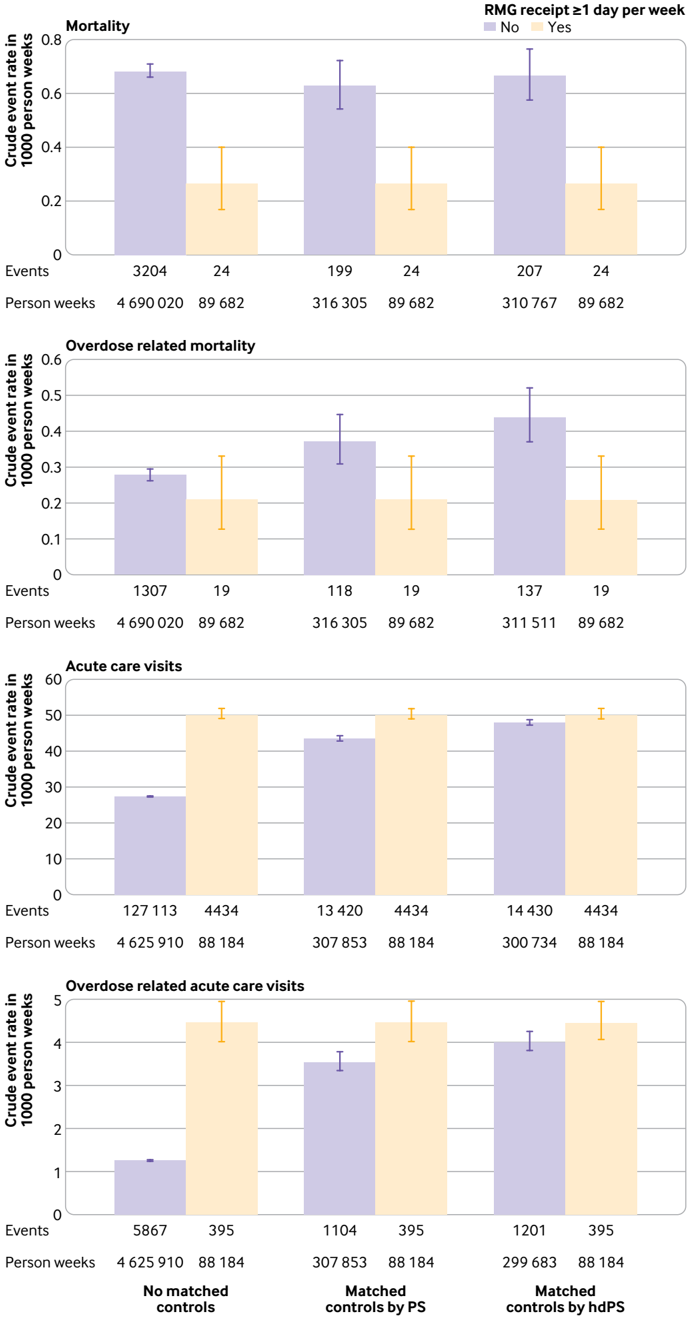
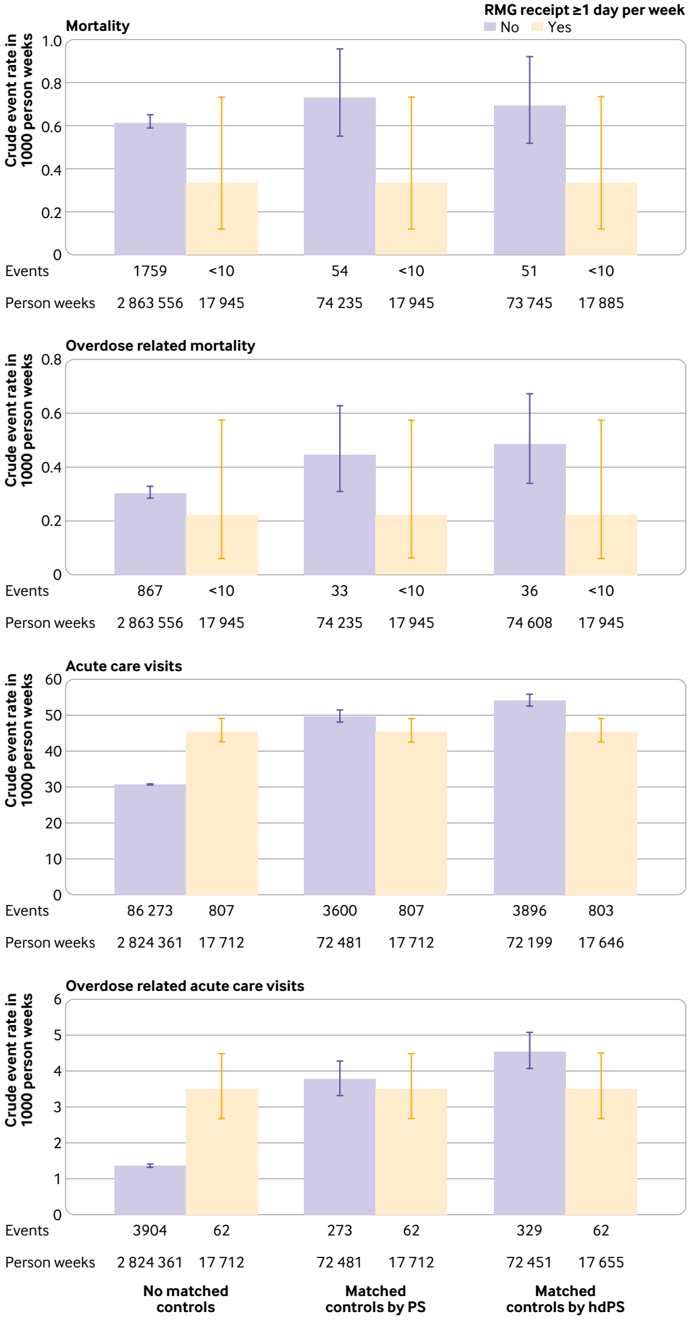
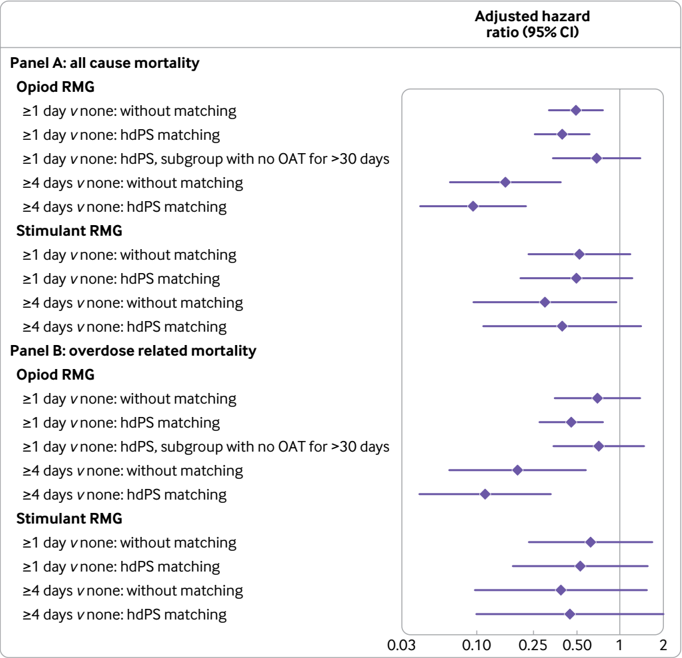
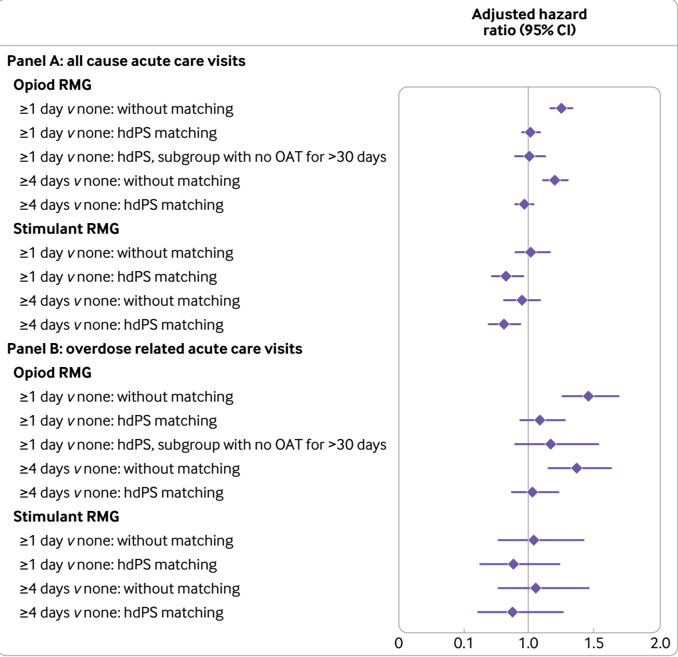
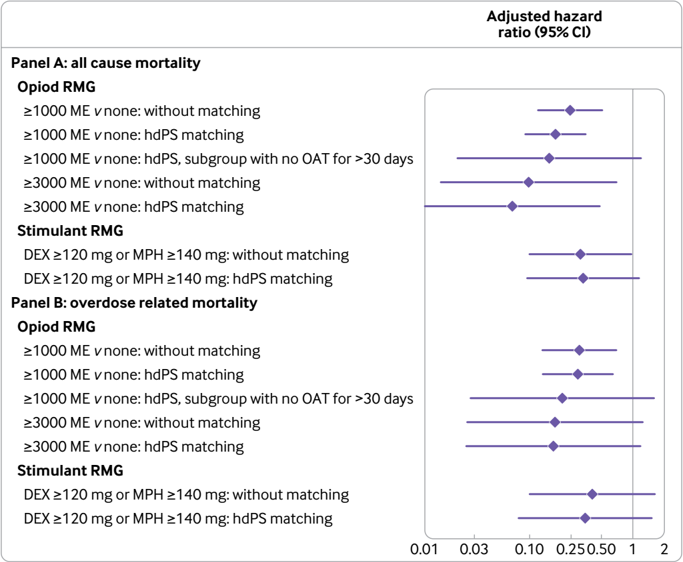
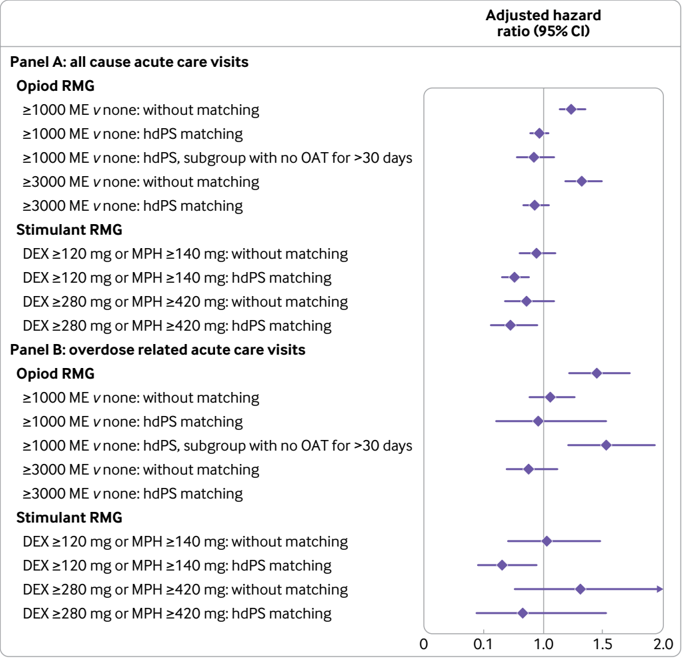
Objective: To determine the effect of opioid and stimulant Risk Mitigation Guidance (RMG) dispensations on mortality and acute care visits during the dual public health emergencies of overdose and covid-19. Design: Population based retrospective cohort study. Setting: British Columbia, Canada. Participants: 5882 people with opioid or stimulant use disorder who received RMG prescriptions for opioids (n=5356) and/or stimulants (n=1061) (535 received both) from 27 March 2020 to 31 August 2021. Main outcome measures: All cause and overdose specific mortality and acute care visits in the week after RMG opioid or stimulant dispensation. RMG recipients were matched 1:1 with controls through use of high dimensional propensity score matching. Marginal structural models, executed on weekly time steps, were used to measure the effect of dispensations on outcomes. Results: RMG opioid dispensations of one day or more were associated with reduced all cause mortality (adjusted hazard ratio 0.39, 95% confidence interval 0.25 to 0.60) and overdose related mortality (0.45, 0.27 to 0.75) in the subsequent week. Dispensations of RMG stimulants (≥1 days) were not significantly associated with reduced all cause mortality (adjusted hazard ratio 0.50, 0.20 to 1.23) or overdose related mortality (0.53, 0.18 to 1.56). The protective effect of RMG opioid dispensations increased with the number of days the medications were dispensed in a given week. People who received four or more days of RMG opioid dispensations had reduced all cause mortality (adjusted hazard ratio 0.09, 0.04 to 0.21) and overdose related mortality (0.11, 0.04 to 0.32) compared with the control group. Opioid RMG dispensations did not significantly modify the odds of all cause or overdose related acute care visits. Dispensations of RMG stimulants were associated with a significant decrease in the odds of acute care visits for any cause but did not affect the odds of overdose related acute care visits. Conclusions: RMG opioid dispensations were associated with reduced overdose related and all cause mortality among a sample of people with opioid use disorder. Pharmaceutical alternatives to the illegal drug supply are promising interventions to reduce mortality in people with opioid use disorder.
Overview
The claims and statistics of this paper haven’t been checked yet.
Free: it reads the open-access text and checks the first 5 claims that cite a source we can check. Create a free account to check every claim.
Integrity signals
Registry
Cites
Statistics
Figures
Verification
Claims the paper makes
The claims and statistics of this paper haven’t been checked yet.
Free: it reads the open-access text and checks the first 5 claims that cite a source we can check. Create a free account to check every claim.
Claims other papers make about this one
Each is checked against this paper’s own text: does it say what the citing paper says it does?
The cited source says what the claim attributes to it.
In the citing paper
“The finding of an increase in opioid hospitalizations and no significant change in opioid-related deaths during the safer supply period differ from the reduction in opioid overdose deaths reported by Slaunwhite et al.8”
From Safer Opioid Supply, Subsequent Drug Decriminalization, and Opioid Overdoses (2025) · cites this paper as Slaunwhite et al.8
Self-check
Percentages, sums and reported differences re-computed from the paper’s own numbers.
The self-check needs the paper’s full text.
Citations
Cites
von Elm, E., Altman, D. G., Egger, M., Pocock, S. J., Gøtzsche, P. C., Vandenbroucke, J. P., & Initiative, F. T. S. (2007) · Annals of Internal Medicine · doi:10.7326/0003-4819-147-8-200710160-00010 · Cited by 17,796
Austin, P. C. (2009) · Statistics in Medicine · doi:10.1002/sim.3697 · Cited by 6,758 · cited 1×
“29 We used an SAS macro version 2 (available at www.drugepi.org) for high dimensional propensity score covariate selection and matching.”
MethodMarginal Structural Models and Causal Inference in Epidemiology
Robins, J. M., Hernán, M. Á., & Brumback, B. (2000) · Epidemiology · doi:10.1097/00001648-200009000-00011 · Cited by 5,581 · cited 1×
“Similarly, we estimated censoring weights 31 Follow-up was censored at incarceration, RMG initiation (if selected for the unexposed group), or administrative loss to follow-up (or death in the analysis on the acute care visit outcome).”
MethodAustin, P. C. (2011) · Pharmaceutical Statistics · doi:10.1002/pst.433 · Cited by 3,949 · cited 1×
“28 We assessed the distributions of covariates before and after matching by the high dimensional propensity score by using standardised mean differences between the exposed and unexposed groups.”
MethodHernán, M. Á., Brumback, B., & Robins, J. M. (2000) · Epidemiology · doi:10.1097/00001648-200009000-00012 · Cited by 1,782 · cited 1×
“30 To control for time varying confounding in the time varying exposure and outcome relation after baseline, we estimated time varying inverse probability weights to create a pseudo-population in which the exposure is independent of the measured confounders.”
MethodD'Agostino, R. B., Lee, M., Belanger, A. J., Cupples, L. A., Anderson, K., & Kannel, W. B. (1990) · Statistics in Medicine · doi:10.1002/sim.4780091214 · Cited by 798 · cited 1×
“32 We used robust variance estimators to calculate confidence limits for marginal structural models.”
MethodCraig, P., Katikireddi, S. V., Leyland, A., & Popham, F. (2017) · Annual Review of Public Health · doi:10.1146/annurev-publhealth-031816-044327 · Cited by 570 · cited 2×
“…these studies have been conducted in controlled clinical settings, intended for the treatment of stimulant use disorder, and have not been implemented with the primary objective of reducing mortality risk in the context of dual public health emergencies of an unregulated drug crisis and covid-19.”
BackgroundLeatherdale, S. T. (2019) · International Journal of Social Research Methodology · doi:10.1080/13645579.2018.1488449 · Cited by 328 · cited 1×
“20 Given the strengths of this study design and the critical need for evidence on the outcomes of RMG prescribing, the objective of this study was to determine the effect of opioid and stimulant RMG dispensations on all cause and overdose related mortality and recurrent acute care visits.”
BackgroundKonstenius, M., Jayaram‐Lindström, N., Guterstam, J., Beck, O., Philips, B., & Franck, J. (2014) · Addiction · doi:10.1111/add.12369 · Cited by 188
PARK, J. N., ROUHANI, S., BELETSKY, L., VINCENT, L., SALONER, B., & SHERMAN, S. G. (2020) · The Milbank Quarterly · doi:10.1111/1468-0009.12470 · Cited by 163
Nosyk, B., Guh, D. P., Bansback, N. J., Oviedo‐Joekes, E., Brissette, S., Marsh, D. C., Meikleham, E., Schechter, M. T., & Anis, A. H. (2012) · Canadian Medical Association Journal · doi:10.1503/cmaj.110669 · Cited by 123
Self-citationMcNeil, R., Fleming, T., Mayer, S., Barker, A., Mansoor, M., Betsos, A., Austin, T., Parusel, S., Ivsins, A., & Boyd, J. (2022) · American Journal of Public Health · doi:10.2105/ajph.2021.306692 · Cited by 115 · cited 4×
“18 An urgent need exists to understand the effect of RMG prescribing on mortality to inform drug policy in North America.”
BackgroundInfluentialImtiaz, S., Nafeh, F., Russell, C., Ali, F., Elton-Marshall, T., & Rehm, J. (2021) · Substance Abuse Treatment, Prevention, and Policy · doi:10.1186/s13011-021-00423-5 · Cited by 101
Gomes, T., Campbell, T. J., Kitchen, S. A., Garg, R., Bozinoff, N., Men, S., Tadrous, M., Munro, C., Antoniou, T., Werb, D., et al. (2022) · JAMA · doi:10.1001/jama.2022.1271 · Cited by 92 · cited 1×
“48 49 We found that opioid RMG dispensations were not associated with acute care use for any cause or for overdoses specifically.”
BackgroundGomes, T., Kolla, G., McCormack, D., Sereda, A., Kitchen, S. A., & Antoniou, T. (2022) · Canadian Medical Association Journal · doi:10.1503/cmaj.220892 · Cited by 92 · cited 2×
“42 Risk factors for acute care use among people who received opioid RMG dispensations included having multiple physical and/or mental health chronic conditions and unstable housing in the previous year.”
BackgroundNuijten, M., Blanken, P., van de Wetering, B., Nuijen, B., van den Brink, W., & Hendriks, V. M. (2016) · The Lancet · doi:10.1016/s0140-6736(16)00205-1 · Cited by 87 · cited 1×
“44-47 Nevertheless, these studies have been conducted in controlled clinical settings, intended for the treatment of stimulant use disorder, and have not been implemented with the primary objective of reducing mortality risk in the context of dual public health emergencies of an unregulated drug…”
BackgroundSchneeweiss, S., Eddings, W., Glynn, R. J., Patorno, E., Rassen, J., & Franklin, J. M. (2017) · Epidemiology · doi:10.1097/ede.0000000000000581 · Cited by 85
Risk of cardiovascular diseases in relation to substance use disorders
Gan, W., Buxton, J. A., Scheuermeyer, F. X., Palis, H., Zhao, B., Desai, R., Janjua, N. Z., & Slaunwhite, A. (2021) · Drug and Alcohol Dependence · doi:10.1016/j.drugalcdep.2021.109132 · Cited by 75
Self-citationMatching with time‐dependent treatments: A review and look forward
Thomas, L. E., Yang, S., WOJDYLA, D. M., & Schaubel, D. E. (2020) · Statistics in Medicine · doi:10.1002/sim.8533 · Cited by 74
Nosyk, B., Slaunwhite, A., Urbanoski, K. A., Hongdilokkul, N., Palis, H., Lock, K., Min, J. E., Zhao, B., Card, K. G., Barker, B., et al. (2021) · BMJ Open · doi:10.1136/bmjopen-2020-048353 · Cited by 68 · cited 5×
“21 We found that among people with a diagnosis of opioid use disorder, dispensations of RMG opioids were associated with reduced overdose related and all cause mortality.”
BackgroundMethodInfluentialSelf-citationOverdose deaths and the COVID ‐19 pandemic in British Columbia, Canada
Palis, H., Bélair, M., Hu, K., Tu, A. W., Buxton, J. A., & Slaunwhite, A. (2021) · Drug and Alcohol Review · doi:10.1111/dar.13424 · Cited by 61
Self-citationPeriods of altered risk for non-fatal drug overdose: a self-controlled case series
Keen, C., Kinner, S. A., Young, J. T., Snow, K. J., Zhao, B., Gan, W., & Slaunwhite, A. (2021) · The Lancet Public Health · doi:10.1016/s2468-2667(21)00007-4 · Cited by 58 · cited 1×
“38-41 Comparison with other studies The protective effect of RMG opioid dispensations on mortality is congruent with findings from an evaluation of a prescribed opioid safer supply programme in Ontario in which mortality was rare among participants receiving medications and primary care compared…”
ResultSelf-citationDevelopment and characteristics of the Provincial Overdose Cohort in British Columbia, Canada
MacDougall, L., Smolina, K., Otterstatter, M. C., Zhao, B., Chong, M., Godfrey, D. M., Mussavi-Rizi, A., Sutherland, J., Kuo, M. E., & Kendall, P. (2019) · PLoS ONE · doi:10.1371/journal.pone.0210129 · Cited by 57
Ivsins, A., MacKinnon, L., Bowles, J. M., Slaunwhite, A., & Bardwell, G. (2022) · Journal of Urban Health · doi:10.1007/s11524-022-00679-7 · Cited by 57 · cited 1×
“42 Previous studies have reported that prescribed safer supply reduced reliance on the illegal drug supply, 43 which may have contributed to reduced mortality risk among opioid RMG recipients.”
BackgroundSelf-citationKeen, C., Kinner, S. A., Young, J. T., Jang, K. L., Gan, W., Samji, H., Zhao, B., Krausz, M. R., & Slaunwhite, A. (2021) · Addiction · doi:10.1111/add.15580 · Cited by 52
Self-citationSelfridge, M., Card, K. G., Kandler, T., Flanagan, E., Lerhe, E., Heaslip, A., Nguyen, A., Moher, M., Pauly, B., Urbanoski, K. A., et al. (2022) · International Journal of Drug Policy · doi:10.1016/j.drugpo.2022.103709 · Cited by 41
Self-citationOtterstatter, M. C., Crabtree, A., Dobrer, S., Kinniburgh, B. A., Klar, S. A., Leamon, A., May‐Hadford, J., Mill, C., Park, M., Tu, A. W., et al. (2018) · Health Promotion and Chronic Disease Prevention in Canada · doi:10.24095/hpcdp.38.9.04 · Cited by 34 · cited 2×
“23 33 37 Many people who received opioid RMG dispensations had previous diagnoses of chronic conditions such as alcohol use disorder, indicating that healthcare providers may have been prescribing to people at the highest risk of mortality.”
BackgroundSelf-citationOverdose and risk factors for coronavirus disease 2019
Slaunwhite, A., Gan, W., Xavier, C. G., Zhao, B., Buxton, J. A., & Desai, R. (2020) · Drug and Alcohol Dependence · doi:10.1016/j.drugalcdep.2020.108047 · Cited by 32 · cited 1×
“33 34 These trends were similar among people who received stimulant RMG dispensations.”
Self-citationEffectiveness of diacetylmorphine versus methadone for the treatment of opioid dependence in women
Oviedo‐Joekes, E., Guh, D. P., Brissette, S., Marchand, K., Marsh, D. C., Chettiar, J., Nosyk, B., Krausz, M. R., Anis, A. H., & Schechter, M. T. (2010) · Drug and Alcohol Dependence · doi:10.1016/j.drugalcdep.2010.03.016 · Cited by 31
Self-citationFactors associated with incomplete toxicology reporting in drug overdose deaths, 2010–2016
Tote, K. M., Bradley, H. M., Martin, E. G., Yucel, R. M., & Rosenberg, E. S. (2019) · Annals of Epidemiology · doi:10.1016/j.annepidem.2019.08.006 · Cited by 25
Oviedo‐Joekes, E., Dobischok, S., Carvajal, J., Macdonald, S., McDermid, C., Klakowicz, P., Harrison, S., Lajeunesse, J., Chow, N., Brown, M., et al. (2023) · BMC Health Services Research · doi:10.1186/s12913-023-09558-6 · Cited by 24
Accurate identification of opioid overdose deaths using coronial data
Roxburgh, A., Schumann, J., Hall, W., Burns, L., & Degenhardt, L. J. (2018) · Forensic Science International · doi:10.1016/j.forsciint.2018.03.032 · Cited by 18
Blanken, P., Nuijten, M., van den Brink, W., & Hendriks, V. M. (2020) · Addiction · doi:10.1111/add.14874 · Cited by 15
Increases in drug overdose deaths in Norway and the United States during the COVID-19 pandemic
Friedman, J. R., & Gjersing, L. (2022) · Scandinavian Journal of Public Health · doi:10.1177/14034948221075025 · Cited by 15
Drug overdose and the risk of cardiovascular diseases: a nested case–control study
Gan, W., Buxton, J. A., Palis, H., Janjua, N. Z., Scheuermeyer, F. X., Xavier, C. G., Zhao, B., Desai, R., & Slaunwhite, A. (2021) · Clinical Research in Cardiology · doi:10.1007/s00392-021-01945-5 · Cited by 13
Self-citationMoshkforoush, M., DeBeck, K., Brar, R., Fairbairn, N. S., Cui, Z., Milloy, M., Buxton, J. A., Oldenburger, T., McLellan, W., Kendall, P., et al. (2022) · Harm Reduction Journal · doi:10.1186/s12954-022-00632-6 · Cited by 6 · cited 2×
“The published literature to date on RMG prescribing in British Columbia includes a case report, 15 a chart review, 16 a cross sectional survey of people who use drugs, 17 and a qualitative study that used interview data.”
BackgroundHong, R. H., Brar, R., & Fairbairn, N. (2022) · Journal of Addiction Medicine · doi:10.1097/adm.0000000000000954 · Cited by 5
Evidence-based Treatment for Stimulant Use Disorder: Time to Hit the Community
Tardelli, V., Bisaga, A., Tadonio, L., Gerra, G., & Fidalgo, T. (2022) · Canadian journal of psychiatry. Revue canadienne de psychiatrie · doi:10.1177/07067437221148831 · Cited by 3
Oviedo‐Joekes, E., Dobischok, S., Carvajal, J., Macdonald, S., McDermid, C., Klakowicz, P., Harrison, S., Lajeunesse, J., Chow, N., Brown, M., et al. (2023) · Research Square · doi:10.21203/rs.3.rs-2570581/v1 · Cited by 3
Using Linked Data to Identify Pathways of Reporting Overdose Events in British Columbia, 2015 - 2017
Graham, E. A., Zhao, B., Flynn, M., Gustafson, P., Irvine, M. A., Slaunwhite, A., Orpana, H., Kuo, M. E., & MacDougall, L. (2022) · International Journal for Population Data Science · doi:10.23889/ijpds.v7i1.1708 · Cited by 2
Self-citation
Cited by
Prescribed safer opioid supply: A scoping review of the evidence
Ledlie, S., Garg, R., Cheng, C., Kolla, G., Antoniou, T., Bouck, Z., & Gomes, T. (2024) · International Journal of Drug Policy · doi:10.1016/j.drugpo.2024.104339 · Cited by 68
The public health risks of counterfeit pills
Friedman, J., & Ciccarone, D. (2025) · The Lancet Public Health · doi:10.1016/s2468-2667(24)00273-1 · Cited by 32
Kolla, G., Pauly, B., Cameron, F., Hobbs, H., Ranger, C., McCall, J., Majalahti, J., Toombs, K., LeMaistre, J., Selfridge, M., et al. (2024) · Harm Reduction Journal · doi:10.1186/s12954-024-01029-3 · Cited by 21
Self-citationMarkoulidakis, A., Hickman, M., McAuley, A., Barnsdale, L. R., Welton, N. J., Glancy, M., Shivaji, T., Collins, C., Lang, J., de Wit, F., et al. (2024) · Addiction · doi:10.1111/add.16500 · Cited by 15
Opioid Coprescription Through Risk Mitigation Guidance and Opioid Agonist Treatment Receipt
Min, J. E., Guerra‐Alejos, B. C., Yan, R., Palis, H., Barker, B., Urbanoski, K. A., Pauly, B., Slaunwhite, A., Bach, P., Ranger, C., et al. (2024) · JAMA Network Open · doi:10.1001/jamanetworkopen.2024.11389 · Cited by 20
Self-citation
Metadata
- Authors
- Slaunwhite, A., Min, J. E., Palis, H., Urbanoski, K., Pauly, B., Barker, B., Crabtree, A., Bach, P., Krebs, E., Dale, L., Meilleur, L., & Nosyk, B.
- Affiliations
- University of British Columbia (CA)
- Centre for Advancing Health Outcomes (CA)
- University of Victoria (CA)
- Simon Fraser University (CA)
- BC Cancer Agency (CA)
- First Nations Health Authority (CA)
- Corresponding author
- Nosyk, Bohdan
- ORCID
- Venue
- BMJ
- Publisher
- BMJ
- Published
- 2024-01-10
- Volume
- 384
- Pages
- e076336
- ISSN
- 1756-1833 (ISSN-L)
- OpenAlex
- W4390718539
- Cited by
- 100
- References
- 40
- Citations by year
- 2026: 17 · 2025: 43 · 2024: 40
- FWCI
- 41.42
- Type
- journal article
- Language
- en
- Update notices
- correction (2024-03-11)
- Open access
- hybrid
- doi.org
- Licence
- Locations
- BMJ (publishedVersion, cc-by-nc)
- PubMed (publishedVersion)
- PubMed Central (publishedVersion, cc-by-nc)
- UVic’s Research and Learning Repository (University of Victoria) (submittedVersion, cc-by-nc)
- HighWire Press Open Archive (submittedVersion)
- Funders
- National Institutes of Health
- Topics
- Health Sciences › Medicine › Public Health, Environmental and Occupational Health › Opioid Use Disorder Treatment
- Health Sciences › Medicine › Epidemiology › HIV, Drug Use, Sexual Risk
- Health Sciences › Medicine › Epidemiology › Substance Abuse Treatment and Outcomes
- Keywords
- opioid use disorder, stimulant use disorder, drug overdose deaths, all-cause mortality, acute care visits, COVID-19 pandemic, public health emergencies, harm reduction, British Columbia
- MeSH terms
- Central Nervous System Stimulants, Analgesics, Opioid, British Columbia, Emergencies, Humans, Opioid-Related Disorders, Public Health, Retrospective Studies, Drug Overdose
About these checks
Registry, retraction, Cites and statistics results are computed, not judged, with one exception: a printed reference that no index lists is read once by a model before it counts as a citation error. Claims are extracted by a model and kept only when their quote appears verbatim in the text; each cited source is then checked, with a model’s help, for whether it says what the claim relies on. Those verdicts can be wrong — read the claim’s quote and the cited source before relying on one.
Statistics and arithmetic are recomputed, not judged.
Confidence bands are shown only for fields calibrated on our annotated test set. None is calibrated yet, so no band is shown.
What counts as a claim ›How we measure confidence ›How we check this ›
Are you an author, or do you see a problem with this page? Request a review
Data sources
Bibliographic data: Semantic Scholar, OpenAlex, Crossref.
Contains information from the Semantic Scholar Academic Graph Datasets, made available under the ODC Attribution License (ODC-BY 1.0).
Semantic Scholar’s data is described in: Kinney, R., et al. (2023). The Semantic Scholar Open Data Platform. arXiv:2301.10140.
