

Glucagon‐like peptide 1 receptor agonist use and risk of thyroid cancer: Scandinavian cohort study
Open accessThe DOI matches its Crossref record; 24 of the 24 references it cites were found in a registry or an index.
Abstract
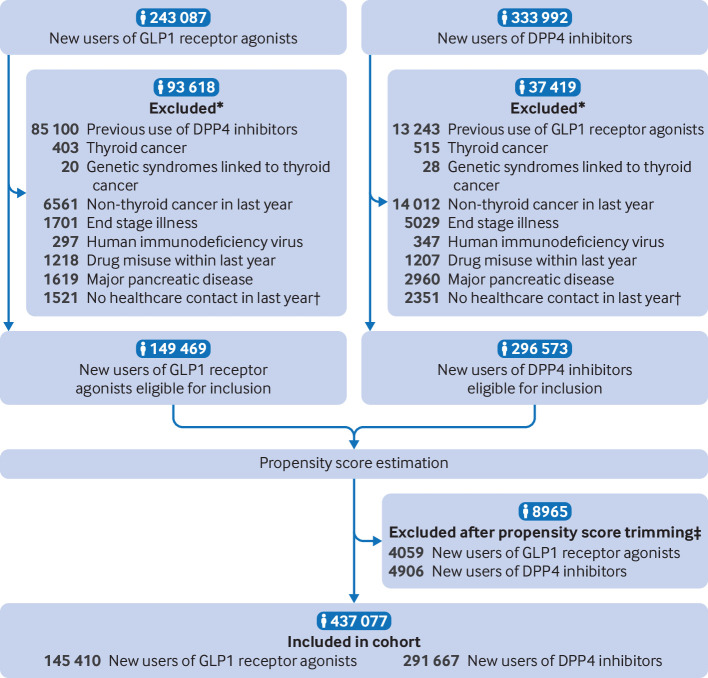
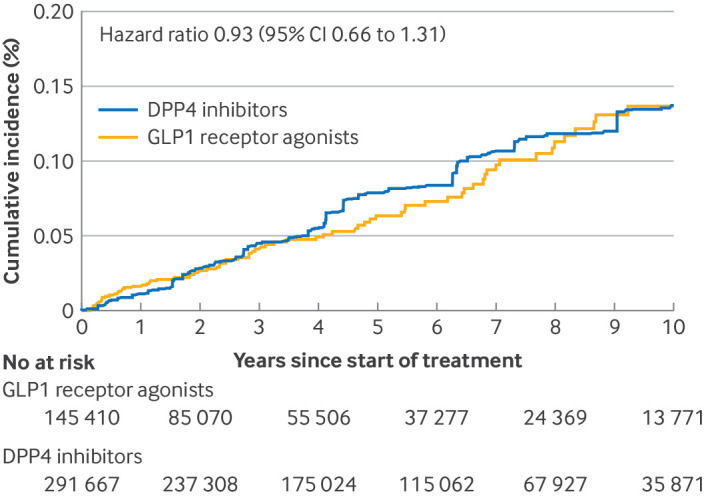
Objective: To investigate whether use of glucagon-like peptide 1 (GLP1) receptor agonists is associated with increased risk of thyroid cancer. Design: Scandinavian cohort study. Setting: Denmark, Norway, and Sweden, 2007-21. Participants: Patients who started GLP1 receptor agonist treatment were compared with patients who started dipeptidyl peptidase 4 (DPP4) inhibitor treatment, and in an additional analysis, patients who started sodium-glucose cotransporter 2 (SGLT2) inhibitor treatment. Main outcome measures: Thyroid cancer identified from nationwide cancer registers. An active-comparator new user study design was used to minimise risks of confounding and time related biases from using real world studies of drug effects. Cox regression was used to estimate hazard ratios, controlling for potential confounders with propensity score weighting. Results: The mean follow-up time was 3.9 years (standard deviation 3.5 years) in the GLP1 receptor agonist group and 5.4 years (standard deviation 3.5 years) in the DPP4 inhibitor group. 76 of 145 410 patients (incidence rate 1.33 events per 10 000 person years) treated with GLP1 receptor agonists and 184 of 291 667 patients (incidence rate 1.46 events per 10 000 person years) treated with DPP4 inhibitors developed thyroid cancer. GLP1 receptor agonist use was not associated with increased risk of thyroid cancer (hazard ratio 0.93, 95% confidence interval 0.66 to 1.31; rate difference −0.13, 95% confidence interval −0.61 to 0.36 events per 10 000 person years). The hazard ratio for medullary thyroid cancer was 1.19 (0.37 to 3.86). In the additional analysis comparing the GLP1 receptor agonist group with the SGLT2 inhibitor group, the hazard ratio for thyroid cancer was 1.16 (0.65 to 2.05). Conclusions: In this large cohort study using nationwide data from three countries, GLP1 receptor agonist use was not associated with a substantially increased risk of thyroid cancer over a mean follow-up of 3.9 years. In the main analysis comparing GLP1 receptor agonists with DPP4 inhibitors, the upper limit of the confidence interval was consistent with no more than a 31% increase in relative risk.
Overview
The claims and statistics of this paper haven’t been checked yet.
Free: it reads the open-access text and checks the first 5 claims that cite a source we can check. Create a free account to check every claim.
Integrity signals
Registry
Cites
Statistics
Figures
Verification
Claims the paper makes
The claims and statistics of this paper haven’t been checked yet.
Free: it reads the open-access text and checks the first 5 claims that cite a source we can check. Create a free account to check every claim.
Claims other papers make about this one
Each is checked against this paper’s own text: does it say what the citing paper says it does?
The source backs part of the claim, not all of it — or backs it for a different population, condition or comparison.
In the citing paper
“Similarly, while murine studies initially raised concerns about thyroid C-cell tumors,71 current human data do not suggest an increased risk.72,73”
From The expanding role of GLP-1 receptor agonists: a narrative review of current evidence and future directions (2025) · cites this paper as [72]
Experimental — accuracy not yet measuredThe cited source says what the claim attributes to it.
In the citing paper
“A recent Scandinavian real‐world study 106 found no increased risk of thyroid cancer among initiators of GLP‐1RA vs. dipeptidyl‐peptidase 4 inhibitors (DPP4i).”
From Real‐world evidence on the utilization, clinical and comparative effectiveness, and adverse effects of newer GLP ‐ 1RA ‐based weight‐loss therapies (2025) · cites this paper as [106]
The cited source says what the claim attributes to it.
In the citing paper
“a Scandinavian cohort study using nationwide cancer registries found no association between GLP-1RA use and thyroid cancer (HR 0.93, 95 % CI 0.66–1.31) (80).”
From The science of safety: adverse effects of GLP-1 receptor agonists as glucose-lowering and obesity medications (2026) · cites this paper as [80]
Self-check
Percentages, sums and reported differences re-computed from the paper’s own numbers.
The self-check needs the paper’s full text.
Citations
Cites
Marginal Structural Models and Causal Inference in Epidemiology
Robins, J. M., Hernán, M. Á., & Brumback, B. (2000) · Epidemiology · doi:10.1097/00001648-200009000-00011 · Cited by 5,581
Hernán, M. Á., Brumback, B., & Robins, J. M. (2000) · Epidemiology · doi:10.1097/00001648-200009000-00012 · Cited by 1,782 · cited 1×
“15 In these analyses, the odds ratio for drug use can be interpreted as a hazard ratio because it is estimated over discrete follow-up intervals.”
The changing incidence of thyroid cancer
Kitahara, C. M., & Sosa, J. A. (2016) · Nature Reviews Endocrinology · doi:10.1038/nrendo.2016.110 · Cited by 1,051
Pancreatitis, pancreatic, and thyroid cancer with glucagon-like peptide-1-based therapies
Elashoff, M., Matveyenko, A. V., Gier, B., Elashoff, R., & Butler, P. C. (2011) · Gastroenterology · doi:10.1053/j.gastro.2011.02.018 · Cited by 944
An Empirical Transition Matrix for Non-homogeneous Markov Chains Based on Censored Observations
Johansen, R. (1978) · Cited by 844
Lund, J. L., Richardson, D. B., & Stürmer, T. (2015) · Current Epidemiology Reports · doi:10.1007/s40471-015-0053-5 · Cited by 739 · cited 1×
“The study design was an active-comparator new user design, 11 with DPP4 inhibitors as the comparator.”
Nordic Cancer Registries – an overview of their procedures and data comparability
Pukkala, E., Engholm, G., Højsgaard Schmidt, L. K., Storm, H., Khan, S., Lambe, M., Pettersson, D., Ólafsdóttir, E., Tryggvadóttir, L., Hakanen, T., et al. (2018) · Acta Oncologica · doi:10.1080/0284186x.2017.1407039 · Cited by 347
GLP-1 Receptor Agonists and the Risk of Thyroid Cancer
Bezin, J., Gouverneur, A., Pénichon, M., Mathieu, C., Garrel, R., Hillaire-Buys, D., Pariente, A., & Faillie, J.-L. (2023) · Diabetes Care · doi:10.2337/dc22-1148 · Cited by 320
Weighing Risks and Benefits of Liraglutide — The FDA's Review of a New Antidiabetic Therapy
Parks, M., & Rosebraugh, C. (2010) · New England Journal of Medicine · doi:10.1056/nejmp1001578 · Cited by 275
Desai, R. J., Rothman, K. J., Bateman, B. T., Hernandez-Diaz, S., & Huybrechts, K. F. (2017) · Epidemiology · doi:10.1097/ede.0000000000000595 · Cited by 245
Cited by
Thomsen, R. W., Mailhac, A., Løhde, J. B., & Pottegård, A. (2025) · Diabetes Obesity and Metabolism · doi:10.1111/dom.16364 · Cited by 207
Moiz, A., Filion, K. B., Tsoukas, M. A., Yu, O. H. Y., Peters, T. M., & Eisenberg, M. J. (2025) · EClinicalMedicine · doi:10.1016/j.eclinm.2025.103363 · Cited by 157
Baxter, S. M., Lund, L. C., Andersen, J. H., Brix, T. H., Hegedüs, L., Hsieh, M. H.-C., Su, C. T.-T., Cheng, M. C.-Y., Chang, Z. C.-J., Lai, E. C.-C., et al. (2025) · Thyroid® · doi:10.1089/thy.2024.0387 · Cited by 81
GLP-1RA Use and Thyroid Cancer Risk
Brito, J. P., Herrin, J. S., SWARNA, K. S., Ospina, N. S., Montori, V. M., Toro-Tobón, D., Umpierrez, G. E., Galindo, R. J., Deng, Y., Mickelson, M. M., et al. (2025) · JAMA Otolaryngology–Head & Neck Surgery · doi:10.1001/jamaoto.2024.4852 · Cited by 76
Obesity-driven inflammation and cancer risk: A comprehensive review
Lamabadusuriya, D. A., Jayasena, H., Bopitiya, A. K., Silva, A. D. D., & Jayasekera, P. T. (2025) · Seminars in Cancer Biology · doi:10.1016/j.semcancer.2025.07.007 · Cited by 79
Levy, S. M., Attia, A. S., Elshazli, R. M., Abdelmaksoud, A., Tatum, D. M., Aiash, H., & Toraih, E. A. (2024) · Cancers · doi:10.3390/cancers17010078 · Cited by 72
“Conversely, large cohort studies found no substantial increase in thyroid cancer risk over a mean follow-up of 3.9 years [18].”
InfluentialJanež, A., Muzurović, E. M., Bogdański, P., Czupryniak, L., Fábryová, Ľ., Fras, Z., Guja, C., Haluzík, M., Kempler, P., Lalic, N. M., et al. (2024) · Diabetes Therapy · doi:10.1007/s13300-024-01615-5 · Cited by 70
Lin, A., Ding, Y., Li, Z., Jiang, A., Liu, Z., Wong, H. Z. H., Cheng, Q., Zhang, J., & Luo, P. (2025) · Biomarker Research · doi:10.1186/s40364-025-00765-3 · Cited by 72
“Overall with a significant increase in thyroid cancer risk [2, 5].”
Weight Reduction with GLP-1 Agonists and Paths for Discontinuation While Maintaining Weight Loss
Reiss, A. B., Gulkarov, S., Lau, R., Klek, S. P., Srivastava, A., Renna, H. A., & De Leon, J. (2025) · Biomolecules · doi:10.3390/biom15030408 · Cited by 58
“In contrast, a more recent Scandinavian trial did not detect a significant association between GLP-1 usage and thyroid cancer [202].”
Ko, A., Chang, Y.-C., Bahar, F., Wang, T. H., Xanthavanij, N., Yu, C.-C., Hsieh, R. J.-L., See, X. Y., Lo, S., Song, J., et al. (2025) · Annals of Internal Medicine · doi:10.7326/annals-25-02237 · Cited by 59
Glucose-Dependent Insulinotropic Polypeptide in Incretin Physiology: Role in Health and Disease
Wolfe, M. M., Boylan, M. O., & Chin, W. W. (2025) · Endocrine Reviews · doi:10.1210/endrev/bnaf006 · Cited by 48
“Bea et al (255) used claims data from the Korean National Health Insurance Database, and sodium-glucose cotransporter-2 inhibitors were chosen as an active comparator because of their previous nonassociation with thyroid cancer.”
InfluentialHuang, Y., Liao, W., Huang, J., Lin, Y., Yang, S., Huang, C., Wang, C., & Su, P. (2024) · Diabetes, Obesity and Metabolism · doi:10.1111/dom.15869 · Cited by 44
Kunutsor, S. K., & Seidu, S. (2025) · Drugs · doi:10.1007/s40265-025-02263-0 · Cited by 45
Ghazaly, M. M., Lee, G. E., Ling, N., Hědenec, P., Maulidiani, M., Hassan, N. R., Zulkifli, M. F., Mohammed, A., & Ghazali, M. S. M. (2024) · Food & medicine homology. · doi:10.26599/fmh.2025.9420068 · Cited by 42
Jalleh, R. J., Talley, N. J., Horowitz, M., & Nauck, M. A. (2026) · Journal of Clinical Investigation · doi:10.1172/jci194740 · Cited by 40
Nassar, M., Nassar, O., Abosheaishaa, H. M., & Misra, A. (2024) · Journal of Endocrinological Investigation · doi:10.1007/s40618-024-02466-4 · Cited by 35
Kim, T. H., Lee, K., Park, S., Oh, J., Park, J., Jo, H., Lee, H., Cho, J., Wen, X., Cho, H., et al. (2025) · Diabetes Obesity and Metabolism · doi:10.1111/dom.16376 · Cited by 37
“30 Thus, further research based on longer-term data is needed to clarify the cancer risks associated with GLP-1 RA use.”
Sagy, Y. W., Ramot, N., Battat, E., Arbel, R., Reges, O., Dicker, D., & Lavie, G. (2025) · EClinicalMedicine · doi:10.1016/j.eclinm.2025.103213 · Cited by 34
Long-term cancer risk in users of GLP-1 agonists in Denmark: a nationwide emulated trial
Gamborg, M., Grand, M. K., Grell, K., Rosthøj, S., Pedersen‐Bjergaard, U., Torp-Pedersen, C. T., & Mørch, L. S. (2025) · The Lancet Regional Health - Europe · doi:10.1016/j.lanepe.2025.101346 · Cited by 32
Gastrointestinal Motility Effects of GLP-1 Receptor Agonists
Bellavance, D. R., Chua, S. G., & Mashimo, H. L. (2025) · Current Gastroenterology Reports · doi:10.1007/s11894-025-00995-3 · Cited by 33
Approach to the patient with thyroid nodules: considering GLP-1 receptor agonists
Kelly, C. A., & Sipos, J. A. (2025) · The Journal of Clinical Endocrinology & Metabolism · doi:10.1210/clinem/dgae722 · Cited by 30
Risk of Thyroid Tumors With GLP-1 Receptor Agonists: A Retrospective Cohort Study
Morales, D. R., Bu, F., Viernes, B., DuVall, S. L., Matheny, M. E., Simon, K., Falconer, T., Richter, L. R., Ostropolets, A., Lau, W. C. Y., et al. (2025) · Diabetes Care · doi:10.2337/dc25-0154 · Cited by 32
“However, a recently reported Scandinavian cohort study also found no evidence of an increased risk of thyroid cancer with GLP-1RA use (38).”
Kupnicka, P., Król, M., Żychowska, J., Łagowski, R., Prajwos, E., Surówka, A., & Chlubek, D. (2024) · Pharmaceuticals · doi:10.3390/ph17111470 · Cited by 26
Daou, C. A. Z., Hosn, O. A., Ghzayel, L., & Mourad, M. (2025) · Endocrinology Diabetes & Metabolism · doi:10.1002/edm2.70038 · Cited by 26
“A Scandinavian cohort study looking at 145,410 patients using GLP1-agonists also found no significant increased risk of thyroid cancer over a mean follow-up of 3.9 years (HR = 0.90, 95% CI 0.58 to 1.38) [25].”
InfluentialPopovic, D. S., Patoulias, D., POPOVIC, L. S., Karakasis, P., Παπάνας, Ν., & Mantzoros, C. S. (2024) · Diabetes Research and Clinical Practice · doi:10.1016/j.diabres.2024.111758 · Cited by 23
Fahim, S. A., Attia, Y. M., Messiha, A. A., Nabawy, A. Y., Refaat, F., & El-Maadawy, W. H. (2025) · Biomedicine & Pharmacotherapy · doi:10.1016/j.biopha.2025.118731 · Cited by 23
Side effects of GLP-1 receptor agonists
Manne‐Goehler, J., & Franco, J. V. A. (2025) · BMJ · doi:10.1136/bmj.r1606 · Cited by 20
Incretin triple agonist retatrutide (LY3437943) alleviates obesity-associated cancer progression
Marathe, S. J., Grey, E. W., Bohm, M. S., Joseph, S. C., Ramesh, A. V., Cottam, M. A., Idrees, K., Wellen, K. E., Hasty, A. H., Rathmell, J. C., et al. (2025) · npj Metabolic Health and Disease · doi:10.1038/s44324-025-00054-5 · Cited by 19
Yang, Y., Liu, W., Zhang, Z., zhang, Y., Wang, X., Wang, J., Cai, H., Liu, Y., Meng, R., Fu, Y., et al. (2025) · Journal of Autoimmunity · doi:10.1016/j.jaut.2025.103414 · Cited by 20
Dharia, A., Desai, D., & Desai, K. (2025) · Endocrine Practice · doi:10.1016/j.eprac.2025.02.005 · Cited by 18
Glenny, E. M., Coleman, M. F., Clutton, G. T., Riesenberg, B. P., Ho, A. N., McFarlane, T. L., Kiesel, V. A., Kucinskas, A. L., Bailey, E. G., Sanchez, K. E., et al. (2024) · bioRxiv (Cold Spring Harbor Laboratory) · doi:10.1101/2024.01.20.576484 · Cited by 18
Ateiwi, Y. A., Mahmood, R. R., Wong, H. J., Low, C. E., Yau, C. E., Lee, A. R. Y. B., Eng, P. C., Lee, M., Chan, M. Y., & Sia, C. (2026) · Diabetes Research and Clinical Practice · doi:10.1016/j.diabres.2026.113158 · Cited by 18
Weight Loss Blockbuster Development: A Role for Unimolecular Polypharmacology
Zhou, Q., Li, G., Hang, K., Li, J., Yang, D., & Wang, M. (2024) · The Annual Review of Pharmacology and Toxicology · doi:10.1146/annurev-pharmtox-061324-011832 · Cited by 16
The multifaceted effects of semaglutide: exploring its broad therapeutic applications
Alkhatib, M., Almasri, N., Alshwayyat, S., Almahariq, H., Hammadeh, B. M., Taimeh, Z., Alkhatib, L., Alshwayat, A. R. I., Saadeh, N. A., & Al‐kurdi, M. A. (2025) · Future Science OA · doi:10.1080/20565623.2025.2483607 · Cited by 18
Glucagon-like peptide-1 medicines and cancer
Yabut, J. M., & Drucker, D. J. (2026) · Nature Cancer · doi:10.1038/s43018-025-01110-1 · Cited by 16
Glucagon-like peptide 1 receptor agonists and cancer risk: the good, the bad and the unknown
Mannucci, E., & Dicembrini, I. (2026) · Nature Reviews Clinical Oncology · doi:10.1038/s41571-026-01135-0 · Cited by 16
“duration of observation (<3 years in most studies 69–71 , 73– 75 ) as”
Yeo, D., Jo, Y., Jeong, J., Jeong, Y. D., Woo, H. G., Son, Y., Kim, S., Rhee, S. Y., & Yon, D. K. (2025) · Diabetes Obesity and Metabolism · doi:10.1111/dom.70298 · Cited by 17
Duchemin, L., Morice, A., Morice, P., Bernardeau, C., Alexandre, J., Fédrizzi, S., Silva, A. D., Boismoreau, L., Faillie, J., & Dolladille, C. (2025) · Diabetes Obesity and Metabolism · doi:10.1111/dom.16504 · Cited by 14
Moiz, A., Peters, T. M., Tsoukas, M. A., Yu, O. H. Y., Filion, K. B., & Eisenberg, M. J. (2026) · EClinicalMedicine · doi:10.1016/j.eclinm.2026.103991 · Cited by 15
Grandhi, N., Liu, L., Wang, M., Thomas, T. S., Schoen, M. W., Sanfilippo, K. M., Gao, F., Colditz, G. A., Carson, K. R., Janakiram, M., et al. (2024) · JNCI Cancer Spectrum · doi:10.1093/jncics/pkae095 · Cited by 13
Rodriguez, N. S., & Hartmann, P. (2025) · Pharmacological Reviews · doi:10.1016/j.pharmr.2025.100058 · Cited by 13
A System-Based Review on Effects of Glucagon-Like Peptide-1 Receptor Agonists: Benefits vs Risks
Fadel, L. P., Thao, G., Chitre, T., Rojas, E. D., Fricko, M. N., Domingo, V., Budginas, B., Guerrero, L. C., Ghatas, M., Arani, N. T., et al. (2025) · Cureus · doi:10.7759/cureus.78575 · Cited by 13
“In a Scandinavian cohort study from three countries, GLP-1RA use was not associated with a substantially increased risk of thyroid cancer over a mean follow-up of 3.9 years [20].”
InfluentialMuller, H. L. (2025) · Biomedicines · doi:10.3390/biomedicines13051016 · Cited by 12
“A large-scale Scandinavian study found no significant increase in thyroid cancer risk in those taking GLP-1 receptor agonists compared with those on other treatments for type 2 diabetes [68].”
Assessment of thyroid cancer risk associated with glucagon‐like peptide 1 receptor agonist use
Vilsbøll, T., Stellfeld, M., Aroda, V. R., Dandanell, S., David, J., Kristiansen, C. T. P., Rasmussen, S., Roberts, F. L., & Hegedűs, L. D. (2025) · Diabetes Obesity and Metabolism · doi:10.1111/dom.70291 · Cited by 12
Curbing the Obesity Epidemic: Should GLP-1 Receptor Agonists Be the Standard of Care for Obesity?
Kaplan, J. M., Zaman, A., & Abushamat, L. A. (2024) · Current Cardiology Reports · doi:10.1007/s11886-024-02097-4 · Cited by 12
Does Incretin Agonism Have Sustainable Efficacy?
Janket, S., Chatanaka, M. K., Sohaei, D., Tamimi, F., Meurman, J. H., & Diamandis, E. P. (2024) · Cells · doi:10.3390/cells13221842 · Cited by 11
Alluri, A. A., Guntupalli, Y., Suvarna, S. S., Prystupa, Y., Khetan, S. P., Vejandla, B., & Swathi, N. L. (2025) · Journal of Basic and Clinical Physiology and Pharmacology · doi:10.1515/jbcpp-2025-0031 · Cited by 12
Evaluating Thyroid Cancer Risk in Glucagon-like Peptide-1 Analog Users With Thyroid Nodules
Balachandra, S., Syed, R., Song, Z., Kasmirski, J. A., Gillis, A., Fazendin, J. M., Lindeman, B. M., & Chen, H. (2025) · Journal of Surgical Research · doi:10.1016/j.jss.2025.05.016 · Cited by 11
Ruggiero, R., Longo, M., Mascolo, A., Nuzzo, M. D., Laino, L. V., Caruso, P., D'Amato, R., Rafaniello, C., Maiorino, M. I., Esposito, K., et al. (2025) · European Journal of Pharmacology · doi:10.1016/j.ejphar.2025.178004 · Cited by 12
When Should the Treatment of Obesity in Thyroid Disease Begin?
Sutkowska, E., Kisiel, M., & Zubkiewicz‐Kucharska, A. (2025) · Biomedicines · doi:10.3390/biomedicines13010157 · Cited by 11
“However, clinical studies have dispelled these concerns as they have not confirmed a significant risk of medullary thyroid cancer (MTC) in this patient group [72].”
McIntyre, R. S. (2025) · American Journal of Psychiatry · doi:10.1176/appi.ajp.20241087 · Cited by 12
GLP-1 signaling in tumor metabolism and immunity: mechanisms and strategies
Luo, Y., Xu, H., Zhao, Y., Yang, B., & Zhang, Y. (2025) · Food & Function · doi:10.1039/d5fo03273c · Cited by 12
Chee, Y. J., & Dalan, R. (2024) · Biomedicines · doi:10.3390/biomedicines12071386 · Cited by 10
Use of GLP-1 Receptor Agonists for the Management of Type 1 Diabetes: A Pediatric Perspective
Nevo-Shenker, M., & Shalitin, S. (2024) · Hormone Research in Paediatrics · doi:10.1159/000541228 · Cited by 9
Zhang, Z., Yang, J., & Gao, L. (2025) · Endocrine Practice · doi:10.1016/j.eprac.2025.07.013 · Cited by 9
Salama, L., & Sinn, L. (2025) · American Journal of Health-System Pharmacy · doi:10.1093/ajhp/zxaf053 · Cited by 9
Paggers, L., Mesotten, D., & Stragier, H. (2024) · European Journal of Anaesthesiology · doi:10.1097/eja.0000000000002103 · Cited by 8
Thyroid Cancer Risk with GLP-1 Receptor Agonists: Evidence, Knowledge Gaps, and the Path Forward
Toro-Tobón, D., Ospina, N. S., & Brito, J. P. (2025) · Thyroid · doi:10.1089/thy.2024.0690 · Cited by 8
Effect of GLP-1 Receptor Agonists on Patients with Thyroid Carcinomas Undergoing Active Surveillance
Patrizio, A., Newman, S. K., Tuttle, R. M., & Boucai, L. (2025) · Journal of the Endocrine Society · doi:10.1210/jendso/bvaf182 · Cited by 7
Watts, E., Wadsley, J., Sharma, N., Boelaert, K., & The UK Thyroid Cancer Study Group (2025) · Clinical Endocrinology · doi:10.1111/cen.70084 · Cited by 7
Elangovan, H., Gunton, J. E., Zheng, M., Fan, J.-G., Goh, G. B., Grønbæk, H., & George, J. (2025) · Hepatology International · doi:10.1007/s12072-025-10795-6 · Cited by 7
“…without T2DM with HFpEF SUMMIT (2024) [47] Once weekly subcut Tirzepatide (15 mg) vs placebo Tirzepatide led to lower rates of the composite outcome of death from cardiovascular events and worsening of heart failure events in patients with HFpEF and obesity over a mean follow-up of 3.9 years [56].”
InfluentialHurwitz, S. R., Lanes, S., Quimbo, T., Papazian, A., White, J., Fisher, V. L., Cziraky, M. J., Crowley, M. J., & Willey, V. J. (2025) · Pharmacoepidemiology and Drug Safety · doi:10.1002/pds.70214 · Cited by 7
Eze, E. D., Ntakirutimana, L., Terkimbi, S. D., Walle, M., Umar, A. H., Wondimu, D. H., Olubiyi, M. V., Okeke, O. C., Onaadepo, O., Abdulazeez, J., et al. (2026) · Frontiers in Oncology · doi:10.3389/fonc.2026.1859759 · Cited by 7
Ismail, A., Amer, M. S., & Tawheed, A. (2025) · World Journal of Gastrointestinal Pharmacology and Therapeutics · doi:10.4292/wjgpt.v16.i3.107148 · Cited by 7
“…evaluated thyroid cancer risk in patients on GLP-1RA, particularly liraglutide and semaglutide, compared to DPPI-4 and showed no association between GLP-1RA and risk of any thyroid cancer [hazard ratio (HR) = 0.93, 95%CI: 0.66-1.31] or medullary thyroid cancer (HR = 1.19, 95%CI: 0.37-3.86) [155].”
InfluentialCan GLP-1RAs redefine transplantation standard of care?
Almalki, B. A. (2025) · Trends in Pharmacological Sciences · doi:10.1016/j.tips.2025.08.013 · Cited by 6
Toxicological profile of anti-diabetic drugs and emerging measures to reduce the toxic burden
Dugbartey, G. J., Alornyo, K. K., Dapaa-Addo, C. O., Kwashie, E. K., Harley, Y., & Asiedu, B. N. (2026) · Toxicology Reports · doi:10.1016/j.toxrep.2026.102247 · Cited by 7
Acheampong, C. O., Buse, J. B., Klein, K. R., Kim, L. T., Evron, J. M., Kahkoska, A. R., Thompson, C. A., Wang, T., Pate, V., Leese, P., et al. (2025) · BMJ Open Diabetes Research & Care · doi:10.1136/bmjdrc-2025-005090 · Cited by 5
Pollack, R. M., & Stokar, J. (2025) · Diabetes/Metabolism Research and Reviews · doi:10.1002/dmrr.70104 · Cited by 5
Exposure to GLP-1RA and Risk of Structural Progression in Differentiated Thyroid Cancer
Patrizio, A., Mauguen, A., Fagin, J. A., Farooki, A., Fish, S. A., Flory, J., Newman, S. K., Presswala, L. S., Sabra, M. M., Tuttle, R. M., et al. (2026) · The Journal of Clinical Endocrinology & Metabolism · doi:10.1210/clinem/dgag051 · Cited by 5
Hollingshead, B. D., & Radi, Z. A. (2025) · Journal of Applied Toxicology · doi:10.1002/jat.4779 · Cited by 4
The Natural History of Prediabetes and Cardiovascular Disease in the Pediatric Population
Accacha, S. D., Barillas, J., Gabriel, L., Srivastava, A., Gulkarov, S., Apsan, J., Leon, J. D., & Reiss, A. B. (2026) · Biomedicines · doi:10.3390/biomedicines14010198 · Cited by 4
“These medications are not advised for individuals with a personal or family history of medullary thyroid carcinoma or multiple endocrine neoplasia type 2, due to concerns about C-cell tumors observed in rodents [385,386].”
Marin, R. C., Vesa, C. M., Ţiţ, D. M., Radu, A.-F., & Bungau, G. S. (2026) · International Journal of Molecular Sciences · doi:10.3390/ijms27072988 · Cited by 4
Adiposity and cancer: epidemiology, mechanisms and future perspectives
Watts, E. L., Gonzalez‐Feliciano, A. G., Gunter, M. J., Chatterjee, N., & Moore, S. C. (2026) · Nature Metabolism · doi:10.1038/s42255-026-01529-5 · Cited by 5
Dong, J., Starkey, T., Cheng, V. W. T., Clark, J., Pinato, D. J., Robinson, T., Tilby, M., Turnbull, C. D., & Lee, L. Y. W. (2025) · Cancer Epidemiology · doi:10.1016/j.canep.2025.102837 · Cited by 4
GLP-1 receptor agonists: an emerging tool for obesity-related cancer prevention?
Yarmolinsky, J. W., & Gunter, M. J. (2025) · JNCI Journal of the National Cancer Institute · doi:10.1093/jnci/djaf212 · Cited by 4
Phillips, R., Ma, Y. T., Hanif, W., Shah, T., & Sivakumar, S. (2025) · Journal of Clinical and Translational Hepatology · doi:10.14218/jcth.2025.00303 · Cited by 3
“38,40,41 Due to these conflicting results, there is no clear consensus regarding this risk.”
Jaradat, J. H., Alahmad, R., Jaghbeer, M. A., Abdelaziz, A. A., Afifeh, N. A., Afifeh, G. A., Rao, A., Alzoubi, A., & Nashwan, A. J. (2025) · Cureus · doi:10.7759/cureus.96071 · Cited by 3
GLP-1 receptor agonist initiation and risk of colorectal cancer and colonic polyps
Mari, A. A. M., Alamin, F., Le, M. A., Rizvi, A., & Mansi, I. A. (2026) · The American Journal of the Medical Sciences · doi:10.1016/j.amjms.2026.02.002 · Cited by 3
Incretin Mimetics in Cancer and Cardiovascular Disease
Leong, D. P., Gong, S., Sattar, N. A., Narayan, V., Reizine, N. M., Gerstein, H. C., & Vellky, J. E. (2026) · JACC CardioOncology · doi:10.1016/j.jaccao.2025.12.003 · Cited by 3
Gunasekaran, P., Inban, P., Agrawal, A., Thai, A., Aravazhi, P. S., Tariq, H., Prajjwal, P., & John, J. (2026) · Disease-a-Month · doi:10.1016/j.disamonth.2026.102113 · Cited by 4
Deravi, M., Piszczatoski, C., Phillips, B., Huston, J., & Vascimini, A. (2024) · Journal of Pharmacy Technology · doi:10.1177/87551225241285326 · Cited by 3
Semaglutide and weight management in the Arab countries: Focus on the United Arab Emirates
Semiz, S. (2025) · Health Sciences Review · doi:10.1016/j.hsr.2025.100244 · Cited by 2
Anti-diabetic medications and cancer: links beyond glycemic and body weight control
Cao, M., Lin, C., Cai, X., Lv, F., Yang, W., & Ji, L. (2025) · Precision Clinical Medicine · doi:10.1093/pcmedi/pbaf028 · Cited by 2
Sciscent, B. Y., Eberly, H. W., Lorenz, F. J., Goldrich, D. Y., Goyal, N., & Goldenberg, D. (2026) · OTO Open · doi:10.1002/oto2.70188 · Cited by 2
Liu, J., Chen, Z., Yang, Q., Lin, H., Wang, S., Li, M., Wang, T., Zhao, Z., Xu, M., Chen, Y., et al. (2026) · Communications Medicine · doi:10.1038/s43856-026-01379-y · Cited by 2
Shah, P. P., & Bhattacharya, R. (2026) · American Journal of Preventive Cardiology · doi:10.1016/j.ajpc.2026.101418 · Cited by 2
GLP-1/GIP agonists and cancer: mechanisms, evidence, and nutrition implications
Arslan, S., & Aydin, A. (2026) · Academia oncology. · doi:10.20935/acadonco8234 · Cited by 2
Mixed Medullary and Papillary Thyroid Carcinoma in a Patient on Tirzepatide
Beshay, L. H., Makker, J., & Ahern, S. (2026) · Cureus · doi:10.7759/cureus.107836 · Cited by 2
Salama, S., Omer, E. O. E., Mahmoud, A., ElshikhIdris, M. A. M., Hussien, T. M. M., Ahmed, M., Fadulelsayed, S. O., Ibrahim, S. A. M., Mohammed, H. O. A., & Alhajri, A. H. M. (2026) · Cureus · doi:10.7759/cureus.108005 · Cited by 2
Sarić, M. M., Šikić, N. L., Sorić, T., Sarić, A., Ivanišin, A., Brodić, I., & Milić, M. (2026) · International Journal of Molecular Sciences · doi:10.3390/ijms27125495 · Cited by 2
Haddadin, J., Haddad, A., Nahar, L., Hamarneh, O., & Haddad, F. (2026) · HORMONES · doi:10.1007/s42000-026-00801-3 · Cited by 2
Curtis, L. H., Arterburn, D. E., Toh, S., Guo, J. S., Hernán, M. Á., Iturralde, E., Jastreboff, A. M., Lewis, K. H., Lund, J. L., Maciejewski, M. L., et al. (2026) · Annals of Internal Medicine · doi:10.7326/annals-26-00202 · Cited by 2
Lotfi, M., Akhondi, M., Ghafari, M., Ghorbi, M. D., Rad, M. N., Marbini, M. S., Ebrahimi, M., Sheikholeslami, S. A., & Azimi, S. A. (2025) · Journal of Parathyroid Disease · doi:10.34172/jpd.2025.13293 · Cited by 1
Sen, S., Pai, S., & Harbell, M. W. (2025) · Current Opinion in Anaesthesiology · doi:10.1097/aco.0000000000001522 · Cited by 1
Park, H. J., & Lee, S. S. (2025) · Research in Clinical Pharmacy · doi:10.59931/rcp.25.0004 · Cited by 1
Khaikina, E. V., Kozlov, S. N., & Zaleskaya, A. I. (2025) · Clinical pharmacology and therapy · doi:10.32756/0869-5490-2025-3-40-46 · Cited by 1
Akhtar, Z., Castillo, H. L., & Taneja, D. (2025) · AACE Endocrinology and Diabetes · doi:10.1016/j.aed.2025.09.004 · Cited by 1
Raghunathan, R. S., Jacobs, A. R., Gajic, Z. Z., Castiglioni, S., Dawood, N. B., Arthurs, L., Ranjbar, S., Rothberger, G. D., Seib, C. D., Prescott, J. D., et al. (2025) · Surgery · doi:10.1016/j.surg.2025.109868 · Cited by 1
Warden, B. A., Duell, P. B., Bucheit, J. D., & Purnell, J. Q. (2026) · Journal of clinical lipidology · doi:10.1016/j.jacl.2025.11.013 · Cited by 1
Time‐Related Biases in Observational Studies of GLP ‐1 Agonists and Cancer Risk
Lu, F. (2026) · Journal of Diabetes · doi:10.1111/1753-0407.70202 · Cited by 1
“For example, Pasternak et al. implemented an active-comparator new-user design with predefined lag periods of one and two years in as-treated analyses [5].”
Metadata
- Authors
- Pasternak, B., Wintzell, V., Hviid, A., Eliasson, B., Gudbjörnsdottir, S., Jonasson, C., Hveem, K., Svanström, H., Melbye, M., & Ueda, P.
- Affiliations
- Statens Serum Institut (DK)
- Karolinska Institutet (SE)
- Sahlgrenska University Hospital (SE)
- The Swedish National Diabetes Register, Västra Götalandsregionen, Gothenburg, Sweden
- Norwegian University of Science and Technology (NO)
- University of Copenhagen (DK)
- Corresponding author
- Pasternak, Björn
- ORCID
- Venue
- BMJ
- Publisher
- BMJ
- Published
- 2024-04-10
- Volume
- 385
- Pages
- e078225
- ISSN
- 1756-1833 (ISSN-L)
- PMC
- PMC11004669
- OpenAlex
- W4394707684
- Cited by
- 125
- References
- 24
- Citations by year
- 2026: 47 · 2025: 58 · 2024: 20
- FWCI
- 41.17
- Type
- journal article
- Language
- en
- Open access
- hybrid
- doi.org
- Locations
- BMJ (publishedVersion, cc-by)
- PubMed (publishedVersion)
- PubMed Central (publishedVersion, cc-by)
- Research at the University of Copenhagen (University of Copenhagen) (publishedVersion, cc-by)
- HighWire Press Open Archive (submittedVersion)
- Funders
- Vetenskapsrådet
- Karolinska Institutet
- Novo Nordisk Fonden
- Cancerfonden
- Topics
- Health Sciences › Medicine › Endocrinology, Diabetes and Metabolism › Diabetes Treatment and Management
- Health Sciences › Medicine › Endocrinology, Diabetes and Metabolism › Thyroid Cancer Diagnosis and Treatment
- Life Sciences › Biochemistry, Genetics and Molecular Biology › Molecular Biology › Metabolism, Diabetes, and Cancer
- Keywords
- GLP-1 receptor agonists, thyroid cancer, medullary thyroid carcinoma, DPP-4 inhibitors, SGLT2 inhibitors, drug safety, cancer risk, type 2 diabetes treatment, propensity score weighting
- MeSH terms
- Glucagon-Like Peptide-1 Receptor, Sodium-Glucose Transporter 2 Inhibitors, Glucagon-Like Peptide-1 Receptor Agonists, Adult, Aged, Denmark, Diabetes Mellitus, Type 2, Female, Humans, Hypoglycemic Agents, Male, Middle Aged, Norway, Risk Factors, Scandinavian and Nordic Countries, Sweden, Thyroid Neoplasms, Cohort Studies, Incidence, Proportional Hazards Models, Dipeptidyl-Peptidase IV Inhibitors
About these checks
Registry, retraction, Cites and statistics results are computed, not judged, with one exception: a printed reference that no index lists is read once by a model before it counts as a citation error. Claims are extracted by a model and kept only when their quote appears verbatim in the text; each cited source is then checked, with a model’s help, for whether it says what the claim relies on. Those verdicts can be wrong — read the claim’s quote and the cited source before relying on one.
Statistics and arithmetic are recomputed, not judged.
Confidence bands are shown only for fields calibrated on our annotated test set. None is calibrated yet, so no band is shown.
What counts as a claim ›How we measure confidence ›How we check this ›
Are you an author, or do you see a problem with this page? Request a review
Data sources
Bibliographic data: Semantic Scholar, OpenAlex, Crossref.
Contains information from the Semantic Scholar Academic Graph Datasets, made available under the ODC Attribution License (ODC-BY 1.0).
Semantic Scholar’s data is described in: Kinney, R., et al. (2023). The Semantic Scholar Open Data Platform. arXiv:2301.10140.
