

Glucagon‐like peptide 1 receptor agonist use and risk of thyroid cancer: Scandinavian cohort study
Open accessThe DOI matches its Crossref record; 24 of the 24 references it cites were found in a registry or an index.
Abstract
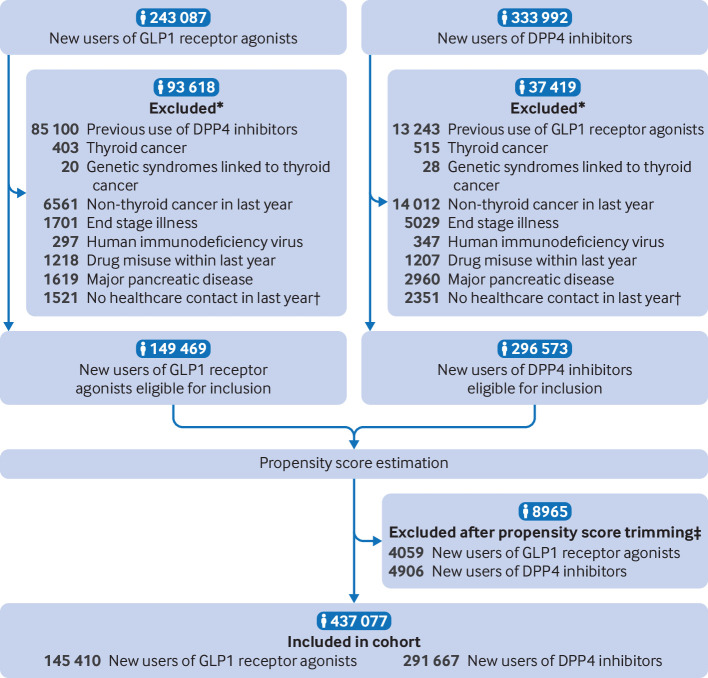
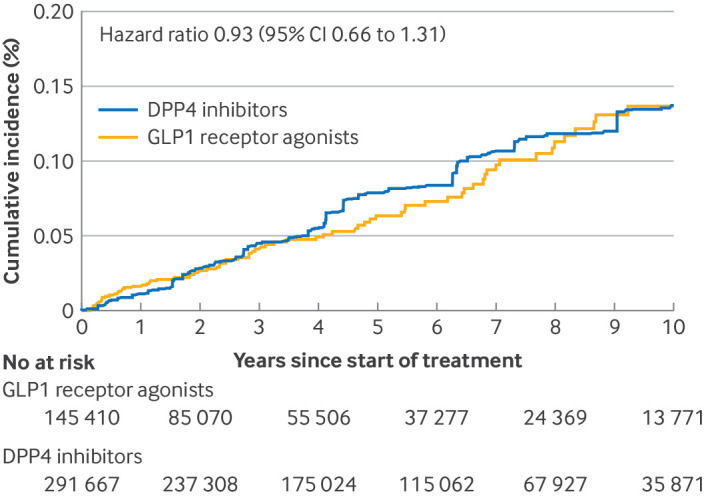
Objective: To investigate whether use of glucagon-like peptide 1 (GLP1) receptor agonists is associated with increased risk of thyroid cancer. Design: Scandinavian cohort study. Setting: Denmark, Norway, and Sweden, 2007-21. Participants: Patients who started GLP1 receptor agonist treatment were compared with patients who started dipeptidyl peptidase 4 (DPP4) inhibitor treatment, and in an additional analysis, patients who started sodium-glucose cotransporter 2 (SGLT2) inhibitor treatment. Main outcome measures: Thyroid cancer identified from nationwide cancer registers. An active-comparator new user study design was used to minimise risks of confounding and time related biases from using real world studies of drug effects. Cox regression was used to estimate hazard ratios, controlling for potential confounders with propensity score weighting. Results: The mean follow-up time was 3.9 years (standard deviation 3.5 years) in the GLP1 receptor agonist group and 5.4 years (standard deviation 3.5 years) in the DPP4 inhibitor group. 76 of 145 410 patients (incidence rate 1.33 events per 10 000 person years) treated with GLP1 receptor agonists and 184 of 291 667 patients (incidence rate 1.46 events per 10 000 person years) treated with DPP4 inhibitors developed thyroid cancer. GLP1 receptor agonist use was not associated with increased risk of thyroid cancer (hazard ratio 0.93, 95% confidence interval 0.66 to 1.31; rate difference −0.13, 95% confidence interval −0.61 to 0.36 events per 10 000 person years). The hazard ratio for medullary thyroid cancer was 1.19 (0.37 to 3.86). In the additional analysis comparing the GLP1 receptor agonist group with the SGLT2 inhibitor group, the hazard ratio for thyroid cancer was 1.16 (0.65 to 2.05). Conclusions: In this large cohort study using nationwide data from three countries, GLP1 receptor agonist use was not associated with a substantially increased risk of thyroid cancer over a mean follow-up of 3.9 years. In the main analysis comparing GLP1 receptor agonists with DPP4 inhibitors, the upper limit of the confidence interval was consistent with no more than a 31% increase in relative risk.
Overview
The claims and statistics of this paper haven’t been checked yet.
Free: it reads the open-access text and checks the first 5 claims that cite a source we can check. Create a free account to check every claim.
Integrity signals
Registry
Cites
Statistics
Figures
Verification
Claims the paper makes
The claims and statistics of this paper haven’t been checked yet.
Free: it reads the open-access text and checks the first 5 claims that cite a source we can check. Create a free account to check every claim.
Claims other papers make about this one
Each is checked against this paper’s own text: does it say what the citing paper says it does?
The source backs part of the claim, not all of it — or backs it for a different population, condition or comparison.
In the citing paper
“Similarly, while murine studies initially raised concerns about thyroid C-cell tumors,71 current human data do not suggest an increased risk.72,73”
From The expanding role of GLP-1 receptor agonists: a narrative review of current evidence and future directions (2025) · cites this paper as [72]
Experimental — accuracy not yet measuredThe cited source says what the claim attributes to it.
In the citing paper
“A recent Scandinavian real‐world study 106 found no increased risk of thyroid cancer among initiators of GLP‐1RA vs. dipeptidyl‐peptidase 4 inhibitors (DPP4i).”
From Real‐world evidence on the utilization, clinical and comparative effectiveness, and adverse effects of newer GLP ‐ 1RA ‐based weight‐loss therapies (2025) · cites this paper as [106]
The cited source says what the claim attributes to it.
In the citing paper
“a Scandinavian cohort study using nationwide cancer registries found no association between GLP-1RA use and thyroid cancer (HR 0.93, 95 % CI 0.66–1.31) (80).”
From The science of safety: adverse effects of GLP-1 receptor agonists as glucose-lowering and obesity medications (2026) · cites this paper as [80]
Self-check
Percentages, sums and reported differences re-computed from the paper’s own numbers.
The self-check needs the paper’s full text.
Citations
Cites
Marginal Structural Models and Causal Inference in Epidemiology
Robins, J. M., Hernán, M. Á., & Brumback, B. (2000) · Epidemiology · doi:10.1097/00001648-200009000-00011 · Cited by 5,581
Hernán, M. Á., Brumback, B., & Robins, J. M. (2000) · Epidemiology · doi:10.1097/00001648-200009000-00012 · Cited by 1,782 · cited 1×
“15 In these analyses, the odds ratio for drug use can be interpreted as a hazard ratio because it is estimated over discrete follow-up intervals.”
The changing incidence of thyroid cancer
Kitahara, C. M., & Sosa, J. A. (2016) · Nature Reviews Endocrinology · doi:10.1038/nrendo.2016.110 · Cited by 1,051
Pancreatitis, pancreatic, and thyroid cancer with glucagon-like peptide-1-based therapies
Elashoff, M., Matveyenko, A. V., Gier, B., Elashoff, R., & Butler, P. C. (2011) · Gastroenterology · doi:10.1053/j.gastro.2011.02.018 · Cited by 944
An Empirical Transition Matrix for Non-homogeneous Markov Chains Based on Censored Observations
Johansen, R. (1978) · Cited by 844
Lund, J. L., Richardson, D. B., & Stürmer, T. (2015) · Current Epidemiology Reports · doi:10.1007/s40471-015-0053-5 · Cited by 739 · cited 1×
“The study design was an active-comparator new user design, 11 with DPP4 inhibitors as the comparator.”
Nordic Cancer Registries – an overview of their procedures and data comparability
Pukkala, E., Engholm, G., Højsgaard Schmidt, L. K., Storm, H., Khan, S., Lambe, M., Pettersson, D., Ólafsdóttir, E., Tryggvadóttir, L., Hakanen, T., et al. (2018) · Acta Oncologica · doi:10.1080/0284186x.2017.1407039 · Cited by 347
GLP-1 Receptor Agonists and the Risk of Thyroid Cancer
Bezin, J., Gouverneur, A., Pénichon, M., Mathieu, C., Garrel, R., Hillaire-Buys, D., Pariente, A., & Faillie, J.-L. (2023) · Diabetes Care · doi:10.2337/dc22-1148 · Cited by 320
Weighing Risks and Benefits of Liraglutide — The FDA's Review of a New Antidiabetic Therapy
Parks, M., & Rosebraugh, C. (2010) · New England Journal of Medicine · doi:10.1056/nejmp1001578 · Cited by 275
Desai, R. J., Rothman, K. J., Bateman, B. T., Hernandez-Diaz, S., & Huybrechts, K. F. (2017) · Epidemiology · doi:10.1097/ede.0000000000000595 · Cited by 245
Cited by
Items 101–167 of 167
Eisa, N., & Barood, O. (2026) · AACE Endocrinology and Diabetes · doi:10.1016/j.aed.2026.03.003 · Cited by 2
Obesity management medications for the surgeon
Harris, M., Mahdi, S., Fairfield, C. J., Brown, L. R., Wadley, M., & Miras, A. D. (2026) · Frontline Gastroenterology · doi:10.1136/flgastro-2025-103307 · Cited by 1
Hung, C., Yen, F., Huang, J.-Y., & Wei, J. C. (2026) · Endocrine Practice · doi:10.1016/j.eprac.2026.05.010 · Cited by 1
Anatriello, A., Liguori, V., Pentella, C., Zinzi, A., Longo, M., Caruso, P., Maiorino, M. I., Esposito, K., & Capuano, A. (2026) · Pharmacological Reports · doi:10.1007/s43440-026-00864-4 · Cited by 1
Incretin-based therapies: a new era in metabolic liver disease management
Elangovan, S., Cheah, C. C. M., & Goh, G. B. (2026) · Hepatoma Research · doi:10.20517/2394-5079.2026.15 · Cited by 1
Hundal, J., Linz, M. O., Anikreddy, S., Sengupta, S., Zhou, K., & Maiti, B. (2026) · JCO Oncology Practice · doi:10.1200/op-26-00061 · Cited by 1
A stewardship framework for incretin-based therapies in weight management
Pace, H., Lauderdale, S., Gunning, K. M., Hvisdas, C., Meinzer, B., Messinger, N. J., Spillane, J., & Vrontos, E. (2026) · Journal of the American Pharmacists Association · doi:10.1016/j.japh.2026.103547 · Cited by 1
Agonistas del receptor del péptido similar al glucagón tipo 1 (aGLP1) y el problema de la obesidad
Arana-Ballestar, S., & Moreno, C. B. (2023) · Boletín de información farmacoterapéutica de Navarra · doi:10.54095/bitn20233104 · Cited by 1
Tsai, Y., Hemphill, N. O., & Kurth, T. (2024) · Diabetologia · doi:10.1007/s00125-024-06300-7 · Cited by 1
Eleftheriadou, A., Riley, D. R. J., Zhao, S. S., Austin, P. J., Hernández, G., Lip, G. Y. H., Jackson, T. L., Wilding, J. P. H., & Alam, U. (2024) · Diabetologia · doi:10.1007/s00125-024-06314-1 · Cited by 1
Kawkgi, O. M. E. (2025) · Clinical Thyroidology · doi:10.1089/ct.2025;37.33-36 · Cited by 1
Endocrinology: What You May Have Missed in 2024
Aman, M., Jeevananthan, A., Martinez-Cruz, M., Namasingh, N., & Batch, B. C. (2025) · Annals of Internal Medicine · doi:10.7326/annals-25-00990 · Cited by 1
A systematic review of transgender male rodent model methodology
Robertson, K., Lane, D., Donner, D. G., Peart, J. N., & Toit, E. D. (2025) · Animal Models and Experimental Medicine · doi:10.1002/ame2.70088 · Cited by 1
“42,43 The limitations of translation should not be ignored regarding GAHT, particularly when considering long-term health effects.”
GLP1 receptor agonists do not increase risk of thyroid cancer
(2024) · Reactions Weekly · doi:10.1007/s40278-024-56649-5
GLP1-Agonisten: Keine substanzielle Risikoerhöhung für Schilddrüsenkarzinome
Franke, K. (2024) · DMW - Deutsche Medizinische Wochenschrift · doi:10.1055/a-2311-2069
Glucagon-like peptide 1 receptor agonists (GLP1a) and the problem of obesity
Arana-Ballestar, S., & Bartolomé-Moreno, C. (2023) · Boletín de información farmacoterapéutica de Navarra · doi:10.54095/bitn20233104en
Glucagon-like Peptide-1 Receptor Agonists and Thyroid Cancer: Myth or Reality?
Goldenberg, R. (2025) · Canadian Diabetes & Endocrinology Today · doi:10.58931/cdet.2025.3137
Adipositas und Herz: neue Medikamente und neue Strategien für Kardiologen
Hollstein, T. (2025) · Aktuelle Kardiologie · doi:10.1055/a-2606-7020
“Gro-ße Gro-ße Endpunktstudien wie EMPA-REG OUTCOME (Empagliflozin) [20], CANVAS (Canagliflozin) [21] und DECLARE-TIMI 58 (Dapagli-flozin) [22] zeigten bei T2DM-Patienten mit hohem Risiko oder etablierter atherosklerotischer Herz-Kreislauf-Erkrankung (ASCVD) eine Reduktion von MACE und/oder eine signifikante Reduktion…”
Son, H., & Cho, S. W. (2025) · Endocrinology and Metabolism · doi:10.3803/enm.2025.2581
Glucagon-like Peptide-1 Receptor Agonists and Gastrointestinal Neoplasms
Kim, Y. J., & Bae, J. (2025) · Journal of Digestive Cancer Research · doi:10.52927/jdcr.2025.13.2.99
Farmácia da Boa Hora, Porto e nos Serviços Farmacêuticos do Hospital Lusíadas, Porto
Leite, A. S. M. (2024) · Portuguese National Funding Agency for Science, Research and Technology (RCAAP Project by FCT) · doi:10.34626/nvv1-9m13
Moiz, A. (2025) · eScholarship@McGill (McGill) · doi:10.82308/2683
Obezite Tedavisinde Güncel Yaklaşımlar
Coşkun, M., & DUMAN, A. (2025) · Özgür Yayınları eBooks · doi:10.58830/ozgur.pub1126.c4585
The Risk of Hypothyroidism With the Use of GLP ‐1 Receptor Agonists in Saudi Arabia
Alfakhri, A., Almadani, O. A., Alroba, R., Alrwisan, A. A., Alshaya, O. A., & Albogami, Y. (2026) · Pharmacoepidemiology and Drug Safety · doi:10.1002/pds.70315
Alves, M. G. (2025) · Portuguese National Funding Agency for Science, Research and Technology (RCAAP Project by FCT)
Mechanisms in diabetes mellitus: Relationships to metabolism and/or neoplasia
D’Elia, J. A., Roshan, B., & Weinrauch, L. A. (2026) · Journal of Diabetes and its Complications · doi:10.1016/j.jdiacomp.2026.109289
ONE PATHWAY, INFINITE POTENTIAL? THE FUTURE OF GLP-1 THERAPIES: A 2026 CLINICAL UPDATE
Fidelis, M., Wojcieszek, M., Gondek, K., Gacka, D., Zalewska, A., Mączyńska, A., Al-karawi, N. A., Kędziorek, P., & Tanç, Z. (2026) · International Journal of Innovative Technologies in Social Science · doi:10.31435/ijitss.1(49).2026.4980
Inkretinmimetika und Schilddrüsenkrebs: Gibt es ein Risiko?
Parzer, V. (2026) · Journal für Endokrinologie Diabetologie und Stoffwechsel · doi:10.1007/s41969-026-00297-7
Reply: Time‐Related Biases in Observational Studies of GLP ‐1 Agonists and Cancer Risk
Cheng, Z., Lin, J., Gu, D., & Liang, F. (2026) · Journal of Diabetes · doi:10.1111/1753-0407.70203
Understanding the link between diabetes and cancer
Morris, D. (2026) · Independent Nurse · doi:10.12968/indn.2026.3.14
Lin, C., Chen, W., Liu, S. X., Cao, B., Ge, Y., Li, Y., Liu, Y., Guo, T., Xu, J., & Wang, C. (2026) · BMJ Open · doi:10.1136/bmjopen-2025-115236
Hu, M., Jiang, C.-J., & Yi, C. (2026) · Experimental and Therapeutic Medicine · doi:10.3892/etm.2026.13178
Prognostic and Therapeutic Significance of DPP4 in SMARCA4-Deficient Non–Small Cell Lung Cancer
Chen, C., Zhong, Z., Luo, X., Dai, W., Xu, L., Cai, W., Xu, Z., Liang, G., & Pang, L. (2026) · Technology in Cancer Research & Treatment · doi:10.1177/15330338261452636
“26,27 A soluble form (sCD26) is detectable in plasma, serum, and urine and largely derives from shedding of the membrane-bound protein 28 .”
Fouad, Y. M., Abdelghany, W. A., & Sheemy, R. Y. E. (2026) · World Journal of Hepatology · doi:10.4254/wjh.v18.i5.118303
GLP-1 drugs like Ozempic show promise for more than weight loss. But what’s science vs hype?
Joyce, P. (2026) · The Conversation · doi:10.64628/aa.y3rgpa3qr
Zarei, M., & Hajiani, Y. (2026) · Diabetology & Metabolic Syndrome · doi:10.1186/s13098-026-02196-y
Micha, J. P., Bohart, R. D., & Goldstein, B. H. (2026) · Expert Review of Anticancer Therapy · doi:10.1080/14737140.2026.2691887
Hsieh, H., Huang, Y., Chang, Y.-W., & Liao, W. (2026) · Therapeutic Advances in Endocrinology and Metabolism · doi:10.1177/20420188261460619
Bitar, E. R., Besir, K., Cummins, K. C., Sears, O., Moheb, M. E., McKee, K., Ruff, S. M., van der Windt, D. J., & Tsung, A. (2026) · Journal of Gastrointestinal Surgery · doi:10.1016/j.gassur.2026.102497
GLP-1 receptor agonists in cardiovascular disease: a guide for cardiologists
Ayton, S. L., Papamargaritis, D., Davies, M. J., McCann, G. P., & Gulsin, G. S. (2026) · British Journal of Cardiology · doi:10.5837/bjc.2026.038
Galindo, I. L. G., Álvarez, M. F., Hernández, G. R., Gonzales, S. J. A., Hernández, F. D. L., García, M. D. C. G., Ramírez, G. A. V., Bautista, M. I. M., & Guerrero, R. P. (2026) · Ciencia Latina Revista Científica Multidisciplinar · doi:10.37811/cl_rcm.v10i4.25167
Porwolik, A., Porwolik, H., Cyran, P., Szydłowski, R., Bodera, M., & Skotarski, M. (2026) · International Journal of Innovative Technologies in Social Science · doi:10.31435/ijitss.2(50).2026.5185
Incretins beyond weight and hyperglycemia management: a consensus statement by AASD
Shaltout, I., Hegazy, M., Meligi, A. A. H. E., Abdelghaffar, S., Wifi, M.-N. A., Saleh, A. A., Hammad, H., Abouzeid, A. A. E. K., Fahmy, E. M., Maghraby, G. G., et al. (2026) · The Egyptian Journal of Internal Medicine · doi:10.1186/s43162-026-00689-w
SGLT-2 inhibitors and risk of 59 long-term health conditions, hospitalization, and mortality
Wang, J., Cooper, J. M., Hathaway, E., Singh, M., Su, L., Gokhale, K., Wambua, S., Crowe, F. L., Adderley, N. J., Thomas, G. N., et al. (2026) · European Journal of Endocrinology · doi:10.1093/ejendo/lvag156
GLP-1 Receptor Agonists and Obesity Related Cancers: What We Know So Far
Raja, N. P., & Kandagari, N. (2026) · Current Oncology Reports · doi:10.1007/s11912-026-01825-z
Barseghyan, L., Munir, I., Chrysafides, S., Simental, A., & Khan, S. (2026) · Journal of Clinical Medicine · doi:10.3390/jcm15207834
Król, M., Woźniak, A., Straszewska, A., Sobantka, P., Mokrzecki, S., Mamach, A., Aleksandrowicz, K., Grodzka, Z., Meszka, M., Bełc, E., et al. (2026) · International Journal of Innovative Technologies in Social Science · doi:10.31435/ijitss.2(50).2026.6208
Zhong, Q., Yang, A. L., & Volic, I. N. (2026) · Elsevier eBooks · doi:10.1016/b978-0-443-44037-3.00999-4
Zhong, Q., Wu, K. W., & Eri, J. (2026) · Elsevier eBooks · doi:10.1016/b978-0-443-44037-3.01001-0
Zhong, Q., Smith-Lopez, K., & Diamond, B. (2026) · Elsevier eBooks · doi:10.1016/b978-0-443-44037-3.01000-9
cabrera, S., Walbaum, M., Bórquez, T., Fuentes, C., Acevedo, M., Varleta, P., Belmar, P., Gómez, P., Sanzana, M. G., la Vega, J. D., et al. (2026) · Revista médica de Chile · doi:10.4067/s0034-98872026000701070
Selecting Cox regression approaches in pharmacoepidemiology: a practical methodological reviewPreprint
Ahmad, W. A., Habtegebriel, M., Barges, S., & Ahmad, N. A. (2026) · doi:10.22541/authorea.15010014/v1
Effects of a GLP-1 agonist and antidiabetic therapies on pheochromocytoma/paraganglioma growth
Wang, K., Stempfle, P., Hamati, J., Fischer, A., Macciò, U., Weber, A., Robledo, M., Maurer, J., Peischer, L., Reul, A., et al. (2026) · Endocrine Related Cancer · doi:10.1530/erc-26-0283
GLP‐1 receptor agonists and serious adverse events: Evidence, uncertainty and clinical implications
Ueda, P. (2026) · Journal of Internal Medicine · doi:10.1111/joim.70170
Self-citationAsiri, A., DANIELS, R., Najim, A., Razak, H. R. A., & Mokbel, K. (2026) · Diabetology · doi:10.3390/diabetology7100200
Thyroid Disease in the Era of Obesity and Glucagon-Like-Peptide-1 Agonists
Coblens, O. M., Dunmire, A. M., & Maldonado-Chapa, F. (2026) · Otolaryngologic Clinics of North America · doi:10.1016/j.otc.2026.06.002
Glucagon-like-peptide-1 receptor agonists
Zhong, Q., Kruse, C., Glanz, T., Berges, M., & Eri, J. (2026) · Elsevier eBooks · doi:10.1016/b978-0-443-44037-3.01015-0
Association of GLP-1 Receptor Agonist Use with Thyroid Outcomes in Adults with Type 2 Diabetes
Hsiao, C.-C., Tsai, M., Jhu, J., Liu, Y.-F., Yen, C., Chen, J.-J., & Chen, P. (2026) · International Journal of Medical Sciences · doi:10.7150/ijms.141099
Beyond a Molecular Link: Rethinking the Leptin–Leptin Receptor Axis in Thyroid Cancer
Hu, Y., Corcoy, R., & Mato, E. (2026) · Oncology Research Featuring Preclinical and Clinical Cancer Therapeutics · doi:10.32604/or.2026.089696
GLP‐1 Receptor Agonists and Cancer Risk in Obesity Treatment
Hofseth, L. J., Murphy, E. A., Playdon, M. C., Makowski, L., Ibele, A. R., Fairman, C. M., & Hébert, J. R. (2026) · Obesity Reviews · doi:10.1111/obr.70247
Metabolic Dysfunction‐Associated Steatotic Liver Disease
Kanwal, F., & Wong, V. W. S. (2026) · Wiley eBooks · doi:10.1002/9781394360031.ch31
GLP-1 RECEPTOR AGONISTS AND THYROID DISEASE: FROM MECHANISM TO CLINICAL PRACTICE
Milewska, A., Bociąg, A., Kowalski, K., Marciniak, R., & Ptach, Ł. (2026) · International Journal of Innovative Technologies in Social Science · doi:10.31435/ijitss.4(52).2026.6324
Jing, F., Zeng, Y., Qin-ling, Y., & Fu, C.-J. (2026) · Molecular Medicine Reports · doi:10.3892/mmr.2026.14054
Stalpaert, S., Tanghe, A., Stremersch, E., Gies, I., Jean-Paul, T., Frederix, K., & Beauloye, V. (2026) · Belgian Journal of Paediatrics
Glucagon-like Peptide-1 Receptor Agonists and Thyroid Cancer: Review of Preclinical and Human Data
Braunstein, E. W., & Braunstein, G. D. (2026) · Endocrine Reviews · doi:10.1210/endrev/bnag044
Metadata
- Authors
- Pasternak, B., Wintzell, V., Hviid, A., Eliasson, B., Gudbjörnsdottir, S., Jonasson, C., Hveem, K., Svanström, H., Melbye, M., & Ueda, P.
- Affiliations
- Statens Serum Institut (DK)
- Karolinska Institutet (SE)
- Sahlgrenska University Hospital (SE)
- The Swedish National Diabetes Register, Västra Götalandsregionen, Gothenburg, Sweden
- Norwegian University of Science and Technology (NO)
- University of Copenhagen (DK)
- Corresponding author
- Pasternak, Björn
- ORCID
- Venue
- BMJ
- Publisher
- BMJ
- Published
- 2024-04-10
- Volume
- 385
- Pages
- e078225
- ISSN
- 1756-1833 (ISSN-L)
- PMC
- PMC11004669
- OpenAlex
- W4394707684
- Cited by
- 125
- References
- 24
- Citations by year
- 2026: 47 · 2025: 58 · 2024: 20
- FWCI
- 41.17
- Type
- journal article
- Language
- en
- Open access
- hybrid
- doi.org
- Locations
- BMJ (publishedVersion, cc-by)
- PubMed (publishedVersion)
- PubMed Central (publishedVersion, cc-by)
- Research at the University of Copenhagen (University of Copenhagen) (publishedVersion, cc-by)
- HighWire Press Open Archive (submittedVersion)
- Funders
- Vetenskapsrådet
- Karolinska Institutet
- Novo Nordisk Fonden
- Cancerfonden
- Topics
- Health Sciences › Medicine › Endocrinology, Diabetes and Metabolism › Diabetes Treatment and Management
- Health Sciences › Medicine › Endocrinology, Diabetes and Metabolism › Thyroid Cancer Diagnosis and Treatment
- Life Sciences › Biochemistry, Genetics and Molecular Biology › Molecular Biology › Metabolism, Diabetes, and Cancer
- Keywords
- GLP-1 receptor agonists, thyroid cancer, medullary thyroid carcinoma, DPP-4 inhibitors, SGLT2 inhibitors, drug safety, cancer risk, type 2 diabetes treatment, propensity score weighting
- MeSH terms
- Glucagon-Like Peptide-1 Receptor, Sodium-Glucose Transporter 2 Inhibitors, Glucagon-Like Peptide-1 Receptor Agonists, Adult, Aged, Denmark, Diabetes Mellitus, Type 2, Female, Humans, Hypoglycemic Agents, Male, Middle Aged, Norway, Risk Factors, Scandinavian and Nordic Countries, Sweden, Thyroid Neoplasms, Cohort Studies, Incidence, Proportional Hazards Models, Dipeptidyl-Peptidase IV Inhibitors
About these checks
Registry, retraction, Cites and statistics results are computed, not judged, with one exception: a printed reference that no index lists is read once by a model before it counts as a citation error. Claims are extracted by a model and kept only when their quote appears verbatim in the text; each cited source is then checked, with a model’s help, for whether it says what the claim relies on. Those verdicts can be wrong — read the claim’s quote and the cited source before relying on one.
Statistics and arithmetic are recomputed, not judged.
Confidence bands are shown only for fields calibrated on our annotated test set. None is calibrated yet, so no band is shown.
What counts as a claim ›How we measure confidence ›How we check this ›
Are you an author, or do you see a problem with this page? Request a review
Data sources
Bibliographic data: Semantic Scholar, OpenAlex, Crossref.
Contains information from the Semantic Scholar Academic Graph Datasets, made available under the ODC Attribution License (ODC-BY 1.0).
Semantic Scholar’s data is described in: Kinney, R., et al. (2023). The Semantic Scholar Open Data Platform. arXiv:2301.10140.
