

The DOI matches its Crossref record; 22 of the 22 references it cites were found in a registry or an index.
Effectiveness and safety of nicotine replacement therapy assisted reduction to stop smoking: systematic review and meta-analysis
Open accessAbstract
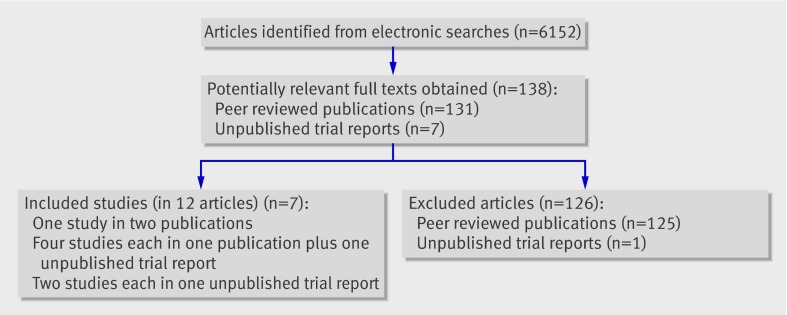
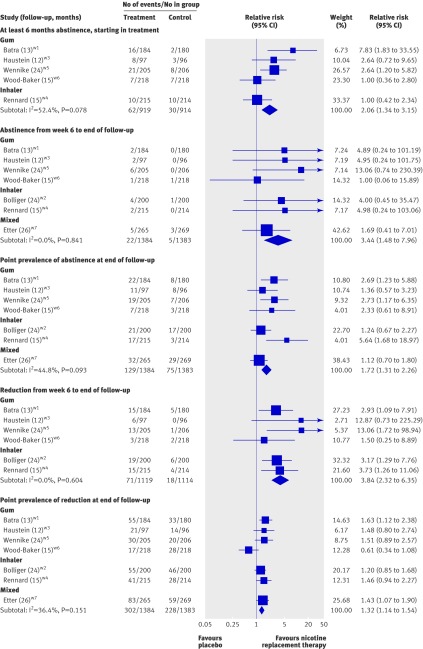
OBJECTIVE: To determine the effectiveness and safety of nicotine replacement therapy assisted reduction to stop smoking. DESIGN: Systematic review of randomised controlled trials. DATA SOURCES: Cochrane Library, Medline, Embase, CINAHL, PsychINFO, Science Citation Index, registries of ongoing trials, reference lists, the drug company that sponsored most of the trials, and clinical experts. Review methods Eligible studies were published or unpublished randomised controlled trials that enrolled smokers who declared no intention to quit smoking in the short term, and compared nicotine replacement therapy (with or without motivational support) with placebo, no treatment, other pharmacological therapy, or motivational support, and reported quit rates. Two reviewers independently applied eligibility criteria. One reviewer assessed study quality and extracted data and these processes were checked by a second reviewer. The primary outcome, six months sustained abstinence from smoking beginning during treatment, was assessed by individual patient data analysis. Other outcomes were cessation and reduction at end of follow-up, and adverse events. DATA SYNTHESIS: Seven placebo controlled randomised controlled trials were included (four used nicotine replacement therapy gum, two nicotine replacement therapy inhaler, and one free choice of therapy). They were reduction studies that reported smoking cessation as a secondary outcome. The trials enrolled a total of 2767 smokers, gave nicotine replacement therapy for 6-18 months, and lasted 12-26 months. 6.75% of smokers receiving nicotine replacement therapy attained sustained abstinence for six months, twice the rate of those receiving placebo (relative risk (fixed effects) 2.06, 95% confidence interval 1.34 to 3.15; (random effects) 1.99, 1.01 to 3.91; five trials). The number needed to treat was 29. All other cessation and reduction outcomes were significantly more likely in smokers given nicotine replacement therapy than those given placebo. There were no statistically significant differences in adverse events (death, odds ratio 1.00, 95% confidence interval 0.25 to 4.02; serious adverse events, 1.16, 0.79 to 1.50; and discontinuation because of adverse events, 1.25, 0.64 to 2.51) except nausea, which was more common with nicotine replacement therapy (8.7% v 5.3%; odds ratio 1.69, 95% confidence interval 1.21 to 2.36). CONCLUSIONS: Available trials indicate that nicotine replacement therapy is an effective intervention in achieving sustained smoking abstinence for smokers who have no intention or are unable to attempt an abrupt quit. Most of the evidence, however, comes from trials with regular behavioural support and monitoring and it is unclear whether using nicotine replacement therapy without regular contact would be as effective.
Overview
The claims and statistics of this paper haven’t been checked yet.
Run the check — free, no account needed. It reads the open-access text and checks the sources it cites.
Integrity signals
Registry
Cites
Statistics
Figures
![Fig 3 Meta-analysis of safety outcomes; pooled estimates are Peto’s odds ratio (fixed effects). Heterogeneity statistic Q for death was 4.04 (P=0.257), for serious adverse events was 11.19 (P=0.048), for discontinuation of treatment because of adverse events was 1.70 (P 0.636), and for nausea was 2.36 (P=0.797). I2 was 0 (negative value [100×[(Q–DF)/Q)] except for serious adverse events, where I2 was 55%](/paper-figures/45d26be3cd064d01bb2781a62937f12d/effectiveness-and-safety-of-nicotine-replacement-therapy-assisted-reduction-to-figure-3.jpg)
Verification
Claims the paper makes
The claims and statistics of this paper haven’t been checked yet.
Run the check — free, no account needed. It reads the open-access text and checks the sources it cites.
Claims other papers make about this one
Each is checked against this paper’s own text: does it say what the citing paper says it does?
In the citing paper
“There is good evidence from both population studies and clinical trials that the provision of NRT to smokers who cut down their cigarette consumption results in more sustained decreases in cigarette consumption and improves their chances of stopping smoking completely.64,65”
From Evaluating Long-term Outcomes of NHS Stop Smoking Services (ELONS): a prospective cohort study (2015) · cites this paper as [65]
Self-check
Percentages, sums and reported differences re-computed from the paper’s own numbers.
The self-check needs the paper’s full text.
Citations
Cites
Treating Tobacco Use and Dependence: 2008 Update
Panel, T. U. A. D. G. (2008) · PsycEXTRA Dataset · doi:10.1037/e566222009-001 · Cited by 3,864
Nicotine replacement therapy for smoking cessation
Stead, L. F., Perera, R., Bullen, C., Mant, D., Hartmann‐Boyce, J., Cahill, K., & Lancaster, T. (2012) · Cochrane Database of Systematic Reviews · doi:10.1002/14651858.cd000146.pub4 · Cited by 2,564
Systematic Reviews in Health Care : Meta-Analysis in Context
Egger, M., Smith, G. D., & Altman, D. G. (2000) · Cited by 2,312
Clinical Practice Guideline: Otitis Media with Effusion (Update)
Rosenfeld, R. M., Shin, J. J., Schwartz, S. R., Coggins, R., Gagnon, L., Hackell, J. M., Hoelting, D., Hunter, L. L., Kummer, A. W., Payne, S. C., et al. (2016) · Otolaryngology–Head and Neck Surgery · doi:10.1177/0194599815623467 · Cited by 2,006
Systematic Reviews in Health Care: Meta‐Analysis in Context
(2001) · doi:10.1002/9780470693926 · Cited by 1,693
Outcome criteria in smoking cessation trials: proposal for a common standard
West, R., Hajek, P., Stead, L., & Stapleton, J. (2005) · Addiction · doi:10.1111/j.1360-0443.2004.00995.x · Cited by 1,285
Measures of abstinence in clinical trials: issues and recommendations
Hughes, J. R., Keely, J. P., NIAURA, R. S., Ossip-Klein, D. J., RICHMOND, R. L., & Swan, G. E. (2003) · Nicotine & Tobacco Research · doi:10.1093/ntr/5.1.13 · Cited by 1,058
Nicotine replacement therapy for smoking cessation
Silagy, C., Lancaster, T., Stead, L., Mant, D., & Fowler, G. (2004) · Cochrane Database of Systematic Reviews · doi:10.1002/14651858.cd000146.pub2 · Cited by 972
“Catastrophic” pathways to smoking cessation: findings from national survey
West, R., & Sohal, T. (2006) · BMJ · doi:10.1136/bmj.38723.573866.ae · Cited by 287
Nicotine replacement therapy for long-term smoking cessation: a meta-analysis
Etter, J., & Stapleton, J. (2006) · Tobacco Control · doi:10.1136/tc.2005.015487 · Cited by 276
Research works printed but not linked: 1
- [16]Kralikova E, Kozak J, Rasmussen T, Cort N. The clinical benefits of NRT-supported smoking reduction. Nicotine Tob Res 2002; 4: 243.
Cited by
Sorted by citations
Special Issue: KDIGO Clinical Practice Guideline for the Care of Kidney Transplant Recipients
Eckardt, K., Kasiske, B. L., & Zeier, M. G. (2009) · American Journal of Transplantation · doi:10.1111/j.1600-6143.2009.02834.x · Cited by 1,574
E-Cigarettes: A Scientific Review
Grana, R., Benowitz, N., & Glantz, S. A. (2014) · Circulation · doi:10.1161/circulationaha.114.007667 · Cited by 1,194
Farsalinos, K. E., & Polosa, R. (2014) · Therapeutic Advances in Drug Safety · doi:10.1177/2042098614524430 · Cited by 596
Shahab, L., Goniewicz, M. L., Blount, B. C., Brown, J., McNeill, A., Alwis, K. U., Feng, J., Wang, L., & West, R. (2017) · Annals of Internal Medicine · doi:10.7326/m16-1107 · Cited by 538
A systematic review of health effects of electronic cigarettes
Pisinger, C. H., & Døssing, M. (2014) · Preventive Medicine · doi:10.1016/j.ypmed.2014.10.009 · Cited by 484
Metadata
- Authors
- Moore, D., Aveyard, P., Connock, M., Wang, D., Fry-Smith, A., & Barton, P.
- Affiliations
- University of Birmingham (GB)
- Corresponding author
- Moore, D.
- Venue
- BMJ
- Publisher
- BMJ
- Published
- 2009-04-02
- Volume
- 338
- Issue
- apr02 3
- Pages
- b1024-b1024
- ISSN
- 0007-1447 (ISSN-L)
- 0959-8138
- 1468-5833
- PMC
- PMC2664870
- OpenAlex
- W2010137196
- Cited by
- 372
- References
- 22
- Citations by year
- 2026: 4 · 2025: 5 · 2024: 8 · 2023: 15 · 2022: 16 · 2021: 17 · 2020: 20 · 2019: 27 · 2018: 23 · 2017: 24 · 2016: 25 · 2015: 31 · 2014: 34 · 2013: 37 · 2012: 30
- FWCI
- 3.07
- Type
- journal article
- Language
- en
- Open access
- hybrid
- doi.org
- Licence
- cc-by-nc
- Locations
- BMJ (publishedVersion, cc-by-nc)
- PubMed Central (publishedVersion, cc-by-nc)
- PubMed (publishedVersion)
- University of Birmingham Research Portal (University of Birmingham) (submittedVersion)
- Funders
- Economic and Social Research Council (ES/G007489/1)
- Topics
- Health Sciences › Medicine › Public Health, Environmental and Occupational Health › Smoking Behavior and Cessation
- Health Sciences › Medicine › Epidemiology › Substance Abuse Treatment and Outcomes
- Social Sciences › Psychology › Applied Psychology › Behavioral Health and Interventions
- Keywords
- nicotine replacement therapy, smoking cessation, smoking reduction, nicotine gum, nicotine inhaler, sustained abstinence, adverse events, nausea, motivational support, nicotine dependence, number needed to treat
- MeSH terms
- Behavior Therapy, Combined Modality Therapy, Female, Humans, Male, Nicotine, Recurrence, Randomized Controlled Trials as Topic, Smoking Cessation, Treatment Outcome, Nicotinic Agonists
About these checks
Registry, retraction, Cites and statistics results are computed, not judged, with one exception: a printed reference that no index lists is read once by a model before it counts as a citation error. Claims are extracted by a model and kept only when their quote appears verbatim in the text; each cited source is then checked, with a model’s help, for whether it says what the claim relies on. Those verdicts can be wrong — read the claim’s quote and the cited source before relying on one.
Statistics and arithmetic are recomputed, not judged.
Confidence bands are shown only for fields calibrated on our annotated test set. None is calibrated yet, so no band is shown.
What counts as a claim ›How we measure confidence ›How we check this ›
Are you an author, or do you see a problem with this page? Request a review
