

The DOI matches its Crossref record; 45 of the 46 references it cites were found in a registry or an index; none of the 38 sources its claims cite is checked for support yet.
Risk of death during and after opiate substitution treatment in primary care: prospective observational study in UK General Practice Research Database
Open accessAbstract
OBJECTIVE: To investigate the effect of opiate substitution treatment at the beginning and end of treatment and according to duration of treatment. DESIGN: Prospective cohort study. Setting UK General Practice Research Database. PARTICIPANTS: Primary care patients with a diagnosis of substance misuse prescribed methadone or buprenorphine during 1990-2005. 5577 patients with 267 003 prescriptions for opiate substitution treatment followed-up (17 732 years) until one year after the expiry of their last prescription, the date of death before this time had elapsed, or the date of transfer away from the practice. MAIN OUTCOME MEASURES: Mortality rates and rate ratios comparing periods in and out of treatment adjusted for sex, age, calendar year, and comorbidity; standardised mortality ratios comparing opiate users' mortality with general population mortality rates. RESULTS: Crude mortality rates were 0.7 per 100 person years on opiate substitution treatment and 1.3 per 100 person years off treatment; standardised mortality ratios were 5.3 (95% confidence interval 4.0 to 6.8) on treatment and 10.9 (9.0 to 13.1) off treatment. Men using opiates had approximately twice the risk of death of women (morality rate ratio 2.0, 1.4 to 2.9). In the first two weeks of opiate substitution treatment the crude mortality rate was 1.7 per 100 person years: 3.1 (1.5 to 6.6) times higher (after adjustment for sex, age group, calendar period, and comorbidity) than the rate during the rest of time on treatment. The crude mortality rate was 4.8 per 100 person years in weeks 1-2 after treatment stopped, 4.3 in weeks 3-4, and 0.95 during the rest of time off treatment: 9 (5.4 to 14.9), 8 (4.7 to 13.7), and 1.9 (1.3 to 2.8) times higher than the baseline risk of mortality during treatment. Opiate substitution treatment has a greater than 85% chance of reducing overall mortality among opiate users if the average duration approaches or exceeds 12 months. CONCLUSIONS: Clinicians and patients should be aware of the increased mortality risk at the start of opiate substitution treatment and immediately after stopping treatment. Further research is needed to investigate the effect of average duration of opiate substitution treatment on drug related mortality.
Overview
AI snapshot
Written from the paper’s full text.
TL;DR
In a UK primary care cohort of opiate users prescribed methadone or buprenorphine, mortality was lower during opiate substitution treatment than off treatment, but risk was elevated in the first weeks of treatment and immediately after stopping. The authors estimate that treatment is likely to reduce overall mortality only when average duration approaches or exceeds 12 months.
Key findings
- Crude mortality was 0.7 per 100 person years on treatment versus 1.3 per 100 person years off treatment; adjusted mortality rate ratio off versus on treatment was 2.29 (95% CI 1.67 to 3.14), and standardised mortality ratios were 5.3 (4.0 to 6.8) on treatment and 10.9 (9.0 to 13.1) off treatment.
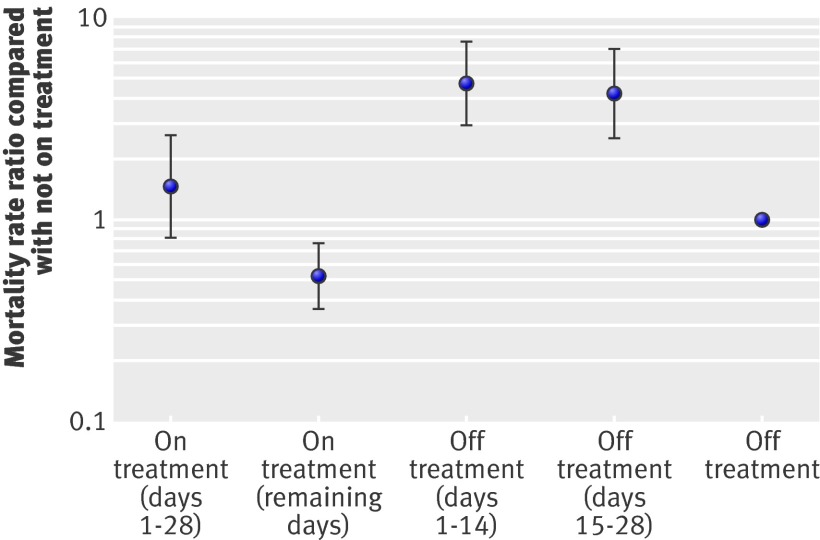
- In the first two weeks of treatment, crude mortality was 1.7 per 100 person years, with an adjusted rate ratio of 3.11 (1.47 to 6.59) compared with the remainder of time on treatment; weeks 3-4 had a crude rate of 1.32 per 100 person years and adjusted rate ratio 2.38 (0.95 to 5.99).
- After treatment stopped, crude mortality was 4.80 per 100 person years in weeks 1-2 and 4.25 in weeks 3-4, with adjusted rate ratios of 9.01 (5.43 to 14.90) and 8.01 (4.70 to 13.66) versus the stable on-treatment period; during the remainder of time off treatment, the crude rate was 0.95 per 100 person years and adjusted rate ratio 1.91 (1.32 to 2.76).
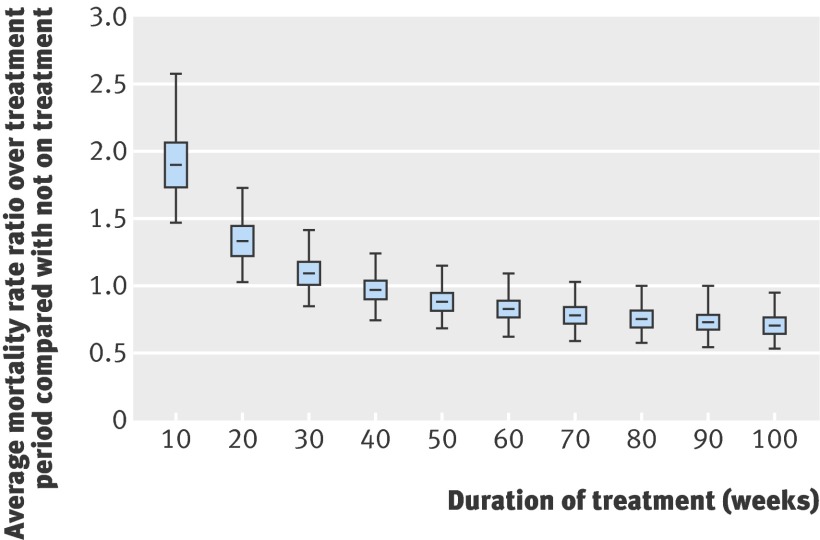
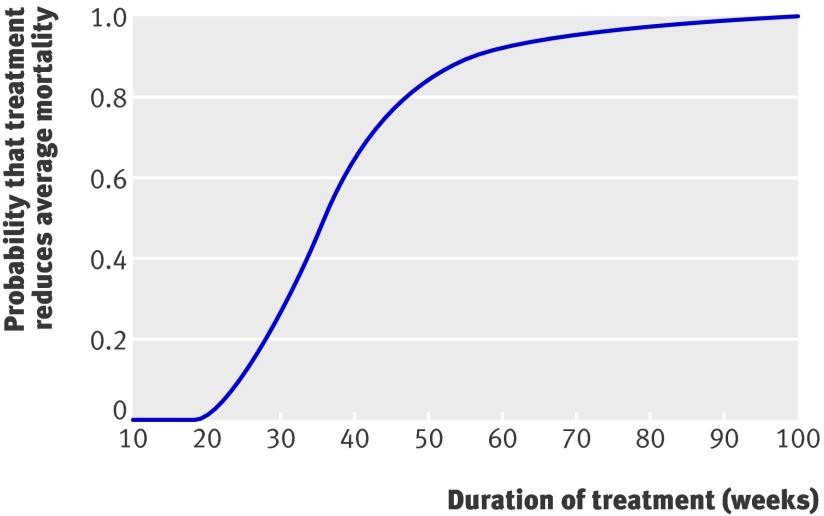
- The modelled probability that opiate substitution treatment reduces overall mortality was less than 25% at 20-30 weeks’ average duration, 65% at 40 weeks, and greater than 85% if average duration approaches or exceeds 12 months.
Methods
- Prospective cohort study using the UK General Practice Research Database, including primary care patients with a diagnosis of substance misuse prescribed methadone or buprenorphine during 1990-2005: 5,577 patients, 267,003 prescriptions, and 17,732 person years of follow-up until one year after the last prescription, death, or transfer away from the practice.
- Time on treatment was defined from prescription expiry, with gaps of less than 28 days counted as on treatment; oral dihydrocodeine prescriptions were included as opiate substitution treatment.
- Poisson regression estimated mortality rate ratios adjusted for sex, age group, calendar period, comorbidity score, treatment episode, and episodes with at least one dose at or above recommended maintenance thresholds; indirect standardised mortality ratios used 1998 sex-specific death rates for England and Wales, with sensitivity analyses restricted to final treatment episodes and excluding dihydrocodeine.
Limitations
- The paper states that classification of time on and off treatment was complicated by gaps in dose, duration, or quantity data, which may have diluted or exaggerated mortality differences; findings were similar in a sensitivity analysis restricted to the last treatment episode.
- The paper states that patients transferring out of the database had no active follow-up, that their characteristics differed from those completing follow-up, and that unrecorded confounders could bias results; follow-up was restricted to 12 months after treatment to limit misclassification.
- The paper states that covariates were limited, the comorbidity index was not ideal or opiate-specific, there was no measure of intervention quality or intensity, outcome was all-cause mortality without cause-specific data, and the duration analyses were modelled rather than directly observed; evident from the text, the observational design cannot establish causality.
Model-written summary. Check it against the paper before relying on it.
Integrity signals
Registry
Cites
Statistics
Figures
Verification
Claims the paper makes
34 Own result · 24 Not checked yet · 19 Own method · 8 Own interpretation · 1 No basis given
A result the paper reports from its own data — it cites no other source for it, so there is none to check. The quote shows it is in the paper.
In the paper
“The adjusted death rate in the first month after treatment stopped was more than four times higher (mortality rate ratio 4.20, 2.53 to 6.96) than in the subsequent period off treatment.”
§ Risk of death during and after opiate substitution treatment in primary care: prospective observational study in UK General Practice Research Database > Results > Effect of opiate substitution treatment on mortality
plaincorrelational- Asserted: passes — The authors put it forward as true.
- Checkable: passes — It can be checked against evidence.
- Load-bearing: passes — The paper’s conclusions depend on it.
- Based: passes — The paper gives a reason why it holds.
A result the paper reports from its own data — it cites no other source for it, so there is none to check. The quote shows it is in the paper.
In the paper
“The crude mortality rate was 4.8 per 100 person years in weeks 1-2 after treatment stopped, 4.3 in weeks 3-4, and 0.95 during the rest of time off treatment: 9 (5.4 to 14.9), 8 (4.7 to 13.7), and 1.9 (1.3 to 2.8) times higher than the baseline risk of mortality during treatment.”
- Also stated in: § Effect of opiate substitution treatment on mortality · plain
“Mortality was also raised substantially in the period immediately after treatment, at 4.8 per 100 person years in the first two weeks and 4.3 per 100 person years in weeks three to four”
§ Risk of death during and after opiate substitution treatment in primary care: prospective observational study in UK General Practice Research Database > Abstract
plain- Asserted: passes — The authors put it forward as true.
- Checkable: passes — It can be checked against evidence.
- Load-bearing: passes — The paper’s conclusions depend on it.
- Based: passes — The paper gives a reason why it holds.
- Also stated in: § Effect of opiate substitution treatment on mortality · plain
A result the paper reports from its own data — it cites no other source for it, so there is none to check. The quote shows it is in the paper.
In the paper
“In the first two weeks of opiate substitution treatment the crude mortality rate was 1.7 per 100 person years: 3.1 (1.5 to 6.6) times higher (after adjustment for sex, age group, calendar period, and comorbidity) than the rate during the rest of time on treatment.”
- Also stated in: § Effect of opiate substitution treatment on mortality · plain
“The mortality rate was raised in the first four weeks: 1.7 per 100 person years in the first two weeks and 1.3 per 100 person years in weeks three to four”
§ Risk of death during and after opiate substitution treatment in primary care: prospective observational study in UK General Practice Research Database > Abstract
plain- Asserted: passes — The authors put it forward as true.
- Checkable: passes — It can be checked against evidence.
- Load-bearing: passes — The paper’s conclusions depend on it.
- Based: passes — The paper gives a reason why it holds.
- Also stated in: § Effect of opiate substitution treatment on mortality · plain
A result the paper reports from its own data — it cites no other source for it, so there is none to check. The quote shows it is in the paper.
In the paper
“Men using opiates had approximately twice the risk of death of women (morality rate ratio 2.0, 1.4 to 2.9).”
- Also stated in: § Effect of opiate substitution treatment on mortality · plain
“Male | 142 | 12 461.2 | 1.14 | 1.67 (1.16 to 2.40) | 0.004 | | 1.97 (1.36 to 2.85) | <0.001 | <0.001”
§ Risk of death during and after opiate substitution treatment in primary care: prospective observational study in UK General Practice Research Database > Abstract
plaincorrelational- Asserted: passes — The authors put it forward as true.
- Checkable: passes — It can be checked against evidence.
- Load-bearing: unclear — It is unclear whether the paper’s conclusions depend on it.
- Based: passes — The paper gives a reason why it holds.
- Also stated in: § Effect of opiate substitution treatment on mortality · plain
A result the paper reports from its own data — it cites no other source for it, so there is none to check. The quote shows it is in the paper.
In the paper
“Crude mortality rates were 0.7 per 100 person years on opiate substitution treatment and 1.3 per 100 person years off treatment; standardised mortality ratios were 5.3 (95% confidence interval 4.0 to 6.8) on treatment and 10.9 (9.0 to 13.1) off treatment.”
- Also stated in: § Effect of opiate substitution treatment on mortality · plain
“The crude mortality rate off treatment was almost double that on treatment (1.3 v 0.7 per 100 person years)”
§ Risk of death during and after opiate substitution treatment in primary care: prospective observational study in UK General Practice Research Database > Abstract
plain- Asserted: passes — The authors put it forward as true.
- Checkable: passes — It can be checked against evidence.
- Load-bearing: passes — The paper’s conclusions depend on it.
- Based: passes — The paper gives a reason why it holds.
- Also stated in: § Effect of opiate substitution treatment on mortality · plain
A result the paper reports from its own data — it cites no other source for it, so there is none to check. The quote shows it is in the paper.
In the paper
“Mortality increased with age and was positively associated with comorbidity score.”
§ Risk of death during and after opiate substitution treatment in primary care: prospective observational study in UK General Practice Research Database > Results > Effect of opiate substitution treatment on mortality
plaincorrelational- Asserted: passes — The authors put it forward as true.
- Checkable: passes — It can be checked against evidence.
- Load-bearing: unclear — It is unclear whether the paper’s conclusions depend on it.
- Based: passes — The paper gives a reason why it holds.
A result the paper reports from its own data — it cites no other source for it, so there is none to check. The quote shows it is in the paper.
In the paper
“After the first four weeks of treatment, the mortality rate for the rest of time on treatment was 0.6 per 100 person years (table 2).”
§ Risk of death during and after opiate substitution treatment in primary care: prospective observational study in UK General Practice Research Database > Results > Effect of opiate substitution treatment on mortality
plain- Asserted: passes — The authors put it forward as true.
- Checkable: passes — It can be checked against evidence.
- Load-bearing: passes — The paper’s conclusions depend on it.
- Based: passes — The paper gives a reason why it holds.
A result the paper reports from its own data — it cites no other source for it, so there is none to check. The quote shows it is in the paper.
In the paper
“which after adjustment was 3.1 (1.5 to 6.6) and 2.4 (0.95 to 6.0) times higher than the mortality in the rest of time on treatment.”
- Also stated in: § Effect of opiate substitution treatment on mortality · plain
“Weeks 3-4 of treatment | 5 | 378.7 | 1.32 | 2.18 (0.87 to 5.47) | <0.001 | | 2.38 (0.95 to 5.99) | <0.001 | <0.001”
§ Risk of death during and after opiate substitution treatment in primary care: prospective observational study in UK General Practice Research Database > Results > Effect of opiate substitution treatment on mortality
plaincorrelational- Asserted: passes — The authors put it forward as true.
- Checkable: passes — It can be checked against evidence.
- Load-bearing: passes — The paper’s conclusions depend on it.
- Based: passes — The paper gives a reason why it holds.
- Also stated in: § Effect of opiate substitution treatment on mortality · plain
A result the paper reports from its own data — it cites no other source for it, so there is none to check. The quote shows it is in the paper.
In the paper
“Crude mortality rates were 0.7 per 100 person years on opiate substitution treatment and 1.3 per 100 person years off treatment; standardised mortality ratios were 5.3 (95% confidence interval 4.0 to 6.8) on treatment and 10.9 (9.0 to 13.1) off treatment.”
- Also stated in: § Effect of opiate substitution treatment on mortality · plain
“The standardised mortality ratio comparing death rates among study patients with the population of England and Wales was 5.3 (4.0 to 6.8) while on treatment and 10.9 (9.0 to 13.1) off treatment.”
§ Risk of death during and after opiate substitution treatment in primary care: prospective observational study in UK General Practice Research Database > Abstract
plaincorrelational- Asserted: passes — The authors put it forward as true.
- Checkable: passes — It can be checked against evidence.
- Load-bearing: passes — The paper’s conclusions depend on it.
- Based: passes — The paper gives a reason why it holds.
- Also stated in: § Effect of opiate substitution treatment on mortality · plain
A result the paper reports from its own data — it cites no other source for it, so there is none to check. The quote shows it is in the paper.
In the paper
“Specifically, we found no evidence that the risk of death in the first 28 days on or first 28 days off treatment differed between methadone and buprenorphine.”
§ Risk of death during and after opiate substitution treatment in primary care: prospective observational study in UK General Practice Research Database > Results > Sensitivity and secondary analyses
plain- Asserted: passes — The authors put it forward as true.
- Checkable: passes — It can be checked against evidence.
- Load-bearing: passes — The paper’s conclusions depend on it.
- Based: passes — The paper gives a reason why it holds.
- It may state two separate claims as one. 19
- Probably not a substantial claim. 23
A result the paper reports from its own data — it cites no other source for it, so there is none to check. The quote shows it is in the paper.
In the paper
“For example, the adjusted mortality rate ratio was 2.8 (1.1 to 7.0) and 2.5 (0.3 to 18.5) for the first 28 days on methadone or buprenorphine and 9.5 (5.1 to 17.5) and 15.7 (6.7 to 36.9) for the first 28 days off methadone or buprenorphine, compared with the risk of death on methadone after the first 28 days of treatment.”
§ Risk of death during and after opiate substitution treatment in primary care: prospective observational study in UK General Practice Research Database > Results > Sensitivity and secondary analyses
plaincorrelational- Asserted: passes — The authors put it forward as true.
- Checkable: passes — It can be checked against evidence.
- Load-bearing: passes — The paper’s conclusions depend on it.
- Based: passes — The paper gives a reason why it holds.
It may state two separate claims as one.
A result the paper reports from its own data — it cites no other source for it, so there is none to check. The quote shows it is in the paper.
In the paper
“For example, the adjusted mortality rate ratio was 2.8 (1.1 to 7.0) and 2.5 (0.3 to 18.5) for the first 28 days on methadone or buprenorphine and 9.5 (5.1 to 17.5) and 15.7 (6.7 to 36.9) for the first 28 days off methadone or buprenorphine, compared with the risk of death on methadone after the first 28 days of treatment.”
§ Risk of death during and after opiate substitution treatment in primary care: prospective observational study in UK General Practice Research Database > Results > Sensitivity and secondary analyses
plaincorrelational- Asserted: passes — The authors put it forward as true.
- Checkable: passes — It can be checked against evidence.
- Load-bearing: passes — The paper’s conclusions depend on it.
- Based: passes — The paper gives a reason why it holds.
It may state two separate claims as one.
A result the paper reports from its own data — it cites no other source for it, so there is none to check. The quote shows it is in the paper.
In the paper
“The mortality rate ratios in first 28 days off treatment were 8.75 (2.34 to 32.75) with evidence of tapered prescribing and 8.27 (4.78 to 14.30) without such evidence (interaction test: χ2=0.32, df=2, P=0.9).”
§ Risk of death during and after opiate substitution treatment in primary care: prospective observational study in UK General Practice Research Database > Results > Sensitivity and secondary analyses
plain- Asserted: passes — The authors put it forward as true.
- Checkable: passes — It can be checked against evidence.
- Load-bearing: unclear — It is unclear whether the paper’s conclusions depend on it.
- Based: passes — The paper gives a reason why it holds.
It may state two separate claims as one.
In the paper
“Treatment guidelines and recent studies have suggested that the start of treatment (the first 28 days) may be associated with an increased risk of death.”
§ Risk of death during and after opiate substitution treatment in primary care: prospective observational study in UK General Practice Research Database > Introduction
What the sources say
- Not checked yetcites 23 24 25 26
hedgedcorrelational- Asserted: passes — The authors put it forward as true.
- Checkable: passes — It can be checked against evidence.
- Load-bearing: passes — The paper’s conclusions depend on it.
- Based: passes — The paper gives a reason why it holds.
Probably not a substantial claim.
What the paper did — it cites no source for this, so there is none to check. The quote shows it is in the paper.
In the paper
“We also restricted the analysis to patients with no prescriptions for oral dihydrocodeine to test whether the findings were the same for patients receiving only methadone or buprenorphine.”
§ Risk of death during and after opiate substitution treatment in primary care: prospective observational study in UK General Practice Research Database > Methods > Sensitivity and secondary analyses
plain- Asserted: passes — The authors put it forward as true.
- Checkable: passes — It can be checked against evidence.
- Load-bearing: fails — The paper’s conclusions may not depend on it.
- Based: passes — The paper gives a reason why it holds.
Probably not a substantial claim. The paper’s conclusions may not depend on it.
What the paper did — it cites no source for this, so there is none to check. The quote shows it is in the paper.
In the paper
“In addition, we fitted an interaction to test whether a difference existed in the risk of death in the first 28 days “off treatment” for patients with evidence of tapered prescribing before treatment ceased.”
§ Risk of death during and after opiate substitution treatment in primary care: prospective observational study in UK General Practice Research Database > Methods > Sensitivity and secondary analyses
plain- Asserted: passes — The authors put it forward as true.
- Checkable: passes — It can be checked against evidence.
- Load-bearing: fails — The paper’s conclusions may not depend on it.
- Based: passes — The paper gives a reason why it holds.
Probably not a substantial claim. The paper’s conclusions may not depend on it.
What the paper did — it cites no source for this, so there is none to check. The quote shows it is in the paper.
In the paper
“We used Poisson regression to estimate mortality rate ratios comparing periods in and out of treatment, adjusted for potential confounders (sex, age group, calendar period, comorbidity score, treatment episode, and episodes with one opiate substitution treatment at or above recommended levels for maintenance).”
§ Risk of death during and after opiate substitution treatment in primary care: prospective observational study in UK General Practice Research Database > Methods > Statistical analysis
plain- Asserted: passes — The authors put it forward as true.
- Checkable: passes — It can be checked against evidence.
- Load-bearing: passes — The paper’s conclusions depend on it.
- Based: passes — The paper gives a reason why it holds.
Probably not a substantial claim.
None of the sources cited for this claim have been checked yet.
In the paper
“For this reason, we restricted follow-up to 12 months after treatment, as any misclassification of patients (and person years) at risk is likely to be small because the rate of cessation/long term abstinence is low33 34”
§ Risk of death during and after opiate substitution treatment in primary care: prospective observational study in UK General Practice Research Database > Discussion > Strengths and weaknesses
What the sources say
- Not checked yetcites [33] Sweeting MJ, De AD, Ades AE, Hickman M. Estimating the prevalence of ex-injecting drug use in the population. Stat Methods Med Res 2009; 18: 381-95. 19036912 10.1177/0962280208094704
- Not checked yetcites [34] Kimber J, Copeland L, Hickman M, Macleod J, McKenzie J, De Angelis D, et al. Survival and cessation in injecting opiate users, a prospective observational study of outcomes and the effect of opiate substitute treatment. BMJ 2010; 340: c3172. 10.1136/bmj.c3172 PMC2895695 20595255
hedged- Asserted: passes — The authors put it forward as true.
- Checkable: passes — It can be checked against evidence.
- Load-bearing: passes — The paper’s conclusions depend on it.
- Based: passes — The paper gives a reason why it holds.
It may state two separate claims as one.
- Rests on an assumption: Some patients who left treatment will have stopped their opiate use and therefore have been at substantially less risk of death than patients who relapsed.
None of the sources cited for this claim have been checked yet.
In the paper
“The overall risk of death, standardised mortality ratios, and overall difference in mortality between time on and off treatment for opiate users in UK primary care in this study are consistent with international literature.4 36”
§ Risk of death during and after opiate substitution treatment in primary care: prospective observational study in UK General Practice Research Database > Discussion > Findings in relation to other studies
What the sources say
- Not checked yetcites [4] Degenhardt L, Bucello C, Mathers B, Briegleb C, Ali H, Hickman M, et al. Mortality among regular or dependent users of heroin and other opioids: a systematic review and meta-analysis of cohort studies. Addiction [forthcoming]. 10.1111/j.1360-0443.2010.03140.x 21054613
- Not checked yetcites [36] Hulse GK, English DR, Milne E, Holman CD. The quantification of mortality resulting from the regular use of illicit opiates. Addiction 1999; 94: 221-9. 10396790 10.1046/j.1360-0443.1999.9422216.x
plain- Asserted: passes — The authors put it forward as true.
- Checkable: passes — It can be checked against evidence.
- Load-bearing: unclear — It is unclear whether the paper’s conclusions depend on it.
- Based: passes — The paper gives a reason why it holds.
It may state two separate claims as one.
What the paper did — it cites no source for this, so there is none to check. The quote shows it is in the paper.
In the paper
“Between 1990 and 2005, 1647 (30%) patients transferred out of their practices: 743 during opiate substitution treatment and 904 in the 12 months after treatment (8% and 10% of the person years of follow-up).”
§ Risk of death during and after opiate substitution treatment in primary care: prospective observational study in UK General Practice Research Database > Results > Sample
plain- Asserted: passes — The authors put it forward as true.
- Checkable: passes — It can be checked against evidence.
- Load-bearing: unclear — It is unclear whether the paper’s conclusions depend on it.
- Based: passes — The paper gives a reason why it holds.
It may state two separate claims as one.
In the paper
“Long term follow-up of injecting drug users from a single primary care centre suggests that survival is substantially improved with each year of exposure to opiate substitution treatment,34 as we estimate in figure 2.”
§ Risk of death during and after opiate substitution treatment in primary care: prospective observational study in UK General Practice Research Database > Discussion > Findings in relation to other studies
What the sources say
- Not checked yetcites [34] Kimber J, Copeland L, Hickman M, Macleod J, McKenzie J, De Angelis D, et al. Survival and cessation in injecting opiate users, a prospective observational study of outcomes and the effect of opiate substitute treatment. BMJ 2010; 340: c3172. 10.1136/bmj.c3172 PMC2895695 20595255
hedgeddirect- Asserted: passes — The authors put it forward as true.
- Checkable: passes — It can be checked against evidence.
- Load-bearing: fails — The paper’s conclusions may not depend on it.
- Based: passes — The paper gives a reason why it holds.
Probably not a substantial claim. The paper’s conclusions may not depend on it.
What the paper did — it cites no source for this, so there is none to check. The quote shows it is in the paper.
In the paper
“Excluding patients who had ever had a prescription for dihydrocodeine (n=1480 patients) did not alter the overall findings”
§ Risk of death during and after opiate substitution treatment in primary care: prospective observational study in UK General Practice Research Database > Results > Sensitivity and secondary analyses
plainn = 1,480- Asserted: passes — The authors put it forward as true.
- Checkable: passes — It can be checked against evidence.
- Load-bearing: fails — The paper’s conclusions may not depend on it.
- Based: passes — The paper gives a reason why it holds.
Probably not a substantial claim. The paper’s conclusions may not depend on it.
What the paper did — it cites no source for this, so there is none to check. The quote shows it is in the paper.
In the paper
“Fourthly, the outcome of our study was all cause mortality, as we had no information on specific causes of death.”
§ Risk of death during and after opiate substitution treatment in primary care: prospective observational study in UK General Practice Research Database > Discussion > Strengths and weaknesses
plain- Asserted: passes — The authors put it forward as true.
- Checkable: passes — It can be checked against evidence.
- Load-bearing: passes — The paper’s conclusions depend on it.
- Based: passes — The paper gives a reason why it holds.
Probably not a substantial claim. It may state two separate claims as one.
A conclusion the paper draws from its own results — it cites no other source for it, so there is none to check. The quote shows it is in the paper.
In the paper
“We hypothesise that the net benefit of opiate substitution treatment on overall mortality may relate to the average duration of treatment.”
- Also stated in: § Implications for policy and practice · hedged
“The effect of opiate substitution treatment on overall drug related mortality may relate to the average duration of treatment in the population”
§ Risk of death during and after opiate substitution treatment in primary care: prospective observational study in UK General Practice Research Database > Discussion
hedgedconditional- Asserted: fails — The authors may not put it forward as true.
- Checkable: passes — It can be checked against evidence.
- Load-bearing: passes — The paper’s conclusions depend on it.
- Based: passes — The paper gives a reason why it holds.
Probably not a substantial claim. The authors may not put it forward as true.
- Also stated in: § Implications for policy and practice · hedged
What the paper did — it cites no source for this, so there is none to check. The quote shows it is in the paper.
In the paper
“Finally, our comparisons of the risk of death in exposed and unexposed populations by duration of opiate substitution treatment are calculated effects and not directly observed effects.”
§ Risk of death during and after opiate substitution treatment in primary care: prospective observational study in UK General Practice Research Database > Discussion > Strengths and weaknesses
plain- Asserted: passes — The authors put it forward as true.
- Checkable: passes — It can be checked against evidence.
- Load-bearing: passes — The paper’s conclusions depend on it.
- Based: passes — The paper gives a reason why it holds.
Probably not a substantial claim.
A conclusion the paper draws from its own results — it cites no other source for it, so there is none to check. The quote shows it is in the paper.
In the paper
“Nevertheless, no trial is likely to have sufficient power to measure the effect of duration of opiate substitution treatment on overall risk of death, so future analyses must inevitably be derived from observational cohorts.”
§ Risk of death during and after opiate substitution treatment in primary care: prospective observational study in UK General Practice Research Database > Discussion > Strengths and weaknesses
hedged- Asserted: passes — The authors put it forward as true.
- Checkable: fails — It may be too vague to check against evidence.
- Load-bearing: passes — The paper’s conclusions depend on it.
- Based: passes — The paper gives a reason why it holds.
Probably not a substantial claim. It may be too vague to check against evidence.
What the paper did — it cites no source for this, so there is none to check. The quote shows it is in the paper.
In the paper
“Firstly, classification of time on and off treatment was complicated by occasional gaps in the information on doses, duration, or quantity prescribed, which may have led to an underestimate or overestimate of the mortality on or off treatment and therefore have diluted or exaggerated the difference between them.”
§ Risk of death during and after opiate substitution treatment in primary care: prospective observational study in UK General Practice Research Database > Discussion > Strengths and weaknesses
hedgedconditional- Asserted: passes — The authors put it forward as true.
- Checkable: passes — It can be checked against evidence.
- Load-bearing: unclear — It is unclear whether the paper’s conclusions depend on it.
- Based: passes — The paper gives a reason why it holds.
It may state two separate claims as one.
What the paper did — it cites no source for this, so there is none to check. The quote shows it is in the paper.
In the paper
“However, other factors or unrecorded confounders may be associated with both mortality and transferring from the study practice (loss to follow-up) that could be a source of bias.”
§ Risk of death during and after opiate substitution treatment in primary care: prospective observational study in UK General Practice Research Database > Discussion > Strengths and weaknesses
hedgedcorrelational- Asserted: passes — The authors put it forward as true.
- Checkable: passes — It can be checked against evidence.
- Load-bearing: passes — The paper’s conclusions depend on it.
- Based: passes — The paper gives a reason why it holds.
Probably not a substantial claim.
A conclusion the paper draws from its own results — it cites no other source for it, so there is none to check. The quote shows it is in the paper.
In the paper
“at longer treatment durations approaching or exceeding a year, opiate substitution treatment is highly likely (more than 85% chance) to reduce the overall mortality in opiate users and lead to a decline in the number of drug related deaths.”
§ Risk of death during and after opiate substitution treatment in primary care: prospective observational study in UK General Practice Research Database > Results > Sensitivity and secondary analyses
hedgeddirect- Asserted: passes — The authors put it forward as true.
- Checkable: passes — It can be checked against evidence.
- Load-bearing: passes — The paper’s conclusions depend on it.
- Based: passes — The paper gives a reason why it holds.
It may state two separate claims as one.
What the paper did — it cites no source for this, so there is none to check. The quote shows it is in the paper.
In the paper
“Secondly, patients who transferred out of the database (which in our study was about 10% per year) had no active follow-up, and patients’ opiate use after leaving opiate substitution treatment was not followed up.”
§ Risk of death during and after opiate substitution treatment in primary care: prospective observational study in UK General Practice Research Database > Discussion > Strengths and weaknesses
plain- Asserted: passes — The authors put it forward as true.
- Checkable: passes — It can be checked against evidence.
- Load-bearing: passes — The paper’s conclusions depend on it.
- Based: passes — The paper gives a reason why it holds.
It may state two separate claims as one.
What the paper did — it cites no source for this, so there is none to check. The quote shows it is in the paper.
In the paper
“Therefore, we did a sensitivity analysis by restricting the analysis to each patient’s final treatment episode.”
§ Risk of death during and after opiate substitution treatment in primary care: prospective observational study in UK General Practice Research Database > Methods > Sensitivity and secondary analyses
plain- Asserted: passes — The authors put it forward as true.
- Checkable: passes — It can be checked against evidence.
- Load-bearing: fails — The paper’s conclusions may not depend on it.
- Based: passes — The paper gives a reason why it holds.
Probably not a substantial claim. The paper’s conclusions may not depend on it.
What the paper did — it cites no source for this, so there is none to check. The quote shows it is in the paper.
In the paper
“We may have misclassified time on and off treatment (in our attempt to allow for missing information on prescriptions) and introduced bias—for example, if occasions existed when patients were genuinely off treatment during a gap of less than 28 days between prescriptions.”
§ Risk of death during and after opiate substitution treatment in primary care: prospective observational study in UK General Practice Research Database > Methods > Sensitivity and secondary analyses
hedgedconditional- Asserted: passes — The authors put it forward as true.
- Checkable: passes — It can be checked against evidence.
- Load-bearing: passes — The paper’s conclusions depend on it.
- Based: passes — The paper gives a reason why it holds.
Probably not a substantial claim. It may state two separate claims as one.
None of the sources cited for this claim have been checked yet.
In the paper
“Although previous studies in the UK have shown that most deaths among active opiate users will be due to overdose”
§ Risk of death during and after opiate substitution treatment in primary care: prospective observational study in UK General Practice Research Database > Discussion > Strengths and weaknesses
What the sources say
- Not checked yetcites [2] Bargagli AM, Hickman M, Davoli M, Perucci CA, Schifano P, Buster M, et al. Drug-related mortality and its impact on adult mortality in eight European countries. Eur J Public Health 2006; 16: 198-202. 16157612 10.1093/eurpub/cki168
- Not checked yetcites [27] Davoli M, Bargagli AM, Perucci CA, Schifano P, Belleudi V, Hickman M, et al. Risk of fatal overdose during and after specialist drug treatment: the VEdeTTE study, a national multi-site prospective cohort study. Addiction 2007; 102: 1954-9. 18031430 10.1111/j.1360-0443.2007.02025.x
plaincorrelational- Asserted: passes — The authors put it forward as true.
- Checkable: passes — It can be checked against evidence.
- Load-bearing: fails — The paper’s conclusions may not depend on it.
- Based: passes — The paper gives a reason why it holds.
Probably not a substantial claim. The paper’s conclusions may not depend on it.
What the paper did — it cites no source for this, so there is none to check. The quote shows it is in the paper.
In the paper
“We fitted an interaction to test for differences in the risk of death at different treatment periods between methadone and buprenorphine.”
§ Risk of death during and after opiate substitution treatment in primary care: prospective observational study in UK General Practice Research Database > Methods > Sensitivity and secondary analyses
plain- Asserted: passes — The authors put it forward as true.
- Checkable: passes — It can be checked against evidence.
- Load-bearing: fails — The paper’s conclusions may not depend on it.
- Based: passes — The paper gives a reason why it holds.
Probably not a substantial claim. The paper’s conclusions may not depend on it.
What the paper did — it cites no source for this, so there is none to check. The quote shows it is in the paper.
In the paper
“Patients who transferred out during the study were more likely to be women (34% v 29%), to be younger (65% v 55% aged under 30), and to have less comorbidity (58% v 63% with lowest comorbid score).”
§ Risk of death during and after opiate substitution treatment in primary care: prospective observational study in UK General Practice Research Database > Results > Sample
plaincorrelational- Asserted: passes — The authors put it forward as true.
- Checkable: passes — It can be checked against evidence.
- Load-bearing: fails — The paper’s conclusions may not depend on it.
- Based: passes — The paper gives a reason why it holds.
Probably not a substantial claim. The paper’s conclusions may not depend on it. It may state two separate claims as one.
In the paper
“the study in Australia showed that these deaths were primarily due to overdose and other injury.24”
§ Risk of death during and after opiate substitution treatment in primary care: prospective observational study in UK General Practice Research Database > Discussion > Findings in relation to other studies
What the sources say
- Not checked yetcites [24] Degenhardt L, Randall D, Hall W, Law M, Butler T, Burns L. Mortality among clients of a state-wide opioid pharmacotherapy program over 20 years: risk factors and lives saved. Drug Alcohol Depend 2009; 105: 9-15. 19608355 10.1016/j.drugalcdep.2009.05.021
plain- Asserted: passes — The authors put it forward as true.
- Checkable: passes — It can be checked against evidence.
- Load-bearing: fails — The paper’s conclusions may not depend on it.
- Based: passes — The paper gives a reason why it holds.
Probably not a substantial claim. The paper’s conclusions may not depend on it.
None of the sources cited for this claim have been checked yet.
In the paper
“In contrast, we found a substantially larger difference in mortality in the first month after treatment stopped than did either the study in Australia (mortality rate ratio approximately 3) or the one in Holland (mortality rate ratio approximately 1).”
§ Risk of death during and after opiate substitution treatment in primary care: prospective observational study in UK General Practice Research Database > Discussion > Findings in relation to other studies
What the sources say
- Not checked yetcites [23] Buster MC, van Brussel GH, van den Brink W. An increase in overdose mortality during the first 2 weeks after entering or re-entering methadone treatment in Amsterdam. Addiction 2002; 97: 993-1001. 12144602 10.1046/j.1360-0443.2002.00179.x
- Not checked yetcites [24] Degenhardt L, Randall D, Hall W, Law M, Butler T, Burns L. Mortality among clients of a state-wide opioid pharmacotherapy program over 20 years: risk factors and lives saved. Drug Alcohol Depend 2009; 105: 9-15. 19608355 10.1016/j.drugalcdep.2009.05.021
plaincorrelational- Asserted: passes — The authors put it forward as true.
- Checkable: passes — It can be checked against evidence.
- Load-bearing: passes — The paper’s conclusions depend on it.
- Based: passes — The paper gives a reason why it holds.
It may state two separate claims as one.
In the paper
“Furthermore, findings in two large cohorts in Italy and Australia have suggested that an excess risk of death exists in the period immediately after treatment ends.”
§ Risk of death during and after opiate substitution treatment in primary care: prospective observational study in UK General Practice Research Database > Introduction
What the sources say
- Not checked yetcites 24 27
hedgedcorrelational- Asserted: passes — The authors put it forward as true.
- Checkable: passes — It can be checked against evidence.
- Load-bearing: passes — The paper’s conclusions depend on it.
- Based: passes — The paper gives a reason why it holds.
Probably not a substantial claim.
None of the sources cited for this claim have been checked yet.
In the paper
“More importantly, we had no factors that could measure the quality or intensity of the intervention, which may have a bearing on both the risk of death at starting opiate substitution treatment and the likelihood of relapse and death in the period immediately after treatment.26 35”
§ Risk of death during and after opiate substitution treatment in primary care: prospective observational study in UK General Practice Research Database > Discussion > Strengths and weaknesses
What the sources say
- Not checked yetcites [26] Department of Health and the devolved administrations. Drug misuse and dependence: UK guidelines on clinical management. Department of Health, 2007.
- Not checked yetcites [35] Zador D. Methadone maintenance: making it better. Addiction 2007; 102: 350-1. 17298640 10.1111/j.1360-0443.2007.01783.x
hedgedconditional- Asserted: passes — The authors put it forward as true.
- Checkable: passes — It can be checked against evidence.
- Load-bearing: passes — The paper’s conclusions depend on it.
- Based: passes — The paper gives a reason why it holds.
It may state two separate claims as one.
None of the sources cited for this claim have been checked yet.
In the paper
“the data are consistent with other studies.19 24 27”
§ Risk of death during and after opiate substitution treatment in primary care: prospective observational study in UK General Practice Research Database > Discussion > Strengths and weaknesses
What the sources say
- Not checked yetcites [19] Fugelstad A, Stenbacka M, Leifman A, Nylander M, Thiblin I. Methadone maintenance treatment: the balance between life-saving treatment and fatal poisonings. Addiction 2007; 102: 406-12. 17298648 10.1111/j.1360-0443.2006.01714.x
- Not checked yetcites [24] Degenhardt L, Randall D, Hall W, Law M, Butler T, Burns L. Mortality among clients of a state-wide opioid pharmacotherapy program over 20 years: risk factors and lives saved. Drug Alcohol Depend 2009; 105: 9-15. 19608355 10.1016/j.drugalcdep.2009.05.021
- Not checked yetcites [27] Davoli M, Bargagli AM, Perucci CA, Schifano P, Belleudi V, Hickman M, et al. Risk of fatal overdose during and after specialist drug treatment: the VEdeTTE study, a national multi-site prospective cohort study. Addiction 2007; 102: 1954-9. 18031430 10.1111/j.1360-0443.2007.02025.x
plain- Asserted: passes — The authors put it forward as true.
- Checkable: passes — It can be checked against evidence.
- Load-bearing: fails — The paper’s conclusions may not depend on it.
- Based: passes — The paper gives a reason why it holds.
Probably not a substantial claim. The paper’s conclusions may not depend on it.
A conclusion the paper draws from its own results — it cites no other source for it, so there is none to check. The quote shows it is in the paper.
In the paper
“Large scale observational studies are needed because although the risk of death in the first four weeks of starting or stopping treatment is comparatively high, it is transient and unlikely to be detected in any general practice or even specialist drug clinic or by any randomised controlled trial.”
§ Risk of death during and after opiate substitution treatment in primary care: prospective observational study in UK General Practice Research Database > Discussion > Strengths and weaknesses
hedged- Asserted: passes — The authors put it forward as true.
- Checkable: unclear — It is unclear whether it could be checked against evidence.
- Load-bearing: passes — The paper’s conclusions depend on it.
- Based: passes — The paper gives a reason why it holds.
It may state two separate claims as one.
In the paper
“For example, we adjusted for an index of comorbidity, but it was not an ideal measure and it was not specific to opiate users.29”
§ Risk of death during and after opiate substitution treatment in primary care: prospective observational study in UK General Practice Research Database > Discussion > Strengths and weaknesses
What the sources say
- Not checked yetcites [29] Perkins AJ, Kroenke K, Unutzer J, Katon W, Williams JW, Hope C, et al. Common comorbidity scales were similar in their ability to predict health care costs and mortality. J Clin Epidemiol 2004; 57: 1040-8. 15528055 10.1016/j.jclinepi.2004.03.002
plain- Asserted: passes — The authors put it forward as true.
- Checkable: passes — It can be checked against evidence.
- Load-bearing: unclear — It is unclear whether the paper’s conclusions depend on it.
- Based: passes — The paper gives a reason why it holds.
It may state two separate claims as one.
None of the sources cited for this claim have been checked yet.
In the paper
“The difference in mortality between opiate users in and out of treatment is stark and well known, but fewer studies have investigated the risk of death at the start of or immediately after treatment.13 19 25 35”
§ Risk of death during and after opiate substitution treatment in primary care: prospective observational study in UK General Practice Research Database > Discussion > Findings in relation to other studies
What the sources say
- Not checked yetcites [13] Mattick RP, Breen C, Kimber J, Davoli M. Methadone maintenance therapy versus no opioid replacement therapy for opioid dependence. Cochrane Database Syst Rev 2009; 3: CD002209. 19588333 10.1002/14651858.CD002209.pub2 PMC7097731
- Not checked yetcites [19] Fugelstad A, Stenbacka M, Leifman A, Nylander M, Thiblin I. Methadone maintenance treatment: the balance between life-saving treatment and fatal poisonings. Addiction 2007; 102: 406-12. 17298648 10.1111/j.1360-0443.2006.01714.x
- Not checked yetcites [25] Caplehorn JR, Drummer OH. Mortality associated with New South Wales methadone programs in 1994: lives lost and saved. Med J Aust 1999; 170: 104-9. 10065120 10.5694/j.1326-5377.1999.tb127675.x
boostedcorrelational- Asserted: passes — The authors put it forward as true.
- Checkable: passes — It can be checked against evidence.
- Load-bearing: fails — The paper’s conclusions may not depend on it.
- Based: passes — The paper gives a reason why it holds.
Probably not a substantial claim. The paper’s conclusions may not depend on it. It may state two separate claims as one.
In the paper
“In addition, McCowan and colleagues showed that overall survival was unrelated to recommended levels of methadone prescription.39”
§ Risk of death during and after opiate substitution treatment in primary care: prospective observational study in UK General Practice Research Database > Discussion > Findings in relation to other studies
What the sources say
- Not checked yetcites [39] McCowan C, Kidd B, Fahey T. Factors associated with mortality in Scottish patients receiving methadone in primary care: retrospective cohort study. BMJ 2009; 338: b2225. 19535400 10.1136/bmj.b2225 PMC3273784
plain- Asserted: passes — The authors put it forward as true.
- Checkable: passes — It can be checked against evidence.
- Load-bearing: fails — The paper’s conclusions may not depend on it.
- Based: passes — The paper gives a reason why it holds.
Probably not a substantial claim. The paper’s conclusions may not depend on it.
None of the sources cited for this claim have been checked yet.
In the paper
“some studies have shown a greater difference in the risk of overdose during and after treatment than for all cause mortality, which we would not have detected.2 27”
§ Risk of death during and after opiate substitution treatment in primary care: prospective observational study in UK General Practice Research Database > Discussion > Strengths and weaknesses
What the sources say
- Not checked yetcites [2] Bargagli AM, Hickman M, Davoli M, Perucci CA, Schifano P, Buster M, et al. Drug-related mortality and its impact on adult mortality in eight European countries. Eur J Public Health 2006; 16: 198-202. 16157612 10.1093/eurpub/cki168
- Not checked yetcites [27] Davoli M, Bargagli AM, Perucci CA, Schifano P, Belleudi V, Hickman M, et al. Risk of fatal overdose during and after specialist drug treatment: the VEdeTTE study, a national multi-site prospective cohort study. Addiction 2007; 102: 1954-9. 18031430 10.1111/j.1360-0443.2007.02025.x
hedgedcorrelational- Asserted: passes — The authors put it forward as true.
- Checkable: passes — It can be checked against evidence.
- Load-bearing: fails — The paper’s conclusions may not depend on it.
- Based: passes — The paper gives a reason why it holds.
Probably not a substantial claim. The paper’s conclusions may not depend on it.
What the paper did — it cites no source for this, so there is none to check. The quote shows it is in the paper.
In the paper
“Our study could not test mechanisms, so any inference in this regard must be cautious.”
§ Risk of death during and after opiate substitution treatment in primary care: prospective observational study in UK General Practice Research Database > Discussion > Implications for policy and practice
hedged- Asserted: passes — The authors put it forward as true.
- Checkable: passes — It can be checked against evidence.
- Load-bearing: fails — The paper’s conclusions may not depend on it.
- Based: passes — The paper gives a reason why it holds.
Probably not a substantial claim. The paper’s conclusions may not depend on it.
None of the sources cited for this claim have been checked yet.
In the paper
“Finally, provision of opiate substitution treatment has substantially increased in the UK,7 but the total number of deaths due to overdose of opiates has remained stable and national targets to reduce their number have not been met.6”
§ Risk of death during and after opiate substitution treatment in primary care: prospective observational study in UK General Practice Research Database > Discussion > Implications for policy and practice
What the sources say
- Not checked yetcites [7] Morgan O, Griffiths C, Hickman M. Association between availability of heroin and methadone and fatal poisoning in England and Wales 1993-2004. Int J Epidemiol 2006; 35: 1579-85. 17077102 10.1093/ije/dyl207
- Not checked yetcites [6] Morgan O, Vicente J, Griffiths P, Hickman M. Trends in overdose deaths from drug misuse in Europe: what do the data tell us? Addiction 2008; 103: 699-700. 18412741 10.1111/j.1360-0443.2007.02102.x
plain- Asserted: passes — The authors put it forward as true.
- Checkable: passes — It can be checked against evidence.
- Load-bearing: passes — The paper’s conclusions depend on it.
- Based: passes — The paper gives a reason why it holds.
It may state two separate claims as one.
None of the sources cited for this claim have been checked yet.
In the paper
“Induction on to opiate substitution treatment, especially with methadone, also poses risks in terms of overdose if the initial dose is too high or if patients continue to use non-prescribed opiates, and the change may be a cause of mental distress.24 26”
§ Risk of death during and after opiate substitution treatment in primary care: prospective observational study in UK General Practice Research Database > Discussion > Implications for policy and practice
What the sources say
- Not checked yetcites [24] Degenhardt L, Randall D, Hall W, Law M, Butler T, Burns L. Mortality among clients of a state-wide opioid pharmacotherapy program over 20 years: risk factors and lives saved. Drug Alcohol Depend 2009; 105: 9-15. 19608355 10.1016/j.drugalcdep.2009.05.021
- Not checked yetcites [26] Department of Health and the devolved administrations. Drug misuse and dependence: UK guidelines on clinical management. Department of Health, 2007.
hedgedconditional- Asserted: passes — The authors put it forward as true.
- Checkable: passes — It can be checked against evidence.
- Load-bearing: unclear — It is unclear whether the paper’s conclusions depend on it.
- Based: passes — The paper gives a reason why it holds.
It may state two separate claims as one.
The paper relies on this without support.
The General Practice Research Database accurately and completely records prescriptions, diagnoses, and deaths for the study population.
“The data for this study come from the General Practice Research Database (www.gprd.com), a large database of anonymised patients’ records from more than 460 general practices in the UK. It collects data from 3.5 million patients, equivalent to around 5.5% of the UK’s population.”
The paper relies on this without support.
Patients in the General Practice Research Database with a diagnosis of substance misuse prescribed methadone or buprenorphine are representative of opiate users receiving opiate substitution treatment in UK primary care.
“The study cohort consisted of patients who received at least one prescription for methadone or buprenorphine between 1 January 1990 and 31 December 2005 and who had a recorded diagnosis of substance misuse.”
The paper relies on this without support.
Patients do not genuinely stop and restart opiate substitution treatment within a four-week period in general practice.
“We chose this period because the prescription data within long term treatment episodes could be incomplete and we considered it unlikely that a patient would genuinely stop and restart treatment in general practice within a four week period.”
The paper relies on this without support.
The model used to project the effect of average duration of opiate substitution treatment on mortality is correctly specified.
“Opiate substitution treatment has a greater than 85% chance of reducing overall mortality among opiate users if the average duration approaches or exceeds 12 months.”
The paper relies on this without support.
The adjusted mortality rate ratios are not substantially confounded by unmeasured factors.
“We used Poisson regression to estimate mortality rate ratios comparing periods in and out of treatment, adjusted for potential confounders (sex, age group, calendar period, comorbidity score, treatment episode, and episodes with one opiate substitution treatment at or above recommended levels for maintenance).”
The authors state this as an assumption.
The mortality of patients who transferred out of the database was the same as for those who remained in their practice, given adjustment for the characteristics that were recorded.
“We assumed, therefore, that the mortality of patients who transferred was the same as for those who remained in their practice, given adjustment for the characteristics that were recorded.”
The paper relies on this without support.
The General Practice Research Database provides a large, reasonably representative sample of patients taking opiate substitution treatment.
“The General Practice Research Database covers approximately 5% of the population in general practice and provides a large, reasonably representative sample of patients taking opiate substitution treatment.”
The paper relies on this without support.
Some patients who left treatment will have stopped their opiate use and therefore have been at substantially less risk of death than patients who relapsed.
“In addition, some patients who left treatment will have stopped their opiate use (and therefore have been at substantially less risk of death than were patients who relapsed).”
Claims other papers make about this one
Each is checked against this paper’s own text: does it say what the citing paper says it does?
In the citing paper
“Successful strategies to reduce opioid overdoses include wider implementation of rescue medications such as naloxone to reverse opioid overdose and enhanced access to drug treatment with medications such as buprenorphine (Albert et al., 2011; Centers for Disease Control and Prevention, 2012; Cornish et al., 2010).”
From National trends in pharmaceutical opioid related overdose deaths compared to other substance related overdose deaths: 1999-2009. (2013) · cites this paper as Cornish et al., 2010
Self-check
Percentages, sums and reported differences re-computed from the paper’s own numbers.
Rated minor: it would not touch a result — a value no result rests on, a p-value that stays on the same side of the significance level, or a conflict that is clerical, resolved elsewhere in the paper, or outside its own findings.
In the paper
“| 2005-6 | 28 | 3192.9 | 0.88 | 0.56 (0.29 to 0.88) | 0.05 |”
§ Risk of death during and after opiate substitution treatment in primary care: prospective observational study in UK General Practice Research Database > Results > Effect of opiate substitution treatment on mortality
Reported 0.56 · recomputed 0.508671
Rated minor: it would not touch a result — a value no result rests on, a p-value that stays on the same side of the significance level, or a conflict that is clerical, resolved elsewhere in the paper, or outside its own findings.
In the paper
“| 1995-9 | 52 | 4806.5 | 1.08 | 0.70 (0.38 to 1.02) | 0.05 |”
§ Risk of death during and after opiate substitution treatment in primary care: prospective observational study in UK General Practice Research Database > Results > Effect of opiate substitution treatment on mortality
Reported 0.7 · recomputed 0.624277
Rated minor: it would not touch a result — a value no result rests on, a p-value that stays on the same side of the significance level, or a conflict that is clerical, resolved elsewhere in the paper, or outside its own findings.
In the paper
“Daily dose was available for 13 118 (97%) of the 13 593 treatment episodes; of these, 3261 (24%) episodes included at least one daily dose above the recommended maintenance threshold.”
§ Risk of death during and after opiate substitution treatment in primary care: prospective observational study in UK General Practice Research Database > Results > Sample
Reported 24 · recomputed 24.858972
Citations
Cites
Drug Dependence, a Chronic Medical Illness
McLellan, A. T., Lewis, D. C., O'Brien, C. P., & Kleber, H. D. (2000) · JAMA · doi:10.1001/jama.284.13.1689 · Cited by 2,622
Buprenorphine maintenance versus placebo or methadone maintenance for opioid dependence
Mattick, R. P., Breen, C. L., Kimber, J., & Davoli, M. (2014) · Cochrane Database of Systematic Reviews · doi:10.1002/14651858.cd002207.pub4 · Cited by 2,312
Methadone maintenance therapy versus no opioid replacement therapy for opioid dependence
Mattick, R. P., Breen, C., Kimber, J., & Davoli, M. (2009) · Cochrane Database of Systematic Reviews · doi:10.1002/14651858.cd002209.pub2 · Cited by 1,654
Degenhardt, L., Bucello, C., Mathers, B., Briegleb, C., Ali, H., Hickman, M., & McLaren, J. (2011) · Addiction · doi:10.1111/j.1360-0443.2010.03140.x · Cited by 856
Self-citationMechanisms of fatal opioid overdose
White, J. M., & Irvine, R. J. (1999) · Addiction · doi:10.1046/j.1360-0443.1999.9479612.x · Cited by 635
Amato, L., Davoli, M., A.Perucci, C., Ferri, M., Faggiano, F., & P. Mattick, R. (2005) · Journal of Substance Abuse Treatment · doi:10.1016/j.jsat.2005.02.007 · Cited by 567
Methadone maintenance therapy versus no opioid replacement therapy for opioid dependence
Mattick, R. P., Breen, C. L., Kimber, J., Davoli, M., & Breen, R. (2003) · Cochrane Database of Systematic Reviews · doi:10.1002/14651858.cd002209 · Cited by 536
Buprenorphine maintenance versus placebo or methadone maintenance for opioid dependence
Mattick, R. P., Kimber, J., Breen, C., & Davoli, M. (2008) · Cochrane Database of Systematic Reviews · doi:10.1002/14651858.cd002207.pub3 · Cited by 501
Role of maintenance treatment in opioid dependence
Ward, J., Hall, W., & Mattick, R. P. (1999) · The Lancet · doi:10.1016/s0140-6736(98)05356-2 · Cited by 419
Fatal heroin 'overdose': a review
Darke, S. G., & ZADOR, D. A. (1996) · Addiction · doi:10.1046/j.1360-0443.1996.911217652.x · Cited by 413
Cited by
Sorted by citations
Sordo, L., Barrio, G., Bravo, M. J., Indave, B. I., Degenhardt, L., Wiessing, L., Ferri, M., & Pastor-Barriuso, R. (2017) · BMJ · doi:10.1136/bmj.j1550 · Cited by 1,816
“3% o f p er so n ye ar s o ut o f t re at m en t) in N os yk e t a l.3 6 doi: 10.1136/bmj.j1550 | BMJ 2017;357:j1550 | the bmj 10 Methadone Gearing et al 1974 Cushman 1977 Grönbladh et al 1990 Caplehorn et al 1996 Buster et al 2002 Scherbaum et al 2002 Davoli et al 2007 Clausen et al 2008 Peles et al 2010 Kimber et al…”
BackgroundInfluentialWalley, A. Y., Xuan, Z., Hackman, H. H., Quinn, E., Doe-Simkins, M., Sorensen-Alawad, A., Ruiz, S., & Ozonoff, A. (2013) · BMJ · doi:10.1136/bmj.f174 · Cited by 999
Global patterns of opioid use and dependence: harms to populations, interventions, and future action
Degenhardt, L. J., Grebely, J., Stone, J., Hickman, M., Vickerman, P. T., Marshall, B. D. L., Bruneau, J., Altice, F. L., Henderson, G., Rahimi‐Movaghar, A., et al. (2019) · The Lancet · doi:10.1016/s0140-6736(19)32229-9 · Cited by 886
Self-citationStrang, J., Volkow, N. D., Degenhardt, L., Hickman, M., Johnson, K., Koob, G. F., Marshall, B. D. L., Tyndall, M., & Walsh, S. L. (2020) · Nature Reviews Disease Primers · doi:10.1038/s41572-019-0137-5 · Cited by 639
Self-citationSanto, T., Clark, B., Hickman, M., Grebely, J., Campbell, G., Sordo, L., Chen, A. B., Tran, L. T., Bharat, C., Padmanathan, P., et al. (2021) · JAMA Psychiatry · doi:10.1001/jamapsychiatry.2021.0976 · Cited by 614
Self-citationBinswanger, I. A., Blatchford, P. J., Mueller, S. R., & Stern, M. F. (2013) · Annals of Internal Medicine · doi:10.7326/0003-4819-159-9-201311050-00005 · Cited by 598
MacArthur, G. J., Minozzi, S., Martin, N. K., Vickerman, P. T., Deren, S., Bruneau, J., Degenhardt, L. J., & Hickman, M. (2012) · BMJ · doi:10.1136/bmj.e5945 · Cited by 502
Self-citationMortality among people who inject drugs: a systematic review and meta-analysis
Mathers, B. M., Degenhardt, L., Bucello, C., Lemon, J., Wiessing, L., & Hickman, M. (2013) · Bulletin of the World Health Organization · doi:10.2471/blt.12.108282 · Cited by 476
Self-citationMartin, N. K., Vickerman, P. T., Grebely, J., Hellard, M. E., Hutchinson, S. J., Lima, V. D., Foster, G. R., Dillon, J. F., Goldberg, D. J., Dore, G. J., et al. (2013) · Hepatology · doi:10.1002/hep.26431 · Cited by 488
Self-citationMaintenance Medication for Opiate Addiction: The Foundation of Recovery
Bart, G. (2012) · Journal of Addictive Diseases · doi:10.1080/10550887.2012.694598 · Cited by 461
Ma, J., Bao, Y., Wang, R., Su, M.-F., Liu, M.-X., Li, J., Degenhardt, L. J., Farrell, M., Blow, F. C., Ilgen, M. A., et al. (2018) · Molecular Psychiatry · doi:10.1038/s41380-018-0094-5 · Cited by 397
Vastrad, D., Chaudhary, G., & Ronad, S. V. (1962) · The Medical Journal of Australia · doi:10.5694/j.1326-5377.1976.tb140860.x · Cited by 393
Calcaterra, S., Glanz, J., & Binswanger, I. A. (2013) · Drug and Alcohol Dependence · doi:10.1016/j.drugalcdep.2012.11.018 · Cited by 330
Martin, N. K., Hickman, M., Hutchinson, S. J., Goldberg, D. J., & Vickerman, P. T. (2013) · Clinical Infectious Diseases · doi:10.1093/cid/cit296 · Cited by 314
Self-citationRetention of patients in opioid substitution treatment: A systematic review
O’Connor, A. M., Cousins, G., Durand, L., Barry, J., & Boland, F. (2020) · PLOS ONE · doi:10.1371/journal.pone.0232086 · Cited by 298
Cost–Effectiveness of Hepatitis C Virus Antiviral Treatment for Injection Drug User Populations
Martin, N. K., Vickerman, P. T., Miners, A. H., Foster, G. R., Hutchinson, S. J., Goldberg, D. J., & Hickman, M. (2011) · Hepatology · doi:10.1002/hep.24656 · Cited by 221
Self-citationPearce, L. A., Min, J. E., Piske, M., Zhou, H., Homayra, F., Slaunwhite, A., Irvine, M. A., McGowan, G., & Nosyk, B. (2020) · BMJ · doi:10.1136/bmj.m772 · Cited by 208
Abrahamsson, T., Berge, J., Öjehagen, A., & Håkansson, A. (2017) · Drug and Alcohol Dependence · doi:10.1016/j.drugalcdep.2017.01.013 · Cited by 169
Krawczyk, N., Mojtabai, R., Stuart, E. A., Fingerhood, M., Agus, D., Lyons, B. C., Weiner, J. P., & Saloner, B. (2020) · Addiction · doi:10.1111/add.14991 · Cited by 177
Prioritization of HCV treatment in the direct-acting antiviral era: An economic evaluation
Martin, N. K., Vickerman, P. T., Dore, G. J., Grebely, J., Miners, A. H., Cairns, J., Foster, G. R., Hutchinson, S. J., Goldberg, D. J., Martin, T., et al. (2016) · Journal of Hepatology · doi:10.1016/j.jhep.2016.02.007 · Cited by 177
Self-citationPierce, M., Bird, S. M., Hickman, M., Marsden, J., Dunn, G., Jones, A., & Millar, T. (2015) · Addiction · doi:10.1111/add.13193 · Cited by 155
Self-citationChang, Z., Lichtenstein, P., Larsson, H., & Fazel, S. (2015) · The Lancet Psychiatry · doi:10.1016/s2215-0366(15)00088-7 · Cited by 152
Ibogaine treatment outcomes for opioid dependence from a twelve-month follow-up observational study
Noller, G., Frampton, C. M., & Yazar‐Klosinski, B. (2017) · The American Journal of Drug and Alcohol Abuse · doi:10.1080/00952990.2017.1310218 · Cited by 170
Predictors of Methadone Treatment Retention from a Multi-Site Study: A Survival Analysis
Kelly, S., O'Grady, K., Mitchell, S., Brown, B., & Schwartz, R. (2011) · Drug and Alcohol Dependence · doi:10.1016/j.drugalcdep.2011.01.008 · Cited by 136
Vickerman, P. T., Martin, N. K., Turner, K., & Hickman, M. (2012) · Addiction · doi:10.1111/j.1360-0443.2012.03932.x · Cited by 140
Self-citationKohan, L. R., Potru, S., Barreveld, A. M., Sprintz, M., Lane, O. P., Aryal, A., Emerick, T. D., Dopp, A., Chhay, S., & Viscusi, E. R. (2021) · Regional Anesthesia & Pain Medicine · doi:10.1136/rapm-2021-103007 · Cited by 147
Kimber, J., Larney, S., Hickman, M., Randall, D., & Degenhardt, L. J. (2015) · The Lancet Psychiatry · doi:10.1016/s2215-0366(15)00366-1 · Cited by 136
Self-citationThe Next Stage of Buprenorphine Care for Opioid Use Disorder
Martin, S. A., Chiodo, L. M., Bosse, J. D., & Wilson, A. (2018) · Annals of Internal Medicine · doi:10.7326/m18-1652 · Cited by 130
Hickman, M., Steer, C. D., Tilling, K. M., Lim, A. G., Marsden, J., Millar, T., Strang, J., Telfer, M., Vickerman, P. T., & Macleod, J. (2018) · Addiction · doi:10.1111/add.14188 · Cited by 133
Self-citationBaldacchino, A., Arbuckle, K., Petrie, D., & McCowan, C. (2014) · BMC Psychiatry · doi:10.1186/1471-244x-14-104 · Cited by 135
Strang, J., McDonald, R., Campbell, G., Degenhardt, L. J., Nielsen, S., Ritter, A. J., & Dale, O. (2019) · Drugs · doi:10.1007/s40265-019-01154-5 · Cited by 136
Self-citationEvans, E., Li, L., Min, J. E., Huang, D. Y. C., Urada, D. I., Liu, L., Hser, Y., & Nosyk, B. (2015) · Addiction · doi:10.1111/add.12863 · Cited by 125
Causes of death in a cohort treated for opioid dependence between 1985 and 2005
Degenhardt, L., Larney, S., Randall, D., Burns, L., & Hall, W. (2014) · Addiction · doi:10.1111/add.12337 · Cited by 124
Krawczyk, N., Buresh, M., Gordon, M., Blue, T. R., Fingerhood, M., & Agus, D. (2019) · Journal of Substance Abuse Treatment · doi:10.1016/j.jsat.2019.05.002 · Cited by 123
Evidence-Based Pharmacological Treatment of Substance Use Disorders and Pathological Gambling
van den Brink, W. (2012) · Current Drug Abuse Reviews · doi:10.2174/1874473711205010003 · Cited by 117
Mash, D. C., Duque, L., Page, B., & Allen-Ferdinand, K. (2018) · Frontiers in Pharmacology · doi:10.3389/fphar.2018.00529 · Cited by 109
Cousins, G., Teljeur, C., Motterlini, N., McCowan, C., Dimitrov, B. D., & Fahey, T. P. (2011) · Journal of Substance Abuse Treatment · doi:10.1016/j.jsat.2011.05.001 · Cited by 101
Farhoudian, A., Baldacchino, A., Clark, N. C., Gerra, G., Ekhtiari, H., Dom, G., Mokri, A., Sadeghi, M., Nematollahi, P., Demasi, M., et al. (2020) · Basic and Clinical Neuroscience Journal · doi:10.32598/bcn.11.covid19.1 · Cited by 107
Pharmacological and Behavioral Treatment of Opioid Use Disorder
Sofuoglu, M., DeVito, E. E., & Carroll, K. M. (2018) · Psychiatric Research and Clinical Practice · doi:10.1176/appi.prcp.20180006 · Cited by 102
Springer, S. A., Paola, A. D., Azar, M. M., Barbour, R. C., Biondi, B. E., Desabrais, M., Lincoln, T., Skiest, D. J., & Altice, F. L. (2018) · JAIDS Journal of Acquired Immune Deficiency Syndromes · doi:10.1097/qai.0000000000001634 · Cited by 96
Macleod, J., Steer, C. D., Tilling, K. M., Cornish, R., Marsden, J., Millar, T., Strang, J., & Hickman, M. (2019) · PLoS Medicine · doi:10.1371/journal.pmed.1002965 · Cited by 96
Self-citationDouble trouble: Psychiatric comorbidity and opioid addiction—All-cause and cause-specific mortality
Bogdanowicz, K., Stewart, R. J., Broadbent, M. T. M., Hatch, S. L., Hotopf, M. H., Strang, J., & Hayes, R. D. (2015) · Drug and Alcohol Dependence · doi:10.1016/j.drugalcdep.2014.12.025 · Cited by 87
Self-citationGlanz, J. M., Binswanger, I. A., Shetterly, S. M., Narwaney, K. J., & Xu, S. (2019) · JAMA Network Open · doi:10.1001/jamanetworkopen.2019.2613 · Cited by 88
Emergency Department‐based Opioid Harm Reduction: Moving Physicians From Willing to Doing
Samuels, E. A., Dwyer, K. H., Mello, M. J., Baird, J. R., Kellogg, A. R., & Bernstein, E. (2016) · Academic Emergency Medicine · doi:10.1111/acem.12910 · Cited by 86
Patriquin, M. A., Bauer, I. E., Soares, J. C., Graham, D. P., & Nielsen, D. A. (2015) · Psychiatric Genetics · doi:10.1097/ypg.0000000000000095 · Cited by 89
Bereavement Following Substance Misuse
Valentine, C., Bauld, L., & Walter, T. (2016) · OMEGA - Journal of Death and Dying · doi:10.1177/0030222815625174 · Cited by 82
Dennis, B. B., Bawor, M., Thabane, L., Sohani, Z. N., & Samaan, Z. (2014) · PLoS ONE · doi:10.1371/journal.pone.0086114 · Cited by 80
Marteau, D., McDonald, R. S., & Patel, K. (2015) · BMJ Open · doi:10.1136/bmjopen-2015-007629 · Cited by 78
Mortality Among People With Opioid Use Disorder: A Systematic Review and Meta-analysis
Bahji, A., Cheng, B., Gray, S., & Stuart, H. L. (2020) · Journal of Addiction Medicine · doi:10.1097/adm.0000000000000606 · Cited by 77
Bird, S. M., Parmar, M., & Strang, J. (2014) · Drugs Education Prevention and Policy · doi:10.3109/09687637.2014.981509 · Cited by 76
Self-citationEthanol Reversal of Tolerance to the Respiratory Depressant Effects of Morphine
Hill, R. W., Lyndon, A., Withey, S. L., Roberts, J., Kershaw, Y. M., MacLachlan, J., Lingford-Hughes, A. R., Kelly, E., Bailey, C. P., Hickman, M., et al. (2015) · Neuropsychopharmacology · doi:10.1038/npp.2015.201 · Cited by 75
Self-citationChou, R., Weimer, M. B., & Dana, T. (2014) · Journal of Pain · doi:10.1016/j.jpain.2014.01.495 · Cited by 75
Is real world evidence influencing practice? A systematic review of CPRD research in NICE guidances
Oyinlola, J. O., Campbell, J., & Kousoulis, A. A. (2016) · BMC Health Services Research · doi:10.1186/s12913-016-1562-8 · Cited by 74
Merrall, E. L. C., Bird, S. M., & Hutchinson, S. J. (2012) · Addiction · doi:10.1111/j.1360-0443.2012.04066.x · Cited by 76
Kelty, E. A., & Hulse, G. K. (2017) · International Journal of Drug Policy · doi:10.1016/j.drugpo.2017.05.039 · Cited by 73
Cousins, G., Boland, F., Courtney, B., Barry, J., Lyons, S., & Fahey, T. P. (2015) · Addiction · doi:10.1111/add.13087 · Cited by 72
Buresh, M., Ratner, J., Zgierska, A. E., Gordin, V., & Alvanzo, A. A. H. (2020) · Journal of General Internal Medicine · doi:10.1007/s11606-020-06115-3 · Cited by 71
Treatment of opioid use disorder in primary care
Buresh, M., Stern, R. S., & Rastegar, D. A. (2021) · BMJ · doi:10.1136/bmj.n784 · Cited by 69
Jolley, C. J., Bell, J. R., Rafferty, G. F., Moxham, J., & Strang, J. (2015) · PLoS ONE · doi:10.1371/journal.pone.0140995 · Cited by 68
Self-citationOliva, E. M., Harris, A. H. S., Trafton, J. A., & Gordon, A. J. (2011) · Drug and Alcohol Dependence · doi:10.1016/j.drugalcdep.2011.10.004 · Cited by 66
Marshall, B. D. L., Green, T. C., Yedinak, J. L., & Hadland, S. E. (2016) · International Journal of Drug Policy · doi:10.1016/j.drugpo.2016.01.022 · Cited by 64
Overcoming Medication Stigma in Peer Recovery: A New Paradigm
Krawczyk, N., Negron, T. M., Nieto, M., Agus, D., & Fingerhood, M. (2018) · Substance Abuse · doi:10.1080/08897077.2018.1439798 · Cited by 70
Bisaga, A. M., Mannelli, P., Sullivan, M. A., Vosburg, S. K., Compton, P. A., WOODY, G. E., & Kosten, T. R. (2018) · American Journal on Addictions · doi:10.1111/ajad.12711 · Cited by 63
Factors associated with methadone maintenance therapy discontinuation among people who inject drugs
Lo, A., Kerr, T. H., Hayashi, K., Milloy, M., Nosova, E., Liu, Y., & Fairbairn, N. S. (2018) · Journal of Substance Abuse Treatment · doi:10.1016/j.jsat.2018.08.009 · Cited by 64
Reduction in mortality risk with opioid agonist therapy: a systematic review and meta‐analysis
Bahji, A., Cheng, B., Gray, S., & Stuart, H. L. (2019) · Acta Psychiatrica Scandinavica · doi:10.1111/acps.13088 · Cited by 62
Hartung, D. M., McCarty, D. W., Fu, R. F., Wiest, K. L., Chalk, M., & Gastfriend, D. R. (2014) · Journal of Substance Abuse Treatment · doi:10.1016/j.jsat.2014.03.007 · Cited by 61
Goel, A., Azargive, S., Weissman, J. S., Shanthanna, H., Hanlon, J. G., Samman, B., Dominicis, M., Ladha, K. S., Lamba, W., Duggan, S., et al. (2019) · British Journal of Anaesthesia · doi:10.1016/j.bja.2019.03.044 · Cited by 61
Boyd, J., Fast, D., Hobbins, M. T., McNeil, R., & Small, W. (2017) · Harm Reduction Journal · doi:10.1186/s12954-017-0159-9 · Cited by 56
Mortality of those who attended drug services in Scotland 1996–2006: Record-linkage study
Merrall, E. L. C., Bird, S. M., & Hutchinson, S. J. (2011) · International Journal of Drug Policy · doi:10.1016/j.drugpo.2011.05.010 · Cited by 57
Cannabis in Palliative Medicine: Improving Care and Reducing Opioid-Related Morbidity
Carter, G. T., Flanagan, A. M., Earleywine, M., Abrams, D. I., Aggarwal, S. K., & Grinspoon, L. (2011) · American Journal of Hospice and Palliative Medicine® · doi:10.1177/1049909111402318 · Cited by 54
Bereavement following a fatal overdose: The experiences of adults in England and Scotland
Templeton, L. J., Valentine, C., McKell, J., Ford, A., Velleman, R. D. B., Walter, T., Hay, G., Bauld, L., & Hollywood, J. (2016) · Drugs Education Prevention and Policy · doi:10.3109/09687637.2015.1127328 · Cited by 54
Nosyk, B., Min, J. E., Evans, E., Li, L., Liu, L., Lima, V. D., Wood, E., & Montaner, J. S. G. (2015) · Clinical Infectious Diseases · doi:10.1093/cid/civ476 · Cited by 51
Mitigating the risk of HIV infection with opioid substitution treatment
Gowing, L., Hickman, M., & Degenhardt, L. J. (2013) · Bulletin of the World Health Organization · doi:10.2471/blt.12.109553 · Cited by 51
Self-citationGountas, I., Sypsa, V., Anagnostou, O., Martin, N. K., Vickerman, P. T., Kafetzopoulos, E., & Hatzakis, A. E. (2017) · Addiction · doi:10.1111/add.13764 · Cited by 49
Self-citationMcAuley, A., Fraser, R., Glancy, M., Yeung, A., Jones, H. E., Vickerman, P. T., Fraser, H., Allen, L., McDonald, S., Stone, J., et al. (2023) · The Lancet Public Health · doi:10.1016/s2468-2667(23)00082-8 · Cited by 51
Self-citationTreating Addictions: Harm Reduction in Clinical Care and Prevention
Drucker, E., Anderson, K., Haemmig, R., Heimer, R., Small, D., Walley, A., Wood, E., & van Beek, I. (2016) · Journal of Bioethical Inquiry · doi:10.1007/s11673-016-9720-6 · Cited by 49
Death matters: understanding heroin/opiate overdose risk and testing potential to prevent deaths
Strang, J. (2015) · Addiction · doi:10.1111/add.12904 · Cited by 48
Self-citationHarris, R., Martin, N. K., Rand, E. A., Mandal, S., Mutimer, D., Vickerman, P. T., Ramsay, M. E., Angelis, D. D., Hickman, M., & Harris, H. (2016) · Journal of Viral Hepatitis · doi:10.1111/jvh.12529 · Cited by 47
Self-citationAnderson, J., Martin, S. A., Gadomski, A., Krupa, N. L., Mullin, D. J., Cahill, A., & Jenkins, P. (2021) · Substance Abuse · doi:10.1080/08897077.2021.1931633 · Cited by 47
Kurz, M., Min, J. E., Dale, L. M., & Nosyk, B. (2021) · Journal of Substance Abuse Treatment · doi:10.1016/j.jsat.2021.108647 · Cited by 45
Huang, C. L.-C., & Lee, C. W. (2012) · Journal of Substance Abuse Treatment · doi:10.1016/j.jsat.2012.08.003 · Cited by 43
Emergency Department Treatment of Opioid Addiction: An Opportunity to Lead
Martin, A., Mitchell, A., Wakeman, S. E., White, B., & Raja, A. S. (2017) · Academic Emergency Medicine · doi:10.1111/acem.13367 · Cited by 43
Gao, L., Dimitropoulou, P., Robertson, R., McTaggart, S., Bennie, M., & Bird, S. M. (2016) · Drug and Alcohol Dependence · doi:10.1016/j.drugalcdep.2016.08.627 · Cited by 42
McNeely, J., Troxel, A. B., Kunins, H. V., Shelley, D., Lee, J. D., Walley, A. Y., Weinstein, Z., Billings, J., Davis, N. J., Marcello, R. K., et al. (2019) · Addiction Science & Clinical Practice · doi:10.1186/s13722-019-0135-7 · Cited by 42
Kennedy, A. J., Wessel, C. B., Levine, R. E., Downer, K., Raymond, M. B., Osakue, D., Hassan, I. F., Merlin, J. S., & Liebschutz, J. M. (2021) · Journal of General Internal Medicine · doi:10.1007/s11606-020-06448-z · Cited by 42
Cousien, A., Tran, V. C., Deuffic‐Burban, S., Jauffret‐Roustide, M., Mabileau, G., Dhersin, J., & Yazdanpanah, Y. (2018) · Journal of Viral Hepatitis · doi:10.1111/jvh.12919 · Cited by 41
Estimating the prevalence of problem drug use from drug‐related mortality data
Jones, H. E., Harris, R., Downing, B. C., Pierce, M., Millar, T., Ades, A. E., Welton, N. J., Presanis, A. M., Angelis, D. D., & Hickman, M. (2020) · Addiction · doi:10.1111/add.15111 · Cited by 41
Self-citationSkeie, I., Brekke, M., Gossop, M., Lindbæk, M., Reinertsen, E., Thoresen, M., & Waal, H. (2011) · BMJ Open · doi:10.1136/bmjopen-2011-000130 · Cited by 40
King, R., Bird, S. M., Overstall, A. M., Hay, G., & Hutchinson, S. J. (2013) · Journal of the Royal Statistical Society Series A (Statistics in Society) · doi:10.1111/rssa.12011 · Cited by 42
White, S. R., Bird, S. M., Merrall, E. L. C., & Hutchinson, S. J. (2015) · PLoS ONE · doi:10.1371/journal.pone.0141073 · Cited by 45
Smoking and Opioid Detoxification: Behavioral Changes and Response to Treatment
Mannelli, P., Wu, L.-T. T., Peindl, K., & Gorelick, D. A. (2013) · Nicotine & Tobacco Research · doi:10.1093/ntr/ntt046 · Cited by 39
Xia, Y., Seaman, S. R., Hickman, M., Macleod, J., Robertson, R., Copeland, L., McKenzie, J., & Angelis, D. D. (2015) · Drug and Alcohol Dependence · doi:10.1016/j.drugalcdep.2015.03.005 · Cited by 38
Self-citationStavseth, M. R., Gossop, M., & Clausen, T. (2013) · Journal of Substance Abuse Treatment · doi:10.1016/j.jsat.2013.10.006 · Cited by 37
Jones, H. E., Welton, N. J., Ades, A. E., Pierce, M., Davies, W., Coleman, B., Millar, T., & Hickman, M. (2015) · Addiction · doi:10.1111/add.13222 · Cited by 37
Self-citationWard, Z., Platt, L., Sweeney, S., Hope, V. D., Maher, L., Hutchinson, S. J., Palmateer, N. E., Smith, J., Craine, N., Taylor, A., et al. (2018) · Addiction · doi:10.1111/add.14217 · Cited by 37
Self-citationBuprenorphine/Naloxone for opioid dependence: clinical practice guideline.
Handford, C. D., Kahan, M., Srivastava, A., Cirone, S., & Palda, V. A. (2011) · Cited by 36
McKeganey, N. (2014) · International Journal of Drug Policy · doi:10.1016/j.drugpo.2014.01.014 · Cited by 36
Kelty, E. A., & Hulse, G. K. (2012) · Addiction · doi:10.1111/j.1360-0443.2012.03910.x · Cited by 36
Utilizing buprenorphine–naloxone to treat illicit and prescription-opioid dependence
Fraser, R., Mauger, S., & Gill, K. (2014) · Neuropsychiatric Disease and Treatment · doi:10.2147/ndt.s39692 · Cited by 41
Durand, L., Boland, F., O’Driscoll, D., Bennett, K., Barry, J., Keenan, E., Fahey, T. P., & Cousins, G. (2020) · Drug and Alcohol Dependence · doi:10.1016/j.drugalcdep.2020.108466 · Cited by 36
Metadata
- Authors
- Cornish, R., Macleod, J., Strang, J., Vickerman, P., & Hickman, M.
- Affiliations
- University of Bristol (GB)
- King's College London (GB)
- Corresponding author
- Hickman, M.
- Venue
- BMJ
- Publisher
- BMJ
- Published
- 2010-10-26
- Volume
- 341
- Issue
- oct26 2
- Pages
- c5475-c5475
- ISSN
- 0007-1447 (ISSN-L)
- 0959-8138
- 1468-5833
- PMC
- PMC2965139
- OpenAlex
- W1965862609
- Semantic Scholar
- da7344e54fb53247f2067d1ebb4f412774ca22dc
- Cited by
- 307
- References
- 46
- Citations by year
- 2026: 2 · 2025: 13 · 2024: 11 · 2023: 11 · 2022: 11 · 2021: 30 · 2020: 27 · 2019: 21 · 2018: 24 · 2017: 23 · 2016: 19 · 2015: 28 · 2014: 23 · 2013: 20 · 2012: 21
- FWCI
- 19.97
- Type
- journal article
- Language
- en
- Open access
- hybrid
- doi.org
- Licence
- cc-by-nc
- Locations
- BMJ (publishedVersion, cc-by-nc)
- PubMed Central (publishedVersion, cc-by-nc)
- PubMed (publishedVersion)
- LSHTM Research Online (London School of Hygiene and Tropical Medicine) (acceptedVersion)
- Research Portal (King's College London) (submittedVersion)
- Explore Bristol Research (submittedVersion)
- Funders
- Economic and Social Research Council (ES/G007543/1)
- Topics
- Health Sciences › Medicine › Public Health, Environmental and Occupational Health › Opioid Use Disorder Treatment
- Health Sciences › Medicine › Epidemiology › Substance Abuse Treatment and Outcomes
- Health Sciences › Medicine › Epidemiology › HIV, Drug Use, Sexual Risk
- Keywords
- opioid substitution therapy, mortality, methadone, buprenorphine, opioid use disorder, substance abuse, treatment duration, early mortality risk, sex differences in mortality, primary care, general practice
- MeSH terms
- Adolescent, Adult, Buprenorphine, Female, United Kingdom, Humans, Male, Methadone, Middle Aged, Opioid-Related Disorders, Narcotics, Prospective Studies, Risk Factors, Time Factors, Young Adult
About these checks
Registry, retraction, Cites and statistics results are computed, not judged, with one exception: a printed reference that no index lists is read once by a model before it counts as a citation error. Claims are extracted by a model and kept only when their quote appears verbatim in the text; each cited source is then checked, with a model’s help, for whether it says what the claim relies on. Those verdicts can be wrong — read the claim’s quote and the cited source before relying on one.
A language model drew the claims from the paper on 2026-10-06, under version 3 of the claim definition (model deepseek-v4.1-flash, prompt extract-v3).
A second model labelled each claim on 2026-10-06 (model jev-1.13-20260917, definition revision gold-guideline-v0.2).
Statistics and arithmetic are recomputed, not judged.
Confidence bands are shown only for fields calibrated on our annotated test set. None is calibrated yet, so no band is shown.
What counts as a claim ›How we measure confidence ›How we check this ›
Are you an author, or do you see a problem with this page? Request a review
