

The DOI matches its Crossref record; 54 of the 56 references it cites were found in a registry or an index; none of the 27 sources its claims cite is checked for support yet.
The gap in life expectancy from preventable physical illness in psychiatric patients in Western Australia: retrospective analysis of population based registers
Open accessAbstract
OBJECTIVE: To examine the mortality experience of psychiatric patients in Western Australia compared with the general population. DESIGN: Population based study. SETTING: Western Australia, 1985-2005. PARTICIPANTS: Psychiatric patients (292,585) registered with mental health services in Western Australia. MAIN OUTCOME MEASURES: Trends in life expectancy for psychiatric patients compared with the Western Australian population and causes of excess mortality, including physical health conditions and unnatural causes of death. RESULTS: When using active prevalence of disorder (contact with services in previous five years), the life expectancy gap increased from 13.5 to 15.9 years for males and from 10.4 to 12.0 years for females between 1985 and 2005. Additionally, 77.7% of excess deaths were attributed to physical health conditions, including cardiovascular disease (29.9%) and cancer (13.5%). Suicide was the cause of 13.9% of excess deaths. CONCLUSIONS: Despite knowledge about excess mortality in people with mental illness, the gap in their life expectancy compared with the general population has widened since 1985. With most excess deaths being due to physical health conditions, public efforts should be directed towards improving physical health to reduce mortality in people with mental illness, in addition to ongoing efforts to prevent suicide.
Overview
AI snapshot
Written from the paper’s full text.
TL;DR
In Western Australia from 1985 to 2005, the life expectancy gap between psychiatric patients and the general population widened from 13.5 to 15.9 years for males and from 10.4 to 12.0 years for females. Most excess deaths were attributed to physical health conditions rather than suicide.
Key findings
- Among 292,585 psychiatric patients in contact with Western Australian mental health services between 1983 and 2007, of whom 47,669 died, the life expectancy gap increased from 13.5 to 15.9 years for males and from 10.4 to 12.0 years for females between 1985 and 2005.
- Overall, 77.7% of excess deaths were attributed to physical health conditions, including cardiovascular disease (29.9%) and cancer (13.5%); suicide accounted for 13.9% of excess deaths. Sex-specific results showed cardiovascular disease as the main cause of 26.2% of excess deaths in male psychiatric patients and 35.3% in female psychiatric patients, cancer for 13.6% in males and 13.3% in females, and suicide for 16.6% in males and 10.1% in females.
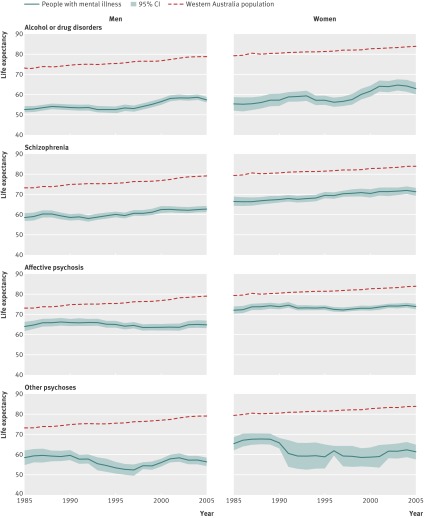
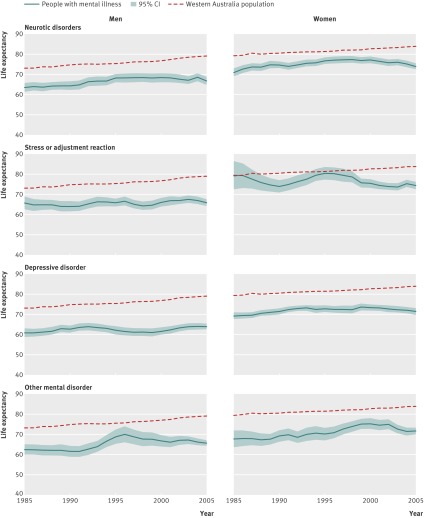
- The largest increases in the life expectancy gap were for other psychoses (14.8 to 22.7 years for males and 14.1 to 22.6 years for females) and stress or adjustment reactions (7.3 to 13.2 years for males and −0.2 to 9.3 years for females). Alcohol or drug disorders had the lowest life expectancy, with a gap exceeding 20 years at each time point.
- General population life expectancy increased from 73.1 to 79.1 years for males and from 79.3 to 83.8 years for females, while the gap for all mental disorders combined widened.
Methods
- Retrospective population-based record-linkage study in Western Australia using the mental health information system and death registrations; 292,585 people had contact with mental health services between 1983 and 2007, with 47,669 deaths, and results covered 1985–2005.
- The primary cohort used an “active” case definition: people with ongoing contact with mental health services or contact in the preceding five years. Life expectancy at birth was calculated with abridged life tables using five-year age groups and five-year death windows, then compared with Western Australian population life tables.
- Excess mortality by cause was calculated as observed deaths minus expected deaths, with expected deaths derived from Western Australian cause-specific death rates by age group, sex, and time period applied to cohort person-years; analyses used SAS.
Limitations
- The paper states reliance on administrative data of contacts with services: not all people with mental illness have contact with services, and the register excludes people with undiagnosed or untreated disorders and those treated only by general practitioners or private psychiatrists and psychologists.
- The paper states that changes in service delivery and diagnostic practices could influence life expectancy trends, and that changes in cause-of-death coding over time could affect cause-specific excess estimates; for example, HIV has been coded as a cause of death in Australia only since 1996, and ICD-10 replaced ICD-9 from 1999, though an Australian Bureau of Statistics analysis suggested little impact on rates.
- Evident from the design: this is an observational record-linkage study, so it cannot establish causality, and the paper does not report individual-level adjustment for potential confounders such as socioeconomic status, lifestyle factors, or medication effects.
Model-written summary. Check it against the paper before relying on it.
Integrity signals
Registry
Cites
Statistics
Figures
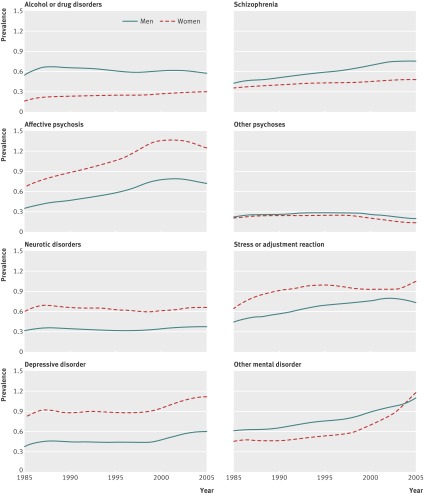
Verification
Claims the paper makes
27 Own result · 18 Not checked yet · 5 Own interpretation · 1 Own method · 1 No basis given
A result the paper reports from its own data — it cites no other source for it, so there is none to check. The quote shows it is in the paper.
In the paper
“Other accidents and injuries accounted for another 8.1% of excess deaths in males and 7.0% in females.”
plain- Asserted: passes — The authors put it forward as true.
- Checkable: passes — It can be checked against evidence.
- Load-bearing: unclear — It is unclear whether the paper’s conclusions depend on it.
- Based: passes — The paper gives a reason why it holds.
A result the paper reports from its own data — it cites no other source for it, so there is none to check. The quote shows it is in the paper.
In the paper
“Additionally, 77.7% of excess deaths were attributed to physical health conditions, including cardiovascular disease (29.9%) and cancer (13.5%).”
- Also stated in: § Possible causes of poor health outcomes in people with mental illness · p. 5 · plain
“Our data show that almost 80% of excess deaths in people with mental illness are due to physical health conditions.”
plaindirect- Asserted: passes — The authors put it forward as true.
- Checkable: passes — It can be checked against evidence.
- Load-bearing: passes — The paper’s conclusions depend on it.
- Based: passes — The paper gives a reason why it holds.
- Also stated in: § Possible causes of poor health outcomes in people with mental illness · p. 5 · plain
A result the paper reports from its own data — it cites no other source for it, so there is none to check. The quote shows it is in the paper.
In the paper
“Suicide was the cause of 16.6% of excess deaths in males and 10.1% in females.”
plain- Asserted: passes — The authors put it forward as true.
- Checkable: passes — It can be checked against evidence.
- Load-bearing: unclear — It is unclear whether the paper’s conclusions depend on it.
- Based: passes — The paper gives a reason why it holds.
A result the paper reports from its own data — it cites no other source for it, so there is none to check. The quote shows it is in the paper.
In the paper
“Among psychiatric patients, males and females with alcohol or drug disorders had the lowest life expectancy in 1985, and the gap in life expectancy exceeded 20 years at each time point.”
plaincorrelational- Asserted: passes — The authors put it forward as true.
- Checkable: passes — It can be checked against evidence.
- Load-bearing: unclear — It is unclear whether the paper’s conclusions depend on it.
- Based: passes — The paper gives a reason why it holds.
A result the paper reports from its own data — it cites no other source for it, so there is none to check. The quote shows it is in the paper.
In the paper
“Overall, most excess deaths were due to physical health conditions, with cardiovascular disease (including stroke) the main cause of 26.2% of excess deaths in male psychiatric patients and 35.3% in female psychiatric patients, and cancer the main cause of 13.6% of excess deaths in males and 13.3% in females (table 3⇓).”
plain- Asserted: passes — The authors put it forward as true.
- Checkable: passes — It can be checked against evidence.
- Load-bearing: unclear — It is unclear whether the paper’s conclusions depend on it.
- Based: passes — The paper gives a reason why it holds.
A result the paper reports from its own data — it cites no other source for it, so there is none to check. The quote shows it is in the paper.
In the paper
“For all mental disorders combined, the gap in life expectancy for males increased from 13.5 years in 1985 to 15.9 years in 2005 and for females from 10.4 years in 1985 to 12.0 years in 2005.”
- Also stated in: § Discussion · p. 5 · boosted
“Our study shows that the size of the gap in life expectancy for people with psychiatric disorders in Western Australia increased between 1985 and 2005, from 13.5 to 15.9 years for males and from 10.4 to 12.0 years for females.”
boosteddirect- Asserted: passes — The authors put it forward as true.
- Checkable: passes — It can be checked against evidence.
- Load-bearing: passes — The paper’s conclusions depend on it.
- Based: passes — The paper gives a reason why it holds.
- Also stated in: § Discussion · p. 5 · boosted
A result the paper reports from its own data — it cites no other source for it, so there is none to check. The quote shows it is in the paper.
In the paper
“Additionally, 77.7% of excess deaths were attributed to physical health conditions, including cardiovascular disease (29.9%) and cancer (13.5%).”
plain- Asserted: passes — The authors put it forward as true.
- Checkable: passes — It can be checked against evidence.
- Load-bearing: unclear — It is unclear whether the paper’s conclusions depend on it.
- Based: passes — The paper gives a reason why it holds.
- Probably not a substantial claim. 11
- The quote only partly states this claim. 2
- It may state two separate claims as one. 10
A result the paper reports from its own data — it cites no other source for it, so there is none to check. The quote shows it is in the paper.
In the paper
“Other accidents and injuries accounted for another 8.1% of excess deaths in males and 7.0% in females.”
plain- Asserted: passes — The authors put it forward as true.
- Checkable: passes — It can be checked against evidence.
- Load-bearing: fails — The paper’s conclusions may not depend on it.
- Based: passes — The paper gives a reason why it holds.
Probably not a substantial claim. The paper’s conclusions may not depend on it.
A result the paper reports from its own data — it cites no other source for it, so there is none to check. The quote shows it is in the paper.
In the paper
“The largest increases in the life expectancy gap were seen for people with other psychoses (14.8 to 22.7 years for males and 14.1 to 22.6 years for females) and stress or adjustment reactions (7.3 to 13.2 years for males and -0.2 to 9.3 years for females, table 2).”
plaincorrelational- Asserted: passes — The authors put it forward as true.
- Checkable: passes — It can be checked against evidence.
- Load-bearing: unclear — It is unclear whether the paper’s conclusions depend on it.
- Based: passes — The paper gives a reason why it holds.
The quote only partly states this claim.
A result the paper reports from its own data — it cites no other source for it, so there is none to check. The quote shows it is in the paper.
In the paper
“The widest gap in life expectancy was seen in people with alcohol and drug disorders, and this gap of more than 20 years was maintained throughout the period of study.”
plaincorrelational- Asserted: passes — The authors put it forward as true.
- Checkable: passes — It can be checked against evidence.
- Load-bearing: passes — The paper’s conclusions depend on it.
- Based: passes — The paper gives a reason why it holds.
It may state two separate claims as one.
In the paper
“Psychiatric patients in this study represented over 5% of the Western Australia population, including a large proportion of people who had only short contacts with services. 59”
What the sources say
- Not checked yetcites [59]
plain- Asserted: passes — The authors put it forward as true.
- Checkable: passes — It can be checked against evidence.
- Load-bearing: fails — The paper’s conclusions may not depend on it.
- Based: passes — The paper gives a reason why it holds.
Probably not a substantial claim. The paper’s conclusions may not depend on it. It may state two separate claims as one.
A result the paper reports from its own data — it cites no other source for it, so there is none to check. The quote shows it is in the paper.
In the paper
“In terms of individual diagnoses, the gap increased for both males and females with adjustment reaction, affective and other psychoses, and depression (figures 2⇓ and 3⇓).”
plaindirect- Asserted: passes — The authors put it forward as true.
- Checkable: passes — It can be checked against evidence.
- Load-bearing: passes — The paper’s conclusions depend on it.
- Based: passes — The paper gives a reason why it holds.
It may state two separate claims as one.
The paper states this without a source or data behind it here, so there is nothing to check it against. The quote shows it is in the paper.
In the paper
“Significant gaps in life expectancy remained for other psychiatric disorders”
plain- Asserted: passes — The authors put it forward as true.
- Checkable: passes — It can be checked against evidence.
- Load-bearing: passes — The paper’s conclusions depend on it.
- Based: passes — The paper gives a reason why it holds.
The quote only partly states this claim.
What the paper did — it cites no source for this, so there is none to check. The quote shows it is in the paper.
In the paper
“Furthermore, changes to some ICD codes would not affect our findings that psychiatric patients in general, and in each psychiatric diagnostic group, experienced a large gap in mortality, and that the majority of excess mortality was attributable to physical health conditions, including cancer and cardiovascular disease.”
hedged- Asserted: passes — The authors put it forward as true.
- Checkable: passes — It can be checked against evidence.
- Load-bearing: unclear — It is unclear whether the paper’s conclusions depend on it.
- Based: passes — The paper gives a reason why it holds.
It may state two separate claims as one.
None of the sources cited for this claim have been checked yet.
In the paper
“The side effects of drugs, particularly the metabolic side effects of antipsychotics, have also received considerable attention. 48 49”
What the sources say
- Not checked yetcites [48]
- Not checked yetcites [49]
plain- Asserted: passes — The authors put it forward as true.
- Checkable: passes — It can be checked against evidence.
- Load-bearing: fails — The paper’s conclusions may not depend on it.
- Based: passes — The paper gives a reason why it holds.
Probably not a substantial claim. The paper’s conclusions may not depend on it.
None of the sources cited for this claim have been checked yet.
In the paper
“Higher rates of substance use have been well documented in people with mental illness, including tobacco, alcohol, and illegal drugs, 42-44 as well as a higher prevalence of unhealthy lifestyles, including poorer diets and less exercise. 45-47”
What the sources say
- Not checked yetcites [42]
- Not checked yetcites [43]
- Not checked yetcites [44]
- Not checked yetcites [45]
- Not checked yetcites [46]
- Not checked yetcites [47]
boostedcorrelational- Asserted: passes — The authors put it forward as true.
- Checkable: passes — It can be checked against evidence.
- Load-bearing: fails — The paper’s conclusions may not depend on it.
- Based: passes — The paper gives a reason why it holds.
Probably not a substantial claim. The paper’s conclusions may not depend on it. It may state two separate claims as one.
In the paper
“The opportunity for them to do so is being foreshortened by premature mortality. 60”
What the sources say
- Not checked yetcites [60]
plaindirect- Asserted: passes — The authors put it forward as true.
- Checkable: fails — It may be too vague to check against evidence.
- Load-bearing: fails — The paper’s conclusions may not depend on it.
- Based: passes — The paper gives a reason why it holds.
Probably not a substantial claim. It may be too vague to check against evidence. The paper’s conclusions may not depend on it.
None of the sources cited for this claim have been checked yet.
In the paper
“However, studies that adjusted for socioeconomic status still found significantly worse morbidity and mortality for people with mental illness, 2 8 showing that social deprivation and disadvantage are not the sole determinants of poor health outcomes in people with mental illness.”
What the sources say
- Not checked yetcites [2]
- Not checked yetcites [8]
boostedcorrelational- Asserted: passes — The authors put it forward as true.
- Checkable: passes — It can be checked against evidence.
- Load-bearing: unclear — It is unclear whether the paper’s conclusions depend on it.
- Based: passes — The paper gives a reason why it holds.
It may state two separate claims as one.
In the paper
“Given that the Nordic countries have some of the most comprehensive and equitable healthcare and social welfare in the world, our results may be more typical of the experience in other places.”
What the sources say
- Not checked yetcites [16]
plain- Asserted: passes — The authors put it forward as true.
- Checkable: passes — It can be checked against evidence.
- Load-bearing: passes — The paper’s conclusions depend on it.
- Based: fails — The paper may give no reason why it holds.
Probably not a substantial claim. The paper may give no reason why it holds. It may state two separate claims as one.
In the paper
“Finally, inequalities in access to, and use of, healthcare are well documented. 50”
What the sources say
- Not checked yetcites [50]
boosted- Asserted: passes — The authors put it forward as true.
- Checkable: passes — It can be checked against evidence.
- Load-bearing: fails — The paper’s conclusions may not depend on it.
- Based: passes — The paper gives a reason why it holds.
Probably not a substantial claim. The paper’s conclusions may not depend on it.
A conclusion the paper draws from its own results — it cites no other source for it, so there is none to check. The quote shows it is in the paper.
In the paper
“For instance, the register does not cover people with undiagnosed and untreated disorders and those who are only treated by general practitioners or private psychiatrists and psychologists.”
plain- Asserted: passes — The authors put it forward as true.
- Checkable: passes — It can be checked against evidence.
- Load-bearing: passes — The paper’s conclusions depend on it.
- Based: passes — The paper gives a reason why it holds.
It may state two separate claims as one.
In the paper
“Socioeconomic disadvantage is also more common in people with mental illness and is associated with health risk behaviours and reduced access to healthcare. 51”
What the sources say
- Not checked yetcites [51]
plaincorrelational- Asserted: passes — The authors put it forward as true.
- Checkable: passes — It can be checked against evidence.
- Load-bearing: unclear — It is unclear whether the paper’s conclusions depend on it.
- Based: passes — The paper gives a reason why it holds.
It may state two separate claims as one.
A conclusion the paper draws from its own results — it cites no other source for it, so there is none to check. The quote shows it is in the paper.
In the paper
“Not all people with mental illness have contact with services, and these data have to be considered representative of the population of people in contact with services, not all people with mental illness.”
plain- Asserted: passes — The authors put it forward as true.
- Checkable: passes — It can be checked against evidence.
- Load-bearing: passes — The paper’s conclusions depend on it.
- Based: passes — The paper gives a reason why it holds.
It may state two separate claims as one.
In the paper
“In contrast with the Nordic study, which showed a slight reduction in the life expectancy gap, we found that the overall gap in life expectancy increased by 2.4 years for males and by 1.6 years for females between 1985 and 2005.”
What the sources say
- Not checked yetcites [12]
plaindirect- Asserted: passes — The authors put it forward as true.
- Checkable: passes — It can be checked against evidence.
- Load-bearing: fails — The paper’s conclusions may not depend on it.
- Based: passes — The paper gives a reason why it holds.
Probably not a substantial claim. The paper’s conclusions may not depend on it.
In the paper
“While life expectancy in Western Australia is high among developed countries, the magnitude of increase in life expectancy between 1985 and 2005 in Western Australia is consistent with that seen in the United Kingdom, the United States, and many European countries. 35”
What the sources say
- Not checked yetcites [35]
plain- Asserted: passes — The authors put it forward as true.
- Checkable: passes — It can be checked against evidence.
- Load-bearing: fails — The paper’s conclusions may not depend on it.
- Based: passes — The paper gives a reason why it holds.
Probably not a substantial claim. The paper’s conclusions may not depend on it.
None of the sources cited for this claim have been checked yet.
In the paper
“Excess morbidity or mortality associated with mental illness is recognised as a complex multifactorial problem. 40 41”
What the sources say
- Not checked yetcites [40]
- Not checked yetcites [41]
plaincorrelational- Asserted: passes — The authors put it forward as true.
- Checkable: fails — It may be too vague to check against evidence.
- Load-bearing: fails — The paper’s conclusions may not depend on it.
- Based: passes — The paper gives a reason why it holds.
Probably not a substantial claim. It may be too vague to check against evidence. The paper’s conclusions may not depend on it.
In the paper
“The proportion of invalid and missed links using this method has been estimated at 0.11%. 22”
What the sources say
- Not checked yetcites [22]
hedged- Asserted: passes — The authors put it forward as true.
- Checkable: passes — It can be checked against evidence.
- Load-bearing: fails — The paper’s conclusions may not depend on it.
- Based: passes — The paper gives a reason why it holds.
Probably not a substantial claim. The paper’s conclusions may not depend on it.
The authors state this as an assumption.
In psychiatric patients under age 15, the mortality rate is equal to the general population mortality rate for that age group.
“Because of the small numbers of psychiatric patients under the age of 15 years, we assumed that the mortality rate in psychiatric patients before age 15 was equal to the mortality rate in the general population for that age group.”
The paper relies on this without support.
Little attention has focused on the mortality rates of people with mental illness in Australia, and there are few interventions designed to reduce the morbidity and mortality associated with common physical illnesses in people with mental illness.
“While inequalities in the health experiences of Indigenous Australians have justifiably attracted substantial public investment, 38 little attention has focused on the mortality rates of people with mental illness in Australia, and there are few interventions designed to reduce the morbidity and mortality associated with common physical illnesses in people with mental illness.”
The authors state this as an assumption.
The most severe cases at any point in time are most likely to receive treatment.
“if it is assumed that the most severe cases at any point in time are most likely to receive treatment”
The authors state this as an assumption.
The most severe cases have the worst mortality outcomes.
“assuming that the most severe cases have the worst mortality outcomes”
The paper relies on this without support.
Substance misuse is a well established risk factor for cardiovascular disease and many cancers.
“Substance misuse is a well established risk factor for cardiovascular disease and many cancers”
Claims other papers make about this one
Each is checked against this paper’s own text: does it say what the citing paper says it does?
In the citing paper
“About 60% of the excess mortality is due to physical illnesses, with cardiovascular disease being dominant.”
In the citing paper
“This mortality gap translates to a 10-20 year shortened life expectancy 3,4”
From Diabetes mellitus in people with schizophrenia, bipolar disorder and major depressive disorder: a systematic review and large scale meta‐analysis (2016) · cites this paper as [4]
In the citing paper
“This mortality gap translates into a 10-20 year shortened life expectancy (3,4) and appears to be widening (5).”
Self-check
Percentages, sums and reported differences re-computed from the paper’s own numbers.
Each contradiction between two passages listed here was confirmed by an independent check.
Rated major: it would touch a result — a value a result rests on, reported and recomputed p-values on opposite sides of the significance level, two passages that conflict with no sign which is right, or a cited work retracted before this paper was published.
In the paper
§ Results · p. 5
“physical conditions represent the majority of excess deaths for all psychiatric disorders.”
§ Tables · p. 11
“| Suicide | 16.6 | 6.1 | 19.8 | 46.4 | 5.3 | 16.2 | 53.3 | 22.7 | 33.4 |”
Citations
Cites
Mortality in relation to smoking: 40 years' observations on male British doctors
Doll, R., Peto, R., Wheatley, K., Gray, R., & Sutherland, I. (1994) · BMJ · doi:10.1136/bmj.309.6959.901 · Cited by 5,932
International Statistical Classification of Diseases and Related Health Problems
Eisfeld, J. (2014) · TSQ Transgender Studies Quarterly · doi:10.1215/23289252-2399740 · Cited by 3,570
Suicide as an outcome for mental disorders: A meta-analysis
Harris, E. C., & Barraclough, B. (1997) · British Journal of Psychiatry · doi:10.1192/bjp.170.3.205 · Cited by 2,589
DE HERT, M., CORRELL, C. U., BOBES, J., CETKOVICH‐BAKMAS, M., COHEN, D., ASAI, I., DETRAUX, J., GAUTAM, S., MÖLLER, H., NDETEI, D. M., et al. (2011) · World Psychiatry · doi:10.1002/j.2051-5545.2011.tb00014.x · Cited by 2,488
Saha, S., Chant, D., & McGrath, J. (2007) · Archives of General Psychiatry · doi:10.1001/archpsyc.64.10.1123 · Cited by 2,065
Excess mortality of mental disorder
Harris, C., & Barraclough, B. (1998) · British Journal of Psychiatry · doi:10.1192/bjp.173.1.11 · Cited by 1,881
de Leon, J., & Diaz, F. J. (2005) · Schizophrenia Research · doi:10.1016/j.schres.2005.02.010 · Cited by 1,276
Atypical antipsychotic drugs and the risk of sudden cardiac death
Ray, W. A., Chung, C. P., Murray, K. T., Hall, K., & Stein, C. M. (2009) · New England Journal of Medicine · doi:10.1056/nejmoa0806994 · Cited by 1,194
Holman, C. D. J., Bass, A. J., Rouse, I. L., & HOBBS, M. S. T. (1999) · Australian and New Zealand Journal of Public Health · doi:10.1111/j.1467-842x.1999.tb01297.x · Cited by 1,037
Manual of the International Statistical Classification of Diseases, Injuries, and Causes of Death.
Schneider, B. A. (1953) · The Quarterly Review of Biology · doi:10.1086/399926 · Cited by 1,000
Cited by
Sorted by citations
Items 601–700 of 818
Arnautovska, U., Soole, R., Kwan, W. W. L., Reid, N., Baker, A., Gordon, E. H., Hubbard, R. E., Siskind, D. J., & Warren, N. (2025) · BMC Psychiatry · doi:10.1186/s12888-025-06830-3 · Cited by 3
Psychological distress among workers at a mine
Havenga, Y., & Bester, M. (2025) · South African Journal of Psychiatry · doi:10.4102/sajpsychiatry.v31i0.2422 · Cited by 3
On Adjusting for Life’s Confounding
Kisely, S. R. (2016) · The Canadian Journal of Psychiatry · doi:10.1177/0706743716660710 · Cited by 3
Self-citationUbiali, A., Raguzzoni, G., Scavo, S. B., Bodini, C. F., Carradori, T., & Martinó, A. (2020) · Online Brazilian Journal of Nursing · doi:10.17665/1676-4285.20206249 · Cited by 3
Bradley, T., Bartlem, K. M., Colyvas, K., Wye, P. M., Campbell, E. M., Reid, K., & Bowman, J. (2021) · Preventive Medicine Reports · doi:10.1016/j.pmedr.2021.101609 · Cited by 3
A Possible Role of Akkermansia muciniphila in the Treatment of Olanzapine-Induced Weight Gain
Bertossi, F. (2024) · Cureus · doi:10.7759/cureus.55733 · Cited by 3
Kisely, S. R., Spilsbury, K., Bull, C. F., Jordan, S. J., Kendall, B. J., Siskind, D. J., Sara, G. E., Protani, M. M., & Lawrence, D. M. (2024) · Epidemiology and Psychiatric Sciences · doi:10.1017/s2045796024000787 · Cited by 3
Self-citationHahn, L. A., Mackinnon, A. J., Foley, D. L., Morgan, V. A., Waterreus, A. J., Watts, G. F., Castle, D. J., Liu, D., & Galletly, C. A. (2016) · Schizophrenia Research · doi:10.1016/j.schres.2016.09.028 · Cited by 3
Assessing the hidden burden of psychiatric disease in patients with nonepileptic seizures
Lenio, S., Baker, S., Watson, M. M., Libbon, R., Sillau, S., & Strom, L. A. (2021) · Epilepsy & Behavior · doi:10.1016/j.yebeh.2021.108382 · Cited by 3
Li, S., Chen, D., Xiu, M., Li, J., & Zhang, X. (2021) · Early Intervention in Psychiatry · doi:10.1111/eip.13240 · Cited by 3
Fehily, C. M. C., McKeon, E., Stettaford, T., Campbell, E. M., Lodge, S., Dray, J., Bartlem, K. M., Reeves, P., Oldmeadow, C. J., Castle, D. J., et al. (2022) · International Journal of Environmental Research and Public Health · doi:10.3390/ijerph19053119 · Cited by 3
Lifespan variation among people with a given disease or condition
Zheng, Y. P., Permanyer, I., Canudas‐Romo, V., Aburto, J. M., Nigri, A., & Plana‐Ripoll, O. (2023) · PLoS ONE · doi:10.1371/journal.pone.0290962 · Cited by 3
Developmental Trajectory of Body Weight in Youths at Risk for Major Mood Disorders
Adepalli, N., Cumby, J., Campbell, N., Pavlová, B., Alda, M., Cahill, L. E., & Uher, R. (2023) · JAMA Network Open · doi:10.1001/jamanetworkopen.2023.38540 · Cited by 3
Healthy lifestyle and risk of incidence, mortality and life expectancy of mental disorders
Tian, S., Wang, Q., Wu, T., Chang, S., Dun, W.-W., Zhang, L., Li, A., & Wang, G. (2025) · Journal of Affective Disorders · doi:10.1016/j.jad.2025.119592 · Cited by 4
Is it time to rethink treatment of early psychosis?
Siskind, D. J., & Dark, F. L. (2016) · Australian & New Zealand Journal of Psychiatry · doi:10.1177/0004867416680299 · Cited by 3
Factors That Influences Mental Health Policy In Albania
Frasheri, E., & Dhamo, E. (2016) · European Scientific Journal ESJ · doi:10.19044/esj.2016.v12n14p175 · Cited by 3
Bailey, J. M., Wye, P. M., Stockings, E., Bartlem, K. M., Metse, A. P., Wiggers, J. H., & Bowman, J. (2016) · The Journal of Smoking Cessation · doi:10.1017/jsc.2016.23 · Cited by 3
Fehily, C. M. C., Bartlem, K. M., Wiggers, J. H., Wolfenden, L., Regan, T., Dray, J., Bailey, J. M., & Bowman, J. (2018) · Systematic Reviews · doi:10.1186/s13643-018-0735-4 · Cited by 3
Tremain, D., Freund, M., Wye, P. M., Bowman, J., Wolfenden, L., Dunlop, A. J., Bartlem, K. M., Lecathelinais, C., & Wiggers, J. H. (2018) · BMJ Open · doi:10.1136/bmjopen-2017-020042 · Cited by 3
Abebe, D., Elstad, J. I., & Lien, L. (2018) · BMC Health Services Research · doi:10.1186/s12913-018-3672-y · Cited by 3
Psychosocial Interventions for Youth Mental Health
Killackey, E. J., & Álvarez‐Jiménez, M. (2019) · Cambridge University Press eBooks · doi:10.1017/9781139839518.012 · Cited by 4
Fehily, C. M. C., Latter, J. L., Bartlem, K. M., Wiggers, J. H., Bradley, T., Rissel, C. E., Reakes, K., Reid, K., Browning, E. R., & Bowman, J. (2020) · Australian and New Zealand Journal of Public Health · doi:10.1111/1753-6405.13039 · Cited by 3
Appraisal of physical health guidelines for severe mental illness
Friend, N., Hughes, J. P., Kisely, S. R., Kumar, R., & Siskind, D. J. (2020) · Australian Health Review · doi:10.1071/ah20080 · Cited by 4
Self-citationBartlem, K. M., Gibson, L., Fehily, C. M. C., Lodge, S., Wiggers, J. H., & Bowman, J. (2021) · Preventive Medicine Reports · doi:10.1016/j.pmedr.2021.101383 · Cited by 3
Porter, C., & Aggar, C. (2021) · International Journal of Mental Health Nursing · doi:10.1111/inm.12899 · Cited by 3
Lerbæk, B., Jørgensen, R., Buus, N., Lauritsen, M. B., Aagaard, J., Nordgaard, J., & McCloughen, A. (2021) · International Journal of Mental Health Nursing · doi:10.1111/inm.12907 · Cited by 3
(2019) · Frontiers research topics · doi:10.3389/978-2-88963-109-4 · Cited by 3
Taylor, C., Fertal, J., & Liao, S. S. (2018) · Journal of Pain and Symptom Management · doi:10.1016/j.jpainsymman.2018.02.014 · Cited by 3
Stanley, S. H., Ferguson, L., & Velayudhan, A. (2019) · Australasian Psychiatry · doi:10.1177/1039856219891596 · Cited by 3
Knowles, A., Chadwick, J., & Vancampfort, D. (2013) · Cochrane Database of Systematic Reviews · doi:10.1002/14651858.cd010554 · Cited by 3
Forty years on – tobacco control then and now
Daube, M. (2013) · Australian and New Zealand Journal of Public Health · doi:10.1111/1753-6405.12075 · Cited by 3
Yu, S.-C., Shu, L.-R., Yu, C., Chen, T., Tsai, S., & Chen, M. (2024) · Journal of Affective Disorders · doi:10.1016/j.jad.2024.08.221 · Cited by 2
Luck, K. E. (2016) · Journal of Hospital Administration · doi:10.5430/jha.v5n4p9 · Cited by 2
Nadjidai, S. E., Kusljic, S., Dowling, N. L., Magennis, J., Stokes, L., Ng, C. H., & Daniel, C. (2020) · International Journal of Mental Health Nursing · doi:10.1111/inm.12764 · Cited by 2
Quemada, C., Morales‐Asencio, J. M., Hurtado, M. M., & Martí‐García, C. (2022) · BMC Nursing · doi:10.1186/s12912-022-00870-w · Cited by 2
Sriramalu, S. B., Elangovan, A. R., Isaac, M., & Raman, K. J. (2022) · Journal of Psychosocial Rehabilitation and Mental Health · doi:10.1007/s40737-022-00301-8 · Cited by 2
Wu, H., Yuan, X., Cui, J., Zhang, Y., Shen, Y., Guo, J., Yu, G., & Kou, C. (2022) · Asian Journal of Psychiatry · doi:10.1016/j.ajp.2022.103370 · Cited by 2
Characteristics and service use of NSW Quitline callers with and without mental health conditions
Lodge, S., Bartlem, K. M., Gibson, L., Fehily, C. M. C., Bradley, T., McKeon, E., Reakes, K., Rickards, S., Hastings, P., & Bowman, J. (2022) · Frontiers in Psychiatry · doi:10.3389/fpsyt.2022.868084 · Cited by 2
Gur, S., Weizman, S., Hermesh, H., Matalon, A., Meyerovitch, J., & Krivoy, A. (2023) · Journal of Psychosomatic Research · doi:10.1016/j.jpsychores.2023.111383 · Cited by 2
Malone, R., Savage, S., Crowley, V., Hennessy, M., O’Connor, P. A., & Kennedy, C. (2024) · Journal of Clinical Medicine · doi:10.3390/jcm13082270 · Cited by 2
Foley, J. D., Bernier, L., Schiavo, S., Davis, M., & Batchelder, A. (2024) · Open Access Journal of Clinical Trials · doi:10.2147/oajct.s451233 · Cited by 2
Piras, M., Lin, J., Sadler, M. C., Ranjbar, S., Grosu, C., Laaboub, N., Preisig, M., Gamma, F., Plessen, K. J., von Gunten, A., et al. (2024) · Translational Psychiatry · doi:10.1038/s41398-024-03177-3 · Cited by 2
Crabb, J., Milne, L., Conway, L., Fulton, M., Dewar, C., McHugh, B., Speed, L., Tourish, P., & McKinnon, M. (2015) · International Journal of Mental Health Promotion · doi:10.1080/14623730.2015.1039776 · Cited by 2
Breitborde, N. J. K., Keller-Hamilton, B. L., Moe, A. M., Pine, J. G., Nelson, N., Weiss, D., Hogan, T. H., Quisenberry, A. J., Teferra, A. A., Ferketich, A. K., et al. (2021) · The Journal of Smoking Cessation · doi:10.1155/2021/6617716 · Cited by 3
Gustad, L. T., Holand, A. M., Hynnekleiv, T., Bjerkeset, O. A., Berk, M., & Romundstad, S. (2022) · PLoS ONE · doi:10.1371/journal.pone.0274271 · Cited by 2
López‐Cuadrado, T., Szmulewicz, A., Öngür, D., & Martínez‐Alés, G. (2023) · General Hospital Psychiatry · doi:10.1016/j.genhosppsych.2023.08.004 · Cited by 2
Stettaford, T., Fehily, C. M. C., Campbell, E. M., Barker, D., Oldmeadow, C. J., McKeon, E., Love, S., Lawn, S., Castle, D. J., & Bowman, J. (2024) · Australian & New Zealand Journal of Psychiatry · doi:10.1177/00048674241257751 · Cited by 2
Plever, S., Kisely, S. R., Bonevski, B., McCarthy, I., Anzolin, M., Siskind, D. J., Ballard, E. L., Emmerson, B., Allan, J., & GARTNER, C. E. (2025) · Australian & New Zealand Journal of Psychiatry · doi:10.1177/00048674251340214 · Cited by 2
Self-citationArrhythmogenic right ventricular cardiomyopathy in a patient with schizophrenia
Kawasaki, K., Miyaji, K., Kodera, S., Suzuki, Y., Kanda, J., & Ikeda, M. (2015) · Clinical Case Reports · doi:10.1002/ccr3.230 · Cited by 2
Norbeck, S., Schuster, H., Driscoll, D., & Ramaswamy, S. (2019) · Journal of Social Distress and the Homeless · doi:10.1080/10530789.2019.1684067 · Cited by 2
Bipolar disorders, obesity, and metabolic disturbances: Mechanisms and implications
Murru, A., Anmella, G., Giménez, A., & Vieta, E. (2020) · Elsevier eBooks · doi:10.1016/b978-0-12-819182-8.00022-3 · Cited by 2
Prevalence of metabolic syndrome in elderly patients with depression
Grover, S., Chakravarty, R. K., Mehra, A., & Chakrabarti, S. (2021) · Journal of Geriatric Mental Health · doi:10.4103/jgmh.jgmh_8_21 · Cited by 2
Mortality in a Moroccan psychiatric hospital
Khlil, C., Attouche, N., Choujaa, H., & Alami, K. M. (2023) · Middle East Current Psychiatry · doi:10.1186/s43045-023-00333-1 · Cited by 2
Li, W., Yue, L., & Xiao, S. (2024) · European Archives of Psychiatry and Clinical Neuroscience · doi:10.1007/s00406-024-01762-7 · Cited by 2
Multiple indicators of ill health are evident in people with psychosis
Foley, D. L. (2017) · Evidence-Based Mental Health · doi:10.1136/eb-2017-102647 · Cited by 2
Prevalência de episódios ansiosos e depressivos em hospital geral
Macellaro, M., de Queiroz, V., Pagnin, D., Tedeschi, L. T., de Morais, R. Q., da Silva, M. M., Amorim, O. P., Aurione, I. V., Filho, E. M. D. S., & Rodrigues, L. R. (2018) · Diversitates International Journal · doi:10.53357/ishu9567 · Cited by 2
İpekçioğlu, D., & Kendirlioglu, B. K. (2019) · Bakirkoy Tip Dergisi / Medical Journal of Bakirkoy · doi:10.4274/btdmjb.galenos.2019.20190214042203 · Cited by 2
Outpatient interventions for smoking cessation and reduction for adults with a mental disorder
Stockings, E., Black, N., Bartlem, K. M., Metse, A. P., Regan, T. W., Bailey, J. M., Wolfenden, L., Wiggers, J., & Bowman, J. (2019) · Cochrane Database of Systematic Reviews · doi:10.1002/14651858.cd013286 · Cited by 3
Broderick, J. M., Vancampfort, D., Mockler, D., Bennett, K., Waugh, A., McDonough, C., Cramer, H., & Walshe, M. (2018) · Cochrane Database of Systematic Reviews · doi:10.1002/14651858.cd013213 · Cited by 2
White, R. L. (2016) · Research Bank (Australian Catholic University) · doi:10.4226/66/5a9cd78cb0bdc · Cited by 2
Francesconi, M., Minichino, A., Khandaker, G. M., Midouhas, E., Lewis, G., & Flouri, E. (2020) · Schizophrenia Research · doi:10.1016/j.schres.2020.11.009 · Cited by 1
Mental Health and SDG3.3, 3d, 3.4 and 3.5
Mphande, F. A. (2023) · Sustainable development goals series · doi:10.1007/978-981-99-4254-1_7 · Cited by 1
Antipsychotic medications and risk of respiratory failure in the respiratory high dependency unit
Winter, S., Kirkpatrick, T., Winckel, K., Honarparvar, F., Robinson, L., Tanzer, T. D., Smith, L., Warren, N., Siskind, D. J., & Ellender, C. M. (2024) · BJPsych Open · doi:10.1192/bjo.2024.773 · Cited by 1
Trower, R., Donohoe, G. J., Mahon, S., Meade, O., & Byrne, M. (2025) · HRB Open Research · doi:10.12688/hrbopenres.14053.1 · Cited by 1
Nissen, L., Løkke, A., Frølund, J. C., Hilberg, O., Højlund, M., Ejlersen, E., & Hjorth, P. (2025) · Nordic Journal of Psychiatry · doi:10.1080/08039488.2025.2484387 · Cited by 1
Abebe, D., Hynek, K. A., Lien, L., Yttri, A. M., & Straiton, M. (2025) · Social Psychiatry and Psychiatric Epidemiology · doi:10.1007/s00127-025-02892-6 · Cited by 1
Zirnsak, T., Nicola, J. D., Kisely, S. R., Siskind, D. J., Protani, M. M., & Brophy, L. M. (2025) · Australasian Psychiatry · doi:10.1177/10398562251406026 · Cited by 1
Self-citationLove, S., Fehily, C. M. C., Ampofo, A. G., Ryall, J., Marasha, F., Latter, J. L., Lodge, S., Jackson, B. D., Campbell, E. M., Oldmeadow, C. J., et al. (2025) · BMC Public Health · doi:10.1186/s12889-025-25089-7 · Cited by 1
Chatterton, M. L., Faller, J., Le, L. K., Engel, L., Williams, L. J., Pasco, J. A., & Mihalopoulos, C. (2024) · Australian & New Zealand Journal of Psychiatry · doi:10.1177/00048674241229931 · Cited by 1
Liberty or life: mental health care in Australia
MacDonald, K., & Ellis, A. (2024) · CNS Spectrums · doi:10.1017/s1092852924000634 · Cited by 1
Claimsformer: Pretrained Transformer for Administrative Claims Data to Predict Chronic Conditions
Gerrard, L., Peng, X., Clarke, A., & Long, G. (2024) · Lecture notes in computer science · doi:10.1007/978-981-96-0351-0_26 · Cited by 1
Prioritising people who use drugs in health policy: An Australian Capital Territory case study
Bowles, D. C., Yarbakhsh, E., & van der Sterren, A. (2025) · Drug and Alcohol Review · doi:10.1111/dar.14001 · Cited by 1
Hanly, G., Campbell, E. M., Bartlem, K. M., Dray, J., Fehily, C. M. C., Colyvas, K., Reynolds, T., Davidson, S., Jeong, S., Wiggers, J. H., et al. (2025) · BMC Public Health · doi:10.1186/s12889-025-21614-w · Cited by 1
Twyman, L., Walsberger, S. C., Baker, A., Ahmadi, S., Oldmeadow, C. J., Weber, M. F., Lawn, S., Hefler, M., Bowman, J., Boss, P., et al. (2025) · Addiction · doi:10.1111/add.16733 · Cited by 1
Kisely, S. R., Siskind, D. J., & Speyer, H. (2025) · BJPsych Open · doi:10.1192/bjo.2025.34 · Cited by 1
Self-citationJohnston, D. J. G., Arnautovska, U., Baker, A., Hickman, I. J., Mayr, H. L., Korman, N., Marx, W., Murray, E., Warren, N., Weighell, S., et al. (2025) · BJPsych Open · doi:10.1192/bjo.2025.10070 · Cited by 1
Manzano, M. J. L., Cangas, A. J., Cerezuela, J. L., & López-Pardo, A. (2025) · Journal of Psychiatric Research · doi:10.1016/j.jpsychires.2025.07.041 · Cited by 1
Tegg, A., Curtis, J., O'Brien, T., Burgess, P. M., Biles, B. J., McMillan, F., & Sara, G. E. (2025) · General Hospital Psychiatry · doi:10.1016/j.genhosppsych.2025.11.001 · Cited by 1
Kiltschewskij, D. J., Reay, W. R., & Cairns, M. J. (2026) · Molecular Psychiatry · doi:10.1038/s41380-026-03464-z · Cited by 1
Bull, C. F., Wheeler, A., Palmer, V. J., Lewis, M., Siskind, D. J., & Kisely, S. R. (2026) · Australian & New Zealand Journal of Psychiatry · doi:10.1177/00048674261475206 · Cited by 1
Self-citationAndersen, A. M. J., Attardo, H. L., Nielsen, B. M., & Kristiansen, T. M. (2018) · Advances in Applied Sociology · doi:10.4236/aasoci.2018.81005 · Cited by 1
Escott‐Price, V. (2019) · V M BEKHTEREV REVIEW OF PSYCHIATRY AND MEDICAL PSYCHOLOGY · doi:10.31363/2313-7053-2019-4-1-8-11 · Cited by 1
Espinel, P. T., Marshall, N. S., Yee, B. J., Hollis, J., Smith, K., D'Rozario, A. L., Gauthier, G., Lambert, T. J. R., & Grunstein, R. R. (2020) · Sleep And Breathing · doi:10.1007/s11325-020-02259-y · Cited by 1
Life Expectancy: A Primer with a Focus on Neurological and Psychiatric Conditions
Katz, R. T., & Katz, R. B. (2017) · AMA guides newsletter · doi:10.1001/amaguidesnewsletters.2017.novdec01 · Cited by 1
Aldhafeeri, B. D. A. (2022) · Pharmacy Education · doi:10.46542/pe.2022.221.142154 · Cited by 1
Freude durch Sport und Bewegung bei psychischen Erkrankungen
Kreppke, J.-N., Cody, R., Faude, O., & Gerber, M. (2022) · Praxis · doi:10.1024/1661-8157/a003830 · Cited by 1
Improving the Physical Health of Rural People Living with Mental Illness
Roberts, R. J. (2021) · Springer eBooks · doi:10.1007/978-981-15-6631-8_42 · Cited by 1
The Impact of Stigma in Seeking Mental Healthcare
Calluso, C., & Bilotta, E. (2023) · Advances in psychology, mental health, and behavioral studies (APMHBS) book series · doi:10.4018/978-1-6684-5049-9.ch003 · Cited by 1
Rates of Covid 19 testing and positivity in US military veterans with SMI
Soreca, I., & Boudreaux-Kelly, M. Y. (2023) · Journal of Psychosomatic Research · doi:10.1016/j.jpsychores.2023.111483 · Cited by 1
Park, J., & Kweon, Y.-R. (2024) · Journal of Korean Academy of Psychiatric and Mental Health Nursing · doi:10.12934/jkpmhn.2024.33.2.104 · Cited by 1
Mortality in national psychiatric hospitals in Sudan: a fifteen-year review of hospital deaths
Osman, A. H. M., Mohamed, M., Osman, I. A., Abdalhai, K. A., & Elawad, L. A. (2025) · BMC Psychiatry · doi:10.1186/s12888-025-06726-2 · Cited by 1
Activities of daily living in hospitalized patients with mental disorders
Wang, Z., Lin, C., Ma, B., & Bian, Y. (2017) · Asian Journal of Psychiatry · doi:10.1016/j.ajp.2017.11.038 · Cited by 1
Treatment of Tobacco Use Disorder and Mood Disorders in Adolescents
Witt, D. R., & Patten, C. A. (2018) · Current Addiction Reports · doi:10.1007/s40429-018-0216-9 · Cited by 1
A Brief Guide to Medications for Psychosis
Harris, A. W. F. (2019) · Elsevier eBooks · doi:10.1016/b978-0-12-815012-2.00023-7 · Cited by 1
Tremain, D., Freund, M., Wolfenden, L., Bowman, J., Dunlop, A. J., Bartlem, K. M., Bailey, J. M., McFadyen, T., Dray, J., Wye, P. M., et al. (2019) · Preventive Medicine · doi:10.1016/j.ypmed.2019.105870 · Cited by 1
Martínez‐Alés, G., López‐Cuadrado, T., Olfson, M., & Bouza, C. (2020) · General Hospital Psychiatry · doi:10.1016/j.genhosppsych.2020.04.007 · Cited by 2
The impact of increasing general hospital admissions on Consultation–Liaison Psychiatry
Holmes, A., Handrinos, D., Jones, S., & Huang, B. (2020) · Australasian Psychiatry · doi:10.1177/1039856220926941 · Cited by 1
Ayub, M., Arsalan, A., Khan, S.-U.-D. A., Bajwa, S., Hussain, F., Umar, M., Khizar, B., Sibtain, M., Butt, A., Mukhtar-Ul-Haq, M., et al. (2021) · BMJ Open · doi:10.1136/bmjopen-2020-042331 · Cited by 1
Time-Restricted Feeding May Be a New Intervention to Improve Metabolism of Schizophrenia Patients
马, 雪. (2021) · International Journal of Psychiatry and Neurology · doi:10.12677/ijpn.2021.102006 · Cited by 1
Metadata
- Authors
- Lawrence, D., Hancock, K. J., & Kisely, S.
- Affiliations
- The Kids Research Institute Australia (AU)
- Griffith University (AU)
- Corresponding author
- Lawrence, D.
- Venue
- BMJ
- Publisher
- BMJ
- Published
- 2013-05-21
- Volume
- 346
- Issue
- may21 1
- Pages
- f2539-f2539
- ISSN
- 1756-1833 (ISSN-L)
- PMC
- PMC3660620
- OpenAlex
- W2138691846
- Semantic Scholar
- 9d6e4ca994e400d3d58b9806747ebbf0bdbef6d9
- Cited by
- 819
- References
- 56
- Citations by year
- 2026: 25 · 2025: 42 · 2024: 57 · 2023: 52 · 2022: 65 · 2021: 75 · 2020: 84 · 2019: 78 · 2018: 69 · 2017: 76 · 2016: 78 · 2015: 59 · 2014: 46 · 2013: 13
- FWCI
- 96.81
- Type
- journal article
- Language
- en
- Open access
- hybrid
- doi.org
- Licence
- cc-by-nc
- Locations
- BMJ (publishedVersion, cc-by-nc)
- Europe PMC (PubMed Central) (publishedVersion, cc-by-nc)
- PubMed Central (publishedVersion, cc-by-nc)
- PubMed (publishedVersion)
- UWA Profiles and Research Repository (UWA) (submittedVersion, other-oa)
- Griffith Research Online (submittedVersion)
- Topics
- Health Sciences › Medicine › Psychiatry and Mental health › Mental Health Treatment and Access
- Social Sciences › Psychology › Clinical Psychology › Psychiatric care and mental health services
- Social Sciences › Psychology › Clinical Psychology › Suicide and Self-Harm Studies
- Keywords
- life expectancy gap, psychiatric patients, excess mortality, physical health conditions, cardiovascular disease, cancer, suicide, mental illness, Western Australia, mortality trends
- MeSH terms
- Aged, Aged, 80 and over, Mental Disorders, Cause of Death, Chronic Disease, Female, Humans, Life Expectancy, Male, Retrospective Studies, Suicide, Western Australia
About these checks
Registry, retraction, Cites and statistics results are computed, not judged, with one exception: a printed reference that no index lists is read once by a model before it counts as a citation error. Claims are extracted by a model and kept only when their quote appears verbatim in the text; each cited source is then checked, with a model’s help, for whether it says what the claim relies on. Those verdicts can be wrong — read the claim’s quote and the cited source before relying on one.
A language model drew the claims from the paper on 2026-10-10, under version 3 of the claim definition (model deepseek-v4.1-flash, prompt extract-v3).
A second model labelled each claim on 2026-10-10 (model jev-1.13-20260917, definition revision gold-guideline-v0.2).
Statistics and arithmetic are recomputed, not judged.
Confidence bands are shown only for fields calibrated on our annotated test set. None is calibrated yet, so no band is shown.
What counts as a claim ›How we measure confidence ›How we check this ›
Are you an author, or do you see a problem with this page? Request a review
