

ROBINS-I: a tool for assessing risk of bias in non-randomised studies of interventions
Open accessThe DOI matches its Crossref record; 27 of the 27 references it cites were found in a registry or an index; none of the 8 sources its claims cite is checked for support yet.
Abstract
Non-randomised studies of the effects of interventions are critical to many areas of healthcare evaluation, but their results may be biased. It is therefore important to understand and appraise their strengths and weaknesses. We developed ROBINS-I (“Risk Of Bias In Non-randomised Studies - of Interventions”), a new tool for evaluating risk of bias in estimates of the comparative effectiveness (harm or benefit) of interventions from studies that did not use randomisation to allocate units (individuals or clusters of individuals) to comparison groups. The tool will be particularly useful to those undertaking systematic reviews that include non-randomised studies.
Overview
CoChat Summary
TL;DR
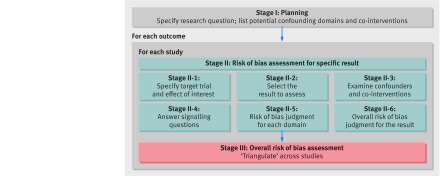
The authors developed ROBINS-I, a consensus-based tool for assessing risk of bias in non-randomised studies of interventions by comparing each study with a hypothetical pragmatic randomised “target” trial. It assesses seven bias domains using signalling questions and produces domain-level and overall risk-of-bias judgements.
Key findings
- ROBINS-I was developed over three years by expert consensus, with piloting and user feedback, and covers seven distinct bias domains: confounding, selection of participants, classification of interventions, deviations from intended interventions, missing data, measurement of outcomes, and selection of the reported result.
- The tool uses signalling questions with response options “Yes,” “Probably yes,” “Probably no,” “No,” and “No information” to inform domain-level judgements.
- Risk-of-bias judgements are categorised as “Low risk,” “Moderate risk,” “Serious risk,” and “Critical risk”; “Low risk” corresponds to the risk of bias in a high quality randomised trial.
- The authors recommend against including studies assessed as at “Critical risk” of bias in any meta-analysis and advocate caution for studies assessed as at “Serious risk” of bias.
Methods
- Development was largely by expert consensus, following seven principles previously described for assessing risk of bias in clinical trials; a core group coordinated recruitment, documents, and administrative support.
- Development activities included an initial scoping meeting in October 2011, a survey of Cochrane Review Groups in March 2012, a meeting in April 2012 to identify bias domains and working groups, a two-day face-to-face meeting in March 2013, piloting within working groups between September 2013 and March 2014, substantial revisions in June 2014, posting of version 1.0.0 in September 2014, and a three-day workshop in December 2014 where the tool was applied to six papers reporting NRSI.
- The paper describes the tool and its conceptual basis rather than reporting a quantitative validation study; no statistical analysis of reliability or validity is presented.
Limitations
- The paper states that the technical difficulty in making risk of bias judgements is expected to limit reliability, despite explicit links between signalling questions and judgements.
- The paper states that ROBINS-I focuses specifically on bias and does not address problems related to imprecision of results, such as when statistical analyses fail to account for clustering or matching of participants.
- The paper states that use of ROBINS-I requires review groups to include members with substantial methodological expertise and familiarity with modern epidemiological thinking; it also notes planned future consideration of specific NRSI types such as self-controlled designs, controlled before-and-after studies, interrupted time series, regression discontinuity, and instrumental variable analyses.
Model-written summary. Check it against the paper before relying on it.
Integrity signals
Registry
Cites
Statistics
Figures
Verification
Claims the paper makes
0 Valid · 0 Not valid · 8 Not checked · 21 Own results and interpretations
What the paper did — it cites no source for this, so there is none to check. The quote shows it is in the paper.
In the paper
“The tool views each study as an attempt to emulate (mimic) a hypothetical pragmatic randomised trial, and covers seven distinct domains through which bias might be introduced”
- Also stated in: § Domains of bias · plain
“We achieved consensus on seven domains through which bias might be introduced into a NRSI (see table 1 and appendix in supplementary data).”
§ ROBINS-I: a tool for assessing risk of bias in non-randomised studies of interventions > Summary points
plain- Asserted: passes — The authors put it forward as true.
- Checkable: passes — It can be checked against evidence.
- Load-bearing: passes — The paper’s conclusions depend on it.
- Based: passes — The paper gives a reason why it holds.
- Also stated in: § Domains of bias · plain
A conclusion the paper draws from its own results — it cites no other source for it, so there is none to check. The quote shows it is in the paper.
In the paper
“Therefore, there is substantial overlap for the last four domains between bias assessments in NRSI and randomised trials.”
§ ROBINS-I: a tool for assessing risk of bias in non-randomised studies of interventions > Methodological issues in assessing risk of bias in non-randomised studies > Domains of bias
plainstates an association- Asserted: passes — The authors put it forward as true.
- Checkable: passes — It can be checked against evidence.
- Load-bearing: unclear — It is unclear whether the paper’s conclusions depend on it.
- Based: passes — The paper gives a reason why it holds.
- Rests on 2 assumptions not shown here.
In the paper
“The tool views each study as an attempt to emulate (mimic) a hypothetical pragmatic randomised trial, and covers seven distinct domains through which bias might be introduced”
- Also stated in: § The target trial · plain
“Evaluations of risk of bias in the results of NRSI are facilitated by considering each NRSI as an attempt to emulate (mimic) a “target” trial.”
§ ROBINS-I: a tool for assessing risk of bias in non-randomised studies of interventions > Summary points
What the sources say
- Not matchedcites 11 12
This doesn’t read as a citation we can look up.
plain- Asserted: passes — The authors put it forward as true.
- Checkable: passes — It can be checked against evidence.
- Load-bearing: passes — The paper’s conclusions depend on it.
- Based: passes — The paper gives a reason why it holds.
- Also stated in: § The target trial · plain
In the paper
“We developed a tool for assessing risk of bias in the results of non-randomised studies of interventions that addresses weaknesses in previously available approaches.4”
§ ROBINS-I: a tool for assessing risk of bias in non-randomised studies of interventions > Discussion
What the sources say
- Not matchedcites [4] Sanderson S, Tatt ID, Higgins JPT. Tools for assessing quality and susceptibility to bias in observational studies in epidemiology: a systematic review and annotated bibliography. Int J Epidemiol 2007; 36: 666- 76. 10.1093/ije/dym018 pmid:17470488. 17470488
We don’t have this paper’s reference list.
plainstates a cause- Asserted: passes — The authors put it forward as true.
- Checkable: passes — It can be checked against evidence.
- Load-bearing: passes — The paper’s conclusions depend on it.
- Based: passes — The paper gives a reason why it holds.
- Not matched
A statement the paper makes itself — it cites no source for it, so there is none to check. The quote shows it is in the paper.
In the paper
“By contrast, unbiased estimation of the effect of starting and adhering to intervention requires consideration of both adherence and differences in additional interventions (“co-interventions”) between intervention groups.”
§ ROBINS-I: a tool for assessing risk of bias in non-randomised studies of interventions > Methodological issues in assessing risk of bias in non-randomised studies > The effect of interest
plain- Asserted: passes — The authors put it forward as true.
- Checkable: passes — It can be checked against evidence.
- Load-bearing: passes — The paper’s conclusions depend on it.
- Based: passes — The paper gives a reason why it holds.
9 more claims
Create a free account to see all 29 claims and every source verdict.
- Probably not a substantial claim. 14
- It may state two separate claims as one. 4
Claims other papers make about this one
Each is checked against this paper’s own text: does it say what the citing paper says it does?
The cited source doesn’t support the claim as written.
In the citing paper
“Quality assessment of RCTs was performed using the Cochrane Collaboration’s tool for assessing risk of bias in randomized trials (RoB-2) by two independent authors (M.A.C.C.A. and M.S.) [14].”
From Efficacy and safety of obicetrapib in patients with dyslipidemia: An updated meta-analysis of randomized controlled trials (2025) · cites this paper as [14]
Checked by a reasoning model — may be wrong.
Experimental — accuracy not yet measuredThe source backs part of the claim, not all of it — or backs it for a different population, condition or comparison.
In the citing paper
“we excluded studies rated to be at critical risk of bias (n = 19) from all of our analyses and figures, except for Fig. 2a”
From A systematic review and meta-analysis of the evidence on learning during the COVID-19 pandemic (2023) · cites this paper as [9]
Experimental — accuracy not yet measuredThe source backs part of the claim, not all of it — or backs it for a different population, condition or comparison.
In the citing paper
“When assessing the risk of bias, seven general principles are relevant, based on theoretical considerations, empirical work, and the experience with assessing risk of bias in RCTs and other studies [55–57].”
From COSMOS-E: Guidance on conducting systematic reviews and meta-analyses of observational studies of etiology (2019) · cites this paper as [56]
Experimental — accuracy not yet measuredThe source backs part of the claim, not all of it — or backs it for a different population, condition or comparison.
In the citing paper
“Relevant domains of risk of bias that should be considered include (i) bias due to (time-dependent) confounding, (ii) bias in selection of participants into the study (selection bias), (iii) bias in measurement of exposures or outcomes (information bias), (iv) bias due to missing data (selection bias), and (v) bias in selection of studies or reported outcomes (selection bias) [56].”
From COSMOS-E: Guidance on conducting systematic reviews and meta-analyses of observational studies of etiology (2019) · cites this paper as [56]
Experimental — accuracy not yet measuredThe source backs part of the claim, not all of it — or backs it for a different population, condition or comparison.
In the citing paper
“A modified Cochrane Collaboration's Risk of Bias in Non-Randomized Studies of Interventions was used to evaluate the risk of bias in selected studies as low, moderate, serious, and critical based on 6 domains (Table 3) (29,30).”
From Alterations in Heart Rate Variability Associated With Irritable Bowel Syndrome or Inflammatory Bowel Disease: A Systematic Review and Meta-Analysis (2021) · cites this paper as [29]
Experimental — accuracy not yet measured
64 more claims about this paper
Create a free account to see every claim other papers make about this one.
Citations
Cites
Yaşlı Kadınlarda Üreme Sağlığı
Kokanalı, D., & Engin Üstün, Y. (n.d.) · DergiPark (Istanbul University) · Cited by 170,090
The Cochrane Collaboration's tool for assessing risk of bias in randomised trials
Higgins, J. P. T., Altman, D. G., Gotzsche, P. C., Juni, P., Moher, D., Oxman, A. D., Savovic, J., Schulz, K. F., Weeks, L., Sterne, J. A. C., et al. (2011) · BMJ · doi:10.1136/bmj.d5928 · Cited by 33,817
Self-citationDermyshi, E., Wang, Y., Yan, C., Hong, W., Qiu, G., Gong, X., & Zhang, T. (2017) · Neonatology · doi:10.1159/000454668 · Cited by 24,451
Two new Later Stone Age sites from the Final Pleistocene in the Falémé Valley, eastern Senegal
Ndiaye, M., Lespez, L., Tribolo, C., Rassé, M., Hadjas, I., Davidoux, S., Huysecom, É., & Douze, K. (2024) · Monash University Research Portal (Monash University) · doi:10.3929/ethz-b-000667478 · Cited by 23,868
(2014) · Medical Entomology and Zoology · Cited by 17,633
Self-citationQUADAS-2: a revised tool for the quality assessment of diagnostic accuracy studies
Whiting, P. F., Rutjes, A. W. S., Westwood, M. E., Mallett, S., Deeks, J. J., Reitsma, J. B., Leeflang, M. M. G., Sterne, J. A. C., Bossuyt, P. M. M., & the QUADAS-2 Group* (2011) · Annals of Internal Medicine · doi:10.7326/0003-4819-155-8-201110180-00009 · Cited by 14,199
Self-citationDowns, S. H., & Black, N. (1998) · Journal of Epidemiology and Community Health · doi:10.1136/jech.52.6.377 · Cited by 8,252
Using Big Data to Emulate a Target Trial When a Randomized Trial Is Not Available: Table 1.
Hernán, M. A., & Robins, J. M. (2016) · American Journal of Epidemiology · doi:10.1093/aje/kwv254 · Cited by 3,115 · cited 1×
“11 12 Such a “target” trial need not be feasible or ethical: for example, it could compare individuals who were and were not assigned to start smoking.”
BackgroundSelf-citationGRADE guidelines: a new series of articles in the Journal of Clinical Epidemiology
Guyatt, G. H., Oxman, A. D., Schünemann, H. J., Tugwell, P., & Knottnerus, A. (2011) · Journal of Clinical Epidemiology · doi:10.1016/j.jclinepi.2010.09.011 · Cited by 3,094
Self-citationEvaluating non-randomised intervention studies
Deeks, J., Dinnes, J., D'Amico, R., Sowden, A., Sakarovitch, C., Song, F., Petticrew, M., & Altman, D. (2003) · Health Technology Assessment · doi:10.3310/hta7270 · Cited by 2,907
Self-citation
Cited by
Items 3,101–3,200 of 19,837
Littlecott, H., Herd, C. P., O’Rourke, J., Chaparro, L. T., Keeling, M. J., Rubin, G. J., & Fearon, E. (2023) · Philosophical Transactions of the Royal Society A Mathematical Physical and Engineering Sciences · doi:10.1098/rsta.2023.0131 · Cited by 47
Lai, Y. K., Lai, N. M., & Lee, S. W. H. (2017) · Annals of Hematology · doi:10.1007/s00277-017-2945-6 · Cited by 35
Marín, A. C., Nyssen, O. P., McNicholl, A. G., et al. (2017) · Drugs · doi:10.1007/s40265-017-0730-4 · Cited by 31
Protease activity as a prognostic factor for wound healing in venous leg ulcers
Westby, M. J., Dumville, J. C., Stubbs, N. C., Norman, G., Wong, J. K. F., Cullum, N. A., & Riley, R. D. (2017) · Cochrane Database of Systematic Reviews · doi:10.1002/14651858.cd012841 · Cited by 35
Bradford, B. F., Thompson, J., Heazell, A. E. P., McCowan, L. M. E., & McKinlay, C. J. D. (2017) · Acta Obstetricia Et Gynecologica Scandinavica · doi:10.1111/aogs.13250 · Cited by 33
Yoshino, T., Arita, R., Horiba, Y., & Watanabe, K. (2019) · BMC Complementary and Alternative Medicine · doi:10.1186/s12906-019-2474-z · Cited by 31
Ribavirin for treating Crimean Congo haemorrhagic fever
Johnson, S., Maayan, N., Mills, I., et al. (2017) · Cochrane Database of Systematic Reviews · doi:10.1002/14651858.cd012713 · Cited by 31
Khanpour Ardestani, S., Karkhaneh, M., Stein, E., Punja, S., Junqueira, D. R., Kuzmyn, T., Pearson, M., Smith, L., Olson, K., & Vohra, S. (2021) · Medicina · doi:10.3390/medicina57070652 · Cited by 30
“Other study designs including single‐arm experimental studies were also appraised by two independent reviewers (SKA, SP) for risk of bias using Cochrane Risk of Bias Assessment Tool for Non‐Randomized Studies of Intervention (ACROBAT_NRSI) which was recently renamed ROBINS‐I [35].”
MethodAntosh, D. D., Dieter, A. A., Balk, E. M., Kanter, G., Kim-Fine, S., Meriwether, K. V., Mamik, M. M., Good, M. M., Singh, R., Alas, A., et al. (2021) · American Journal of Obstetrics and Gynecology · doi:10.1016/j.ajog.2021.05.042 · Cited by 46
Hansrivijit, P., Puthenpura, M. M., Ghahramani, N., Thongprayoon, C., & Cheungpasitporn, W. (2020) · International Urology and Nephrology · doi:10.1007/s11255-020-02699-1 · Cited by 44
Potentially effective drugs for the treatment of COVID-19 or MIS-C in children: a systematic review
Wang, Z., Zhao, S., Tang, Y., Wang, Z., Shi, Q., Dang, X., Gan, L., Peng, S., Li, W., Zhou, Q. X., et al. (2022) · European Journal of Pediatrics · doi:10.1007/s00431-022-04388-w · Cited by 37
Partap, U., Chowdhury, R., Taneja, S., Bhandari, N., Costa, A. D., Bahl, R., & Fawzi, W. W. (2022) · BMJ Global Health · doi:10.1136/bmjgh-2021-007537 · Cited by 41
Waddington, H. S., Villar, P. F., & Valentine, J. C. (2022) · Evaluation Review · doi:10.1177/0193841x221116721 · Cited by 39
Self-citationRomo‐Nava, F., Guerdjikova, A. I., Mori, N. N., Scheer, F. A. J. L., Burgess, H. J., McNamara, R. K., Welge, J. A., Grilo, C. M., & McElroy, S. L. (2022) · Frontiers in Nutrition · doi:10.3389/fnut.2022.978412 · Cited by 37
van Weelden, W. J., Birkendahl, P. B., Lalisang, R. I., IntHout, J., Kruitwagen, R. F. P. M., Romano, A., & Pijnenborg, J. M. A. (2022) · BJOG An International Journal of Obstetrics & Gynaecology · doi:10.1111/1471-0528.17331 · Cited by 34
Sadana, D., Kaur, S., Sankaramangalam, K. P., Saini, I., Banerjee, K., Siuba, M., Amaral, V., Gadre, S. K., Torbic, H., Krishnan, S., et al. (2022) · Critical Care and Resuscitation · doi:10.51893/2022.4.oa4 · Cited by 47
Murage, N. W., Ahmed, N. M., Underwood, T., Walters, Z. S., & Breininger, S. P. (2023) · Cancer and Metastasis Reviews · doi:10.1007/s10555-023-10088-0 · Cited by 34
Khanna, P., Haritha, D., Das, A., et al. (2023) · Indian Journal of Gastroenterology · doi:10.1007/s12664-022-01308-6 · Cited by 30
Can natural irrigants replace sodium hypochlorite? A systematic review
Susila, A. V., Sai, S., Sharma, N., Balasubramaniam, A., Veronica, A. K., & Nivedhitha, S. (2023) · Clinical Oral Investigations · doi:10.1007/s00784-023-04913-7 · Cited by 39
Bontinis, V., Bontinis, A., Koutsoumpelis, A., Chorti, A. G., Rafailidis, V. D., Giannopoulos, A., & Ktenidis, K. (2023) · Journal of Vascular Surgery Venous and Lymphatic Disorders · doi:10.1016/j.jvsv.2023.03.011 · Cited by 33
Zheng, Y., Yan, L., Chen, Y., Zhang, X., Sun, W., Lv, J., Zhou, J., Gu, X., Zhao, X., Luo, W., et al. (2023) · Mindfulness · doi:10.1007/s12671-023-02121-8 · Cited by 30
Cipriani, A., Seedat, S., Milligan, L., Salanti, G., Macleod, M. R., Hastings, J., Thomas, J., Michie, S., Furukawa, T. A., Gilbert, D., et al. (2023) · BMJ Mental Health · doi:10.1136/bmjment-2023-300759 · Cited by 31
DAWOOD, H. M., Kroeger, A. T., Chavda, V., Chapple, I., & Kebschull, M. (2023) · European Journal of Orthodontics · doi:10.1093/ejo/cjad011 · Cited by 50
Rehabilitation Interventions for Head and Neck Cancer–Associated Lymphedema
Cheng, J. T., Leite, V. F., Tennison, J. M., Gutiérrez, C., Kline‐Quiroz, C. M., Capozzi, L., Yu, S., Krause, K. J., Langelier, D. M., & Parke, S. C. (2023) · JAMA Otolaryngology–Head & Neck Surgery · doi:10.1001/jamaoto.2023.1473 · Cited by 31
Iron supplements in pregnant women with normal iron status: A systematic review and meta‐analysis
Hansen, R., Sejer, E. P. F., Holm, C., & Schroll, J. B. (2023) · Acta Obstetricia Et Gynecologica Scandinavica · doi:10.1111/aogs.14607 · Cited by 41
Keane, D., Phillips, G., Mitchell, N., Connolly, R. M., & Hegarty, J. M. (2023) · Psycho-Oncology · doi:10.1002/pon.6183 · Cited by 36
Watson, J., Jordan, R., Gardiner, L., Adab, P., & Jolly, K. B. (2023) · International Journal of COPD · doi:10.2147/copd.s396317 · Cited by 36
Llera-Romero, A. S., Martín, M. A., Iranzo‐Cortés, J. E., & Garcovich, D. (2023) · The Korean Journal of Orthodontics · doi:10.4041/kjod22.272 · Cited by 41
Pharmaco-EEG of antipsychotic treatment response: a systematic review
Pieri, M. D., Rochas, V., Sabé, M., Michel, C. M., & Kaiser, S. (2023) · Schizophrenia · doi:10.1038/s41537-023-00419-z · Cited by 42
Maternal satisfaction with group care: a systematic review
Sadiku, F., Bucinca, H., Talrich, F., Molliqaj, V., Selmani, E., McCourt, C., Rijnders, M. E. B., Little, G. A., Goodman, D. C., Rising, S. S., et al. (2023) · AJOG Global Reports · doi:10.1016/j.xagr.2023.100301 · Cited by 40
Nurse, K., O’Shea, M., Ling, M., Castle, N., & Sheen, J. A. (2024) · Psychotherapy Research · doi:10.1080/10503307.2024.2308159 · Cited by 70
GRADE pearls and pitfalls—Part 1: Systematic reviews and meta‐analyses
Duhailib, Z. A., Granholm, A., Alhazzani, W. A., Oczkowski, S. J. W., Belley‐Côté, E. P., & Møller, M. H. (2024) · Acta Anaesthesiologica Scandinavica · doi:10.1111/aas.14386 · Cited by 36
Singh, H., Samkange‐Zeeb, F., Kolschen, J., Herrmann, R., Hübner, W., Barnils, N. P., Brand, T., Zeeb, H., & Schüz, B. (2024) · Frontiers in Public Health · doi:10.3389/fpubh.2024.1332720 · Cited by 41
Cai, F., Li, J., Liang, W., Wang, L., & Ruan, J. (2024) · EClinicalMedicine · doi:10.1016/j.eclinm.2024.102589 · Cited by 30
Tomlinson, E., Cooper, C., Davenport, C. F., Rutjes, A. W., Leeflang, M., Mallett, S., & Whiting, P. F. (2024) · Journal of Clinical Epidemiology · doi:10.1016/j.jclinepi.2024.111370 · Cited by 43
Self-citationMari, A., Cadenar, A., Giudici, S., et al. (2024) · Prostate Cancer and Prostatic Diseases · doi:10.1038/s41391-024-00850-y · Cited by 30
Ollivier, B., Luyckx, T., Stragier, B., & Vandenneucker, H. (2024) · Knee Surgery Sports Traumatology Arthroscopy · doi:10.1002/ksa.12401 · Cited by 33
Hagenacker, T., Maggi, L., Coratti, G., Youn, B., Raynaud, S., Paradis, A. D., & Mercuri, E. M. (2024) · Neurology and Therapy · doi:10.1007/s40120-024-00653-2 · Cited by 41
Park, H.-S., Kim, G., Kim, N. J., Ha, S., & Yim, H. (2024) · Frontiers in Immunology · doi:10.3389/fimmu.2024.1454427 · Cited by 45
Boulet, N., Pensier, J., Occéan, B., Fabbro-Péray, P., Mimoz, O., Rickard, C. M., Buetti, N., Lefrant, J.-Y., Muller, L., & Roger, C. (2024) · Critical Care · doi:10.1186/s13054-024-05162-0 · Cited by 42
Yu, J., Wu, Y., Zhu, Z., & Lu, H. (2025) · Nutrition Journal · doi:10.1186/s12937-024-01060-x · Cited by 39
Longhini, J., Gauthier, K., Konradsen, H., Palese, A., Kabir, Z. N., & Waldréus, N. (2025) · BMC Nursing · doi:10.1186/s12912-025-02867-7 · Cited by 49
Overall Dietary Intake and Prognosis after Breast Cancer: A Systematic Review
Terranova, C. O., Protani, M. M., & Reeves, M. M. (2018) · Nutrition and Cancer · doi:10.1080/01635581.2018.1412478 · Cited by 31
Risk of Recurrence of Adverse Events Following Immunization: A Systematic Review
Zafack, J. G., Serres, G. D., Kiely, M., Gariépy, M.-C., Rouleau, I., & Top, K. A. (2017) · PEDIATRICS · doi:10.1542/peds.2016-3707 · Cited by 33
Siegal, D. M., Manning, N., Chornenki, N. L. J., Hillis, C., & Heddle, N. M. (2018) · Journal of Intensive Care Medicine · doi:10.1177/0885066618810374 · Cited by 41
The Pharmacological Treatment of Arterial Hypertension in Frail, Older Patients
Mühlbauer, V., Dallmeier, D., Brefka, S., Bollig, C., Voigt-Radloff, S., & Denkinger, M. D. (2019) · Deutsches Ärzteblatt international · doi:10.3238/arztebl.2019.0023 · Cited by 37
Kang, T. W., Jung, J. H., Hwang, E. C., Borofsky, M. S., Kim, M. H., & Dahm, P. (2020) · Cochrane Database of Systematic Reviews · doi:10.1002/14651858.cd013251.pub2 · Cited by 34
Riis, C. L., Bechmann, T., Jensen, P. T., Coulter, A., & Steffensen, K. D. (2019) · Patient Related Outcome Measures · doi:10.2147/prom.s195296 · Cited by 34
Thaivalappil, A., Young, I., Paco, C. A., Jeyapalan, A., & Papadopoulos, A. (2019) · Food Control · doi:10.1016/j.foodcont.2019.106782 · Cited by 38
Boers, N., Michielsens, C. A. J., van der Heijde, D. M. F. M., den Broeder, A. A., & Welsing, P. M. J. (2019) · Rheumatology · doi:10.1093/rheumatology/kez363 · Cited by 33
Tan, S. M., Han, E. K. L., Quek, R. Y. C., Singh, S. R., Gea‐Sánchez, M., & Legido‐Quigley, H. (2019) · Journal of Advanced Nursing · doi:10.1111/jan.14218 · Cited by 93
Koletsi, D., Iliadi, A., Eliades, T., et al. (2019) · Materials · doi:10.3390/ma12213575 · Cited by 30
Kwon, C., Lee, B., & Kim, S.-H. (2020) · Medicine · doi:10.1097/md.0000000000019342 · Cited by 33
Tai Ji Quan as antihypertensive lifestyle therapy: A systematic review and meta-analysis
Wu, Y., Johnson, B. T., Chen, S., Chen, Y., Livingston, J., & Pescatello, L. S. (2020) · Journal of sport and health science/Journal of Sport and Health Science · doi:10.1016/j.jshs.2020.03.007 · Cited by 33
Jeyaraman, M. M., Rabbani, R., Copstein, L., Robson, R. C., Al‐Yousif, N., Pollock, M., Xia, J., Balijepalli, C., Hofer, K., Mansour, S., et al. (2020) · Journal of Clinical Epidemiology · doi:10.1016/j.jclinepi.2020.09.033 · Cited by 35
Self-citationRehabilitation therapy for patients with glioma
Zhao, K., Yu, C., Gan, Z., Huang, M., Wu, T., & Zhao, N. (2020) · Medicine · doi:10.1097/md.0000000000023087 · Cited by 30
Anjewierden, S., Han, Z., Brown, A. M., Donskey, C. J., & Deshpande, A. (2020) · Infection Control and Hospital Epidemiology · doi:10.1017/ice.2020.1236 · Cited by 33
Coltell, I. B., Balciscueta, Z., Uribe, N., & García‐Granero, E. (2020) · Techniques in Coloproctology · doi:10.1007/s10151-020-02350-2 · Cited by 30
Buttazzoni, A. N., Brar, K., & Minaker, L. M. (2021) · Journal of Medical Internet Research · doi:10.2196/16490 · Cited by 41
Lim, H. K., Gong, E. J., Min, B., Kang, S. J., Shin, C. M., Byeon, J., Choi, M., Park, C. G., Cho, J. Y., Lee, S. T., et al. (2020) · Clinical Endoscopy · doi:10.5946/ce.2020.192 · Cited by 31
Yasuma, N., Imamura, K., Watanabe, K., Nishi, D., Kawakami, N., & Takano, A. (2020) · Drug and Alcohol Dependence · doi:10.1016/j.drugalcdep.2020.108470 · Cited by 34
Sørensen, K. M. (2021) · Library & Information Science Research · doi:10.1016/j.lisr.2020.101067 · Cited by 30
A systematic review of nerve-sparing surgery for high-risk prostate cancer
Morozov, A., ESUT-YAUWP Group, Barret, É., et al. (2021) · Minerva Urology and Nephrology · doi:10.23736/s2724-6051.20.04178-8 · Cited by 30
Cha, B. H., Jang, M., & Lee, S. H. (2021) · Clinical Endoscopy · doi:10.5946/ce.2020.254 · Cited by 30
Hillebrand, M. C., Worschech, F., Wilz, G., Fellgiebel, A., & Wuttke, A. (2021) · Physiology & Behavior · doi:10.1016/j.physbeh.2021.113338 · Cited by 39
Nanda, A., Hung, I. F., Kwong, A., Man, V. C., Roy, P. G., Davies, L. C., & Douek, M. (2021) · Journal of Evidence-Based Medicine · doi:10.1111/jebm.12424 · Cited by 33
Tabusa, H., Blazeby, J. M., Blencowe, N., et al. (2021) · Colorectal Disease · doi:10.1111/codi.15621 · Cited by 30
Self-citationDonovan, R. L., Varma, J., Whitehouse, M. R., et al. (2021) · Journal of Orthopaedics · doi:10.1016/j.jor.2021.03.003 · Cited by 30
Nikolaou, N. I., Netherton, S. J., Welsford, M., et al. (2021) · Resuscitation · doi:10.1016/j.resuscitation.2021.03.019 · Cited by 30
Milakovic, M., Corrado, A. M., Tadrous, M., Nguyen, M. E., Vuong, S., & Ivers, N. M. (2021) · CMAJ Open · doi:10.9778/cmajo.20200067 · Cited by 32
Luijken, K., Spekreijse, J. J., van Smeden, M., Gardarsdóttir, H., & Groenwold, R. H. H. (2021) · Pharmacoepidemiology and Drug Safety · doi:10.1002/pds.5258 · Cited by 41
Lerut, J. P., Foguenne, M., & Lai, Q. (2021) · Updates in Surgery · doi:10.1007/s13304-021-01078-4 · Cited by 33
Lopes‐Júnior, L. C., Urbano, I. R., Schuab, S. I. P. D. C., Pessanha, R. M., Rosa, G. S., & de Lima, R. A. G. (2021) · Revista da Escola de Enfermagem da USP · doi:10.1590/s1980-220x2020025103709 · Cited by 79
Staibano, P., Levin, M., McHugh, T., Gupta, M., & Sommer, D. D. (2021) · JAMA Otolaryngology–Head & Neck Surgery · doi:10.1001/jamaoto.2021.0930 · Cited by 39
Management of periprosthetic breast infection: a systematic review and meta-analysis
Kanapathy, M., Faderani, R., Arumugam, V., et al. (2021) · Journal of Plastic Reconstructive & Aesthetic Surgery · doi:10.1016/j.bjps.2021.05.070 · Cited by 30
Perego, G., Vigezzi, G. P., Cocciolo, G., Chiappa, F., Salvati, S., Balzarini, F., Odone, A., Signorelli, C., & Gianfredi, V. (2021) · Vaccines · doi:10.3390/vaccines9090998 · Cited by 36
Capuzzi, E., Caldiroli, A., Capellazzi, M., Tagliabue, I., Marcatili, M., Colmegna, F., Clerici, M., Buoli, M., & Dakanalis, A. (2021) · International Journal of Molecular Sciences · doi:10.3390/ijms22179338 · Cited by 41
Asthma severity and impact on perinatal outcomes: an updated systematic review and meta‐analysis
Xu, Z., Doust, J. A., Wilson, L. F., Dobson, A. J., Dharmage, S. C., & Mishra, G. D. (2021) · BJOG An International Journal of Obstetrics & Gynaecology · doi:10.1111/1471-0528.16968 · Cited by 33
Berton, A., Gulotta, L. V., Longo, U. G., et al. (2021) · Journal of Clinical Medicine · doi:10.3390/jcm10245868 · Cited by 30
Rahman, S., Thomas, B., Maynard, N., Park, M. H., Wahedally, M. A. H., Trudgill, N. J., Crosby, T. D. L., Cromwell, D. A., & Underwood, T. (2021) · British journal of surgery · doi:10.1093/bjs/znab427 · Cited by 37
Kowalewski, K., Hartung, F. O., von Hardenberg, J., Haney, C. M., KRIEGMAIR, M. C., Nuhn, P., Patroi, P., Westhoff, N., Honeck, P. R., Herrmann, T. R. W., et al. (2022) · Journal of Endourology · doi:10.1089/end.2021.0788 · Cited by 30
Matsuzaki, S., Ueda, Y., Nagase, Y., Matsuzaki, S., Kakuda, M., Kakuda, S., Sakaguchi, H., Hisa, T., & Kamiura, S. (2022) · Biomedicines · doi:10.3390/biomedicines10020390 · Cited by 36
Catalogue of bias: selective outcome reporting bias
Thomas, E. T., & Heneghan, C. J. (2022) · BMJ Evidence-Based Medicine · doi:10.1136/bmjebm-2021-111845 · Cited by 40
Eshtiaghi, A., Dhoot, A. S., Mihalache, A., et al. (2022) · Ophthalmology Retina · doi:10.1016/j.oret.2022.02.009 · Cited by 30
El‐Awaisi, A., Al‐Shaibi, S., Al‐Ansari, R., Naseralallah, L. M. A., & Awaisu, A. (2022) · Journal of Clinical Pharmacy and Therapeutics · doi:10.1111/jcpt.13633 · Cited by 37
HIPEC in Peritoneal Metastasis of Gastric Origin: A Systematic Review of Regimens and Techniques
Gronau, F., Feldbruegge, L., Oberwittler, F., et al. (2022) · Journal of Clinical Medicine · doi:10.3390/jcm11051456 · Cited by 30
Chiou, S., Clarke, E., Lam, C., Harvey, T., & Nightingale, T. E. (2022) · Frontiers in Physiology · doi:10.3389/fphys.2022.831372 · Cited by 38
Rebelo, A., Pereira, J. R., Martinho, D. V., Duarte, J. P., Coelho-e-Silva, M. J., & Valente‐dos‐Santos, J. (2022) · Healthcare · doi:10.3390/healthcare10040593 · Cited by 48
Pelosof, R., dos Santos, L. A., Farhat, L. C., Gattaz, W. F., Talib, L. L., & Brunoni, A. R. (2022) · The World Journal of Biological Psychiatry · doi:10.1080/15622975.2022.2058083 · Cited by 33
Bai, J., Jia, Z., Chen, Y., Li, Y., Zheng, S., & Duan, Z. (2022) · World Journal of Surgery · doi:10.1007/s00268-021-06382-z · Cited by 34
Boon, M. H., Burns, J., Craig, P., Griebler, U., Heise, T. L., Katikireddi, S. V., Rehfuess, E. A., Shepperd, S., Thomson, H., & Bero, L. A. (2022) · American Journal of Public Health · doi:10.2105/ajph.2021.306658 · Cited by 33
Mölsä, M. E., Lax, M., Korhonen, J., Gumpel, T. P., & Söderberg, P. (2022) · Frontiers in Psychology · doi:10.3389/fpsyg.2022.844698 · Cited by 43
Tang, P., Davies, M., Bashir, Y., Betts, T. R., Pedersen, M. E. F., Rajappan, K., Ginks, M., & Wijesurendra, R. S. (2022) · EP Europace · doi:10.1093/europace/euac068 · Cited by 31
Gadelkarim, M., Elmegeed, A. A., Allam, A. H., Awad, A. K., Shehata, M., AbouEl-Enein, A., Alsadek, M. E., Deeb, M. A., & Afifi, A. M. (2022) · Joint Bone Spine · doi:10.1016/j.jbspin.2022.105404 · Cited by 35
Kirkham, A. M., Bailey, A. J.-M., Monaghan, M., Shorr, R., Lalu, M. M., Fergusson, D. A., & Allan, D. (2022) · Stem Cells Translational Medicine · doi:10.1093/stcltm/szac038 · Cited by 35
Liu, Z., Karamesinis, A. D., Plummer, M. P., Segal, R., Bellomo, R., Smith, J. A., & Perry, L. A. (2022) · British Journal of Anaesthesia · doi:10.1016/j.bja.2022.05.026 · Cited by 34
Detterbeck, F. C., Mase, V. J., Li, A. X., Kumbasar, U., Bade, B. C., Park, H. S.-M., Decker, R. H., Madoff, D. C., Woodard, G. A., Brandt, W. S., et al. (2022) · Journal of Thoracic Disease · doi:10.21037/jtd-21-1824 · Cited by 32
Scuteri, D., Guida, F., Boccella, S., Palazzo, E., Maione, S., Rodríguez‐Landa, J. F., Martínez-Mota, L., Tonin, P., Bagetta, G., & Corasaniti, M. T. (2022) · Pharmaceutics · doi:10.3390/pharmaceutics14081672 · Cited by 32
Karaszewska, D., Cleintuar, P., Oudijn, M. S., Lok, A., Elburg, A. A. V., Denys, D. A. J. P., & Mocking, R. J. T. (2022) · Translational Psychiatry · doi:10.1038/s41398-022-02102-w · Cited by 41
Impact of telehealth interventions added to peritoneal dialysis-care: a systematic review
Biebuyck, G. K. M., Neradová, A., de Fijter, C. W. H., & Jakulj, L. (2022) · BMC Nephrology · doi:10.1186/s12882-022-02869-6 · Cited by 35
Metadata
- Authors
- Sterne, J. A., Hernán, M. A., Reeves, B. C., Savović, J., Berkman, N. D., Viswanathan, M., Henry, D., Altman, D. G., Ansari, M. T., Boutron, I., Carpenter, J. R., Chan, A.-W., Churchill, R., Deeks, J. J., Hróbjartsson, A., Kirkham, J., Jüni, P., Loke, Y. K., Pigott, T. D., Ramsay, C. R., Regidor, D., Rothstein, H. R., Sandhu, L., Santaguida, P. L., Schünemann, H. J., Shea, B., Shrier, I., Tugwell, P., Turner, L., Valentine, J. C., Waddington, H., Waters, E., Wells, G. A., Whiting, P. F., & Higgins, J. P.
- Affiliations
- University of Bristol (GB)
- University Hospitals Bristol NHS Foundation Trust (GB)
- RTI International (US)
- University of Toronto (CA)
- University of Oxford (GB)
- University of Ottawa (CA)
- Inserm (FR)
- London School of Hygiene & Tropical Medicine (GB)
- University of York (GB)
- University of Birmingham (GB)
- University of Southern Denmark (DK)
- University of Liverpool (GB)
- St. Michael's Hospital (CA)
- University of East Anglia (GB)
- Loyola University Chicago (US)
- University of Aberdeen (GB)
- Kaiser Permanente (US)
- Baruch College (US)
- McMaster University (CA)
- Cochrane Canada (CA)
- Jewish General Hospital (CA)
- Ottawa Hospital Research Institute (CA)
- University of Louisville (US)
- London International Development Centre (GB)
- The University of Melbourne (AU)
- Ottawa Heart Institute (CA)
- Corresponding author
- Sterne, Jonathan AC
- ORCID
- Sterne, Jonathan AC
- Reeves, Barnaby C
- Savović, Jelena
- Berkman, Nancy D
- Viswanathan, Meera
- Henry, David
- Altman, Douglas G
- Boutron, Isabelle
- Carpenter, James R
- Chan, An-Wen
- Churchill, Rachel
- Deeks, Jonathan J
- Hróbjartsson, Asbjørn
- Kirkham, Jamie
- Jüni, Peter
- Loke, Yoon K
- Ramsay, Craig R
- Rothstein, Hannah R
- Santaguida, Pasqualina L
- Schünemann, Holger J
- Shrier, Ian
- Tugwell, Peter
- Valentine, Jeffrey C
- Waddington, Hugh
- Wells, George A
- Whiting, Penny F
- Higgins, Julian PT
- Venue
- BMJ
- Publisher
- BMJ
- Published
- 2016-10-12
- Volume
- 355
- Pages
- i4919
- ISSN
- 1756-1833 (ISSN-L)
- PMC
- PMC5062054
- OpenAlex
- W2531269403
- Cited by
- 20,329
- References
- 26
- Citations by year
- 2026: 3595 · 2025: 3693 · 2024: 3237 · 2023: 2484 · 2022: 2425 · 2021: 2040 · 2020: 1386 · 2019: 771 · 2018: 459 · 2017: 197 · 2016: 15
- FWCI
- 446.93
- Type
- journal article
- Language
- en
- Open access
- hybrid
- doi.org
- Licence
- cc-by-nc
- www.bmj.org/licenses/tdm/1.0/terms-and-conditions.html (tdm)
- Locations
- BMJ (publishedVersion, cc-by-nc)
- Europe PMC (PubMed Central) (publishedVersion, cc-by-nc)
- PubMed Central (publishedVersion, cc-by-nc)
- PubMed (publishedVersion)
- Bristol Research (University of Bristol) (publishedVersion, cc-by-nc)
- University of Southern Denmark Research Portal (University of Southern Denmark) (publishedVersion, cc-by-nc)
- White Rose Research Online (University of Leeds, The University of Sheffield, University of York) (acceptedVersion)
- UEA Digital Repository (University of East Anglia) (acceptedVersion, other-oa)
- LSHTM Research Online (London School of Hygiene and Tropical Medicine) (acceptedVersion)
- Aberdeen University Research Archive (Aberdeen University) (submittedVersion, other-oa)
- CUNY Academic Works (City University of New York) (submittedVersion, cc-by-nc)
- DSpace@MIT (Massachusetts Institute of Technology) (submittedVersion, cc-by-nc)
- eScholarship@McGill (McGill) (submittedVersion, cc-by)
- eScholarship (California Digital Library) (submittedVersion, cc-by)
- HighWire Press Open Archive (submittedVersion)
- Research Explorer (The University of Manchester) (submittedVersion, other-oa)
- Funders
- Cancer Research UK (16895)
- National Institute for Health and Care Research (NF-SI-0611-10168)
- University of Bristol
- National Institutes of Health (CA134294)
- Medical Research Council (MR/M025209/1, MC_UU_12023/21, MR/J004855/1, MC_UU_12023/24)
- National Cancer Institute (P01CA134294, R35CA197449)
- Topics
- Social Sciences › Decision Sciences › Statistics, Probability and Uncertainty › Meta-analysis and systematic reviews
- Physical Sciences › Mathematics › Statistics and Probability › Advanced Causal Inference Techniques
- Physical Sciences › Mathematics › Statistics and Probability › Statistical Methods in Epidemiology
- Keywords
- ROBINS-I, risk of bias assessment, non-randomized studies, observational studies, comparative effectiveness, systematic reviews, allocation bias, confounding, attrition bias, reporting bias, selection bias
- MeSH terms
- Clinical Trials as Topic, Humans, Pilot Projects, Risk, Statistics as Topic, Bias, Confounding Factors, Epidemiologic, Observational Studies as Topic
About these checks
Registry, retraction, Cites and statistics results are computed, not judged, with one exception: a printed reference that no index lists is read once by a model before it counts as a citation error. Claims are extracted by a model and kept only when their quote appears verbatim in the text; each cited source is then checked, with a model’s help, for whether it says what the claim relies on. Those verdicts can be wrong — read the claim’s quote and the cited source before relying on one.
A language model drew the claims from the paper on 2026-09-29, under version 3 of the claim definition (model deepseek-v4.1-flash, prompt extract-v3).
A second model labelled each claim on 2026-09-29 (model jev-1.13-20260917, definition revision gold-guideline-v0.2).
Statistics and arithmetic are recomputed, not judged.
Confidence bands are shown only for fields calibrated on our annotated test set. None is calibrated yet, so no band is shown.
What counts as a claim ›How we measure confidence ›How we check this ›
Are you an author, or do you see a problem with this page? Request a review
Data sources
Bibliographic data: Semantic Scholar, OpenAlex, Crossref.
Contains information from the Semantic Scholar Academic Graph Datasets, made available under the ODC Attribution License (ODC-BY 1.0).
Semantic Scholar’s data is described in: Kinney, R., et al. (2023). The Semantic Scholar Open Data Platform. arXiv:2301.10140.
