

The DOI matches its Crossref record; 62 of the 62 references it cites were found in a registry or an index.
Mortality from different causes associated with meat, heme iron, nitrates, and nitrites in the NIH-AARP Diet and Health Study: population based cohort study
Open accessAbstract
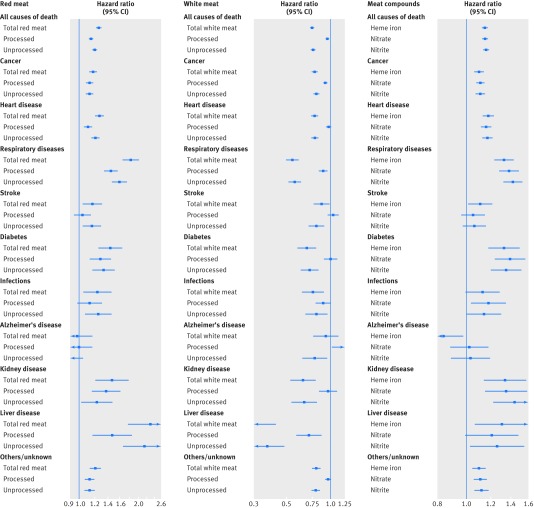
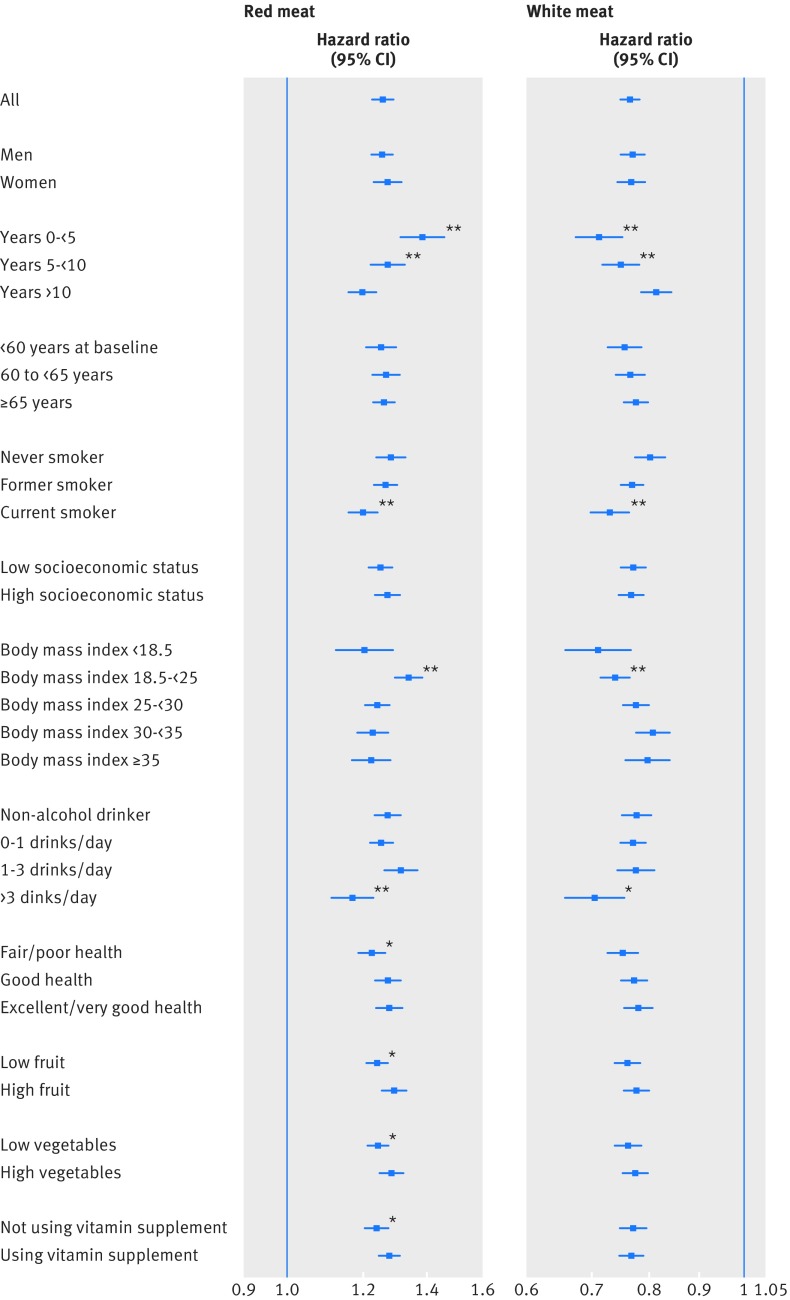
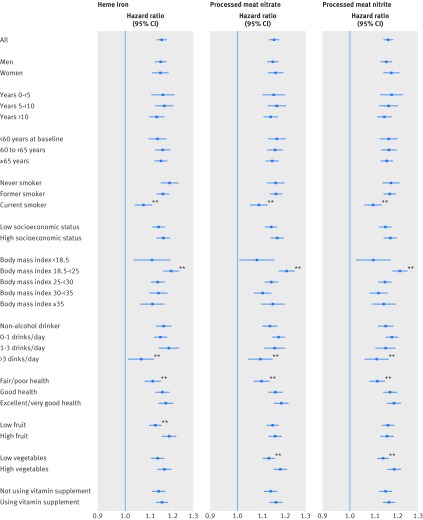
Objective To determine the association of different types of meat intake and meat associated compounds with overall and cause specific mortality. Design Population based cohort study. Setting Baseline dietary data of the NIH-AARP Diet and Health Study (prospective cohort of the general population from six states and two metropolitan areas in the US) and 16 year follow-up data until 31 December 2011. Participants 536 969 AARP members aged 50-71 at baseline. Exposures Intake of total meat, processed and unprocessed red meat (beef, lamb, and pork) and white meat (poultry and fish), heme iron, and nitrate/nitrite from processed meat based on dietary questionnaire. Adjusted Cox proportional hazards regression models were used with the lowest fifth of calorie adjusted intakes as reference categories. Main outcome measure Mortality from any cause during follow-up. Results An increased risk of all cause mortality (hazard ratio for highest versus lowest fifth 1.26, 95% confidence interval 1.23 to 1.29) and death due to nine different causes associated with red meat intake was observed. Both processed and unprocessed red meat intakes were associated with all cause and cause specific mortality. Heme iron and processed meat nitrate/nitrite were independently associated with increased risk of all cause and cause specific mortality. Mediation models estimated that the increased mortality associated with processed red meat was influenced by nitrate intake (37.0-72.0%) and to a lesser degree by heme iron (20.9-24.1%). When the total meat intake was constant, the highest fifth of white meat intake was associated with a 25% reduction in risk of all cause mortality compared with the lowest intake level. Almost all causes of death showed an inverse association with white meat intake. Conclusions The results show increased risks of all cause mortality and death due to nine different causes associated with both processed and unprocessed red meat, accounted for, in part, by heme iron and nitrate/nitrite from processed meat. They also show reduced risks associated with substituting white meat, particularly unprocessed white meat.
Overview
The claims and statistics of this paper haven’t been checked yet.
Run the check — free, no account needed. It reads the open-access text and checks the sources it cites.
Integrity signals
Registry
Cites
Statistics
Figures
Verification
Claims the paper makes
The claims and statistics of this paper haven’t been checked yet.
Run the check — free, no account needed. It reads the open-access text and checks the sources it cites.
Claims other papers make about this one
Each is checked against this paper’s own text: does it say what the citing paper says it does?
The source backs part of the claim, not all of it — or backs it for a different population, condition or comparison.
In the citing paper
“Several observational and crosssectional studies have shown the harmful association between MASLD and high intake of red and processed meat. 302 -304”
From EASL-EASD-EASO Clinical Practice Guidelines on the management of metabolic dysfunction-associated steatotic liver disease (MASLD). (2024) · cites this paper as [302]
Experimental — accuracy not yet measuredThe cited source says what the claim attributes to it.
In the citing paper
“Yet, both prospective cohorts used one dietary measurement at baseline.29 30”
From Red meat intake and risk of coronary heart disease among US men: prospective cohort study (2020) · cites this paper as [30]
The cited source says what the claim attributes to it.
In the citing paper
“In another prospective US cohort study, the dietary intake of processed and unprocessed red meat was each associated with higher risk of mortality from heart disease.30”
From Red meat intake and risk of coronary heart disease among US men: prospective cohort study (2020) · cites this paper as [30]
In the citing paper
“Higher red and processed meat consumption have been consistently associated with increased premature death”
From Association Between Plant and Animal Protein Intake and Overall and Cause-Specific Mortality (2020) · cites this paper as [32]
Self-check
Percentages, sums and reported differences re-computed from the paper’s own numbers.
The self-check needs the paper’s full text.
Citations
Cites
Two new Later Stone Age sites from the Final Pleistocene in the Falémé Valley, eastern Senegal
Ndiaye, M., Lespez, L., Tribolo, C., Rassé, M., Hadjas, I., Davidoux, S., Huysecom, É., & Douze, K. (2024) · Monash University Research Portal (Monash University) · doi:10.3929/ethz-b-000667478 · Cited by 24,214
[1] Role of free radicals and catalytic metal ions in human disease: An overview
Halliwell, B., & Gutteridge, J. M. C. (1990) · Methods in Enzymology · doi:10.1016/0076-6879(90)86093-b · Cited by 4,994
Rothman, K. J., Greenland, S., & Lash, T. L. (1998) · Cited by 2,096
Micha, R., Wallace, S. K., & Mozaffarian, D. (2010) · Circulation · doi:10.1161/circulationaha.109.924977 · Cited by 1,244
Workgroup Report: Drinking-Water Nitrate and Health—Recent Findings and Research Needs
Ward, M. H., de Kok, T. M. C. M., Levallois, P., Brender, J. D., Guliš, G., Nolan, B. T., & VanDerslice, J. A. (2005) · Environmental Health Perspectives · doi:10.1289/ehp.8043 · Cited by 924
Self-citationDietary Guidelines for Americans
Mosher, A. L., Piercy, K. L., Webber, B. J., Goodwin, S. K., Casavale, K. O., & Olson, R. D. (2014) · American Journal of Lifestyle Medicine · doi:10.1177/1559827614521755 · Cited by 868
Guenther, P. M., Kirkpatrick, S. I., Reedy, J., Krebs‐Smith, S. M., Buckman, D. W., Dodd, K. W., Casavale, K. O., & Carroll, R. J. (2014) · Journal of Nutrition · doi:10.3945/jn.113.183079 · Cited by 824
Red Meat Consumption and Mortality: Results From 2 Prospective Cohort Studies
Sun, Q. (2012) · Archives of Internal Medicine · doi:10.1001/archinternmed.2011.2287 · Cited by 763
Pan, A., Sun, Q., Bernstein, A. M., Schulze, M. B., Manson, J. E., Willett, W. C., & Hu, F. B. (2011) · The American Journal of Clinical Nutrition · doi:10.3945/ajcn.111.018978 · Cited by 709
Design and Serendipity in Establishing a Large Cohort with Wide Dietary Intake Distributions
Schatzkin, A. G., Subar, A. F., Thompson, F. E., Harlan, L. C., Tangrea, J. A., Hollenbeck, A. R., Hurwitz, P. E., Coyle, L. M., Schussler, N., Michaud, D. S., et al. (2001) · American Journal of Epidemiology · doi:10.1093/aje/154.12.1119 · Cited by 608
Cited by
Sorted by citations
Food in the Anthropocene: the EAT–Lancet Commission on healthy diets from sustainable food systems
Willett, W., Rockström, J., Loken, B., Springmann, M., Lang, T., Vermeulen, S., Garnett, T., Tilman, D., DeClerck, F., Wood, A., et al. (2019) · The Lancet · doi:10.1016/s0140-6736(18)31788-4 · Cited by 10,880
Tacke, F., Horn, P., Wai-Sun Wong, V., Ratziu, V., Bugianesi, E., Francque, S., Zelber-Sagi, S., Valenti, L., Roden, M., Schick, F., et al. (2024) · Journal of Hepatology · doi:10.1016/j.jhep.2024.04.031 · Cited by 2,210
Meat consumption, health, and the environment
Godfray, H. C. J., Aveyard, P. N., Garnett, T., Hall, J. W., Key, T. J., Lorimer, J., Pierrehumbert, R. T., Scarborough, P., Springmann, M., & Jebb, S. A. (2018) · Science · doi:10.1126/science.aam5324 · Cited by 2,318
(2024) · Obesity Facts · doi:10.1159/000539371 · Cited by 545
Kim, H., Caulfield, L. E., Garcia‐Larsen, V., Steffen, L. M., Coresh, J., & Rebholz, C. M. (2019) · Journal of the American Heart Association · doi:10.1161/jaha.119.012865 · Cited by 437
Metadata
- Authors
- Etemadi, A., Sinha, R., Ward, M. H., Graubard, B. I., Inoue-Choi, M., Dawsey, S. M., & Abnet, C. C.
- Affiliations
- National Institutes of Health (US)
- National Cancer Institute (US)
- Corresponding author
- Etemadi, Arash
- Venue
- BMJ
- Publisher
- BMJ
- Published
- 2017-05-09
- Volume
- 357
- Pages
- j1957
- ISSN
- 1756-1833 (ISSN-L)
- 0959-8138
- PMC
- PMC5423547
- OpenAlex
- W2613130362
- Cited by
- 296
- References
- 62
- Citations by year
- 2026: 15 · 2025: 20 · 2024: 31 · 2023: 29 · 2022: 44 · 2021: 41 · 2020: 38 · 2019: 38 · 2018: 27 · 2017: 13
- FWCI
- 29.79
- Type
- journal article
- Language
- en
- Open access
- hybrid
- doi.org
- Licence
- Locations
- BMJ (publishedVersion, cc-by-nc)
- Europe PMC (PubMed Central) (publishedVersion, cc-by-nc)
- PubMed Central (publishedVersion, cc-by-nc)
- PubMed (publishedVersion)
- HighWire Press Open Archive (submittedVersion)
- Funders
- National Institutes of Health
- Topics
- Health Sciences › Medicine › Public Health, Environmental and Occupational Health › Nutritional Studies and Diet
- Life Sciences › Agricultural and Biological Sciences › Animal Science and Zoology › Meat and Animal Product Quality
- Physical Sciences › Environmental Science › Ecology › Agriculture Sustainability and Environmental Impact
- Keywords
- meat consumption, red meat, processed meat, white meat, heme iron, nitrate, nitrite, all-cause mortality, cause-specific mortality, dietary risk factors, mediation analysis, NIH-AARP Diet and Health Study
- MeSH terms
- Aged, Diet, Diet Surveys, Feeding Behavior, Female, Follow-Up Studies, Heme, Humans, Iron, Male, Meat, Middle Aged, Mortality, Nitrates, Nitrites, Prospective Studies, Risk, United States, Proportional Hazards Models
About these checks
Registry, retraction, Cites and statistics results are computed, not judged, with one exception: a printed reference that no index lists is read once by a model before it counts as a citation error. Claims are extracted by a model and kept only when their quote appears verbatim in the text; each cited source is then checked, with a model’s help, for whether it says what the claim relies on. Those verdicts can be wrong — read the claim’s quote and the cited source before relying on one.
Statistics and arithmetic are recomputed, not judged.
Confidence bands are shown only for fields calibrated on our annotated test set. None is calibrated yet, so no band is shown.
What counts as a claim ›How we measure confidence ›How we check this ›
Are you an author, or do you see a problem with this page? Request a review
