

The DOI matches its Crossref record; 55 of the 56 references it cites were found in a registry or an index.
Temporal trend in dementia incidence since 2002 and projections for prevalence in England and Wales to 2040: modelling study
Open accessAbstract
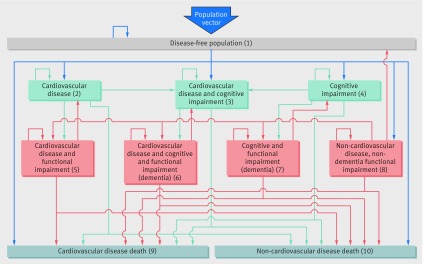
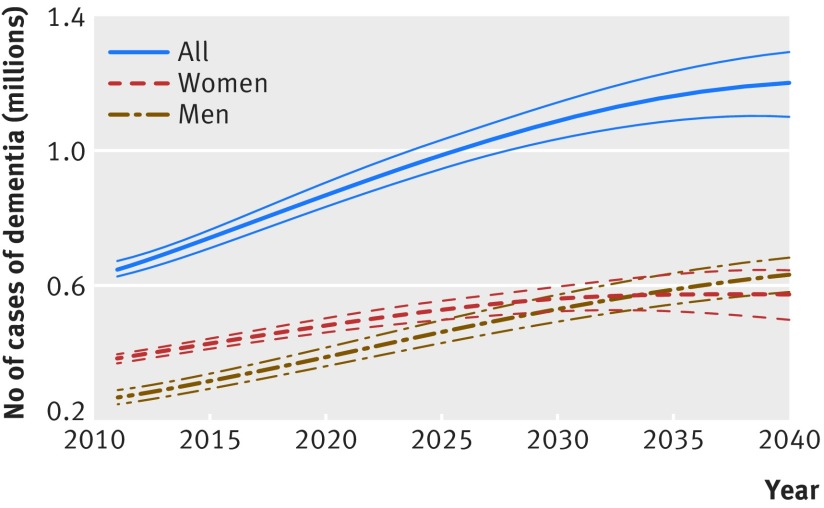
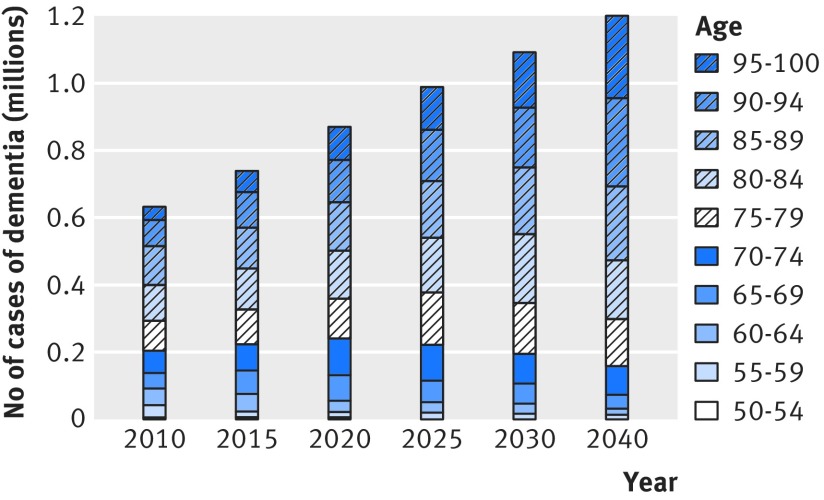
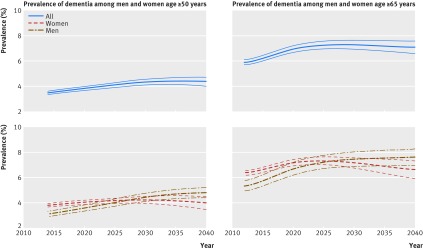
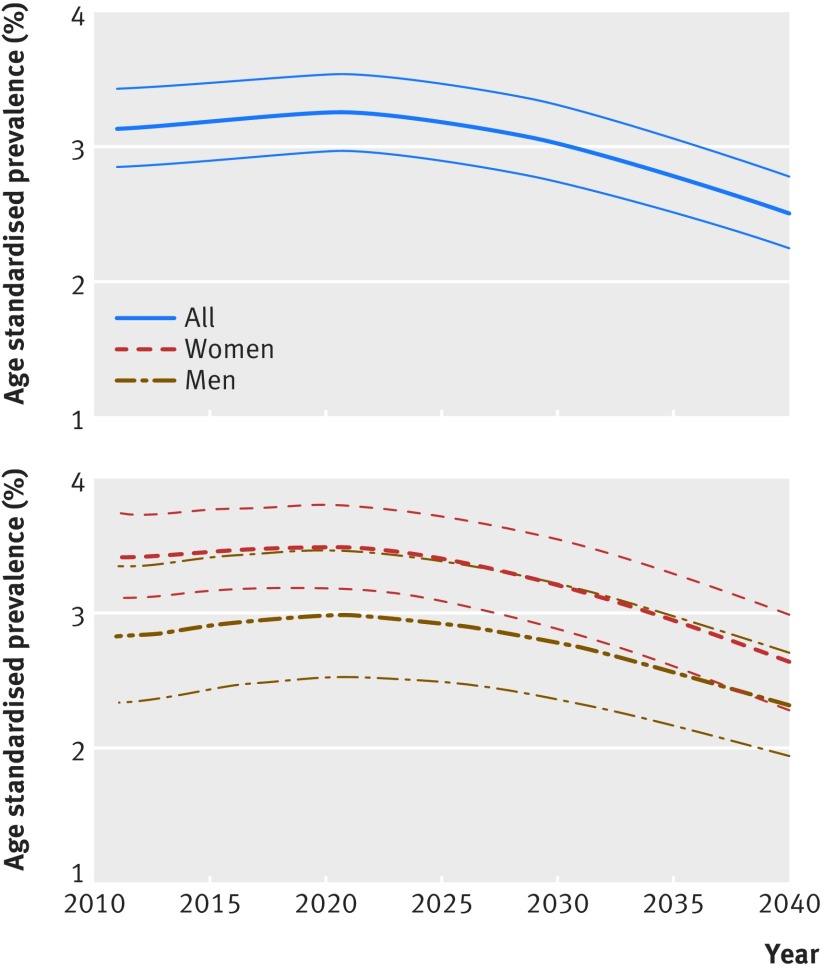
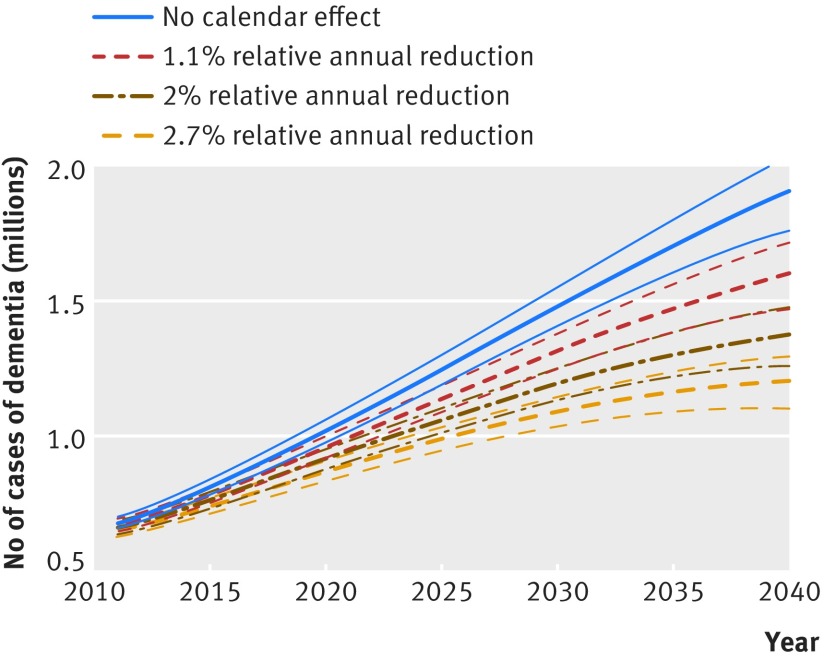
Objective To forecast dementia prevalence with a dynamic modelling approach that integrates calendar trends in dementia incidence with those for mortality and cardiovascular disease. Design Modelling study. Setting General adult population of England and Wales. Participants The English Longitudinal Study of Ageing (ELSA) is a representative panel study with six waves of data across 2002-13. Men and women aged 50 or more years, selected randomly, and their cohabiting partners were recruited to the first wave of ELSA (2002-03). 11392 adults participated (response rate 67%). To maintain representativeness, refreshment participants were recruited to the study at subsequent waves. The total analytical sample constituted 17 906 people. Constant objective criteria based on cognitive and functional impairment were used to ascertain dementia cases at each wave. Main outcome measures To estimate calendar trends in dementia incidence, correcting for bias due to loss to follow-up of study participants, a joint model of longitudinal and time-to-event data was fitted to ELSA data. To forecast future dementia prevalence, the probabilistic Markov model IMPACT-BAM (IMPACT-Better Ageing Model) was developed. IMPACT-BAM models transitions of the population aged 35 or more years through states of cardiovascular disease, cognitive and functional impairment, and dementia, to death. It enables prediction of dementia prevalence while accounting for the growing pool of susceptible people as a result of increased life expectancy and the competing effects due to changes in mortality, and incidence of cardiovascular disease. Results In ELSA, dementia incidence was estimated at 14.3 per 1000 person years in men and 17.0/1000 person years in women aged 50 or more in 2010. Dementia incidence declined at a relative rate of 2.7% (95% confidence interval 2.4% to 2.9%) for each year during 2002-13. Using IMPACT-BAM, we estimated there were approximately 767 000 (95% uncertainty interval 735 000 to 797 000) people with dementia in England and Wales in 2016. Despite the decrease in incidence and age specific prevalence, the number of people with dementia is projected to increase to 872 000, 1 092 000, and 1 205 000 in 2020, 2030, and 2040, respectively. A sensitivity analysis without the incidence decline gave a much larger projected growth, of more than 1.9 million people with dementia in 2040. Conclusions Age specific dementia incidence is declining. The number of people with dementia in England and Wales is likely to increase by 57% from 2016 to 2040. This increase is mainly driven by improved life expectancy.
Overview
The claims and statistics of this paper haven’t been checked yet.
Run the check — free, no account needed. It reads the open-access text and checks the sources it cites.
Integrity signals
Registry
Cites
Statistics
Figures
Verification
Claims the paper makes
The claims and statistics of this paper haven’t been checked yet.
Run the check — free, no account needed. It reads the open-access text and checks the sources it cites.
Claims other papers make about this one
Each is checked against this paper’s own text: does it say what the citing paper says it does?
The source backs part of the claim, not all of it — or backs it for a different population, condition or comparison.
In the citing paper
“Modelling of the UK change suggests a 57% increase in the number of people with dementia from 2016 to 2040, 70% of that expected if age-specific incidence rates remained steady,10 such that by 2040 there will be 1·2 million UK people with dementia.”
From Dementia prevention, intervention, and care: 2020 report of the Lancet Commission (2020) · cites this paper as [10]
Experimental — accuracy not yet measured
Self-check
Percentages, sums and reported differences re-computed from the paper’s own numbers.
The self-check needs the paper’s full text.
Citations
Cites
Correspondence - Tranexamic acid for traumatic brain injury
(2005) · London School of Economics and Political Science Theses Online (London School of Economics and Political Science) · doi:10.1016/s0140-6736 · Cited by 11,894
The projected effect of risk factor reduction on Alzheimer's disease prevalence
Barnes, D. E., & Yaffe, K. S. (2011) · The Lancet Neurology · doi:10.1016/s1474-4422(11)70072-2 · Cited by 2,846
Alzheimer disease in the United States (2010–2050) estimated using the 2010 census
Hebert, L. E., Weuve, J., Scherr, P. A., & Evans, D. A. (2013) · Neurology · doi:10.1212/wnl.0b013e31828726f5 · Cited by 2,642
Cohort profile: The English longitudinal study of ageing
Steptoe, A., Breeze, E., Banks, J., & Nazroo, J. (2013) · International Journal of Epidemiology · doi:10.1093/ije/dys168 · Cited by 1,779
Self-citationDefeating Alzheimer's disease and other dementias: a priority for European science and society
Winblad, B., Amouyel, P., Andrieu, S., Ballard, C., Brayne, C., Brodaty, H., Cedazo-Minguez, A., Dubois, B., Edvardsson, D., Feldman, H., et al. (2016) · The Lancet Neurology · doi:10.1016/s1474-4422(16)00062-4 · Cited by 1,676
Matthews, F. E., Arthur, A., Barnes, L. E., Bond, J., Jagger, C., Robinson, L., & Brayne, C. (2013) · The Lancet · doi:10.1016/s0140-6736(13)61570-6 · Cited by 1,155
Incidence of dementia over three decades in the Framingham heart study
Satizabal, C. L., Beiser, A. S., Chouraki, V., Chêne, G., Dufouil, C., & Seshadri, S. (2016) · New England Journal of Medicine · doi:10.1056/nejmoa1504327 · Cited by 1,051
Recent global trends in the prevalence and incidence of dementia, and survival with dementia
Prince, M., Ali, G.-C., Guerchet, M., Prina, A. M., Albanese, E., & Wu, Y.-T. (2016) · Alzheimer's Research & Therapy · doi:10.1186/s13195-016-0188-8 · Cited by 876
Timing of onset of cognitive decline: results from Whitehall II prospective cohort study
Singh-Manoux, A., Kivimaki, M., Glymour, M. M., Elbaz, A., Berr, C., Ebmeier, K. P., Ferrie, J. E., & Dugravot, A. (2012) · BMJ · doi:10.1136/bmj.d7622 · Cited by 836
Self-citation
Cited by
Sorted by citations
Dementia prevention, intervention, and care: 2020 report of the Lancet Commission
Livingston, G., Huntley, J., Sommerlad, A., Ames, D., Ballard, C., Banerjee, S., Brayne, C., Burns, A., Cohen-Mansfield, J., Cooper, C., et al. (2020) · The Lancet · doi:10.1016/s0140-6736(20)30367-6 · Cited by 10,430
Retracted2023 Alzheimer's disease facts and figures
(2023) · Alzheimer's & Dementia · doi:10.1002/alz.13016 · Cited by 3,212
2024 Alzheimer's disease facts and figures
(2024) · Alzheimer's & Dementia · doi:10.1002/alz.13809 · Cited by 2,536
2019 Alzheimer’s disease facts and figures.
Alzheimer's Association (2019) · Alzheimer's & Dementia · doi:10.1016/j.jalz.2019.01.010 · Cited by 2,461
2020 Alzheimer's disease facts and figures
(2020) · Alzheimer's & Dementia · doi:10.1002/alz.12068 · Cited by 2,353
Metadata
- Authors
- Ahmadi-Abhari, S., Guzman-Castillo, M., Bandosz, P., Shipley, M. J., Muniz-Terrera, G., Singh-Manoux, A., Kivimäki, M., Steptoe, A., Capewell, S., O’Flaherty, M., & Brunner, E. J.
- Affiliations
- University of Liverpool (GB)
- University College London (GB)
- Venue
- BMJ
- Publisher
- BMJ
- Published
- 2017-07-05
- Volume
- 358
- Pages
- j2856
- ISSN
- 1756-1833 (ISSN-L)
- 0959-8138
- PMC
- PMC5497174
- OpenAlex
- W2724131311
- Cited by
- 301
- References
- 56
- Citations by year
- 2026: 20 · 2025: 43 · 2024: 43 · 2023: 23 · 2022: 38 · 2021: 27 · 2020: 31 · 2019: 42 · 2018: 28 · 2017: 5
- FWCI
- 23.82
- Type
- journal article
- Language
- en
- Open access
- hybrid
- doi.org
- Locations
- BMJ (publishedVersion, cc-by)
- Europe PMC (PubMed Central) (publishedVersion, cc-by)
- PubMed Central (publishedVersion, cc-by)
- PubMed (publishedVersion)
- Edinburgh Research Explorer (University of Edinburgh) (publishedVersion, cc-by)
- UCL Discovery (University College London) (submittedVersion)
- Työväentutkimus Vuosikirja (submittedVersion)
- HighWire Press Open Archive (submittedVersion)
- Funders
- British Heart Foundation (RG/16/11/32334, K013351, 32334, PG/11/63/29011, RG/13/2/30098)
- NordForsk (RG/16/11/32334, K013351)
- Medical Research Council (MR/K013351/1, K013351, RG/16/11/32334)
- Economic and Social Research Council (ES/J023299/1)
- National Institute on Aging (R01AG017644)
- Topics
- Health Sciences › Medicine › Psychiatry and Mental health › Dementia and Cognitive Impairment Research
- Social Sciences › Demography › Insurance, Mortality, Demography, Risk Management
- Physical Sciences › Mathematics › Statistics and Probability › Statistical Methods in Epidemiology
- Keywords
- dementia, dementia incidence, dementia prevalence projections, temporal trends, Markov model, cardiovascular disease, cognitive impairment, functional disability, mortality, loss to follow-up, England and Wales, population aging, dementia risk factors, English Longitudinal Study of Ageing
- MeSH terms
- Aged, Dementia, England, Female, Health Surveys, Humans, Life Expectancy, Longitudinal Studies, Male, Middle Aged, Models, Theoretical, Population Surveillance, Socioeconomic Factors, Time Factors, Wales, Incidence, Prevalence, Sex Distribution
About these checks
Registry, retraction, Cites and statistics results are computed, not judged, with one exception: a printed reference that no index lists is read once by a model before it counts as a citation error. Claims are extracted by a model and kept only when their quote appears verbatim in the text; each cited source is then checked, with a model’s help, for whether it says what the claim relies on. Those verdicts can be wrong — read the claim’s quote and the cited source before relying on one.
Statistics and arithmetic are recomputed, not judged.
Confidence bands are shown only for fields calibrated on our annotated test set. None is calibrated yet, so no band is shown.
What counts as a claim ›How we measure confidence ›How we check this ›
Are you an author, or do you see a problem with this page? Request a review
