

The DOI matches its Crossref record; 67 of the 67 references it cites were found in a registry or an index; none of the 57 sources its claims cite is checked for support yet.
History of modern nutrition science—implications for current research, dietary guidelines, and food policy
Open accessAbstract
Dariush Mozaffarian and colleagues describe how the history of modern nutrition science has shaped current thinking
Overview
AI snapshot
Written from the paper’s full text.
TL;DR
This historical review argues that modern nutrition science is young and was shaped by early single-nutrient deficiency discoveries, leaving a reductionist legacy in research, dietary guidelines, and policy. It calls for a shift toward food-based diet patterns and systems-level policy to address both undernutrition and diet-related non-communicable diseases.
Key findings
- Modern nutrition science is less than a century old: the first vitamin was isolated and chemically defined in 1926, and the first half of the 20th century focused on identifying and synthesizing vitamins and minerals to prevent deficiency diseases such as scurvy, beriberi, pellagra, rickets, xerophthalmia, and nutritional anaemias.
- A reductionist, single-nutrient model was extended to diet-related non-communicable diseases, exemplified by the 1977 US Senate report *Dietary Goals for the United States* and the 1980 *Dietary Guidelines for Americans*, which focused on total fat, saturated fat, cholesterol, sugar, sodium, and fiber.
- Later evidence showed that a focus on total fat produced little measurable health benefit, while diet patterns such as Mediterranean and similar food-based patterns showed more consistent benefits; single-nutrient theories were inadequate to explain many effects of diet on non-communicable diseases.
- Lower income countries now face a “double burden” of conventional malnutrition (insufficient calories and micronutrients) and modern malnutrition (poor diet quality) leading to obesity, type 2 diabetes, cardiovascular diseases, and cancer; policy should prioritize food-based targets, trusted communication, and integrated systems-level strategies.
Methods
- Design: narrative historical review and commentary on modern nutrition science, dietary guidelines, and food policy; no systematic review, data sample, or formal quantitative analysis is described.
- Approach: chronological synthesis of key historical events from the 1910s to the present, organized into eras such as vitamin discovery, fat versus sugar and the protein gap, diet-related chronic diseases and supplementation, and recent evidence debates and diet patterns.
- Main analysis: interpretive synthesis linking historical developments to current research priorities, dietary guidelines, and policy recommendations.
Limitations
- The paper does not state formal limitations.
- Evident from the text: as a narrative historical review, it does not describe systematic search or selection criteria, quantitative synthesis, or formal risk-of-bias assessment; conclusions rely on selected historical events and cited literature.
Model-written summary. Check it against the paper before relying on it.
Integrity signals
Registry
Cites
Statistics
Figures
Verification
Claims the paper makes
30 Not checked yet · 28 Own interpretation · 24 No basis given · 1 Own method
None of the sources cited for this claim have been checked yet.
In the paper
“This new science of single nutrient deficiency diseases also led to fortification of selected staple foods with micronutrients, such as iodine in salt and niacin (vitamin B3) and iron in wheat flour and bread.8 9 10”
§ History of modern nutrition science—implications for current research, dietary guidelines, and food policy > 1910s to 1950s: era of vitamin discovery
What the sources say
- Not checked yetcites [8] Backstrand JR The history and future of food fortification in the United States: a public health perspective. Nutr Rev 2002; 60: 15- 26. 10.1301/002966402760240390 11842999
- Not checked yetcites [9] Bishai D Nalubola R The history of food fortification in the United States: Its relevance for current fortification efforts in developing countries. Econ Dev Cult Change 2002; 51: 37- 53 10.1086/345361
- Not checked yetcites [10] Fletcher RJ Bell IP Lambert JP Public health aspects of food fortification: a question of balance. Proc Nutr Soc 2004; 63: 605- 14. 10.1079/PNS2004391 15831133
plaindirect- Asserted: passes — The authors put it forward as true.
- Checkable: passes — It can be checked against evidence.
- Load-bearing: unclear — It is unclear whether the paper’s conclusions depend on it.
- Based: passes — The paper gives a reason why it holds.
The paper states this without a source or data behind it here, so there is nothing to check it against. The quote shows it is in the paper.
In the paper
“These approaches proved to be effective at reducing the prevalence of many common deficiency diseases, including goitre (iodine), xerophthalmia (vitamin A), rickets (vitamin D), and anaemia (iron).”
§ History of modern nutrition science—implications for current research, dietary guidelines, and food policy > 1910s to 1950s: era of vitamin discovery
plaindirect- Asserted: passes — The authors put it forward as true.
- Checkable: passes — It can be checked against evidence.
- Load-bearing: unclear — It is unclear whether the paper’s conclusions depend on it.
- Based: passes — The paper gives a reason why it holds.
A conclusion the paper draws from its own results — it cites no other source for it, so there is none to check. The quote shows it is in the paper.
In the paper
“However, the chemical synthesis of vitamins quickly led to food based strategies being supplanted by treatment with individual vitamin supplements.”
§ History of modern nutrition science—implications for current research, dietary guidelines, and food policy > 1910s to 1950s: era of vitamin discovery
plaindirect- Asserted: passes — The authors put it forward as true.
- Checkable: passes — It can be checked against evidence.
- Load-bearing: unclear — It is unclear whether the paper’s conclusions depend on it.
- Based: unclear — It is unclear why the paper says it holds.
None of the sources cited for this claim have been checked yet.
In the paper
“This pushed the field beyond the RDA framework and other nutrient metrics designed to identify thresholds for nutrient deficiency diseases, and towards complex biological effects of foods and diet patterns.40 41 42 43 44”
§ History of modern nutrition science—implications for current research, dietary guidelines, and food policy > 1990s to the present: evidence debates, diet patterns, the double burden
What the sources say
- Not checked yetcites [40] Jacobs DR Jr Tapsell LC Food, not nutrients, is the fundamental unit in nutrition. Nutr Rev 2007; 65: 439- 50. 17972438
- Not checked yetcites [41] Mozaffarian D Ludwig DS Dietary guidelines in the 21st century–a time for food. JAMA 2010; 304: 681- 2. 10.1001/jama.2010.1116 20699461
- Not checked yetcites [42] Jacobs DR Tapsell LC Food synergy: the key to a healthy diet. Proc Nutr Soc 2013; 72: 200- 6. 10.1017/S0029665112003011 23312372
plaindirect- Asserted: passes — The authors put it forward as true.
- Checkable: passes — It can be checked against evidence.
- Load-bearing: passes — The paper’s conclusions depend on it.
- Based: passes — The paper gives a reason why it holds.
A conclusion the paper draws from its own results — it cites no other source for it, so there is none to check. The quote shows it is in the paper.
In the paper
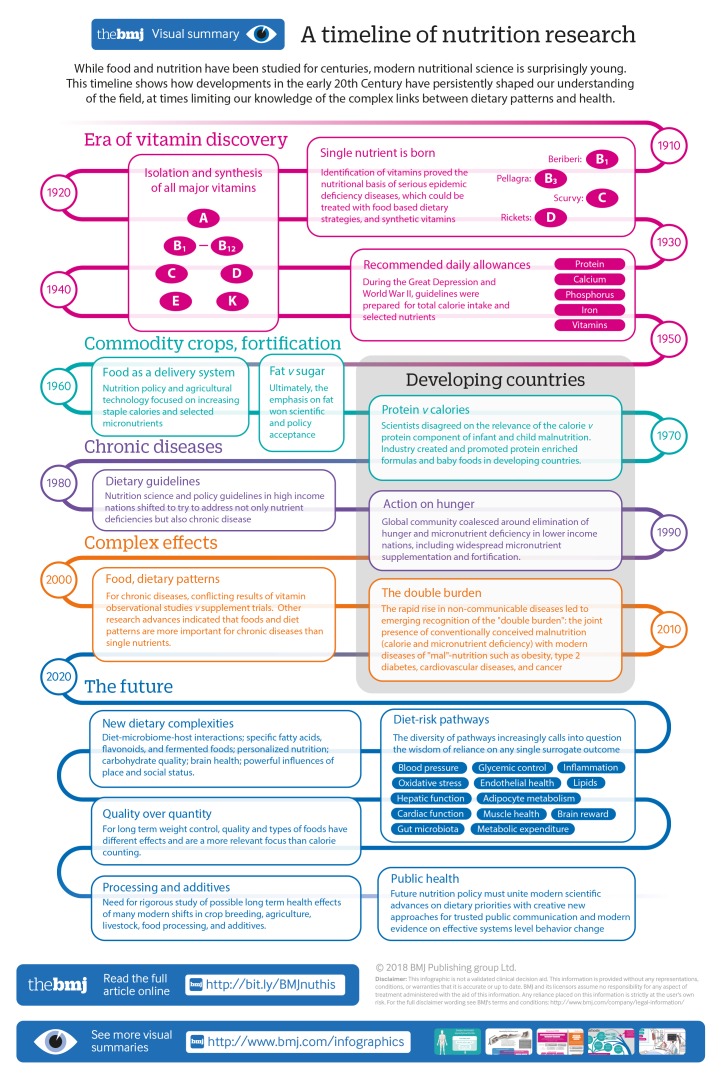
“Together, these advances suggested that single nutrient theories were inadequate to explain many effects of diet on non-communicable diseases.”
§ History of modern nutrition science—implications for current research, dietary guidelines, and food policy > 1990s to the present: evidence debates, diet patterns, the double burden
hedged- Asserted: passes — The authors put it forward as true.
- Checkable: passes — It can be checked against evidence.
- Load-bearing: passes — The paper’s conclusions depend on it.
- Based: passes — The paper gives a reason why it holds.
None of the sources cited for this claim have been checked yet.
In the paper
“The debate essentially ended when in 1975 leading scientists in the US and London independently concluded from the scientific evidence that a lack of food was the main problem:22”
§ History of modern nutrition science—implications for current research, dietary guidelines, and food policy > 1950s to 1970s: fat versus sugar and the protein gap
What the sources say
- Not checked yetcites [22] Carpenter K Protein and energy: a study of changing ideas in nutrition. Cambridge University Press, 1994.
- Not checked yetcites [23] Waterlow JC Payne PR The protein gap. Nature 1975; 258: 113- 7. 10.1038/258113a0 810729
plaindirect- Asserted: passes — The authors put it forward as true.
- Checkable: passes — It can be checked against evidence.
- Load-bearing: unclear — It is unclear whether the paper’s conclusions depend on it.
- Based: passes — The paper gives a reason why it holds.
A conclusion the paper draws from its own results — it cites no other source for it, so there is none to check. The quote shows it is in the paper.
In the paper
“However, the earlier decades of uncertainty had fostered a multinational industry that continued to promote formula and baby foods in low income countries based on their protein content and nutrient fortification.”
§ History of modern nutrition science—implications for current research, dietary guidelines, and food policy > 1950s to 1970s: fat versus sugar and the protein gap
plaindirect- Asserted: passes — The authors put it forward as true.
- Checkable: passes — It can be checked against evidence.
- Load-bearing: unclear — It is unclear whether the paper’s conclusions depend on it.
- Based: unclear — It is unclear why the paper says it holds.
A conclusion the paper draws from its own results — it cites no other source for it, so there is none to check. The quote shows it is in the paper.
In the paper
“This conclusion influenced subsequent efforts to tackle malnutrition in developing countries.”
§ History of modern nutrition science—implications for current research, dietary guidelines, and food policy > 1950s to 1970s: fat versus sugar and the protein gap
plaindirect- Asserted: passes — The authors put it forward as true.
- Checkable: passes — It can be checked against evidence.
- Load-bearing: unclear — It is unclear whether the paper’s conclusions depend on it.
- Based: passes — The paper gives a reason why it holds.
In the paper
“This was not without controversy: in 1980, the US National Academy of Sciences Food and Nutrition Board reviewed the data and concluded that insufficient evidence existed to limit total fat, saturated fat, and dietary cholesterol across the population.20”
§ History of modern nutrition science—implications for current research, dietary guidelines, and food policy > 1950s to 1970s: fat versus sugar and the protein gap
What the sources say
- Not checked yetcites [20] National Research Council Food and Nutrition Board Toward healthful diets. National Academy of Sciences, 1980.
plain- Asserted: passes — The authors put it forward as true.
- Checkable: passes — It can be checked against evidence.
- Load-bearing: unclear — It is unclear whether the paper’s conclusions depend on it.
- Based: passes — The paper gives a reason why it holds.
None of the sources cited for this claim have been checked yet.
In the paper
“This progress was extended to recognition of the relevance of diet patterns such as traditional Mediterranean or vegetarian diets that emphasised minimally processed foods such as fruits, vegetables, nuts, beans, whole grains, and plant oils and low amounts of highly processed foods rich in starch, sugar, salt, and additives.32 33”
§ History of modern nutrition science—implications for current research, dietary guidelines, and food policy > 1990s to the present: evidence debates, diet patterns, the double burden
What the sources say
- Not checked yetcites [32] Dietary Guidelines Advisory Committee Scientific Report of the 2015 Dietary Guidelines Advisory Committee 2015. http://www.health.gov/dietaryguidelines/2015-scientific-report/
- Not checked yetcites [33] Mozaffarian D Dietary and policy priorities for cardiovascular disease, diabetes, and obesity: a comprehensive review. Circulation 2016; 133: 187- 225. 10.1161/CIRCULATIONAHA.115.018585 26746178 PMC4814348
plaincorrelational- Asserted: passes — The authors put it forward as true.
- Checkable: passes — It can be checked against evidence.
- Load-bearing: unclear — It is unclear whether the paper’s conclusions depend on it.
- Based: passes — The paper gives a reason why it holds.
- Probably not a substantial claim. 29
- It may state two separate claims as one. 25
The paper states this without a source or data behind it here, so there is nothing to check it against. The quote shows it is in the paper.
In the paper
“The first vitamin was isolated and chemically defined in 1926, less than 100 years ago”
§ History of modern nutrition science—implications for current research, dietary guidelines, and food policy > Abstract
plain- Asserted: passes — The authors put it forward as true.
- Checkable: passes — It can be checked against evidence.
- Load-bearing: fails — The paper’s conclusions may not depend on it.
- Based: fails — The paper may give no reason why it holds.
Probably not a substantial claim. The paper’s conclusions may not depend on it. The paper may give no reason why it holds.
None of the sources cited for this claim have been checked yet.
In the paper
“In 1932, vitamin C was isolated and definitively documented, for the first time, to protect against scurvy,6 some 200 years after ship’s surgeon James Lind tested lemons for treating scurvy in sailors.7”
§ History of modern nutrition science—implications for current research, dietary guidelines, and food policy > 1910s to 1950s: era of vitamin discovery
What the sources say
- Not checked yetcites [6] American Chemical Society National Historic Chemical Landmarks. The Discovery of Vitamin C by Albert Szent-Györgyi. 2002. https://www.acs.org/content/acs/en/education/whatischemistry/landmarks/szentgyorgyi.html
- Not checked yetcites [7] Lind J A Treatise of the scurvy. A Millar, 1753.
boosteddirect- Asserted: passes — The authors put it forward as true.
- Checkable: passes — It can be checked against evidence.
- Load-bearing: fails — The paper’s conclusions may not depend on it.
- Based: passes — The paper gives a reason why it holds.
Probably not a substantial claim. The paper’s conclusions may not depend on it.
The paper states this without a source or data behind it here, so there is nothing to check it against. The quote shows it is in the paper.
In the paper
“Their identification in animal and human studies proved the nutritional basis of serious deficiency diseases and initially led to dietary strategies to tackle beriberi (vitamin B1), pellagra (vitamin B3), scurvy (vitamin C), pernicious anaemia (vitamin B12), rickets (vitamin D), and other deficiency conditions.”
§ History of modern nutrition science—implications for current research, dietary guidelines, and food policy > 1910s to 1950s: era of vitamin discovery
plaindirect- Asserted: passes — The authors put it forward as true.
- Checkable: passes — It can be checked against evidence.
- Load-bearing: unclear — It is unclear whether the paper’s conclusions depend on it.
- Based: passes — The paper gives a reason why it holds.
It may state two separate claims as one.
In the paper
“Casimir Funk in 1913 came up with idea of a “vital amine” in food, originating from the observation that the hulk of unprocessed rice protected chickens against a beriberi-like condition.5”
§ History of modern nutrition science—implications for current research, dietary guidelines, and food policy > 1910s to 1950s: era of vitamin discovery
What the sources say
- Not checked yetcites [5] Eijkman C. Nobel Lecture: the Nobel Prize in Physiology or Medicine. 1929. https://www.nobelprize.org/nobel_prizes/medicine/laureates/1929/eijkman-lecture.html.
plaindirect- Asserted: passes — The authors put it forward as true.
- Checkable: passes — It can be checked against evidence.
- Load-bearing: fails — The paper’s conclusions may not depend on it.
- Based: passes — The paper gives a reason why it holds.
Probably not a substantial claim. The paper’s conclusions may not depend on it. It may state two separate claims as one.
A conclusion the paper draws from its own results — it cites no other source for it, so there is none to check. The quote shows it is in the paper.
In the paper
“This article describes key historical events in modern nutrition science that form the basis of our current understanding of diet and health and clarify contemporary priorities, new trends, and controversies in nutrition science and policy.”
§ History of modern nutrition science—implications for current research, dietary guidelines, and food policy > Abstract
plaindirect- Asserted: passes — The authors put it forward as true.
- Checkable: fails — It may be too vague to check against evidence.
- Load-bearing: passes — The paper’s conclusions depend on it.
- Based: passes — The paper gives a reason why it holds.
Probably not a substantial claim. It may be too vague to check against evidence. It may state two separate claims as one.
The paper states this without a source or data behind it here, so there is nothing to check it against. The quote shows it is in the paper.
In the paper
“By the mid-20th century all major vitamins had been isolated and synthesised (fig 1).”
§ History of modern nutrition science—implications for current research, dietary guidelines, and food policy > 1910s to 1950s: era of vitamin discovery
plain- Asserted: passes — The authors put it forward as true.
- Checkable: passes — It can be checked against evidence.
- Load-bearing: fails — The paper’s conclusions may not depend on it.
- Based: fails — The paper may give no reason why it holds.
Probably not a substantial claim. The paper’s conclusions may not depend on it. The paper may give no reason why it holds.
The paper states this without a source or data behind it here, so there is nothing to check it against. The quote shows it is in the paper.
In the paper
“The first half of the 20th century witnessed the identification and synthesis of many of the known essential vitamins and minerals and their use to prevent and treat nutritional deficiency related diseases including scurvy, beriberi, pellagra, rickets, xerophthalmia, and nutritional anaemias.”
§ History of modern nutrition science—implications for current research, dietary guidelines, and food policy > 1910s to 1950s: era of vitamin discovery
plaindirect- Asserted: passes — The authors put it forward as true.
- Checkable: passes — It can be checked against evidence.
- Load-bearing: unclear — It is unclear whether the paper’s conclusions depend on it.
- Based: passes — The paper gives a reason why it holds.
It may state two separate claims as one.
In the paper
“For example, the first recommended dietary allowances (RDAs) were a direct result of these concerns, when the League of Nations, British Medical Association, and the US government separately commissioned scientists to generate new minimum dietary requirements to be prepared for war.14”
§ History of modern nutrition science—implications for current research, dietary guidelines, and food policy > 1910s to 1950s: era of vitamin discovery
What the sources say
- Not checked yetcites [14] Harper AE Evolution of recommended dietary allowances–new directions? Annu Rev Nutr 1987; 7: 509- 37. 10.1146/annurev.nu.07.070187.002453 3300745
plaindirect- Asserted: passes — The authors put it forward as true.
- Checkable: passes — It can be checked against evidence.
- Load-bearing: unclear — It is unclear whether the paper’s conclusions depend on it.
- Based: passes — The paper gives a reason why it holds.
It may state two separate claims as one.
The paper states this without a source or data behind it here, so there is nothing to check it against. The quote shows it is in the paper.
In the paper
“This “vital amine” or vitamin was first isolated in 1926 and named thiamine, and subsequently synthesised in 1936 as vitamin B1.”
§ History of modern nutrition science—implications for current research, dietary guidelines, and food policy > 1910s to 1950s: era of vitamin discovery
plain- Asserted: passes — The authors put it forward as true.
- Checkable: passes — It can be checked against evidence.
- Load-bearing: fails — The paper’s conclusions may not depend on it.
- Based: fails — The paper may give no reason why it holds.
Probably not a substantial claim. The paper’s conclusions may not depend on it. The paper may give no reason why it holds. It may state two separate claims as one.
A conclusion the paper draws from its own results — it cites no other source for it, so there is none to check. The quote shows it is in the paper.
In the paper
“Research on the role of nutrition in complex non-communicable chronic diseases, such as cardiovascular disease, diabetes, obesity, and cancers, is even more recent, accelerating over the past two or three decades and especially after 2000.”
§ History of modern nutrition science—implications for current research, dietary guidelines, and food policy > Abstract
plain- Asserted: passes — The authors put it forward as true.
- Checkable: passes — It can be checked against evidence.
- Load-bearing: fails — The paper’s conclusions may not depend on it.
- Based: fails — The paper may give no reason why it holds.
Probably not a substantial claim. The paper’s conclusions may not depend on it. The paper may give no reason why it holds.
A conclusion the paper draws from its own results — it cites no other source for it, so there is none to check. The quote shows it is in the paper.
In the paper
“Accelerating economic development and modernisation of agricultural, food processing, and food formulation techniques continued to reduce single nutrient deficiency diseases globally.”
§ History of modern nutrition science—implications for current research, dietary guidelines, and food policy > 1970s to 1990s: diet related chronic diseases and supplementation
plaindirect- Asserted: passes — The authors put it forward as true.
- Checkable: passes — It can be checked against evidence.
- Load-bearing: fails — The paper’s conclusions may not depend on it.
- Based: fails — The paper may give no reason why it holds.
Probably not a substantial claim. The paper’s conclusions may not depend on it. The paper may give no reason why it holds.
The paper states this without a source or data behind it here, so there is nothing to check it against. The quote shows it is in the paper.
In the paper
“Among the most important scientific development of recent decades was the design and completion of multiple, complementary, large nutrition studies, including prospective observational cohorts, randomised clinical trials, and, more recently, genetic consortiums.”
§ History of modern nutrition science—implications for current research, dietary guidelines, and food policy > 1990s to the present: evidence debates, diet patterns, the double burden
plain- Asserted: passes — The authors put it forward as true.
- Checkable: passes — It can be checked against evidence.
- Load-bearing: fails — The paper’s conclusions may not depend on it.
- Based: fails — The paper may give no reason why it holds.
Probably not a substantial claim. The paper’s conclusions may not depend on it. The paper may give no reason why it holds.
The paper states this without a source or data behind it here, so there is nothing to check it against. The quote shows it is in the paper.
In the paper
“Field trials provided a basis for WHO recommendations for widespread micronutrient supplementation, especially during pregnancy, with iron and vitamin A, and for fortification of salt with iodine to prevent goitre and developmental abnormalities such as congenital hypothyroidism and hearing loss.”
§ History of modern nutrition science—implications for current research, dietary guidelines, and food policy > 1970s to 1990s: diet related chronic diseases and supplementation
plaindirect- Asserted: passes — The authors put it forward as true.
- Checkable: passes — It can be checked against evidence.
- Load-bearing: unclear — It is unclear whether the paper’s conclusions depend on it.
- Based: passes — The paper gives a reason why it holds.
It may state two separate claims as one.
None of the sources cited for this claim have been checked yet.
In the paper
“For weight loss and glycaemic control, decades of emphasis on low fat diets were questioned by the results of a series of prospective cohort studies, metabolic feeding studies, and randomised trials, which showed that foods rich in healthy fats produced benefit, while foods rich in starch and sugar caused harm.33 45 46 47”
§ History of modern nutrition science—implications for current research, dietary guidelines, and food policy > 1990s to the present: evidence debates, diet patterns, the double burden
What the sources say
- Not checked yetcites [33] Mozaffarian D Dietary and policy priorities for cardiovascular disease, diabetes, and obesity: a comprehensive review. Circulation 2016; 133: 187- 225. 10.1161/CIRCULATIONAHA.115.018585 26746178 PMC4814348
- Not checked yetcites [45] Mensink RP Zock PL Kester AD Katan MB Effects of dietary fatty acids and carbohydrates on the ratio of serum total to HDL cholesterol and on serum lipids and apolipoproteins: a meta-analysis of 60 controlled trials. Am J Clin Nutr 2003; 77: 1146- 55. 10.1093/ajcn/77.5.1146 12716665
- Not checked yetcites [46] Tobias DK Chen M Manson JE Ludwig DS Willett W Hu FB Effect of low-fat diet interventions versus other diet interventions on long-term weight change in adults: a systematic review and meta-analysis. Lancet Diabetes Endocrinol 2015; 3: 968- 79. 10.1016/S2213-8587(15)00367-8 26527511 PMC4667723
plaindirect- Asserted: passes — The authors put it forward as true.
- Checkable: passes — It can be checked against evidence.
- Load-bearing: passes — The paper’s conclusions depend on it.
- Based: passes — The paper gives a reason why it holds.
It may state two separate claims as one.
A conclusion the paper draws from its own results — it cites no other source for it, so there is none to check. The quote shows it is in the paper.
In the paper
“This led to a proliferation of industrially crafted food products low in fat, saturated fat, and cholesterol and fortified with micronutrients, as well as expansion of other nutrient focused technologies to reduce saturated fat such as partial hydrogenation of vegetable oils.”
§ History of modern nutrition science—implications for current research, dietary guidelines, and food policy > 1970s to 1990s: diet related chronic diseases and supplementation
plaindirect- Asserted: passes — The authors put it forward as true.
- Checkable: passes — It can be checked against evidence.
- Load-bearing: unclear — It is unclear whether the paper’s conclusions depend on it.
- Based: passes — The paper gives a reason why it holds.
It may state two separate claims as one.
The paper states this without a source or data behind it here, so there is nothing to check it against. The quote shows it is in the paper.
In the paper
“Ultimately, the emphasis on fat won scientific and policy acceptance, embodied in the 1977 US Senate committee report Dietary Goals for the United States, which recommended low fat, low cholesterol diets for all.”
§ History of modern nutrition science—implications for current research, dietary guidelines, and food policy > 1950s to 1970s: fat versus sugar and the protein gap
plaindirect- Asserted: passes — The authors put it forward as true.
- Checkable: passes — It can be checked against evidence.
- Load-bearing: unclear — It is unclear whether the paper’s conclusions depend on it.
- Based: passes — The paper gives a reason why it holds.
It may state two separate claims as one.
A conclusion the paper draws from its own results — it cites no other source for it, so there is none to check. The quote shows it is in the paper.
In the paper
“At the same time, the rising burdens of diet related non-communicable diseases began to be recognised, leading to new research directions.”
§ History of modern nutrition science—implications for current research, dietary guidelines, and food policy > 1950s to 1970s: fat versus sugar and the protein gap
plaindirect- Asserted: passes — The authors put it forward as true.
- Checkable: passes — It can be checked against evidence.
- Load-bearing: fails — The paper’s conclusions may not depend on it.
- Based: passes — The paper gives a reason why it holds.
Probably not a substantial claim. The paper’s conclusions may not depend on it. It may state two separate claims as one.
In the paper
“Evidence was increasing that vitamin A supplements could prevent child mortality from infection, such as measles, as well as preventing night blindness and xerophthalmia.26”
§ History of modern nutrition science—implications for current research, dietary guidelines, and food policy > 1970s to 1990s: diet related chronic diseases and supplementation
What the sources say
- Not checked yetcites [26] Sommer A West KPJ Vitamin A deficiency: health, survival, and vision. Oxford University Press, 1996.
hedgeddirect- Asserted: passes — The authors put it forward as true.
- Checkable: passes — It can be checked against evidence.
- Load-bearing: unclear — It is unclear whether the paper’s conclusions depend on it.
- Based: passes — The paper gives a reason why it holds.
It may state two separate claims as one.
The paper states this without a source or data behind it here, so there is nothing to check it against. The quote shows it is in the paper.
In the paper
“Coronary mortality also began to fall in high income countries, but many other diet related chronic diseases were increasing, including obesity, type 2 diabetes, and several cancers.”
§ History of modern nutrition science—implications for current research, dietary guidelines, and food policy > 1970s to 1990s: diet related chronic diseases and supplementation
plaincorrelational- Asserted: passes — The authors put it forward as true.
- Checkable: passes — It can be checked against evidence.
- Load-bearing: fails — The paper’s conclusions may not depend on it.
- Based: fails — The paper may give no reason why it holds.
Probably not a substantial claim. The paper’s conclusions may not depend on it. The paper may give no reason why it holds. It may state two separate claims as one.
The paper states this without a source or data behind it here, so there is nothing to check it against. The quote shows it is in the paper.
In the paper
“Clinical trials allowed further testing of specific questions in targeted, often high risk populations, in particular effects of isolated vitamin supplements and, more recently, specific diet patterns.”
§ History of modern nutrition science—implications for current research, dietary guidelines, and food policy > 1990s to the present: evidence debates, diet patterns, the double burden
plain- Asserted: passes — The authors put it forward as true.
- Checkable: passes — It can be checked against evidence.
- Load-bearing: fails — The paper’s conclusions may not depend on it.
- Based: passes — The paper gives a reason why it holds.
Probably not a substantial claim. The paper’s conclusions may not depend on it.
The paper states this without a source or data behind it here, so there is nothing to check it against. The quote shows it is in the paper.
In the paper
“Genetic consortiums provided important evidence on genetic influences on dietary choices, gene-diet interactions affecting disease risk factors and endpoints, and Mendelian randomisation studies of causal effects of nutritional biomarkers.”
§ History of modern nutrition science—implications for current research, dietary guidelines, and food policy > 1990s to the present: evidence debates, diet patterns, the double burden
plaincorrelational- Asserted: passes — The authors put it forward as true.
- Checkable: passes — It can be checked against evidence.
- Load-bearing: fails — The paper’s conclusions may not depend on it.
- Based: passes — The paper gives a reason why it holds.
Probably not a substantial claim. The paper’s conclusions may not depend on it. It may state two separate claims as one.
A conclusion the paper draws from its own results — it cites no other source for it, so there is none to check. The quote shows it is in the paper.
In the paper
“Thus, despite the shift in scientific thinking to focus on economic development, substantial emphasis remained or even accelerated on providing sufficient calories, most often as starchy staples, plus vitamin fortification and supplementation.”
§ History of modern nutrition science—implications for current research, dietary guidelines, and food policy > 1950s to 1970s: fat versus sugar and the protein gap
plain- Asserted: passes — The authors put it forward as true.
- Checkable: passes — It can be checked against evidence.
- Load-bearing: passes — The paper’s conclusions depend on it.
- Based: passes — The paper gives a reason why it holds.
It may state two separate claims as one.
None of the sources cited for this claim have been checked yet.
In the paper
“In contrast to single nutrients, physiological intervention trials, large cohort studies, and randomised clinical trials provided more consistent evidence for diet patterns, such as low fat diets (few significant effects) or Mediterranean and similar food based patterns (consistent benefits).32 33”
§ History of modern nutrition science—implications for current research, dietary guidelines, and food policy > 1990s to the present: evidence debates, diet patterns, the double burden
What the sources say
- Not checked yetcites [32] Dietary Guidelines Advisory Committee Scientific Report of the 2015 Dietary Guidelines Advisory Committee 2015. http://www.health.gov/dietaryguidelines/2015-scientific-report/
- Not checked yetcites [33] Mozaffarian D Dietary and policy priorities for cardiovascular disease, diabetes, and obesity: a comprehensive review. Circulation 2016; 133: 187- 225. 10.1161/CIRCULATIONAHA.115.018585 26746178 PMC4814348
plaincorrelational- Asserted: passes — The authors put it forward as true.
- Checkable: passes — It can be checked against evidence.
- Load-bearing: passes — The paper’s conclusions depend on it.
- Based: passes — The paper gives a reason why it holds.
It may state two separate claims as one.
The paper states this without a source or data behind it here, so there is nothing to check it against. The quote shows it is in the paper.
In the paper
“In addition, nutrient supplementation strategies remained effective at preventing or treating endemic deficiency diseases.”
§ History of modern nutrition science—implications for current research, dietary guidelines, and food policy > 1950s to 1970s: fat versus sugar and the protein gap
plaindirect- Asserted: passes — The authors put it forward as true.
- Checkable: passes — It can be checked against evidence.
- Load-bearing: passes — The paper’s conclusions depend on it.
- Based: fails — The paper may give no reason why it holds.
Probably not a substantial claim. The paper may give no reason why it holds.
A conclusion the paper draws from its own results — it cites no other source for it, so there is none to check. The quote shows it is in the paper.
In the paper
“More importantly, these studies followed the deficiency disease model, largely considering isolated single nutrients.”
§ History of modern nutrition science—implications for current research, dietary guidelines, and food policy > 1970s to 1990s: diet related chronic diseases and supplementation
plain- Asserted: passes — The authors put it forward as true.
- Checkable: passes — It can be checked against evidence.
- Load-bearing: passes — The paper’s conclusions depend on it.
- Based: passes — The paper gives a reason why it holds.
It may state two separate claims as one.
A conclusion the paper draws from its own results — it cites no other source for it, so there is none to check. The quote shows it is in the paper.
In the paper
“During the next 20 to 30 years, calorie malnutrition and specific vitamin deficiencies fell sharply in high income countries because of economic development and large increases in low cost processing of staple foods fortified with minerals and vitamins.”
§ History of modern nutrition science—implications for current research, dietary guidelines, and food policy > 1950s to 1970s: fat versus sugar and the protein gap
plaindirect- Asserted: passes — The authors put it forward as true.
- Checkable: passes — It can be checked against evidence.
- Load-bearing: fails — The paper’s conclusions may not depend on it.
- Based: fails — The paper may give no reason why it holds.
Probably not a substantial claim. The paper’s conclusions may not depend on it. The paper may give no reason why it holds.
The paper states this without a source or data behind it here, so there is nothing to check it against. The quote shows it is in the paper.
In the paper
“At the same time, work by John Yudkin and others implicated excess sugar in coronary disease, hypertriglyceridemia, cancer, and dental caries.”
§ History of modern nutrition science—implications for current research, dietary guidelines, and food policy > 1950s to 1970s: fat versus sugar and the protein gap
plaindirect- Asserted: passes — The authors put it forward as true.
- Checkable: passes — It can be checked against evidence.
- Load-bearing: fails — The paper’s conclusions may not depend on it.
- Based: fails — The paper may give no reason why it holds.
Probably not a substantial claim. The paper’s conclusions may not depend on it. The paper may give no reason why it holds. It may state two separate claims as one.
The paper states this without a source or data behind it here, so there is nothing to check it against. The quote shows it is in the paper.
In the paper
“Cohort studies provided, for the first time, individual level, multivariable adjusted findings on a range of nutrients, foods, and diet patterns and a diversity of health outcomes.”
§ History of modern nutrition science—implications for current research, dietary guidelines, and food policy > 1990s to the present: evidence debates, diet patterns, the double burden
plain- Asserted: passes — The authors put it forward as true.
- Checkable: passes — It can be checked against evidence.
- Load-bearing: fails — The paper’s conclusions may not depend on it.
- Based: fails — The paper may give no reason why it holds.
Probably not a substantial claim. The paper’s conclusions may not depend on it. The paper may give no reason why it holds.
The paper states this without a source or data behind it here, so there is nothing to check it against. The quote shows it is in the paper.
In the paper
“Modern nutrition science is young: It is less than one century since the first vitamin was isolated in 1926”
§ History of modern nutrition science—implications for current research, dietary guidelines, and food policy > Nutrition policy
plain- Asserted: passes — The authors put it forward as true.
- Checkable: passes — It can be checked against evidence.
- Load-bearing: passes — The paper’s conclusions depend on it.
- Based: fails — The paper may give no reason why it holds.
Probably not a substantial claim. The paper may give no reason why it holds.
A conclusion the paper draws from its own results — it cites no other source for it, so there is none to check. The quote shows it is in the paper.
In the paper
“After decades of focus on simple, reductionist metrics such as dietary fat, saturated fat, nutrient density, and energy density, the emerging true complexities of different foods and diet patterns create genuine challenges for understanding influences on health and wellbeing.”
§ History of modern nutrition science—implications for current research, dietary guidelines, and food policy > 1990s to the present: evidence debates, diet patterns, the double burden
plaindirect- Asserted: passes — The authors put it forward as true.
- Checkable: fails — It may be too vague to check against evidence.
- Load-bearing: passes — The paper’s conclusions depend on it.
- Based: passes — The paper gives a reason why it holds.
Probably not a substantial claim. It may be too vague to check against evidence.
A conclusion the paper draws from its own results — it cites no other source for it, so there is none to check. The quote shows it is in the paper.
In the paper
“Recognition of complexity is a key lesson of the past.”
§ History of modern nutrition science—implications for current research, dietary guidelines, and food policy > Future of nutrition science
plain- Asserted: passes — The authors put it forward as true.
- Checkable: fails — It may be too vague to check against evidence.
- Load-bearing: passes — The paper’s conclusions depend on it.
- Based: passes — The paper gives a reason why it holds.
Probably not a substantial claim. It may be too vague to check against evidence.
A conclusion the paper draws from its own results — it cites no other source for it, so there is none to check. The quote shows it is in the paper.
In the paper
“This is seen, for example, in the reductionist, single nutrient focus of many of the UN sustainable development goals.”
§ History of modern nutrition science—implications for current research, dietary guidelines, and food policy > 1990s to the present: evidence debates, diet patterns, the double burden
plaincorrelational- Asserted: passes — The authors put it forward as true.
- Checkable: passes — It can be checked against evidence.
- Load-bearing: fails — The paper’s conclusions may not depend on it.
- Based: fails — The paper may give no reason why it holds.
Probably not a substantial claim. The paper’s conclusions may not depend on it. The paper may give no reason why it holds.
In the paper
“This is common in scientific progress whether in nutrition, clinical medicine, physics, political science, or economics: initial observations lead to reasonable, simplified theories that achieve certain practical benefits, which are then inevitably advanced by new knowledge and recognition of ever-increasing complexity.35”
§ History of modern nutrition science—implications for current research, dietary guidelines, and food policy > Future of nutrition science
What the sources say
- Not checked yetcites [35] Mozaffarian D Forouhi NG Dietary guidelines and health—is nutrition science up to the task? BMJ 2018; 360: k822. 10.1136/bmj.k822 29549076
boosteddirect- Asserted: passes — The authors put it forward as true.
- Checkable: fails — It may be too vague to check against evidence.
- Load-bearing: passes — The paper’s conclusions depend on it.
- Based: passes — The paper gives a reason why it holds.
Probably not a substantial claim. It may be too vague to check against evidence.
In the paper
“Even when non-communicable diseases are considered, the predominant focus is on obesity rather than the diverse risk pathways and conditions affected by nutrition—facilitating a misleading concept of “overnutrition” rather than unhealthy dietary composition as the root problem.55”
§ History of modern nutrition science—implications for current research, dietary guidelines, and food policy > 1990s to the present: evidence debates, diet patterns, the double burden
What the sources say
- Not checked yetcites [55] Min J Zhao Y Slivka L Wang Y Double burden of diseases worldwide: coexistence of undernutrition and overnutrition-related non-communicable chronic diseases. Obes Rev 2018; 19: 49- 61. 10.1111/obr.12605 28940822 PMC5962023
plaindirect- Asserted: passes — The authors put it forward as true.
- Checkable: passes — It can be checked against evidence.
- Load-bearing: passes — The paper’s conclusions depend on it.
- Based: passes — The paper gives a reason why it holds.
It may state two separate claims as one.
The paper states this without a source or data behind it here, so there is nothing to check it against. The quote shows it is in the paper.
In the paper
“Relatively little rigorous evaluation has been done on potential long term health consequences of modern shifts in agricultural practices, livestock feeding, crop breeding, and food processing methods such as grain milling and processing; plant oil extraction, deodorisation, and interesterification; dairy fat homogenisation; and use of emulsifiers and thickeners.”
§ History of modern nutrition science—implications for current research, dietary guidelines, and food policy > Future of nutrition science
plain- Asserted: passes — The authors put it forward as true.
- Checkable: passes — It can be checked against evidence.
- Load-bearing: passes — The paper’s conclusions depend on it.
- Based: fails — The paper may give no reason why it holds.
Probably not a substantial claim. The paper may give no reason why it holds.
None of the sources cited for this claim have been checked yet.
In the paper
“However, it is now clear that knowledge alone has relatively limited effects on behaviour, and that broader systems, policy, and environmental strategies are needed for effective change.66 67”
§ History of modern nutrition science—implications for current research, dietary guidelines, and food policy > Nutrition policy
What the sources say
- Not checked yetcites [66] Afshin A Micha R Khatibzadeh S Dietary policies to reduce non-communicable diseases. In: Brown GW Yamey G Wamala S, eds. The handbook of global health policy. 1st ed John Wiley & Sons, Ltd, 2014. 10.1002/9781118509623.ch9
- Not checked yetcites [67] Mozaffarian D Afshin A Benowitz NL American Heart Association Council on Epidemiology and Prevention, Council on Nutrition, Physical Activity and Metabolism, Council on Clinical Cardiology, Council on Cardiovascular Disease in the Young, Council on the Kidney in Cardiovasc Population approaches to improve diet, physical activity, and smoking habits: a scientific statement from the American Heart Association. Circulation 2012; 126: 1514- 63. 10.1161/CIR.0b013e318260a20b 22907934 PMC3881293
boosteddirect- Asserted: passes — The authors put it forward as true.
- Checkable: passes — It can be checked against evidence.
- Load-bearing: passes — The paper’s conclusions depend on it.
- Based: passes — The paper gives a reason why it holds.
It may state two separate claims as one.
The paper states this without a source or data behind it here, so there is nothing to check it against. The quote shows it is in the paper.
In the paper
“The first half of the 20th century focused on the discovery, isolation, and synthesis of essential micronutrients and their role in deficiency diseases”
§ History of modern nutrition science—implications for current research, dietary guidelines, and food policy > Nutrition policy
plain- Asserted: passes — The authors put it forward as true.
- Checkable: passes — It can be checked against evidence.
- Load-bearing: passes — The paper’s conclusions depend on it.
- Based: fails — The paper may give no reason why it holds.
Probably not a substantial claim. The paper may give no reason why it holds.
None of the sources cited for this claim have been checked yet.
In the paper
“In addition, a precipitous rise in non-communicable diseases in these countries has led to new focus on the “double burden”—both conventionally conceived malnutrition (insufficient calories and micronutrients) leading to poor maternal and child health and modern malnutrition (poor diet quality) leading to obesity, type 2 diabetes, cardiovascular diseases, and cancer.”
§ History of modern nutrition science—implications for current research, dietary guidelines, and food policy > 1990s to the present: evidence debates, diet patterns, the double burden
What the sources say
- Not checked yetcites [53] Black RE Victora CG Walker SP Maternal and Child Nutrition Study Group Maternal and child undernutrition and overweight in low-income and middle-income countries. Lancet 2013; 382: 427- 51. 10.1016/S0140-6736(13)60937-X 23746772
- Not checked yetcites [54] Kosaka S Umezaki M A systematic review of the prevalence and predictors of the double burden of malnutrition within households. Br J Nutr 2017; 117: 1118- 27. 10.1017/S0007114517000812 28514987
- Not checked yetcites [55] Min J Zhao Y Slivka L Wang Y Double burden of diseases worldwide: coexistence of undernutrition and overnutrition-related non-communicable chronic diseases. Obes Rev 2018; 19: 49- 61. 10.1111/obr.12605 28940822 PMC5962023
plaindirect- Asserted: passes — The authors put it forward as true.
- Checkable: passes — It can be checked against evidence.
- Load-bearing: passes — The paper’s conclusions depend on it.
- Based: passes — The paper gives a reason why it holds.
It may state two separate claims as one.
None of the sources cited for this claim have been checked yet.
In the paper
“In lower income countries, concerns about vitamin supplementation have emerged, such as harms associated with higher dose vitamin A supplements, risk of exacerbating infections such as malaria with iron, and safety concerns about folic acid fortification of flour, which might exacerbate neurological and cognitive deficits among people with low vitamin B12 levels.49 50 51 52”
§ History of modern nutrition science—implications for current research, dietary guidelines, and food policy > 1990s to the present: evidence debates, diet patterns, the double burden
What the sources say
- Not checked yetcites [49] Crider KS Bailey LB Berry RJ Folic acid food fortification—its history, effect, concerns, and future directions. Nutrients 2011; 3: 370- 84. 10.3390/nu3030370 22254102 PMC3257747
- Not checked yetcites [50] Castillo-Lancellotti C Tur JA Uauy R Impact of folic acid fortification of flour on neural tube defects: a systematic review. Public Health Nutr 2013; 16: 901- 11. 10.1017/S1368980012003576 22850218 PMC10271422
- Not checked yetcites [51] Fawzi WW The benefits and concerns related to vitamin a supplementation. J Infect Dis 2006; 193: 756- 9. 10.1086/500369 16479507
hedgedconditional- Asserted: passes — The authors put it forward as true.
- Checkable: passes — It can be checked against evidence.
- Load-bearing: unclear — It is unclear whether the paper’s conclusions depend on it.
- Based: passes — The paper gives a reason why it holds.
It may state two separate claims as one.
A conclusion the paper draws from its own results — it cites no other source for it, so there is none to check. The quote shows it is in the paper.
In the paper
“Over months to years, some foods may impair pathways of weight homeostasis, others may have relatively neutral effects, and others may promote integrity of weight regulation.”
§ History of modern nutrition science—implications for current research, dietary guidelines, and food policy > Future of nutrition science
hedgedconditional- Asserted: passes — The authors put it forward as true.
- Checkable: passes — It can be checked against evidence.
- Load-bearing: passes — The paper’s conclusions depend on it.
- Based: passes — The paper gives a reason why it holds.
It may state two separate claims as one.
The paper states this without a source or data behind it here, so there is nothing to check it against. The quote shows it is in the paper.
In the paper
“●Lower income countries are recognising a growing “double burden” (combined undernutrition and non-communicable disease)”
§ History of modern nutrition science—implications for current research, dietary guidelines, and food policy > Nutrition policy
plain- Asserted: passes — The authors put it forward as true.
- Checkable: passes — It can be checked against evidence.
- Load-bearing: fails — The paper’s conclusions may not depend on it.
- Based: fails — The paper may give no reason why it holds.
Probably not a substantial claim. The paper’s conclusions may not depend on it. The paper may give no reason why it holds.
A conclusion the paper draws from its own results — it cites no other source for it, so there is none to check. The quote shows it is in the paper.
In the paper
“These long term effects will be especially relevant as anti-obesity efforts shift from secondary prevention (weight loss in people with obesity) towards primary prevention (avoidance of long term weight gain in populations).”
§ History of modern nutrition science—implications for current research, dietary guidelines, and food policy > Future of nutrition science
plaincorrelational- Asserted: passes — The authors put it forward as true.
- Checkable: fails — It may be too vague to check against evidence.
- Load-bearing: passes — The paper’s conclusions depend on it.
- Based: passes — The paper gives a reason why it holds.
Probably not a substantial claim. It may be too vague to check against evidence.
A conclusion the paper draws from its own results — it cites no other source for it, so there is none to check. The quote shows it is in the paper.
In the paper
“Although reductionist policies may have some value to reduce specific additives—eg, trans fats, sodium, added sugar—whole food based policies will be crucial to fully address diet related illnesses.”
§ History of modern nutrition science—implications for current research, dietary guidelines, and food policy > Nutrition policy
hedgedconditional- Asserted: passes — The authors put it forward as true.
- Checkable: fails — It may be too vague to check against evidence.
- Load-bearing: passes — The paper’s conclusions depend on it.
- Based: passes — The paper gives a reason why it holds.
Probably not a substantial claim. It may be too vague to check against evidence. It may state two separate claims as one.
The paper states this without a source or data behind it here, so there is nothing to check it against. The quote shows it is in the paper.
In the paper
“Recent advances in nutrition science have shown that foods and diet patterns, rather than nutrient focused metrics, explain many effects of diet on non-communicable disease”
§ History of modern nutrition science—implications for current research, dietary guidelines, and food policy > Nutrition policy
boosteddirect- Asserted: passes — The authors put it forward as true.
- Checkable: passes — It can be checked against evidence.
- Load-bearing: passes — The paper’s conclusions depend on it.
- Based: fails — The paper may give no reason why it holds.
Probably not a substantial claim. The paper may give no reason why it holds.
In the paper
“Growing realisation of the importance of overall diet patterns has stimulated not only scientific inquiry but also a deluge of empirical, commercial, and popular dietary patterns of varying origin and scientific backing.48”
§ History of modern nutrition science—implications for current research, dietary guidelines, and food policy > 1990s to the present: evidence debates, diet patterns, the double burden
What the sources say
- Not checked yetcites [48] US News and World Report. Best diets. 2018. https://health.usnews.com/best-diet.
plaindirect- Asserted: passes — The authors put it forward as true.
- Checkable: passes — It can be checked against evidence.
- Load-bearing: unclear — It is unclear whether the paper’s conclusions depend on it.
- Based: passes — The paper gives a reason why it holds.
It may state two separate claims as one.
A conclusion the paper draws from its own results — it cites no other source for it, so there is none to check. The quote shows it is in the paper.
In the paper
“This construct breaks down for incentivising consumption of healthy foods.”
§ History of modern nutrition science—implications for current research, dietary guidelines, and food policy > Nutrition policy
plain- Asserted: passes — The authors put it forward as true.
- Checkable: passes — It can be checked against evidence.
- Load-bearing: passes — The paper’s conclusions depend on it.
- Based: fails — The paper may give no reason why it holds.
Probably not a substantial claim. The paper may give no reason why it holds.
- Rests on an assumption: Most policy innovation has focused on sugar sweetened drinks, following the WHO Framework Convention on Tobacco Control model of tax, restrict places of sale, restrict marketing, and warning labels.
The paper relies on this without support.
Nutrition policy to reduce non-communicable diseases has so far generally relied on consumer knowledge—informing the public through education, dietary guidelines, and product nutrition labels—assuming people will make better choices.
“Nutrition policy to reduce non-communicable diseases has so far generally relied on consumer knowledge—simply inform the public through education, dietary guidelines, product nutrition labels, etc, and people will make better choices.”
The paper relies on this without support.
Policy makers continue to promote total calorie labelling laws for menus and packaging and other calorie reduction policies, rather than aiming to increase calories from healthy foods and reduce calories from unhealthy foods.
“Another example of policy lag involves energy balance. Policy makers continue to promote total calorie labelling laws for menus and packaging and other calorie reduction policies, rather than aiming to increase calories from healthy foods and reduce calories from unhealthy foods.”
The paper relies on this without support.
The public is bewildered by evolving dietary messages.
“The public is understandably bewildered by these evolving dietary messages.”
The paper relies on this without support.
Many food companies compound the confusion by marketing products rich in refined flours, sugar, salt, and industrial additives, exploiting added micronutrients or terms such as organic, local, or natural to supply a false aura of healthiness.
“Many food companies compound the confusion by marketing products rich in refined flours, sugar, salt, and industrial additives, exploiting added micronutrients or terms such as “organic,” “local,” or “natural” to supply a false aura of healthiness.”
The paper relies on this without support.
Most policy innovation has focused on sugar sweetened drinks, following the WHO Framework Convention on Tobacco Control model of tax, restrict places of sale, restrict marketing, and warning labels.
“Most policy innovation has focused on sugar sweetened drinks, following the model of the WHO Framework Convention on Tobacco Control: tax, restrict places of sale, restrict marketing, use warning labels.”
Claims other papers make about this one
Each is checked against this paper’s own text: does it say what the citing paper says it does?
The source backs part of the claim, not all of it — or backs it for a different population, condition or comparison.
In the citing paper
“The recommendation to limit dietary saturated fat intake is primarily drawn from observational studies rather than randomized controlled trials of cardiovascular disease prevention.”
From Saturated Fat Restriction for Cardiovascular Disease Prevention: A Systematic Review and Meta-analysis of Randomized Controlled Trials (2025) · cites this paper as [1]
Experimental — accuracy not yet measuredIn the citing paper
“The majority of these actions have been taken in HICs in Europe 189 , although UMICs with high obesity and diet-related NCD burdens in Latin America and the Pacific Islands are world leaders 88,192,193 .”
From Ultra‐processed foods and the nutrition transition: global, regional and national trends, food systems transformations and political economy drivers (2020) · cites this paper as [192]
Citations
Cites
Maternal and child undernutrition and overweight in low-income and middle-income countries
Black, R. E., Victora, C. G., Walker, S. P., Bhutta, Z. A., Christian, P., de Onis, M., Ezzati, M., Grantham-McGregor, S., Katz, J., Martorell, R., et al. (2013) · The Lancet · doi:10.1016/s0140-6736(13)60937-x · Cited by 8,475
Self-citationMensink, R. P., Zock, P. L., Kester, A. D., & Katan, M. B. (2003) · The American Journal of Clinical Nutrition · doi:10.1093/ajcn/77.5.1146 · Cited by 2,811 · cited 1×
“33 45-47 This progress was extended to recognition of the relevance of diet patterns such as traditional Mediterranean or vegetarian diets that emphasised minimally processed foods such as fruits, vegetables, nuts, beans, whole grains, and plant oils and low amounts of highly processed foods rich…”
BackgroundMozaffarian, D. (2016) · Circulation · doi:10.1161/circulationaha.115.018585 · Cited by 2,216 · cited 8×
“32 33 This concordance was”
InfluentialSelf-citationEnergy and protein requirements : report of a Joint FAO/WHO/UNU Expert Consultation
Fao, J., Energy, U. E. C. O., & Requirements, P. (1985) · Medical Entomology and Zoology · Cited by 1,857
Omega-3 Fatty Acids and Cardiovascular Disease
Mozaffarian, D., & Wu, J. H. Y. (2011) · Journal of the American College of Cardiology · doi:10.1016/j.jacc.2011.06.063 · Cited by 1,771 · cited 1×
“Our understanding of diet related biological pathways will continue to expand (fig 1), 33 57 61 highlighting the limitations of using single surrogate outcomes to determine the full health effects of any dietary factor.”
BackgroundSelf-citationWillett, W. C. (2012) · Oxford University Press eBooks · doi:10.1093/acprof:oso/9780199754038.001.0001 · Cited by 1,754
Diet, Nutrition, and the Prevention of Chronic Diseases
Leong, A. (1992) · Pathology · doi:10.1016/s0031-3025(16)36541-2 · Cited by 1,633
Interactions of Nutrition and Infection
Scrimshaw, N. S., Taylor, C. E., & Gordon, J. E. (1969) · Public Health · doi:10.1016/s0033-3506(69)80119-8 · Cited by 1,298
Mente, A., de Koning, L., Shannon, H. S., & Anand, S. S. (2009) · Archives of Internal Medicine · doi:10.1001/archinternmed.2009.38 · Cited by 1,267 · cited 1×
“30 31 Some experts interpreted the discordance as evidence for irredeemable shortcomings of observational studies (inherent residual confounding).”
BackgroundEvidence for Health Decision Making — Beyond Randomized, Controlled Trials
Frieden, T. R. (2017) · New England Journal of Medicine · doi:10.1056/nejmra1614394 · Cited by 770 · cited 2×
“34-39 Together, these advances suggested that single nutrient theories were inadequate to explain many effects of diet on non-communicable diseases.”
Background
Research works printed but not linked: 2
- [6]American Chemical Society National Historic Chemical Landmarks. The Discovery of Vitamin C by Albert Szent-Györgyi. 2002. https://www.acs.org/content/acs/en/education/whatischemistry/landmarks/szentgyorgyi.html
- [24]Davis C Saltos E Dietary recommendations and how they have changed over time. America’s eating habits: changes and consequences. Agriculture Information Bulletin No 750.USDA, ERA, 1999.
Cited by
Sorted by citations
Items 201–300 of 484
GroceryDB: Prevalence of Processed Food in Grocery StoresPreprint
Ravandi, B., Ispirova, G., Sebek, M., Mehler, P., Barabási, A.-Ĺ., & Menichetti, G. (2022) · medRxiv · doi:10.1101/2022.04.23.22274217 · Cited by 7
Methodology and challenges for harmonization of nutritional data from seven historical studies
Avraham, S. B., Chetrit, A., Agay, N., et al. (2024) · Nutrition Journal · doi:10.1186/s12937-024-00976-8 · Cited by 6
What Do Australians Eat? A Systematic Review of Dietary Patterns and Adverse Health Outcomes
Zegeye, A., Dickinson, K. M., Mekonnen, T. C., Reynolds, A. C., Appleton, S., Mohammadi, L., Eckert, D. J., Adams, R., Livingstone, K. M., & Melaku, Y. A. (2025) · Nutrition Reviews · doi:10.1093/nutrit/nuaf028 · Cited by 10
“17,120 Second, analyzing dietary patterns is beneficial for evaluating dietary guidelines and can help identify the complex relationships between diet and health outcomes, as the combined effect of an entire diet may be greater than that of its individual components.”
Research roadmap for ultra‐processed foods in the context of the Australian food system
Machado, P. P., Russell, C., de Melo, P. R., Baker, P., & Lawrence, M. A. (2025) · Nutrition & Dietetics · doi:10.1111/1747-0080.70018 · Cited by 6
“30,31 The NOVA system and its identification of UPFs have been important in drawing attention to how the conventional (nutri-ent-centric) nutrition science approach alone is not sufficient to explain the complexity between diet – health relationships and planetary impacts.”
Is obesity the next step in evolution through brain changes?
Ricart, W., Crujeiras, A. B., Mateos, A., Castells-Nobau, A., & Fernández‐Real, J. M. (2023) · Neuroscience Applied · doi:10.1016/j.nsa.2023.103927 · Cited by 7
“Obesity and overweight n, 2021; Swinburn et al., 2011; Prentice, 2006; Brownell and Frieden, 2009; Mozaffarian et al., 2018; Vartiainen et al., 2010).”
Vergères, G., Bochud, M., Chaparro, C. J., Moretti, D., Pestoni, G., Probst-Hensch, N., Rezzi, S., Rohrmann, S., & Brück, W. (2024) · British Journal of Nutrition · doi:10.1017/s0007114524001466 · Cited by 6
“Over the decades, the focus changed, and nutrition science confronted the challenge of studying the associations of foods and dietary patterns with cardiometabolic diseases and other chronic diseases, using data from prospective population-based cohorts or intervention studies (2) .”
BackgroundCantabrana, B., Peña-Iglesias, P., Castro-Estrada, P., Suárez, L., Bordallo, J., Alonso, E. B., & Sánchez, M. (2024) · Nutrition · doi:10.1016/j.nut.2024.112608 · Cited by 9
Sajdakowska, M., Jeżewska-Zychowicz, M., Gębski, J., & Kiełb, A. (2024) · Foods · doi:10.3390/foods13223616 · Cited by 6
“Other studies indicate that with increased knowledge about nutrition recommendations, consumers made beneficial nutritional decisions [73,74].”
SARS-CoV-2 / COVID-19 PANDEMIC – AN UPDATE
Shanmugam, R., Sangeetha, T., Fathah, Z., Yatoo, M. I., Tiwari, R., Pandey, M. K., Dhama, J., Chandra, R., Malik, Y. S., Dhama, K., et al. (2020) · Journal of Experimental Biology and Agricultural Sciences · doi:10.18006/2020.8(spl-1-sars-cov-2).s219.s245 · Cited by 6
“…pandemic is a revolutionary period for the high research in nutritional science, healthy food items and adopts dietary intervention strategies for improving COVID-19 outcome and to protect the health of humans (Mozaffarian et al., 2018; Wu et al., 2019; Messina et al., 2020; Panyod et al., 2020).”
BackgroundDeficiencia de hierro, la injusta herencia
(2020) · Archivos Argentinos de Pediatria · doi:10.5546/aap.2020.156 · Cited by 6
Alves, M. D. A., Molina, M. D. C. B., da Fonseca, M. D. J. M., Lotufo, P. A., Benseñor, I. M., & Marchioni, D. M. L. (2022) · British Journal Of Nutrition · doi:10.1017/s0007114522000253 · Cited by 7
“In this context, dietary patterns (DP) analysis has emerged as a complementary method (2) , where food consumption is characterised in a holistic way and may better inform the comprehensive effect of diet on health outcomes (1,4) .”
Fortification of fruit products - A review
Asare, E. O., Bhujel, N. K., Čížková, H., & Rajchl, A. (2022) · Czech Journal of Food Sciences · doi:10.17221/28/2022-cjfs · Cited by 6
Miele, M. J. D. O., Souza, R. T., Vieira, M. C., Pacagnella, R. C., & Cecatti, J. G. (2022) · International Journal of Gynecology & Obstetrics · doi:10.1002/ijgo.14469 · Cited by 6
Impact of Dietary Fats on Cardiovascular Disease with a Specific Focus on Omega-3 Fatty Acids
Maggioni, A. P., Poli, G., & Mannucci, P. M. (2022) · Journal of Clinical Medicine · doi:10.3390/jcm11226652 · Cited by 6
“The authors emphasized that the US dietary guidelines [3] recommend limiting the intake of saturated fatty acid (SFA) to <10% of total calories in order to reduce cardiovascular disease, despite evidence that a number of foods containing saturated fat, including dairy products such as yogurt, dark chocolate and unproc…”
BackgroundChuang, S.-C., Wu, I., Hsiung, C. A., Chan, H., Cheng, C.-W., Chen, H., Chiu, Y., Lee, M. M., Chang, H., & Hsu, C. (2023) · Journal of Nutrition · doi:10.1016/j.tjnut.2023.04.015 · Cited by 6
Mahmood, A., Napi, N. N. M., & Mohamad, N. J. (2024) · Pertanika journal of tropical agricultural science · doi:10.47836/pjtas.47.2.11 · Cited by 6
Hafez, D., Lopez, K. S., Saslow, L. R., & Richardson, C. R. (2021) · Frontiers in Nutrition · doi:10.3389/fnut.2021.682137 · Cited by 6
“recommendation for chronic disease prevention and management since the 1980s (1).”
BackgroundKwon, Y., Lee, S., Lee, H. S., & Lee, J. (2021) · Nutrients · doi:10.3390/nu13093008 · Cited by 8
“, fish, nuts, avocados, and seeds) be encouraged [41].”
Tüccar, T. B., & Akbulut, G. (2021) · International Journal for Vitamin and Nutrition Research · doi:10.1024/0300-9831/a000734 · Cited by 7
Children’s menus in shopping centre restaurants: a multicentric study
Viegas, C., Lima, J. P. M., Afonso, C., Tóth, A. J., Illés, C. B., Bittsánszky, A., Šatalić, Z., Vidaček, S., Fabijanic, V., Durán‐Agüero, S., et al. (2021) · British Food Journal · doi:10.1108/bfj-05-2021-0504 · Cited by 6
Brief History of Human Nutrition
Trüeb, R. M. (2020) · Springer eBooks · doi:10.1007/978-3-030-59920-1_2 · Cited by 6
Leech, R. M., Boushey, C. J., & McNaughton, S. A. (2021) · International Journal of Behavioral Nutrition and Physical Activity · doi:10.1186/s12966-021-01115-w · Cited by 11
“The emphasis by dietary guidelines on foods that make up the whole diet, rather than on individual nutrients, reflects the increasing body of evidence that has accrued over recent decades in relation to the health effects of specific food groups and dietary patterns [5, 6].”
BackgroundTaxing confectionery, biscuits, and cakes to control obesity
Moore, J. B., & Fielding, B. A. (2019) · BMJ · doi:10.1136/bmj.l5298 · Cited by 6
Simpson, F. M., Wade, A. T., Stanford, T., Mellow, M. L., Collins, C. E., Murphy, K. J., Keage, H. A. D., Hunter, M., Ware, N., Barker, D., et al. (2024) · Nutrients · doi:10.3390/nu16223890 · Cited by 6
Supporting healthy eating behavior through social marketing
Carins, J., & Rundle-Thiele, S. R. (2023) · Elsevier eBooks · doi:10.1016/b978-0-323-85615-7.00016-1 · Cited by 5
Zapata, M. E., Rovirosa, A., & Carmuega, E. (2020) · Archivos Argentinos de Pediatria · doi:10.5546/aap.2020.eng.160 · Cited by 5
Tran, N. R., Leech, R. M., Livingstone, K. M., & McNaughton, S. A. (2023) · British Journal Of Nutrition · doi:10.1017/s0007114523002325 · Cited by 5
“Prior research on healthy dietary patterns has often focused on analysing overall daily intake, with few studies considering consumption patterns at eating occasions (5) .”
BackgroundThe imprecision of micronutrient requirement values: the example of vitamin D
Fernandes, T. H., & Bell, V. (2023) · Journal of Food Science · doi:10.1111/1750-3841.16889 · Cited by 5
Advancing the decadal plan for the science of nutrition: Progressing a framework for implementation
Truby, H., Allman-Farinelli, M. A., Beck, E. J., et al. (2024) · Nutrition & Dietetics · doi:10.1111/1747-0080.12876 · Cited by 5
Yu, T., Zhang, S., Wakayama, R., Horimoto, T., Tange, C., Nishita, Y., & Otsuka, R. (2024) · Frontiers in Nutrition · doi:10.3389/fnut.2024.1413980 · Cited by 5
Cacau, L. T., Lotufo, P. A., Benseñor, I. M., et al. (2025) · Ciência & Saúde Coletiva · doi:10.1590/1413-81232025306.14412023 · Cited by 5
Pędziwiatr, M., Mizera, M., Wysocki, M., Małczak, P., Stefura, T., Gajewska, N., Torbicz, G., Droś, J., Kacprzyk, A., Major, P., et al. (2019) · Clinical Nutrition · doi:10.1016/j.clnu.2019.05.024 · Cited by 5
Muñoz-Ruiz, M. A., González, L., Abril-Ulloa, V., et al. (2021) · Journal of Nutritional Science · doi:10.1017/jns.2020.55 · Cited by 5
“DBM is associated with a change in the dietary patterns of the population from a natural diet to a diet with a high content of ultra-processed products((2,3)).”
BackgroundMethodAssociation Between Restaurant Menu Item Descriptions and Their Nutrient Content
Krobath, D. M., Masters, W. A., & Mueller, M. P. (2021) · American Journal of Preventive Medicine · doi:10.1016/j.amepre.2020.08.027 · Cited by 5
The Interaction between Feed Bioactive Compounds and Chicken Genome
Gvozdanović, K., Kralik, Z., Radišić, Ž., Košević, M., Kralik, G., & Kušec, I. D. (2023) · Animals · doi:10.3390/ani13111831 · Cited by 7
“The concept reached its peak after the isolation of vitamin C in 1936, when it was officially documented for the first time that this vitamin protects against scurvy [2].”
BackgroundDiktas, H. E., Lozano, C. P., Saha, S., Broyles, S. T., Martin, C. K., & Apolzan, J. W. (2025) · Journal of Nutrition · doi:10.1016/j.tjnut.2025.09.027 · Cited by 5
Plant-Derived miRNAs as Potential Cross-Kingdom Cancer Regulators
Rakhmetullina, A., Lubas, Z., & Zielenkiewicz, P. (2025) · Genes · doi:10.3390/genes16121441 · Cited by 5
“The influence of different diets on human health has been studied for many years [6,7].”
Food Synergy: A Paradigm Shift in Nutrition Science
Jacobs, D. R., & Temple, N. J. (2023) · Nutrition and health · doi:10.1007/978-3-031-24663-0_23 · Cited by 4
Looking to the future: Agendas, directions, and resources for nutrition research
Heitman, K. N., Hubbard, J. L., Easter, L. H., & Kilkus, J. M. (2024) · Nutrition in Clinical Practice · doi:10.1002/ncp.11154 · Cited by 4
Ekoja, E. E., Onekutu, A., & Ode, H. S. (2020) · Archives of Phytopathology and Plant Protection · doi:10.1080/03235408.2020.1843324 · Cited by 4
“Tons of animal fats and oils are wasted annually in slaughter/processing houses due to low public demand, limited consumer awareness of their importance, dietary guidelines, and legislation in the form of nutrition labelling (Mozaffarian et al. 2018; Alm 2020).”
BackgroundHumanitarian Food Assistance and Nutrition Outcomes among Refugees: A Historical Perspective
Guli, A. E., Barakagira, A., & Zombeire, R. (2023) · Journal of Scientific Research and Reports · doi:10.9734/jsrr/2023/v29i11723 · Cited by 4
Roy, G., & Drouin‐Chartier, J. (2023) · Current Opinion in Lipidology · doi:10.1097/mol.0000000000000908 · Cited by 4
“Over the past 35 years, nutrition science has shifted from a nutrient-centric approach to a food-based and dietary pattern-based approach [18].”
BackgroundTransforming agri-food systems for multiple wins in nutrition, inclusion and environment
Fan, S., Zhao, Q., & Wang, J. (2024) · Journal of Integrative Agriculture · doi:10.1016/j.jia.2024.01.017 · Cited by 4
Geißlitz, S., & Scherf, K. A. (2020) · Elsevier eBooks · doi:10.1016/b978-0-08-100596-5.22762-5 · Cited by 6
Tulchinsky, T. H., Varavikova, E. A., & Cohen, M. J. (2023) · Elsevier eBooks · doi:10.1016/b978-0-12-822957-6.00009-0 · Cited by 4
Namaki, M., Hashemian, M., Arj, A., Poustchi, H., Roshandel, G., Loghman, A. H., Sepanlou, S. G., Pourshams, A., Khoshnia, M., Gharavi, A., et al. (2023) · Archives of Iranian Medicine · doi:10.34172/aim.2023.74 · Cited by 4
Saaty, A. H., & Aljadani, H. (2024) · BMC Public Health · doi:10.1186/s12889-024-19064-x · Cited by 5
Influence of Diet and Food Components on Mental Health
Moreno-Campuzano, S., Ontiveros-Torres, A. C., Pacheco‐Herrero, M., Hernándes‐Alejandro, M., Bonilla‐Delgado, J., Luna‐Muñoz, J., & Ontiveros‐Torres, M. Á. (2019) · Elsevier eBooks · doi:10.1016/b978-0-08-100596-5.22896-5 · Cited by 5
Can We Solve the Problem of Global Syndemic? Mediterranean Diet as a Potential Solution
Petkoska, A. T. (2021) · Acta Scientifci Nutritional Health · doi:10.31080/asnh.2020.05.0819 · Cited by 3
Spiro, A., & Wood, V. (2021) · Nutrition Bulletin · doi:10.1111/nbu.12512 · Cited by 4
Gidley, M. J. (2020) · Nature Food · doi:10.1038/s43016-020-00168-7 · Cited by 4
Short term high‐fat diet induced liver ILC1 differentiation associated with the TLR9 activation
Hou, P., Yu, Y., Bai, Q., Lang, H., Qin, Y., Zhu, J., Zhang, Q.-Y., Yi, L., & Mi, M. (2024) · The Journal of Nutritional Biochemistry · doi:10.1016/j.jnutbio.2024.109810 · Cited by 3
From stool to sequence: decoding the human diet with FoodSeq
Superdock, D. K., Petrone, B. L., Kirtley, M. C., & David, L. A. (2025) · mSystems · doi:10.1128/msystems.00158-25 · Cited by 4
“Once a field rooted in biochemistry, nutrition scientists naturally pursued metabolomics for the exploration of dietary metabolites (81).”
Toward adaptive public health: The case against one size fits all
Chaput, J. (2025) · Journal of Epidemiology and Population Health · doi:10.1016/j.jeph.2025.203150 · Cited by 3
Selinger, E., Rylander, C., & Skeie, G. (2023) · Food & Nutrition Research · doi:10.29219/fnr.v67.9536 · Cited by 3
“This has led to heated discussions about the reliability of such an approach, especially due to many discordances between findings of cohort studies and subsequent trials (3).”
Future Visions of Personalized and Precision Nutrition
Heber, D., & Li, Z. (2023) · Elsevier eBooks · doi:10.1016/b978-0-443-15315-0.00018-3 · Cited by 3
Animal breeding and feeding tools may close human nutrition gaps
Egelandsdal, B., Grabež, V., Mydland, L. T., Haug, A., & Prestløkken, E. (2024) · Frontiers in Animal Science · doi:10.3389/fanim.2024.1426044 · Cited by 3
Kobayashi, Y., Uchida, T., Inoue, T., Iwasaki, Y., Ito, R., Saito, K., Akiyama, H., Tsuda, K., & Yoshida, K. (2024) · Procedia Computer Science · doi:10.1016/j.procs.2024.09.697 · Cited by 3
Andersson, H. (2025) · Discourse Context & Media · doi:10.1016/j.dcm.2025.100863 · Cited by 3
Tiboni-Oschilewski, O., Corvalán, C., & Kanter, R. (2025) · Frontiers in Sustainable Food Systems · doi:10.3389/fsufs.2025.1496063 · Cited by 3
Woteki, C. E., Kramer, B. L., Cohen, S. E., & Lancaster, V. (2020) · Annual Review of Nutrition · doi:10.1146/annurev-nutr-121619-045319 · Cited by 3
Ravichandran, A., Babuji, M., Gowri, M. S., et al. (2020) · Human Reproduction Open · doi:10.1093/hropen/hoaa068 · Cited by 3
“Over the past few decades, nutrition research has evolved from single nutrient studies focussing on specific components, such as vitamins, dietary sugars and fat, to those analysing dietary patterns that capture complex interactions of different food constituents consumed on a routine basis and the level of adherence…”
BackgroundProposed Changes to Nutrition Curricula in Higher Education
Nix, E. (2022) · Journal of Nutrition Education and Behavior · doi:10.1016/j.jneb.2022.08.005 · Cited by 4
General principles in nutrigenomics and nutrigenetics
Otero, M. C. B., & Bernolo, L. F. (2022) · Elsevier eBooks · doi:10.1016/b978-0-12-824412-8.00018-7 · Cited by 3
Hlangwani, E., & Doorsamy, W. (2023) · Elsevier eBooks · doi:10.1016/b978-0-323-98341-9.00008-6 · Cited by 4
Mellor, D. D., & Green, D. J. (2023) · Journal of Human Nutrition and Dietetics · doi:10.1111/jhn.13155 · Cited by 3
Wortmann, H. R., Gisch, U. A., Bergmann, M. M., & Warschburger, P. (2023) · Nutrients · doi:10.3390/nu15051248 · Cited by 6
“To account for the complex nature of diet, the study of overall dietary patterns has emerged in recent decades as a promising alternative to conventional approaches that focus on single nutrients or foods [13].”
BackgroundHoes, L. L. F., Geleijnse, J. M., Bonekamp, N. E., Dorresteijn, J. A. N., van der Meer, M. G., van der Schouw, Y. T., Visseren, F. L. J., & Koopal, C. (2024) · Nutrition Metabolism and Cardiovascular Diseases · doi:10.1016/j.numecd.2024.01.015 · Cited by 3
Is there an “optimal” diet for prevention of inflammatory bowel disease?
Yao, C. K., Fitzpatrick, J. A., Machado, P. P., & Staudacher, H. M. (2024) · JGH Open · doi:10.1002/jgh3.70016 · Cited by 3
“Third, the role of industrial food processing in affecting diet and health has also been increasingly recognized for its contribution to disease development, 9 and may also be important in the context of IBD.”
BackgroundObesity Phenotypes, Lifestyle Medicine, and Population Health: Precision Needed Everywhere!
Després, J., Chartrand, D. J., Murphy-Després, A., Lemieux, I., & Alméras, N. (2025) · Journal of Obesity & Metabolic Syndrome · doi:10.7570/jomes24043 · Cited by 5
Twenty years of behavioral nutrition– A reflection on the road less travelled
Lien, N., Clare Collins, A. O., Hingle, M. D., & Rosenkranz, R. R. (2025) · International Journal of Behavioral Nutrition and Physical Activity · doi:10.1186/s12966-025-01804-w · Cited by 3
Menos nutrientes e mais alimentos: proposta de abordagem para escolhas conscientes
Viegas, C., & da Rocha, A. M. C. N. (2020) · Acta Portuguesa de Nutrição · doi:10.21011/apn.2020.2314 · Cited by 3
“A resposta da indústria alimentar traduz-se em produtos que evidenciam estas características específicas (11).”
BackgroundVariedad en la calidad de la dieta en adultos españoles y mexicanos
Martı́nez-Bebiá, M., Latorre, J. A., Giménez-Blasi, N., Anaya‐Loyola, M. A., López-Moro, A., Jiménez‐Monreal, A. M., Olea‐Serrano, F., & Mariscal‐Arcas, M. (2021) · Archivos Latinoamericanos de Nutrición · doi:10.37527/2021.71.2.005 · Cited by 3
Cediel, G. (2022) · Revista de la Facultad de Medicina · doi:10.15446/revfacmed.v71n1.94256 · Cited by 5
Eating habits of Serbian consumers regarding content of fat and salt in meat products
Đinović-Stojanović, J., Ristić, M., & Troeger, K. (2019) · IOP Conference Series Earth and Environmental Science · doi:10.1088/1755-1315/333/1/012056 · Cited by 3
The Role of Diet on Life and Health Span—Lessons Learned Over the Past 75 Years
Houston, D. K. (2019) · The Journals of Gerontology Series A · doi:10.1093/gerona/glz273 · Cited by 3
Lennon, K., & Muir, F. E. (2020) · MedEdPublish · doi:10.15694/mep.2020.000211.2 · Cited by 4
“By contrast over-nutrition and obesity, defined as a body mass index (BMI) of more than 30kg/m 2 , is a significant risk factor for the development of non-communicable diseases (Purnell, 2000; Hill, Wyatt and Peters, 2012; Mozaffarian, Rosenberg and Uauy, 2018).”
Kruseman, M., Chatelan, A., Farina, E., Carrard, I., Cela, J., Guessous, I., & Marques-Vidal, P. M. (2021) · Nutrients · doi:10.3390/nu13020677 · Cited by 3
Lio, R. M. S., Maugeri, A., Rosa, M. C. L., Giunta, G., Panella, M. M., Cianci, A., Caruso, M. A. T., Agodi, A., & Barchitta, M. (2022) · Scientific Reports · doi:10.1038/s41598-022-15370-9 · Cited by 3
Nutrition and Chronic Conditions
Ojo, O. (2019) · MDPI eBooks · doi:10.3390/books978-3-03897-603-5 · Cited by 3
Primed for power: a short cultural history of protein
Blaxter, T., & Garnett, T. (2022) · doi:10.56661/ba271ef5 · Cited by 3
Polhuis, K. C. M. M. (2023) · doi:10.18174/631882 · Cited by 3
OLEOGELS – AN ALTERNATIVE TO REPLACE ANIMAL FATS IN MEAT PRODUCTS
STOJANOVSKA, T., Kalevska, T., Nedelkoska, D. N., et al. (2023) · Journal of Agriculture and Plant Sciences · doi:10.46763/japs23212071s · Cited by 2
Rose, N., & Kolodinsky, J. (2025) · Frontiers in Public Health · doi:10.3389/fpubh.2025.1679616 · Cited by 3
Xian, X., Cao, S., Wang, X., Zhang, Z., Yang, X., Zeng, L., Wang, Y., Shen, K., & Wang, Q. (2026) · BMC Public Health · doi:10.1186/s12889-026-26311-w · Cited by 2
“…multidimensional parameters such as macronutrient ratios, micronutrient density, food processing methods, and cooking techniques, has proved more effective than single-nutrient studies in revealing the synergistic/antagonistic effects of nutrients on the mechanisms of disease development [6].”
Fresán, U., Bianchi, M. A., & Hallström, E. (2026) · The International Journal of Life Cycle Assessment · doi:10.1007/s11367-026-02571-x · Cited by 3
Papandreou, D., Alsuwaidi, A., Taha, Z., Giaginis, C., Vasios, G. K., & Andreou, E. P. (2026) · Nutrients · doi:10.3390/nu18071040 · Cited by 2
“At the same time, they must navigate inherent scientific uncertainty, wide variation across populations, and the practical challenges of large-scale implementation [1,2].”
InfluentialPublic knowledge of ultra-processed foods: Insights from a national survey of Australian adults
Machado, P. P., Denniss, E., Russell, C. G., Khandpur, N., Lacy‐Nichols, J., Russell, C., Gabe, K. T., & McNaughton, S. A. (2026) · Nutrition Journal · doi:10.1186/s12937-026-01345-3 · Cited by 2
“These terms, and others such as Energy-Dense, Nutrient-Poor (EDNP) foods, have a strong nutrient-focus and disregard level of processing on their basis, diverging from contemporary nutrition science focus on dietary patterns and food processing [65, 66].”
Fundamentos humanos e históricos de la nutrición clínica
Talavera, M. L. (2020) · Revista de Nutrición Clínica y Metabolismo · doi:10.35454/rncm.v3n2.160 · Cited by 2
Smil, V. (2021) · Oxford University Press eBooks · doi:10.1093/oso/9780190060664.003.0001 · Cited by 3
Consumo alimentar e obesidade: teorias e evidências
Sichieri, R., & Pereira, R. A. (2022) · Editora FIOCRUZ eBooks · doi:10.7476/9786557081648 · Cited by 2
Individualization, Precision Nutrition Developments for the 21st Century
Hazas, M. L. D. L., & Dávalos, A. (2022) · Springer eBooks · doi:10.1007/978-3-031-10153-3_2 · Cited by 2
Miranda, V. N., de Oliveira, E. G., Madrid, A. P. O. L., et al. (2022) · Revista Española de Nutrición Humana y Dietética · doi:10.14306/renhyd.26.3.1686 · Cited by 2
O’Hearn, A., Westman, E. C., Yancy, W. S., & Wellington, N. (2023) · Elsevier eBooks · doi:10.1016/b978-0-12-821617-0.00002-4 · Cited by 2
Dünden Bugüne Beslenme ve Diyetetik Eğitimi, Beslenme ve Diyetetik Eğitiminin Standardizasyonu
Işgın‐Atıcı, K., & Pekcan, A. G. (2023) · Journal of Nutrition and Dietetics · doi:10.33076/2023.bdd.1804 · Cited by 2
VEGAN BESLENMEDE ALTERNATİF SÜT ÜRÜNLERİ: TEKNOLOJİK VE BESLENME YÖNÜ
Altınay, C., & Şanlı, T. (2023) · GIDA / THE JOURNAL OF FOOD · doi:10.15237/gida.gd23114 · Cited by 2
Multiomics: Functional Molecular Biomarkers of Micronutrients for Public Health Application
Allen, L. H., Fenech, M. F., LeVatte, M., West, K. P., & Wishart, D. S. (2024) · Annual Review of Nutrition · doi:10.1146/annurev-nutr-062322-022751 · Cited by 3
Loy, M. H., Mahadevan, R., Mascarenhas, M. R., et al. (2025) · Pediatric Annals · doi:10.3928/19382359-20250108-02 · Cited by 2
de Vasconcelos, F. D. A. G. (2025) · Revista de Nutrição · doi:10.1590/1678-9865202538e240088pt · Cited by 2
Reducing waste in nutritional epidemiology: review and perspectives
Hawwash, D., Yang, C., & Lachat, C. K. (2019) · Proceedings of The Nutrition Society · doi:10.1017/s002966511900051x · Cited by 3
“However, understanding what constitutes an optimal diet, remains a challenge((2)).”
Metadata
- Authors
- Mozaffarian, D., Rosenberg, I., & Uauy, R.
- Affiliations
- Tufts University (US)
- University of London (GB)
- Venue
- BMJ
- Publisher
- BMJ
- Published
- 2018-06-13
- Volume
- 361
- Pages
- k2392
- ISSN
- 1756-1833 (ISSN-L)
- 0959-8138
- PMC
- PMC5998735
- OpenAlex
- W2808671770
- Semantic Scholar
- 1849f3a34ef73ad70bc3adec0cd226e7300aad4a
- Cited by
- 484
- References
- 65
- Citations by year
- 2026: 43 · 2025: 53 · 2024: 53 · 2023: 67 · 2022: 72 · 2021: 78 · 2020: 69 · 2019: 43 · 2018: 6
- FWCI
- 45.89
- Type
- journal article
- Language
- en
- Open access
- hybrid
- doi.org
- Licence
- Locations
- BMJ (publishedVersion, cc-by-nc)
- Europe PMC (PubMed Central) (publishedVersion, other-oa)
- PubMed Central (publishedVersion, cc-by-nc)
- PubMed (publishedVersion)
- LSHTM Research Online (London School of Hygiene and Tropical Medicine) (acceptedVersion)
- HighWire Press Open Archive (submittedVersion)
- Universidad de Chile (submittedVersion, cc-by-nc-nd)
- Funders
- National Heart, Lung, and Blood Institute (R01HL130735)
- Topics
- Life Sciences › Agricultural and Biological Sciences › Food Science › Nutrition, Health, and Society Studies
- Social Sciences › Arts and Humanities › History and Philosophy of Science › History of Science and Medicine
- Health Sciences › Nursing › Nutrition and Dietetics › Dietetics, Nutrition, and Education
- Keywords
- history of nutrition science, nutrition research, dietary guidelines, food policy, nutrition science
- MeSH terms
- Chronic Disease, Diet, Dietary Carbohydrates, Dietary Fats, Humans, Vitamins, Nutrition Policy, Dietary Supplements, Biomedical Research, History, 20th Century, History, 21st Century, Nutritional Sciences
About these checks
Registry, retraction, Cites and statistics results are computed, not judged, with one exception: a printed reference that no index lists is read once by a model before it counts as a citation error. Claims are extracted by a model and kept only when their quote appears verbatim in the text; each cited source is then checked, with a model’s help, for whether it says what the claim relies on. Those verdicts can be wrong — read the claim’s quote and the cited source before relying on one.
A language model drew the claims from the paper on 2026-10-10, under version 3 of the claim definition (model deepseek-v4.1-flash, prompt extract-v3).
A second model labelled each claim on 2026-10-10 (model jev-1.13-20260917, definition revision gold-guideline-v0.2).
Statistics and arithmetic are recomputed, not judged.
Confidence bands are shown only for fields calibrated on our annotated test set. None is calibrated yet, so no band is shown.
What counts as a claim ›How we measure confidence ›How we check this ›
Are you an author, or do you see a problem with this page? Request a review
