

Comparison of a ready-to-use liquid glucagon injection administered by autoinjector to glucagon emergency kit for the symptomatic relief of severe hypoglycemia: two randomized crossover non-inferiority studies
Open accessThe DOI matches its Crossref record; 21 of the 21 references it cites were found in a registry or an index.
Abstract
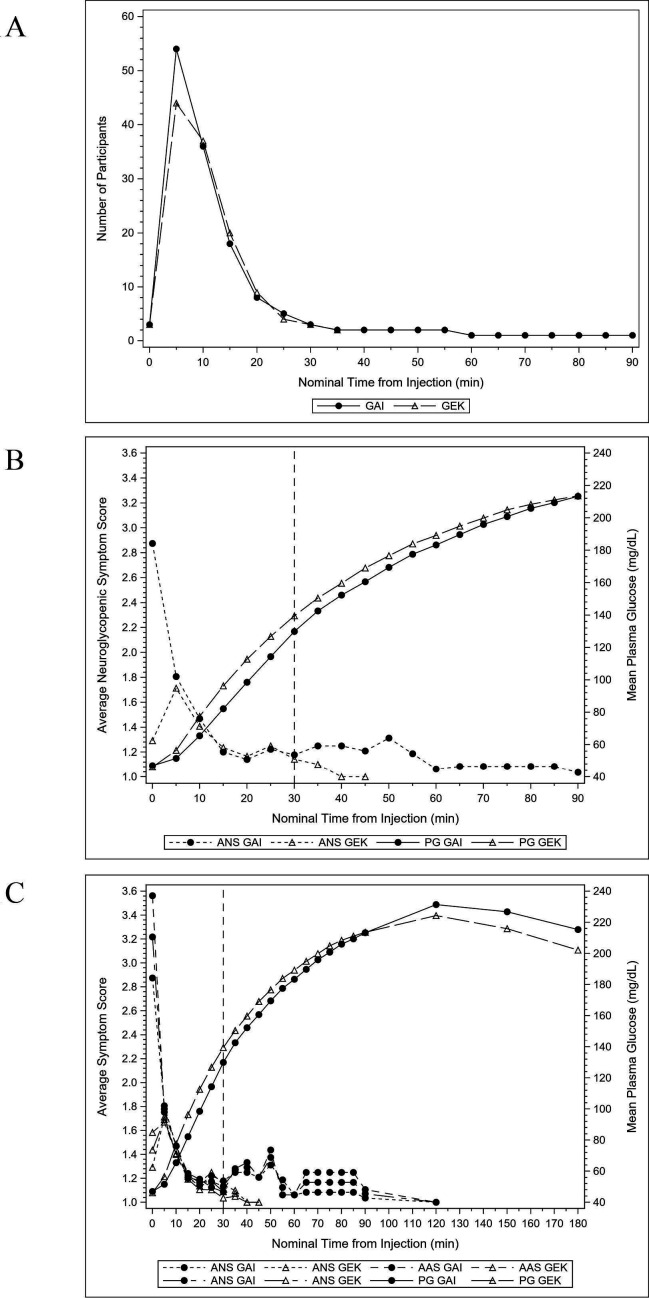
Introduction: To prevent medical sequelae of severe hypoglycemic emergencies, prompt and reliable rescue intervention is critically important. A ready-to-use, liquid stable glucagon, administered subcutaneously by glucagon autoinjector (GAI), Gvoke HypoPen (glucagon injection; Xeris Pharmaceuticals), was evaluated for rescue treatment of severe hypoglycemia. Research design and methods: Two phase III, randomized, controlled, blinded, non-inferiority crossover studies were conducted in 161 adults with type 1 diabetes to compare 1 mg doses of GAI versus glucagon emergency kit (GEK) for treating insulin-induced severe hypoglycemia. Efficacy was evaluated as either a return of plasma glucose to >70 mg/dL (3.9 mmol/L) or increase ≥20 mg/dL (1.1 mmol/L) from a baseline glucose of <50 mg/dL (2.9 mmol/L), within 30 min of dosing. Results: For successful plasma glucose recovery within 30 min, treatment with GAI was non-inferior to GEK. Treatment with GAI was non-inferior to GEK for a plasma glucose >70 mg/dL (3.9 mmol/L) or neuroglycopenic symptom relief within 30 min. From administration of glucagon, the mean time to achieve plasma glucose >70 mg/dL (3.9 mmol/L) or increase ≥20 mg/dL (1.1 mmol/L) was 13.8±5.6 min for GAI and 10.0±3.6 min for GEK. This mean time does not account for the significantly shorter (p<0.0001) drug preparation and administration time for GAI (27.3±19.7 s) versus GEK (97.2±45.1 s). The incidence of treatment emergent adverse events was comparable in both groups. Conclusions: A ready-to-use GAI was non-inferior to GEK, with a similar tolerability profile. GAI is an effective, safe, and well-tolerated rescue treatment for severe hypoglycemia and is a viable alternative to GEK. Trial registration numbers: NCT02656069 and NCT03439072.
Overview
The claims and statistics of this paper haven’t been checked yet.
Free: it reads the open-access text and checks the first 5 claims that cite a source we can check. Create a free account to check every claim.
Integrity signals
Registry
Cites
Statistics
Figures
Verification
Claims the paper makes
The claims and statistics of this paper haven’t been checked yet.
Free: it reads the open-access text and checks the first 5 claims that cite a source we can check. Create a free account to check every claim.
Claims other papers make about this one
Each is checked against this paper’s own text: does it say what the citing paper says it does?
The check wasn’t confident either way, so it gives no verdict — never disputed.
In the citing paper
“In persons with T2D being treated with alpha-glucosidase inhibitors, who develop hypoglycemia due to use of hypoglycemic agents, oral glucose or lactose-containing foods (dairy products) must be given because alpha-glucosidase inhibitors inhibit the breakdown and absorption of complex carbohydrates and disaccharides.1218–1225”
From American Association of Clinical Endocrinology Clinical Practice Guideline: Developing a Diabetes Mellitus Comprehensive Care Plan-2022 Update. (2022) · cites this paper as [1225]
Experimental — accuracy not yet measured
Self-check
Percentages, sums and reported differences re-computed from the paper’s own numbers.
The self-check needs the paper’s full text.
Citations
Cites
R: A Language and Environment for Statistical Computing
R Core Team (2025) · doi:10.32614/r.manuals · Cited by 352,181
Standards of Medical Care in Diabetes
Power, D. (2006) · Diabetes Care · doi:10.2337/diacare.29.02.06.dc05-1593 · Cited by 8,673
DRAIZE, J. H., WOODARD, G., & CALVERY, H. O. (1944) · The Journal of Pharmacology and Experimental Therapeutics · doi:10.1016/s0022-3565(25)08751-8 · Cited by 2,602
6. Glycemic Targets: Standards of Medical Care in Diabetes—2021
American Diabetes Association (2021) · Diabetes Care · doi:10.2337/dc21-s006 · Cited by 847
Gold, A. E., Macleod, K. M., & Frier, B. M. (1994) · Diabetes Care · doi:10.2337/diacare.17.7.697 · Cited by 810
Frequency of Severe Hypoglycemia Requiring Emergency Treatment in Type 1 and Type 2 Diabetes
Leese, G. P., Wang, J., Broomhall, J., Kelly, P., Marsden, A., Morrison, W., Frier, B. M., Morris, A. D., & For the DARTS/MEMO Collaboration (2003) · Diabetes Care · doi:10.2337/diacare.26.4.1176 · Cited by 559
Hypoglycemia in Type 1 and Type 2 Diabetes: Physiology, Pathophysiology,and Management
Briscoe, V. J., & Davis, S. N. (2006) · Clinical Diabetes · doi:10.2337/diaclin.24.3.115 · Cited by 174
Treatment of severe diabetic hypoglycemia with glucagon: an underutilized therapeutic approach
Kedia (2011) · Diabetes, Metabolic Syndrome and Obesity: Targets and Therapy · doi:10.2147/dmso.s20633 · Cited by 131
Rickels, M. R., Ruedy, K. J., Foster, N. C., Piché, C. A., Dulude, H., Sherr, J. L., Tamborlane, W. V., Bethin, K. E., DiMeglio, L. A., Wadwa, R. P., et al. (2016) · Diabetes Care · doi:10.2337/dc15-1498 · Cited by 128
Sherr, J. L., Ruedy, K. J., Foster, N. C., Piché, C. A., Dulude, H., Rickels, M. R., Tamborlane, W. V., Bethin, K. E., DiMeglio, L. A., Fox, L. A., et al. (2016) · Diabetes Care · doi:10.2337/dc15-1606 · Cited by 122
Cited by
Blonde, L., Umpierrez, G. E., Reddy, S. S., McGill, J. B., Berga, S. L., Bush, M., Chandrasekaran, S., DeFronzo, R. A., Einhorn, D., Galindo, R. J., et al. (2022) · Endocrine Practice · doi:10.1016/j.eprac.2022.08.002 · Cited by 507
Samson, S. L., Vellanki, P., Blonde, L., Christofides, E. A., Galindo, R. J., Hirsch, I. B., Isaacs, S. D., Izuora, K. E., Low Wang, C. C., Twining, C. L., et al. (2023) · Endocrine Practice · doi:10.1016/j.eprac.2023.02.001 · Cited by 375
Abraham, M. B., Karges, B., Dovč, K., Naranjo, D. M., Arbeláez, A. M., Mbogo, J., Javelikar, G., Jones, T. W., & Mahmud, F. H. (2022) · Pediatric Diabetes · doi:10.1111/pedi.13443 · Cited by 143
“A premixed SC autoinjector Gvoke HypoPen (liquid-stable glucagon) is also available for use in children >2 years of age.(172,173) The availability of different forms of glucagon varies across different regions of the world and”
BackgroundValentine, V., Newswanger, B., Prestrelski, S., Andre, A. D., & Garibaldi, M. (2019) · Diabetes Technology & Therapeutics · doi:10.1089/dia.2019.0148 · Cited by 49
Self-citationThieu, V. T., Mitchell, B. D., Varnado, O. J., & Frier, B. M. (2020) · Diabetes, Obesity and Metabolism · doi:10.1111/dom.13941 · Cited by 44
Samson, S. L., Vellanki, P., Blonde, L., Hirsch, I. B., Hoang, T. D., Isaacs, S. D., Izuora, K. E., Wang, C. C. L., Ooi, C. P., Padilla, B. I., et al. (2026) · Endocrine Practice · doi:10.1016/j.eprac.2026.01.006 · Cited by 36
Translational aspects of glucagon: current use and future prospects
Kaur, J., & Seaquist, E. R. (2023) · Journal of Endocrinology · doi:10.1530/joe-22-0278 · Cited by 21
Pathophysiology and management of hypoglycemia in diabetes
RANGEL, E. S., Deajon-Jackson, J. D., & Hwang, J. J. (2022) · Annals of the New York Academy of Sciences · doi:10.1111/nyas.14904 · Cited by 21
Aronson, R., Riddell, M. C., Conoscenti, V., & JUNAIDI, M. K. (2023) · Diabetes Care · doi:10.2337/dc22-1145 · Cited by 15
“The safety profile for 150 mg of glucagon mirrored that for 1 mg of similar glucagon (19) and other glucagon formulations (20,21).”
BackgroundHypoglycemic Events in the Emergency Department
Maheswaran, A. B., Gimbar, R. P., Eisenberg, Y., & Lin, J. (2022) · Endocrine Practice · doi:10.1016/j.eprac.2022.01.006 · Cited by 12
Giménez, M., Khunti, K., Matsuhisa, M., Chenji, S., Syring, K. E., & Yan, Y. (2023) · Diabetes Therapy · doi:10.1007/s13300-023-01466-6 · Cited by 11
Brand-Eubanks, D. C. (2019) · Clinical Diabetes · doi:10.2337/cd19-0040 · Cited by 10
Pieber, T. R., Aronson, R., Christiansen, M. P., Bode, B., Junaidi, K., & Conoscenti, V. (2022) · Diabetes, Obesity and Metabolism · doi:10.1111/dom.14699 · Cited by 8
“nausea, vomiting, headache, injection site discomfort) reported with other glucagon formulations, including ready-to-use glucagon analogue and powdered formulation for intranasal administration.(2,11,12) No serious AEs or deaths for AEs were reported.”
BackgroundMethodResultSelf-citationAddendum 1: Forum for Injection Technique and Therapy Expert Recommendations, India
Kalra, S., Unnikrishnan, A., KUMAR, K. M. P., Sahay, R. K., Chandalia, H. B., Saboo, B., Sundaram, A., Kesavadev, J., Shukla, R., WANGNOO, S. K., et al. (2022) · Diabetes Therapy · doi:10.1007/s13300-022-01332-x · Cited by 8
“More recently, ready-to-use glucagon in pre-filled syringes has become more available [20].”
BackgroundAlsaif, M., Farhat, A. A. K., Blumer, Z., & Barham, L. (2024) · Health Economics Review · doi:10.1186/s13561-024-00505-7 · Cited by 7
“SH resolution was modelled to occur in 98.7%, which was the average response rate from two clinical trials evaluating glucagon 1 mg pre-filled injections [25].”
MethodInfluentialUniform trehalose nanogels for glucagon stabilization
Puente, E. G., Sivasankaran, R. P., Vinciguerra, D., Yang, J., Lower, H.-A. C., Hevener, A. L., & Maynard, H. D. (2024) · RSC Applied Polymers · doi:10.1039/d3lp00226h · Cited by 7
Implantable device with magnetically rotating disk for needle‐free administrations of emergency drug
Kim, C. R., Han, J. H., Kim, M., Kim, M. J., Kim, S., Cho, Y. C., Ji, H. B., Min, C. H., Lee, C., & Choy, Y. B. (2023) · Bioengineering & Translational Medicine · doi:10.1002/btm2.10479 · Cited by 3
Out of Sight, Out of Mind: A Call to Action for the Treatment of Hypoglycemia
Goldman, J. D., & Isaacs, D. M. (2024) · Clinical Diabetes · doi:10.2337/cd24-0014 · Cited by 3
JUNAIDI, M. K., Krecic, M. R., Close, N., & Conoscenti, V. (2023) · Journal of Diabetes Science and Technology · doi:10.1177/19322968231179164 · Cited by 1
Self-citationPaucity of Published Data and Protocols for Hypoglycemia Management in Long-term Care
Krecic, M. R., Meyer, J. H., & Chavanu, K. J. (2024) · The Senior Care Pharmacist · doi:10.4140/tcp.n.2024.373 · Cited by 1
Can Mini-Dose Glucagon Prevent Fasting-Induced Hypoglycemia and Preserve Fasting?
Algeffari, M. (2025) · Cureus · doi:10.7759/cureus.98620 · Cited by 1
“A study reveals that only 13% of caregivers were able to administer the full dose of injectable glucagon during a simulated severe hypoglycemia event, proving the practical challenges with these formulations [30].”
Alsaif, M., Farhat, A., Blumer, Z., & Barham, L. (2024) · Figshare · doi:10.6084/m9.figshare.25762903
Metadata
- Authors
- Christiansen, M. P., Cummins, M., Prestrelski, S., Close, N. C., Nguyen, A., & Junaidi, K.
- Affiliations
- Diablo Clinical Research (US)
- Xeris Pharmaceuticals (United States) (US)
- EmpiriStat Inc, Kitty Hawk, North Carolina, USA
- Corresponding author
- Junaidi, Khaled
- Venue
- BMJ Open Diabetes Research & Care
- Publisher
- BMJ
- Published
- 2021-10
- Volume
- 9
- Issue
- 1
- Pages
- e002137
- ISSN
- 2052-4897 (ISSN-L)
- PMC
- PMC8499286
- OpenAlex
- W3203034103
- Cited by
- 22
- References
- 21
- Citations by year
- 2026: 1 · 2025: 1 · 2024: 5 · 2023: 6 · 2022: 6
- FWCI
- 3.17
- Type
- journal article
- Language
- en
- Open access
- gold
- doi.org
- Licence
- Locations
- BMJ Open Diabetes Research & Care (publishedVersion, cc-by-nc)
- PubMed Central (publishedVersion, cc-by-nc)
- PubMed (publishedVersion)
- DOAJ (DOAJ: Directory of Open Access Journals) (submittedVersion)
- Funders
- Xeris Pharmaceuticals, Inc. (N/A)
- Topics
- Health Sciences › Medicine › Endocrinology, Diabetes and Metabolism › Diabetes Management and Research
- Health Sciences › Medicine › Endocrinology, Diabetes and Metabolism › Diabetes Treatment and Management
- Health Sciences › Medicine › Public Health, Environmental and Occupational Health › Patient Safety and Medication Errors
- Keywords
- glucagon, severe hypoglycemia, type 1 diabetes, insulin-induced hypoglycemia, neuroglycopenic symptoms, non-inferiority, treatment-emergent adverse events, drug tolerability
- MeSH terms
- Blood Glucose, Glucagon, Humans, Hypoglycemia, Insulin, Cross-Over Studies
About these checks
Registry, retraction, Cites and statistics results are computed, not judged, with one exception: a printed reference that no index lists is read once by a model before it counts as a citation error. Claims are extracted by a model and kept only when their quote appears verbatim in the text; each cited source is then checked, with a model’s help, for whether it says what the claim relies on. Those verdicts can be wrong — read the claim’s quote and the cited source before relying on one.
Statistics and arithmetic are recomputed, not judged.
Confidence bands are shown only for fields calibrated on our annotated test set. None is calibrated yet, so no band is shown.
What counts as a claim ›How we measure confidence ›How we check this ›
Are you an author, or do you see a problem with this page? Request a review
Data sources
Bibliographic data: Semantic Scholar, OpenAlex, Crossref.
Contains information from the Semantic Scholar Academic Graph Datasets, made available under the ODC Attribution License (ODC-BY 1.0).
Semantic Scholar’s data is described in: Kinney, R., et al. (2023). The Semantic Scholar Open Data Platform. arXiv:2301.10140.
