

Process evaluation of a pragmatic implementation trial to support self-management for the prevention and management of type 2 diabetes in Uganda, South Africa and Sweden in the SMART2D project
Open accessPublished version of a preprint
The DOI matches its Crossref record; 36 of the 37 references it cites were found in a registry or an index.
Abstract
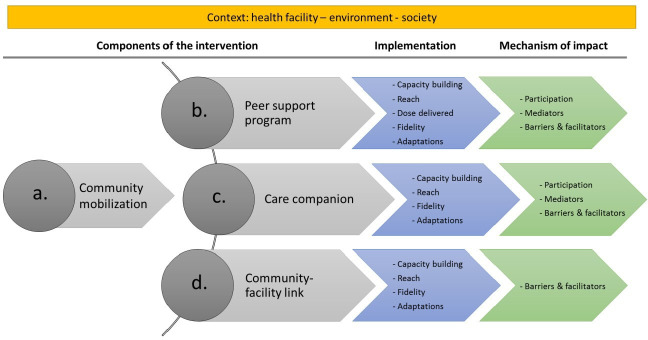
INTRODUCTION: Type 2 diabetes (T2D) and its complications are increasing rapidly. Support for healthy lifestyle and self-management is paramount, but not adequately implemented in health systems. Process evaluations facilitate understanding why and how interventions work through analyzing the interaction between intervention theory, implementation and context. The Self-Management and Reciprocal Learning for Type 2 Diabetes project implemented and evaluated community-based interventions (peer support program; care companion; and link between facility care and community support) for persons at high risk of or having T2D in a rural community in Uganda, an urban township in South Africa, and socioeconomically disadvantaged urban communities in Sweden. RESEARCH DESIGN AND METHODS: This paper reports implementation process outcomes across the three sites, guided by the Medical Research Council framework for complex intervention process evaluations. Data were collected through observations of peer support group meetings using a structured guide, and semistructured interviews with project managers, implementers, and participants. RESULTS: The countries aligned implementation in accordance with the feasibility and relevance in the local context. In Uganda and Sweden, the implementation focused on peer support; in South Africa, it focused on the care companion part. The community-facility link received the least attention. Continuous capacity building received a lot of attention, but intervention reach, dose delivered, and fidelity varied substantially. Intervention-related and context-related barriers affected participation. CONCLUSIONS: Identification of the key uncertainties and conditions facilitates focus and efficient use of resources in process evaluations, and context relevant findings. The use of an overarching framework allows to collect cross-contextual evidence and flexibility in evaluation design to adapt to the complex nature of the intervention. When designing interventions, it is crucial to consider aspects of the implementing organization or structure, its absorptive capacity, and to thoroughly assess and discuss implementation feasibility, capacity and organizational context with the implementation team and recipients. These recommendations are important for implementation and scale-up of complex interventions. TRIAL REGISTRATION NUMBER: ISRCTN11913581.
Overview
The claims and statistics of this paper haven’t been checked yet.
Free: it reads the open-access text and checks the first 5 claims that cite a source we can check. Create a free account to check every claim.
Integrity signals
Registry
Cites
Statistics
Figures
Verification
Claims the paper makes
The claims and statistics of this paper haven’t been checked yet.
Free: it reads the open-access text and checks the first 5 claims that cite a source we can check. Create a free account to check every claim.
Claims other papers make about this one
Each is checked against this paper’s own text: does it say what the citing paper says it does?
The source backs part of the claim, not all of it — or backs it for a different population, condition or comparison.
In the citing paper
“In rural multiethnic Texas communities, participants often struggle to maintain consistent diabetic meal plans due to a lack of household support: many families prepare separate regular dishes rather than unified low-sugar, low-fat meals for diabetic members, and limited peer communication channels leave patients without shared experience exchange and mutual supervision on healthy cooking and”
From Implementation and translation of evidence-based dietary strategies for type 2 diabetes in resource-limited settings: a scoping review based on the CFIR framework (2026) · cites this paper as [126]
Experimental — accuracy not yet measured
Self-check
Percentages, sums and reported differences re-computed from the paper’s own numbers.
The self-check needs the paper’s full text.
Citations
Cites
The "what" and "why" of goal pursuits: Human needs and the self-determination of behavior
Deci, E. L., & Ryan, R. M. (2000) · Psychological Inquiry · doi:10.1207/s15327965pli1104_01 · Cited by 34,210
Developing and evaluating complex interventions: the new Medical Research Council guidance
Craig, P., Dieppe, P., Macintyre, S., Michie, S., Nazareth, I., & Petticrew, M. (2008) · BMJ · doi:10.1136/bmj.a1655 · Cited by 10,995
Proctor, E., Silmere, H., Raghavan, R., Hovmand, P., Aarons, G., Bunger, A., Griffey, R., & Hensley, M. (2011) · Administration and Policy in Mental Health and Mental Health Services Research · doi:10.1007/s10488-010-0319-7 · Cited by 8,721 · cited 1×
“This was further discussed and clarified within country teams and in two cross-country meetings.”
Process evaluation of complex interventions: Medical Research Council guidance
Moore, G. F., Audrey, S., Barker, M., Bond, L., Bonell, C., Hardeman, W., Moore, L., O'Cathain, A., Tinati, T., Wight, D., et al. (2015) · BMJ · doi:10.1136/bmj.h1258 · Cited by 6,204
Developing and Evaluating Complex Interventions: New Guidance
Craig, P., Dieppe, P. A., MacIntyre, S., Michie, S., Nazareth, I., & Petticrew, M. P. (2006) · UCL Discovery (University College London) · Cited by 1,979
Lindström, J., & Tuomilehto, J. (2003) · Diabetes Care · doi:10.2337/diacare.26.3.725 · Cited by 1,862
Standards for Reporting Implementation Studies (StaRI) Statement
Pinnock, H., Barwick, M., Carpenter, C. R., Eldridge, S., Grandes, G., Griffiths, C. J., Rycroft-Malone, J., Meissner, P., Murray, E., Patel, A., et al. (2017) · BMJ · doi:10.1136/bmj.i6795 · Cited by 1,446
A commentary on studies presenting projections of the future prevalence of dementia
Norton, S., Matthews, F. E., & Brayne, C. (2013) · BMC Public Health · doi:10.1186/1471-2458-13-1 · Cited by 634
The Global Burden of Disease Study and the Preventable Burden of NCD
Benziger, C. P., Roth, G. A., & Moran, A. E. (2016) · Global Heart · doi:10.1016/j.gheart.2016.10.024 · Cited by 547
Means, A. R., Kemp, C. G., Gwayi-Chore, M.-C., Gimbel, S., Soi, C., Sherr, K., Wagenaar, B. H., Wasserheit, J. N., & Weiner, B. J. (2020) · Implementation Science · doi:10.1186/s13012-020-0977-0 · Cited by 418 · cited 1×
“When designing an intervention, it is crucial to consider aspects of the implementing organization or structure, absorptive capacity, and to thoroughly assess and discuss implementation feasibility, capacity and organizational context with the implementation team and recipients.”
Recruiting Vulnerable Populations into Research: A Systematic Review of Recruitment Interventions
UyBico, S. J., Pavel, S., & Gross, C. P. (2007) · Journal of General Internal Medicine · doi:10.1007/s11606-007-0126-3 · Cited by 384 · cited 1×
“When designing an intervention, it is crucial to consider aspects of the implementing organization or structure, absorptive capacity, and to thoroughly assess and discuss implementation feasibility, capacity and organizational context with the implementation team and recipients.”
Peer Support For Self-Management Of Diabetes Improved Outcomes In International Settings
Fisher, E. B., Boothroyd, R. I., Coufal, M. M., Baumann, L. C., Mbanya, J. C., Rotheram-Borus, M. J., Sanguanprasit, B., & Tanasugarn, C. (2012) · Health Affairs · doi:10.1377/hlthaff.2011.0914 · Cited by 309 · cited 1×
“When designing an intervention, it is crucial to consider aspects of the implementing organization or structure, absorptive capacity, and to thoroughly assess and discuss implementation feasibility, capacity and organizational context with the implementation team and recipients.”
Ibrahim, N., Thompson, D., Nixdorf, R., Kalha, J., Mpango, R., Moran, G., Mueller-Stierlin, A., Ryan, G., Mahlke, C., Shamba, D., et al. (2020) · Social Psychiatry and Psychiatric Epidemiology · doi:10.1007/s00127-019-01739-1 · Cited by 251 · cited 1×
“When designing an intervention, it is crucial to consider aspects of the implementing organization or structure, absorptive capacity, and to thoroughly assess and discuss implementation feasibility, capacity and organizational context with the implementation team and recipients.”
Wierenga, D., Engbers, L. H., Van Empelen, P., Duijts, S., Hildebrandt, V. H., & Van Mechelen, W. (2013) · BMC Public Health · doi:10.1186/1471-2458-13-1190 · Cited by 219
Overview of Peer Support Models to Improve Diabetes Self-Management and Clinical Outcomes
Heisler, M. (2007) · Diabetes Spectrum · doi:10.2337/diaspect.20.4.214 · Cited by 204
Kane, J., Landes, M., Carroll, C., Nolen, A., & Sodhi, S. (2017) · BMC Family Practice · doi:10.1186/s12875-017-0613-5 · Cited by 134
A Review of Volunteer-Based Peer Support Interventions in Diabetes
Tang, T. S., Ayala, G. X., Cherrington, A., & Rana, G. (2011) · Diabetes Spectrum · doi:10.2337/diaspect.24.2.85 · Cited by 93
The Global Alliance for Chronic Diseases, P. E. W. G., Limbani, F., Goudge, J., Joshi, R., Maar, M. A., Miranda, J. J., Oldenburg, B. F., Parker, G., Pesantes, M. A., Riddell, M. A., et al. (2019) · BMC Public Health · doi:10.1186/s12889-019-7261-8 · Cited by 91 · cited 1×
“9 This focus is often not made explicit by designers, implementers and researchers, which affects the quality and utility of such evaluations.”
Evaluation of a peer support program for women with breast cancer—lessons for practitioners
Dunn, J., Steginga, S. K., Occhipinti, S., & Wilson, K. (1999) · Journal of Community & Applied Social Psychology · doi:10.1002/(sici)1099-1298(199901/02)9:1<13::aid-casp488>3.0.co;2-f · Cited by 74 · cited 1×
“When designing an intervention, it is crucial to consider aspects of the implementing organization or structure, absorptive capacity, and to thoroughly assess and discuss implementation feasibility, capacity and organizational context with the implementation team and recipients.”
Self-management of non-communicable diseases in low- and middle-income countries: A scoping review
Hearn, J., Ssinabulya, I., Schwartz, J. I., Akiteng, A. R., Ross, H. J., & Cafazzo, J. A. (2019) · PLoS ONE · doi:10.1371/journal.pone.0219141 · Cited by 74
Man, J. D., Aweko, J., Daivadanam, M., Alvesson, H. M., Delobelle, P., Mayega, R. W., Östenson, C., Kirunda, B. E., Kasujja, F. X., Guwatudde, D., et al. (2019) · PLoS ONE · doi:10.1371/journal.pone.0213530 · Cited by 69
Self-citationTimm, L., Annerstedt, K. S., Ahlgren, J. Á., Absetz, P., Alvesson, H. M., Forsberg, B. C., & Daivadanam, M. (2022) · PLoS ONE · doi:10.1371/journal.pone.0275576 · Cited by 68 · cited 1×
“When designing an intervention, it is crucial to consider aspects of the implementing organization or structure, absorptive capacity, and to thoroughly assess and discuss implementation feasibility, capacity and organizational context with the implementation team and recipients.”
Self-citationMolina, R. L., Neal, B. J., Bobanski, L., Singh, V. P., Neville, B. A., Delaney, M. M., Lipsitz, S., Karlage, A., Shetye, M., & Semrau, K. E. A. (2020) · Implementation Science · doi:10.1186/s13012-019-0962-7 · Cited by 59
Levitt, N. S., Puoane, T., Denman, C. A., Abrahams-Gessel, S., Surka, S., Mendoza, C., Khanam, M., Alam, S., & Gaziano, T. A. (2015) · Global Health Action · doi:10.3402/gha.v8.26318 · Cited by 44
Self-citationMake the Unconscious Explicit to Boost the Science of Consciousness
Eriksson, J., Fontan, A., & Pedale, T. (2020) · Frontiers in Psychology · doi:10.3389/fpsyg.2020.00260 · Cited by 43
Timm, L., Harcke, K., Karlsson, I., Annerstedt, K. S., Alvesson, H. M., Stattin, N. S., Forsberg, B. C., Östenson, C., & Daivadanam, M. (2020) · Global Health Action · doi:10.1080/16549716.2020.1795439 · Cited by 38 · cited 1×
“Table 2 gives an overview of the process evaluation results for context, community mobilization and the three intervention components as implemented at the three sites.”
Self-citationTesting a Self-Determination Theory Model of Healthy Eating in a South African Township
Man, J. D., Wouters, E., Delobelle, P., Puoane, T. R., Daivadanam, M., Absetz, P., Remmen, R., & van Olmen, J. (2020) · Frontiers in Psychology · doi:10.3389/fpsyg.2020.02181 · Cited by 35
Self-citationGuwatudde, D. Y., Absetz, P., Delobelle, P., Östenson, C., van Olmen, J., Alvesson, H. M., Mayega, R. W., Kiracho, E. E., Kiguli, J., Sundberg, C. J., et al. (2018) · BMJ Open · doi:10.1136/bmjopen-2017-019981 · Cited by 30
Self-citationvan Olmen, J., Delobelle, P., Guwatudde, D. Y., Absetz, P., Sanders, D. M., Alvesson, H. M., Puoane, T. R., Östenson, C., Tomson, G. B., Mayega, R. W., et al. (2018) · BMJ Global Health · doi:10.1136/bmjgh-2018-001068 · Cited by 29
Self-citationAllison, R., Lecky, D. M., Town, K., Rugman, C., Ricketts, E. J., Ockendon-Powell, N., Folkard, K., Dunbar, J. K., & McNulty, C. A. M. (2017) · BMC Family Practice · doi:10.1186/s12875-017-0618-0 · Cited by 28
What Motivates People With (Pre)Diabetes to Move? Testing Self-Determination Theory in Rural Uganda
Man, J. D., Wouters, E., Absetz, P., Daivadanam, M., Naggayi, G., Kasujja, F. X., Remmen, R., Guwatudde, D. Y., & van Olmen, J. (2020) · Frontiers in Psychology · doi:10.3389/fpsyg.2020.00404 · Cited by 28
Self-citationA practical tool to predict type 2 diabetes risk
Lindstr, J., & Tuomilehto, J. O. (2003) · Cited by 27
Absetz, P., van Olmen, J., Guwatudde, D., Puoane, T. R., Alvesson, H. M., Delobelle, P., Mayega, R. W., Kasujja, F. X., Naggayi, G., Timm, L., et al. (2020) · Translational Behavioral Medicine · doi:10.1093/tbm/ibz188 · Cited by 18
Self-citationTimm, L., Karlsson, I., Annerstedt, K. S., Absetz, P., Forsberg, B. C., Daivadanam, M., & Alvesson, H. M. (2021) · Nutrients · doi:10.3390/nu13113862 · Cited by 18
Self-citationSolving the Puzzle to Lasting Impact of the National Diabetes Prevention Program
Ritchie, N. D. (2020) · Diabetes Care · doi:10.2337/dci20-0031 · Cited by 17
Guwatudde, D. Y., Delobelle, P., Absetz, P., van Olmen, J., Mayega, R. W., Kasujja, F. X., Man, J. D., Hassen, M., Kiracho, E. E., Kiguli, J., et al. (2022) · PLOS Global Public Health · doi:10.1371/journal.pgph.0000425 · Cited by 11
Self-citationKarim, S. S. A. (2005) · Elsevier eBooks · doi:10.1016/b978-012465271-2/50017-0 · Cited by 3
Research works printed but not linked: 2
- van Olmen J, Delobelle P, Guwatudde D, et al. Using a cross-contextual reciprocal learning approach in a multisite implementation research project to improve self-management for type 2 diabetes. BMJ Glob Health 2018; 3: e001068– 9. 10.1136/bmjgh-2018-001068 PMC6267315 30555727 · DOI
- Guwatudde D, Absetz P, Delobelle P, et al. Study protocol for the SMART2D adaptive implementation trial: a cluster randomised trial comparing facility-only care with integrated facility and community care to improve type 2 diabetes outcomes in Uganda, South Africa and Sweden. BMJ Open 2018; 8: e019981– 12. 10.1136/bmjopen-2017-019981 PMC5879646 29550780 · DOI
Cited by
Supported self-management in long-term conditions in an African context
Hale, L. A., Wilkinson, A., Pilusa, S. I., & Stewart, A. (2024) · South African Journal of Physiotherapy · doi:10.4102/sajp.v80i1.1978 · Cited by 4
Eficiencia del Gasto Público en la salud
Cano, M., Llauce, C. T. D. J. C., & León, M. F. C. (2025) · Podium · doi:10.31095/podium.2024.46.5 · Cited by 3
Shrestha, A., Yang, L., Demissie, G. D., Dhital, R., Jeemon, P., Ganeshkumar, P., Gupta, S., Karmacharya, B. M., Thankappan, K. R., Oldenburg, B. F., et al. (2025) · BMJ Public Health · doi:10.1136/bmjph-2024-001371 · Cited by 3
Pinto, C., Burgess, M., Levitt, N. S., Delobelle, P., & McGrath, N. M. (2026) · Global Health Action · doi:10.1080/16549716.2025.2608423 · Cited by 2
“…to seven unique interventions contained details around experience of and engagement with goal setting from a participant perspective [32,41,42,44,46,50,53] and few publications (6/24) related to five unique interventions included facilitator feedback on the use of goal setting [37,39,41,50,53].”
InfluentialSelf-citationShao, K., Lei, H., Zhu, J., Chen, X., Sina, Y., & Yao, R. (2026) · Frontiers in Public Health · doi:10.3389/fpubh.2026.1870603
Metadata
- Authors
- van Olmen, J., Absetz, P., Mayega, R. W., Timm, L., Delobelle, P., Alvesson, H. M., Naggayi, G., Kasujja, F., Hassen, M., de Man, J., Sidney Annerstedt, K., Puoane, T., Östenson, C.-G., Tomson, G., Guwatudde, D., & Daivadanam, M.
- Affiliations
- Department of Family Medicine and Population Health, University of Antwerp, Antwerpen, Belgium
- University of Tampere (FI)
- Makerere University (UG)
- Karolinska Institutet (SE)
- Vrije Universiteit Brussel (BE)
- Karolinska Universitetssjukhuset, Stockholm, Sweden
- University of the Western Cape (ZA)
- Department of Global Public Health, Karolinska Institutet, Stockholm, Sweden
- Uppsala University (SE)
- Department of Global Health, Centrum för arbets- och miljömedicin, Stockholm, Sweden
- ORCID
- Venue
- BMJ Open Diabetes Research & Care
- Publisher
- BMJ
- Published
- 2022-09
- Volume
- 10
- Issue
- 5
- Pages
- e002902
- ISSN
- 2052-4897 (ISSN-L)
- PMC
- PMC9516210
- OpenAlex
- W4297140840
- Cited by
- 5
- References
- 36
- Citations by year
- 2026: 2 · 2025: 2 · 2024: 1
- FWCI
- 0.86
- Type
- journal article
- Language
- en
- Open access
- gold
- doi.org
- Licence
- Locations
- BMJ Open Diabetes Research & Care (publishedVersion, cc-by-nc)
- Research Square (acceptedVersion, cc-by)
- PubMed Central (publishedVersion, cc-by-nc)
- PubMed (publishedVersion)
- Uppsala University Publications (Uppsala University) (submittedVersion, other-oa)
- DOAJ (DOAJ: Directory of Open Access Journals) (submittedVersion, cc-by-sa)
- Tampere University Institutional Repository (Tampere University) (submittedVersion, cc-by-nc)
- VUBIR (Vrije Universiteit Brussel) (submittedVersion)
- Funders
- European Commission (643692, HCO-05-2014, SMART2D)
- Sweden International Development Cooperation Agency (Project #HS 343.)
- Topics
- Health Sciences › Health Professions › General Health Professions › Health Policy Implementation Science
- Health Sciences › Medicine › Endocrinology, Diabetes and Metabolism › Diabetes Management and Education
- Social Sciences › Public Administration › Evaluation and Performance Assessment
- Keywords
- type 2 diabetes, self-management, peer support, community-based intervention, implementation process evaluation, complex interventions, capacity building, intervention fidelity, barriers to participation, rural and urban communities
- MeSH terms
- Self-Management, Diabetes Mellitus, Type 2, Humans, South Africa, Sweden, Uganda
About these checks
Registry, retraction, Cites and statistics results are computed, not judged, with one exception: a printed reference that no index lists is read once by a model before it counts as a citation error. Claims are extracted by a model and kept only when their quote appears verbatim in the text; each cited source is then checked, with a model’s help, for whether it says what the claim relies on. Those verdicts can be wrong — read the claim’s quote and the cited source before relying on one.
Statistics and arithmetic are recomputed, not judged.
Confidence bands are shown only for fields calibrated on our annotated test set. None is calibrated yet, so no band is shown.
What counts as a claim ›How we measure confidence ›How we check this ›
Are you an author, or do you see a problem with this page? Request a review
Data sources
Bibliographic data: Semantic Scholar, OpenAlex, Crossref.
Contains information from the Semantic Scholar Academic Graph Datasets, made available under the ODC Attribution License (ODC-BY 1.0).
Semantic Scholar’s data is described in: Kinney, R., et al. (2023). The Semantic Scholar Open Data Platform. arXiv:2301.10140.
