

Alcohol and hepatocellular carcinoma
Open accessThe DOI matches its Crossref record; 117 of the 117 references it cites were found in a registry or an index.
Abstract
Background: Alcohol is classified as a Group 1 carcinogen by the International Agency for Research on Cancer because it induces hepatocellular carcinoma (among other cancers) in humans. An excessive alcohol intake may result in fatty liver, acute/chronic hepatitis, and cirrhosis and eventually lead to hepatocellular carcinoma. It has been reported that alcohol abuse increases the relative risk of hepatocellular carcinoma by 3- to 10-fold. Aim and Methods: To clarify the known mechanisms of alcohol-related carcinogenesis, we searched Pubmed using the terms alcohol and immune mechanism, alcohol and cancer, and immune mechanism and cancer and summarized the articles as a qualitative review. Results: From a clinical perspective, it is well known that alcohol interacts with other factors, such as smoking, viral hepatitis, and diabetes, leading to an increased risk of hepatocellular carcinoma. There are several possible mechanisms through which alcohol may induce liver carcinogenicity, including the mutagenic effects of acetaldehyde and the production of ROS due to the excessive hepatic deposition of iron. Furthermore, it has been reported that alcohol accelerates hepatitis C virus-induced liver tumorigenesis through TLR4 signaling. Despite intense investigations to elucidate the mechanisms, they remain poorly understood. Conclusion: This review summarizes the recent findings of clinical and pathological studies that have investigated the carcinogenic effects of alcohol in the liver.
Overview
The claims and statistics of this paper haven’t been checked yet.
Free: it reads the open-access text and checks the first 5 claims that cite a source we can check. Create a free account to check every claim.
Integrity signals
Registry
Cites
Statistics
Figures
Verification
Claims the paper makes
The claims and statistics of this paper haven’t been checked yet.
Free: it reads the open-access text and checks the first 5 claims that cite a source we can check. Create a free account to check every claim.
Claims other papers make about this one
Each is checked against this paper’s own text: does it say what the citing paper says it does?
The source backs part of the claim, not all of it — or backs it for a different population, condition or comparison.
In the citing paper
“It is known that excessive alcohol consumption leads to a 3- to 10-fold increase in the risk of HCC and accounts for 30% of HCC cases worldwide [109,110].”
From Pathophysiological Aspects of Alcohol Metabolism in the Liver (2021) · cites this paper as [109]
Experimental — accuracy not yet measuredThe cited source says what the claim attributes to it.
In the citing paper
“Alcohol is recognized as a carcinogen by the International Agency for Research on Cancer. This is because alcohol causes many types of cancers, including hepatocellular carcinoma (HCC) in humans [109].”
From Pathophysiological Aspects of Alcohol Metabolism in the Liver (2021) · cites this paper as [109]
Self-check
Percentages, sums and reported differences re-computed from the paper’s own numbers.
The self-check needs the paper’s full text.
Citations
Cites
1 retracted
Chen, C.-L., Uthaya Kumar, D. B., Punj, V., Xu, J., Sher, L., Tahara, S. M., Hess, S., & Machida, K. (2016) · Cell Metabolism · doi:10.1016/j.cmet.2015.12.004 · Cited by 388 · cited 1×
“lation of the mitochondrial metabolism in NS5A Tg mice.(110) These studies suggest the crucial involvement of”
BackgroundRetractedGlobal cancer statistics, 2012
Torre, L. A., Bray, F., Siegel, R. L., Ferlay, J., Lortet‐Tieulent, J., & Jemal, A. (2015) · CA: A Cancer Journal for Clinicians · doi:10.3322/caac.21262 · Cited by 26,850
Siegel, R. L., Miller, K. D., & Jemal, A. (2017) · CA: A Cancer Journal for Clinicians · doi:10.3322/caac.21387 · Cited by 14,712
EASL Clinical Practice Guidelines: Management of hepatocellular carcinoma
Galle, P. R., Forner, A., Llovet, J. M., Mazzaferro, V., Piscaglia, F., Raoul, J.-L., Schirmacher, P., & Vilgrain, V. (2018) · Journal of Hepatology · doi:10.1016/j.jhep.2018.03.019 · Cited by 11,406
EASL–EORTC Clinical Practice Guidelines: Management of hepatocellular carcinoma
European Association for the Study of the Liver, & European Organisation for Research and Treatment of Cancer (2012) · Journal of Hepatology · doi:10.1016/j.jhep.2011.12.001 · Cited by 5,218
AASLD guidelines for the treatment of hepatocellular carcinoma
Heimbach, J. K., Kulik, L. M., Finn, R. S., Sirlin, C. B., Abecassis, M. M., Roberts, L. R., Zhu, A. X., Murad, M. H., & Marrero, J. A. (2018) · Hepatology · doi:10.1002/hep.29086 · Cited by 4,070 · cited 2×
“recommended by the European Association for the Study of the Liver.(7) 8 Incidentally, the previous AASLD guide-”
BackgroundInfluentialGender Disparity in Liver Cancer Due to Sex Differences in MyD88-Dependent IL-6 Production
Naugler, W. E., Sakurai, T., Kim, S., Maeda, S., Kim, K., Elsharkawy, A. M., & Karin, M. (2007) · Science · doi:10.1126/science.1140485 · Cited by 1,955
The Prevalence of Hepatitis C Virus Infection in the United States, 1999 through 2002
Armstrong, G. L., Wasley, A., Simard, E. P., McQuillan, G. M., Kuhnert, W. L., & Alter, M. J. (2006) · Annals of Internal Medicine · doi:10.7326/0003-4819-144-10-200605160-00004 · Cited by 1,955
The Liver as an Immunological Organ
Racanelli, V., & Rehermann, B. (2006) · Hepatology · doi:10.1002/hep.21060 · Cited by 1,377
A meta-analysis of alcohol consumption and the risk of 15 diseases
Corrao, G. (2004) · Preventive Medicine · doi:10.1016/j.ypmed.2003.11.027 · Cited by 1,077
El–Serag, H. B., Hampel, H., & Javadi, F. (2006) · Clinical Gastroenterology and Hepatology · doi:10.1016/j.cgh.2005.12.007 · Cited by 826
Overview: how is alcohol metabolized by the body?
(2006) · PubMed Central · Cited by 813
Hassan, M. M., Hwang, L.-Y., Hatten, C. J., Swaim, M., Li, D., Abbruzzese, J. L., Beasley, P., & Patt, Y. Z. (2002) · Hepatology · doi:10.1053/jhep.2002.36780 · Cited by 762
Rivera, C. A., Adegboyega, P., van Rooijen, N., Tagalicud, A., Allman, M., & Wallace, M. (2007) · Journal of Hepatology · doi:10.1016/j.jhep.2007.04.019 · Cited by 693
Donato, F. (2002) · American Journal of Epidemiology · doi:10.1093/aje/155.4.323 · Cited by 677 · cited 17×
“18 24 48–50 Furthermore, heavy alcohol consumption has also been shown to increase the risk of developing HCC.(18) 44 Patients with coexisting HBV (defined by (hepatitis B s antigen) HBsAg-positivity) are at increased risk of developing fibrosis(48) and HCC.”
BackgroundResultInfluentialHoechst, B., Voigtlaender, T., Ormandy, L., Gamrekelashvili, J., Zhao, F., Wedemeyer, H., Lehner, F., Manns, M. P., Greten, T. F., & Korangy, F. (2009) · Hepatology · doi:10.1002/hep.23054 · Cited by 643
Drinking habits as cofactors of risk for alcohol induced liver damage
Bellentani, S., Saccoccio, G., Costa, G., Tiribelli, C., Manenti, F., Sodde, M., Croce’, L. S., Sasso, F., Pozzato, G., Cristianini, G., et al. (1997) · Gut · doi:10.1136/gut.41.6.845 · Cited by 630
Gender Differences in Pharmacokinetics of Alcohol
Baraona, E., Abittan, C. S., Dohmen, K., Moretti, M., Pozzato, G., Chayes, Z. W., Schaefer, C., & Lieber, C. S. (2001) · Alcoholism: Clinical and Experimental Research · doi:10.1097/00000374-200104000-00004 · Cited by 579 · cited 1×
“After the oral administration of alcohol, women show less first-pass metabolism of alcohol, which is defined as the difference in the amount of orally administered ethanol and the quantities in the systemic blood, due to their lower gastric alcohol dehydrogenase (ADH) activity, which results in a higher serum concentr…”
BackgroundEpidemiology of Alcoholic Liver Disease
Grant, B., Dufour, M., & Harford, T. (1988) · Seminars in Liver Disease · doi:10.1055/s-2008-1040525 · Cited by 536 · cited 1×
“approximately 10%–20% of heavy drinkers develop cirrhosis.(9) Furthermore, several previous studies that”
BackgroundBode, C., Kugler, V., & Bode, J. C. (1987) · Journal of Hepatology · doi:10.1016/s0168-8278(87)80003-x · Cited by 529
Epidemiology of Alcoholic Liver Disease
Mandayam, S., Jamal, M. M., & Morgan, T. R. (2004) · Seminars in Liver Disease · doi:10.1055/s-2004-832936 · Cited by 524
Overweight, obesity and risk of liver cancer: a meta-analysis of cohort studies
Larsson, S. C., & Wolk, A. (2007) · British Journal of Cancer · doi:10.1038/sj.bjc.6603932 · Cited by 495
A comparison of fibrosis progression in chronic liver diseases
Poynard, T., Mathurin, P., Lai, C.-L., Guyader, D., Poupon, R., Tainturier, M.-H., Myers, R. P., Muntenau, M., Ratziu, V., Manns, M., et al. (2003) · Journal of Hepatology · doi:10.1016/s0168-8278(02)00413-0 · Cited by 474 · cited 1×
“23 In addition, women showed a more rapid progression (20 years) to cirrhosis than men (35 years).(24) Among individuals who consume more than 80 g/day of alcohol, the risk of HCC development in women has been shown to be almost fivefold higher than that in men.”
BackgroundWang, C., Wang, X., Gong, G., Ben, Q., Qiu, W., Chen, Y., Li, G., & Wang, L. (2012) · International Journal of Cancer · doi:10.1002/ijc.26165 · Cited by 449
Impact of alcohol on the histological and clinical progression of Hepatitis C infection
Wiley, T. E., McCarthy, M., Breidi, L., McCarthy, M., & Layden, T. J. (1998) · Hepatology · doi:10.1002/hep.510280330 · Cited by 436
Trinchet, J.-C., Chaffaut, C., Bourcier, V., Degos, F., Henrion, J., Fontaine, H., Roulot, D., Mallat, A., Hillaire, S., Cales, P., et al. (2010) · Hepatology · doi:10.1002/hep.24545 · Cited by 400 · cited 1×
“in patients with cirrhosis were diagnosed at a non-early stage.(12) It is therefore necessary to determine the traits of patients with alcoholic liver cirrhosis that increase their risk of HCC and the traits of patients with AUD who show the highest risk of HCC.”
BackgroundCurrent concepts in the pathogenesis of alcoholic liver injury
Tsukamoto, H., & Lu, S. C. (2001) · The FASEB Journal · doi:10.1096/fj.00-0650rev · Cited by 382 · cited 1×
“Furthermore, in patients with AUD, the hepatic MAT activity and the expression of the MAT1A gene are reported to be decreased.(93) SAMe also works as a methyl group donor for protein methylation.”
BackgroundII. Alcoholic liver injury involves activation of Kupffer cells by endotoxin
Thurman, R. G. (1998) · American Journal of Physiology-Gastrointestinal and Liver Physiology · doi:10.1152/ajpgi.1998.275.4.g605 · Cited by 377
Bala, S., Marcos, M., Kodys, K., Csak, T., Catalano, D., Mandrekar, P., & Szabo, G. (2011) · Journal of Biological Chemistry · doi:10.1074/jbc.m110.145870 · Cited by 361
Chew, V., Chen, J., Lee, D., Loh, E., Lee, J., Lim, K. H., Weber, A., Slankamenac, K., Poon, R. T. P., Yang, H., et al. (2012) · Gut · doi:10.1136/gutjnl-2011-300509 · Cited by 359 · cited 1×
“In clinical studies, patients with HCC with low levels of tumour-infiltrating lymphocytes showed poor prognosis.(100) 101 Furthermore, the antitumour ability of NK cells has been shown to be reduced in patients with HCC.”
BackgroundMechanism of alcohol-induced oxidative stress and neuronal injury
Haorah, J., Ramirez, S. H., Floreani, N., Gorantla, S., Morsey, B., & Persidsky, Y. (2008) · Free Radical Biology and Medicine · doi:10.1016/j.freeradbiomed.2008.08.030 · Cited by 348 · cited 1×
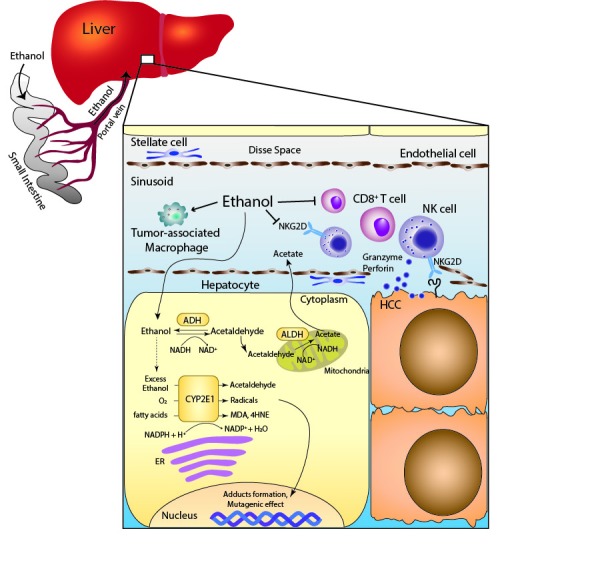
“Subsequently, the increase of ROS results in the generation of lipid peroxidation products, such as malondialdehyde (MDA) and 4-hydroxy-2-nonenal (4HNE).(83) A significant increase in CYP2E1 could be induced for 1 week in patients who consumed more than 40 g of ethanol per day and was further elevated after 4 weeks.”
BackgroundCorrao, G., & Aricò, S. (1998) · Hepatology · doi:10.1002/hep.510270404 · Cited by 324 · cited 1×
“47 In patients with a high alcohol intake (>60 g/day to 125 g/day), the coexistence of HCV has been shown to increase the risk of alcohol-associated liver cirrhosis.(17) 18 24 48–50 Furthermore, heavy alcohol consumption has also been shown to increase the risk of developing HCC.”
BackgroundDiabetes mellitus and risk of hepatocellular carcinoma: a systematic review and meta‐analysis
Wang, P., Kang, D., Cao, W., Wang, Y., & Liu, Z. (2012) · Diabetes/Metabolism Research and Reviews · doi:10.1002/dmrr.1291 · Cited by 310
Exacerbation of Alcoholic Liver Injury by Enteral Endotoxin in Rats
Mathurin, P., Deng, Q.-G., Keshavarzian, A., Choudhary, S., Holmes, E. W., & Tsukamoto, H. (2000) · Hepatology · doi:10.1053/jhep.2000.19621 · Cited by 297 · cited 4×
“The plasma LPS levels were elevated in ethanol-fed animals and the plasma endotoxin levels were found to be elevated in patients with ALD.107 108 Machida et al109 reported that an HCV-derived protein, NS5A, induced the expression of the TLR4 gene in hepatocytes and B cells.109 They also showed that alcohol induced the…”
BackgroundInfluentialCai, L., Zhang, Z., Zhou, L., Wang, H., Fu, J., Zhang, S., Shi, M., Zhang, H., Yang, Y., Wu, H., et al. (2008) · Clinical Immunology · doi:10.1016/j.clim.2008.08.012 · Cited by 288 · cited 16×
“It has been shown that MAT1A knockout mice develop SAMe deficiency, fatty liver and HCC.92 Furthermore, in patients with AUD, the hepatic MAT activity and the expression of the MAT1A gene are reported to be decreased.93 SAMe also works as a methyl group donor for protein methylation.”
ResultInfluentialAlbano, E., Clot, P., Morimoto, M., Tomasi, A., Ingelman-Sundberg, M., & French, S. W. (1996) · Hepatology · doi:10.1002/hep.510230121 · Cited by 278 · cited 1×
“In an animal model, the induction of CYP2E1 by ethanol causes the production of hydroxyethyl radicals and lipid peroxidation.(85) Furthermore, in humans, it has been shown that ethanol-mediated CYP2E1 induction leads to the increased levels of ROS, lipid peroxidation, MDA and 4HNE.”
Yuan, J., Govindarajan, S., Arakawa, K., & Yu, M. C. (2004) · Cancer · doi:10.1002/cncr.20427 · Cited by 275
Chew, V., Tow, C., Teo, M., Wong, H. L., Chan, J., Gehring, A., Loh, M., Bolze, A., Quek, R., Lee, V. K. M., et al. (2010) · Journal of Hepatology · doi:10.1016/j.jhep.2009.07.013 · Cited by 259
Jeong, W., Park, O., & Gao, B. (2008) · Gastroenterology · doi:10.1053/j.gastro.2007.09.034 · Cited by 247 · cited 1×
“1 in the liver.(106) However, further studies are needed as it is difficult to completely clarify the association between NK cells and alcohol-induced HCC.”
BackgroundCsak, T., Velayudham, A., Hritz, I., Petrasek, J., Levin, I., Lippai, D., Catalano, D., Mandrekar, P., Dolganiuc, A., Kurt-Jones, E., et al. (2011) · American Journal of Physiology-Gastrointestinal and Liver Physiology · doi:10.1152/ajpgi.00163.2009 · Cited by 229
ALDH2 polymorphism and alcohol-related cancers in Asians: a public health perspective
Chang, J. S., Hsiao, J.-R., & Chen, C.-H. (2017) · Journal of Biomedical Science · doi:10.1186/s12929-017-0327-y · Cited by 223
Loomba, R., Yang, H.-I., Su, J., Brenner, D., Barrett-Connor, E., Iloeje, U., & Chen, C.-J. (2013) · American Journal of Epidemiology · doi:10.1093/aje/kws252 · Cited by 221 · cited 1×
“52).(66) Although the mechanisms of the synergistic effect between ALD and diabetes are unknown, several mechanisms have been suggested to underlie the development of diabetes and/or obesity-induced HCC in patients with non-alcoholic steatohepatitis.”
BackgroundKlair, J. S., Yang, J. D., Abdelmalek, M. F., Guy, C. D., Gill, R. M., Yates, K., Unalp‐Arida, A., Lavine, J. E., Clark, J. M., Diehl, A. M., et al. (2016) · Hepatology · doi:10.1002/hep.28514 · Cited by 201 · cited 1×
“However, several studies have demonstrated that oestrogen protects against liver inflammation and fibrosis in a NASH model, and oestrogen deficiency has been reported to worsen steatohepatitis and liver fibrosis in human.(42) 43 As oestrogen has multiple functions and the expression profile of the mechanisms might dif…”
BackgroundOneta, C. M., Lieber, C. S., Li, J., Rüttimann, S., Schmid, B., Lattmann, J., Rosman, A. S., & Seitz, H. K. (2002) · Journal of Hepatology · doi:10.1016/s0168-8278(01)00223-9 · Cited by 194 · cited 1×
“A significant increase in CYP2E1 could be induced for 1 week in patients who consumed more than 40 g of ethanol per day and was further elevated after 4 weeks.(84) In an animal model, the induction of CYP2E1 by ethanol causes the production of hydroxyethyl radicals and lipid peroxidation.”
BackgroundTumor Microenvironment, a Paradigm in Hepatocellular Carcinoma Progression and Therapy
Tahmasebi Birgani, M., & Carloni, V. (2017) · International Journal of Molecular Sciences · doi:10.3390/ijms18020405 · Cited by 193
Machida, K., Cheng, K. T. H., Sung, V. M.-H., Levine, A. M., Foung, S., & Lai, M. M. C. (2006) · Journal of Virology · doi:10.1128/jvi.80.2.866-874.2006 · Cited by 192 · cited 1×
“108 Machida et al(109) reported that an HCV-derived protein, NS5A, induced the expression of the TLR4 gene in hepatocytes and B cells.(109) They also showed that alcohol induced the progression of HCC through LPS-TLR4signaling activation.”
BackgroundDNA Damage, DNA Repair, and Alcohol Toxicity--A Review
Brooks, P. J. (1997) · Alcoholism: Clinical & Experimental Research · doi:10.1097/00000374-199709000-00021 · Cited by 190
Bruguera, M., & Forns, X. (2006) · Medicina Clínica · doi:10.1157/13090276 · Cited by 181 · cited 1×
“0%).(46) 47 In patients with a high alcohol intake (>60 g/day to 125 g/day), the coexistence of HCV has been shown to increase the risk of alcohol-associated liver cirrhosis.”
BackgroundIkeda, K., Saitoh, S., Suzuki, Y., Kobayashi, M., Tsubota, A., Fukuda, M., Koida, I., Arase, Y., Chayama, K., Murashima, N., et al. (1998) · Cancer · doi:10.1002/(sici)1097-0142(19980301)82:5<827::aid-cncr5>3.0.co;2-g · Cited by 175
Lin, C.-W., Lin, C.-C., Mo, L.-R., Chang, C.-Y., Perng, D.-S., Hsu, C.-C., Lo, G.-H., Chen, Y.-S., Yen, Y.-C., Hu, J.-T., et al. (2013) · Journal of Hepatology · doi:10.1016/j.jhep.2012.11.045 · Cited by 174
Mata, A. M., González-Diéguez, M.-L., Cadahía, V., Varela, M., Pérez, R., Navascués, C. Á., Sotorríos, N. G., Martínez, M., Rodrigo, L., & Rodríguez, M. (2012) · Clinical Gastroenterology and Hepatology · doi:10.1016/j.cgh.2012.09.007 · Cited by 174 · cited 1×
“6%.(10) 11 Thus, it might be appropriate”
Estrogen increases sensitivity of hepatic Kupffer cells to endotoxin
Ikejima, K., Enomoto, N., Iimuro, Y., Ikejima, A., Fang, D., Xu, J., Forman, D. T., Brenner, D. A., & Thurman, R. G. (1998) · American Journal of Physiology-Gastrointestinal and Liver Physiology · doi:10.1152/ajpgi.1998.274.4.g669 · Cited by 171
Alcohol Consumption and Alcoholic Liver Disease: Evidence of a Threshold Level of Effects of Ethanol
Savolainen, V. T., Liesto, K., Männikkö, A., Penttilä, A., & Karhunen, P. J. (1993) · Alcoholism: Clinical and Experimental Research · doi:10.1111/j.1530-0277.1993.tb05673.x · Cited by 168
Hepatocellular Carcinoma in Obesity, Type 2 Diabetes, and NAFLD
Reeves, H. L., Zaki, M. Y. W., & Day, C. P. (2016) · Digestive Diseases and Sciences · doi:10.1007/s10620-016-4085-6 · Cited by 166 · cited 1×
“Although the mechanisms of the synergistic effect between ALD and diabetes are unknown, several mechanisms have been suggested to underlie the development of diabetes and/or obesity-induced HCC in patients with non-alcoholic steatohepatitis.(67) In terms of cost-effective surveillance, a recent cohort study investigat…”
BackgroundNanji, A. A., Jokelainen, K., Fotouhinia, M., Rahemtulla, A., Thomas, P., Tipoe, G. L., Su, G. L., & Dannenberg, A. J. (2001) · American Journal of Physiology-Gastrointestinal and Liver Physiology · doi:10.1152/ajpgi.2001.281.6.g1348 · Cited by 161
Role of methionine adenosyltransferase and S-adenosylmethionine in alcohol-associated liver cancer
Lu, S. C.-L., & Mato, J. M. (2005) · Alcohol · doi:10.1016/j.alcohol.2005.03.011 · Cited by 156 · cited 1×
“In most cases, DNA methylation is associated with a decreased gene expression because of interference with the interaction of transcription factor and CpG islands of promoter lesions (usually unmethylated).(91) It has been shown that alcohol inhibits the synthesis of S-adenosyl-L-methionine (SAMe), which is a universa…”
BackgroundEstrogen deficiency worsens steatohepatitis in mice fed high-fat and high-cholesterol diet
Kamada, Y., Kiso, S., Yoshida, Y., Chatani, N., Kizu, T., Hamano, M., Tsubakio, M., Takemura, T., Ezaki, H., Hayashi, N., et al. (2011) · American Journal of Physiology-Gastrointestinal and Liver Physiology · doi:10.1152/ajpgi.00211.2011 · Cited by 154
European Code against Cancer 4th Edition: Alcohol drinking and cancer
Scoccianti, C., Cecchini, M., Anderson, A. S., Berrino, F., Boutron‐Ruault, M., Espina, C., Key, T. J., Leitzmann, M. F., Norat, T., Powers, H. J., et al. (2016) · Cancer Epidemiology · doi:10.1016/j.canep.2016.09.011 · Cited by 147 · cited 16×
“It has been shown that MAT1A knockout mice develop SAMe deficiency, fatty liver and HCC.92 Furthermore, in patients with AUD, the hepatic MAT activity and the expression of the MAT1A gene are reported to be decreased.93 SAMe also works as a methyl group donor for protein methylation.”
BackgroundInfluentialFitness Versus Fatness: Moving Beyond Weight Loss in Nonalcoholic Fatty Liver Disease
Johnson, N. A., & George, J. (2010) · Hepatology · doi:10.1002/hep.23711 · Cited by 146
European Code against Cancer 4th Edition: Alcohol drinking and cancer
Scoccianti, C., Cecchini, M., Anderson, A. S., Berrino, F., Boutron‐Ruault, M., Espina, C., Key, T. J., Leitzmann, M. F., Norat, T., Powers, H. J., et al. (2015) · Cancer Epidemiology · doi:10.1016/j.canep.2015.01.007 · Cited by 144
Alcohol and hepatocellular carcinoma: A review and a point of view
Testino, G., Leone, S., & Borro, P. (2014) · World Journal of Gastroenterology · doi:10.3748/wjg.v20.i43.15943 · Cited by 142 · cited 17×
“It has been shown that MAT1A knockout mice develop SAMe deficiency, fatty liver and HCC.92 Furthermore, in patients with AUD, the hepatic MAT activity and the expression of the MAT1A gene are reported to be decreased.93 SAMe also works as a methyl group donor for protein methylation.”
BackgroundInfluentialOtani, K., Korenaga, M., Beard, M. R., Li, K., Qian, T., Showalter, L., Singh, A. K., Wang, T., & Weinman, S. A. (2005) · Gastroenterology · doi:10.1053/j.gastro.2004.10.045 · Cited by 140
Yang, W.-S., Va, P., Bray, F., Gao, S., Gao, J., Li, H.-L., & Xiang, Y.-B. (2011) · PLoS ONE · doi:10.1371/journal.pone.0027326 · Cited by 134
Munaka, M., Kohshi, K., Kawamoto, T., Takasawa, S., Nagata, N., Itoh, H., Oda, S., & Katoh, T. (2003) · Journal of Cancer Research and Clinical Oncology · doi:10.1007/s00432-003-0439-5 · Cited by 132 · cited 1×
“55).(21) 22 Thus, the amount of ethanol consumption might provide an indication of the risk of liver cirrhosis and HCC.”
BackgroundNischalke, H. D., Berger, C., Luda, C., Berg, T., Müller, T., Grünhage, F., Lammert, F., Coenen, M., Krämer, B., Körner, C., et al. (2011) · PLoS ONE · doi:10.1371/journal.pone.0027087 · Cited by 130
Guyot, E., Sutton, A., Rufat, P., Laguillier, C., Mansouri, A., Moreau, R., Ganne‐Carrié, N., Beaugrand, M., Charnaux, N., Trinchet, J., et al. (2012) · Journal of Hepatology · doi:10.1016/j.jhep.2012.09.036 · Cited by 129
Obe, G., Jonas, R., & Schmidt, S. H. (1986) · Mutation Research Letters · doi:10.1016/0165-7992(86)90075-8 · Cited by 116 · cited 1×
“thine phosphoribosyltransferase (HPRT) gene in lymphocytes,(76) and induces sister chromatid exchanges.(77) Meanwhile the formation of adducts with DNA, for example, N(2)-ethyl-deoxyguanosine (N(2)-Et-dG),(78) has been found in patients with ALD.”
BackgroundEstrogen, estrogen receptors, and hepatocellular carcinoma: Are we there yet?
Sukocheva, O. A. (2018) · World Journal of Gastroenterology · doi:10.3748/wjg.v24.i1.1 · Cited by 104
Asare, G. A., Mossanda, K. S., Kew, M. C., Paterson, A. C., Kahler-Venter, C. P., & Siziba, K. (2006) · Toxicology · doi:10.1016/j.tox.2005.11.006 · Cited by 98 · cited 1×
“Iron overload has been shown to cause DNA strand breaks and p53 mutation, which could cause hepatocarcinogenesis.(89) 90”
BackgroundFalleti, E., Cussigh, A., Cmet, S., Fabris, C., & Toniutto, P. (2015) · Digestive and Liver Disease · doi:10.1016/j.dld.2015.09.009 · Cited by 97 · cited 16×
“A recent genome-wide association study in Europe revealed that the gene polymorphisms of TM6SF2 and PNPLA3 could be regarded as potential genetic risk factors for the development of alcohol-related HCC.(115)”
BackgroundInfluentialIron Accumulation in Alcoholic Liver Diseases
Kohgo, Y., Ohtake, T., Ikuta, K., Suzuki, Y., Hosoki, Y., Saito, H., & Kato, J. (2005) · Alcoholism: Clinical and Experimental Research · doi:10.1097/01.alc.0000189274.00479.62 · Cited by 97
Tanaka, K., Tsuji, I., Wakai, K., Nagata, C., Mizoue, T., Inoue, M., & Tsugane, S. (2008) · Japanese Journal of Clinical Oncology · doi:10.1093/jjco/hyn108 · Cited by 97
Wang, F., Yang, J.-L., Yu, K.-K., Xu, M., Xu, Y.-Z., Chen, L., Lu, Y.-M., Fang, H.-S., Wang, X.-Y., Hu, Z.-Q., et al. (2015) · Molecular Cancer · doi:10.1186/s12943-014-0274-0 · Cited by 97 · cited 1×
“results in the activation of NF-kB signalling; conversely the expression levels of VEGF and MCP-1, the tumour growth, angiogenesis and metastasis were suppressed by the inhibition of alcohol-mediated ROS production and NF-kB signalling.(88) Apart from above-mentioned mechanisms of CYP2E1-mediated ROS generation, iron…”
BackgroundObservations on the relation between alcohol absorption and the rate of gastric emptying.
Holt, S. (1981) · PubMed · Cited by 93
Increased circulating products of lipid peroxidation in patients with alcoholic liver disease.
Aleynik, S. I., Leo, M. A., Aleynik, M. K., & Lieber, C. S. (1998) · PubMed · Cited by 93
Increased Circulating Products of Lipid Peroxidation in Patients with Alcoholic Liver Disease
Aleynik, S. I., Leo, M. A., Aleynik, M. K., & Lieber, C. S. (1998) · Alcoholism: Clinical and Experimental Research · doi:10.1111/j.1530-0277.1998.tb03637.x · Cited by 92 · cited 1×
“Furthermore, in humans, it has been shown that ethanol-mediated CYP2E1 induction leads to the increased levels of ROS, lipid peroxidation, MDA and 4HNE.(86) 4HNE, one of the lipid peroxidation products, can cause a mutation at codon 249 of the p53 gene(87); this mutation is commonly found in HCC (20%–30%).”
BackgroundSubleski, J. J., Hall, V. L., Back, T. C., Ortaldo, J. R., & Wiltrout, R. H. (2006) · Cancer Research · doi:10.1158/0008-5472.can-06-0811 · Cited by 89 · cited 1×
“103 A study using an animal model demonstrated that the depletion of NK cells resulted in a decrease in the antitumour activity of IL-18/IL-12 therapy.(104) With regard to the relationship between NK cells and alcohol use, many studies have reported an association between alcohol consumption and NK cell dysfunction.”
MethodSakamoto, T., Hara, M., Higaki, Y., Ichiba, M., Horita, M., Mizuta, T., Eguchi, Y., Yasutake, T., Ozaki, I., Yamamoto, K., et al. (2006) · International Journal of Cancer · doi:10.1002/ijc.21505 · Cited by 88
Brandon‐Warner, E., Walling, T. L., Schrum, L. W., & McKillop, I. H. (2012) · Alcoholism: Clinical and Experimental Research · doi:10.1111/j.1530-0277.2011.01660.x · Cited by 88 · cited 1×
“Because there are no animal models of alcohol-induced HCC alone, a chemical-induced (DEN) HCC model is mainly used to study the effects of alcohol intake on hepatocarcinogenesis.(32) 71 72 However, the priming effect of hepatocarcinogenesis and the progressive effects have been well investigated.”
MethodLim, J. K., Tate, J. P., Fultz, S. L., Goulet, J. L., Conigliaro, J., Bryant, K. J., Gordon, A. J., Gibert, C., Rimland, D., Bidwell Goetz, M., et al. (2014) · Clinical Infectious Diseases · doi:10.1093/cid/ciu097 · Cited by 88
Epigenetic signatures of alcohol abuse and hepatitis infection during human hepatocarcinogenesis
Hlady, R. A., Tiedemann, R. L., Puszyk, W., Zendejas, I., Roberts, L. R., Choi, J.-H., Liu, C., & Robertson, K. D. (2014) · Oncotarget · doi:10.18632/oncotarget.2444 · Cited by 87
Ambade, A., Satishchandran, A., & Szabo, G. (2016) · Scientific Reports · doi:10.1038/srep21340 · Cited by 85
Matsuda, T., Terashima, I., Matsumoto, Y., Yabushita, H., Matsui, S., & Shibutani, S. (1999) · Biochemistry · doi:10.1021/bi982134j · Cited by 83
Alcohol Consumption, Folate Intake, Hepatocellular Carcinoma, and Liver Disease Mortality
Persson, E. C., Schwartz, L. M., Park, Y., Trabert, B., Hollenbeck, A. R., Graubard, B. I., Freedman, N. D., & McGlynn, K. A. (2013) · Cancer Epidemiology, Biomarkers & Prevention · doi:10.1158/1055-9965.epi-12-1169 · Cited by 82
Marrogi, A. J., Khan, M. A., van Gijssel, H. E., Welsh, J. A., Rahim, H., Demetris, A. J., Kowdley, K. V., Hussain, S. P., Nair, J., Bartsch, H., et al. (2001) · JNCI Journal of the National Cancer Institute · doi:10.1093/jnci/93.21.1652 · Cited by 82
Trepo, E., Guyot, E., Ganne-Carrie, N., Degre, D., Gustot, T., Franchimont, D., Sutton, A., Nahon, P., & Moreno, C. (2012) · Hepatology · doi:10.1002/hep.25518 · Cited by 80
Aloman, C., Gehring, S., Wintermeyer, P., Kuzushita, N., & Wands, J. R. (2006) · Gastroenterology · doi:10.1053/j.gastro.2006.11.016 · Cited by 76
Molecular Mechanisms of Alcohol-Induced Hepatic Fibrosis
Siegmund, S. V., Dooley, S., & Brenner, D. A. (2005) · Digestive Diseases · doi:10.1159/000090174 · Cited by 75 · cited 1×
“With regard to liver fibrosis, acetaldehyde produced in the hepatocytes can enter the hepatic stellate cell (HSC) and induces the expression of type I collagen genes in vitro.(81) Acetaldehyde adducts with protein have been shown in HSC.”
BackgroundSexual Dimorphism in Alcohol Induced Adipose Inflammation Relates to Liver Injury
Fulham, M. A., & Mandrekar, P. (2016) · PLoS ONE · doi:10.1371/journal.pone.0164225 · Cited by 71
Zhao, J., Adams, A., Roberts, B., O’Neil, M. F., Vittal, A., Schmitt, T. M., Kumer, S. C., Cox, J., Li, Z., Weinman, S. A., et al. (2018) · Hepatology · doi:10.1002/hep.29587 · Cited by 68
Insulin resistance and steatosis in hepatitis C virus infection
Zekry, A., McHutchison, J. G., & Diehl, A. M. (2005) · Gut · doi:10.1136/gut.2004.059873 · Cited by 65
Estriol sensitizes rat Kupffer cells via gut-derived endotoxin
Enomoto, N., Yamashina, S., Schemmer, P., Rivera, C. A., Bradford, B. U., Enomoto, A., Brenner, D. A., & Thurman, R. G. (1999) · American Journal of Physiology-Gastrointestinal and Liver Physiology · doi:10.1152/ajpgi.1999.277.3.g671 · Cited by 62
Yan, G., Wang, X., Sun, C., Zheng, X., Wei, H., Tian, Z., & Sun, R. (2017) · Scientific Reports · doi:10.1038/s41598-017-02887-7 · Cited by 60
Risk factors for hepatocellular carcinoma in a cohort infected with hepatitis B or C
Walter, S. R., Thein, H., Gidding, H. F., Amin, J., Law, M. G., George, J., & Dore, G. J. (2011) · Journal of Gastroenterology and Hepatology · doi:10.1111/j.1440-1746.2011.06785.x · Cited by 57 · cited 16×
“It has been shown that MAT1A knockout mice develop SAMe deficiency, fatty liver and HCC.92 Furthermore, in patients with AUD, the hepatic MAT activity and the expression of the MAT1A gene are reported to be decreased.93 SAMe also works as a methyl group donor for protein methylation.”
BackgroundInfluentialAcetaldehyde‐induced mutation at the hprt Locus in Human Lymphocytes In Vitro
He, S., Lambert, B., & McCormick, J. J. (1990) · Environmental and Molecular Mutagenesis · doi:10.1002/em.2850160202 · Cited by 54
Cytochrome P450 1A2 Metabolizes 17β-Estradiol to Suppress Hepatocellular Carcinoma
Ren, J., Chen, G. Y., Liu, Y., Su, X., Hu, B., Leung, B. C. S., Wang, Y., Ho, R. L. K., Yang, S., Lü, G., et al. (2016) · PLoS ONE · doi:10.1371/journal.pone.0153863 · Cited by 54
Uetake, S., Yamauchi, M., Itoh, S., Kawashima, O., Takeda, K., & Ohata, M. (2003) · Alcoholism Clinical and Experimental Research · doi:10.1097/01.alc.0000079449.47468.b0 · Cited by 52
Adult mouse model of early hepatocellular carcinoma promoted by alcoholic liver disease
Ambade, A., Satishchandran, A., Gyongyosi, B., Lowe, P., & Szabo, G. (2016) · World Journal of Gastroenterology · doi:10.3748/wjg.v22.i16.4091 · Cited by 52
Wu, H., Yao, S., Zhang, S., Wang, J.-R., Guo, P.-D., Li, X., Gan, W. J., Mei, L., Gao, T.-M., & Li, J.-M. (2017) · Journal of Hepatology · doi:10.1016/j.jhep.2017.01.030 · Cited by 51
Alcohol and Viral Hepatitis: Role of Lipid Rafts
Dolganiuc, A. (2015) · Alcohol research · doi:10.35946/arcr.v37.2.13 · Cited by 49
Genetics of Alcoholic Liver Disease
Daly, A. K., Day, C. P., & Anstee, Q. M. (2015) · Seminars in Liver Disease · doi:10.1055/s-0035-1567832 · Cited by 48 · cited 1×
“metabolism, oxidative stress-related pathway activation and inflammatory responses.(69) As described above in”
BackgroundKasztelan‐Szczerbińska, B., Surdacka, A., Celiński, K., Roliński, J., Zwolak, A., Miącz, S., & Szczerbiński, M. (2015) · PLoS ONE · doi:10.1371/journal.pone.0128347 · Cited by 46
Sex-Specific Differences in the Development of Acute Alcohol-Induced Liver Steatosis in Mice
Wagnerberger, S., Fiederlein, L., Kanuri, G., Stahl, C., Millonig, G., Mueller, S., Bischoff, S. C., & Bergheim, I. (2013) · Alcohol and Alcoholism · doi:10.1093/alcalc/agt138 · Cited by 46
Interaction of alcohol intake and cofactors on the risk of cirrhosis
Stroffolini, T., Cotticelli, G., Medda, E., Niosi, M., Del Vecchio-Blanco, C., Addolorato, G., Petrelli, E., Salerno, M. T., Picardi, A., Bernardi, M., et al. (2009) · Liver International · doi:10.1111/j.1478-3231.2010.02261.x · Cited by 46
Zhang, F., Little, A., & Zhang, H. (2016) · Journal of Leukocyte Biology · doi:10.1189/jlb.1a0716-298rr · Cited by 43 · cited 1×
“ated macrophages and/or M2 macrophages in mouse models.(96) 97 These studies strongly indicate that the”
BackgroundDouds, A. C., Cox, M. A., Iqbal, T. H., & Cooper, B. T. (2003) · Alcohol and Alcoholism · doi:10.1093/alcalc/agg040 · Cited by 40
Yu, M., & Li, Z. (2017) · Frontiers of Medicine · doi:10.1007/s11684-017-0546-3 · Cited by 39
Laso, F. J., Almeida, J., de la Torres, E. P., Vaquero, J. M., Marcos, M., & Órfão, A. (2010) · Alcoholism Clinical and Experimental Research · doi:10.1111/j.1530-0277.2010.01160.x · Cited by 38 · cited 1×
“blood of patients with alcoholic liver cirrhosis showed reduced cytotoxic activity against cancer cells.(105) In an animal model, alcohol ingestion reduced the cytotoxicity of NK cells, which resulted from the reduction of NKG2D.”
BackgroundParadis, V, Scoazec, J. Y., Köllinger, M., Holstege, A., Moreau, A., Feldmann, G., & Bedossa, P. (1996) · Journal of Histochemistry & Cytochemistry · doi:10.1177/44.9.8773571 · Cited by 36 · cited 2×
“Acetaldehyde interacts with certain amino acids in proteins, for example, the formation of adducts with O6-methylguanine methyltransferase causes DNA repair system dysfunction.80 With regard to liver fibrosis, acetaldehyde produced in the hepatocytes can enter the hepatic stellate cell (HSC) and induces the expression…”
BackgroundPrevalence of hepatitis C virus infection in alcoholic patients: cohort study and systematic review
Novo-Veleiro, I., Calle, C. D. L., Domínguez-Quibén, S., Pastor, I., Marcos, M., & Laso, F.-J. (2013) · Alcohol and Alcoholism · doi:10.1093/alcalc/agt044 · Cited by 31
Is alcohol a risk factor for liver cirrhosis in HBsAg and anti-HCV negative subjects?
Corrao, G., Aricò, S., Zambon, A., Torchio, P., Lepore, A. R., Busellu, G., & di Orio, F. (1997) · Journal of Hepatology · doi:10.1016/s0168-8278(97)80350-9 · Cited by 23
Gallucci, R. M., Sloan, D. K., O'Dell, S. J., & Reinke, L. A. (2004) · Alcoholism Clinical and Experimental Research · doi:10.1097/01.alc.0000118316.20560.0d · Cited by 21
Santamaría, E., Muñoz, J., Fernández‐Irigoyen, J., Sesma, L., Mora, M. I., Berasain, C., Lu, S. C.-L., Mato, J. M., Prìeto, J., Avila, M. A., et al. (2006) · Journal of Proteome Research · doi:10.1021/pr050429v · Cited by 21 · cited 16×
“It has been shown that MAT1A knockout mice develop SAMe deficiency, fatty liver and HCC.92 Furthermore, in patients with AUD, the hepatic MAT activity and the expression of the MAT1A gene are reported to be decreased.93 SAMe also works as a methyl group donor for protein methylation.”
BackgroundInfluentialPredictors of Increased Risk of Hepatocellular Carcinoma in Patients with Type 2 Diabetes
Si, W. K., Chung, J. W., Jun-Hyeon, C., Baeg, J. Y., Jang, E. S., Yoon, H., Kim, J., Shin, C. M., Park, Y. S., Hwang, J., et al. (2016) · PLoS ONE · doi:10.1371/journal.pone.0158066 · Cited by 20 · cited 1×
“In terms of cost-effective surveillance, a recent cohort study investigated the potential predictors of HCC in 3544 patients with diabetes without viral hepatitis and suggested that a DM-HCC risk score included age >65 years, low triglyceride levels and high gamma-glutamyl transferase levels.(68) In this study, althou…”
BackgroundYamada, S., Matsuoka, H., Harada, Y., Momosaka, Y., Izumi, H., Kohno, K., Yamaguchi, Y., & Eto, S. (1999) · Alcoholism Clinical and Experimental Research · doi:10.1111/j.1530-0277.1999.tb04536.x · Cited by 19
Characterisation of the DNA repair enzyme for O6-methylguanine in cirrhosis
Collier, J. D., Bassendine, M. F., Burt, A. D., & Major, G. N. (1996) · Journal of Hepatology · doi:10.1016/s0168-8278(96)80068-7 · Cited by 17 · cited 1×
“Acetaldehyde interacts with certain amino acids in proteins, for example, the formation of adducts with O6-methylguanine methyltransferase causes DNA repair system dysfunction.(80) With regard to liver fibrosis, acetaldehyde produced in the hepatocytes can enter the hepatic stellate cell (HSC) and induces the expressi…”
Background
Cited by
Pathophysiological Aspects of Alcohol Metabolism in the Liver
Hyun, J., Han, J., Lee, C., Yoon, M., & Jung, Y. (2021) · International Journal of Molecular Sciences · doi:10.3390/ijms22115717 · Cited by 324
Coelho-Júnior, H. J., Trichopoulou, A., & Panza, F. (2021) · Ageing Research Reviews · doi:10.1016/j.arr.2021.101395 · Cited by 216
Choi, S., Kim, B. K., Yon, D. K., Lee, S. W., Lee, H. G., Chang, H. H., Park, S., Koyanagi, A., Jacob, L., Dragioti, E., et al. (2023) · Clinical and Molecular Hepatology · doi:10.3350/cmh.2022.0316 · Cited by 101
Alcohol and hepatocarcinogenesis
Taniai, M. (2020) · Clinical and Molecular Hepatology · doi:10.3350/cmh.2020.0203 · Cited by 117
“It has been shown that estrogen increases the sensitivity of Kupffer cells to LPS, which results in more severe liver injury, and many previous studies have reported that more severe inflammatory responses in the liver and fat tissue, which were associated with TLR4 signaling, were seen in female patients.(5) In patie…”
BackgroundMethodInfluentialRole of alcohol in pathogenesis of hepatitis B virus infection
Ganesan, M., Eikenberry, A., Poluektova, L. Y., Kharbanda, K. K., & Osna, N. A. (2020) · World Journal of Gastroenterology · doi:10.3748/wjg.v26.i9.883 · Cited by 61
Metadata
- Authors
- Matsushita, H., & Takaki, A.
- Affiliations
- Okayama University (JP)
- Corresponding author
- Takaki, Akinobu
- Venue
- BMJ Open Gastroenterology
- Publisher
- BMJ
- Published
- 2019-04
- Volume
- 6
- Issue
- 1
- Pages
- e000260
- ISSN
- 2054-4774 (ISSN-L)
- PMC
- PMC6505979
- OpenAlex
- W2933220359
- Cited by
- 110
- References
- 117
- Citations by year
- 2026: 9 · 2025: 23 · 2024: 16 · 2023: 16 · 2022: 18 · 2021: 14 · 2020: 11 · 2019: 3
- FWCI
- 1.71
- Type
- journal article
- Language
- en
- Open access
- gold
- doi.org
- Licence
- cc-by-nc
- Locations
- BMJ Open Gastroenterology (publishedVersion, cc-by-nc)
- Europe PMC (PubMed Central) (publishedVersion, cc-by-nc)
- PubMed Central (publishedVersion, cc-by-nc)
- PubMed (publishedVersion)
- DOAJ (DOAJ: Directory of Open Access Journals) (submittedVersion, cc-by-sa)
- Topics
- Health Sciences › Medicine › Pathology and Forensic Medicine › Alcohol Consumption and Health Effects
- Health Sciences › Medicine › Hepatology › Hepatocellular Carcinoma Treatment and Prognosis
- Health Sciences › Medicine › Hepatology › Liver physiology and pathology
- Keywords
- alcohol, hepatocellular carcinoma, acetaldehyde, reactive oxygen species, iron accumulation, TLR4 signaling, hepatitis C virus, liver cirrhosis, smoking, viral hepatitis, diabetes mellitus, immune mechanisms, carcinogenesis mechanisms
About these checks
Registry, retraction, Cites and statistics results are computed, not judged, with one exception: a printed reference that no index lists is read once by a model before it counts as a citation error. Claims are extracted by a model and kept only when their quote appears verbatim in the text; each cited source is then checked, with a model’s help, for whether it says what the claim relies on. Those verdicts can be wrong — read the claim’s quote and the cited source before relying on one.
Statistics and arithmetic are recomputed, not judged.
Confidence bands are shown only for fields calibrated on our annotated test set. None is calibrated yet, so no band is shown.
What counts as a claim ›How we measure confidence ›How we check this ›
Are you an author, or do you see a problem with this page? Request a review
Data sources
Bibliographic data: Semantic Scholar, OpenAlex, Crossref.
Contains information from the Semantic Scholar Academic Graph Datasets, made available under the ODC Attribution License (ODC-BY 1.0).
Semantic Scholar’s data is described in: Kinney, R., et al. (2023). The Semantic Scholar Open Data Platform. arXiv:2301.10140.
