

‘Women and babies are dying but not of Ebola’: the effect of the Ebola virus epidemic on the availability, uptake and outcomes of maternal and newborn health services in Sierra Leone
Open accessThe DOI matches its Crossref record; 7 of the 7 references it cites were found in a registry or an index.
Abstract
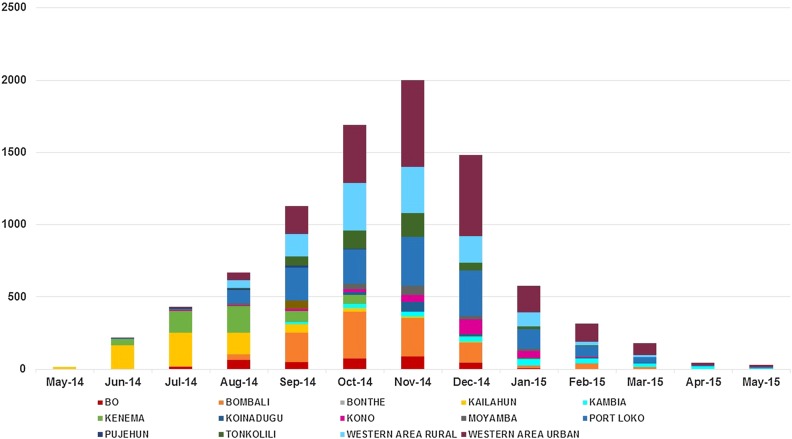
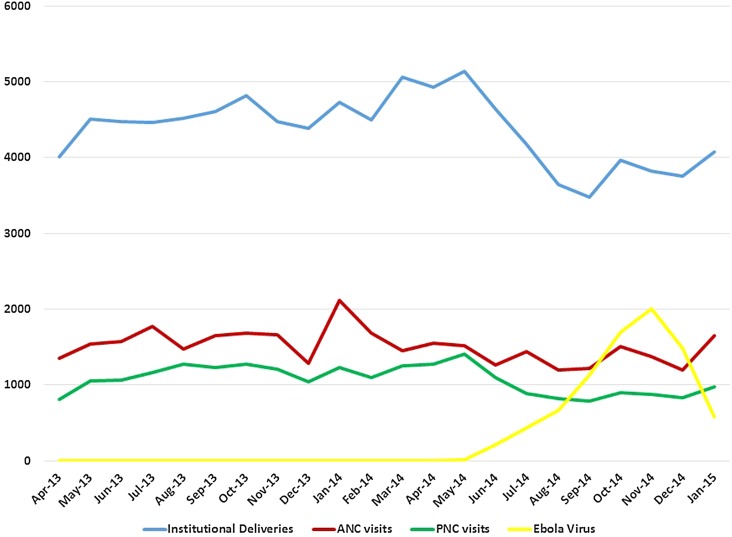
Background: We sought to determine the impact of the Ebola virus epidemic on the availability, uptake and outcome of routine maternity services in Sierra Leone. Methods: The number of antenatal and postnatal visits, institutional births, availability of emergency obstetric care (EmOC), maternal deaths and stillbirths were assessed by month, by districts and by level of healthcare for 10 months during, and 12 months prior to, the Ebola virus disease (EVD) epidemic. All healthcare facilities designated to provide comprehensive (n=13) or basic (n=67) EmOC across the 13 districts of Sierra Leone were included. Results: Preservice students were not deployed during the EVD epidemic. The number of healthcare providers in facilities remained constant (incidence rate ratio (IRR) 1.03, 95% CI 1.00 to 1.07). Availability of antibiotics, oxytocics, anticonvulsants, manual removal of placenta, removal of retained products of conception, blood transfusion and caesarean section were not affected by the EVD epidemic. Across Sierra Leone, following the onset of the EVD epidemic, there was a 18% decrease in the number of women attending for antenatal (IRR 0.82, 95% CI 0.79 to 0.84); 22% decrease in postnatal attendance (IRR 0.78, 95% CI 0.75 to 0.80) visits and 11% decrease in the number of women attending for birth at a healthcare facility (IRR 0.89, 95% CI 0.87 to 0.91). There was a corresponding 34% increase in the facility maternal mortality ratio (IRR 1.34, 95% CI 1.07 to 1.69) and 24% increase in the stillbirth rate (IRR 1.24, 95% CI 1.14 to 1.35). Conclusions: During the EVD epidemic, fewer pregnant women accessed healthcare. For those who did, an increase in maternal mortality and stillbirth was observed. In the post-Ebola phase, ‘readiness’ (or not) of the global partners for large-scale epidemics has been the focus of debate. The level of functioning of the health system with regard to ability to continue to provide high-quality effective routine care needs more attention.
Overview
The claims and statistics of this paper haven’t been checked yet.
Free: it reads the open-access text and checks the first 5 claims that cite a source we can check. Create a free account to check every claim.
Integrity signals
Registry
Cites
Statistics
Figures
Verification
Claims the paper makes
The claims and statistics of this paper haven’t been checked yet.
Free: it reads the open-access text and checks the first 5 claims that cite a source we can check. Create a free account to check every claim.
Claims other papers make about this one
Each is checked against this paper’s own text: does it say what the citing paper says it does?
The source backs part of the claim, not all of it — or backs it for a different population, condition or comparison.
In the citing paper
“These delays are worse during pandemics leading to low hospital visits for antenatal care, delivery, and postnatal care [6].”
From Community-based referral transportation system for accessing emergency obstetric services in the Rohingya refugee camp during the COVID-19 pandemic in Bangladesh: facilitators and barriers through beneficiaries’ and providers’ lens using a mixed-method design (2022) · cites this paper as [6]
Experimental — accuracy not yet measured
Self-check
Percentages, sums and reported differences re-computed from the paper’s own numbers.
The self-check needs the paper’s full text.
Citations
Cites
Monitoring emergency obstetric care : a handbook
Disability (2009) · Cited by 986
Moon, S., Sridhar, D., Pate, M. A., Jha, A. K., Clinton, C., Delaunay, S., Edwin, V., Fallah, M., Fidler, D. P., Garrett, L., et al. (2015) · The Lancet · doi:10.1016/s0140-6736(15)00946-0 · Cited by 629
Ameh, C., Msuya, S., Hofman, J., Raven, J., Mathai, M., & van den Broek, N. (2012) · PLoS ONE · doi:10.1371/journal.pone.0049938 · Cited by 139 · cited 1×
“Data were obtained on the availability of healthcare providers, availability and provision of EmOC signal functions, drugs, equipment, number of ANC and PNC visits, number of births at the facility, reported number of emergency complications, maternal deaths, and stillbirths.(11) Signal functions were classified as be…”
BackgroundSelf-citationBarden-O'Fallon, J., Barry, M. A., Brodish, P., & Hazerjian, J. (2015) · PLoS Currents · doi:10.1371/currents.outbreaks.0b0ba06009dd091bc39ddb3c6d7b0826 · Cited by 64
Dynes, M. M., Miller, L. J., Sam, T., Vandi, M. A., & Tomczyk, B. (2015) · PubMed · Cited by 58
Ebola viral disease and pregnancy
Black, B. O., Caluwaerts, S., & Achar, J. (2015) · Obstetric Medicine · doi:10.1177/1753495x15597354 · Cited by 55 · cited 1×
“However, such isolation may also prevent women from receiving timely obstetric care.(6) Obstetric care is considered one of the most high-risk areas for exposure to body fluids, through which EVD is spread, and as a consequence healthcare providers face increased risks of exposure to Ebola and so may be reluctant to a…”
BackgroundBlack, B. O. (2014) · BJOG An International Journal of Obstetrics & Gynaecology · doi:10.1111/1471-0528.13232 · Cited by 25 · cited 1×
“It can be difficult to differentiate between complications of pregnancy such as obstetric haemorrhage (the leading cause of maternal death in low resource settings) and the case definition of EVD, which could affect patient management.(5) Women suspected of having EVD would normally be isolated until their Ebola statu…”
Background
Cited by
Items 101–140 of 140
ABCHANDE, J. S. (2024) · Portuguese National Funding Agency for Science, Research and Technology (RCAAP Project by FCT) · Cited by 1
Burns, R. (2025) · LSHTM Research Online (London School of Hygiene and Tropical Medicine) · doi:10.17037/pubs.04677403 · Cited by 1
Burkhardt, G., Erland, E., & Kahn, P. (2019) · Global maternal and child health · doi:10.1007/978-3-319-97637-2_20
THE IMPACT OF CORONA VIRUS DISEASE-19 (COVID-19) ON POSTGRADUATE PAEDIATRIC RESIDENTS
Hussain, S., Malik, Q. U., Ahmed, Z., Razzaq, A., Ikram, F., Shoaib, M., Tabbasum, S., & Abbass, R. (2020) · Pakistan Armed Forces Medical Journal
Maternal and Newborn Health Concerns in a Growing Urban Population
Frantz, A. L. (2020) · Springer eBooks · doi:10.1007/978-3-319-31816-5_4074-1
Henderson, R. R. (2022) · Springer eBooks · doi:10.1007/978-981-19-1296-2_11
Effects of Ebola epidemic on obstetrical emergencies and outcomes in the region of Kindia, Guinea
Camara, S., Baldé, M. D., Camara, B. S., Diallo, A., Diallo, R., Toure, A. O., Soumah, A. M., Sall, A. O., Kourouma, K., & Délamou, A. (2022) · International Journal of Reproduction Contraception Obstetrics and Gynecology · doi:10.18203/2320-1770.ijrcog20223116
Delivery of women's healthcare across the UK during the Covid-19 pandemic
Rimmer, M. (2022) · Ubiquity Proceedings · doi:10.5334/uproc.55
Mahbub, M. J. (2023) · Zenodo (CERN European Organization for Nuclear Research) · doi:10.5281/zenodo.8181212
THE GENDERED IMPACT OF COVID-19: HOW INDONESIAN WOMEN ARE DISPROPORTIONATELY AFFECTED
Anabel, I., & Kusumasari, B. (2023) · BUANA GENDER Jurnal Studi Gender dan Anak · doi:10.22515/bg.v8i1.6456
Samura, S., Youkee, D., Molleh, B., Kanu, J. S., Vandy, M. J., Koedoyoma, S., Bangura, T., Lansana, H. K., Musa, I. F., Kabba, M., et al. (2025) · medRxiv · doi:10.1101/2025.03.05.25323450
Nsengiyumva, P., & Moloi, P. P. (2025) · Preprints.org · doi:10.20944/preprints202505.1853.v1
Seasonal variations in child mortality during the 2014–2015 Ebola epidemic in Sierra Leone
Kanu, J. S., Vandi, M. A., Ward, C. L., Gorina, Y., Ikoona, E. N., Moffett, D. B., Singh, T., Jambai, A., Redd, J. T., Foster, M. A., et al. (2025) · Annals of Epidemiology · doi:10.1016/j.annepidem.2025.08.010
Rodo, M., Singh, L., Russell, N., & Singh, N. (2022) · Figshare · doi:10.6084/m9.figshare.20001030
Ngandu, M., Mešić, A., Pry, J., Mwamba, C., Roff, F., Chipungu, J., Azgad, Y., & Sharma, A. (2022) · Figshare · doi:10.6084/m9.figshare.20461894
Rodo, M., Singh, L., Russell, N., & Singh, N. (2022) · Figshare · doi:10.6084/m9.figshare.20001027
Gómez-Pérez, G. P., de Graaff, A. E., Dekker, J. T., Agyei, B. B., Dada, I., Milimo, E., Ommeh, M. S., Risha, P., de Wit, T. F. R., & Spieker, N. (2024) · Figshare · doi:10.6084/m9.figshare.25302879
Shafiq, Y., Rubini, E., Fazal, Z. Z., Bukhari, M. M., Zakaria, M., Zeeshan, N. U. H., Muhammad, A., Ragazzoni, L., Barone‐Adesi, F., & Valente, M. (2024) · Figshare · doi:10.6084/m9.figshare.26674811
Mayhew, S. H., Doyle, K., Babawo, L. S., Mokuwa, E. Y., Rohan, H., Martínez-Álvarez, M., Josephine, B., & Pitt, C. (2024) · Figshare · doi:10.6084/m9.figshare.26713379
Rodo, M., Singh, L., Russell, N., & Singh, N. (2022) · Figshare · doi:10.6084/m9.figshare.20001033
Rodo, M., Singh, L., Russell, N., & Singh, N. (2022) · Figshare · doi:10.6084/m9.figshare.20001036
Shafiq, Y., Rubini, E., Fazal, Z. Z., Bukhari, M. M., Zakaria, M., Zeeshan, N. U. H., Muhammad, A., Ragazzoni, L., Barone‐Adesi, F., & Valente, M. (2024) · Figshare · doi:10.6084/m9.figshare.26674817
Gómez-Pérez, G. P., de Graaff, A. E., Dekker, J. T., Agyei, B. B., Dada, I., Milimo, E., Ommeh, M. S., Risha, P., de Wit, T. F. R., & Spieker, N. (2024) · Figshare · doi:10.6084/m9.figshare.25303198
Shafiq, Y., Rubini, E., Fazal, Z. Z., Bukhari, M. M., Zakaria, M., Zeeshan, N. U. H., Muhammad, A., Ragazzoni, L., Barone‐Adesi, F., & Valente, M. (2024) · Figshare · doi:10.6084/m9.figshare.26674814
American Journal of Public Health Research
(n.d.) · RWTH Publications (RWTH Aachen)
A systems lens on pandemic preparedness: Integrating vaccine supply and demand modeling
Guttieres, D. (2025) · Lirias
Bull, D. A. (2026) · Zenodo (CERN European Organization for Nuclear Research) · doi:10.5281/zenodo.18161558
Kaseje, N. C. (2025) · LSHTM Research Online (London School of Hygiene and Tropical Medicine) · doi:10.17037/pubs.04678285
Altare, C., Kakish, Y., Prager, G., Mobaideen, A., Rihani, W., OKeeffe, J., Fawad, M., Hayek, H., Spiegel, P., & Khalifa, A. M. (2026) · Conflict and Health · doi:10.1186/s13031-026-00800-6
“Routine health services were disrupted significantly during previous outbreaks, for example, during the Ebola epidemic in West Africa (2014–2016) and the cholera outbreak in Yemen (2018), where increases in non-outbreak related mortality, such as maternal mortality, were reported [9].”
SAIMSARA (2026) · SAIMSARA Journal · doi:10.62487/saimsara976931fc
The Legal Anatomy of the Body: Health, Rights, and Politics in Times of Emergency
Balestrieri, M., & Cauduro, A. (2026) · Ius gentium · doi:10.1007/978-3-032-26434-3
The Invisible Women: Gender in Global Legal Regimes of Health Emergencies
Samson, M. (2026) · Ius gentium · doi:10.1007/978-3-032-26434-3_14
Ernst, K. C., Luzingu, J. K., Virani, M., & Miiro, F. N. (2026) · Springer eBooks · doi:10.1007/978-1-0716-5436-1_8
Sellu, E. J., Bebeley, S. J., Mabey, P. T., & Mbavai, J. J. (2026) · American journal of public health research · doi:10.12691/ajphr-14-4-8
Mishra, S. K., & Sahu, K. K. (2026) · Siddhant- A Journal of Decision Making · doi:10.5958/2231-0657.2026.00005.4
Peaks, A. (2026) · Repository@Hull (Worktribe) (University of Hull)
Osborne, A., Mustapha, M., Vandy, A., Njai, A. J., Moses, F., & Kabba, M. (2026) · Health Policy and Planning · doi:10.1093/heapol/czag122
Semaan, A., Annerstedt, K. S., Beňová, L., Dossou, J.-P., Hounsou, C. B., Agballa, G., Namazzi, G., Kandeya, B., Meja, S., Mkoka, D. A., et al. (2023) · doi:10.3389/fgwh.2023.1192473.s003
Hedstrom, A., Mubiri, P., Nyonyintono, J., Nakakande, J., Magnusson, B., Vaughan, M., Waiswa, P., & Batra, M. (2021) · doi:10.1371/journal.pone.0260006.r002
Stevens, J. R., Sabin, L. L., Onyango, M. A., Sarker, M., & Declercq, E. (2022) · doi:10.1371/journal.pone.0278336.r001
Metadata
- Authors
- Jones, S. A., Gopalakrishnan, S., Ameh, C. A., White, S., & van den Broek, N. R.
- Affiliations
- Liverpool School of Tropical Medicine (GB)
- Centre for Maternal and Newborn Health, Liverpool School of Tropical Medicine, Liverpool, UK
- Corresponding author
- Jones, Susan A
- Venue
- BMJ Global Health
- Publisher
- BMJ
- Published
- 2016-10
- Volume
- 1
- Issue
- 3
- Pages
- e000065
- ISSN
- 2059-7908 (ISSN-L)
- PMC
- PMC5321347
- OpenAlex
- W2527759547
- Cited by
- 114
- References
- 7
- Citations by year
- 2026: 4 · 2025: 6 · 2024: 14 · 2023: 9 · 2022: 30 · 2021: 18 · 2020: 16 · 2019: 11 · 2018: 2 · 2017: 3 · 2016: 1
- FWCI
- 6.59
- Type
- journal article
- Language
- en
- Open access
- gold
- doi.org
- Licence
- cc-by
- Locations
- BMJ Global Health (publishedVersion, cc-by)
- Europe PMC (PubMed Central) (publishedVersion, other-oa)
- PubMed Central (publishedVersion, cc-by)
- PubMed (publishedVersion)
- LSTM Online Archive (Liverpool School of Tropical Medicine) (acceptedVersion)
- Topics
- Health Sciences › Medicine › Pediatrics, Perinatology and Child Health › Global Maternal and Child Health
- Health Sciences › Medicine › Infectious Diseases › Viral Infections and Outbreaks Research
- Health Sciences › Health Professions › General Health Professions › Health and Conflict Studies
- Keywords
- obstetric care, emergency obstetric care, antenatal care uptake, postpartum care, facility-based childbirth, maternal mortality, stillbirth, health system resilience, Sierra Leone, health facility readiness, disaster preparedness, health system evaluation
About these checks
Registry, retraction, Cites and statistics results are computed, not judged, with one exception: a printed reference that no index lists is read once by a model before it counts as a citation error. Claims are extracted by a model and kept only when their quote appears verbatim in the text; each cited source is then checked, with a model’s help, for whether it says what the claim relies on. Those verdicts can be wrong — read the claim’s quote and the cited source before relying on one.
Statistics and arithmetic are recomputed, not judged.
Confidence bands are shown only for fields calibrated on our annotated test set. None is calibrated yet, so no band is shown.
What counts as a claim ›How we measure confidence ›How we check this ›
Are you an author, or do you see a problem with this page? Request a review
Data sources
Bibliographic data: Semantic Scholar, OpenAlex, Crossref.
Contains information from the Semantic Scholar Academic Graph Datasets, made available under the ODC Attribution License (ODC-BY 1.0).
Semantic Scholar’s data is described in: Kinney, R., et al. (2023). The Semantic Scholar Open Data Platform. arXiv:2301.10140.
