

Does retraction after misconduct have an impact on citations? A pre–post study
Open accessPublished version of a preprint
The DOI matches its Crossref record; 27 of the 27 references it cites were found in a registry or an index.
Abstract
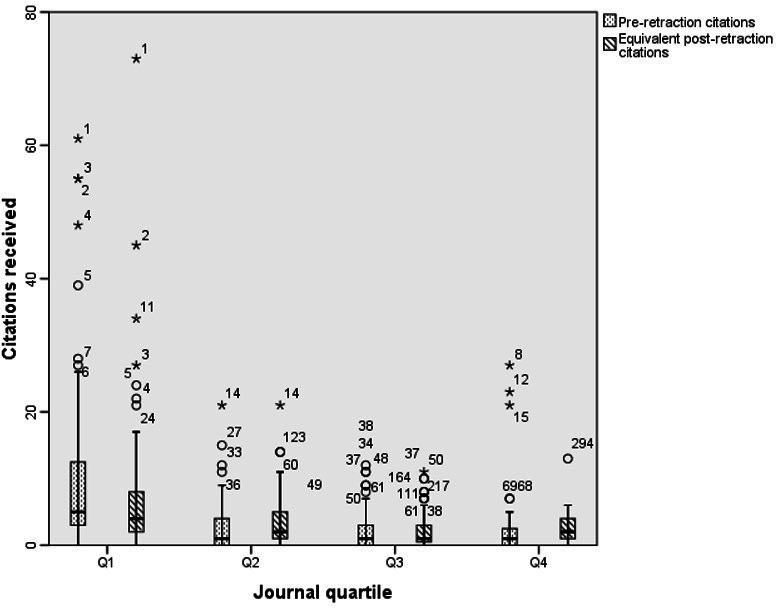
Background: Retracted articles continue to be cited after retraction, and this could have consequences for the scientific community and general population alike. This study was conducted to analyse the association of retraction on citations received by retracted papers due to misconduct using two-time frames: during a postretraction period equivalent to the time the article had been in print before retraction; and during the total postretraction period. Methods: Quasiexperimental, pre–post evaluation study. A total of 304 retracted original articles and literature reviews indexed in MEDLINE fulfilled the inclusion criteria. Articles were required to have been published in a journal indexed in MEDLINE from January 2013 through December 2015 and been retracted between January 2014 and December 2016. The main outcome was the number of citations received before and after retraction. Results were broken down by journal quartile according to impact factor and the most cited papers during the preretraction period were specifically analysed. Results: There was an increase in postretraction citations when compared with citations received preretraction. There were some exceptions however: first, citations received by articles published in first-quartile journals decreased immediately after retraction (p<0.05), only to increase again after some time had elapsed; and second, postretraction citations decreased significantly in the case of articles that had received many citations before their retraction (p<0.05). Conclusions: The results indicate that retraction of articles has no association on citations in the long term, since the retracted articles continue to be cited, thus circumventing their retraction.
Overview
The claims and statistics of this paper haven’t been checked yet.
Free: it reads the open-access text and checks the first 5 claims that cite a source we can check. Create a free account to check every claim.
Integrity signals
Registry
Cites
Statistics
Figures
Verification
Claims the paper makes
The claims and statistics of this paper haven’t been checked yet.
Free: it reads the open-access text and checks the first 5 claims that cite a source we can check. Create a free account to check every claim.
Claims other papers make about this one
Each is checked against this paper’s own text: does it say what the citing paper says it does?
The cited source says what the claim attributes to it.
In the citing paper
“Although retraction is intended to remove published research from the citable literature, retraction does not stop the diffusion of the retracted paper. Empirical studies have shown that papers continue to be cited after being retracted”
From Continued use of retracted papers: Temporal trends in citations and (lack of) awareness of retractions shown in citation contexts in biomedicine (2021) · cites this paper as Candal-Pedreira, Ruano-Ravina et al., 2020
The cited source says what the claim attributes to it.
In the citing paper
“Although this problem has been identified previously,102 103 104 it has not yet been corrected.”
From Investigating the impact of trial retractions on the healthcare evidence ecosystem (VITALITY Study I): retrospective cohort study (2025) · cites this paper as [102]
Self-check
Percentages, sums and reported differences re-computed from the paper’s own numbers.
The self-check needs the paper’s full text.
Citations
Cites
5 retracted
Wakefield, A., Murch, S., Anthony, A., Linnell, J., Casson, D., Malik, M., Berelowitz, M., Dhillon, A., Thomson, M., Harvey, P., et al. (1998) · The Lancet · doi:10.1016/s0140-6736(97)11096-0 · Cited by 3,006
RetractedLancet, T. E. O. T. (2010) · The Lancet · doi:10.1016/s0140-6736(10)60175-4 · Cited by 465
RetractedRetraction of an interpretation
Murch, S. H., Anthony, A., Casson, D. H., Malik, M., Berelowitz, M., Dhillon, A. P., Thomson, M. A., Valentine, A., Davies, S. E., & Walker-Smith, J. A. (2004) · The Lancet · doi:10.1016/s0140-6736(04)15715-2 · Cited by 321
RetractedRetraction rates are on the rise
Cokol, M., Ozbay, F., & Rodriguez‐Esteban, R. (2008) · The EMBO Reports · doi:10.1038/sj.embor.7401143 · Cited by 149 · cited 1×
“The frequency of retracted publications is an important indicator of both the quality of the peer review process and the pressure on researchers to publish, widely known as “publish or perish” (1,8).”
BackgroundRetractedCampos-Varela, I., Villaverde-Castañeda, R., & Ruano-Raviña, A. (2020) · Gaceta Sanitaria · doi:10.1016/j.gaceta.2019.05.008 · Cited by 41
Self-citationRetractedMisconduct accounts for the majority of retracted scientific publications
Fang, F. C., Steen, R. G., & Casadevall, A. (2012) · Proceedings of the National Academy of Sciences · doi:10.1073/pnas.1212247109 · Cited by 1,232 · cited 3×
“For these reasons, there is a need to generate scientific evidence that would allow for systematic and rigorous analysis of the characteristics of the retracted articles and the causes of their retraction (1).”
BackgroundRetractions in the scientific literature: is the incidence of research fraud increasing?
Steen, R. G. (2011) · Journal of Medical Ethics · doi:10.1136/jme.2010.040923 · Cited by 405
Interrupted Time Series Analysis
(2014) · Encyclopedia of Criminology and Criminal Justice · doi:10.1007/978-1-4614-5690-2_100362 · Cited by 385
A Comprehensive Survey of Retracted Articles from the Scholarly Literature
Grieneisen, M. L., & Zhang, M. (2012) · PLoS ONE · doi:10.1371/journal.pone.0044118 · Cited by 355 · cited 1×
“The situation is rendered more serious still by the fact that only a small proportion of cases of scientific misconduct are known (12,13).”
BackgroundScience publishing: The trouble with retractions
Van Noorden, R. (2011) · Nature · doi:10.1038/478026a · Cited by 328
Cited by
Hsiao, T.-K., & Schneider, J. (2021) · Quantitative Science Studies · doi:10.1162/qss_a_00155 · Cited by 98
Reducing Health Misinformation in Science: A Call to Arms
Swire‐Thompson, B., & Lazer, D. M. J. (2022) · The Annals of the American Academy of Political and Social Science · doi:10.1177/00027162221087686 · Cited by 50
Kataoka, Y., Banno, M., Tsujimoto, Y., Ariie, T., Taito, S., Suzuki, T., Oide, S., & Furukawa, T. A. (2022) · Journal of Clinical Epidemiology · doi:10.1016/j.jclinepi.2022.06.015 · Cited by 44
Retracted(2022) · doi:10.1101/2022.01.30.22270124 · Cited by 44
Bibliometric and Altmetric Analysis of Retracted Articles on COVID-19
Khan, H., Gupta, P., Zimba, O., & Gupta, L. (2022) · Journal of Korean Medical Science · doi:10.3346/jkms.2022.37.e44 · Cited by 41
Xu, C., Fan, S., Tian, Y., Liu, F., Furuya-Kanamori, L., Clark, J., Zhang, C., Li, S., Lin, L., Chu, H., et al. (2025) · BMJ · doi:10.1136/bmj-2024-082068 · Cited by 39
Self-correction in science: The effect of retraction on the frequency of citations
Kühberger, A., Streit, D., & Scherndl, T. (2022) · PLoS ONE · doi:10.1371/journal.pone.0277814 · Cited by 38
Wittau, J., & Seifert, R. (2024) · Naunyn-Schmiedeberg s Archives of Pharmacology · doi:10.1007/s00210-024-03272-8 · Cited by 36
Mitigating Dataset Harms Requires Stewardship: Lessons from 1000 Papers
Peng, K., Mathur, A., & Narayanan, A. (2021) · arXiv · doi:10.48550/arxiv.2108.02922 · Cited by 31
“Several studies have shown that articles continue to be cited after retraction (e.g., [22, 9, 74]).”
BackgroundA bibliometric study of article retractions in technology fields in developing economies countries
Eldakar, M. A. M., & Shehata, A. M. K. (2023) · Scientometrics · doi:10.1007/s11192-023-04823-1 · Cited by 28
Avenell, A., Bolland, M. J., Gamble, G. D., & Grey, A. (2024) · Accountability in Research · doi:10.1080/08989621.2022.2082290 · Cited by 26
A quantitative and qualitative open citation analysis of retracted articles in the humanities
Heibi, I., & Peroni, S. (2022) · Quantitative Science Studies · doi:10.1162/qss_a_00222 · Cited by 23
The Citation of Retracted Papers and Impact on the Integrity of the Scientific Biomedical Literature
da Silva, J. A. T., Santos-d’Amorim, K., & Bornemann‐Cimenti, H. (2025) · Learned Publishing · doi:10.1002/leap.1667 · Cited by 21
Evolution and characterization of health sciences paper retractions in Brazil and Portugal
Candal‐Pedreira, C., Ruano‐Raviña, A., Rey‐Brandariz, J., Mourino, N., Ravara, S., Aguiar, P. M. V., & Pérez‐Ríos, M. (2022) · Accountability in Research · doi:10.1080/08989621.2022.2080549 · Cited by 21
Self-citationIs biomedical research self-correcting? Modelling insights on the persistence of spurious science
Grimes, D. R. (2024) · Royal Society Open Science · doi:10.1098/rsos.231056 · Cited by 18
Schneider, J., Woods, N. D., Proescholdt, R., Fu, Y., & The RISRS Team (2021) · MetArXiv (OSF Preprints) · doi:10.31222/osf.io/ms579 · Cited by 18
Metadata analysis of retracted fake papers in Naunyn-Schmiedeberg’s Archives of Pharmacology
Wittau, J., & Seifert, R. (2023) · Naunyn-Schmiedeberg s Archives of Pharmacology · doi:10.1007/s00210-023-02850-6 · Cited by 17
Reducing the spread of retracted pain research
Ferraro, M. C., Soliman, N., Fisher, E., & Cashin, A. G. (2024) · Journal of Pain · doi:10.1016/j.jpain.2024.104747 · Cited by 17
Citation network analysis of retractions in molecular biology field
Feng, S., Feng, L., Han, F., Zhang, Y., Ren, Y., Wang, L., & Yuan, J. (2024) · Scientometrics · doi:10.1007/s11192-024-05101-4 · Cited by 16
Zheng, E., Fang, Z., & Fu, H. (2024) · Information Processing & Management · doi:10.1016/j.ipm.2023.103640 · Cited by 15
Inaccuracy in the Scientific Record and Open Postpublication Critique
Brewin, C. R. (2023) · Perspectives on Psychological Science · doi:10.1177/17456916221141357 · Cited by 14
Retracted systematic reviews continued to be frequently cited: a citation analysis
Wang, Z., Shi, Q., Zhou, Q., Zhao, S., Hou, R., Lu, S., Gao, X., & Chen, Y. (2022) · Journal of Clinical Epidemiology · doi:10.1016/j.jclinepi.2022.05.013 · Cited by 13
RetractedMerga, M. K. (2024) · Journal of Library Administration · doi:10.1080/01930826.2024.2371275 · Cited by 12
Some Insights into the Factors Influencing Continuous Citation of Retracted Scientific Papers
Tang, B. L. (2023) · Publications · doi:10.3390/publications11040047 · Cited by 10
Retraction of Scientific Papers: Types of Retraction, Consequences, and Impacts
Candal‐Pedreira, C., Pérez‐Ríos, M., & Ruano‐Raviña, A. (2022) · Springer eBooks · doi:10.1007/978-3-030-99680-2_40 · Cited by 13
Self-citationLa Oficina de Integridad Científica en España. Una tarea pendiente
Candal‐Pedreira, C., Álvarez‐Dardet, C., Ruano‐Raviña, A., & Pérez‐Ríos, M. (2022) · Gaceta Sanitaria · doi:10.1016/j.gaceta.2022.02.005 · Cited by 10
Self-citationSantos-d’Amorim, K., de Melo, R. R., Correia, A. E. G. C., Miranda, M. K. F. D. O., & da Silveira, M. A. A. (2023) · Em Questão · doi:10.19132/1808-5245.29.125494 · Cited by 9
The trend and ripple effects of retractions in primary health care: A bibliometric analysis
Lin, K.-C., Chen, Y.-C., Lin, M.-H., & Chen, T. (2024) · Journal of the Chinese Medical Association · doi:10.1097/jcma.0000000000001149 · Cited by 7
Systematic examination of post‐ and pre‐citation of Indian‐authored retracted papers
Palla, I. A., Singson, M., & Thiyagarajan, S. (2023) · Learned Publishing · doi:10.1002/leap.1572 · Cited by 7
Retracted studies in systematic reviews and clinical guidelines
Candal‐Pedreira, C., & Ruano‐Raviña, A. (2025) · BMJ · doi:10.1136/bmj.r724 · Cited by 6
Self-citationRetraction trends in Indonesian research: misconduct, AI risks, and policy gaps
Samala, A. D., Ferdian, F., Fiandra, Y. A., Hanafiah, M. H., Rawas, S., & Asad, M. M. (2025) · Quality & Quantity · doi:10.1007/s11135-025-02453-8 · Cited by 7
Addressing disorder in scholarly communication: Strategies from NISO Plus 2021
Avissar-Whiting, M., Bakker, C., Heckner, H., Massip, S., Schneider, J., Townsend, R., & Woods, N. D. (2021) · Information Services & Use · doi:10.3233/isu-210113 · Cited by 6
A data mining-based study on academic publication retractions in the 21st Century
Shen, Q., Gao, X., & Xiong, X. (2025) · Accountability in Research · doi:10.1080/08989621.2025.2528064 · Cited by 7
Ivory, J., & Elson, M. (2023) · Current Psychology · doi:10.1007/s12144-023-05216-6 · Cited by 6
Tracing the Retraction Cascade: Identifying Non-retracted but Potentially Retractable Articles
Usman, M., & Balke, W. (2024) · Lecture notes in computer science · doi:10.1007/978-3-031-72437-4_7 · Cited by 6
Citation of updated and co-published Cochrane Methodology Reviews
Zhu, L., Yang, Z., Deng, H., Zhang, Y., Liao, X., & Clarke, M. J. (2023) · Systematic Reviews · doi:10.1186/s13643-023-02270-w · Cited by 6
Citing documents of Wakefield’s retracted article: the domino effect of authors and journals
Leta, J., de Araújo, K. M., & Treiber, S. (2022) · Scientometrics · doi:10.1007/s11192-022-04353-2 · Cited by 5
Making a List Requires Checking it Twice: A Call for Empirical Evidence in Characteristics Lists
Makel, M. C. (2025) · Gifted Child Quarterly · doi:10.1177/00169862251392934 · Cited by 5
da Silva, J. A. T., & Nazarovets, S. (2023) · Scientometrics · doi:10.1007/s11192-023-04769-4 · Cited by 5
The Impact of Generative AI on the LIS Ecosystem: Threats and Opportunities
Hovious, A., & Smith, A. J. M. (2025) · Library trends · doi:10.1353/lib.2025.a968527 · Cited by 5
García-Romero, A., lez-Mancebo, S. G. A., Espallardo, C., & Concepción, M. A. (2026) · Scientometrics · doi:10.1007/s11192-026-05699-7 · Cited by 4
Uncovering the reasons of retraction in virology: a citation and Altmetric investigation
Malla, R. A., & Wani, Z. A. (2024) · Global Knowledge, Memory and Communication · doi:10.1108/gkmc-11-2023-0415 · Cited by 4
Merga, M. K. (2024) · Higher Education Research & Development · doi:10.1080/07294360.2024.2416394 · Cited by 4
Tracking the Retracted in Asia Higher Education Research Field
Cheng, M., & Xinhua, Y. (2026) · Higher Education Quarterly · doi:10.1111/hequ.70127 · Cited by 3
Lyu, C., Matbouriahi, M., Naudet, F., Ioannidis, J. P. A., & Cristea, I. A. (2026) · JAMA Network Open · doi:10.1001/jamanetworkopen.2026.7424 · Cited by 3
An analysis of availability and implications of unlabeled retracted articles on Sci-Hub
Biju, V. V., Jose, S., Franklin, J., & Jasimudeen, S. (2025) · Accountability in Research · doi:10.1080/08989621.2024.2446558 · Cited by 3
Papapanou, M., Siristatidis, C. S., Paraskevas, T., Lai, S., & Mol, B. W. (2026) · Journal of Clinical Epidemiology · doi:10.1016/j.jclinepi.2026.112259 · Cited by 3
How the National Library of Medicine should evolve in an era of artificial intelligence
Lenert, L. A. (2025) · Journal of the American Medical Informatics Association · doi:10.1093/jamia/ocaf041 · Cited by 3
Beyond Retractions: A Topic-Based Analysis of the Impact and Lifespan of Retracted Papers
Lou, Y., Zhou, Z., & Li, M. (2026) · Journal of Data and Information Science · doi:10.1515/jdis-2026-0064 · Cited by 2
Trends and Characteristics of Retracted Articles in the Smoking Field: An Observational Study
de Granda‐Orive, J. I., Jimenez-Ruiz, C. A., Aleixandre‐Benavent, R., Padilla, D. E. L., Rábade, C., Jiménez-Gómez, M., & Alonso‐Arroyo, A. (2025) · Open Respiratory Archives · doi:10.1016/j.opresp.2025.100496 · Cited by 2
Novel biomedical research must not be a work of fiction
Lazar, M. A. (2021) · Journal of Clinical Investigation · doi:10.1172/jci150827 · Cited by 2
Characteristics of retracted biomedical research papers from Latin American institutions
Ramos‐Castaneda, J. A., Candal‐Pedreira, C., Pérez‐Ríos, M., Teijeiro, A., Ruano‐Raviña, A., & García, G. (2025) · Revista de Saúde Pública · doi:10.11606/s1518-8787.2025059006328 · Cited by 2
Self-citationIvory, J., & Elson, M. (2023) · PsyArXiv (OSF Preprints) · doi:10.31234/osf.io/hy45v · Cited by 1
Paper mills in dermatology: a cross-sectional study of retracted publications
Tan, E., Epstein, R. J., Ahmed, S., & Williams, H. C. (2026) · British Journal of Dermatology · doi:10.1093/bjd/ljag381 · Cited by 1
Hidabi, M. A., Lee, Y., Yusoff, Z., Teh, P. L., Chia, W. C., & Uwasomba, C. F. (2023) · International Journal of Metadata Semantics and Ontologies · doi:10.1504/ijmso.2023.140701 · Cited by 1
“But what is next?”: Culture & Psychology ’s next chapter
Carriere, K. R. (2025) · Culture & Psychology · doi:10.1177/1354067x251320494 · Cited by 1
Mapping global research on emergency obstetric care bibliometric visualization analysis 2010–2025
Khairiah, R., Azizah, I., Anggraini, N., & Mariyani (2026) · Multidisciplinary Reviews · doi:10.31893/multirev.2026494
Studd, H., Avenell, A., Grey, A. B., & Bolland, M. J. (2026) · Research Integrity and Peer Review · doi:10.64898/2026.02.25.26346683
Paving the Road for Replications: Experimental Results from an Online Research Bibliography
Zimmermann, C., Reed, W. R., & Coupé, T. (2021) · doi:10.20955/wp.2021.013
Individual and collective epistemic virtue in science
Tunç, D. U., & Pritchard, D. (2026) · Synthese · doi:10.1007/s11229-025-05396-7
Research Retractions: Scoping Review with ☸️SAIMSARA
SAIMSARA (2026) · SAIMSARA Journal · doi:10.62487/saimsaraada9ec85
Saikia, S., Nisha, F., & Verma, M. K. (2025) · Applied Environmental Education & Communication · doi:10.1080/1533015x.2025.2599330
Trust, scholarship and data sharing
Thistlethwaite, J. E. (2022) · The Clinical Teacher · doi:10.1111/tct.13452
Perceptions of Chinese Biomedical Researchers Towards Academic Misconduct: An Updated Survey
Liao, Q., Chen, K.-L., Zheng, M., Zhang, Y.-Y., Fan, Y., Eslick, G. D., He, X.-X., He, H., Chen, K.-Y., & Xia, H. H. (2026) · Journal of Academic Ethics · doi:10.1007/s10805-026-09750-3
الأبحاث المصرية المسحوبة من النشر: دراسة ببليومترية تحليلية
عثمان, إ. ر. (2022) · المجلة المصرية لعلوم المعلومات · doi:10.21608/jesi.2021.96329.1038
العدد كاملا من المجلة المصرية لعلوم المعلومات، مج 9، ع2، اكتوبر 2022
يوسف, أ. د. ر. (2022) · المجلة المصرية لعلوم المعلومات · doi:10.21608/jesi.2022.315659
Zhou, Z., Lu, X., & Yang, L. (2026) · Journal of Data and Information Science · doi:10.1515/jdis-2026-0069
Tian, Y., Peng, Z., Doi, S. A. R., Furuya‐Kanamori, L., Cao, H., Lin, L., Chu, H., Loke, Y. K., Mol, B. W., Golder, S., et al. (2026) · medRxiv · doi:10.64898/2026.02.20.26346631
Porel, P., & Khan, S. (2026) · International Journal For Multidisciplinary Research · doi:10.36948/ijfmr.2026.v08i04.86849
Building trust in science: International Research Integrity Index
Ibáñez, N. C., Bueno‐Cavanillas, A., & Khan, K. S. (2026) · Medicina de Familia SEMERGEN · doi:10.1016/j.semerg.2025.102681
Moussa, S. (2026) · Iberoamerican Journal of Psychology and Public Policy · doi:10.56754/2810-6598.2026.0056
Standing on Slippery Shoulders: An Analysis of Post Retraction Citation in Business and ManagementPreprint
García-Romero, A., lez-Mancebo, S. G. A., Ortega, C., & Perdomo, M. A. C. (2023) · SSRN Electronic Journal · doi:10.2139/ssrn.4418554
Retractions in dentistry: reasons, time to retraction and post-retraction citations
Cabrera, L. H., Moya, M. O. C., & Ramos, N. P. (2025) · SAP Dentistry · doi:10.62486/dent2025152
Bočina, R., Mijatović, A., & Marušić, A. (2026) · Research Integrity and Peer Review · doi:10.1186/s41073-026-00236-9
The Dark Sides of Modern Science: Credit Attribution, Citation and Impact
Sochi, T. (2025) · PhilPapers (PhilPapers Foundation) · doi:10.5281/zenodo.17546566
Erfanmanesh, A. (2025) · Journal of Medical Library and Information Science · doi:10.22037/jmlis.v6i.48705
La ética en la publicación de las ciencias sociales en Iberoamérica
Santana Cañizares, L. Y., Agustín-Lacruz, M. C., & Oliván, J. A. S. (2024) · Zaguan (University of Zaragoza Repository)
An index to quantify scientific debtPreprint
Zen, N. (2026) · arXiv (Cornell University) · doi:10.48550/arxiv.2607.23011
Can economic approaches to science do away with epistemic virtue?
Tunç, D. U. (2024) · PhilSci-Archive (University of Pittsburgh)
Citation Reuse After Article Reinstatement: Evidence from Three Restoration EventsPreprint
Miao, S. (2026) · Research Square · doi:10.21203/rs.3.rs-11320757/v1
Metadata
- Authors
- Candal-Pedreira, C., Ruano-Ravina, A., Fernández, E., Ramos, J., Campos-Varela, I., & Pérez-Ríos, M.
- Affiliations
- Preventive Medicine and Public Health, University of Santiago de Compostela, Santiago de Compostela, Galicia, Spain
- Institut Català d'Oncologia (ES)
- Centro de Investigación Biomédica en Red de Enfermedades Respiratorias (ES)
- Liver Unit, Department of Internal Medicine, Vall d’Hebron University Teaching Hospital, Vall d’Hebron Research Institute, Barcelona, Spain
- Venue
- BMJ Global Health
- Publisher
- BMJ
- Published
- 2020-11
- Volume
- 5
- Issue
- 11
- Pages
- e003719
- ISSN
- 2059-7908 (ISSN-L)
- PMC
- PMC7668300
- OpenAlex
- W3101830111
- Cited by
- 67
- References
- 27
- Citations by year
- 2026: 13 · 2025: 11 · 2024: 10 · 2023: 11 · 2022: 15 · 2021: 7
- FWCI
- 11.35
- Type
- journal article
- Language
- en
- Open access
- gold
- doi.org
- Licence
- Locations
- BMJ Global Health (publishedVersion, cc-by-nc)
- bioRxiv (Cold Spring Harbor Laboratory) (acceptedVersion)
- PubMed Central (publishedVersion, cc-by-nc)
- PubMed (publishedVersion)
- Dipòsit Digital de la Universitat de Barcelona (Universitat de Barcelona) (publishedVersion, cc-by-nc)
- DOAJ (DOAJ: Directory of Open Access Journals) (submittedVersion, cc-by-sa)
- Hispana (submittedVersion, cc-by-nc)
- Topics
- Social Sciences › Education › Academic integrity and plagiarism
- Social Sciences › Library and Information Sciences › scientometrics and bibliometrics research
- Social Sciences › Library and Information Sciences › Academic Publishing and Open Access
- Keywords
- retraction, research misconduct, citation impact, retracted article, bibliometric analysis, journal impact factor, scientific integrity
About these checks
Registry, retraction, Cites and statistics results are computed, not judged, with one exception: a printed reference that no index lists is read once by a model before it counts as a citation error. Claims are extracted by a model and kept only when their quote appears verbatim in the text; each cited source is then checked, with a model’s help, for whether it says what the claim relies on. Those verdicts can be wrong — read the claim’s quote and the cited source before relying on one.
Statistics and arithmetic are recomputed, not judged.
Confidence bands are shown only for fields calibrated on our annotated test set. None is calibrated yet, so no band is shown.
What counts as a claim ›How we measure confidence ›How we check this ›
Are you an author, or do you see a problem with this page? Request a review
Data sources
Bibliographic data: Semantic Scholar, OpenAlex, Crossref.
Contains information from the Semantic Scholar Academic Graph Datasets, made available under the ODC Attribution License (ODC-BY 1.0).
Semantic Scholar’s data is described in: Kinney, R., et al. (2023). The Semantic Scholar Open Data Platform. arXiv:2301.10140.
