

The DOI matches its Crossref record; 110 of the 114 references it cites were found in a registry or an index.
The influence of the urban food environment on diet, nutrition and health outcomes in low-income and middle-income countries: a systematic review
Open accessAbstract
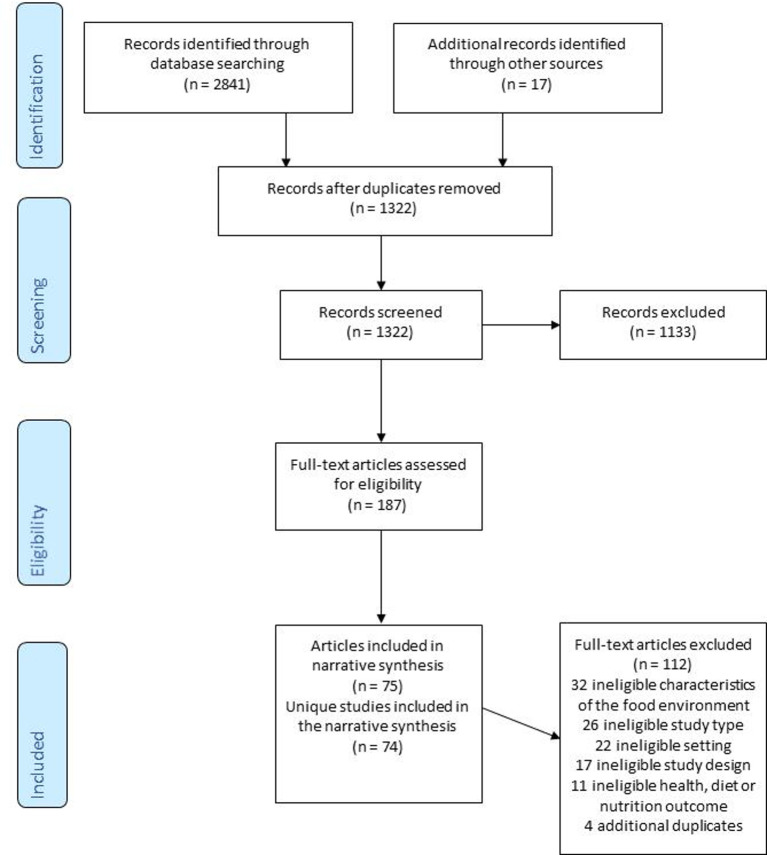
INTRODUCTION: Diet and nutrition are leading causes of global morbidity and mortality. Our study aimed to identify and synthesise evidence on the association between food environment characteristics and diet, nutrition and health outcomes in low-income and middle-income countries (LMICs), relevant to urban settings, to support development and implementation of appropriate interventions. METHODS: We conducted a comprehensive search of 9 databases from 1 January 2000 to 16 September 2020 with no language restrictions. We included original peer-reviewed observational studies, intervention studies or natural experiments conducted in at least one urban LMIC setting and reporting a quantitative association between a characteristic of the food environment and a diet, nutrition or health outcome. Study selection was done independently in duplicate. Data extraction and quality appraisal using the National Heart Lung and Blood Institute checklists were completed based on published reports using a prepiloted form on Covidence. Data were synthesised narratively. RESULTS: 74 studies met eligibility criteria. Consistent evidence reported an association between availability characteristics in the neighbourhood food environment and dietary behaviour (14 studies, 10 rated as good quality), while the balance of evidence suggested an association with health or nutrition outcomes (17 of 24 relevant studies). We also found a balance of evidence that accessibility to food in the neighbourhood environment was associated with diet (10 of 11 studies) although evidence of an association with health outcomes was contradictory. Evidence on other neighbourhood food environment characteristics was sparse and mixed. Availability in the school food environment was also found to be associated with relevant outcomes. Studies investigating our other primary outcomes in observational studies of the school food environment were sparse, but most interventional studies were situated in schools. We found very little evidence on how workplace and home food environments are associated with relevant outcomes. This is a substantial evidence gap. CONCLUSION: 'Zoning' or 'healthy food cart' interventions to alter food availability may be appropriate in urban LMIC. PROSPERO REGISTRATION NUMBER: CRD42020207475.
Overview
The claims and statistics of this paper haven’t been checked yet.
Run the check — free, no account needed. It reads the open-access text and checks the sources it cites.
Integrity signals
Registry
Cites
Statistics
Figures
Verification
Claims the paper makes
The claims and statistics of this paper haven’t been checked yet.
Run the check — free, no account needed. It reads the open-access text and checks the sources it cites.
Claims other papers make about this one
Each is checked against this paper’s own text: does it say what the citing paper says it does?
The cited source says what the claim attributes to it.
In the citing paper
“Public health studies have found that food environments matter for people ' s food choices to at least some extent, impacting the quality of their diets and health outcomes (Westbury et al. 2021; Caspi et al. 2012).”
From Corporate concentration and power matter for agency in food systems (2025) · cites this paper as Westbury et al. 2021
Self-check
Percentages, sums and reported differences re-computed from the paper’s own numbers.
The self-check needs the paper’s full text.
Citations
Cites
Page, M. J., Moher, D., Bossuyt, P. M., Boutron, I., Hoffmann, T. C., Mulrow, C. D., Shamseer, L., Tetzlaff, J. M., Akl, E. A., Brennan, S. E., et al. (2021) · BMJ · doi:10.1136/bmj.n160 · Cited by 13,262
Ng, M., Fleming, T., Robinson, M., Thomson, B., Graetz, N., Margono, C., Mullany, E. C., Biryukov, S., Abbafati, C., Abera, S. F., et al. (2014) · The Lancet · doi:10.1016/s0140-6736(14)60460-8 · Cited by 11,952
Afshin, A., Sur, P. J., Fay, K. A., Cornaby, L., Ferrara, G., Salama, J. S., Mullany, E. C., Abate, K. H., Abbafati, C., Abebe, Z., et al. (2019) · The Lancet · doi:10.1016/s0140-6736(19)30041-8 · Cited by 5,811
The role of telehealth during COVID-19 outbreak: a systematic review based on current evidence
Monaghesh, E., & Hajizadeh, A. (2020) · BMC Public Health · doi:10.1186/s12889-020-09301-4 · Cited by 1,941
The local food environment and diet: a systematic review
Caspi, C. E., Sorensen, G., Subramanian, S. V., & Kawachi, I. (2012) · Health & Place · doi:10.1016/j.healthplace.2012.05.006 · Cited by 1,404
Calder, P., Carr, A., Gombart, A., & Eggersdorfer, M. (2020) · Nutrients · doi:10.3390/nu12041181 · Cited by 972
Turner, C. J., Aggarwal, A., Walls, H., Herforth, A., Drewnowski, A., Coates, J., Kalamatianou, S., & Kadiyala, S. (2018) · Global Food Security · doi:10.1016/j.gfs.2018.08.003 · Cited by 729
Immune function and micronutrient requirements change over the life course
Maggini, S., Pierre, A., & Calder, P. C. (2018) · Nutrients · doi:10.3390/nu10101531 · Cited by 710
Robinson, M., Shipton, D., Walsh, D., Whyte, B., & McCartney, G. (2015) · BMC Public Health · doi:10.1186/1471-2458-15-1 · Cited by 696
Swinburn, B. A., Sacks, G., Vandevijvere, S., Kumanyika, S., Lobstein, T., Neal, B. C., Barquera, S., Friel, S., Hawkes, C., Kelly, B., et al. (2013) · Obesity Reviews · doi:10.1111/obr.12087 · Cited by 681
Research works printed but not linked: 5
- World Health Organisation . Global status report on noncommunicable diseases 2010. Chapter 2: NCDs and development. Geneva World Health Organisation; 2011: 8.
- World Health Organisation . Global status report on noncommunicable diseases 2010. NCDs and development 2011; Chapter 2.
- United Nations . World urbanization prospects: the 2018 revision: population division of the United nations department of economic and social Affairs (un DESA); 2018: 126.
- Charoenbut, 2018, Workplace and individual factors influence eating practices of Thai factory workers, Malays J Nut, 24, 417
- Zheng, 2013, A population-based study of obesity and its complications in children and adolescents, Int Medical J, 20, 691
Cited by
Sorted by citations
Dicken, S. J., Jassil, F. C., Brown, A., Kalis, M., Stanley, C., Ranson, C., Ruwona, T., Qamar, S., Buck, C., Mallik, R., et al. (2025) · Nature Medicine · doi:10.1038/s41591-025-03842-0 · Cited by 129
Food environment and obesity: A systematic review and meta-analysis
Pineda, E., Stockton, J., Scholes, S., Lassale, C., & Mindell, J. S. (2024) · BMJ Nutrition, Prevention & Health · doi:10.1136/bmjnph-2023-000663 · Cited by 125
Corporate concentration and power matter for agency in food systems
Clapp, J., Vriezen, R., Laila, A., Conti, C., Gordon, L., Hicks, C., & Rao, N. (2025) · Food Policy · doi:10.1016/j.foodpol.2025.102897 · Cited by 64
Toward Heart-Healthy and Sustainable Cities: A Policy Statement From the American Heart Association
Rajagopalan, S., Ramaswami, A., Bhatnagar, A., Brook, R. D., Fenton, M., Gardner, C. D., Neff, R., Russell, A. G., Seto, K. C., & Whitsel, L. P. (2024) · Circulation · doi:10.1161/cir.0000000000001217 · Cited by 49
A socio-ecological framework for cancer prevention in low and middle-income countries
Akinyemiju, T., Ogunsina, K., Gupta, A., Liu, I., Braithwaite, D., & Hiatt, R. A. (2022) · Frontiers in Public Health · doi:10.3389/fpubh.2022.884678 · Cited by 48
Metadata
- Authors
- Westbury, S., Ghosh, I., Jones, H. M., Mensah, D., Samuel, F., Irache, A., Azhar, N., Al-Khudairy, L., Iqbal, R., & Oyebode, O.
- Affiliations
- Monash University (AU)
- University of Warwick (GB)
- Coventry University (GB)
- University of Ibadan (NG)
- Aga Khan University (PK)
- Corresponding author
- Oyebode, Oyinlola
- ORCID
- Venue
- BMJ Global Health
- Publisher
- BMJ
- Published
- 2021-10
- Volume
- 6
- Issue
- 10
- Pages
- e006358
- ISSN
- 2059-7908 (ISSN-L)
- PMC
- PMC8506857
- OpenAlex
- W3205366518
- Cited by
- 107
- References
- 114
- Citations by year
- 2026: 27 · 2025: 28 · 2024: 24 · 2023: 18 · 2022: 9 · 2021: 1
- FWCI
- 2.69
- Type
- journal article
- Language
- en
- Open access
- gold
- doi.org
- Licence
- Locations
- BMJ Global Health (publishedVersion, cc-by-nc)
- PubMed Central (publishedVersion, cc-by-nc)
- PubMed (publishedVersion)
- Warwick Research Archive Portal (University of Warwick) (acceptedVersion)
- University of Birmingham Research Portal (University of Birmingham) (acceptedVersion, other-oa)
- Queen Mary Research Online (Queen Mary University of London) (submittedVersion, cc-by-nc)
- eCommons - AKU (Aga Khan University) (submittedVersion, cc-by-nc)
- DOAJ (DOAJ: Directory of Open Access Journals) (submittedVersion, cc-by-sa)
- Pure (Coventry University) (submittedVersion, cc-by-nc)
- University of Warwick (cc-by-nc)
- Funders
- NIHR (Global Health Research Unit on Improving Health in Slums)
- Topics
- Health Sciences › Medicine › Public Health, Environmental and Occupational Health › Food Security and Health in Diverse Populations
- Health Sciences › Nursing › Nutrition and Dietetics › Nutrition, Health and Food Behavior
- Social Sciences › Transportation › Urban Transport and Accessibility
- Keywords
- urban food environment, food access, dietary behaviour, nutritional outcomes, health outcomes, low- and middle-income countries, school food environment, workplace food environment, home food environment
- MeSH terms
- Developing Countries, Diet, Humans, Poverty, Outcome Assessment, Health Care
About these checks
Registry, retraction, Cites and statistics results are computed, not judged, with one exception: a printed reference that no index lists is read once by a model before it counts as a citation error. Claims are extracted by a model and kept only when their quote appears verbatim in the text; each cited source is then checked, with a model’s help, for whether it says what the claim relies on. Those verdicts can be wrong — read the claim’s quote and the cited source before relying on one.
Statistics and arithmetic are recomputed, not judged.
Confidence bands are shown only for fields calibrated on our annotated test set. None is calibrated yet, so no band is shown.
What counts as a claim ›How we measure confidence ›How we check this ›
Are you an author, or do you see a problem with this page? Request a review
