

A household-based community health worker programme for non-communicable disease, malnutrition, tuberculosis, HIV and maternal health: a stepped-wedge cluster randomised controlled trial in Neno District, Malawi
Open accessThe DOI matches its Crossref record; 43 of the 43 references it cites were found in a registry or an index.
Abstract
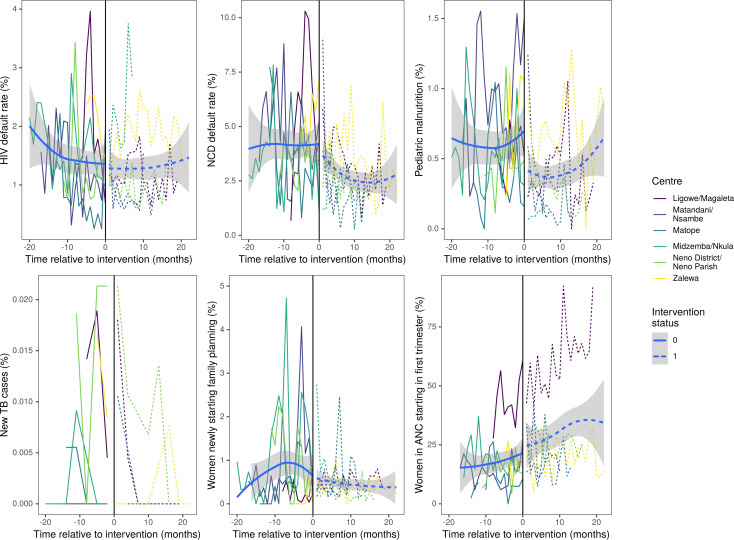
BACKGROUND: Community health worker (CHW) programmes are a valuable component of primary care in resource-poor settings. The evidence supporting their effectiveness generally shows improvements in disease-specific outcomes relative to the absence of a CHW programme. In this study, we evaluated expanding an existing HIV and tuberculosis (TB) disease-specific CHW programme into a polyvalent, household-based model that subsequently included non-communicable diseases (NCDs), malnutrition and TB screening, as well as family planning and antenatal care (ANC). METHODS: We conducted a stepped-wedge cluster randomised controlled trial in Neno District, Malawi. Six clusters of approximately 20 000 residents were formed from the catchment areas of 11 healthcare facilities. The intervention roll-out was staggered every 3 months over 18 months, with CHWs receiving a 5-day foundational training for their new tasks and assigned 20-40 households for monthly (or more frequent) visits. FINDINGS: The intervention resulted in a decrease of approximately 20% in the rate of patients defaulting from chronic NCD care each month (-0.8 percentage points (pp) (95% credible interval: -2.5 to 0.5)) while maintaining the already low default rates for HIV patients (0.0 pp, 95% CI: -0.6 to 0.5). First trimester ANC attendance increased by approximately 30% (6.5pp (-0.3, 15.8)) and paediatric malnutrition case finding declined by 10% (-0.6 per 1000 (95% CI -2.5 to 0.8)). There were no changes in TB programme outcomes, potentially due to data challenges. INTERPRETATION: CHW programmes can be successfully expanded to more comprehensively address health needs in a population, although programmes should be carefully tailored to CHW and health system capacity.
Overview
The claims and statistics of this paper haven’t been checked yet.
Free: it reads the open-access text and checks the first 5 claims that cite a source we can check. Create a free account to check every claim.
Integrity signals
Registry
Cites
Statistics
Figures

Verification
Claims the paper makes
The claims and statistics of this paper haven’t been checked yet.
Free: it reads the open-access text and checks the first 5 claims that cite a source we can check. Create a free account to check every claim.
Claims other papers make about this one
Each is checked against this paper’s own text: does it say what the citing paper says it does?
The source backs part of the claim, not all of it — or backs it for a different population, condition or comparison.
In the citing paper
“One of the primary reasons for choosing the SWD was the ethical imperative to ensure that all study participants eventually received the intervention, especially when the intervention was expected to be beneficial (44, 46, 47, 52, 55, 57, 69, 96, 97, 106, 110).”
From Applications and implementation considerations for stepped-wedge designs in sub-Saharan Africa: a systematic review (2026) · cites this paper as [44]
Experimental — accuracy not yet measuredThe cited source says what the claim attributes to it.
In the citing paper
“Integration care models were also implemented in some studies combining multiple health services or interventions into a cohesive approach (44, 77, 83, 97).”
From Applications and implementation considerations for stepped-wedge designs in sub-Saharan Africa: a systematic review (2026) · cites this paper as [44]
The check wasn’t confident either way, so it gives no verdict — never disputed.
In the citing paper
“Ethical considerations were a major rationale for selecting SWD in many studies (44, 46, 47, 52, 55, 57, 69, 96, 97, 106, 110) onsistent with prior work emphasising the design's capacity to support equity in intervention rollout (6).”
From Applications and implementation considerations for stepped-wedge designs in sub-Saharan Africa: a systematic review (2026) · cites this paper as [44]
Experimental — accuracy not yet measured
Self-check
Percentages, sums and reported differences re-computed from the paper’s own numbers.
The self-check needs the paper’s full text.
Citations
Cites
Understanding predictive information criteria for Bayesian models
Gelman, A., Hwang, J., & Vehtari, A. (2014) · Statistics and Computing · doi:10.1007/s11222-013-9416-2 · Cited by 2,104
A weakly informative default prior distribution for logistic and other regression models
Gelman, A., Jakulin, A., Pittau, M. G., & Su, Y.-S. (2008) · The Annals of Applied Statistics · doi:10.1214/08-aoas191 · Cited by 1,790
The stepped wedge cluster randomised trial: rationale, design, analysis, and reporting
Hemming, K., Haines, T. P., Chilton, P. J., Girling, A. J., & Lilford, R. J. (2015) · BMJ · doi:10.1136/bmj.h391 · Cited by 1,410 · cited 1×
“26 The study protocol has been previously published, 27 with the results of the study reported in this manuscript.”
Self-citationA WEAKLY INFORMATIVE DEFAULT PRIOR DISTRIBUTION FOR LOGISTIC AND OTHER REGRESSION MODELS
Gelman, A., Jakulin, A., & Grazia, M. (2009) · Cited by 1,352
Perry, H. B., Zulliger, R., & Rogers, M. M. (2014) · Annual Review of Public Health · doi:10.1146/annurev-publhealth-032013-182354 · Cited by 944
Kim, K., Choi, J. S., Choi, E., Nieman, C. L., Joo, J. H., Lin, F. R., Gitlin, L. N., & Han, H.-R. (2016) · American Journal of Public Health · doi:10.2105/ajph.2015.302987 · Cited by 498
Lee, A. C., Mullany, L. C., Koffi, A. K., Rafiqullah, I., Khanam, R., Folger, L. V., Rahman, M., Mitra, D. K., Labrique, A., Christian, P., et al. (2020) · BMC Pregnancy and Childbirth · doi:10.1186/s12884-019-2665-0 · Cited by 336
Assurance in clinical trial design
O'Hagan, A., Stevens, J. W., & Campbell, M. J. (2005) · Pharmaceutical Statistics · doi:10.1002/pst.175 · Cited by 294
Jeet, G., Thakur, J. S., Prinja, S., & Singh, M. (2017) · PLOS ONE · doi:10.1371/journal.pone.0180640 · Cited by 280
Schneider, H., Okello, D., & Lehmann, U. (2016) · Human Resources for Health · doi:10.1186/s12960-016-0163-2 · Cited by 177
Rich, M. L., Miller, A. C., Niyigena, P., Franke, M. F., Niyonzima, J. B., Socci, A., Drobac, P. C., Hakizamungu, M., Mayfield, A., Ruhayisha, R., et al. (2012) · JAIDS Journal of Acquired Immune Deficiency Syndromes · doi:10.1097/qai.0b013e31824476c4 · Cited by 172
Analysis of cluster randomised stepped wedge trials with repeated cross-sectional samples
Hemming, K., Taljaard, M., & Forbes, A. (2017) · Trials · doi:10.1186/s13063-017-1833-7 · Cited by 166
Abdel-All, M., Putica, B., Praveen, D., Abímbọ́lá, Ṣ., & Joshi, R. (2017) · BMJ Open · doi:10.1136/bmjopen-2016-015529 · Cited by 162
Bayesian methods of analysis for cluster randomized trials with binary outcome data
Turner, R. M., Omar, R. Z., & Thompson, S. G. (2001) · Statistics in Medicine · doi:10.1002/1097-0258(20010215)20:3<453::aid-sim803>3.0.co;2-l · Cited by 126
Agarwal, S., Curtis, S. L., Angeles, G., Speizer, I. S., Singh, K., & Thomas, J. C. (2019) · Human Resources for Health · doi:10.1186/s12960-019-0402-4 · Cited by 121
Takemura, T., Kielmann, K., & Blaauw, D. (2016) · Human Resources for Health · doi:10.1186/s12960-015-0097-0 · Cited by 113
Torpey, K. E., Kabaso, M. E., Mutale, L. N., Kamanga, M. K., Mwango, A. J., Simpungwe, J., Suzuki, C., & Mukadi, Y. D. (2008) · PLoS ONE · doi:10.1371/journal.pone.0002204 · Cited by 107
The Effectiveness of Community Health Workers for CVD Prevention in LMIC
Khetan, A. K., Purushothaman, R., Chami, T., Hejjaji, V., Madan Mohan, S. K., Josephson, R. A., & Webel, A. R. (2017) · Global Heart · doi:10.1016/j.gheart.2016.07.001 · Cited by 89
Wroe, E. B., Kalanga, N., Mailosi, B. G. D., Mwalwanda, S., Kachimanga, C., Nyangulu, K., Dunbar, E. L., Kerr, L., Nazimera, L., & Dullie, L. (2015) · Healthcare · doi:10.1016/j.hjdsi.2015.08.002 · Cited by 85
Self-citationProactive community case management and child survival in periurban Mali
Johnson, A. D., Thiero, O., Whidden, C., Poudiougou, B., Diakité, D., Traoré, F., Samaké, S., Koné, D., Cissé, I., & Kayentao, K. (2018) · BMJ Global Health · doi:10.1136/bmjgh-2017-000634 · Cited by 76
Mishra, S. R., Lygidakis, C., Neupane, D., Gyawali, B., Uwizihiwe, J. P., Virani, S. S., Kallestrup, P., & Miranda, J. J. (2019) · Health Policy and Planning · doi:10.1093/heapol/czy099 · Cited by 71
Wroe, E. B., Kalanga, N., Dunbar, E. L., Nazimera, L., Price, N. F., Shah, A., Dullie, L., Mailosi, B. G. D., Gonani, G., Ndarama, E. P. L., et al. (2020) · BMJ Open · doi:10.1136/bmjopen-2020-036836 · Cited by 63
Self-citationCallaghan‐Koru, J. A., Nonyane, B. A. S., Guenther, T., Sitrin, D., Ligowe, R., Chimbalanga, E., Zimba, E., Kachale, F., Shah, R., & Baqui, A. H. (2013) · BMC Public Health · doi:10.1186/1471-2458-13-1052 · Cited by 55
Watson, S., Sahota, H., Taylor, C. A., Chen, Y., & Lilford, R. J. (2018) · Global Health Research and Policy · doi:10.1186/s41256-018-0073-z · Cited by 53
Self-citationSatti, H., Motsamai, S., Chetane, P., Marumo, L., Barry, D. J., Riley, J., McLaughlin, M., Seung, K. J., & Mukherjee, J. S. (2012) · PLoS ONE · doi:10.1371/journal.pone.0042700 · Cited by 51
Abrahams‐Gessel, S., Denman, C. A., Montano, C. M., Gaziano, T. A., Levitt, N. S., Rivera‐Andrade, A., Munguía, D., Zulu, J., Khanam, M. A., & Puoane, T. R. (2015) · Global Heart · doi:10.1016/j.gheart.2014.12.009 · Cited by 46
Using district health information to monitor sustainable development
Farnham, A., Utzinger, J., Kulinkina, A. V., & Winkler, M. S. (2019) · Bulletin of the World Health Organization · doi:10.2471/blt.19.239970 · Cited by 44
Self-citationGuenther, T., Nsona, H., Makuluni, R., Chisema, M., Jenda, G., Chimbalanga, E., & Sadruddin, S. (2019) · Journal of Global Health · doi:10.7189/jogh.09.010808 · Cited by 43
Realizing the Value of Community Health Workers — New Opportunities for Sustainable Financing
Lapidos, A., Lapedis, J., & Heisler, M. (2019) · New England Journal of Medicine · doi:10.1056/nejmp1815382 · Cited by 42
Dunbar, E. L., Wroe, E. B., Nhlema, B., Kachimanga, C., Gupta, R., Taylor, C., Michaelis, A. P., Cundale, K., Dullie, L., Jumbe, A., et al. (2018) · BMJ Open · doi:10.1136/bmjopen-2017-019473 · Cited by 40
Self-citationNaranjee, N., Ngxongo, T. S. P., & Sibiya, M. N. (2019) · African Journal of Primary Health Care & Family Medicine · doi:10.4102/phcfm.v11i1.1981 · Cited by 39
Wroe, E. B., Dunbar, E. L., Kalanga, N., Dullie, L., Kachimanga, C., Mganga, A., Herce, M. E., Beste, J., Rigodon, J., Nazimera, L., et al. (2018) · BMJ Global Health · doi:10.1136/bmjgh-2017-000552 · Cited by 31
Self-citationImpact and economic evaluation of a novel HIV service delivery model in rural Malawi
McBain, R. K., Petersen, E. M., Tophof, N., Dunbar, E. L., Kalanga, N., Nazimera, L., Mganga, A., Dullie, L., Mukherjee, J. S., & Wroe, E. B. (2017) · AIDS · doi:10.1097/qad.0000000000001578 · Cited by 29
Self-citationDoctor, H. V., & Salimu, S. N. (2017) · AIMS Public Health · doi:10.3934/publichealth.2017.6.590 · Cited by 29
Kachimanga, C., Dunbar, E. L., Watson, S., Cundale, K., Makungwa, H., Wroe, E. B., Malindi, C., Nazimera, L., Palazuelos, D., Drake, J., et al. (2020) · BMC Pregnancy and Childbirth · doi:10.1186/s12884-019-2714-8 · Cited by 26
Self-citationBrown, C., Lilford, R. J., Griffiths, F. E., Oppong-Darko, P., Ndambo, M. K., Okoh-Owusu, M., & Wroe, E. B. (2019) · Human Resources for Health · doi:10.1186/s12960-019-0412-2 · Cited by 20
Self-citationBorzie, K., Jasper, N., Southall, D. P., MacDonald, R., Kola, A., Dolo, O., Magnus, A., Watson, S., Casement, M., Dahn, B. T., et al. (2020) · BMC Pregnancy and Childbirth · doi:10.1186/s12884-020-02921-z · Cited by 16
Self-citationPopulation-based screening for pulmonary tuberculosis utilizing community health workers in Ethiopia
Merid, Y., Mulate, Y. W., Hailu, M., Hailu, T., Habtamu, G., Abebe, M., Datiko, D. G., & Aseffa, A. (2019) · International Journal of Infectious Diseases · doi:10.1016/j.ijid.2019.10.012 · Cited by 13
Ramathebane, M. M., Makatjane, T. J., Thetsane, R. M., & Mokhethi, M. C. (2019) · African Journal of Primary Health Care & Family Medicine · doi:10.4102/phcfm.v11i1.1944 · Cited by 10
Palazuelos, D., Jabateh, L., Choi, M., Jimenez, A., Hing, M., Iberico, M., Nhlema, B., & Wroe, E. B. (2021) · Global Health Science and Practice · doi:10.9745/ghsp-d-20-00405 · Cited by 9
Self-citationSchwarz, D., Kim, J., Ratcliffe, H. L., Bell, G. A., Awoonor‐Williams, J. K., Nimako, B., Otupiri, E., Lipsitz, S. R., Hirschhorn, L. R., & Bitton, A. (2019) · Gates Open Research · doi:10.12688/gatesopenres.12979.2 · Cited by 8
Schwarz, D., Kim, J., Ratcliffe, H. L., Bell, G. A., Awoonor‐Williams, J. K., Nimako, B., Otupiri, E., Lipsitz, S. R., Hirschhorn, L. R., & Bitton, A. (2019) · Gates Open Research · doi:10.12688/gatesopenres.12979.3 · Cited by 7
Kachimanga, C., Malindi, C., Limbe, G., Wroe, E. B., Makungwa, H., Musisi, I., Dunbar, E. L., Ngambi, J., Nazimera, L., & Drake, J. (2016) · Annals of Global Health · doi:10.1016/j.aogh.2016.04.641 · Cited by 1
Self-citation
Research works printed but not linked: 1
- World Health Organization. Global experience of community health workers for delivery of health related millennium development goals: a systematic review, country case studies and recommendations for integration into National health systems 2010.
Cited by
Nida, S., Tyas, A. S. A., Putri, N. E., Larasanti, A., Widoyopi, A. A., Sumayyah, R., Listiana, S., & Espressivo, A. (2024) · BMC Family Practice · doi:10.1186/s12875-024-02319-2 · Cited by 77
Tesema, A. G., Mabunda, S. A., Chaudhri, K., Sunjaya, A. P., Thio, S., Yakubu, K., Jeyakumar, R., Godinho, M. A., John, R., Eltigany, M., et al. (2025) · PLOS Global Public Health · doi:10.1371/journal.pgph.0004289 · Cited by 30
Experiences of community health workers on adopting mHealth in rural Malawi: A qualitative study
Kachimanga, C., Mulwafu, M., Ndambo, M. K., Harare, J., Murkherjee, J., Kulinkina, A. V., Mbae, S. M., Ndarama, E. P. L., van den Akker, T., & Abejirinde, I. O. (2024) · Digital Health · doi:10.1177/20552076241253994 · Cited by 29
Self-citationAron, M. B., Ndambo, M. K., Munyaneza, F., Mulwafu, M., Makungwa, H., Nhlema, B., & Connolly, E. (2023) · Human Resources for Health · doi:10.1186/s12960-023-00839-z · Cited by 22
Self-citationWroe, E. B., Mailosi, B. G. D., Price, N. F., Kachimanga, C., Shah, A., Kalanga, N., Dunbar, E. L., Nazimera, L., Gizaw, M., Boudreaux, C., et al. (2022) · BMJ Open · doi:10.1136/bmjopen-2022-063701 · Cited by 22
Self-citation
Metadata
- Authors
- Wroe, E. B., Nhlema, B., Dunbar, E. L., Kulinkina, A. V., Kachimanga, C., Aron, M., Dullie, L., Makungwa, H., Chabwera, B., Phiri, B., Nazimera, L., Ndarama, E. P. L., Michaelis, A., McBain, R., Brown, C., Palazuelos, D., Lilford, R., & Watson, S. I.
- Affiliations
- Brigham and Women's Hospital (US)
- Partners In Health (US)
- Ministry of Health (MW)
- University of Warwick (GB)
- University of Birmingham (GB)
- Institute of Applied Health Research, University of Birmingham, Birmingham, UK
- Corresponding author
- Wroe, Emily B
- ORCID
- Venue
- BMJ Global Health
- Publisher
- BMJ
- Published
- 2021-09
- Volume
- 6
- Issue
- 9
- Pages
- e006535
- ISSN
- 2059-7908 (ISSN-L)
- PMC
- PMC8444244
- OpenAlex
- W3199565358
- Cited by
- 36
- References
- 43
- Citations by year
- 2026: 5 · 2025: 8 · 2024: 12 · 2023: 8 · 2022: 3
- FWCI
- 5.68
- Type
- journal article
- Language
- en
- Open access
- gold
- doi.org
- Licence
- Locations
- BMJ Global Health (publishedVersion, cc-by-nc)
- Europe PMC (PubMed Central) (publishedVersion, other-oa)
- PubMed Central (publishedVersion, cc-by-nc)
- PubMed (publishedVersion)
- edoc (University of Basel) (acceptedVersion)
- University of Birmingham Research Portal (University of Birmingham) (submittedVersion, cc-by-nc)
- DOAJ (DOAJ: Directory of Open Access Journals) (submittedVersion, cc-by-sa)
- edoc (University of Basel)
- Funders
- National Institute for Health and Care Research (16/136/87)
- National Institute for Health Research Applied Research Collaboration West
- Topics
- Health Sciences › Medicine › Pediatrics, Perinatology and Child Health › Global Maternal and Child Health
- Health Sciences › Medicine › Public Health, Environmental and Occupational Health › Global Health Workforce Issues
- Health Sciences › Medicine › Pediatrics, Perinatology and Child Health › Public Health and Nutrition
- Keywords
- community health workers, non-communicable diseases, malnutrition, tuberculosis, HIV, maternal health, prenatal care, family planning, treatment default, tuberculosis screening, primary care
- MeSH terms
- Maternal Health, Noncommunicable Diseases, Child, Community Health Workers, Female, Humans, Malawi, Pregnancy, Tuberculosis, HIV Infections, Malnutrition
About these checks
Registry, retraction, Cites and statistics results are computed, not judged, with one exception: a printed reference that no index lists is read once by a model before it counts as a citation error. Claims are extracted by a model and kept only when their quote appears verbatim in the text; each cited source is then checked, with a model’s help, for whether it says what the claim relies on. Those verdicts can be wrong — read the claim’s quote and the cited source before relying on one.
Statistics and arithmetic are recomputed, not judged.
Confidence bands are shown only for fields calibrated on our annotated test set. None is calibrated yet, so no band is shown.
What counts as a claim ›How we measure confidence ›How we check this ›
Are you an author, or do you see a problem with this page? Request a review
Data sources
Bibliographic data: Semantic Scholar, OpenAlex, Crossref.
Contains information from the Semantic Scholar Academic Graph Datasets, made available under the ODC Attribution License (ODC-BY 1.0).
Semantic Scholar’s data is described in: Kinney, R., et al. (2023). The Semantic Scholar Open Data Platform. arXiv:2301.10140.
