

Threats by artificial intelligence to human health and human existence
Open accessThe DOI matches its Crossref record; 37 of the 38 references it cites were found in a registry or an index, and 1 are not checked yet; 11 of the 54 sources its claims cite were checked for support.
Abstract
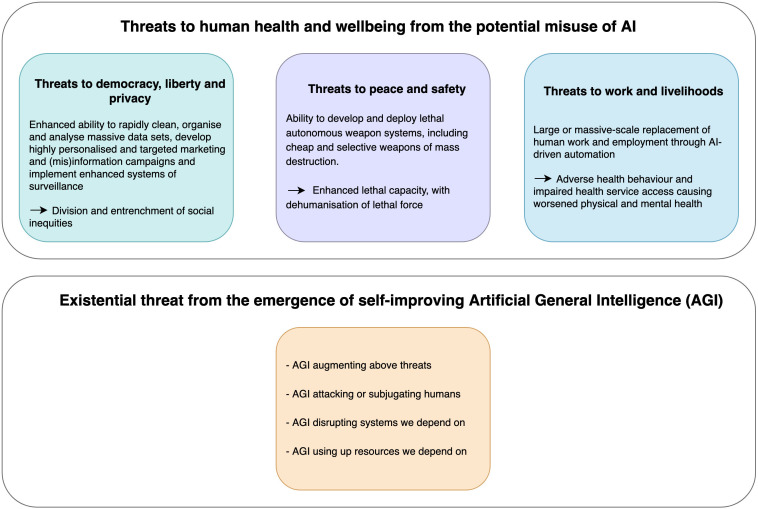
While artificial intelligence (AI) offers promising solutions in healthcare, it also poses a number of threats to human health and well-being via social, political, economic and security-related determinants of health. We describe three such main ways misused narrow AI serves as a threat to human health: through increasing opportunities for control and manipulation of people; enhancing and dehumanising lethal weapon capacity and by rendering human labour increasingly obsolescent. We then examine self-improving ‘artificial general intelligence’ (AGI) and how this could pose an existential threat to humanity itself. Finally, we discuss the critical need for effective regulation, including the prohibition of certain types and applications of AI, and echo calls for a moratorium on the development of self-improving AGI. We ask the medical and public health community to engage in evidence-based advocacy for safe AI, rooted in the precautionary principle.
Verified 2026-10-05 · 1 reference not checked yet
Overview
CoChat Summary
TL;DR
This paper argues that narrow AI can harm human health through upstream social, political, economic and security pathways—control/manipulation, lethal autonomous weapons, and labour displacement—while self-improving AGI could pose an existential threat. It calls for effective regulation, prohibitions on certain AI applications, and a moratorium on self-improving AGI, with the medical and public health community advocating for safe AI under the precautionary principle.
Key findings
- The paper identifies three main narrow-AI threats to health via social and upstream determinants: control and manipulation (including AI-driven election subversion in the 2013 and 2017 Kenyan elections, the 2016 US presidential election and the 2017 French presidential election, and surveillance expansion in at least 75 countries), lethal autonomous weapons (e.g., a shipping container could hold a million explosive drones), and job loss/obsolescence (projections of tens to hundreds of millions of jobs lost over the coming decade).
- It notes AI can worsen health inequities through biased data and deployment, citing an AI-driven pulse oximeter that overestimated blood oxygen in darker-skinned patients and facial recognition systems more likely to misclassify gender in darker-skinned subjects.
- It argues self-improving AGI could pose an existential threat; a survey of AI society members predicted a 50% likelihood of AGI development between 2040 and 2065, with 18% believing it would be existentially catastrophic, and dozens of institutions are conducting AGI research and development.
- It calls for effective regulation, prohibition of certain AI types and applications, and a moratorium on self-improving AGI until safeguards are in place, urging medical and public health evidence-based advocacy rooted in the precautionary principle.
Methods
- Design: Conceptual/commentary paper that describes three narrow-AI threats and the existential threat of AGI; no formal study design is reported.
- Data or sample: Not stated in the paper; no empirical sample or dataset is described.
- Main analysis: Not stated in the paper; the argument is developed through narrative synthesis with cited examples and expert surveys.
Limitations
- The paper states that AGI effects and outcomes cannot be known with certainty and that there are differing opinions about the degree of risk and trade-offs.
- The paper does not report a systematic search or empirical validation; this is evident from the absence of methods or data.
- The threats are largely prospective and contingent on policy and development trajectories; the paper itself notes future outcomes depend on policy decisions taken now and that there is no guarantee added productivity would be distributed fairly.
Model-written summary. Check it against the paper before relying on it.
Integrity signals
Registry
Cites
Statistics
Figures
Verification
Claims the paper makes
6 Valid · 2 Not valid · 23 Not checked · 15 Own results and interpretations
The cited sources support only part of this claim — read each source’s verdict below.
In the paper
“Although there is some acknowledgement of the risks and potential harms associated with the application of AI in medicine and healthcare,11–16 20 there is still little discussion within the health community about the broader and more upstream social, political, economic and security-related threats posed by AI.”
§ Threats by artificial intelligence to human health and human existence > Introduction
What the sources say
- Could not verifycites [11] Challen R, Denny J, Pitt M, et al. Artificial intelligence, bias and clinical safety. BMJ Qual Saf 2019; 28: 231– 7. 10.1136/bmjqs-2018-008370 PMC6560460 30636200 sourceExperimental — accuracy not yet measured
Our copy of Challen et al. (2019) contains no statement about how much or how little the health community discusses upstream social, political, economic or security-related threats from AI. The Introduction (p. 1) touches adjacent themes only — economic estimates ('a 14% effect on global gross domestic product by 2030'), 'political appetite for the rapid development of the AI industry', and 'increasing concerns about the ethical and medico-legal impact' — and Trends in ML research explicitly defers the wider societal debate ('This is a complex discussion and beyond the remit of this article'), which is a statement of the paper's own scope rather than of the state of community discourse. Security-related threats are not mentioned anywhere in our copy. Searched: 'little discussion within the health community about broader upstream social political economic security threats', 'security-related threats, existential risk, arms race, governance and regulation of AI beyond healthcare', 'ethical and medico-legal concerns while broader societal debate is limited'. (LLM, conf=0.70)
- Not checked yetcites [12] Ellahham S, Ellahham N, Simsekler MCE. Application of artificial intelligence in the health care safety context: opportunities and challenges. Am J Med Qual 2020; 35: 341– 8. 10.1177/1062860619878515 31581790 source
- Not checked yetcites [13] STUDY - panel for the future of science and technology - european parliamentary research service. artificial intelligence in healthcare. 2022. Available: https://www.europarl.europa.eu/RegData/etudes/STUD/2022/729512/EPRS_STU(2022)729512_EN.pdf [Accessed 17 Nov 2022].
- Partly supportedcites [14] Gerke S, Minssen T, Cohen G. Chapter 12 - ethical and legal challenges of artificial intelligence-driven healthcare. In: Bohr A, Memarzadeh K, eds. Artificial Intelligence in Healthcare: Academic Press. 2020: 295– 336. sourceExperimental — accuracy not yet measured
The closest statement in our copy is the Conclusion, which says 'it is also important to have public and political discussions centered on the ethics of AI-driven healthcare such as its implications on the human workforce and the society as a whole' — a normative call implying such broader discussion is needed, plus the Informed consent section's remark that this question 'has not received enough attention in the ethical debate' (a narrow, downstream clinical-ethics point). Together these support only part of the claim: under-attention to AI's broader societal implications. What the source does not state is the specific assertion that the health community in particular engages little with upstream social, political, ECONOMIC and SECURITY-related threats; our copy nowhere characterises the state of health-community debate in those terms, and it itself devotes sections to cybersecurity threats (nation-state actors, adversarial manipulation of AI) and to economic/policy trends (US and European AI strategies, automation-and-economy report). (LLM, conf=0.65)
- Not checked yetcites [15] Morley J, Floridi L. An ethically mindful approach to AI for health care. Lancet 2020; 395: 254– 5.: S0140-6736(19)32975-7. 10.1016/S0140-6736(19)32975-7 31982053 source
- Could not verifycites [16] Leslie D, Mazumder A, Peppin A, et al. Does “ AI ” stand for augmenting inequality in the era of covid-19 healthcare? BMJ 2021; 372: n304. 10.1136/bmj.n304 33722847 PMC7958301 sourceExperimental — accuracy not yet measured
Our full copy of Leslie et al. (BMJ 2021, n304) argues that AI deployed against covid-19 risks entrenching and amplifying health inequality, and it does discuss upstream social and economic drivers (Abstract; 'Biases in the choices made for AI design and use'; Conclusion: 'we must deal effectively with systemic racism, wealth disparities, and other structural inequities'). But no passage characterises the state of debate inside the health community — it makes no claim that discussion of broader upstream social, political, economic or security-related AI threats is scarce, and it does not address political or security threats at all. Searched: 'little discussion within the health community / upstream social political economic security threats', 'ethical debate has focused narrowly / gap in policy discussion', and 'wider societal risks of AI beyond healthcare: democracy, surveillance, economic disruption, weapons'; the copy is not truncated, so the point is simply absent rather than missing. (LLM, conf=0.65)
- Not checked yetcites [20] WHO. Ethics and governance of artificial intelligence for health. 2021. Available: https://apps.who.int/iris/rest/bitstreams/1352854/retrieve [Accessed 3 Aug 2022].
plain- Asserted: passes — The authors put it forward as true.
- Checkable: passes — It can be checked against evidence.
- Load-bearing: passes — The paper’s conclusions depend on it.
- Based: passes — The paper gives a reason why it holds.
- Could not verify
The cited sources support only part of this claim — read each source’s verdict below.
In the paper
“The use of this power to generate commercial revenue for social media platforms, for example, has contributed to the rise in polarisation and extremist views observed in many parts of the world.21”
§ Threats by artificial intelligence to human health and human existence > Threats from the misuse of artificial intelligence
What the sources say
- Partly supportedcites [21] Lorenz-Spreen P, Oswald L, Lewandowsky S, et al. A systematic review of worldwide causal and correlational evidence on digital media and democracy. Nat Hum Behav 2023; 7: 74– 101. 10.1038/s41562-022-01460-1 36344657 PMC9883171 sourceExperimental — accuracy not yet measured
Our copy does support the outcome half of the claim: the Results section 'Polarization' reports that 'high digital media use was for the most part linked to higher levels of polarization' across a range of political contexts and platforms, with causal articles in established democracies finding increased polarization, and the 'Populism' subsection reports associations with 'online right-wing radicalization in Austria, Sweden and Australia' and increased far-right populist support. The Conclusion also credits the platforms' curatorial power, stating that 'the bulk of empirical findings summarized here can be attributed to the current status quo of an information ecosystem produced and curated by large, commercial platforms... their power over what content and how content gets the most attention', and the Limitations note that Facebook's news feed down-ranked counter-attitudinal exposure, 'hence supporting a process that fosters polarization'. What no passage states is the monetization mechanism the citing sentence attributes: our copy nowhere says that this power was used 'to generate commercial revenue' (no discussion of advertising income, business models or profit incentives as a driver of polarization or extremism), and the review's own findings are framed largely as associations rather than as a causal contribution of commercial revenue generation. Searches for 'commercial revenue / business model / advertising / monetization / attention economy' and for 'algorithmic recommendation / radicalization' returned only the passages above. (LLM, conf=0.72)
plainstates a cause- Asserted: passes — The authors put it forward as true.
- Checkable: passes — It can be checked against evidence.
- Load-bearing: unclear — It is unclear whether the paper’s conclusions depend on it.
- Based: passes — The paper gives a reason why it holds.
- Partly supported
Every source the paper cites for this claim was checked and supports it.
In the paper
“Weapons are autonomous in so far as they can locate, select and ‘engage’ human targets without human supervision.34”
§ Threats by artificial intelligence to human health and human existence > Threats from the misuse of artificial intelligence
What the sources say
- Supportedcites [34] Javorsky E, Tegmark M, Helfand I. Lethal autonomous weapons. BMJ 2019; 364: l1171. 10.1136/bmj.l1171 30910775 source
The 'Third revolution in warfare' section (p.1-2) of our copy defines lethal autonomous weapon systems as "any system capable of targeting and initiating the use of potentially lethal force without direct human supervision and direct human involvement in lethal decision making," i.e. the complete automation of lethal harm — the same content the citing sentence paraphrases as locating, selecting and engaging human targets without human supervision. The Abstract likewise states these weapons "would remove all human control over the use of deadly force." The citing authors' quotation marks around 'engage' signal their own rewording of the source's 'targeting and initiating the use of potentially lethal force', which does not change the substance. (LLM, conf=0.85)
plain- Asserted: passes — The authors put it forward as true.
- Checkable: passes — It can be checked against evidence.
- Load-bearing: passes — The paper’s conclusions depend on it.
- Based: passes — The paper gives a reason why it holds.
- Supported
The cited sources support only part of this claim — read each source’s verdict below.
In the paper
“However, in a survey of most-cited authors on AI in 2012/2013, participants predicted the full automation of human labour shortly after the end of this century.39”
§ Threats by artificial intelligence to human health and human existence > Threats from the misuse of artificial intelligence
What the sources say
- Partly supportedcites [39] Grace K, Salvatier J, Dafoe A, et al. Viewpoint: when will AI exceed human performance? evidence from AI experts. Jair 2018; 62: 729– 54.: abs/1705.08807. 10.1613/jair.1.11222 sourceExperimental — accuracy not yet measured
Section 3, “Time Until Machines Outperform Humans,” reports a 50% forecast for full automation of labor 122 years after the survey, supporting a date beyond the end of this century. But Section 2, “Survey Method,” says the survey sampled researchers who published at the 2015 NIPS and ICML conferences, not most-cited AI authors in 2012/2013. The claim also omits the forecast’s 50% probability qualifier. (LLM, conf=0.88)
plain- Asserted: passes — The authors put it forward as true.
- Checkable: passes — It can be checked against evidence.
- Load-bearing: unclear — It is unclear whether the paper’s conclusions depend on it.
- Based: passes — The paper gives a reason why it holds.
- Partly supported
A conclusion the paper draws from its own results — it cites no other source for it, so there is none to check. The quote shows it is in the paper.
In the paper
“We describe three such main ways misused narrow AI serves as a threat to human health: through increasing opportunities for control and manipulation of people; enhancing and dehumanising lethal weapon capacity and by rendering human labour increasingly obsolescent.”
§ Threats by artificial intelligence to human health and human existence > Abstract
plainstates a cause- Asserted: passes — The authors put it forward as true.
- Checkable: passes — It can be checked against evidence.
- Load-bearing: passes — The paper’s conclusions depend on it.
- Based: unclear — It is unclear why the paper says it holds.
16 more claims
Create a free account to see all 46 claims and to verify the 43 references still open.
- It may state two separate claims as one. 17
- Probably not a substantial claim. 12
Claims other papers make about this one
Each is checked against this paper’s own text: does it say what the citing paper says it does?
The cited source says what the claim attributes to it.
In the citing paper
“AI technologies can be misused, resulting in negative consequences for both the individual and society”
From Assessment of AI ethical reflection: the development and validation of the AI ethical reflection scale (AIERS) for university students (2025) · cites this paper as Federspiel et al., 2023
Citations
Cites
The potential for artificial intelligence in healthcare
Davenport, T., & Kalakota, R. (2019) · Future Healthcare Journal · doi:10.7861/futurehosp.6-2-94 · Cited by 3,800
(2018) · Cited by 3,510
A 61-million-person experiment in social influence and political mobilization
Bond, R. M., Fariss, C. J., Jones, J. J., Kramer, A. D. I., Marlow, C., Settle, J. E., & Fowler, J. H. (2012) · Nature · doi:10.1038/nature11421 · Cited by 2,575 · cited 1×
“22 23 26 Cases of AI-driven subversion of elections include the 2013 and 2017 Kenyan elections, 27 the 2016 US presidential election and the 2017 French presidential election.”
BackgroundEthical and legal challenges of artificial intelligence-driven healthcare
Gerke, S., Minssen, T., & Cohen, G. (2020) · Artificial Intelligence in Healthcare · doi:10.1016/b978-0-12-818438-7.00012-5 · Cited by 1,170
Racial bias in pulse oximetry measurement
Sjoding, M. W., Dickson, R. P., Iwashyna, T. J., Gay, S. E., & Valley, T. S. (2020) · New England Journal of Medicine · doi:10.1056/nejmc2029240 · Cited by 1,114 · cited 1×
“17 Facial recognition systems have also been shown to be more likely to misclassify gender in subjects who are darker-skinned.”
BackgroundArtificial intelligence, bias and clinical safety
Challen, R., Denny, J., Pitt, M., Gompels, L., Edwards, T., & Tsaneva-Atanasova, K. (2019) · BMJ Quality & Safety · doi:10.1136/bmjqs-2018-008370 · Cited by 956 · cited 3×
“18 20 Although there is some acknowledgement of the risks and potential harms associated with the application of AI in medicine and healthcare, 11–16 20 there is still little discussion”
BackgroundThe Malicious Use of Artificial Intelligence: Forecasting, Prevention, and Mitigation
Brundage, M., Avin, S., Clark, J., Toner, H., Eckersley, P., Garfinkel, B., Dafoe, A., Scharre, P., Zeitzoff, T., Filar, B., et al. (2018) · Apollo - University of Cambridge Repository · doi:10.17863/cam.22520 · Cited by 849
The Malicious Use of Artificial Intelligence: Forecasting, Prevention, and Mitigation
Brundage, M., Avin, S., Clark, J., Toner, H., Eckersley, P., Garfinkel, B., Dafoe, A., Scharre, P., Zeitzoff, T., Filar, B., et al. (2018) · arXiv · doi:10.48550/arxiv.1802.07228 · Cited by 849
AI can be sexist and racist — it’s time to make it fair
Zou, J., & Schiebinger, L. (2018) · Nature · doi:10.1038/d41586-018-05707-8 · Cited by 765
Future Progress in Artificial Intelligence: A Survey of Expert Opinion
Müller, V. C., & Bostrom, N. (2016) · Synthese Library · doi:10.1007/978-3-319-26485-1_33 · Cited by 655 · cited 1×
“58 Presently, dozens of institutions are conducting research and development into AGI.”
Background
Research works printed but not linked: 2
- Oxford Economics. How robots change the world. 2019. Available: https://resources.oxfordeconomics.com/how-robots-change-the-world [Accessed 20 Apr 2020].
- Omohundro SM. The basic AI drives. Artificial General Intelligence 2008: Proceedings of the First AGI Conference; IOS Press, 2008: 483– 92
Cited by
Items 101–200 of 215
Ethical Issues Raised by Artificial Intelligence and Big Data in Population Health: A Scoping Review
Couture, V., Roy, M.-C., Dez, E., Tremblay, F., & Bélisle-Pipon, J.-C. (2025) · Frontiers in Sociology · doi:10.3389/fsoc.2025.1536389 · Cited by 3
Zaytseva, T. N., & Baraksanova, K. M. (2025) · Bulletin of Rehabilitation Medicine · doi:10.38025/2078-1962-2025-24-1-112-119 · Cited by 3
The human factor in AI governance: Dispositional predictors of public concern and regulatory support
Eom, D., Renner, J., Zhu, Y. E., Shao, A., Choi, S., Newman, T. P., Brossard, D., & Scheufele, D. A. (2026) · Technology in Society · doi:10.1016/j.techsoc.2026.103389 · Cited by 3
From Counsel to Code: Implications of AI Dependency for Authentic Human Bonds – A Systematic Review
Kamener, K. (2025) · Premier Journal of Artificial Intelligence · doi:10.70389/pjai.100020 · Cited by 3
Tuncer, C., Tekin, R. T., Uludağ, V., Kılıç, G., & Taskesen, A. (2026) · European Spine Journal · doi:10.1007/s00586-026-09795-3 · Cited by 3
Ethical considerations of AI integration in palliative care: a qualitative study
Qiu, M., Wu, Y., Zeng, L., & Zhang, F. (2026) · BMC Palliative Care · doi:10.1186/s12904-026-02059-3 · Cited by 3
Austin, Z., & Gregory, P. A. M. (2026) · Pharmacy · doi:10.3390/pharmacy14020057 · Cited by 3
“For these reasons, many of those who were involved in the initial development of AI have raised alarms regarding its growth and proliferation, particularly in the context of enormous for-profit technology companies [19].”
The digital determinants of health: a new era for global public health
Shaw, J., Gross, N., Saldaña‐Tejeda, A., Atuire, C., Prainsack, B., Holly, L., & Kickbusch, I. (2026) · The Lancet · doi:10.1016/s0140-6736(26)01292-4 · Cited by 3
Groumpos, P. P. (2024) · IgMin Research · doi:10.61927/igmin183 · Cited by 4
Lumbar Radicular Pain in the Eyes of Artificial Intelligence: Can You ‘Imagine’ What I ‘Feel’?
Temel, M. H., Erden, Y., & Bağcıer, F. (2024) · World Neurosurgery · doi:10.1016/j.wneu.2024.09.075 · Cited by 3
Will artificial intelligence threaten humanity?
Farahani, M. S., & Ghasemi, G. (2024) · Sustainable Economies · doi:10.62617/se.v2i2.65 · Cited by 4
“…and human asset capability are upheld by each of the five components of AI application areas of HR. Well-being and Safety improvement were viewed as vital components under the AI application in HR. Federspiel et al. [5] examined the potential threats of AI to human health and human existence.”
BackgroundBiosecurity and Artificial Intelligence in the Life Sciences
Ekins, S. (2024) · GEN Biotechnology · doi:10.1089/genbio.2024.0051 · Cited by 3
Public Health Legal Protections in an Era of Artificial Intelligence
Hodge, J. G., Piatt, J. L., White, E. N., & Gostin, L. O. (2024) · American Journal of Public Health · doi:10.2105/ajph.2024.307619 · Cited by 3
Žižek, S. Š., Mulej, M., Šket, R., Potočnik, A., & Horvat, B. K. (2026) · Palgrave studies in governance, leadership and responsibility · doi:10.1007/978-3-031-96887-7_8 · Cited by 3
Procedural, Substantive, and By-Design Approach toward a Third Stage of Bioethics
Ribas, S. (2023) · IntechOpen eBooks · doi:10.5772/intechopen.1001984 · Cited by 2
Hyperbole or Hypothetical? Ethics for AI in the Future of Applied Pedagogy
Hayes, C. (2023) · Advances in educational technologies and instructional design book series · doi:10.4018/979-8-3693-0205-7.ch001 · Cited by 2
AI-Driven Hospital Accounting: A Path to Financial Health
Kaur, J. (2024) · Advances in finance, accounting, and economics book series · doi:10.4018/979-8-3693-1331-2.ch010 · Cited by 2
Torres-Fernández, D., Dalsuco, J., Bramugy, J. M., Bassat, Q., & Varo, R. (2024) · Expert Review of Anti-infective Therapy · doi:10.1080/14787210.2024.2354839 · Cited by 3
“AI may also pose important threats to global health, ‘through increasing opportunities for control and manipulation of people, enhancing and dehuma-nizing lethal weapon capacity, and by rendering human labor increasingly obsolescent’ [66].”
BackgroundArtificial intelligence and public health: challenges and opportunities
Thomas, J. (2024) · Elsevier eBooks · doi:10.1016/b978-0-443-22270-2.00023-x · Cited by 2
AI in healthcare: an introduction for clinicians
Maiter, A., Alabed, S., Allen, G., & Alahdab, F. (2025) · BMJ Evidence-Based Medicine · doi:10.1136/bmjebm-2024-112966 · Cited by 2
India’s fragmented landscape of AI regulation and governance and the work and employment scenario
Roy, C., & Sarma, K. D. (2025) · Global Political Economy · doi:10.1332/26352257y2025d000000039 · Cited by 2
Can a Machine be Conscious? Towards Universal Criteria for Machine ConsciousnessPreprint
Anwar, N. A., & Badea, C. (2024) · arXiv (Cornell University) · doi:10.48550/arxiv.2404.15369 · Cited by 2
“…entities may inflict upon humanity, whether individually Hindocha and Badea [2022] or collectively [Agar, 2020, Hildt, 2023], have made for an unprecedented rise in academic, industrial, political, as well as public, interest in machine intelligence and consciousness [Federspiel et al., 2023].”
BackgroundHaeri, M. (n.d.) · Summit (Simon Fraser University) · Cited by 2
Testing the limits of large language models in debating humans
Flamino, J., Modi, M. S., Szymanski, B. K., Cross, B., & Mikolajczyk, C. (2025) · Scientific Reports · doi:10.1038/s41598-025-98378-1 · Cited by 1
“Considering the tenuous relationship forming between humans and AI in the face of the fast-paced integration of AI into everyday life 19,20 , we implemented an exploratory measure for the agents’ ability to blend in with the human players during the games.”
AI-Powered Hospital Accounting: Towards Sound Financial Management
Pramanik, S. (2024) · Advances in finance, accounting, and economics book series · doi:10.4018/979-8-3693-2683-1.ch008 · Cited by 1
Human red blood cell acetylcholinesterase activity: a revisit after fifteen years
Ke, P., Stidham, R. A., Castaneto, M. S., Forbes, A. M., Fathke, R. L., Crochet, R. B., Lewis, J. W., Wegner, M. D., & Mont, S. L. (2024) · Drug and Chemical Toxicology · doi:10.1080/01480545.2024.2329752 · Cited by 1
“…agents (the Novichoks) (chai et al., 2018) in Ukraine and eastern europe, recent reports on weaponization of artificial intelligence (ai) have also set a chilling alarm to the entire world (Dresp-langley, 2023; Federspiel et al., 2023; Raffa et al., 2022; saeed et al., 2023; Urbina et al., 2022).”
Enhancing Assessment Systems in Higher Education: A Review on Artificial Intelligence Usage
Al-Amin, M., Saqui, F. Z., & Khan, M. R. (2024) · Advances in educational technologies and instructional design book series · doi:10.4018/979-8-3693-2145-4.ch002 · Cited by 2
Design for the Long Now: Temporal Tools for Navigating Ethics in HCI
Jardine, J., Nadal, C., Barry, M., Snow, D., McDermott, F., & Robinson, S. (2024) · Designing Interactive Systems Conference · doi:10.1145/3656156.3658392 · Cited by 3
AI-Driven Cyber Threats: Behavioral Analysis and Strategic Defenses
Masaeid, T. F. A. (2025) · Advances in computational intelligence and robotics book series · doi:10.4018/979-8-3373-6801-6.ch011 · Cited by 1
Zurru, A. L. (2024) · Journal of Inclusive Methodology and Technology in Learning and Teaching · doi:10.32043/jimtlt.v4i1.158 · Cited by 1
Jin, Y., Feng, C., Zhao, J., Lin, W., & Li, B. (2026) · Journal of International Medical Research · doi:10.1177/03000605261438348 · Cited by 1
“33 Consequently, it is crucial to recognize and operate within the current constraints of LLM technology.”
Perspectives of Rural Primary School Students on the Concept of Artificial Intelligence
KURT, E. B., Öztürk, A., & Bal, B. (2026) · e-Kafkas Eğitim Araştırmaları Dergisi · doi:10.30900/kafkasegt.1816094 · Cited by 1
Artificial Intelligence, Existential Risks and International Obligations
Tache, C. E. P. (2026) · Springer eBooks · doi:10.1007/978-3-032-19547-0_2 · Cited by 1
The case for near-term artificial intelligence risks to be considered a public health problem
Armitage, R. C. (2026) · Global Public Health · doi:10.1080/17441692.2026.2716984 · Cited by 1
Reyes, T. M. D. L., & Oraiz, C. (2026) · Psychology and Education A Multidisciplinary Journal · doi:10.70838/pemj.540501 · Cited by 1
Far, S. B., Qazani, M. R. C., & Rad, A. I. (2026) · Artificial Intelligence Review · doi:10.1007/s10462-026-11567-w · Cited by 1
Understanding Artificial Intelligence and Applications in Oncology: Narrative Review
ÇİÇİN, F. N., & Sayın, S. (2024) · Journal of Oncological Sciences · doi:10.37047/jos.2023-98875 · Cited by 1
ARTIFICIAL INTELLIGENCE AND HUMAN COMPETENCE: ANALYSIS OF TEXT EDITING PROGRAMS IN UZBEK LANGUAGE
Menglibayevna, B. B., & Yusupovna, N. M. (2024) · Markaziy osiyoda media va kommunikatsiyalar xalqaro ilmiy jurnali. · doi:10.62499/ijmcc.vi7.76 · Cited by 1
Artificial intelligence and neural networks: new context of identification
Mamedova, N., Ivleva, M. I., Vityaev, S., Buzskaya, O., & Rubtsov, A. (2025) · Journal on Innovation and Sustainability RISUS · doi:10.23925/2179-3565.2025v16i2p146-154 · Cited by 1
Artificial Intelligence: Historical Evolution, Conceptual Framework, and Societal Reflections
Ateş, F. (2025) · Özgür Yayınları eBooks · doi:10.58830/ozgur.pub926.c3887 · Cited by 2
Artificial Intelligence and Climate Change: A Review of Causes and Opportunities
Watts, M. J., & Bayrak, A. (2025) · Communications in computer and information science · doi:10.1007/978-981-96-7033-8_13 · Cited by 1
Role of Artificial Intelligence in Management Education in India
Rupali Santosh Kalekar, M. A. V. (2023) · Journal of Propulsion Technology · Cited by 1
Gödel’s Loophole 2.0Preprint
Guerra-Pujol, F. E. (2023) · SSRN Electronic Journal · doi:10.2139/ssrn.4519241 · Cited by 1
Gnambs, T., Griese, F., & Zinn, S. (2025) · PsyArXiv (OSF Preprints) · doi:10.31234/osf.io/emg4f · Cited by 1
Artificial Intelligence in Clinical Decision Making: Opportunities and Ethical Challenges
Shuja, A. (2026) · Developmental medico-life-sciences · doi:10.69750/dmls.03.02.0192 · Cited by 2
For Better or for Worse? Ethical Implications of Generative AI
Hayes, C. (2024) · Advances in computational intelligence and robotics book series · doi:10.4018/979-8-3693-1565-1.ch007
Building Democratisation and Agency: The Adoption of Ethical AI Practice in Pedagogy
Hayes, C. (2024) · Advances in higher education and professional development book series · doi:10.4018/979-8-3693-1666-5.ch003
AI-Powered Hospital Accounting: Towards Sound Financial Management
Pramanik, S. (2024) · Advances in finance, accounting, and economics book series · doi:10.4018/979-8-3693-2185-0.ch013
The Power of Innovation in Organizational and Social Change
Araque, J. C., & Weiss, E. L. (2024) · Oxford University Press eBooks · doi:10.1093/oso/9780197753392.003.0002
Halk Sağlığında Yapay Zekâ (YZ) Kullanımı ve Geleceği
GÖDE, A. (2024) · DergiPark · Cited by 4
Tang, A. (2025) · Wiley eBooks · doi:10.1002/9781394204847.ch3
Vineis, P., & Colombi, G. (2025) · Frontiers research topics · doi:10.3389/978-2-8325-6008-2
AI explains gastric cancer surgery: readability versus reliability
Hong, W.-Q., Hu, R.-H., Cui, X., Jiang, X., & Zhang, S. (2025) · International Journal of Surgery · doi:10.1097/js9.0000000000002440
The Role of Nanotechnology and Artificial Intelligence in Human Existence
(2024) · Nanotechnology and Nanomaterials Research · doi:10.47275/2692-885x-127
Ghildiyal, V., Sharma, H., & Kuruva, M. B. (2025) · Emerald Group Publishing Limited eBooks · doi:10.1108/978-1-83708-724-220251002
Tira, C., & Kihara, A. (2025) · Journal of Business and Strategic Management · doi:10.47941/jbsm.3150
“Acquiring advanced software, hardware, and training requires investments that are often beyond the budgets of public health institutions (Federspiel et al., 2023).”
Artificial Intelligence in Warehouse Logistics as a Tool for Spatial Structure Optimization
Markiewicz, R., Norek, T., Rabe, M., Łopatka, A., Bilan, Y. V., & Gawlik, A. (2025) · Proceedings of the International Conference on Information Systems Development · doi:10.62036/isd.2025.147
Dehumanization in healthcare: is artificial intelligence a threat or a salvation?
Geldof, M., Ryland, A., & Malfait, S. (2025) · Intensive and Critical Care Nursing · doi:10.1016/j.iccn.2025.104284
China's strategy for AI in public health
Zhan, S. (2025) · The Lancet Public Health · doi:10.1016/s2468-2667(25)00275-0
Examining the Perceived Performance of Artificial Intelligence on the Behavioral Front
Javed, S. (2024) · UMT Artificial Intelligence Review · doi:10.32350/umt-air.41.02
Artificial intelligence in cardiothoracic monitoring and echocardiography
Bryant, J. M., Jelly, C. A., & Kertai, M. D. (2025) · Current Opinion in Anaesthesiology · doi:10.1097/aco.0000000000001598
Yuan, M.-Y., Hong, W.-Q., Hu, R.-H., Jiang, X., & Zhang, S. (2025) · Journal of Cancer Education · doi:10.1007/s13187-025-02793-x
Future Warfare: Navigating AI Integration in Military Combat Decision-Making
Passos, M., & Fernandes Meleiro, M. R. (2024) · Lund University Publications Student Papers (Lund University)
Understanding Readiness and Motivation for Digital Mental Health Support
Jardine, J. (2025) · Trinity's Access to Research Output (TARA) (Trinity College Dublin)
Rice, R. E., & Wu, M.-Y. (2025) · International journal of communication · Cited by 12
Erkers Lund, J., & Lipska, R. (2025) · Diva portal (Dalarna University Library)
The Dark Sides of Modern Science: The Curse
Sochi, T. (2025) · PhilPapers (PhilPapers Foundation) · doi:10.6084/m9.figshare.30426631
Marumo, P. O., & S, M. S. (2025) · Veredas do Direito Direito Ambiental e Desenvolvimento Sustentável · doi:10.18623/rvd.v22.n5.3619
SelfHeal: A Self-Healing AI Control Framework for Autonomous Recovery from Unsafe BehaviourPreprint
Shamszaman, Z. U., Sardar, B., Islam, S., Papastergiou, S., & Yashashvisindhu, B. (2025) · doi:10.36227/techrxiv.176704491.10830617/v1
Patient Safety in the Era of Artificial Intelligence: A Point-of-Care Nurses’ Practical Guide
Linerode, S., Ou, L., Akbarian, A., & Hall, H. (2025) · International Journal of Advance Research in Nursing · doi:10.33545/nursing.2025.v8.i2.j.615
Metodologia para detecção de noticias falsas usando rotulo de vies politico
Lisboa, L. A. M. [. (2024) · LA Referencia (Red Federada de Repositorios Institucionales de Publicaciones Científicas)
Interferência Da Inteligência Artificial Na Saúde Da Criança
Espósito, S. B., & Vieira, I. V. D. Q. (2026) · Editora Pasteur eBooks · doi:10.59290/9250202111
Pesquisa Multidisciplinar em Saúde Ed. XX
Vascão, E., TRIPODO, E. B. C., & Freitas, G. B. L. D. (2026) · Editora Pasteur eBooks · doi:10.59290/978-65-6029-319-9
How to counteract the delegitimization of science
Gronemeyer, H. (2026) · International Journal of Cancer · doi:10.1002/ijc.70393
“Generative artificial intelligence may play an ambivalent role in this regard, serving both as a tool for fact-checking 3 and as a means for amplifying misinformation 4,5 if misused.”
Gnambs, T., Griese, F., & Zinn, S. (2026) · Psychological Test Adaptation and Development · doi:10.1027/2698-1866/a000118
Barakat, O., & BOUHSAIN, I. (2025) · IJDAM - International Journal of Digitalization and Applied Management. · doi:10.23882/ijdam.26253
Yhteiskehittämällä resurssiviisaita digitaalisia sosiaali-, terveys- ja hyvinvointipalveluja
Tanja, V., & Satu, A. (2025) · UTUPub (University of Turku)
Yhteiskehittämällä resurssiviisaita digitaalisia sosiaali-, terveys- ja hyvinvointipalveluja
Satu, A. (2025) · UTUPub (University of Turku)
Yhteiskehittämällä resurssiviisaita digitaalisia sosiaali-, terveys- ja hyvinvointipalveluja
Tuomisto, A., & Collanus, E. (2025) · UTUPub (University of Turku)
Yhteiskehittämällä resurssiviisaita digitaalisia sosiaali-, terveys- ja hyvinvointipalveluja
Riitta, S. (2025) · UTUPub (University of Turku)
josset, J.-M., Ragot, M., & Rochat, J. (2026) · SSRN Electronic Journal · doi:10.2139/ssrn.6448358
Co-creating data ecosystems with urban informal communities for justice and transformationPreprint
de Albuquerque, J. P., Abascal, Á., Alugbin, O., Amole, T., Baruwa, K., Cheruiyot, C., Mitham-Clarke, A., Dixon, D., Du, X., Elias, P., et al. (2026) · Research Square · doi:10.21203/rs.3.rs-8927918/v1
Jiao, T., Wu, C., Zhang, Q., Yang, W., Li, Y., Zhang, Y. M., & Xin, J. L. (2026) · Knowledge-Based Systems · doi:10.1016/j.knosys.2026.115896
Application of Generative Artificial Intelligence for Innovative Teaching
Kadoić, N., Munđar, J. G., & Jagačić, T. (2026) · Applied Sciences · doi:10.3390/app16083699
Societal Risks of Generative AI: A Comparative Analysis
Mevada, J. R., Deshmukh, P. D., Panchal, S. V., Lakhe, A., & Vaishnav, S. (2026) · Lecture notes in networks and systems · doi:10.1007/978-3-032-19684-2_37
DeepSeek vs. ChatGPT : A New Challenge in AI Competion
Asly, I., Essabbar, D., & Chakraoui, M. (2026) · International Conference on Global Aeronautical Engineering and Satellite Technology (GAST) · doi:10.1109/gast67799.2026.11523252
“The potential misuse of open-source super intelligent AI by malicious actors represents an immediate and profound threat to global security [30].”
Beyond the SDGs: Degrowth as an Alternative
González, G. R., González, A. E. R., Carrillo, F. J., & López, A. C. (2026) · Sustainable development goals series · doi:10.1007/978-3-032-14294-8_3
Using AI for rapid and cost-effective identification of core themes in qualitative text data
Bartone, P. (2026) · Survey Practice · doi:10.29115/sp-2026-0024
Challenges, risks, and future prospects of AI
Rathi, K., Ranazunjare, R., Kulkarni, S., Firdous, S. M., & Rathi, G. (2026) · Elsevier eBooks · doi:10.1016/b978-0-443-40501-3.00002-9
Stahel, P. F., Ziran, N. M., Butler, N., & Coimbra, R. S. M. (2026) · The Journal of Trauma: Injury, Infection, and Critical Care · doi:10.1097/ta.0000000000005083
The Benefits of Generative AI for Global Health Partnerships: From Fragmentation to Cohesion
Sui, C., & Kalogeropoulos, D. (2026) · Advances in computational intelligence and robotics book series · doi:10.4018/979-8-2600-2238-2.ch002
Abraham, A. (2026) · Jurnal Pendidikan Agama dan Teologi · doi:10.59581/jpat-widyakarya.v4i1.6273
Quando l’Intelligenza Artificiale incontra la didattica inclusiva. La voce dei docenti specializzati
Montanari, M., & Travaglini, A. (2026) · Annali online della Didattica e della Formazione Docente · doi:10.15160/2038-1034/3256
Restoring the epistemic Integrity of the indigenous knowledge system by braiding knowledge
Abrahams, S. (2026) · Open University of Cape Town (University of Cape Town)
AI-Driven Employment: Navigating Algorithmic Discrimination and Public Health (Preprint)Preprint
Alexander, A. A. (2026) · doi:10.2196/preprints.104438
Ersöz, A. R., & KELLECİ, S. Ç. (2026) · Journal of Research in Business · doi:10.54452/jrb.1801206
Contextualizing Trustworthy AI Principles for PractitionersPreprint
Vadlamani, S. L., Male, S., & Baysal, O. (2026) · SSRN Electronic Journal · doi:10.2139/ssrn.7036089
Zhang, A., Yu, J., Tao, Q., Zhou, T., Sheng, A., Li, R., Wu, X., & Yu, Z. (2026) · Journal of Medical Internet Research · doi:10.2196/89300
“Specifically, physiological risks refer to potential or actual physical harm to patients resulting from misdiagnosis or mistreatment due to algorithmic biases, limited data samples, or technical malfunctions in the process of AI-assis-ted diagnosis and treatment [28].”
Metadata
- Authors
- Federspiel, F., Mitchell, R., Asokan, A., Umana, C., & McCoy, D.
- Affiliations
- London School of Hygiene & Tropical Medicine (GB)
- Sydney Children's Hospital (AU)
- Independent Researcher/Consultant (Human Rights, International Peace and Security), Washington, DC, USA
- Co-President, International Physicians for the Prevention of Nuclear War (IPPNW), San José, Costa Rica
- United Nations University-International Institute for Global Health (MY)
- Corresponding author
- McCoy, David
- Venue
- BMJ Global Health
- Publisher
- BMJ
- Published
- 2023-05
- Volume
- 8
- Issue
- 5
- Pages
- e010435
- ISSN
- 2059-7908 (ISSN-L)
- PMC
- PMC10186390
- OpenAlex
- W4376132814
- Semantic Scholar
- 0e7e64fe344f5255cfbff8a6aadbe562850059ae
- Cited by
- 156
- References
- 36
- Citations by year
- 2026: 31 · 2025: 40 · 2024: 65 · 2023: 20
- FWCI
- 6.10
- Type
- journal article
- Language
- en
- Open access
- gold
- doi.org
- Licence
- Locations
- BMJ Global Health (publishedVersion, cc-by-nc)
- PubMed Central (publishedVersion, cc-by-nc)
- PubMed (publishedVersion)
- LSHTM Research Online (London School of Hygiene and Tropical Medicine) (acceptedVersion)
- DOAJ (DOAJ: Directory of Open Access Journals) (submittedVersion, cc-by-sa)
- Topics
- Physical Sciences › Computer Science › Artificial Intelligence › Ethics and Social Impacts of AI
- Health Sciences › Medicine › Health Informatics › Artificial Intelligence in Healthcare and Education
- Physical Sciences › Environmental Science › Management, Monitoring, Policy and Law › Innovation, Sustainability, Human-Machine Systems
- Keywords
- artificial intelligence, narrow AI, artificial general intelligence, existential risk, human health, health determinants, lethal autonomous weapons, dehumanization, AI regulation, precautionary principle, AI safety, public health advocacy
- MeSH terms
- Artificial Intelligence, Female, Humans, Labor, Obstetric, Pregnancy, Public Health
About these checks
Registry, retraction, Cites and statistics results are computed, not judged, with one exception: a printed reference that no index lists is read once by a model before it counts as a citation error. Claims are extracted by a model and kept only when their quote appears verbatim in the text; each cited source is then checked, with a model’s help, for whether it says what the claim relies on. Those verdicts can be wrong — read the claim’s quote and the cited source before relying on one.
The claim verdicts this report counts are experimental: their accuracy is not yet measured.
A language model drew the claims from the paper on 2026-10-05, under version 3 of the claim definition (model deepseek-v4.1-flash, prompt extract-v3).
A second model labelled each claim on 2026-10-05 (model jev-1.13-20260917, definition revision gold-guideline-v0.2).
Cited sources are checked with a language model’s help (qwen3.8-omni-flash and gpt-6-sol).
Statistics and arithmetic are recomputed, not judged.
Confidence bands are shown only for fields calibrated on our annotated test set. None is calibrated yet, so no band is shown.
What counts as a claim ›How we measure confidence ›How we check this ›
Are you an author, or do you see a problem with this page? Request a review
Data sources
Bibliographic data: Semantic Scholar, OpenAlex, Crossref.
Contains information from the Semantic Scholar Academic Graph Datasets, made available under the ODC Attribution License (ODC-BY 1.0).
Semantic Scholar’s data is described in: Kinney, R., et al. (2023). The Semantic Scholar Open Data Platform. arXiv:2301.10140.
