

Threats by artificial intelligence to human health and human existence
Open accessThe DOI matches its Crossref record; 37 of the 38 references it cites were found in a registry or an index, and 1 are not checked yet; 11 of the 54 sources its claims cite were checked for support.
Abstract
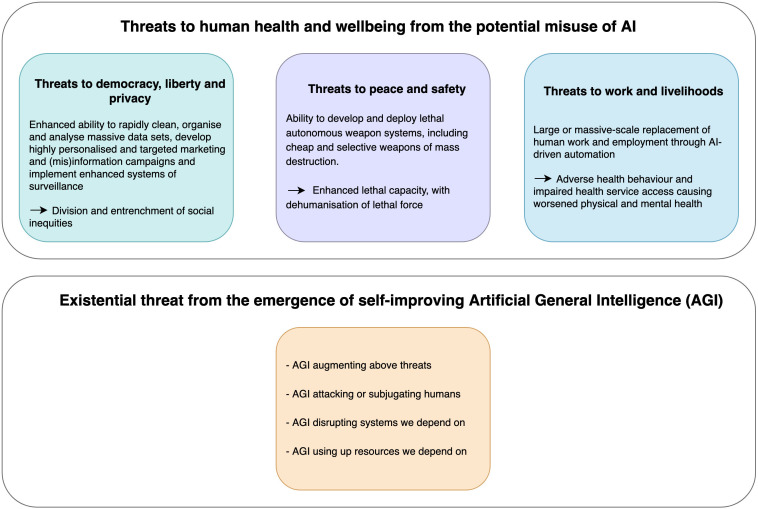
While artificial intelligence (AI) offers promising solutions in healthcare, it also poses a number of threats to human health and well-being via social, political, economic and security-related determinants of health. We describe three such main ways misused narrow AI serves as a threat to human health: through increasing opportunities for control and manipulation of people; enhancing and dehumanising lethal weapon capacity and by rendering human labour increasingly obsolescent. We then examine self-improving ‘artificial general intelligence’ (AGI) and how this could pose an existential threat to humanity itself. Finally, we discuss the critical need for effective regulation, including the prohibition of certain types and applications of AI, and echo calls for a moratorium on the development of self-improving AGI. We ask the medical and public health community to engage in evidence-based advocacy for safe AI, rooted in the precautionary principle.
Verified 2026-10-05 · 1 reference not checked yet
Overview
CoChat Summary
TL;DR
This paper argues that narrow AI can harm human health through upstream social, political, economic and security pathways—control/manipulation, lethal autonomous weapons, and labour displacement—while self-improving AGI could pose an existential threat. It calls for effective regulation, prohibitions on certain AI applications, and a moratorium on self-improving AGI, with the medical and public health community advocating for safe AI under the precautionary principle.
Key findings
- The paper identifies three main narrow-AI threats to health via social and upstream determinants: control and manipulation (including AI-driven election subversion in the 2013 and 2017 Kenyan elections, the 2016 US presidential election and the 2017 French presidential election, and surveillance expansion in at least 75 countries), lethal autonomous weapons (e.g., a shipping container could hold a million explosive drones), and job loss/obsolescence (projections of tens to hundreds of millions of jobs lost over the coming decade).
- It notes AI can worsen health inequities through biased data and deployment, citing an AI-driven pulse oximeter that overestimated blood oxygen in darker-skinned patients and facial recognition systems more likely to misclassify gender in darker-skinned subjects.
- It argues self-improving AGI could pose an existential threat; a survey of AI society members predicted a 50% likelihood of AGI development between 2040 and 2065, with 18% believing it would be existentially catastrophic, and dozens of institutions are conducting AGI research and development.
- It calls for effective regulation, prohibition of certain AI types and applications, and a moratorium on self-improving AGI until safeguards are in place, urging medical and public health evidence-based advocacy rooted in the precautionary principle.
Methods
- Design: Conceptual/commentary paper that describes three narrow-AI threats and the existential threat of AGI; no formal study design is reported.
- Data or sample: Not stated in the paper; no empirical sample or dataset is described.
- Main analysis: Not stated in the paper; the argument is developed through narrative synthesis with cited examples and expert surveys.
Limitations
- The paper states that AGI effects and outcomes cannot be known with certainty and that there are differing opinions about the degree of risk and trade-offs.
- The paper does not report a systematic search or empirical validation; this is evident from the absence of methods or data.
- The threats are largely prospective and contingent on policy and development trajectories; the paper itself notes future outcomes depend on policy decisions taken now and that there is no guarantee added productivity would be distributed fairly.
Model-written summary. Check it against the paper before relying on it.
Integrity signals
Registry
Cites
Statistics
Figures
Verification
Claims the paper makes
6 Valid · 2 Not valid · 23 Not checked · 15 Own results and interpretations
The cited sources support only part of this claim — read each source’s verdict below.
In the paper
“Although there is some acknowledgement of the risks and potential harms associated with the application of AI in medicine and healthcare,11–16 20 there is still little discussion within the health community about the broader and more upstream social, political, economic and security-related threats posed by AI.”
§ Threats by artificial intelligence to human health and human existence > Introduction
What the sources say
- Could not verifycites [11] Challen R, Denny J, Pitt M, et al. Artificial intelligence, bias and clinical safety. BMJ Qual Saf 2019; 28: 231– 7. 10.1136/bmjqs-2018-008370 PMC6560460 30636200 sourceExperimental — accuracy not yet measured
Our copy of Challen et al. (2019) contains no statement about how much or how little the health community discusses upstream social, political, economic or security-related threats from AI. The Introduction (p. 1) touches adjacent themes only — economic estimates ('a 14% effect on global gross domestic product by 2030'), 'political appetite for the rapid development of the AI industry', and 'increasing concerns about the ethical and medico-legal impact' — and Trends in ML research explicitly defers the wider societal debate ('This is a complex discussion and beyond the remit of this article'), which is a statement of the paper's own scope rather than of the state of community discourse. Security-related threats are not mentioned anywhere in our copy. Searched: 'little discussion within the health community about broader upstream social political economic security threats', 'security-related threats, existential risk, arms race, governance and regulation of AI beyond healthcare', 'ethical and medico-legal concerns while broader societal debate is limited'. (LLM, conf=0.70)
- Not checked yetcites [12] Ellahham S, Ellahham N, Simsekler MCE. Application of artificial intelligence in the health care safety context: opportunities and challenges. Am J Med Qual 2020; 35: 341– 8. 10.1177/1062860619878515 31581790 source
- Not checked yetcites [13] STUDY - panel for the future of science and technology - european parliamentary research service. artificial intelligence in healthcare. 2022. Available: https://www.europarl.europa.eu/RegData/etudes/STUD/2022/729512/EPRS_STU(2022)729512_EN.pdf [Accessed 17 Nov 2022].
- Partly supportedcites [14] Gerke S, Minssen T, Cohen G. Chapter 12 - ethical and legal challenges of artificial intelligence-driven healthcare. In: Bohr A, Memarzadeh K, eds. Artificial Intelligence in Healthcare: Academic Press. 2020: 295– 336. sourceExperimental — accuracy not yet measured
The closest statement in our copy is the Conclusion, which says 'it is also important to have public and political discussions centered on the ethics of AI-driven healthcare such as its implications on the human workforce and the society as a whole' — a normative call implying such broader discussion is needed, plus the Informed consent section's remark that this question 'has not received enough attention in the ethical debate' (a narrow, downstream clinical-ethics point). Together these support only part of the claim: under-attention to AI's broader societal implications. What the source does not state is the specific assertion that the health community in particular engages little with upstream social, political, ECONOMIC and SECURITY-related threats; our copy nowhere characterises the state of health-community debate in those terms, and it itself devotes sections to cybersecurity threats (nation-state actors, adversarial manipulation of AI) and to economic/policy trends (US and European AI strategies, automation-and-economy report). (LLM, conf=0.65)
- Not checked yetcites [15] Morley J, Floridi L. An ethically mindful approach to AI for health care. Lancet 2020; 395: 254– 5.: S0140-6736(19)32975-7. 10.1016/S0140-6736(19)32975-7 31982053 source
- Could not verifycites [16] Leslie D, Mazumder A, Peppin A, et al. Does “ AI ” stand for augmenting inequality in the era of covid-19 healthcare? BMJ 2021; 372: n304. 10.1136/bmj.n304 33722847 PMC7958301 sourceExperimental — accuracy not yet measured
Our full copy of Leslie et al. (BMJ 2021, n304) argues that AI deployed against covid-19 risks entrenching and amplifying health inequality, and it does discuss upstream social and economic drivers (Abstract; 'Biases in the choices made for AI design and use'; Conclusion: 'we must deal effectively with systemic racism, wealth disparities, and other structural inequities'). But no passage characterises the state of debate inside the health community — it makes no claim that discussion of broader upstream social, political, economic or security-related AI threats is scarce, and it does not address political or security threats at all. Searched: 'little discussion within the health community / upstream social political economic security threats', 'ethical debate has focused narrowly / gap in policy discussion', and 'wider societal risks of AI beyond healthcare: democracy, surveillance, economic disruption, weapons'; the copy is not truncated, so the point is simply absent rather than missing. (LLM, conf=0.65)
- Not checked yetcites [20] WHO. Ethics and governance of artificial intelligence for health. 2021. Available: https://apps.who.int/iris/rest/bitstreams/1352854/retrieve [Accessed 3 Aug 2022].
plain- Asserted: passes — The authors put it forward as true.
- Checkable: passes — It can be checked against evidence.
- Load-bearing: passes — The paper’s conclusions depend on it.
- Based: passes — The paper gives a reason why it holds.
- Could not verify
The cited sources support only part of this claim — read each source’s verdict below.
In the paper
“The use of this power to generate commercial revenue for social media platforms, for example, has contributed to the rise in polarisation and extremist views observed in many parts of the world.21”
§ Threats by artificial intelligence to human health and human existence > Threats from the misuse of artificial intelligence
What the sources say
- Partly supportedcites [21] Lorenz-Spreen P, Oswald L, Lewandowsky S, et al. A systematic review of worldwide causal and correlational evidence on digital media and democracy. Nat Hum Behav 2023; 7: 74– 101. 10.1038/s41562-022-01460-1 36344657 PMC9883171 sourceExperimental — accuracy not yet measured
Our copy does support the outcome half of the claim: the Results section 'Polarization' reports that 'high digital media use was for the most part linked to higher levels of polarization' across a range of political contexts and platforms, with causal articles in established democracies finding increased polarization, and the 'Populism' subsection reports associations with 'online right-wing radicalization in Austria, Sweden and Australia' and increased far-right populist support. The Conclusion also credits the platforms' curatorial power, stating that 'the bulk of empirical findings summarized here can be attributed to the current status quo of an information ecosystem produced and curated by large, commercial platforms... their power over what content and how content gets the most attention', and the Limitations note that Facebook's news feed down-ranked counter-attitudinal exposure, 'hence supporting a process that fosters polarization'. What no passage states is the monetization mechanism the citing sentence attributes: our copy nowhere says that this power was used 'to generate commercial revenue' (no discussion of advertising income, business models or profit incentives as a driver of polarization or extremism), and the review's own findings are framed largely as associations rather than as a causal contribution of commercial revenue generation. Searches for 'commercial revenue / business model / advertising / monetization / attention economy' and for 'algorithmic recommendation / radicalization' returned only the passages above. (LLM, conf=0.72)
plainstates a cause- Asserted: passes — The authors put it forward as true.
- Checkable: passes — It can be checked against evidence.
- Load-bearing: unclear — It is unclear whether the paper’s conclusions depend on it.
- Based: passes — The paper gives a reason why it holds.
- Partly supported
Every source the paper cites for this claim was checked and supports it.
In the paper
“Weapons are autonomous in so far as they can locate, select and ‘engage’ human targets without human supervision.34”
§ Threats by artificial intelligence to human health and human existence > Threats from the misuse of artificial intelligence
What the sources say
- Supportedcites [34] Javorsky E, Tegmark M, Helfand I. Lethal autonomous weapons. BMJ 2019; 364: l1171. 10.1136/bmj.l1171 30910775 source
The 'Third revolution in warfare' section (p.1-2) of our copy defines lethal autonomous weapon systems as "any system capable of targeting and initiating the use of potentially lethal force without direct human supervision and direct human involvement in lethal decision making," i.e. the complete automation of lethal harm — the same content the citing sentence paraphrases as locating, selecting and engaging human targets without human supervision. The Abstract likewise states these weapons "would remove all human control over the use of deadly force." The citing authors' quotation marks around 'engage' signal their own rewording of the source's 'targeting and initiating the use of potentially lethal force', which does not change the substance. (LLM, conf=0.85)
plain- Asserted: passes — The authors put it forward as true.
- Checkable: passes — It can be checked against evidence.
- Load-bearing: passes — The paper’s conclusions depend on it.
- Based: passes — The paper gives a reason why it holds.
- Supported
The cited sources support only part of this claim — read each source’s verdict below.
In the paper
“However, in a survey of most-cited authors on AI in 2012/2013, participants predicted the full automation of human labour shortly after the end of this century.39”
§ Threats by artificial intelligence to human health and human existence > Threats from the misuse of artificial intelligence
What the sources say
- Partly supportedcites [39] Grace K, Salvatier J, Dafoe A, et al. Viewpoint: when will AI exceed human performance? evidence from AI experts. Jair 2018; 62: 729– 54.: abs/1705.08807. 10.1613/jair.1.11222 sourceExperimental — accuracy not yet measured
Section 3, “Time Until Machines Outperform Humans,” reports a 50% forecast for full automation of labor 122 years after the survey, supporting a date beyond the end of this century. But Section 2, “Survey Method,” says the survey sampled researchers who published at the 2015 NIPS and ICML conferences, not most-cited AI authors in 2012/2013. The claim also omits the forecast’s 50% probability qualifier. (LLM, conf=0.88)
plain- Asserted: passes — The authors put it forward as true.
- Checkable: passes — It can be checked against evidence.
- Load-bearing: unclear — It is unclear whether the paper’s conclusions depend on it.
- Based: passes — The paper gives a reason why it holds.
- Partly supported
A conclusion the paper draws from its own results — it cites no other source for it, so there is none to check. The quote shows it is in the paper.
In the paper
“We describe three such main ways misused narrow AI serves as a threat to human health: through increasing opportunities for control and manipulation of people; enhancing and dehumanising lethal weapon capacity and by rendering human labour increasingly obsolescent.”
§ Threats by artificial intelligence to human health and human existence > Abstract
plainstates a cause- Asserted: passes — The authors put it forward as true.
- Checkable: passes — It can be checked against evidence.
- Load-bearing: passes — The paper’s conclusions depend on it.
- Based: unclear — It is unclear why the paper says it holds.
16 more claims
Create a free account to see all 46 claims and to verify the 43 references still open.
- It may state two separate claims as one. 17
- Probably not a substantial claim. 12
Claims other papers make about this one
Each is checked against this paper’s own text: does it say what the citing paper says it does?
The cited source says what the claim attributes to it.
In the citing paper
“AI technologies can be misused, resulting in negative consequences for both the individual and society”
From Assessment of AI ethical reflection: the development and validation of the AI ethical reflection scale (AIERS) for university students (2025) · cites this paper as Federspiel et al., 2023
Citations
Cites
The potential for artificial intelligence in healthcare
Davenport, T., & Kalakota, R. (2019) · Future Healthcare Journal · doi:10.7861/futurehosp.6-2-94 · Cited by 3,800
(2018) · Cited by 3,510
A 61-million-person experiment in social influence and political mobilization
Bond, R. M., Fariss, C. J., Jones, J. J., Kramer, A. D. I., Marlow, C., Settle, J. E., & Fowler, J. H. (2012) · Nature · doi:10.1038/nature11421 · Cited by 2,575 · cited 1×
“22 23 26 Cases of AI-driven subversion of elections include the 2013 and 2017 Kenyan elections, 27 the 2016 US presidential election and the 2017 French presidential election.”
BackgroundEthical and legal challenges of artificial intelligence-driven healthcare
Gerke, S., Minssen, T., & Cohen, G. (2020) · Artificial Intelligence in Healthcare · doi:10.1016/b978-0-12-818438-7.00012-5 · Cited by 1,170
Racial bias in pulse oximetry measurement
Sjoding, M. W., Dickson, R. P., Iwashyna, T. J., Gay, S. E., & Valley, T. S. (2020) · New England Journal of Medicine · doi:10.1056/nejmc2029240 · Cited by 1,114 · cited 1×
“17 Facial recognition systems have also been shown to be more likely to misclassify gender in subjects who are darker-skinned.”
BackgroundArtificial intelligence, bias and clinical safety
Challen, R., Denny, J., Pitt, M., Gompels, L., Edwards, T., & Tsaneva-Atanasova, K. (2019) · BMJ Quality & Safety · doi:10.1136/bmjqs-2018-008370 · Cited by 956 · cited 3×
“18 20 Although there is some acknowledgement of the risks and potential harms associated with the application of AI in medicine and healthcare, 11–16 20 there is still little discussion”
BackgroundThe Malicious Use of Artificial Intelligence: Forecasting, Prevention, and Mitigation
Brundage, M., Avin, S., Clark, J., Toner, H., Eckersley, P., Garfinkel, B., Dafoe, A., Scharre, P., Zeitzoff, T., Filar, B., et al. (2018) · Apollo - University of Cambridge Repository · doi:10.17863/cam.22520 · Cited by 849
The Malicious Use of Artificial Intelligence: Forecasting, Prevention, and Mitigation
Brundage, M., Avin, S., Clark, J., Toner, H., Eckersley, P., Garfinkel, B., Dafoe, A., Scharre, P., Zeitzoff, T., Filar, B., et al. (2018) · arXiv · doi:10.48550/arxiv.1802.07228 · Cited by 849
AI can be sexist and racist — it’s time to make it fair
Zou, J., & Schiebinger, L. (2018) · Nature · doi:10.1038/d41586-018-05707-8 · Cited by 765
Future Progress in Artificial Intelligence: A Survey of Expert Opinion
Müller, V. C., & Bostrom, N. (2016) · Synthese Library · doi:10.1007/978-3-319-26485-1_33 · Cited by 655 · cited 1×
“58 Presently, dozens of institutions are conducting research and development into AGI.”
Background
Research works printed but not linked: 2
- Oxford Economics. How robots change the world. 2019. Available: https://resources.oxfordeconomics.com/how-robots-change-the-world [Accessed 20 Apr 2020].
- Omohundro SM. The basic AI drives. Artificial General Intelligence 2008: Proceedings of the First AGI Conference; IOS Press, 2008: 483– 92
Cited by
A comprehensive AI policy education framework for university teaching and learning
Chan, C. K. Y. (2023) · International Journal of Educational Technology in Higher Education · doi:10.1186/s41239-023-00408-3 · Cited by 1,577
Artificial intelligence and human translation: A contrastive study based on legal texts
Moneus, A. M., & Sahari, Y. (2024) · Heliyon · doi:10.1016/j.heliyon.2024.e28106 · Cited by 220
Generative AI in Higher Education: The ChatGPT Effect
Chan, C. K. Y., & Colloton, T. (2024) · Routledge · doi:10.4324/9781003459026 · Cited by 203
AI Chatbots, Health Privacy, and Challenges to HIPAA Compliance
Marks, M., & Haupt, C. E. (2023) · JAMA · doi:10.1001/jama.2023.9458 · Cited by 171
Knopp, M. I., Warm, E. J., Weber, D., Kelleher, M., Kinnear, B., Schumacher, D. J., Santen, S. A., Mendonça, E., & Turner, L. (2023) · JMIR Medical Education · doi:10.2196/50373 · Cited by 133
AI in renewable energy: A review of predictive maintenance and energy optimization
Hamdan, A., Ibekwe, K. I., Ilojianya, V. I., Sonko, S., & Etukudoh, E. A. (2024) · International Journal of Science and Research Archive · doi:10.30574/ijsra.2024.11.1.0112 · Cited by 211
“While concerns about ethical implications and potential misuse remain, AI promises to be a defining force in shaping the future of humanity (Federspiel et al., 2023).”
Artificial intelligence in sustainable development research
Gohr, C., Aboytes, J. G. R., Belomestnykh, S., Berg-Moelleken, D., Chauhan, N., Engler, J., Heydebreck, L. V., Hintz, M. J., Kretschmer, M.-F., Krügermeier, C., et al. (2025) · Nature Sustainability · doi:10.1038/s41893-025-01598-6 · Cited by 156
“Moreover, broader concerns about the potential risks of AI—such as its ability to control and disempower citizens, or even pose existential threats to humanity—are also central to these debates 59–61 .”
The mechanisms of AI hype and its planetary and social costs
Markelius, A., Wright, C., Kuiper, J., Delille, N., & Kuo, Y.-T. (2024) · AI and Ethics · doi:10.1007/s43681-024-00461-2 · Cited by 76
“Numerous headlines and substantial investments have emphasised the notion of AI as an existential threat to humanity [86].”
Frenkenberg, A., & Hochman, G. (2025) · Systems · doi:10.3390/systems13020082 · Cited by 97
“As AI is increasingly perceived not only as a tool but also as a potential rival, it fosters a profound sense of vulnerability and existential threat [61,62].”
Borger, J. G., Ng, A. P., Anderton, H., Ashdown, G. W., Auld, M., Blewitt, M. E., Brown, D. V., Call, M. J., Collins, P., Freytag, S., et al. (2023) · Immunology & Cell Biology · doi:10.1111/imcb.12689 · Cited by 103
Menz, B. D., Modi, N. D., Sorich, M. J., & Hopkins, A. M. (2024) · JAMA Internal Medicine · doi:10.1001/jamainternmed.2023.5947 · Cited by 99
Ethical Implications of Chatbot Utilization in Nephrology
Valencia, O. A. G., Suppadungsuk, S., Thongprayoon, C., Miao, J., Tangpanithandee, S., Craici, I. M., & Cheungpasitporn, W. (2023) · Journal of Personalized Medicine · doi:10.3390/jpm13091363 · Cited by 104
“It is crucial to prioritize the privacy and security of this data [30].”
Wang, Z., Chai, C.-S., Li, J., & Lee, V. W. Y. (2025) · International Journal of Educational Technology in Higher Education · doi:10.1186/s41239-025-00519-z · Cited by 78
“Although AI is bringing revolutionary changes, AI technologies can be misused, resulting in negative consequences for both the individual and society (Federspiel et al., 2023; Paraman & Anamalah, 2023).”
The dangers of generative artificial intelligence
Tredinnick, L., & Laybats, C. (2023) · Business Information Review · doi:10.1177/02663821231183756 · Cited by 52
“An article in BMJ Global Health was published warning of the existential threat of AI (Federspiel et al., 2023).”
BackgroundMarques, M., Almeida, A. M., & Pereira, H. (2024) · Cureus · doi:10.7759/cureus.69405 · Cited by 92
Managing workplace AI risks and the future of work
Howard, J., & Schulte, P. A. (2024) · American Journal of Industrial Medicine · doi:10.1002/ajim.23653 · Cited by 66
Kusunose, K., Kashima, S., & Sata, M. (2023) · Circulation Journal · doi:10.1253/circj.cj-23-0308 · Cited by 53
Dergaa, I., Fekih‐Romdhane, F., Glenn, J. M., Fessi, M. S., Chamari, K., Dhahbi, W., Zghibi, M., Bragazzi, N. L., Aissa, M. B., Guelmami, N., et al. (2023) · New Asian Journal of Medicine · doi:10.61838/kman.najm.1.2.4 · Cited by 58
Prospects of Cybersecurity in Smart Cities
Almeida, F. L. (2023) · Future Internet · doi:10.3390/fi15090285 · Cited by 66
“Elliott and Soifer [49] and Federspiel et al. [50] refer to the vulnerabilities that occur by adopting smart systems based on artificial intelligence, as they not only collect a wide variety of sensitive information from people and their social circles, but also control city facilities and influence…”
AI literacy in geographic education and research: Capabilities, caveats, and criticality
Wilby, R. L., & Esson, J. (2023) · Geographical Journal · doi:10.1111/geoj.12548 · Cited by 58
Wang, G., Obrenovic, B., Gu, X., & Godinić, D. (2025) · Current Psychology · doi:10.1007/s12144-025-07357-2 · Cited by 63
“Several studies have shown that adversely affected individuals experience the pro - gressive integration of AI threats (Federspiel et al., 2023).”
The future of artificial intelligence: Fear, hope or indifference?
Yarovenko, H., Kuzior, A., Norek, T., & Lopatka, A. (2024) · Human Technology · doi:10.14254/1795-6889.2024.20-3.10 · Cited by 49
Li, B., & Gilbert, S. (2024) · npj Digital Medicine · doi:10.1038/s41746-024-01345-9 · Cited by 53
Exploring the Potential of Chatbots in Critical Care Nephrology
Suppadungsuk, S., Thongprayoon, C., Miao, J., Krisanapan, P., Qureshi, F., Kashani, K., & Cheungpasitporn, W. (2023) · Medicines · doi:10.3390/medicines10100058 · Cited by 37
Li, J., & Kang, X. (2024) · Engineering Applications of Artificial Intelligence · doi:10.1016/j.engappai.2024.108690 · Cited by 46
DeepSeek: Is it the End of Generative AI Monopoly or the Mark of the Impending Doomsday?
Sallam, M., Al-Mahzoum, K., Sallam, M., & Mijwil, M. M. (2025) · Mesopotamian Journal of Big Data · doi:10.58496/mjbd/2025/002 · Cited by 55
“The potential misuse of open-source superintelligent AI by malicious actors represents an immediate and profound threat to global security [54].”
Özüdoğru, G., & Durak, H. Y. (2025) · Information Development · doi:10.1177/02666669251335657 · Cited by 47
“Federspiel et al. (2023) addressed the threats related to the potential misuse of AI for health under three headings: (1) democracy, privacy and freedom, (2) peace and security, (3) work and livelihood.”
Jin, S. A., & Ryu, E. (2024) · Technological Forecasting and Social Change · doi:10.1016/j.techfore.2024.123877 · Cited by 46
Kozak, J., & Fel, S. (2024) · Religions · doi:10.3390/rel15030331 · Cited by 41
Opportunities and Challenges of Chatbots in Ophthalmology: A Narrative Review
Sabaner, M. C., Anguita, R., Antaki, F., Balas, M., Boberg‐Ans, L. C., Desideri, L. F., Grauslund, J., Hansen, M. S., Klefter, O. N., Potapenko, I. O., et al. (2024) · Journal of Personalized Medicine · doi:10.3390/jpm14121165 · Cited by 35
“Another concern regarding chatbots is whether they might violate the foundational principle of the AI and robotics industry: to avoid causing harm to humans or sharing information that could lead to harm [94].”
Artificial intelligence in clinical nutrition and dietetics: A brief overview of current evidence
Atwal, K. (2024) · Nutrition in Clinical Practice · doi:10.1002/ncp.11150 · Cited by 33
“49 ChatGPT has been featured as a coauthor on a scientific paper.”
Omeh, C. B., Olelewe, C. J., & Hu, X. (2024) · Education and Information Technologies · doi:10.1007/s10639-024-13018-x · Cited by 37
“According to Federspiel et al. (2023), misuse of artificial intelligence could encourage manipulation of people, exacerbate inequality, and widen the digital gap, risking the survival of the human race.”
Resistance towards autonomous vehicles (AVs)
Nordhoff, S. (2024) · Transportation Research Interdisciplinary Perspectives · doi:10.1016/j.trip.2024.101117 · Cited by 34
Baronchelli, A. (2024) · Philosophical Transactions of the Royal Society B: Biological Sciences · doi:10.1098/rstb.2023.0028 · Cited by 29
“Thus, for example, invitations to halt the development of self-improving artificial general intelligence [8] are difficult to implement, even where there is a will to do so, owing to the opacity of the research taking place behind closed doors.”
BackgroundHow will I break AI? Post-Luddism in the AI age: Fuzzy MCDM synergy
Darıcı, S., Riaz, M., Demir, G., Gencer, Z. T., & Pamucar, D. S. (2024) · Technological Forecasting and Social Change · doi:10.1016/j.techfore.2024.123327 · Cited by 29
Psychiatry in the age of AI: transforming theory, practice, and medical education
Zhang, X., & Zheng, H. (2025) · Frontiers in Public Health · doi:10.3389/fpubh.2025.1660448 · Cited by 30
Artificial Intelligence in the Management of Heart Failure
Cheema, B. S., Hourmozdi, J., Kline, A. S., Ahmad, F. S., & Khera, R. (2025) · Journal of Cardiac Failure · doi:10.1016/j.cardfail.2025.02.020 · Cited by 24
Nichifor, E., Brătucu, G., Chițu, I. B., Lupșa-Tătaru, D. A., Chișinău, E. M., Todor, R. D., Albu, R.-G., & Bălășescu, S. (2023) · Electronics · doi:10.3390/electronics12214538 · Cited by 24
Dealing with digital paralysis: Surviving a cyberattack in a National Cancer center
Keogh, R. J., Harvey, H. M., Brady, C., Hassett, E., Costelloe, S. J., O’Sullivan, M. J., Twomey, M., O’Leary, M. J., Cahill, M. R., O’Riordan, A., et al. (2024) · Journal of Cancer Policy · doi:10.1016/j.jcpo.2023.100466 · Cited by 22
Chatting with artificial intelligence to combat antibiotic resistance: Opportunities and challenges
Abavisani, M., Khoshrou, A., Foroushan, S. K., & Sahebkar, A. (2024) · Current Research in Biotechnology · doi:10.1016/j.crbiot.2024.100197 · Cited by 23
Performance of ChatGPT in Answering Clinical Questions on the Practical Guideline of Blepharoptosis
Shiraishi, M., Tomioka, Y., Miyakuni, A., Ishii, S., Hori, A., Park, H., Ohba, J., & Okazaki, M. (2024) · Aesthetic Plastic Surgery · doi:10.1007/s00266-024-04005-1 · Cited by 20
Risks of Artificial Intelligence (AI) in Medicine
Siafakas, N. M., & Vasarmidi, E. (2024) · Pneumon · doi:10.18332/pne/191736 · Cited by 32
“Furthermore, the race of the major AI companies to develop the best, fastest, cheapest, and most profitable medical algorithms, raises extreme pressure on the developing scientists and that may cause fatal errors and a lack of transparency 14,24 .”
BackgroundHuman Dignity and Artificial Intelligence in Healthcare: A Basis for a Catholic Ethics on AI
Gozum, I. E. A., & Flake, C. C. (2024) · Journal of Religion and Health · doi:10.1007/s10943-024-02206-1 · Cited by 20
“Patients may suffer grave effects from AI algorithm flaws, mal-functions, or vulnerabilities (Federspiel et al., 2023).”
Kumar, A. B., & Mohanty, A. (2024) · Advances in human and social aspects of technology book series · doi:10.4018/979-8-3693-3334-1.ch002 · Cited by 20
Dhahir, D. F., Kenda, N., Dirgahayu, D., Syarifuddin, S., Djaffar, R., Widihastuti, R., Rustam, M., & Pala, R. (2024) · Jurnal Pekommas · doi:10.56873/jpkm.v9i2.5873 · Cited by 22
Bangash, S. H., Khan, I., Husnain, G., Irfan, M. A., & Iqbal, A. (2024) · VFAST Transactions on Software Engineering · doi:10.21015/vtse.v12i1.1760 · Cited by 21
Yang, J., Chu, S., & Cao, Y. (2024) · Journal of Current Issues & Research in Advertising · doi:10.1080/10641734.2024.2403485 · Cited by 21
“…scholars are also raising alarms about the ethical concerns arising with the adoption of AI in the workforce, such as the just distribution of power and resources (Ghassemi et al. 2023) and possible threats to the labor force (Mirbabaie et al. 2022) and human well-being (Federspiel et al. 2023).”
The Gates Foundation’s new AI initiative: attempting to leapfrog global health inequalities?
Shaffer, J. D., Alenichev, A., & Faure, M. C. (2023) · BMJ Global Health · doi:10.1136/bmjgh-2023-013874 · Cited by 20
“27 The absence of democratic governance of these tools is a grave and growing threat.”
BackgroundADAY ÖĞRETMENLERİN YAPAY ZEKÂ ALGILARI VE EĞİTİMDE YAPAY ZEKÂ KULLANIMINA İLİŞKİN DÜŞÜNCELERİ
COŞKUN, B. (2024) · Kapadokya eğitim dergisi. · doi:10.69643/kaped.1566047 · Cited by 18
Artificial Intelligence in Endocrinology: On Track Toward Great Opportunities
Assié, G., & Allassonnière, S. (2024) · The Journal of Clinical Endocrinology & Metabolism · doi:10.1210/clinem/dgae154 · Cited by 17
Perception and Ethical Challenges for the Future of AI as Encountered by Surveyed New Engineers
Khogali, H. O., & Mekid, S. (2024) · Societies · doi:10.3390/soc14120271 · Cited by 15
Windermere, S. A., Shah, S., Hey, G. E., McGrath, K. V., & Rahman, M. (2025) · World Neurosurgery · doi:10.1016/j.wneu.2025.123809 · Cited by 17
Preparing for next-generation information warfare with generative AI
Pauwels, E. (2024) · Econstor (Econstor) · Cited by 15
Day, T., Gonzalez, M., Kim, J., McDaniel, P. N., Redican, K., & Zhu, T. (2025) · The Professional Geographer · doi:10.1080/00330124.2025.2478075 · Cited by 14
“Alternatively, it could potentially lead to a dystopian world in which humans play a subordinate role to machines, or even result in human extinction (Bengio 2023; Federspiel et al. 2023; Dung 2024).”
Habib, F. A. B. (2025) · Education and Information Technologies · doi:10.1007/s10639-024-13271-0 · Cited by 16
Martinelli, C. V., Giordano, A., Carnevale, V., Burk, S. R., Porto, L., Vizzielli, G., & Ercoli, A. (2025) · Mayo Clinic Proceedings Digital Health · doi:10.1016/j.mcpdig.2025.100206 · Cited by 18
“6,18 e 21 These biases can lead to unequal performance across different demographic characteristic groups, potentially exacerbating health care disparities.”
(2024) · Journal of Management Changes in the Digital Era · doi:10.33168/jmcde.2024.0101 · Cited by 17
“It should be recognized that a person becomes a target for manipulation (Federspiel et al., 2023) of both his personal and public consciousness through the use of virtual and other tools (Carroll et al., 2023).”
Sinha, C. (2025) · Oxford Open Digital Health · doi:10.1093/oodh/oqaf016 · Cited by 13
“When AI solutions are not developed or deployed responsibly, they pose significant risks to health and other legal, social, economic and cultural aspects of lives and livelihoods [13].”
Artificial Intelligence in the Scientific and Technological Paradigm of Global Economy
Lukianenko, D., & Cімахова, А. О. (2024) · Problemy Ekorozwoju · doi:10.35784/preko.6256 · Cited by 16
Transforming Physiology and Healthcare through Foundation Models
Godwin, R. C., Tung, A., Berkowitz, D. E., & Melvin, R. L. (2025) · Physiology · doi:10.1152/physiol.00048.2024 · Cited by 14
Alwazna, R. Y., Hurley, Z., & Elyas, T. (2025) · International Journal for the Semiotics of Law - Revue internationale de Sémiotique juridique · doi:10.1007/s11196-025-10295-8 · Cited by 12
Leading AI Adoption in Organizations: Introducing a Behavioral Human-Centered Approach
Schweitzer, S., Narayanan, D., McGuire, J., & Cremer, D. D. (2025) · International Journal of Human-Computer Interaction · doi:10.1080/10447318.2025.2531287 · Cited by 15
“Easy-to-recall cultural narratives of automation eliminating jobs (Frey & Osborne, 2017) or even of robots posing an existential threat to humanity (Federspiel et al., 2023) may also hinder people ’ s adoption of AI because these examples are vivid, regardless of whether they are true or…”
Gupta, A. K., Talukder, M., Wang, T., Daneshjou, R., & Piguet, V. (2024) · Journal of Investigative Dermatology · doi:10.1016/j.jid.2023.10.046 · Cited by 12
Adams, J. (2025) · AI & Society · doi:10.1007/s00146-025-02398-4 · Cited by 10
“Similarly, AI’s disruption to “human values and organisational systems that support wellbeing” (Gluckman and Allen 2018, p. 10), as well as the more speculative threat to human existence itself (Federspiel et al. 2023), have been raised as matters of the public good.”
Exploring pre-service teachers’ perspectives on integrating artificial intelligence in education
Panagou, D., Stylos, G., & Kotsis, K. Τ. (2025) · Journal of Digital Educational Technology · doi:10.30935/jdet/17297 · Cited by 12
“This agrees with an analysis by BMJ global health (Federspiel et al., 2023).”
Kostenko, O. V. (2025) · doi:10.69635/978-1-0690482-5-7 · Cited by 10
Syafaruddin, B., Sarda, M., Mawaddah, N., & Agustinanda, B. (2025) · ETDC Indonesian Journal of Research and Educational Review · doi:10.51574/ijrer.v5i1.4367 · Cited by 10
“Furthermore, while many studies view Artificial Intelligence (AI) as a threat to human values (Bozkurt & Gursoy, 2025; Federspiel et al., 2023; Groumpos, 2019), this research finds that AI (through Artificial Neural Networks) has the potential to "humanize" education.”
Focal points and blind spots of human-centered AI: AI risks in written online media
Sebestyen, M. (2025) · Humanities and Social Sciences Communications · doi:10.1057/s41599-025-04814-y · Cited by 12
Democracias generativas: inteligencia artificial y manipulación en el siglo XXI
Alegría, J. P. (2024) · Trayectorias Humanas Trascontinentales · doi:10.25965/trahs.6334 · Cited by 10
Duah, J. E., Lu, X. B., McGivern, P., & Jing, Y. (2024) · International Conference on Big Data and Education (ICBDE) · doi:10.1145/3704289.3704293 · Cited by 10
“Highlighted risks include the potential for manipulation, social divisiveness, and deepened inequalities, pointing to existential threats [38].”
Alqurashi, M. A., & Alshagrawi, S. S. (2025) · The Open Public Health Journal · doi:10.2174/0118749445369173250203072754 · Cited by 13
Hlede, V., Valanci, S., D’Antuono, G., Dow, H., Wiggins, R. H., Dorman, T., & O’Beirne, R. (2026) · JMIR Medical Education · doi:10.2196/69156 · Cited by 9
“AI’s rapid evolution is associated with ethical, legal, social, and professional opportunities and risks for health and continuing professional development (CPD) professionals, patients, and the broader society [3,4].”
Generative artificial intelligence and the risk of technodigital colonialism
Cambraia, L., & Pyrrho, M. (2025) · Frontiers in Political Science · doi:10.3389/fpos.2025.1628139 · Cited by 14
Núñez‐Delgado, A. (2024) · The Science of The Total Environment · doi:10.1016/j.scitotenv.2024.173310 · Cited by 9
Abavisani, M., Khoshrou, A., & Sahebkar, A. (2024) · Drug Discovery Today · doi:10.1016/j.drudis.2024.103909 · Cited by 8
Daly, T. P., Mastroleo, I., García‐Valiña, L., Melamed, I. N., Santi, M. F., Ochoa, T. J., Pinto, M. F., CUMMINS, P. J., Camino, B. G., MACPHERSON, C. C., et al. (2025) · Journal of Empirical Research on Human Research Ethics · doi:10.1177/15562646251325621 · Cited by 7
“…human displacement due to disasters and political fallout, as well as challenges related to the growing use of arti fi cial intelligence worldwide (Federspiel et al., 2023), it is hoped that the groundwork described in this paper will continue to inspire further research ethics education across…”
Hägglund, S., Andtfolk, M., Rosenberg, S., Wingren, M., Andersson, S., & Nyholm, L. (2024) · Frontiers in Robotics and AI · doi:10.3389/frobt.2024.1332110 · Cited by 9
Using Artificial Intelligence in Patient Care—Some Considerations for Doctors and Medical Regulators
Ooi, K. (2024) · Asian Bioethics Review · doi:10.1007/s41649-024-00291-8 · Cited by 8
“On that note, medical regulators should emphasise the need to use AI responsibly so that it does not worsen existing health and social inequalities (Federspiel et al. 2023; World Health Organisation 2023a).”
Klingelhöfer, D., Braun, M., Dröge, J., Groneberg, D. A., & Brüggmann, D. (2025) · Globalization and Health · doi:10.1186/s12992-025-01128-1 · Cited by 6
“Therefore, further development of AI must be accompanied by a deeper understanding of AI, including its implications for societal equity and health security, as well as a deep and broad public and professional debate [14].”
Evolutionary Trajectories of Consciousness: From Biological Foundations to Technological Horizons
Gusev, E., Sarapultsev, A., & Komelkova, M. V. (2025) · Brain Sciences · doi:10.3390/brainsci15070734 · Cited by 6
“Additionally, the improper use of narrow AI poses a threat to human health by increasing the possibilities for control and manipulation of people [358].”
Fox, S., & Victores, J. G. (2024) · Informatics · doi:10.3390/informatics11020036 · Cited by 10
“The safety of human interaction with artificial intelligence (AI) is a topic of wide-spread debate [1,2].”
BackgroundHow to make sense of the ethical issues raised by artificial intelligence in medicine
Komesaroff, P. A., & Felman, E. R. (2023) · Internal Medicine Journal · doi:10.1111/imj.16180 · Cited by 6
Hafezi‐Nejad, N., & Trivedi, P. S. (2023) · Radiology · doi:10.1148/radiol.232308 · Cited by 6
Artificial Intelligence and Peacebuilding: Opportunities and Challenges
(IPIE), I. P. O. T. I. E., Zelizer, C., Ogenga, F. O., Schirch, L., Tauchnitz, E. A., Valenzuela, S., & Howard, P. N. (2025) · doi:10.61452/rngw7145 · Cited by 7
Pan-Evo: The Evolution of Information and Biology’s Part in This
Sherwin, W. B. (2024) · Biology · doi:10.3390/biology13070507 · Cited by 5
Yang, B., Ye, T., Wu, L. L., & Zhao, Y. (2025) · International Journal of Hospitality Management · doi:10.1016/j.ijhm.2025.104522 · Cited by 5
A global call to action on the digital determinants of health
Shaw, J., Atuire, C., Celi, L. A., Davis, S. L. M., Fante-Coleman, T., Ferryman, K. S., Lyndon, M., Osorio, J. S., Suresha, D., & Tiangco, B. (2026) · npj Digital Medicine · doi:10.1038/s41746-026-02765-5 · Cited by 6
ARTIFICIAL INTELLIGENCE IN HEALTHCARE : ANALYSIS FROM THE PERSPECTIVE OF MAQASID AL-SHARIAH
Yunos, A. S., & Hamdan, M. N. (2024) · Journal of Information System and Technology Management · doi:10.35631/jistm.935004 · Cited by 8
Grand (meta) challenges in planetary health: environmental, social, and cognitive
Butler, C. D. (2024) · Frontiers in Public Health · doi:10.3389/fpubh.2024.1373787 · Cited by 5
The Pulse of AI: Implementation of Artificial Intelligence in Healthcare and its Potential Hazards
Zaidi, S. G. S., Shaikh, A., & Surani, S. (2024) · The Open Respiratory Medicine Journal · doi:10.2174/0118743064289936240115105057 · Cited by 6
TRUST-VL: An Explainable News Assistant for General Multimodal Misinformation DetectionPreprint
Yan, Z., Qi, P., Hsu, W., & Lee, M. L. (2025) · arXiv (Cornell University) · doi:10.48550/arxiv.2509.04448 · Cited by 5
“For example, during the 2024 U.S. presidential election, foreign actors used AI-generated deepfakes and manipulated media to spread false narratives and influence voter perception, prompting official sanctions (Federspiel et al., 2023).”
Mohd Shith Putera, N. S. F., Saripan, H., Abu Hassan, R., & Prihandono, I. (2024) · Asian Journal of University Education · doi:10.24191/ajue.v20i3.27862 · Cited by 7
“The statistics reverberate with studies by Federspiel et al., highlighting mismatch in education and communication about rapidly changing regulations (Federspiel et al., 2023).”
Endometriosis: a cancer-mimicking disease and the need for a translational perspective
Martinelli, C., Vidali, A., Chiara, F., Mazzarotti, G., Messaoudi, S. E., Alfano, L., Ercoli, A., & Giordano, A. (2025) · Annals of Research in Oncology · doi:10.48286/aro.2025.107 · Cited by 4
Alwazna, R. Y. (2025) · International Journal for the Semiotics of Law - Revue internationale de Sémiotique juridique · doi:10.1007/s11196-025-10337-1 · Cited by 4
“It progressively influences human existence in different ways [20].”
Biological threats and community level approach to early detection
Romanik, N., & Jha, A. K. (2026) · BMJ · doi:10.1136/bmj-2025-086457 · Cited by 4
Yapay Zekâ ve İnsan Çevirisi: Hukuk Metinlerine Dayalı Karşılaştırmalı Bir Çalışma
(2024) · Karamanoğlu Mehmetbey Üniversitesi Uluslararası Filoloji ve Çeviribilim Dergisi · doi:10.55036/ufced.1477008 · Cited by 4
Self-Promotion by Non-Human Service Agents: An Examination of the Impact on Customer Satisfaction
Söderlund, M., & Mårtensson, M. (2025) · Services Marketing Quarterly · doi:10.1080/15332969.2025.2504291 · Cited by 5
“Examples of threatening activities are the subjugation of humans and taking over human jobs (Federspiel et al., 2023; Złotowski et al., 2017).”
Artificial intelligence in healthcare
Palmer, S. J. (2024) · British Journal of Healthcare Assistants · doi:10.12968/bjha.2024.18.4.153 · Cited by 4
Misaligned AI constitutes a growing public health threat
Pierson, L., & Tsai, B. (2023) · BMJ · doi:10.1136/bmj.p1340 · Cited by 4
Preparing for the future: artificial intelligence in menopausal health care
Ang, S. B., & Hillard, T. (2025) · Climacteric · doi:10.1080/13697137.2025.2469476 · Cited by 5
“Whilst the list of potential applications and benefits of AI is endless and growing fast, caution is needed to recognize the potential risks and threats of issues like security, governance and inaccuracy [10].”
Metadata
- Authors
- Federspiel, F., Mitchell, R., Asokan, A., Umana, C., & McCoy, D.
- Affiliations
- London School of Hygiene & Tropical Medicine (GB)
- Sydney Children's Hospital (AU)
- Independent Researcher/Consultant (Human Rights, International Peace and Security), Washington, DC, USA
- Co-President, International Physicians for the Prevention of Nuclear War (IPPNW), San José, Costa Rica
- United Nations University-International Institute for Global Health (MY)
- Corresponding author
- McCoy, David
- Venue
- BMJ Global Health
- Publisher
- BMJ
- Published
- 2023-05
- Volume
- 8
- Issue
- 5
- Pages
- e010435
- ISSN
- 2059-7908 (ISSN-L)
- PMC
- PMC10186390
- OpenAlex
- W4376132814
- Semantic Scholar
- 0e7e64fe344f5255cfbff8a6aadbe562850059ae
- Cited by
- 156
- References
- 36
- Citations by year
- 2026: 31 · 2025: 40 · 2024: 65 · 2023: 20
- FWCI
- 6.10
- Type
- journal article
- Language
- en
- Open access
- gold
- doi.org
- Licence
- Locations
- BMJ Global Health (publishedVersion, cc-by-nc)
- PubMed Central (publishedVersion, cc-by-nc)
- PubMed (publishedVersion)
- LSHTM Research Online (London School of Hygiene and Tropical Medicine) (acceptedVersion)
- DOAJ (DOAJ: Directory of Open Access Journals) (submittedVersion, cc-by-sa)
- Topics
- Physical Sciences › Computer Science › Artificial Intelligence › Ethics and Social Impacts of AI
- Health Sciences › Medicine › Health Informatics › Artificial Intelligence in Healthcare and Education
- Physical Sciences › Environmental Science › Management, Monitoring, Policy and Law › Innovation, Sustainability, Human-Machine Systems
- Keywords
- artificial intelligence, narrow AI, artificial general intelligence, existential risk, human health, health determinants, lethal autonomous weapons, dehumanization, AI regulation, precautionary principle, AI safety, public health advocacy
- MeSH terms
- Artificial Intelligence, Female, Humans, Labor, Obstetric, Pregnancy, Public Health
About these checks
Registry, retraction, Cites and statistics results are computed, not judged, with one exception: a printed reference that no index lists is read once by a model before it counts as a citation error. Claims are extracted by a model and kept only when their quote appears verbatim in the text; each cited source is then checked, with a model’s help, for whether it says what the claim relies on. Those verdicts can be wrong — read the claim’s quote and the cited source before relying on one.
The claim verdicts this report counts are experimental: their accuracy is not yet measured.
A language model drew the claims from the paper on 2026-10-05, under version 3 of the claim definition (model deepseek-v4.1-flash, prompt extract-v3).
A second model labelled each claim on 2026-10-05 (model jev-1.13-20260917, definition revision gold-guideline-v0.2).
Cited sources are checked with a language model’s help (qwen3.8-omni-flash and gpt-6-sol).
Statistics and arithmetic are recomputed, not judged.
Confidence bands are shown only for fields calibrated on our annotated test set. None is calibrated yet, so no band is shown.
What counts as a claim ›How we measure confidence ›How we check this ›
Are you an author, or do you see a problem with this page? Request a review
Data sources
Bibliographic data: Semantic Scholar, OpenAlex, Crossref.
Contains information from the Semantic Scholar Academic Graph Datasets, made available under the ODC Attribution License (ODC-BY 1.0).
Semantic Scholar’s data is described in: Kinney, R., et al. (2023). The Semantic Scholar Open Data Platform. arXiv:2301.10140.
