

Developing, implementing, and governing artificial intelligence in medicine: a step-by-step approach to prevent an artificial intelligence winter
Open accessThe DOI matches its Crossref record; 75 of the 76 references it cites were found in a registry or an index.
Abstract
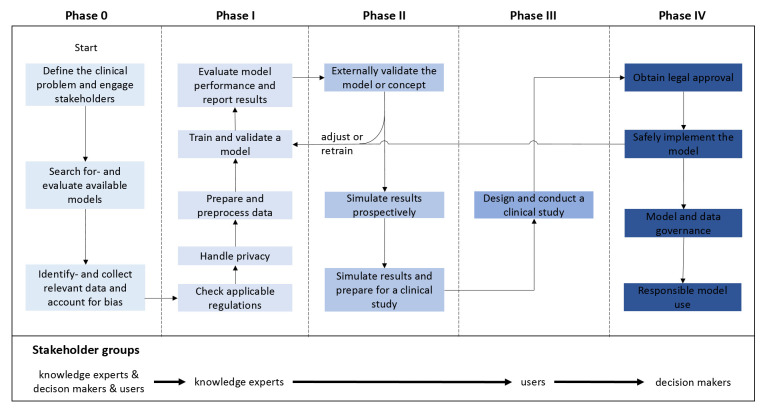
Objective: Although the role of artificial intelligence (AI) in medicine is increasingly studied, most patients do not benefit because the majority of AI models remain in the testing and prototyping environment. The development and implementation trajectory of clinical AI models are complex and a structured overview is missing. We therefore propose a step-by-step overview to enhance clinicians’ understanding and to promote quality of medical AI research. Methods: We summarised key elements (such as current guidelines, challenges, regulatory documents and good practices) that are needed to develop and safely implement AI in medicine. Conclusion: This overview complements other frameworks in a way that it is accessible to stakeholders without prior AI knowledge and as such provides a step-by-step approach incorporating all the key elements and current guidelines that are essential for implementation, and can thereby help to move AI from bytes to bedside.
Overview
The claims and statistics of this paper haven’t been checked yet.
Free: it reads the open-access text and checks the first 5 claims that cite a source we can check. Create a free account to check every claim.
Integrity signals
Registry
Cites
Statistics
Figures
![Figure 1 Global evolution of research in artificial intelligence in medicine. The number of AI papers in humans on PubMed.com was arranged by year, 2011–2020. The blue bars represent the number of studies. The following search was performed: (“artificial intelligence”[MeSH Terms] OR (“artificial”[All Fields) and “intelligence”[All Fields]) OR “artificial intelligence”[All Fields]) OR (“machine learning”[MeSH Terms] OR (“machine”[All Fields] AND “learning”[All Fields]) OR “machine learning”[All Fields]) OR (“deep learning”[MeSH Terms] OR (“deep”[All Fields] AND “learning”[All Fields]) OR “deep learning”[All Fields]).](https://figures.cochat.ai/paper-figures/c94412a7ef2e4a69951fb3b111377b00/developing-implementing-and-governing-artificial-intelligence-in-medicine-a-step-figure-1.jpg)
Verification
Claims the paper makes
The claims and statistics of this paper haven’t been checked yet.
Free: it reads the open-access text and checks the first 5 claims that cite a source we can check. Create a free account to check every claim.
Claims other papers make about this one
Each is checked against this paper’s own text: does it say what the citing paper says it does?
The source backs part of the claim, not all of it — or backs it for a different population, condition or comparison.
In the citing paper
“Regular maintenance is also necessary to update the model as new data becomes available and to retrain it if its performance drops [56, 62].”
From Generative AI in healthcare: an implementation science informed translational path on application, integration and governance (2024) · cites this paper as [62]
Experimental — accuracy not yet measuredThe source backs part of the claim, not all of it — or backs it for a different population, condition or comparison.
In the citing paper
“Generative AI models need to be validated to ensure that they are accurate and reliable [62].”
From Generative AI in healthcare: an implementation science informed translational path on application, integration and governance (2024) · cites this paper as [62]
Experimental — accuracy not yet measuredThe source backs part of the claim, not all of it — or backs it for a different population, condition or comparison.
In the citing paper
“Development of AI prediction algorithms consists of several stages, each of which may contribute to bias [18,19].”
From Bias in artificial intelligence algorithms and recommendations for mitigation (2023) · cites this paper as [18]
Experimental — accuracy not yet measuredThe cited source says what the claim attributes to it.
In the citing paper
“It is necessary to clean and preprocess the collected data to ensure its quality and consistency [61, 62].”
From Generative AI in healthcare: an implementation science informed translational path on application, integration and governance (2024) · cites this paper as [62]
The cited source says what the claim attributes to it.
In the citing paper
“Therefore, after implementation, assessment of the algorithms needs to continue throughout the entire lifespan [18].”
From Bias in artificial intelligence algorithms and recommendations for mitigation (2023) · cites this paper as [18]
Self-check
Percentages, sums and reported differences re-computed from the paper’s own numbers.
The self-check needs the paper’s full text.
Citations
Cites
User Acceptance of Computer Technology: A Comparison of Two Theoretical Models
Davis, F. D., Bagozzi, R. P., & Warshaw, P. R. (1989) · Management Science · doi:10.1287/mnsc.35.8.982 · Cited by 25,709
The FAIR Guiding Principles for scientific data management and stewardship
Wilkinson, M. D., Dumontier, M., Aalbersberg, I. J., Appleton, G., Axton, M., Baak, A., Blomberg, N., Boiten, J.-W., da Silva Santos, L. B., Bourne, P. E., et al. (2016) · Scientific Data · doi:10.1038/sdata.2016.18 · Cited by 18,423
High-performance medicine: the convergence of human and artificial intelligence
Topol, E. J. (2019) · Nature Medicine · doi:10.1038/s41591-018-0300-7 · Cited by 10,450
The use of the area under the ROC curve in the evaluation of machine learning algorithms
Bradley, A. P. (1997) · Pattern Recognition · doi:10.1016/s0031-3203(96)00142-2 · Cited by 7,217
Rajkomar, A., Dean, J., & Kohane, I. (2019) · New England Journal of Medicine · doi:10.1056/nejmra1814259 · Cited by 4,579
Collins, G. S., Reitsma, J. B., Altman, D. G., & Moons, K. G. M. (2015) · BMJ · doi:10.1136/bmj.g7594 · Cited by 4,388
Collins, G. S., Reitsma, J. B., Altman, D. G., & Moons, K. G. M. (2015) · British Journal of Cancer · doi:10.1038/bjc.2014.639 · Cited by 3,293
Key challenges for delivering clinical impact with artificial intelligence
Kelly, C. J., Karthikesalingam, A., Suleyman, M., Corrado, G., & King, D. (2019) · BMC Medicine · doi:10.1186/s12916-019-1426-2 · Cited by 3,136
PROBAST: A Tool to Assess the Risk of Bias and Applicability of Prediction Model Studies
Wolff, R. F., Moons, K. G. M., Riley, R. D., Whiting, P. F., Westwood, M., Collins, G. S., Reitsma, J. B., Kleijnen, J., Mallett, S., & for the PROBAST Group† (2019) · Annals of Internal Medicine · doi:10.7326/m18-1376 · Cited by 2,984
Calculating the sample size required for developing a clinical prediction model
Riley, R. D., Ensor, J., Snell, K. I. E., Harrell, F. E., Martin, G. P., Reitsma, J. B., Moons, K. G. M., Collins, G., & van Smeden, M. (2020) · BMJ · doi:10.1136/bmj.m441 · Cited by 2,917
Research works printed but not linked: 1
- MBAM BN, Chauhan G, Naumann T, et al. Rethinking clinical prediction: why machine learning must consider year of care and feature aggregation. machine learning for health (ML4H). NeurIPS 2018.
Cited by
Items 101–169 of 169
Saleem, M., Bidoki, M. Z., Alsuraihi, W., Al-Garadi, M. A., & Ahmed, A. (2026) · Healthcare · doi:10.3390/healthcare14182922 · Cited by 2
Deshamudre, R., Ziabari, S. S. M., & van Houten, M. (2023) · Lecture notes in computer science · doi:10.1007/978-3-031-48316-5_2 · Cited by 2
Preventive Care Recommendations via Benefit–Burden Trade-Offs: A Patient-Centered Utility Framework
Alves, R., & Costa, B. (2025) · Journal of Health Informatics and Digital Systems · doi:10.68159/k455554631 · Cited by 2
Knowledge-Grounded Medical Dialogue Generation
Kambhamettu, H., Huang, Y., Johnson, K. B., & Bradbury, A. R. (2024) · Studies in computational intelligence · doi:10.1007/978-3-031-63592-2_16 · Cited by 2
(2022) · doi:10.21203/rs.3.rs-2326665/v1 · Cited by 1
ÖZKAYA, M., YILMAZ, M., & Asil, E. (2023) · Turkiye Klinikleri Journal of Health Sciences · doi:10.5336/healthsci.2023-98623 · Cited by 1
Tekin, A., Herasevich, S., Minteer, S. A., Gajic, O., & Barwise, A. K. (2024) · Applied Clinical Informatics · doi:10.1055/a-2451-9046 · Cited by 1
Case Studies and Clinical Applications of AI in Imaging
Beohar, R., Purandare, D., Bhoite, S., Polshettiwar, D., & Polshettiwar, S. A. (2025) · Advances in computational intelligence and robotics book series · doi:10.4018/979-8-3373-5801-7.ch009 · Cited by 1
van de Sande, D., Grünhagen, D. J., Hilling, D. E., van der Ster, B. J. P., Smit, J. M., van Bommel, J., Verhoef, C. K., Gommers, D., & van Genderen, M. E. (2025) · NEJM AI · doi:10.1056/aics2401132 · Cited by 1
Self-citationPublic Perception of AI: Awareness and Trust in Artificial Intelligence (AI)
Zinyemba, L., Ndoro, C. J., & Zinyemba, M. A. (2024) · Jocap - Journal of Contemporary African Philosophy · doi:10.65846/uysv2685 · Cited by 1
Swinkels, E., van den Berg, G. H., Magnée, M., Pelgrum-Keurhorst, M. N., Waal, G. H., & van Gaal, B. G. I. (2026) · BMC Palliative Care · doi:10.1186/s12904-026-02064-6 · Cited by 1
Jensen, L., & Hansen, M. (2026) · Journal of integrative nursing and palliative care · doi:10.51847/b3qcajeheg · Cited by 1
van de Sande, D., Bloemen, I., Sleijfer, S., Ikram, M. A., Hooft, L., Gommers, D., & van Genderen, M. E. (2026) · npj Digital Medicine · doi:10.1038/s41746-026-03154-8 · Cited by 1
Self-citationAllaart, C. G., van Houwelingen, S., Hilkens, P. H. E., van Halteren, A., Biesma, D. H., Dijksman, L. M., & van der Nat, P. B. (2024) · JMIR Human Factors · doi:10.2196/56521 · Cited by 1
The Potential Applications and Implications of Large Language Models in the Medical Field
Sim, M. S., & Hong, S. W. (2025) · Gyemyeong uidae haksulji · doi:10.46308/kmj.2025.00178 · Cited by 1
“Concerns about privacy, data security, and regulatory compliance remain central to the clinical deployment of LLMs [19].”
A Compass for North Carolina Health Care Workers Navigating the Adoption of Artificial Intelligence
Mosley, Y., Tardif-Douglin, M., & Edmondson, L. (2024) · North Carolina Medical Journal · doi:10.18043/001c.120571 · Cited by 1
“After several periods of fluctuating interest, known as “AI winters,” AI integration in health care has recently accelerated due to technological leaps [8, 9].”
Zhu, M., Luo, B., Wu, X., Zhao, Y., Wang, S., Hu, Y., Liu, R., Zhang, C., Li, J., Wang, H., et al. (2026) · Applied Clinical Informatics · doi:10.1055/a-2921-5990
Flexibilidad financiera y crediticia en la década de los ochenta
Wilkins, M. G. (1981) · Harvard-Deusto business review
Arduino and the Construction of a Height and Heart Rate Meter
Vera, A. A., González, J., & González, C. M. (2023) · Lecture notes in computer science · doi:10.1007/978-3-031-37117-2_4
(2023) · Elsevier eBooks · doi:10.1016/b978-0-323-90534-3.16001-9
Artificial Intelligence in Medicine for Advance Treatment: A Survey
Shnawa, A. H., Hadi, M. R., Jebur, M. A., Adnan, M. M., Hameed, W., & Mohammed, G. (2023) · International Conference on Engineering Technology and its Applications (IICETA) · doi:10.1109/iiceta57613.2023.10351440
“Because to this special ability, Big Blue finally defeated world chess master Gary Kasparov on May 11, 1997 [7-9].”
Background(2024) · Compunet ( The Egyptian Information Journal ) · doi:10.21608/jstc.2024.355421
Diagnosing and staging of periampullary adenocarcinoma
Litjens, G. (2024) · Radboud University Press eBooks · doi:10.54195/9789493296879
Chrimes, D., & Wang, X. (2025) · doi:10.2196/preprints.85106
Wesdorp, N. J., Zeeuw, J. M., Postma, S. C. J., Roor, J., van Waesberghe, J. H. T. M., van den Bergh, J. E., Nota, I. M., Moos, S. I., Kemna, R., Vadakkumpadan, F., et al. (2024) · Figshare · doi:10.6084/m9.figshare.26648310
Self-citationLiljendahl, M. S., Loft, N., Egeberg, A., Skov, L., & Nguyen, T.-L. (2023) · Figshare · doi:10.6084/m9.figshare.22604171
Marques, M. J. M. (2024) · Portuguese National Funding Agency for Science, Research and Technology (RCAAP Project by FCT)
Badkas, A. (2023) · Open Repository and Bibliography (University of Luxembourg)
Sitaula, J., Karki, S., Ghimire, S., & Khatri, D. (2025) · doi:10.2196/preprints.83341
Nassou, Y., & Moukadem, K. (2025) · European Journal of Medical and Health Research · doi:10.59324/ejmhr.2025.3(3).33
AI Governance and Implementation in Radiography Practice
Malamateniou, C., Kumar, A., Lip, G., Pierce, R. L., & Kyratsis, Y. (2026) · Springer eBooks · doi:10.1007/978-3-032-05080-9_4
Ferro, S. (2025) · IEEE International Conference on Intelligent Data Acquisition and Advanced Computing Systems: Technology and Applications (IDAACS) · doi:10.1109/idaacs68557.2025.11322365
Regressionsanalyse zur Berechnung des ROSC-Zeitpunkts – eine Machbarkeitsstudie
Luckscheiter, A., Zink, W., Thiel, M., & Schneider‐Lindner, V. (2026) · Die Anaesthesiologie · doi:10.1007/s00101-026-01648-4
Kokol, P., Žlahtič, B., Vošner, H. B., Završnik, J., & Završnik, T. (2026) · Applied Sciences · doi:10.3390/app16031524
Althammer, A., Hummel, A., Steghöfer, J.-P., Reichel, F., Kolonko, J., Hatfield, S., Fischer, M., Schlögl-Flierl, K., Ziethmann, P., Weiss, M., et al. (2026) · medRxiv · doi:10.64898/2026.02.04.26345355
Managing Organizational and Societal Challenges of AI: Insights from Education and Cyber Security
Walancik, M., Klonowska, I., & Bukowski, M. (2026) · Routledge eBooks · doi:10.1201/9781003644194
Applications of Artificial Intelligence in Healthcare: From Diagnosis to Treatment Optimization
Hasanuddin, M., & Khodijah, S. (2025) · Journal of Data Science and Informatics Engineering · doi:10.64803/jodsie.v1i1.13
Siddiqui, M. F., Mouna, A., Калматович, К. Р., Kozhobekov, K. G., Isaeva, G., Karimovna, K. G., Ghezlane, A., Zhanbaeva, A. K., Bukarbaevna, I. J., Tashpolotova, M. A., et al. (2026) · Elsevier eBooks · doi:10.1016/b978-0-443-44415-9.00005-3
Machine learning-based prediction of out-of-hospital births in prehospital emergency care
Wach, J., Lewandowski, Ł., Staniczek, J., Juárez‐Vela, R., & Czapla, M. (2026) · Advances in Clinical and Experimental Medicine · doi:10.17219/acem/218972
Mohd, S., Kaur, R., & Singh, T. (2025) · Emerald Group Publishing Limited eBooks · doi:10.1108/978-1-83662-314-420251026
Swartz, Z. (2026) · AORN Journal · doi:10.1002/aorn.70085
Hashim, A., Giamperoli, A., Indre, M. G., & Piscaglia, F. (2026) · Ultraschall in der Medizin - European Journal of Ultrasound · doi:10.1055/a-2809-9211
Muñoz, Á. A., Yamamoto, Y., & Sandström, K. (2026) · Proceedings of the Design Society · doi:10.1017/pds.2026.10373
“Healthcare research has produced holistic AI development frameworks (Assadi et al., 2022; Sande et al., 2022), examples of scaffolding ideation (Yildirim et al., 2023), human-AI onboarding materials (Cai et al., 2019, 2021), approaches to identifying and designing vision system applications…”
Intent-Aligned Evaluation of Clinical Predictive Models: A Phase-Based Methodological FrameworkPreprint
Rahrooh, A., Feng, J., Garlid, A. O., Manuel, V., Inkelas, M., & Bui, A. A. T. (2026) · SSRN Electronic Journal · doi:10.2139/ssrn.7072896
Chen, F., Wang, L., Liu, H., Khan, Q., Tang, B., & Bao, N. (2026) · Journal of Nanobiotechnology · doi:10.1186/s12951-026-04551-7
“Furthermore, translating research and its outcomes into clinical practice remains challenging, particularly balancing model accuracy with real-world clinical practice [338, 339].”
The Smart Manufacturing: Revolution Technology, Workforce, and Sustainability
Maladzhi, R. W., & Bello, K. A. (2025) · IEEE Connecting the Unconnected Europe, Middle East, and Africa Regional Summit (CTUS-EMEA) · doi:10.1109/ctus-emea68989.2025.11592206
“Manufacturers should take a step-by-step approach to implement these technologies [13].”
Artificial intelligence, nursing, and social justice
Tanrıverdi, G. (2026) · Nursing Ethics · doi:10.1177/09697330261470503
Humanizing the pediatric intensive care unit through new technologies and artificial intelligence
Unzueta‐Roch, J. L., Castillo-Sanz, A., Larraz, A. M., García‐Salido, A., & Garde, A. M. D. A. (2026) · Frontiers in Health Services · doi:10.3389/frhs.2026.1868374
“A new step-by-step approach has been proposed to improve the quality, safety, and transparency of AI research (25).”
Parzniewski, M., Ostruszka, N., Marusińska, M., Karpiński, M., Czyz, W., Kolawa, S., Markiewicz, W., Borowiec, A., Pilecka, J., & Wojciechowski, J. (2026) · International Journal of Innovative Technologies in Social Science · doi:10.31435/ijitss.3(51).2026.5768
“Adherence in practice is still patchy; a 2022 audit found that only about 28% of sepsis ML papers fully met the TRIPOD checklist (van de Sande et al., 2022).”
Artificiell intelligens inom psykiatrisk diagnostik och vård
Panula, J. M. (2024) · Helda - University of Helsinki Institutional Repository
Yoo, B., Kim, C. W., & Oh, J.-H. (2026) · Healthcare Informatics Research · doi:10.4258/hir.2026.32.3.224
“…methodological challenges in evaluating AI-enabled CDSSs. Khairat et al. [14] emphasized that physician acceptance and usability are important determinants of CDSS adoption. van de Sande et al. [15] proposed a step-by-step approach to the development, implementation, and governance of medical AI.”
Byberg, E. (2026) · IntechOpen eBooks · doi:10.5772/intechopen.1017322
Yan, S., Gao, T.-T., & Zhao, X. (2026) · Frontiers in Immunology · doi:10.3389/fimmu.2026.1846143
AI Governance in Healthcare: Transparency, Bias Mitigation, and Lifecycle Monitoring Models
Benali, A., Cherif, Y., Boudiaf, K., & Touati, S. (2025) · Journal of Artificial Intelligence for Healthcare Systems · doi:10.68159/u336824617
A Foundation Model Adaptation Framework for Domain-Specific Clinical Analytics Integration
Okafor, C., & Bello, A. (2026) · Journal of Artificial Intelligence for Healthcare Systems · doi:10.68159/g399381482
Technology in Diverse Populations: Issues of Inclusion, Accessibility, and Bias
Thames, A. D., & Cavanagh, L. (2026) · Oxford University Press eBooks · doi:10.1093/9780197814116.003.0011
A Radiology Workflow Intelligence Mesh for AI-Embedded Diagnostic Operations
Amrani, F. Z., & Benali, Y. (2023) · Journal of Artificial Intelligence for Healthcare Systems · doi:10.68159/q798488740
Semedo, G., Valpaços, E., Teles, L. M. R., Gago, B., & Rocha, N. P. (2026) · Healthcare · doi:10.3390/healthcare14172865
“Retrospective information is also associated with more low-data-quality risks and usually requires more processing, increasing the risk of bias [43,50].”
InfluentialAgrawal, R. K., Husain, A., Tambe, W. M. A., Yadav, P. K., & Chatterjee, A. (2026) · Informatics · doi:10.3390/informatics13110186
ANTUNES, P. I., de Melo, A. B. O., do Nascimento, M. E. B., Pimentel, A. L. D., Pereira, J. A., Guedes, B. A., Lima, D. C. F. B., Leite, M. F., SILVA, I. L., Araújo, R. C., et al. (2026) · Brazilian Journal of Implantology and Health Sciences · doi:10.36557/2674-8169.2026v8n9p1645-1686
Multi-agent AI for liver disease guideline development and maintenance: a proof-of-concept study
Wang, X., Wen, X., Xue, T., Yin, K., Wang, Y., Ma, C., 马慧, Huang, R., Shen, R., Feng, B., et al. (2026) · Communications Medicine · doi:10.1038/s43856-026-01961-4
Negoiță, D.-C., Gîndac, C., Akula, A., Marin, K. C., & Ilie, A. C. (2026) · Current Oncology · doi:10.3390/curroncol33100626
“Stepwise implementation approaches emphasise ongoing evaluation [35], and transparent assessment of effectiveness remains necessary throughout deployment [36].”
Luckscheiter, A., Hoppe, U., Grützner, P.-A., & Gather, A. (2026) · Die Anaesthesiologie · doi:10.1007/s00101-026-01757-0
Ostrovsky, D. A., Talmor, D. S., & Novack, V. (2026) · Intensive Care Medicine · doi:10.1007/s00134-026-08660-7
Artificial Intelligence in Infectious Disease Care: From Prediction to Clinical Impact
Hassan, A. A., Isak, M. A., Mohamed, M. D., Sudi, L. A., Ibrahim, I. O., & Abdullahi, Y. B. (2026) · Intelligence-Based Medicine · doi:10.1016/j.ibmed.2026.100529
Metadata
- Authors
- van de Sande, D., Van Genderen, M. E., Smit, J. M., Huiskens, J., Visser, J. J., Veen, R. E. R., van Unen, E., BA, O. H., Gommers, D., & Bommel, J. V.
- Affiliations
- Department of Adult Intensive Care, Erasmus Medical Center, Rotterdam, The Netherlands
- Erasmus MC (NL)
- SAS Institute Inc, Health, Huizen, The Netherlands
- Active Medical Devices/Medical Device Software, CE Plus GmbH, Badenweiler, Germany
- ORCID
- Venue
- BMJ Health & Care Informatics
- Publisher
- BMJ
- Published
- 2022-02
- Volume
- 29
- Issue
- 1
- Pages
- e100495
- ISSN
- 2632-1009 (ISSN-L)
- PMC
- PMC8860016
- OpenAlex
- W4213117535
- Semantic Scholar
- f079d2c49646735ffe09e4117b075f4e900f4420
- Cited by
- 135
- References
- 76
- Citations by year
- 2026: 21 · 2025: 31 · 2024: 42 · 2023: 32 · 2022: 8
- FWCI
- 1.94
- Type
- journal article
- Language
- en
- Open access
- gold
- doi.org
- Licence
- Locations
- BMJ Health & Care Informatics (publishedVersion, cc-by-nc)
- PubMed Central (publishedVersion, cc-by-nc)
- PubMed (publishedVersion)
- EUR Research Repository (Erasmus University Rotterdam) (publishedVersion, cc-by-nc)
- EUR Research Repository (Erasmus University Rotterdam) (submittedVersion, cc-by-nc)
- DOAJ (DOAJ: Directory of Open Access Journals) (submittedVersion, cc-by-sa)
- Topics
- Health Sciences › Medicine › Health Informatics › Artificial Intelligence in Healthcare and Education
- Physical Sciences › Computer Science › Artificial Intelligence › Ethics and Social Impacts of AI
- Physical Sciences › Computer Science › Artificial Intelligence › Artificial Intelligence Applications
- Keywords
- artificial intelligence in healthcare, AI governance, AI winter, best practices
- MeSH terms
- Artificial Intelligence, Humans, Biomedical Research
About these checks
Registry, retraction, Cites and statistics results are computed, not judged, with one exception: a printed reference that no index lists is read once by a model before it counts as a citation error. Claims are extracted by a model and kept only when their quote appears verbatim in the text; each cited source is then checked, with a model’s help, for whether it says what the claim relies on. Those verdicts can be wrong — read the claim’s quote and the cited source before relying on one.
Statistics and arithmetic are recomputed, not judged.
Confidence bands are shown only for fields calibrated on our annotated test set. None is calibrated yet, so no band is shown.
What counts as a claim ›How we measure confidence ›How we check this ›
Are you an author, or do you see a problem with this page? Request a review
Data sources
Bibliographic data: Semantic Scholar, OpenAlex, Crossref.
Contains information from the Semantic Scholar Academic Graph Datasets, made available under the ODC Attribution License (ODC-BY 1.0).
Semantic Scholar’s data is described in: Kinney, R., et al. (2023). The Semantic Scholar Open Data Platform. arXiv:2301.10140.
