

Anticipating artificial intelligence in mammography screening: views of Swedish breast radiologists
Open accessThe DOI matches its Crossref record; 31 of the 31 references it cites were found in a registry or an index.
Abstract
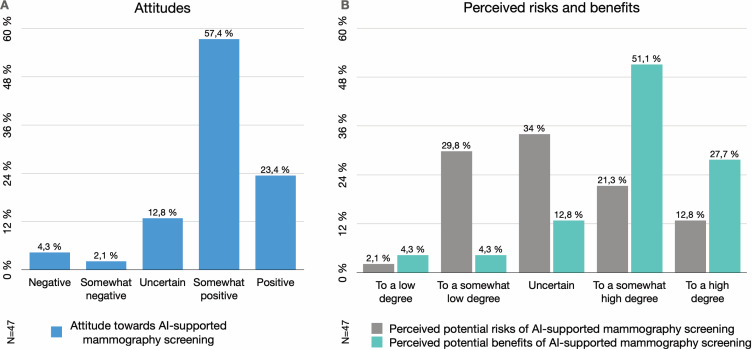
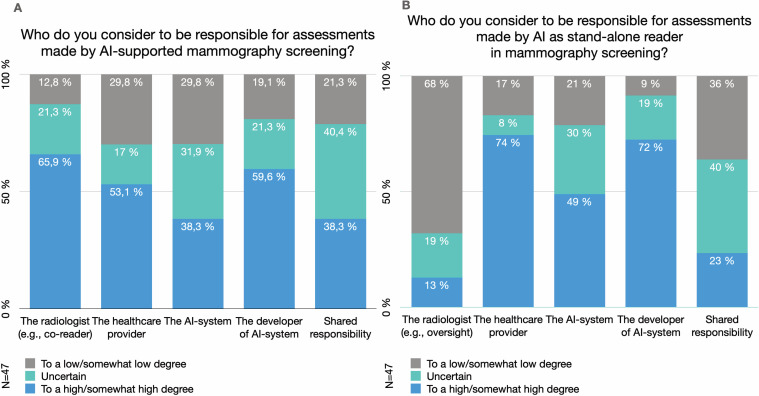
Objectives: Artificial intelligence (AI) is increasingly tested and integrated into breast cancer screening. Still, there are unresolved issues regarding its possible ethical, social and legal impacts. Furthermore, the perspectives of different actors are lacking. This study investigates the views of breast radiologists on AI-supported mammography screening, with a focus on attitudes, perceived benefits and risks, accountability of AI use, and potential impact on the profession. Methods: We conducted an online survey of Swedish breast radiologists. As early adopter of breast cancer screening, and digital technologies, Sweden is a particularly interesting case to study. The survey had different themes, including: attitudes and responsibilities pertaining to AI, and AI’s impact on the profession. Responses were analysed using descriptive statistics and correlation analyses. Free texts and comments were analysed using an inductive approach. Results: Overall, respondents (47/105, response rate 44.8%) were highly experienced in breast imaging and had a mixed knowledge of AI. A majority (n=38, 80.8%) were positive/somewhat positive towards integrating AI in mammography screening. Still, many considered there to be potential risks to a high/somewhat high degree (n=16, 34.1%) or were uncertain (n=16, 34.0%). Several important uncertainties were identified, such as defining liable actor(s) when AI is integrated into medical decision-making. Conclusions: Swedish breast radiologists are largely positive towards integrating AI in mammography screening, but there are significant uncertainties that need to be addressed, especially regarding risks and responsibilities. The results stress the importance of understanding actor-specific and context-specific challenges to responsible implementation of AI in healthcare.
Overview
The claims and statistics of this paper haven’t been checked yet.
Free: it reads the open-access text and checks the first 5 claims that cite a source we can check. Create a free account to check every claim.
Integrity signals
Registry
Cites
Statistics
Figures
Verification
Claims the paper makes
The claims and statistics of this paper haven’t been checked yet.
Free: it reads the open-access text and checks the first 5 claims that cite a source we can check. Create a free account to check every claim.
Claims other papers make about this one
Each is checked against this paper’s own text: does it say what the citing paper says it does?
The source backs part of the claim, not all of it — or backs it for a different population, condition or comparison.
In the citing paper
“In terms of medical decision-making in clinical settings, most studies reported on benefits relating to a better diagnostic quality in either improved sensitivity and specificity or reducing the likelihood of missed diagnoses [31, 33, 38, 44, 46, 52, 55, 60–75].”
From Healthcare professionals’ perspectives on artificial intelligence in patient care: a systematic review of hindering and facilitating factors on different levels (2025) · cites this paper as [61]
Experimental — accuracy not yet measuredThe source backs part of the claim, not all of it — or backs it for a different population, condition or comparison.
In the citing paper
“Furthermore, AI contributes to better clinical outcomes and ensures consistency of care by mitigating human factors like exhaustion [46, 61, 66].”
From Healthcare professionals’ perspectives on artificial intelligence in patient care: a systematic review of hindering and facilitating factors on different levels (2025) · cites this paper as [61]
Experimental — accuracy not yet measured
Self-check
Percentages, sums and reported differences re-computed from the paper’s own numbers.
The self-check needs the paper’s full text.
Citations
Cites
International evaluation of an AI system for breast cancer screening
McKinney, S. M., Sieniek, M., Godbole, V., Godwin, J., Antropova, N., Ashrafian, H., Back, T., Chesus, M., Corrado, G. S., Darzi, A., et al. (2020) · Nature · doi:10.1038/s41586-019-1799-6 · Cited by 3,287
Rajpurkar, P., Chen, E., Banerjee, O., & Topol, E. J. (2022) · Nature Medicine · doi:10.1038/s41591-021-01614-0 · Cited by 3,212
Barley, S. R. (1986) · Administrative Science Quarterly · doi:10.2307/2392767 · Cited by 2,315
Barley, S. R. (2007) · Strategy as Practice · doi:10.1017/cbo9780511618925.007 · Cited by 2,116
Perry, N., Broeders, M., de Wolf, C., Törnberg, S., Holland, R., & von Karsa, L. (2008) · Annals of Oncology · doi:10.1093/annonc/mdm481 · Cited by 1,020
Rodriguez-Ruiz, A., Lång, K., Gubern-Merida, A., Broeders, M., Gennaro, G., Clauser, P., Helbich, T. H., Chevalier, M., Tan, T., Mertelmeier, T., et al. (2019) · JNCI: Journal of the National Cancer Institute · doi:10.1093/jnci/djy222 · Cited by 692
Self-citationLebovitz, S., Lifshitz-Assaf, H., & Levina, N. (2022) · Organization Science · doi:10.1287/orsc.2021.1549 · Cited by 632
Pesapane, F., Volonté, C., Codari, M., & Sardanelli, F. (2018) · Insights into Imaging · doi:10.1007/s13244-018-0645-y · Cited by 479 · cited 1×
“28 We could not identify one unified vision of a preferred way to use AI in mammography screening.”
MethodGeis, J. R., Brady, A. P., Wu, C. C., Spencer, J., Ranschaert, E., Jaremko, J. L., Langer, S. G., Borondy Kitts, A., Birch, J., Shields, W. F., et al. (2019) · Radiology · doi:10.1148/radiol.2019191586 · Cited by 388 · cited 1×
“12 22 Prior studies show high willingness to use AI in clinical practice, but this could differ depending on subfield.”
BackgroundFreeman, K., Geppert, J., Stinton, C., Todkill, D., Johnson, S., Clarke, A., & Taylor-Phillips, S. (2021) · BMJ · doi:10.1136/bmj.n1872 · Cited by 338
Gong, B., Nugent, J. P., Guest, W., Parker, W., Chang, P. J., Khosa, F., & Nicolaou, S. (2019) · Academic Radiology · doi:10.1016/j.acra.2018.10.007 · Cited by 325
Carter, S. M., Rogers, W., Win, K. T., Frazer, H., Richards, B., & Houssami, N. (2020) · The Breast · doi:10.1016/j.breast.2019.10.001 · Cited by 312
Dembrower, K., Wåhlin, E., Liu, Y., Salim, M., Smith, K., Lindholm, P., Eklund, M., & Strand, F. (2020) · The Lancet Digital Health · doi:10.1016/s2589-7500(20)30185-0 · Cited by 290
Lost in thought—the limits of the human mind and the future of medicine
Obermeyer, Z., & Lee, T. H. (2017) · New England Journal of Medicine · doi:10.1056/nejmp1705348 · Cited by 252
Huisman, M., Ranschaert, E., Parker, W., Mastrodicasa, D., Koci, M., Pinto de Santos, D., Coppola, F., Morozov, S., Zins, M., Bohyn, C., et al. (2021) · European Radiology · doi:10.1007/s00330-021-07781-5 · Cited by 243
European Society of Radiology (ESR) (2019) · Insights into Imaging · doi:10.1186/s13244-019-0798-3 · Cited by 196
Exploring stakeholder attitudes towards AI in clinical practice
Scott, I. A., Carter, S. M., & Coiera, E. (2021) · BMJ Health & Care Informatics · doi:10.1136/bmjhci-2021-100450 · Cited by 193
Impact of the rise of artificial intelligence in radiology: What do radiologists think?
Waymel, Q., Badr, S., Demondion, X., Cotten, A., & Jacques, T. (2019) · Diagnostic and Interventional Imaging · doi:10.1016/j.diii.2019.03.015 · Cited by 191 · cited 6×
“AI, artificial intelligence.”
BackgroundInfluentialCoppola, F., Faggioni, L., Regge, D., Giovagnoni, A., Golfieri, R., Bibbolino, C., Miele, V., Neri, E., & Grassi, R. (2021) · La radiologia medica · doi:10.1007/s11547-020-01205-y · Cited by 171
Lauritzen, A. D., Rodríguez-Ruiz, A., von Euler-Chelpin, M. C., Lynge, E., Vejborg, I., Nielsen, M., Karssemeijer, N., & Lillholm, M. (2022) · Radiology · doi:10.1148/radiol.210948 · Cited by 166
Huisman, M., Ranschaert, E., Parker, W., Mastrodicasa, D., Koci, M., Pinto de Santos, D., Coppola, F., Morozov, S., Zins, M., Bohyn, C., et al. (2021) · European Radiology · doi:10.1007/s00330-021-07782-4 · Cited by 139
Collado-Mesa, F., Alvarez, E., & Arheart, K. (2018) · Journal of the American College of Radiology · doi:10.1016/j.jacr.2017.12.021 · Cited by 137
Can artificial intelligence reduce the interval cancer rate in mammography screening?
Lång, K., Hofvind, S., Rodríguez-Ruiz, A., & Andersson, I. (2021) · European Radiology · doi:10.1007/s00330-021-07686-3 · Cited by 109
Self-citationArtificial intelligence for breast cancer screening: Opportunity or hype?
Houssami, N., Lee, C. I., Buist, D. S. M., & Tao, D. (2017) · The Breast · doi:10.1016/j.breast.2017.09.003 · Cited by 106
Double reading in breast cancer screening: considerations for policy-making
Taylor‐Phillips, S., & Stinton, C. (2019) · British Journal of Radiology · doi:10.1259/bjr.20190610 · Cited by 83
Radiological surveillance of interval breast cancers in screening programmes
Houssami, N., Irwig, L., & Ciatto, S. (2006) · The Lancet Oncology · doi:10.1016/s1470-2045(06)70617-9 · Cited by 81
AI-based prevention of interval cancers in a national mammography screening program
Byng, D., Strauch, B., Gnas, L., Leibig, C., Stephan, O., Bunk, S., & Hecht, G. (2022) · European Journal of Radiology · doi:10.1016/j.ejrad.2022.110321 · Cited by 53
Anxiety and Its Association With Screening Mammography
Loving, V. A., Aminololama‐Shakeri, S., & Leung, J. W. T. (2021) · Journal of Breast Imaging · doi:10.1093/jbi/wbab024 · Cited by 50
The Ethics of AI in Biomedical Research, Patient Care and Public Health
Blasimme, A., & Vayena, E. (2019) · SSRN Electronic Journal · doi:10.2139/ssrn.3368756 · Cited by 48
The Ethics of AI in Biomedical Research, Patient Care, and Public Health
Blasimme, A., & Vayena, E. (2020) · The Oxford Handbook of Ethics of AI · doi:10.1093/oxfordhb/9780190067397.013.45 · Cited by 44
Mammography Screening and Research Evidence: The Swedish Contribution
Duffy, S. W. (2021) · Journal of Breast Imaging · doi:10.1093/jbi/wbab067 · Cited by 5
Cited by
Eisemann, N., Bunk, S., Mukama, T., Baltus, H., Elsner, S. A., Gomille, T., Hecht, G., Heywang-Köbrunner, S., Rathmann, R., Siegmann-Luz, K., et al. (2025) · Nature Medicine · doi:10.1038/s41591-024-03408-6 · Cited by 217
“…whereby AI predictions influence the use of AI-enabled software; radi-ologists’ personal preferences and attitudes affect their decision to adopt AI 36 ; radiologists have varied levels of expertise and competence in interpreting mammography examinations 37 ; the involvement of a supervising…”
Henzler, D., Schmidt, S., Koçar, A., Herdegen, S., Lindinger, G. L., Maris, M. T., Bak, M. A. R., Willems, D. L., Tan, H. L., Lauerer, M., et al. (2025) · BMC Health Services Research · doi:10.1186/s12913-025-12664-2 · Cited by 54
“…o m e s [ 33 , 54 , 55 , 61 , 79 , 84 ] • C o n s i s t e n c y o f c a r e ( n o e x h a u s t i o n , n o h u n g e r , n o e m o t i o n ) [ 46 , 61 , 66 ] • T i m e l i n e ss o f c a r e [ 44 ] • S c i e n t i fi c o b j e c t i v i t y [ 69 ] • H e a l t h i m p r o v e m e n t , n o s i d e…”
InfluentialPhysicians’ required competencies in AI-assisted clinical settings: a systematic review
Schuitmaker, L., Drogt, J., Benders, M., & Jongsma, K. (2025) · British Medical Bulletin · doi:10.1093/bmb/ldae025 · Cited by 54
“These include a proper regulatory framework that addresses accountability, responsibility, and trust [ 26,38,40,41,49,50,52,54,63,64,67–70].”
InfluentialPesapane, F., Hauglid, M. K., Fumagalli, M., Petersson, L., Parkar, A. P., Cassano, E., & Horgan, D. (2024) · European Journal of Radiology · doi:10.1016/j.ejrad.2024.111852 · Cited by 48
Pedersen, M. R. V., Kusk, M. W., Lysdahlgaard, S., Mork-Knudsen, H., Malamateniou, C., & Jensen, J. (2024) · Radiography · doi:10.1016/j.radi.2024.04.020 · Cited by 28
Metadata
- Authors
- Högberg, C., Larsson, S., & Lång, K.
- Affiliations
- Lund University (SE)
- Corresponding author
- Högberg, Charlotte
- Venue
- BMJ Health & Care Informatics
- Publisher
- BMJ
- Published
- 2023-05
- Volume
- 30
- Issue
- 1
- Pages
- e100712
- ISSN
- 2632-1009 (ISSN-L)
- PMC
- PMC10230899
- OpenAlex
- W4377564314
- Cited by
- 28
- References
- 30
- Citations by year
- 2026: 10 · 2025: 10 · 2024: 6 · 2023: 2
- FWCI
- 1.11
- Type
- journal article
- Language
- en
- Open access
- gold
- doi.org
- Locations
- BMJ Health & Care Informatics (publishedVersion, cc-by)
- PubMed Central (publishedVersion, cc-by)
- PubMed (publishedVersion)
- Lund University Publications (Lund University) (submittedVersion, other-oa)
- DOAJ (DOAJ: Directory of Open Access Journals) (submittedVersion, cc-by-sa)
- Funders
- Cancerfonden (21 1631 Pj)
- Vetenskapsrådet (ref. 2019-00198)
- Confederation of Regional Cancer Centers in Sweden (SKR dnr 21/00060)
- Swedish Governmental Funding for Clinical Research (2020-Projekt0079)
- Topics
- Health Sciences › Medicine › Health Informatics › Artificial Intelligence in Healthcare and Education
- Physical Sciences › Computer Science › Artificial Intelligence › AI in cancer detection
- Health Sciences › Medicine › Radiology, Nuclear Medicine and Imaging › Digital Radiography and Breast Imaging
- Keywords
- artificial intelligence, mammography screening, breast cancer screening, professional attitudes, AI accountability, AI liability, clinical decision-making, benefits and risks of AI, responsible AI deployment
- MeSH terms
- Radiologists, Artificial Intelligence, Breast Neoplasms, Female, Humans, Mammography, Sweden
About these checks
Registry, retraction, Cites and statistics results are computed, not judged, with one exception: a printed reference that no index lists is read once by a model before it counts as a citation error. Claims are extracted by a model and kept only when their quote appears verbatim in the text; each cited source is then checked, with a model’s help, for whether it says what the claim relies on. Those verdicts can be wrong — read the claim’s quote and the cited source before relying on one.
Statistics and arithmetic are recomputed, not judged.
Confidence bands are shown only for fields calibrated on our annotated test set. None is calibrated yet, so no band is shown.
What counts as a claim ›How we measure confidence ›How we check this ›
Are you an author, or do you see a problem with this page? Request a review
Data sources
Bibliographic data: Semantic Scholar, OpenAlex, Crossref.
Contains information from the Semantic Scholar Academic Graph Datasets, made available under the ODC Attribution License (ODC-BY 1.0).
Semantic Scholar’s data is described in: Kinney, R., et al. (2023). The Semantic Scholar Open Data Platform. arXiv:2301.10140.
