

Behavioural activation versus mindfulness-based guided self-help treatment administered through a smartphone application: a randomised controlled trial
Open accessThe DOI matches its Crossref record; 62 of the 62 references it cites were found in a registry or an index.
Abstract
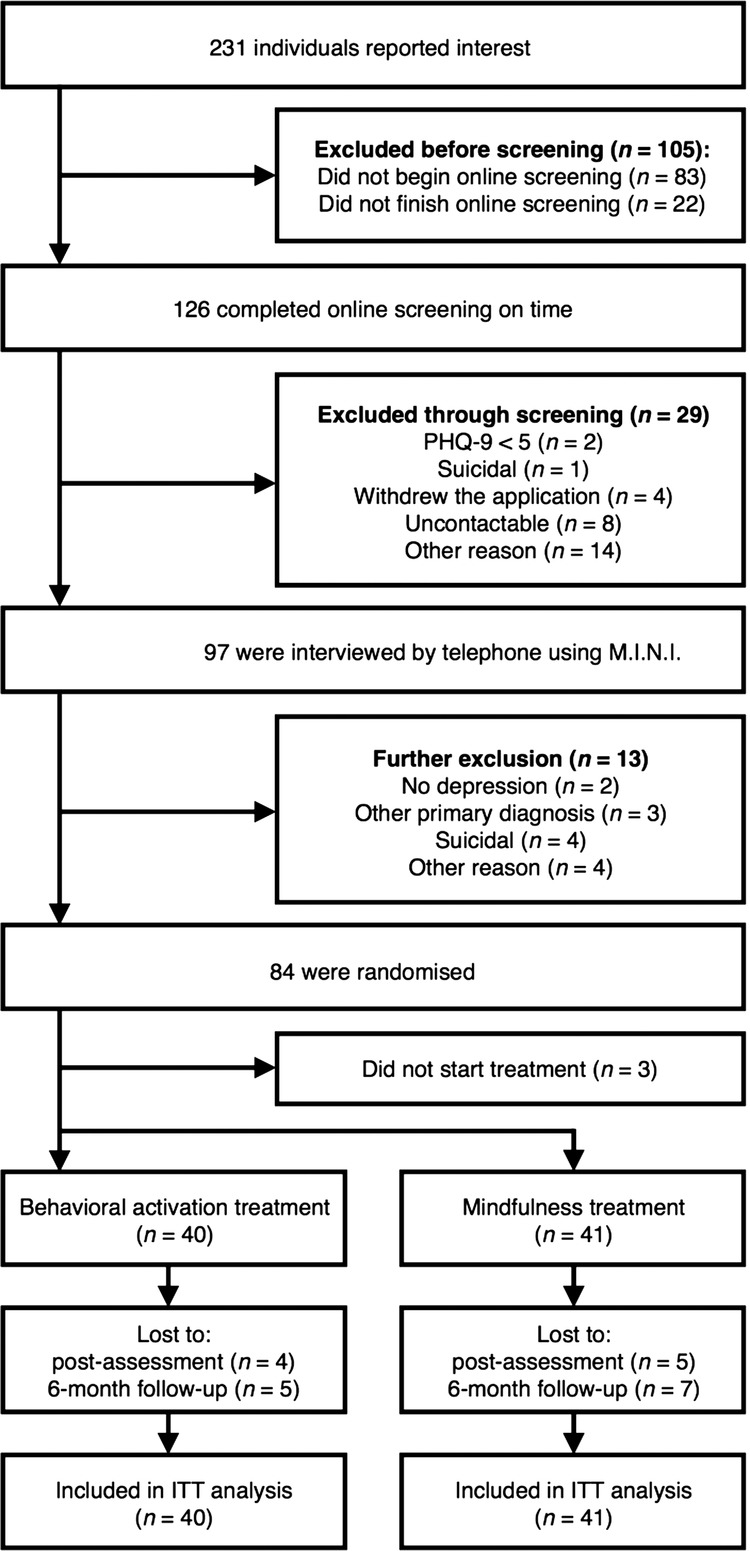
Objectives: Evaluating and comparing the effectiveness of two smartphone-delivered treatments: one based on behavioural activation (BA) and other on mindfulness. Design: Parallel randomised controlled, open, trial. Participants were allocated using an online randomisation tool, handled by an independent person who was separate from the staff conducting the study. Setting: General community, with recruitment nationally through mass media and advertisements. Participants: 40 participants diagnosed with major depressive disorder received a BA treatment, and 41 participants received a mindfulness treatment. 9 participants were lost at the post-treatment. Intervention: BA: An 8-week long behaviour programme administered via a smartphone application. Mindfulness: An 8-week long mindfulness programme, administered via a smartphone application. Main outcome measures: The Beck Depression Inventory-II (BDI-II) and the nine-item Patient Health Questionnaire Depression Scale (PHQ-9). Results: 81 participants were randomised (mean age 36.0 years (SD=10.8)) and analysed. Results showed no significant interaction effects of group and time on any of the outcome measures either from pretreatment to post-treatment or from pretreatment to the 6-month follow-up. Subgroup analyses showed that the BA treatment was more effective than the mindfulness treatment among participants with higher initial severity of depression from pretreatment to the 6-month follow-up (PHQ-9: F (1, 362.1)=5.2, p<0.05). In contrast, the mindfulness treatment worked better than the BA treatment among participants with lower initial severity from pretreatment to the 6-month follow-up (PHQ-9: F (1, 69.3)=7.7, p<0.01); BDI-II: (F(1, 53.60)=6.25, p<0.05). Conclusions: The two interventions did not differ significantly from one another. For participants with higher severity of depression, the treatment based on BA was superior to the treatment based on mindfulness. For participants with lower initial severity, the treatment based on mindfulness worked significantly better than the treatment based on BA. Trial registration: Clinical Trials NCT01463020 .
Overview
The claims and statistics of this paper haven’t been checked yet.
Free: it reads the open-access text and checks the first 5 claims that cite a source we can check. Create a free account to check every claim.
Integrity signals
Registry
Cites
Statistics
Figures
Verification
Claims the paper makes
The claims and statistics of this paper haven’t been checked yet.
Free: it reads the open-access text and checks the first 5 claims that cite a source we can check. Create a free account to check every claim.
Claims other papers make about this one
Each is checked against this paper’s own text: does it say what the citing paper says it does?
The source backs part of the claim, not all of it — or backs it for a different population, condition or comparison.
In the citing paper
“In addition, in-person MBIs seem effective at treating preinjury predictors of PSAC, such as mood disorders [14-17], somatization-related illness [14,18,19], headache disorders [20], and chronic pain [21].”
From Smartphone App–Delivered Mindfulness-Based Intervention for Mild Traumatic Brain Injury in Adolescents: Protocol for a Feasibility Randomized Controlled Trial (2024) · cites this paper as [17]
Experimental — accuracy not yet measuredThe cited source says what the claim attributes to it.
In the citing paper
“More recent research indicates that depression can be treated successfully with CBT and BA based self-help interventions delivered over the Internet [8,9,10].”
From A Systematic Review of Cognitive Behavioral Therapy and Behavioral Activation Apps for Depression (2016) · cites this paper as [9]
In the citing paper
“Ly et al [52] found no between-group effects between mobile-based behavioral activation and mindfulness apps for depression.”
From MoodHacker Mobile Web App With Email for Adults to Self-Manage Mild-to-Moderate Depression: Randomized Controlled Trial (2016) · cites this paper as [52]
Self-check
Percentages, sums and reported differences re-computed from the paper’s own numbers.
The self-check needs the paper’s full text.
Citations
Cites
The PHQ-9: Validity of a brief depression severity measure
Kroenke, K., Spitzer, R. L., & Williams, J. B. W. (2001) · Journal of General Internal Medicine · doi:10.1046/j.1525-1497.2001.016009606.x · Cited by 44,910
(1998) · The Journal of Clinical Psychiatry · Cited by 19,139
An inventory for measuring clinical anxiety: Psychometric properties.
Beck, A. T., Epstein, N., Brown, G., & Steer, R. A. (1988) · Journal of Consulting and Clinical Psychology · doi:10.1037/0022-006x.56.6.893 · Cited by 14,407
The benefits of being present: Mindfulness and its role in psychological well-being
Brown, K. W., & Ryan, R. M. (2003) · Journal of Personality and Social Psychology · doi:10.1037/0022-3514.84.4.822 · Cited by 13,448
(1998) · PubMed · Cited by 10,216
Borenstein, M., Hedges, L. V., Higgins, J. P. T., & Rothstein, H. R. (2021) · doi:10.1002/9781119558378 · Cited by 9,799
Cognitive Therapy for Depression: (675542012-001)
(2012) · PsycEXTRA Dataset · doi:10.1037/e675542012-001 · Cited by 9,663
Beck, A. T., Steer, R. A., & Brown, G. (2011) · PsycTESTS Dataset · doi:10.1037/t00742-000 · Cited by 7,535
(1993) · Cited by 7,136
(1999) · Cited by 5,934
Research works printed but not linked: 2
- Hofmann SG Sawyer AT Witt AA The effect of mindfulness-based therapy on anxiety and depression: a meta-analytic review. J Consult Clin Psychol 2010; 78: 169 20350028 PMC2848393 · DOI · Paper page
- Beck AT Cognitive therapy of depression. The Guilford Press, 1979
Cited by
Items 201–272 of 272
Neumayr, C., Voderholzer, U., & Schlegl, S. (2020) · Verhaltenstherapie · doi:10.1159/000510954 · Cited by 6
“Die Follow-up-Zeiträume variierten zwischen 12 Wochen [Watts et al., 2013] und 8 Monaten [Ly et al., 2014].”
BackgroundInfluentialApolinário-Hagen, J., & Salewski, C. (2018) · Springer eBooks · doi:10.1007/978-981-10-6577-4_22 · Cited by 5
Psychotherapy Using Electronic Media
Mucić, D., & Hilty, D. M. (2019) · Springer eBooks · doi:10.1007/978-3-030-24082-0_15 · Cited by 7
Mental health mobile app use to manage psychological difficulties: an umbrella review
Badesha, K., Wilde, S., & Dawson, D. L. (2022) · Mental Health Review Journal · doi:10.1108/mhrj-02-2021-0014 · Cited by 11
Sard-Peck, T. E., Martín-Asuero, A., Oller, M. T., Calvo, A., & Santesteban‐Echarri, O. (2019) · Psiquiatría Biológica · doi:10.1016/j.psiq.2019.03.001 · Cited by 11
Alqahtani, F., & Orji, R. (2025) · Human Behavior and Emerging Technologies · doi:10.1155/hbe2/8111089 · Cited by 14
Schuster, R., Berger, T., & Laireiter, A. (2018) · doi:10.7892/boris.113561 · Cited by 4
Reducing Burnout through a Mindful Meditation Mobile App: A Randomized Controlled Trial
Lanz, J. J., Fritson, K. K., Hoffert, K., & Carrillo, K. (2019) · Journal of Psychology and Behavioral Science · doi:10.15640/jpbs.v7n2a7 · Cited by 5
“There are positive effects of mindfulness interventions on factors such as stress, affect, irritability, anxiety, and depression (Economides, Martman, Bell, & Sanderson, 2018; Ly et al., 2014; Spijkerman et al., 2016).”
BackgroundSit, H. F., Li, G., Chen, W. L., Sou, E. K. L., Wong, M., Burchert, S., Hong, I. W., Sit, H. Y., Lam, A. I. F., & Hall, B. J. (2022) · Internet Interventions · doi:10.1016/j.invent.2022.100579 · Cited by 6
Adjunctive use of mindfulness-based mobile application in depression: randomized controlled study
Sarlon, J., Schneider, E., Brühl, A. B., Ulrich, S., Liwinski, T., Doll, J. P. K., Muehlauser, M., & Lang, U. E. (2024) · European Archives of Psychiatry and Clinical Neuroscience · doi:10.1007/s00406-024-01884-y · Cited by 4
“Ly et al. [26] demonstrated comparable effects of a self-developed mindfulness-based app and behavioural activation via an app major depression on a clinical population of MDD. Nonetheless, research on MBI through mobile applications for depression is limited, thereby constraining the…”
Efficacy of Smartphone Apps in Patients With Depressive Disorders: A Systematic Review
Hernández-Gómez, A., Valdés-Florido, M. J., Lahera, G., & Andrade-González, N. (2022) · Frontiers in Psychiatry · doi:10.3389/fpsyt.2022.871966 · Cited by 5
Vázquez, F. L., Blanco, V., Hita, I., Torres, Á., Otero, P., Páramo, M., & Salmerón, M. (2023) · Journal of Clinical Medicine · doi:10.3390/jcm12185872 · Cited by 5
“Based on studies evaluating apps to treat depression [35], we assumed an alpha of 0.05, a power of 80%, and a sample loss of 15%; therefore, the estimated sample size needed was 174 caregivers (approximately 58 per group).”
BackgroundInfluentialHlynsson, J. I., Kristjánsson, T., Andersson, G., & Carlbring, P. (2025) · Frontiers in Psychology · doi:10.3389/fpsyg.2025.1568141 · Cited by 5
Self-citationInvestigating mental wellbeing self-care in higher education using BERTopic modeling
Ali, M., van Berkel, N., Tag, B., Paananen, V., Oppenlaender, J., Yatani, K., & Hosio, S. J. (2025) · Discover Mental Health · doi:10.1007/s44192-025-00323-1 · Cited by 7
“While computational tools expedite the identification of trends and topics, and people by providing ubiquitous access through, e.g. mobile tools [64], human experts offer essential validation, natural support, critical context, and interpretation of findings.”
Sarlon, J., Doll, J. P. K., Schmassmann, A., Brand, S., Ferreira, N., Mühlhauser, M., Urech-Meyer, S., Schweinfurth, N., Lang, U. E., & Brühl, A. B. (2022) · JMIR Research Protocols · doi:10.2196/33423 · Cited by 3
“However, and surprisingly, from the reviewed studies, only one study targeted 40 individuals with MDD [44]; the results indicate comparable effects of a mindfulness-based app and behavioral activation via a major depression app.”
BackgroundMethodBenefits of Using Activity Recommender Technology for Self-management of Depressive Symptoms
Rohani, D. A., Faurholt‐Jepsen, M., Kessing, L. V., & Bardram, J. E. (2021) · ACM Transactions on Computing for Healthcare · doi:10.1145/3462212 · Cited by 3
Occupational Therapy Interventions for College Students With Learning Differences
Nagata, R., Forry, S., & Lannigan, E. G. (2022) · American Journal of Occupational Therapy · doi:10.5014/ajot.2022.050057 · Cited by 7
“Intervention 3: Health and Wellness Intervention (Relaxation) Isaac guided Taylor to schedule times during her week to take mindfulness breaks and to set daily alerts to remind her (Chan et al., 2012; Ly et al., 2014).”
Digital Mental Health Interventions: Impact and Considerations
Shelton, C. R., Kotsiou, A., & Hetzel‐Riggin, M. D. (2021) · Advances in human and social aspects of technology book series · doi:10.4018/978-1-7998-6453-0.ch008 · Cited by 4
Internet-Delivered Cognitive Behavior Therapy (ICBT) for Obsessive-Compulsive Disorder
Wootton, B. M., Andersson, E., & Rück, C. (2016) · Springer eBooks · doi:10.1007/978-3-319-06083-5_6 · Cited by 3
Vilca, L. W., Echabaudes-Ilizarbe, R. I., Aquino-Hidalgo, J. M., Ventura‐León, J., Martinez‐Munive, R., & White, M. (2020) · Psychological Reports · doi:10.1177/0033294120981930 · Cited by 4
“…Departamento de Psicolog�ıa, Universidad Peruana Uni�on, Carretera Central Km. 19, Ña~na, Lima, Per�u. Email: lwquiro@gmail.com 650 Psychological Reports 125(1) efficacy in group interventions (Mahen et al., 2019; Simmonds-Buckley et al., 2019) and through mobile applications (Ly et al., 2014).”
BackgroundSenthilnathan, V., Zahir, S., Simpson, R., Jaglal, S. B., Craven, B. C., Fetterly, M.-J., Perrier, L., & Munce, S. (2025) · BMJ Open · doi:10.1136/bmjopen-2024-086287 · Cited by 3
Positive Technology for Helping People Cope with Stress
Villani, D., Cipresso, P., Gaggioli, A., & Riva, G. (2020) · IGI Global eBooks · doi:10.4018/978-1-7998-3432-8.ch038 · Cited by 3
Borrelli, B., Endrighi, R., DUNSIGER, S. I., Busch, A. M., Bock, B. C., Risica, P. M., Hughes, R. B., & Lasater, T. M. (2023) · Disability and health journal · doi:10.1016/j.dhjo.2023.101480 · Cited by 2
Al-Wahedi, M., Ismail, S., Alkhofani, W., & Azman, A. (2024) · Psychology · doi:10.4236/psych.2024.159087 · Cited by 4
The Use of Technology to Augment Clinical Care in Depression and Anxiety Disorders: An Evidence Map
Maher, A. R., Apaydin, E. A., Raaen, L. B., Motala, A., Shanman, R., & Hempel, S. (2019) · RAND Corporation eBooks · doi:10.7249/rr2177 · Cited by 2
“…al., 2016; Littlewood et al., 2015; Lokman et al., 2017; Lorian, Titov, and Grisham, 2012; Ludman et al., 2007; Luxton et al., 2016; Ly et al., 2015; Ly et al., 2014; Lynch et al., 2004; Mackinnon, Griffiths, and Christensen, 2008; Mahoney, Tarlow, and Jones, 2003; Mall et al., 2011; MaplesKeller…”
Bibliometric Analysis of Interventional Literature on Mobile Health: The Most Highly Cited Articles
Ameri, A., Salmanizadeh, F., & Bahaadinbeigy, K. (2021) · Frontiers in Health Informatics · doi:10.30699/fhi.v10i1.262 · Cited by 4
“, 2014 [97] Mental health disorders Self-monitoring”
BackgroundInfluentialFiore, J. (2015) · KU ScholarWorks (The University of Kansas) · Cited by 3
Ecological momentary interventions for depression: A systematic review and meta-analysis
Yuen, S. Y., Lo, H. K. Y., Jin, J. X. H., Ho, F. Y., Poon, C.-Y., Yeung, W.-F., Yu, B. Y. M., Lee, C. T., Myin‐Germeys, I., & Chung, K. F. (2026) · Journal of Affective Disorders · doi:10.1016/j.jad.2026.121547 · Cited by 1
Sicard, V., Cairncross, M., Zemek, R. L., Silverberg, N. D., Goldfield, G. S., Reed, N. P., Saab, B. J., Smith, A., & Ledoux, A. (2026) · JMIR Rehabilitation and Assistive Technologies · doi:10.2196/84623 · Cited by 2
“MBIs may target several known preinjury risk factors for PSAC, including mood disorders [28-30], somatization [28,31,32], headache disorders [33], and chronic pain [34].”
Albertini, V., & Manfrida, G. (2015) · PSICOBIETTIVO · doi:10.3280/psob2014-003002 · Cited by 1
Tecnologie positive per il benessere: proposte di intervento
Gaggioli, A., Riva, G., & Villani, D. (2015) · RICERCHE DI PSICOLOGIA · doi:10.3280/rip2015-001016 · Cited by 1
Engaging Elderly Breast Cancer Patients Through an e-health Intervention: A Case Series Study
Villani, D., Cognetta, C., Toniolo, D., Scanzi, F., & Riva, G. (2018) · Lecture notes of the Institute for Computer Sciences, Social Informatics and Telecommunications Engineering · doi:10.1007/978-3-030-01093-5_14 · Cited by 1
Greenhalgh, M., Duvall, J. A., Candiotti, J. L., Chung, C. S., Jorgensen-Wagers, K., Smolinksi, G., Peterson, S., Schneider, U., Cooper, R., & Cooper, R. A. (2022) · Handbook of Neuroengineering · doi:10.1007/978-981-15-2848-4_47-1 · Cited by 1
Preliminary Criteria For Ict in Assisting Students With Psychological Problems
Jakovljevic, M., Karačić, M. J., & Pjano, O. (2024) · Journal Human Research in Rehabilitation · doi:10.21554/hrr.042403 · Cited by 1
Huang, D., Lai, S.-C., Lo, L., Hong, T.-H., & Chiou, W. (2020) · Lecture notes in computer science · doi:10.1007/978-3-030-60114-0_45 · Cited by 1
E-mindful health: Evaluation of mobile apps for mindfulness
Mani, M. (2017) · Queensland University of Technology · doi:10.5204/thesis.eprints.102651 · Cited by 6
Noone, C. (2016) · Arrow@dit (Dublin Institute of Technology) · doi:10.13025/17145 · Cited by 1
Internet-based Treatment of Depression in Primary Care: Effectiveness and Feasibility
Kivi, M. (2015) · Gothenburg University Publications Electronic Archive (Gothenburg University)
Cyberage and Child Mental Health
Boon, J. S. T., & Fung, D. S. S. (2016) · Springer eBooks · doi:10.1007/978-81-322-3619-1_10 · Cited by 1
Digital Heath Interventions in Mental Health
Stanimirovic, A. (2018) · Advances in psychology, mental health, and behavioral studies (APMHBS) book series · doi:10.4018/978-1-5225-7513-9.ch009
Fala sério: um aplicativo desenvolvido com jovens sobre suas necessidades de saúde
Lachtim, S. A. F. (2018) · Digital Library of Theses and Dissertations (Universidade de São Paulo) · doi:10.11606/t.7.2018.tde-05112018-152500
A Pilot Project to Reduce PTSD Symptoms in U.S. Veterans Using an Innovative Therapy
Cheng, S. (2017) · KU ScholarWorks (University of Kansas)
Meditation for Major Depressive Disorder: A Systematic Review
Sorbero, M. E. S., Ahluwalia, S. C., Reynolds, K. A., Lovejoy, S. L., Farris, C. A., Sloan, J., Miles, J. N. V., Vaughan, C., Kandrack, R., Apaydin, E. A., et al. (2015) · RAND Corporation eBooks · doi:10.7249/rr1138 · Cited by 1
Analysis and Development of a Platform for Generating Context-Aware Apps for Mental Health
Miralles, I. (2019) · Tesis Doctorals en Xarxa (Consorci de Serveis Universitaris de Catalunya) · doi:10.6035/14101.2019.142529
Autotraining using sustainable digital technologies: myth or reality
Александровна, Ф.-С. М., & Kuramshina, D. (2021) · E3S Web of Conferences · doi:10.1051/e3sconf/202125807039
“[14] described an experiment in which a mobile application that diagnosed the level of depression, anxiety, and stress in young people was used.”
BackgroundRakowska, J. M. (2021) · Wydawnictwa Uniwersytetu Warszawskiego eBooks · doi:10.31338/uw.9788323547655 · Cited by 2
An Emerging Model of Pregnancy Care: The Introduction of New Technologies in Maternal Wellbeing
Carissoli, C., Villani, D., & Riva, G. (2019) · IGI Global eBooks · doi:10.4018/978-1-7998-2351-3.ch002
Lipschitz, J. M., Boxtel, R. V., Torous, J. B., Firth, J., Lebovitz, J. G., Burdick, K. E., & Hogan, T. P. (2022) · doi:10.2196/preprints.39204
Russell, L., Ugalde, A., Milne, D., Austin, D., & Livingston, P. M. (2017) · doi:10.2196/preprints.9645 · Cited by 1
100 Highly Cited Interventional Studies on Mobile Health: a Bibliometric Analysis (Preprint)Preprint
Ameri, A., Salmanizadeh, F., Keshvardoost, S., & Bahaadinbeigy, K. (2019) · doi:10.2196/preprints.17600
Digital Heath Interventions in Mental Health
Stanimirovic, A. (2021) · IGI Global eBooks · doi:10.4018/978-1-7998-8544-3.ch019
Schuster, R. (2017) · OSF Preprints (OSF Preprints) · doi:10.31219/osf.io/avfub
Efficacy of Virtual Care for Depressive Disorders: A Systematic Review and Meta-Analysis (Preprint)Preprint
Schiller, C. E., Prim, J., Bauer, A. E., Lux, L. J., Lundegard, L. C., Kang, M., Hellberg, S. N., Thompson, K. A., Webber, T. K., Teklezghi, A. T., et al. (2022) · doi:10.2196/preprints.38955
Lappalainen, R. I., Keinonen, K., & Lappalainen, P. (2022) · Oxford University Press eBooks · doi:10.1093/oxfordhb/9780197550076.013.28
Smartphone-Based Treatment in Psychiatry: A Systematic Review
Faurholt‐Jepsen, M., Tønning, M. L., & Kessing, L. V. (2023) · Springer eBooks · doi:10.1007/978-3-031-10698-9_5
Greenhalgh, M., Duvall, J. A., Candiotti, J. L., Chung, C. S., Jorgensen-Wagers, K., Smolinksi, G., Peterson, S., Schneider, U., Cooper, R., & Cooper, R. A. (2023) · Handbook of Neuroengineering · doi:10.1007/978-981-16-5540-1_47
Protocolo virtual autodirigido de Activación Conductual para la Depresión “ACTÍVATE”
Capador, D. N., Jiménez, V. A. H., Mantilla, M. M., & Cajamarca, D. S. (2022) · Psychologia · doi:10.21500/19002386.5713
The Effectiveness of an Imagery-Based Behavioral Activation Intervention for Depressive Symptoms
Yun, S., & Shim, E. (2024) · Korean Journal of Stress Research · doi:10.17547/kjsr.2024.32.4.204
“두 집단 (BAT-I, BAT) × 4회 측 정(사전, 중간, 사후, 추후) 반 복측 정 분 산 분석, 검정 력 .80, 유의수준 .05, 중간 효과 크 기 .25 [24]를 기준으로 최 소 24명의 참가자가 필 요한 것 으 로 산출되었 다. 본 연구와 유사한 BAT 연구[32]의 탈락률 25%를 고려하여 총 30명의 참가자를 모집하였으며, 정신 과 약물치료나 심리치료 등의 개입을 받고 있는 경우 제 외 하였다.”
Digital Therapies of Psychiatric Disorders: Focus on Depression Symptoms
Biagianti, B., Nahum, M., Yitzhak, N., & Vinogradov, S. (2025) · Oxford University Press eBooks · doi:10.1093/med/9780197640654.003.0073
Integrating Mindfulness into a Routine Schedule: The Role of Mindfulness Apps
van Emmerik, A., & Schoenmakers, T. M. (2025) · Nutrition and health · doi:10.1007/978-3-031-87441-3_20
Sicard, V., Cairncross, M., Zemek, R. L., Silverberg, N. D., Goldfield, G. S., Reed, N. P., Saab, B. J., Smith, A., & Ledoux, A. (2025) · doi:10.2196/preprints.84623
Liem, A., Garabiles, M. R., Pakingan, K. A., Chen, W., Lam, A. I. F., Burchert, S., & Hall, B. J. (2021) · Figshare · doi:10.6084/m9.figshare.14433437
Liem, A., Garabiles, M. R., Pakingan, K. A., Chen, W., Lam, A. I. F., Burchert, S., & Hall, B. J. (2021) · Figshare · doi:10.6084/m9.figshare.14433434
Carpati, A., Plutchik, J., Schupak, M., & Sala, M. (2026) · doi:10.2196/preprints.90730
Mu, J., & Sun, P. (2026) · Well-Being Sciences Review · doi:10.54844/wsr.2026.1139
“Multiple studies have reported that mMHIs can effectively reduce stress. by Ly et al. (2014) found that behavioral activation was more effective for patients with higher initial depression severity, while mindfulness was more effective for patients with lower initial severity.”
Carpati, A., Plutchik, J., Schupak, M., & Sala, M. (2026) · Journal of Medical Internet Research · doi:10.2196/90730
Huang, M., Lin, H., & Zhou, H. (2026) · International Journal of Human-Computer Interaction · doi:10.1080/10447318.2026.2686796
Edan, S., & Lipsicas, C. B. (2026) · Journal of Technology in Behavioral Science · doi:10.1007/s41347-026-00665-9
Cerazy, D., & Kraszewski, S. (2026) · doi:10.2196/preprints.115272
Metadata
- Authors
- Ly, K. H., Trüschel, A., Jarl, L., Magnusson, S., Windahl, T., Johansson, R., Carlbring, P., & Andersson, G.
- Affiliations
- Linköping University (SE)
- Stockholm University (SE)
- Corresponding author
- Ly, Kien Hoa
- Venue
- BMJ Open
- Publisher
- BMJ
- Published
- 2014-01
- Volume
- 4
- Issue
- 1
- Pages
- e003440
- ISSN
- 2044-6055 (ISSN-L)
- PMC
- PMC3902198
- OpenAlex
- W2111116768
- Cited by
- 269
- References
- 62
- Citations by year
- 2026: 8 · 2025: 13 · 2024: 11 · 2023: 18 · 2022: 20 · 2021: 24 · 2020: 30 · 2019: 23 · 2018: 39 · 2017: 33 · 2016: 26 · 2015: 17 · 2014: 7
- FWCI
- 42.88
- Type
- journal article
- Language
- en
- Open access
- gold
- doi.org
- Licence
- cc-by-nc
- Locations
- BMJ Open (publishedVersion, cc-by-nc)
- Europe PMC (PubMed Central) (publishedVersion, cc-by-nc)
- PubMed Central (publishedVersion, cc-by-nc)
- PubMed (publishedVersion)
- DiVA (Linkoping University) (submittedVersion, other-oa)
- HighWire Press Open Archive (submittedVersion)
- Funders
- Vetenskapsrådet (2011-02476)
- Topics
- Social Sciences › Psychology › Applied Psychology › Digital Mental Health Interventions
- Social Sciences › Psychology › Clinical Psychology › Mindfulness and Compassion Interventions
- Social Sciences › Psychology › Experimental and Cognitive Psychology › Anxiety, Depression, Psychometrics, Treatment, Cognitive Processes
- Keywords
- behavioral activation, mindfulness-based interventions, guided self-help, smartphone-based intervention, major depressive disorder, depression severity, treatment effectiveness, digital mental health interventions
- MeSH terms
- Smartphone, Adult, Behavior Therapy, Major Depressive Disorder, Female, Humans, Male, Middle Aged, Psychiatric Status Rating Scales, Self Care, Young Adult, Mobile Applications, Mindfulness
About these checks
Registry, retraction, Cites and statistics results are computed, not judged, with one exception: a printed reference that no index lists is read once by a model before it counts as a citation error. Claims are extracted by a model and kept only when their quote appears verbatim in the text; each cited source is then checked, with a model’s help, for whether it says what the claim relies on. Those verdicts can be wrong — read the claim’s quote and the cited source before relying on one.
Statistics and arithmetic are recomputed, not judged.
Confidence bands are shown only for fields calibrated on our annotated test set. None is calibrated yet, so no band is shown.
What counts as a claim ›How we measure confidence ›How we check this ›
Are you an author, or do you see a problem with this page? Request a review
Data sources
Bibliographic data: Semantic Scholar, OpenAlex, Crossref.
Contains information from the Semantic Scholar Academic Graph Datasets, made available under the ODC Attribution License (ODC-BY 1.0).
Semantic Scholar’s data is described in: Kinney, R., et al. (2023). The Semantic Scholar Open Data Platform. arXiv:2301.10140.
