

Behavioural activation versus mindfulness-based guided self-help treatment administered through a smartphone application: a randomised controlled trial
Open accessThe DOI matches its Crossref record; 62 of the 62 references it cites were found in a registry or an index.
Abstract
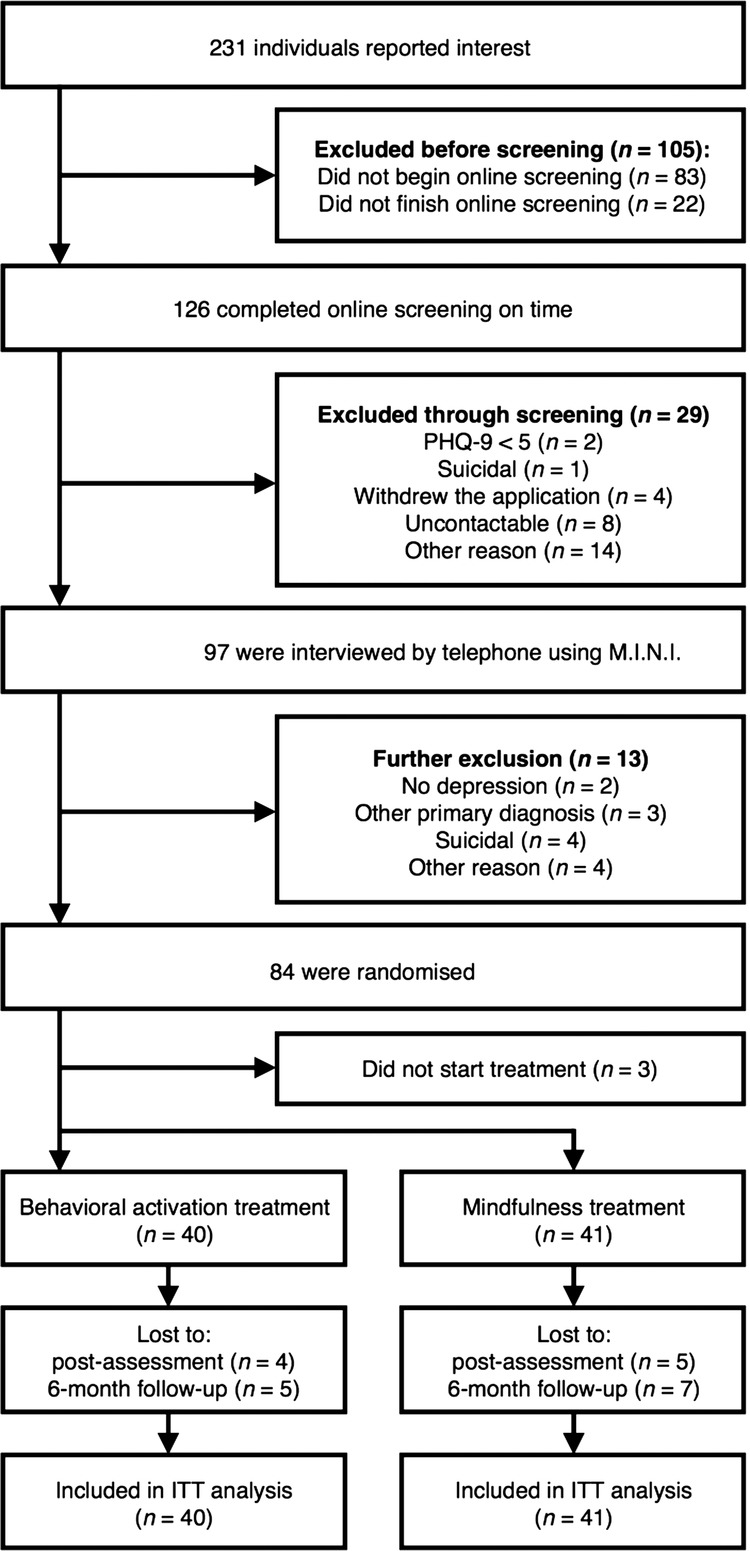
Objectives: Evaluating and comparing the effectiveness of two smartphone-delivered treatments: one based on behavioural activation (BA) and other on mindfulness. Design: Parallel randomised controlled, open, trial. Participants were allocated using an online randomisation tool, handled by an independent person who was separate from the staff conducting the study. Setting: General community, with recruitment nationally through mass media and advertisements. Participants: 40 participants diagnosed with major depressive disorder received a BA treatment, and 41 participants received a mindfulness treatment. 9 participants were lost at the post-treatment. Intervention: BA: An 8-week long behaviour programme administered via a smartphone application. Mindfulness: An 8-week long mindfulness programme, administered via a smartphone application. Main outcome measures: The Beck Depression Inventory-II (BDI-II) and the nine-item Patient Health Questionnaire Depression Scale (PHQ-9). Results: 81 participants were randomised (mean age 36.0 years (SD=10.8)) and analysed. Results showed no significant interaction effects of group and time on any of the outcome measures either from pretreatment to post-treatment or from pretreatment to the 6-month follow-up. Subgroup analyses showed that the BA treatment was more effective than the mindfulness treatment among participants with higher initial severity of depression from pretreatment to the 6-month follow-up (PHQ-9: F (1, 362.1)=5.2, p<0.05). In contrast, the mindfulness treatment worked better than the BA treatment among participants with lower initial severity from pretreatment to the 6-month follow-up (PHQ-9: F (1, 69.3)=7.7, p<0.01); BDI-II: (F(1, 53.60)=6.25, p<0.05). Conclusions: The two interventions did not differ significantly from one another. For participants with higher severity of depression, the treatment based on BA was superior to the treatment based on mindfulness. For participants with lower initial severity, the treatment based on mindfulness worked significantly better than the treatment based on BA. Trial registration: Clinical Trials NCT01463020 .
Overview
The claims and statistics of this paper haven’t been checked yet.
Free: it reads the open-access text and checks the first 5 claims that cite a source we can check. Create a free account to check every claim.
Integrity signals
Registry
Cites
Statistics
Figures
Verification
Claims the paper makes
The claims and statistics of this paper haven’t been checked yet.
Free: it reads the open-access text and checks the first 5 claims that cite a source we can check. Create a free account to check every claim.
Claims other papers make about this one
Each is checked against this paper’s own text: does it say what the citing paper says it does?
The source backs part of the claim, not all of it — or backs it for a different population, condition or comparison.
In the citing paper
“In addition, in-person MBIs seem effective at treating preinjury predictors of PSAC, such as mood disorders [14-17], somatization-related illness [14,18,19], headache disorders [20], and chronic pain [21].”
From Smartphone App–Delivered Mindfulness-Based Intervention for Mild Traumatic Brain Injury in Adolescents: Protocol for a Feasibility Randomized Controlled Trial (2024) · cites this paper as [17]
Experimental — accuracy not yet measuredThe cited source says what the claim attributes to it.
In the citing paper
“More recent research indicates that depression can be treated successfully with CBT and BA based self-help interventions delivered over the Internet [8,9,10].”
From A Systematic Review of Cognitive Behavioral Therapy and Behavioral Activation Apps for Depression (2016) · cites this paper as [9]
In the citing paper
“Ly et al [52] found no between-group effects between mobile-based behavioral activation and mindfulness apps for depression.”
From MoodHacker Mobile Web App With Email for Adults to Self-Manage Mild-to-Moderate Depression: Randomized Controlled Trial (2016) · cites this paper as [52]
Self-check
Percentages, sums and reported differences re-computed from the paper’s own numbers.
The self-check needs the paper’s full text.
Citations
Cites
The PHQ-9: Validity of a brief depression severity measure
Kroenke, K., Spitzer, R. L., & Williams, J. B. W. (2001) · Journal of General Internal Medicine · doi:10.1046/j.1525-1497.2001.016009606.x · Cited by 44,910
(1998) · The Journal of Clinical Psychiatry · Cited by 19,139
An inventory for measuring clinical anxiety: Psychometric properties.
Beck, A. T., Epstein, N., Brown, G., & Steer, R. A. (1988) · Journal of Consulting and Clinical Psychology · doi:10.1037/0022-006x.56.6.893 · Cited by 14,407
The benefits of being present: Mindfulness and its role in psychological well-being
Brown, K. W., & Ryan, R. M. (2003) · Journal of Personality and Social Psychology · doi:10.1037/0022-3514.84.4.822 · Cited by 13,448
(1998) · PubMed · Cited by 10,216
Borenstein, M., Hedges, L. V., Higgins, J. P. T., & Rothstein, H. R. (2021) · doi:10.1002/9781119558378 · Cited by 9,799
Cognitive Therapy for Depression: (675542012-001)
(2012) · PsycEXTRA Dataset · doi:10.1037/e675542012-001 · Cited by 9,663
Beck, A. T., Steer, R. A., & Brown, G. (2011) · PsycTESTS Dataset · doi:10.1037/t00742-000 · Cited by 7,535
(1993) · Cited by 7,136
(1999) · Cited by 5,934
Research works printed but not linked: 2
- Hofmann SG Sawyer AT Witt AA The effect of mindfulness-based therapy on anxiety and depression: a meta-analytic review. J Consult Clin Psychol 2010; 78: 169 20350028 PMC2848393 · DOI · Paper page
- Beck AT Cognitive therapy of depression. The Guilford Press, 1979
Cited by
Torous, J., Bucci, S., Bell, I. H., Kessing, L. V., Faurholt‐Jepsen, M., Whelan, P., Carvalho, A. F., Keshavan, M., Linardon, J., & Firth, J. (2021) · World Psychiatry · doi:10.1002/wps.20883 · Cited by 1,199
Firth, J., Torous, J., Nicholas, J., Carney, R., Pratap, A., Rosenbaum, S., & Sarris, J. (2017) · World Psychiatry · doi:10.1002/wps.20472 · Cited by 1,097
Inkster, B., Sarda, S., & Subramanian, V. (2018) · doi:10.2196/preprints.12106 · Cited by 1,063
“Mobile app–administered therapy either stand-alone or in blended mode has been found to show positive effects on patients with depression across severity levels in randomized controlled trial (RCT) studies [23-28].”
BackgroundSpijkerman, M. P. J., Pots, W. T. M., & Bohlmeijer, E. T. (2016) · Clinical Psychology Review · doi:10.1016/j.cpr.2016.03.009 · Cited by 975
“…effectiveness of online MBIs in the context of mental health and well-being (e.g. Boettcher et al., 2014; Buhrman et al., 2013; Dowd et al., 2015; Ly et al., 2014; Pots et al., 2016; Trompetter, Bohlmeijer, Veehof, & Schreurs, 2014; Zernicke et al., 2014), to our knowledge, no published…”
BackgroundLinardon, J., Cuijpers, P., Carlbring, P., Messer, M., & Fuller‐Tyszkiewicz, M. (2019) · World Psychiatry · doi:10.1002/wps.20673 · Cited by 860
Self-citationCan Mobile Phone Apps Influence People’s Health Behavior Change? An Evidence Review
Zhao, J., Freeman, B., & Li, M. (2016) · Journal of Medical Internet Research · doi:10.2196/jmir.5692 · Cited by 618
Internet-Delivered Psychological Treatments
Andersson, G. (2016) · Annual Review of Clinical Psychology · doi:10.1146/annurev-clinpsy-021815-093006 · Cited by 595
Self-citationLinardon, J., & Fuller-Tyszkiewicz, M. (2020) · Journal of Consulting and Clinical Psychology · doi:10.1037/ccp0000459 · Cited by 573
Torous, J., Lipschitz, J., Ng, M., & Firth, J. (2020) · Journal of Affective Disorders · doi:10.1016/j.jad.2019.11.167 · Cited by 546
Payne, H. E., Lister, C., West, J. H., & Bernhardt, J. M. (2015) · JMIR mHealth and uHealth · doi:10.2196/mhealth.3335 · Cited by 524
Mindfulness on-the-go: Effects of a mindfulness meditation app on work stress and well-being
Bostock, S., Crosswell, A. D., Prather, A. A., & Steptoe, A. (2019) · Journal of Occupational Health Psychology · doi:10.1037/ocp0000118 · Cited by 465
“…using smartphone apps to deliver mindfulness interventions to healthy adults found benefits comparable with traditional delivery methods on outcomes of subjective well-being, depressive symptoms, and compassion (Howells, Ivtzan, & Eiroa-Orosa, 2016; Lim, Condon, & DeSteno, 2015; Ly et al., 2014).”
The impact of digital technology on psychological treatments and their dissemination
Fairburn, C. G., & Patel, V. (2017) · Behaviour Research and Therapy · doi:10.1016/j.brat.2016.08.012 · Cited by 448
“, 2016), behavioural activation (Ly et al., 2014), interpersonal psychotherapy (Donker, et al.”
Ly, K. H., Ly, A.-M., & Andersson, G. (2017) · Internet Interventions · doi:10.1016/j.invent.2017.10.002 · Cited by 368
Self-citationJosephine, K., Josefine, L., Philipp, D., David, E., & Harald, B. (2017) · Journal of Affective Disorders · doi:10.1016/j.jad.2017.07.021 · Cited by 341
A Systematic Review of Cognitive Behavioral Therapy and Behavioral Activation Apps for Depression
Huguet, A., Rao, S., McGrath, P. J., Wozney, L., Wheaton, M., Conrod, J., & Rozario, S. (2016) · PLOS ONE · doi:10.1371/journal.pone.0154248 · Cited by 328
“We excluded web-based/Internet-enabled apps only accessible via the PLOS ONE | DOI:10.1371/journal.pone.0154248 May 2, 2016 2 / 19 mobile device’s Web browser because they are very challenging to identify in a systematic way.”
BackgroundInfluentialInternet interventions: Past, present and future
Andersson, G. (2018) · Internet Interventions · doi:10.1016/j.invent.2018.03.008 · Cited by 315
Self-citationHistorical and philosophical bases of the cognitive-behavioral therapies.
Dobson, K. S., & Dozois, D. J. A. (2019) · Cited by 272
Torous, J., Staples, P., Shanahan, M., Lin, C., Peck, P., Keshavan, M., & Onnela, J.-P. (2015) · JMIR Mental Health · doi:10.2196/mental.3889 · Cited by 258
“Other studies using apps to assess depressive symptoms have employed rating scales that included either single-point measurements with no follow-up [27,28], combined assessment with personalized feedback [25], or enhanced treatment [18,29].”
Economides, M., Martman, J., Bell, M. J., & Sanderson, B. (2018) · Mindfulness · doi:10.1007/s12671-018-0905-4 · Cited by 250
Van Ameringen, M., Turna, J., Khalesi, Z., Pullia, K., & Patterson, B. (2017) · Depression and Anxiety · doi:10.1002/da.22657 · Cited by 234
“There are five studies exploring the efficacy of a treatment-based smartphone app targeting MDD symptoms (Burns et al., 2011; Ly et al., 2014; Mohr et al., 2017; Wahle, Kowatsch, Fleisch, Rufer, & Weidt, 2016; Watts et al., 2013).”
BackgroundMethodInfluentialChampion, L., Economides, M., & Chandler, C. (2018) · PLOS ONE · doi:10.1371/journal.pone.0209482 · Cited by 225
“It should be noted however, that other studies investigating the efficacy of app-based mindfulness training reported benefits that were maintained for at least 3 [20] to 6 [58] months.”
BackgroundRozental, A., Kottorp, A., Boettcher, J., Andersson, G., & Carlbring, P. (2016) · PLOS ONE · doi:10.1371/journal.pone.0157503 · Cited by 223
Self-citationMantani, A., Kato, T., Furukawa, T. A., Horikoshi, M., Imai, H., Hiroe, T., Chino, B., Funayama, T., Yonemoto, N., Zhou, Q., et al. (2017) · Journal of Medical Internet Research · doi:10.2196/jmir.8602 · Cited by 192
“Another group of researchers developed a smartphone app for behavioral activation and tested it against its face-to-face full version [35] or against a mindfulness-based program [36] among 93 and 81 patients, respectively, who were recruited through advertisements in mass media but whose diagnosis of major depression…”
Smartphone Apps for the Treatment of Mental Disorders: Systematic Review
Miralles, I., Granell, C., Díaz-Sanahuja, L., Van Woensel, W., Bretón-López, J., Mira, A., Castilla, D., & Casteleyn, S. (2020) · JMIR mHealth and uHealth · doi:10.2196/14897 · Cited by 188
“RELAX [78], N/A [79], Life Armor; PE Coach; Positive Activity Jackpot; Eventful; Tactical Breather; VHB; Daily Yoga; Simply Yoga [79,80],PE Coach [81-84], PTSD Coach [85-91] Trauma and stressor-related disorders”
BackgroundInfluentialVersluis, A., Verkuil, B., Spinhoven, P., van der Ploeg, M. M., & Brosschot, J. F. (2016) · Journal of Medical Internet Research · doi:10.2196/jmir.5642 · Cited by 186
“Only 5 studies had a low risk of bias on this domain [52,57,58,61,62], with 5 other studies having a low risk of bias on “random sequence generation” and an unclear or high risk on “allocation concealment” [26,31,32,48,55].”
InfluentialJayawardene, W. P., Lohrmann, D. K., Erbe, R. G., & Torabi, M. R. (2017) · Preventive Medicine Reports · doi:10.1016/j.pmedr.2016.11.013 · Cited by 185
“involved a version of Mindfulness-Based Self-Help (MBSH) (Ly et al., 2014).”
BackgroundSommers-Spijkerman, M., Austin, J., Bohlmeijer, E., & Pots, W. (2021) · JMIR Mental Health · doi:10.2196/28168 · Cited by 179
“gSix outliers were removed: Allexandre et al [41] (study 1); Hoffmann et al [129]; Levin et al [130] (study 1); Levin et al [48]; Ly et al [49]; Mak et al”
BackgroundMethodSchueller, S. M., Tomasino, K. N., & Mohr, D. C. (2017) · Clinical Psychology: Science and Practice · doi:10.1037/h0101740 · Cited by 70
Ly, K. H., Topooco, N., Cederlund, H., Wallin, A., Bergström, J., Molander, O., Carlbring, P., & Andersson, G. (2015) · PLOS ONE · doi:10.1371/journal.pone.0126559 · Cited by 171
“In light of the research support for BA [9] as well as of the initial promising findings of smartphone-delivered psychological treatment for depression [3,5], we assumed that a combination of these two aspects might be useful to explore in such a way that the number of treatment sessions would be reduced by means of t…”
BackgroundResultSelf-citationBatra, S., Baker, R., Wang, T., Forma, F., DiBiasi, F., & Peters-Strickland, T. (2017) · Medical Devices: Evidence and Research · doi:10.2147/mder.s144158 · Cited by 169
“Two studies demonstrated the efficacy of delivering psychotherapy via mobile apps.(28,30) However, a previously published systematic literature review found little evidence to support the efficacy of CBT apps,(23) although a computerized version was found to be effective for anxiety and depression.”
InfluentialEcological momentary interventions for depression and anxiety
Schueller, S. M., Aguilera, A., & Mohr, D. C. (2017) · Depression and Anxiety · doi:10.1002/da.22649 · Cited by 168
“EMIs intended to reduce depression do so through interventions aimed at various proximal outcomes such as engagement in pleasurable activities (Ly et al., 2014), increasing positive emotions (Tugade & du Pont, 2014), or other pathways.”
BackgroundIvanova, E., Lindner, P., Ly, K. H., Dahlin, M., Vernmark, K., Andersson, G., & Carlbring, P. (2016) · Journal of Anxiety Disorders · doi:10.1016/j.janxdis.2016.09.012 · Cited by 165
“There has lso been some evidence that apps can be used to deliver depression reatment programs (Ly, Trüschel et al., 2014; Watts et al., 2013). he primary advantage of providing mental health interventions hrough apps is the ability to create opportunities for behavioral al Anxiety Scale-Self…”
BackgroundSelf-citationWu, A., Scult, M. A., Barnes, E. D., Betancourt, J. A., Falk, A., & Gunning, F. M. (2021) · npj Digital Medicine · doi:10.1038/s41746-021-00386-8 · Cited by 161
Birney, A. J., Gunn, R., Russell, J. K., & Ary, D. V. (2016) · JMIR mHealth and uHealth · doi:10.2196/mhealth.4231 · Cited by 159
“Ly et al [52] found no between-group effects between mobile-based behavioral activation and mindfulness apps for depression.”
Rathbone, A. L., Clarry, L., & Prescott, J. (2017) · Journal of Medical Internet Research · doi:10.2196/jmir.8598 · Cited by 158
“In a noninferiority trial, Ly et al [45] compared blended treatment, which consisted of a mobile phone and face-to-face therapy, against full behavioral activation treatment for depression.”
Kerst, A., Zielasek, J., & Gäebel, W. (2019) · European Archives of Psychiatry and Clinical Neuroscience · doi:10.1007/s00406-018-0974-3 · Cited by 186
El Morr, C., Ritvo, P., Ahmad, F., Moineddin, R., & MVC Team (2020) · JMIR Mental Health · doi:10.2196/18595 · Cited by 145
“Of the remaining 5 studies, 4 [45,56-58] had samples of between 50 and 100 participants, and 1 [59] had a sample of fewer than 50.”
Noone, C., & Hogan, M. J. (2018) · BMC Psychology · doi:10.1186/s40359-018-0226-3 · Cited by 140
“Previous studies involving smartphone delivery of mindfulness interventions focused on workplace stress [50], wellbeing [49], depression [51] and compassion [52].”
BackgroundMcPhee, M. D., Keough, M. T., Rundle, S. M., Heath, L. M., Wardell, J. D., & Hendershot, C. S. (2020) · Frontiers in Psychiatry · doi:10.3389/fpsyt.2020.574676 · Cited by 155
Ly, K. H., Asplund, K., & Andersson, G. (2014) · Internet Interventions · doi:10.1016/j.invent.2014.06.003 · Cited by 133
“…considering their functionalities (Boschen and Casey, 2008), it has been suggested that smartphones will be integrated even further in society (Ly et al., 2014), and therefore may be important in distributing psychological and health interventions both in a clinical (Donker et al., 2013) and…”
BackgroundMethodSelf-citationLinardon, J. (2020) · Behavior Therapy · doi:10.1016/j.beth.2019.10.002 · Cited by 133
Web-Based Mindfulness Interventions for Mental Health Treatment: Systematic Review and Meta-Analysis
Sevilla-Llewellyn-Jones, J., Santesteban-Echarri, O., Pryor, I., McGorry, P., & Alvarez-Jimenez, M. (2018) · JMIR Mental Health · doi:10.2196/10278 · Cited by 128
“Not reported Not applicable—platform already designed Not specific—as part of their training (4th year) Clinical Psychology MSc; supervised AAQ-IIb Ly et al, 2014 [37]”
BackgroundMethodInfluentialMindfulness for Novice Pediatric Nurses: Smartphone Application Versus Traditional Intervention
Morrison Wylde, C., Mahrer, N. E., Meyer, R. M. L., & Gold, J. I. (2017) · Journal of Pediatric Nursing · doi:10.1016/j.pedn.2017.06.008 · Cited by 124
“…phone applications have been developed and shown to be effective in addressing a number of symptoms and disorders including pain, minor depression, obesity, and posttraumatic stress disorder (Kuhn et al., 2014; Ly et al., 2014; Smith et al., 2015; Wearing, Nollen, Befort, Davis, & Agemy, 2014).”
BackgroundCurrent research and trends in the use of smartphone applications for mood disorders
Torous, J., & Powell, A. C. (2015) · Internet Interventions · doi:10.1016/j.invent.2015.03.002 · Cited by 121
“We identified ten studies on the role of smartphone applications for major depressive disoder (Bush et al., 2013; Bindhim et al., 2015; Pelletier et al., 2013; Webb et al., 2013; Kauer et al., 2012; Hammonds et al., 2015; Schaffer et al., 2013; Ly et al., 2014; Watts et al., 2013; Burns et al., 2011).”
BackgroundMcCloud, T., Jones, R., Lewis, G., Bell, V., & Tsakanikos, E. (2020) · JMIR mHealth and uHealth · doi:10.2196/15418 · Cited by 118
“There is evidence that computerized forms of self-directed CBT (cCBT) can be as effective as traditional CBT in the treatment of depression and anxiety [10,12-14], and cCBT is now recommended in the United Kingdom for treating subclinical to moderate depression [15].”
BackgroundCavanagh, K., Churchard, A., O’Hanlon, P., Mundy, T., Votolato, P., Jones, F., Gu, J., & Strauss, C. (2018) · Mindfulness · doi:10.1007/s12671-017-0856-1 · Cited by 120
“Guided 8-week online mindfulness programmes have demonstrated comparable efficacy in comparison to active control conditions (Ly et al. 2014; Thompson et al. 2010), and unguided 8-week online mindfulness programmes have demonstrated efficacy in comparison to wait list conditions in randomised…”
BackgroundCarissoli, C., Villani, D., & Riva, G. (2015) · Cyberpsychology, Behavior, and Social Networking · doi:10.1089/cyber.2014.0062 · Cited by 118
“A longer intervention could overcome the initial difficulties and generate higher results in terms of acceptance and efficacy, as in the case of Ly et al.’s 35 study, which found good results by using an 8 week smartphone-based mindfulness intervention with minimal therapist contact.”
Scott, I. A., Scuffham, P., Gupta, D., Harch, T. M., Borchi, J., & Richards, B. (2018) · Australian Health Review · doi:10.1071/ah18064 · Cited by 143
McIndoo, C. C., File, A. A., Preddy, T., Clark, C. G., & Hopko, D. R. (2016) · Behaviour Research and Therapy · doi:10.1016/j.brat.2015.12.012 · Cited by 111
Mobile Tele-Mental Health: Increasing Applications and a Move to Hybrid Models of Care
Chan, S., Torous, J., Hinton, L., & Yellowlees, P. (2014) · Healthcare · doi:10.3390/healthcare2020220 · Cited by 108
“Software applications for providing or monitoring mental healthcare on smart phones are being created around the world [9,10].”
BackgroundA Contemporary View on Online and Web Tools for Students with Sensory & Learning Disabilities
Bravou, V., & Drigas, A. S. (2019) · International Journal of Online and Biomedical Engineering (iJOE) · doi:10.3991/ijoe.v15i12.10833 · Cited by 196
“Both applications were implemented, as iPhone applications, using objective C programming language and as mobile web applications for other smartphones [32].”
MethodSmoktunowicz, E., Barak, A., Andersson, G., Banos, R. M., Berger, T., Botella, C., Dear, B. F., Donker, T., Ebert, D. D., Hadjistavropoulos, H., et al. (2020) · Internet Interventions · doi:10.1016/j.invent.2020.100331 · Cited by 107
“…of a specialist's involvement, which can be comprised of resolving technical problems, answering non-clinical questions, building rapport, supporting clients in gaining a deeper understanding of material, prompting completion, providing clinically informed feedback, and more (Andersson, 2014).”
BackgroundSelf-citationRosen, K. D., Paniagua, S. M., Kazanis, W., Jones, S., & Potter, J. S. (2018) · Psycho-Oncology · doi:10.1002/pon.4764 · Cited by 106
Digital Mental Health Interventions for Depression: Scoping Review of User Engagement
Lipschitz, J. M., Van Boxtel, R., Torous, J., Firth, J., Lebovitz, J. G., Burdick, K. E., & Hogan, T. P. (2022) · Journal of Medical Internet Research · doi:10.2196/39204 · Cited by 105
“…(n=4). al [13] a CBT: cognitive behavioral therapy. b TAU: treatment as usual. c N/A: no treatment administered. d The intervention in Ly et al [30] contained elements of daily self-management/skill building, but completion was defined by interactions with a clinician so this was deemed…”
Internet-based cognitive—behavior therapy for procrastination: A randomized controlled trial.
Rozental, A., Forsell, E., Svensson, A., Andersson, G., & Carlbring, P. (2015) · Journal of Consulting and Clinical Psychology · doi:10.1037/ccp0000023 · Cited by 103
Self-citationTindall, L., Mikocka‐Walus, A., McMillan, D., Wright, B., Hewitt, C., & Gascoyne, S. (2017) · Psychology and Psychotherapy: Theory, Research and Practice · doi:10.1111/papt.12121 · Cited by 103
Stolz, T., Schulz, A., Krieger, T., Vincent, A., Urech, A., Moser, C., Westermann, S., & Berger, T. (2018) · Journal of Consulting and Clinical Psychology · doi:10.1037/ccp0000301 · Cited by 102
Efficacy of a Mindfulness-Based Mobile Application: a Randomized Waiting-List Controlled Trial
van Emmerik, A. A. P., Berings, F., & Lancee, J. (2018) · Mindfulness · doi:10.1007/s12671-017-0761-7 · Cited by 101
“Ly et al. (2014) compared an 8-week MBI to an 8-week behavioral activation program in 81 participants with major depressive disorder.”
BackgroundMethodResultInfluentialBehavioural activation therapy for depression in adults
Uphoff, E., Ekers, D., Robertson, L., Dawson, S., Sanger, E., South, E., Samaan, Z., Richards, D., Meader, N., & Churchill, R. (2020) · Cochrane Database of Systematic Reviews · doi:10.1002/14651858.cd013305.pub2 · Cited by 98
Goldberg, S. B., Imhoff-Smith, T., Bolt, D. M., Wilson-Mendenhall, C. D., Dahl, C. J., Davidson, R. J., & Rosenkranz, M. A. (2020) · JMIR Mental Health · doi:10.2196/23825 · Cited by 97
“For this, it could be important or even necessary, for safety reasons, to include some amount of professional guidance [41], perhaps telephone or text-based support [125].”
BackgroundGoldberg, S. B., Imhoff-Smith, T., Bolt, D. M., Wilson-Mendenhall, C. D., Dahl, C. J., Davidson, R. J., & Rosenkranz, M. A. (2020) · doi:10.2196/preprints.23825 · Cited by 97
Coelhoso, C. C., Tobo, P. R., Lacerda, S. S., Lima, A. H., Barrichello, C. R. C., Amaro Jr, E., & Kozasa, E. H. (2019) · Journal of Medical Internet Research · doi:10.2196/14269 · Cited by 95
“Studies involving smartphone delivery of mindfulness interventions focusing on workplace stress [64,65], well-being [41,66-68], and depression [69] showed comparable results to previous traditional interventions focused on the same outcome variables.”
A systematic review and meta-analysis on the efficacy of Internet-delivered behavioral activation
Huguet, A., Miller, A., Kisely, S., Rao, S., Saadat, N., & McGrath, P. J. (2018) · Journal of Affective Disorders · doi:10.1016/j.jad.2018.02.073 · Cited by 85
Noone, C., & Hogan, M. J. (2016) · BMC Psychology · doi:10.1186/s40359-016-0122-7 · Cited by 81
“on workplace stress [42], wellbeing [41], depression [43]”
BackgroundLy, K. H., Janni, E., Wrede, R., Sedem, M., Donker, T., Carlbring, P., & Andersson, G. (2015) · Internet Interventions · doi:10.1016/j.invent.2014.12.002 · Cited by 78
“A more detailed explanation of the intervention has been described elsewhere (Ly et al., 2014).”
BackgroundMethodInfluentialSelf-citationSchultchen, D., Terhorst, Y., Holderied, T., Stach, M., Messner, E.-M., Baumeister, H., & Sander, L. B. (2021) · International Journal of Behavioral Medicine · doi:10.1007/s12529-020-09944-y · Cited by 76
Goldberg, S. B., Bolt, D. M., & Davidson, R. J. (2021) · Journal of Medical Internet Research · doi:10.2196/26749 · Cited by 74
Depression screening using mobile phone usage metadata: a machine learning approach
Razavi, R., Gharipour, A., & Gharipour, M. (2020) · Journal of the American Medical Informatics Association · doi:10.1093/jamia/ocz221 · Cited by 74
“47 The study 49 provides a systematic review and comparison of mobile-based interventions for depression, where many of these interventions have been found to be highly effective.”
BackgroundLinardon, J., Messer, M., Goldberg, S. B., & Fuller-Tyszkiewicz, M. (2024) · Clinical Psychology Review · doi:10.1016/j.cpr.2023.102370 · Cited by 74
Torous, J., Levin, M. E., Ahern, D. K., & Oser, M. L. (2017) · Cognitive and Behavioral Practice · doi:10.1016/j.cbpra.2016.05.007 · Cited by 73
“Many CBA studies identified in this article reported data on participant adherence to the application (Ly et al., 2014a;, 2013; Rizvi et al., 2011) but it is unknown exactly how rates of adherence to a smartphone application translate into adherence with treatment and the degree of adherence…”
InfluentialDeady, M., Johnston, D., Milne, D., Glozier, N., Peters, D., Calvo, R., & Harvey, S. (2018) · JMIR mHealth and uHealth · doi:10.2196/11661 · Cited by 72
“Although the dominant therapeutic approach in this area is cognitive behavioral therapy, there is increasing evidence that mindfulness and other approaches may hold distinct utility in this space [22-24].”
Linardon, J. (2023) · Behaviour Research and Therapy · doi:10.1016/j.brat.2023.104421 · Cited by 69
Smartphone-Based Psychotherapeutic Micro-Interventions to Improve Mood in a Real-World Setting
Meinlschmidt, G., Lee, J.-H., Stalujanis, E., Belardi, A., Oh, M., Jung, E. K., Kim, H.-C., Alfano, J., Yoo, S.-S., & Tegethoff, M. (2016) · Frontiers in Psychology · doi:10.3389/fpsyg.2016.01112 · Cited by 68
Toward Game-Based Digital Mental Health Interventions: Player Habits and Preferences
Mandryk, R. L., & Birk, M. V. (2017) · Journal of Medical Internet Research · doi:10.2196/jmir.6906 · Cited by 67
“For example, previous research has shown that mobile phone apps can be used to treat a variety of mental health disorders such as depression or anxiety [17-19].”
Anmella, G., Sanabra, M., Primé-Tous, M., Segú, X., Cavero, M., Morilla, I., Grande, I., Ruiz, V., Mas, A., Martín-Villalba, I., et al. (2023) · Journal of Medical Internet Research · doi:10.2196/43293 · Cited by 65
Sverre, K. T., Nissen, E. R., Farver-Vestergaard, I., Johannsen, M., & Zachariae, R. (2023) · Clinical Psychology Review · doi:10.1016/j.cpr.2022.102234 · Cited by 65
Self-Management Education Through mHealth: Review of Strategies and Structures
Bashi, N., Fatehi, F., Fallah, M., Walters, D., & Karunanithi, M. (2018) · JMIR mHealth and uHealth · doi:10.2196/10771 · Cited by 63
“Papers included in the review reflected study designs across the research spectrum including RCTs (n=6) [28-33] and case-control (n=1) [39], proof-of-concept (n=2) [36,40], and feasibility and pilot studies (n=5) [37,41-44].”
InfluentialO’Connor, M., Munnelly, A., Whelan, R., & McHugh, L. (2018) · Behavior Therapy · doi:10.1016/j.beth.2017.07.007 · Cited by 62
Menon, V., Rajan, T. M., & Sarkar, S. (2017) · Indian Journal of Psychological Medicine · doi:10.4103/0253-7176.198956 · Cited by 62
Engagement with mobile health interventions for depression: A systematic review
Molloy, A., & Anderson, P. L. (2021) · Internet Interventions · doi:10.1016/j.invent.2021.100454 · Cited by 59
Mobile Mental Health: Navigating New Rules and Regulations for Digital Tools
Armontrout, J. A., Torous, J. B., Fisher, M., Drogin, E. Y., & Gutheil, T. G. (2016) · Current Psychiatry Reports · doi:10.1007/s11920-016-0726-x · Cited by 65
Methodology and Reporting of Mobile Health and Smartphone Application Studies for Schizophrenia
Torous, J., Firth, J., Mueller, N., Onnela, J. P., & Baker, J. T. (2017) · Harvard Review of Psychiatry · doi:10.1097/hrp.0000000000000133 · Cited by 59
Eustis, E. H., Hayes-Skelton, S. A., Orsillo, S. M., & Roemer, L. (2018) · Behavior Therapy · doi:10.1016/j.beth.2018.05.009 · Cited by 57
Human Support in App-Based Cognitive Behavioral Therapies for Emotional Disorders: Scoping Review
Bernstein, E. E., Weingarden, H., Wolfe, E. C., Hall, M. D., Snorrason, I., & Wilhelm, S. (2022) · Journal of Medical Internet Research · doi:10.2196/33307 · Cited by 54
“…Affairs) YesYesVenkatesan et al, 2020 [80]1Vida Health ——dDagöö et al, 2014 [81]; Imamura et al, 2019 [82]; Ly et al, 2012 [83]; Ly et al, 2015 [84]; Ly et al, 2014 [85]; Springgate et al, 2018 [86]; Stolz et al, 2018 [87]; Uwatoko et al, 2018 [88]; Vázquez et al, 2018 [89]; Wilanksy et al,…”
Sturgill, R., Martinasek, M., Schmidt, T., & Goyal, R. (2021) · JMIR Formative Research · doi:10.2196/25372 · Cited by 51
“A study by Ly et al showed that behavioral activation and mindfulness treatment helped adult participants who suffered from major depression [28].”
InfluentialMUBS: A Personalized Recommender System for Behavioral Activation in Mental Health
Rohani, D. A., Lopategui, A. Q., Tuxen, N., Faurholt‐Jepsen, M., Kessing, L. V., & Bardram, J. E. (2020) · CHI Conference on Human Factors in Computing Systems · doi:10.1145/3313831.3376879 · Cited by 71
“B l u e W a t c h [ 17 ] A p ti v a t e [ 10 ] H e ad G e a r [ 11 ] BA app [ 36 ] M O SS [ 54 ] M o r i bu s [ 47 ] M U B S core component of BA.”
MethodAcceptability of Digital Mental Health Interventions for Depression and Anxiety: Systematic Review
Lau, C. K. Y., Saad, A., Camara, B., Rahman, D., & Bolea-Alamanac, B. (2024) · Journal of Medical Internet Research · doi:10.2196/52609 · Cited by 51
Personality-based approach for tailoring persuasive mental health applications
Alqahtani, F., Meier, S. M., & Orji, R. (2021) · User Modeling and User-Adapted Interaction · doi:10.1007/s11257-021-09289-5 · Cited by 64
US college student mental health and COVID-19: Comparing pre-pandemic and pandemic timepoints
Frazier, P. A., Liu, Y., Asplund, A., Meredith, L. N., & Nguyen‐Feng, V. N. (2021) · Journal of American College Health · doi:10.1080/07448481.2021.1987247 · Cited by 61
“43 Second, despite the plethora of potential implications of the pandemic, students may primarily be concerned about the impact of the pandemic on their academics, such as difficulty adjusting to having all online courses.”
BackgroundRitvo, P., Knyahnytska, Y., Pirbaglou, M., Wang, W., Tomlinson, G., Zhao, H., Linklater, R., Bai, S., Kirk, M., Katz, J., et al. (2021) · Journal of Medical Internet Research · doi:10.2196/24380 · Cited by 48
“Online CBT-M research with student and adult populations has yielded psychometric and neurophysiological [10-20] benefits in single-arm and randomized controlled trials (RCTs).”
App-Based Interventions for Moderate to Severe Depression: A Systematic Review and Meta-Analysis
Bae, H., Shin, H., Ji, H.-G., Kwon, J. S., Kim, H., & Hur, J.-W. (2023) · JAMA Network Open · doi:10.1001/jamanetworkopen.2023.44120 · Cited by 47
Boettcher, J., Magnusson, K., Marklund, A., Berglund, E., Blomdahl, R., Braun, U., Delin, L., Lundén, C., Sjöblom, K., Sommer, D., et al. (2018) · Computers in Human Behavior · doi:10.1016/j.chb.2018.04.052 · Cited by 47
Self-citationInternet-assisted cognitive behavioral therapy
Andersson, G., & Carlbring, P. (2017) · Psychiatric Clinics of North America · doi:10.1016/j.psc.2017.08.004 · Cited by 45
Self-citationSystematic review and meta-analysis of adverse events in clinical trials of mental health apps
Linardon, J., Fuller-Tyszkiewicz, M., Firth, J., Goldberg, S. B., Anderson, C., McClure, Z., & Torous, J. (2024) · npj Digital Medicine · doi:10.1038/s41746-024-01388-y · Cited by 44
Roy, M. J., Costanzo, M. E., Highland, K. B., Olsen, C., Clayborne, D., & Law, W. (2017) · Cyberpsychology, Behavior, and Social Networking · doi:10.1089/cyber.2017.0221 · Cited by 43
Tønning, M. L., Faurholt-Jepsen, M., Frost, M., Martiny, K., Tuxen, N., Rosenberg, N., Busk, J., Winther, O., Melbye, S. A., Thaysen-Petersen, D., et al. (2021) · Journal of Affective Disorders · doi:10.1016/j.jad.2020.12.141 · Cited by 42
“…2019) identified only seven RCTs investigating the effect of smartphone-based treatment in patients with a validated diagnosis of a depressive disorder (Hur et al., 2018; Ly et al., 2015; Ly et al., 2014; Mantani et al., 2017; Roepke et al., 2015; Stiles-Shields et al., 2019; Watts et al., 2013).”
BackgroundMethodInfluentialSeshadri, A., Orth, S. S., Adaji, A., Singh, B., Clark, M. M., Frye, M. A., McGillivray, J., & Fuller-Tyszkiewicz, M. (2021) · American Journal of Psychotherapy · doi:10.1176/appi.psychotherapy.20200006 · Cited by 42
Gu, J., Cavanagh, K., & Strauss, C. (2018) · Mindfulness · doi:10.1007/s12671-017-0867-y · Cited by 40
“To our knowledge, only nine studies have compared MBSH interventions to matched control conditions (Carissoli et al. 2015; Dowd et al. 2015; Howells et al. 2016; Jimenez 2008; Ly et al. 2014; Mongrain et al. 2016; Niles et al. 2012; Stankovic 2015; Wahbeh et al. 2016).”
ResultTønning, M. L., Kessing, L. V., Bardram, J. E., & Faurholt-Jepsen, M. (2019) · Journal of Medical Internet Research · doi:10.2196/15362 · Cited by 40
“Within these 12 trials, 5 trials used the patient-reported outcome as the primary outcome measure in nonblinded patients [25,28,29,32,33].”
BackgroundMethodInfluentialRozental, A., Forsström, D., Tangen, J. A., & Carlbring, P. (2015) · Internet Interventions · doi:10.1016/j.invent.2015.05.001 · Cited by 39
Self-citation
Metadata
- Authors
- Ly, K. H., Trüschel, A., Jarl, L., Magnusson, S., Windahl, T., Johansson, R., Carlbring, P., & Andersson, G.
- Affiliations
- Linköping University (SE)
- Stockholm University (SE)
- Corresponding author
- Ly, Kien Hoa
- Venue
- BMJ Open
- Publisher
- BMJ
- Published
- 2014-01
- Volume
- 4
- Issue
- 1
- Pages
- e003440
- ISSN
- 2044-6055 (ISSN-L)
- PMC
- PMC3902198
- OpenAlex
- W2111116768
- Cited by
- 269
- References
- 62
- Citations by year
- 2026: 8 · 2025: 13 · 2024: 11 · 2023: 18 · 2022: 20 · 2021: 24 · 2020: 30 · 2019: 23 · 2018: 39 · 2017: 33 · 2016: 26 · 2015: 17 · 2014: 7
- FWCI
- 42.88
- Type
- journal article
- Language
- en
- Open access
- gold
- doi.org
- Licence
- cc-by-nc
- Locations
- BMJ Open (publishedVersion, cc-by-nc)
- Europe PMC (PubMed Central) (publishedVersion, cc-by-nc)
- PubMed Central (publishedVersion, cc-by-nc)
- PubMed (publishedVersion)
- DiVA (Linkoping University) (submittedVersion, other-oa)
- HighWire Press Open Archive (submittedVersion)
- Funders
- Vetenskapsrådet (2011-02476)
- Topics
- Social Sciences › Psychology › Applied Psychology › Digital Mental Health Interventions
- Social Sciences › Psychology › Clinical Psychology › Mindfulness and Compassion Interventions
- Social Sciences › Psychology › Experimental and Cognitive Psychology › Anxiety, Depression, Psychometrics, Treatment, Cognitive Processes
- Keywords
- behavioral activation, mindfulness-based interventions, guided self-help, smartphone-based intervention, major depressive disorder, depression severity, treatment effectiveness, digital mental health interventions
- MeSH terms
- Smartphone, Adult, Behavior Therapy, Major Depressive Disorder, Female, Humans, Male, Middle Aged, Psychiatric Status Rating Scales, Self Care, Young Adult, Mobile Applications, Mindfulness
About these checks
Registry, retraction, Cites and statistics results are computed, not judged, with one exception: a printed reference that no index lists is read once by a model before it counts as a citation error. Claims are extracted by a model and kept only when their quote appears verbatim in the text; each cited source is then checked, with a model’s help, for whether it says what the claim relies on. Those verdicts can be wrong — read the claim’s quote and the cited source before relying on one.
Statistics and arithmetic are recomputed, not judged.
Confidence bands are shown only for fields calibrated on our annotated test set. None is calibrated yet, so no band is shown.
What counts as a claim ›How we measure confidence ›How we check this ›
Are you an author, or do you see a problem with this page? Request a review
Data sources
Bibliographic data: Semantic Scholar, OpenAlex, Crossref.
Contains information from the Semantic Scholar Academic Graph Datasets, made available under the ODC Attribution License (ODC-BY 1.0).
Semantic Scholar’s data is described in: Kinney, R., et al. (2023). The Semantic Scholar Open Data Platform. arXiv:2301.10140.
