

Design, implementation and reporting strategies to reduce the instance and impact of missing patient-reported outcome (PRO) data: a systematic review
The DOI matches its Crossref record; 13 of the 13 references it cites were found in a registry or an index.
Abstract
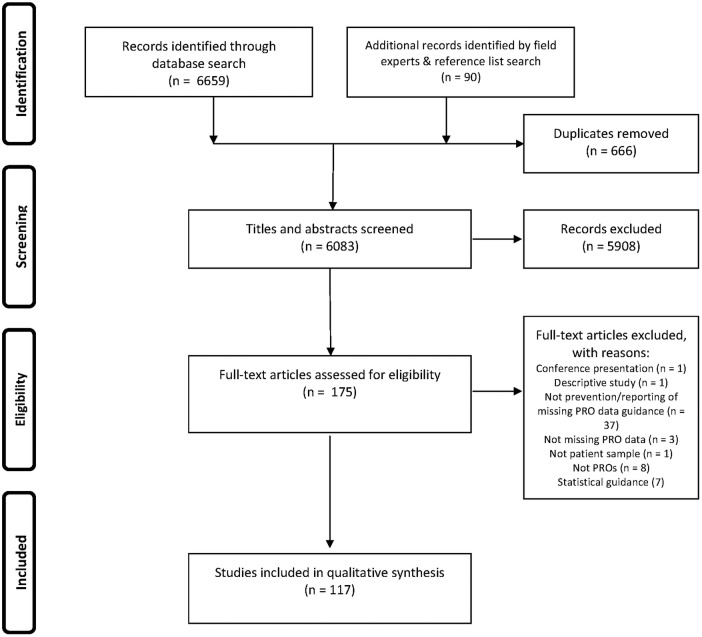
Objectives: Patient-reported outcomes (PROs) provide important information about the impact of treatment from the patients' perspective. However, missing PRO data may compromise the interpretability and value of the findings. We aimed to report: (1) a non-technical summary of problems caused by missing PRO data; and (2) a systematic review by collating strategies to: (A) minimise rates of missing PRO data, and (B) facilitate transparent interpretation and reporting of missing PRO data in clinical research. Our systematic review does not address statistical handling of missing PRO data. Data sources: MEDLINE and Cumulative Index to Nursing and Allied Health Literature (CINAHL) databases (inception to 31 March 2015), and citing articles and reference lists from relevant sources. Eligibility criteria: English articles providing recommendations for reducing missing PRO data rates, or strategies to facilitate transparent interpretation and reporting of missing PRO data were included. Methods: 2 reviewers independently screened articles against eligibility criteria. Discrepancies were resolved with the research team. Recommendations were extracted and coded according to framework synthesis. Results: 117 sources (55% discussion papers, 26% original research) met the eligibility criteria. Design and methodological strategies for reducing rates of missing PRO data included: incorporating PRO-specific information into the protocol; carefully designing PRO assessment schedules and defining termination rules; minimising patient burden; appointing a PRO coordinator; PRO-specific training for staff; ensuring PRO studies are adequately resourced; and continuous quality assurance. Strategies for transparent interpretation and reporting of missing PRO data include utilising auxiliary data to inform analysis; transparently reporting baseline PRO scores, rates and reasons for missing data; and methods for handling missing PRO data. Conclusions: The instance of missing PRO data and its potential to bias clinical research can be minimised by implementing thoughtful design, rigorous methodology and transparent reporting strategies. All members of the research team have a responsibility in implementing such strategies.
Overview
The claims and statistics of this paper haven’t been checked yet.
Free: it reads the open-access text and checks the first 5 claims that cite a source we can check. Create a free account to check every claim.
Integrity signals
Registry
Cites
Statistics
Figures
Verification
Claims the paper makes
The claims and statistics of this paper haven’t been checked yet.
Free: it reads the open-access text and checks the first 5 claims that cite a source we can check. Create a free account to check every claim.
Claims other papers make about this one
Each is checked against this paper’s own text: does it say what the citing paper says it does?
The check wasn’t confident either way, so it gives no verdict — never disputed.
In the citing paper
“The lack of reported calibration protocols could potentially affect the reliability and comparability of findings across studies, particularly for subjective measures such as esthetic outcomes and patient satisfaction measures (Mercieca‐Bebber et al. 2016).”
From Patient- and Clinician-Reported Outcomes and Outcome Measures Evaluating Timing of Implant Loading in the Edentulous Maxilla: A Systematic Review of Prospective Studies (2026) · cites this paper as Mercieca‐Bebber et al. 2016
Experimental — accuracy not yet measured
Self-check
Percentages, sums and reported differences re-computed from the paper’s own numbers.
The self-check needs the paper’s full text.
Citations
Cites
Gale, N. K., Heath, G., Cameron, E., Rashid, S., & Redwood, S. (2013) · BMC Medical Research Methodology · doi:10.1186/1471-2288-13-117 · Cited by 10,865
RUBIN, D. B. (1976) · Biometrika · doi:10.1093/biomet/63.3.581 · Cited by 9,925
U.S. Department of Health and Human Services FDA Center for Drug Evaluation and Research, U.S. Department of Health and Human Services FDA Center for Biologics Evaluation and Research, & U.S. Department of Health and Human Services FDA Center for Devices and Radiological Health (2006) · Health and Quality of Life Outcomes · doi:10.1186/1477-7525-4-79 · Cited by 2,856
Principled missing data methods for researchers
Dong, Y., & Peng, C.-Y. J. (2013) · SpringerPlus · doi:10.1186/2193-1801-2-222 · Cited by 2,208 · cited 2×
“Therefore, assuming the study is adequately powered, the results should not be altered too much if the MCAR are ignored in analysis; however, the standard error of the estimates will be inflated.(19) Many examples of MCAR are caused by poor study design and implementation, and are hence ‘preventable’ sources of missin…”
The prevention and treatment of missing data in clinical trials
Little, R. J., D'Agostino, R., Cohen, M. L., Dickersin, K., Emerson, S. S., Farrar, J. T., Frangakis, C., Hogan, J. W., Molenberghs, G., Murphy, S. A., et al. (2012) · New England Journal of Medicine · doi:10.1056/nejmsr1203730 · Cited by 1,884
Reporting of Patient-Reported Outcomes in Randomized Trials: The CONSORT PRO Extension
Calvert, M., Blazeby, J., Altman, D. G., Revicki, D. A., Moher, D., Brundage, M. D., & CONSORT PRO Group, F. T. (2013) · JAMA · doi:10.1001/jama.2013.879 · Cited by 1,386
Self-citationReducing waste from incomplete or unusable reports of biomedical research
Glasziou, P., Altman, D. G., Bossuyt, P., Boutron, I., Clarke, M., Julious, S., Michie, S., Moher, D., & Wager, E. (2014) · The Lancet · doi:10.1016/s0140-6736(13)62228-x · Cited by 1,319
Direction and impact of language bias in meta-analyses of controlled trials: empirical study
Jüni, P., Holenstein, F., Sterne, J., Bartlett, C., & Egger, M. (2002) · International Journal of Epidemiology · doi:10.1093/ije/31.1.115 · Cited by 892
Cherny, N. I., Sullivan, R., Dafni, U., Kerst, J. M., Sobrero, A., Zielinski, C., de Vries, E. G. E., & Piccart, M. J. (2015) · Annals of Oncology · doi:10.1093/annonc/mdv249 · Cited by 818
What contributions do languages other than English make on the results of meta-analyses?
Moher, D., Pham, Klassen, T. P., Schulz, K. F., Berlin, J. A., Jadad, A. R., & Liberati, A. (2000) · Journal of Clinical Epidemiology · doi:10.1016/s0895-4356(00)00188-8 · Cited by 453
Research works printed but not linked: 55
- European Medicines Agency. Oncology Working Party. Draft Reflection Paper on the use of patient reported outcome (PRO) measures in oncology studies. EMA, 2014 http://www.ema.europa.eu/docs/en_GB/document_library/Scientific_guideline/2014/06/WC500168852.pdf (accessed 2 Sept 2014). 26275979
- Bernhard J, Cella DF, Coates AS Missing quality of life data in cancer clinical trials: serious problems and challenges. Stat Med 1998; 17: 517– 32. 10.1002/(SICI)1097-0258(19980315/15)17:5/7<517::AID-SIM799>3.0.CO;2-S 9549801 · DOI · Paper page
- Staquet M, Berzon R, Osoba D Guidelines for reporting results of quality of life assessments in clinical trials. Qual Life Res 1996; 5: 496– 502. 10.1007/BF00540022 8973129 · DOI · Paper page
- Bernhard J, Gelber RD, Hürny C Preface. Stat Med 1998; 17: 511– 12. 10.1002/(SICI)1097-0258(19980315/15)17:5/7<511::AID-SIM798>3.0.CO;2-C · doi:10.1002/(sici)1097-0258(19980315/15)17:5/7<511::aid-sim798>3.0.co;2-c
- Bylicki O, Gan HK, Joly F Poor patient-reported outcomes reporting according to CONSORT guidelines in randomized clinical trials evaluating systemic cancer therapy. Ann Oncol 2015; 26: 231– 7. 10.1093/annonc/mdu489 25355720 · DOI
- Efficace F, Fayers P, Pusic A Quality of patient-reported outcome reporting across cancer randomized controlled trials according to the CONSORT patient-reported outcome extension: a pooled analysis of 557 trials. Cancer 2015; 121: 3335– 42. 10.1002/cncr.29489 26079197 PMC4755292 · DOI
- Fielding S, Maclennan G, Cook JA A review of RCTs in four medical journals to assess the use of imputation to overcome missing data in quality of life outcomes. Trials 2008; 9: 51 10.1186/1745-6215-9-51 18694492 PMC3225816 · DOI · Paper page
- Friedlander M, Mercieca-Bebber RL, King MT Patient-reported outcomes (PRO) in ovarian cancer clinical trials-lost opportunities and lessons learned. Ann Oncol 2016; 27(Suppl 1): i66– 71. 10.1093/annonc/mdw080 27141076 · DOI
- Fairclough DL, Peterson HF, Cella D Comparison of several model-based methods for analysing incomplete quality of life data in cancer clinical trials. Stat Med 1998; 17: 781– 96. 10.1002/(SICI)1097-0258(19980315/15)17:5/7<781::AID-SIM821>3.0.CO;2-O 9549823 · DOI · Paper page
- Fairclough DL, Peterson HF, Chang V Why are missing quality of life data a problem in clinical trials of cancer therapy? Stat Med 1998; 17: 667– 77. 10.1002/(SICI)1097-0258(19980315/15)17:5/7<667::AID-SIM813>3.0.CO;2-6 9549815 · DOI · Paper page
- Bell ML, Fairclough DL Practical and statistical issues in missing data for longitudinal patient-reported outcomes. Stat Methods Med Res 2014; 23: 440– 59. 10.1177/0962280213476378 23427225 · DOI · Paper page
- Curran D, Bacchi M, Schmitz SFH Identifying the types of missingness in quality of life data from clinical trials. Stat Med 1998; 17: 739– 56. 10.1002/(SICI)1097-0258(19980315/15)17:5/7<739::AID-SIM818>3.0.CO;2-M 9549820 · doi:10.1002/(sici)1097-0258(19980315/15)17:5/7<739::aid-sim818>3.0.co;2-m
- Curran D, Molenberghs G, Fayers PM Incomplete quality of life data in randomized trials: missing forms. Stat Med 1998; 17: 697– 709. 10.1002/(SICI)1097-0258(19980315/15)17:5/7<697::AID-SIM815>3.0.CO;2-Y 9549817 · doi:10.1002/(sici)1097-0258(19980315/15)17:5/7<697::aid-sim815>3.0.co;2-y
- Fielding S, Fayers PM, Ramsay CR Investigating the missing data mechanism in quality of life outcomes: a comparison of approaches. Health Qual Life Outcomes 2009; 7: 57 10.1186/1477-7525-7-57 19545408 PMC2711047 · DOI
- Moher D, Liberati A, Tetzlaff J Preferred reporting items for systematic reviews and meta-analyses: The PRISMA statement. PLoS Med 2009; 6: e1000097 10.1371/journal.pmed.1000097 19621072 PMC2707599 · DOI · Paper page
- Barnett-Page E, Thomas J Methods for the synthesis of qualitative research: a critical review. BMC Med Res Methodol 2009; 9: 59 10.1186/1471-2288-9-59 19671152 PMC3224695 · DOI · Paper page
- Land SR, Ritter MW, Costantino JP Compliance with patient-reported outcomes in multicenter clinical trials: methodologic and practical approaches. J Clin Oncol 2007; 25: 5113– 20. 10.1200/JCO.2007.12.1749 17991930 · DOI
- Cella DF, Lloyd SR Data collection strategies for patient-reported information. Qual Manag Health Care 1994; 2: 28– 35. 10.1097/00019514-199402040-00006 10137605 · DOI
- Fallowfield LJ, Harper P Health-related quality of life in patients undergoing drug therapy for advanced non-small-cell lung cancer. Lung Cancer 2005; 48: 365– 77. 10.1016/j.lungcan.2004.11.018 15893006 · DOI
- Little RJ, Cohen ML, Dickersin K The design and conduct of clinical trials to limit missing data. Stat Med 2012; 31: 3433– 43. 10.1002/sim.5519 22829439 PMC5944851 · DOI · Paper page
- Walker M, Brown J, Brown K Practical problems with the collection and interpretation of serial quality of life assessments in patients with malignant glioma. J Neurooncol 2003; 63: 179– 86. 10.1023/A:1023900802254 12825822 · DOI
- Taphoorn MJ, Sizoo EM, Bottomley A Review on quality of life issues in patients with primary brain tumors. Oncologist 2010; 15: 618– 26. 10.1634/theoncologist.2009-0291 20507891 PMC3227985 · DOI · Paper page
- Aaronson NK Quality of life research in cancer clinical trials: a need for common rules and language. Oncology (Williston Park, NY) 1990; 4: 59– 66. 2143411
- Fallowfield L Compliance issues in quality of life assessment: experiences of two Cancer Research Campaign sponsored groups. Stat Med 1998; 17: 541– 6. 10.1002/(SICI)1097-0258(19980315/15)17:5/7<541::AID-SIM801>3.0.CO;2-# 9549803 · DOI
- Larkin ME, Lorenzi GM, Bayless M Evolution of the study coordinator role: the 28-year experience in Diabetes Control and Complications Trial/Epidemiology of Diabetes Interventions and Complications (DCCT/EDIC). Clin Trials 2012; 9: 418– 25. 10.1177/1740774512449532 22729476 PMC3815574 · DOI
- Bernhard J, Gusset H, Hürny C Practical issues in quality of life assessment in multicentre trials conducted by the Swiss Group for Clinical Cancer Research. Stat Med 1998; 17: 633– 9. 10.1002/(SICI)1097-0258(19980315/15)17:5/7<633::AID-SIM810>3.0.CO;2-U 9549812 · DOI
- Ganz PA, Day R, Costantino J Compliance with quality of life data collection in the National Surgical Adjuvant Breast and Bowel Project (NSABP) Breast Cancer Prevention Trial. Stat Med 1998; 17: 613– 22. 10.1002/(SICI)1097-0258(19980315/15)17:5/7<613::AID-SIM808>3.0.CO;2-9 9549810 · doi:10.1002/(sici)1097-0258(19980315/15)17:5/7<613::aid-sim808>3.0.co;2-9
- Wisniewski SR, Leon AC, Otto MW Prevention of missing data in clinical research studies. Biol Psychiatry 2006; 59: 997– 1000. 10.1016/j.biopsych.2006.01.017 16566901 · DOI
- Bernhard J, Peterson HF, Coates AS Quality of life assessment in International Breast Cancer Study Group (IBCSG) trials: practical issues and factors associated with missing data. Stat Med 1998; 17: 587– 601. 10.1002/(SICI)1097-0258(19980315/15)17:5/7<587::AID-SIM806>3.0.CO;2-# 9549808 · DOI
- Hahn EA, Webster KA, Cella D Missing data in quality of life research in Eastern Cooperative Oncology Group (ECOG) clinical trials: problems and solutions. Stat Med 1998; 17: 547– 59. 10.1002/(SICI)1097-0258(19980315/15)17:5/7<547::AID-SIM802>3.0.CO;2-F 9549804 · DOI
- Cella DF Methods and problems in measuring quality of life. Support Care Cancer 1995; 3: 11– 22. 10.1007/BF00343916 7697298 · DOI
- Wilcox S, Shumaker SA, Bowen DJ Promoting adherence and retention to clinical trials in special populations: a women's health initiative workshop. Control Clin Trials 2001; 22: 279– 89. 10.1016/S0197-2456(00)00130-6 11384790 · DOI
- Young T, Maher J Collecting quality of life data in EORTC clinical trials—what happens in practice? Psychooncology 1999; 8: 260– 3. 10.1002/(SICI)1099-1611(199905/06)8:3<260::AID-PON383>3.0.CO;2-Z 10390738 · doi:10.1002/(sici)1099-1611(199905/06)8:3<260::aid-pon383>3.0.co;2-z
- Osoba D, Dancey J, Zee B Health-related quality-of-life studies of the National Cancer Institute of Canada Clinical Trials Group. J Natl Cancer Inst. 1996; Monographs 2: 107–111. 8750480
- Hellard ME, Sinclair MI, Forbes AB Methods used to maintain a high level of participant involvement in a clinical trial. J Epidemiol Community Health 2001; 55: 348– 51. 10.1136/jech.55.5.348 11297658 PMC1731891 · DOI
- Revicki D, Fairclough D Preventing missing data. In: Fayers P, Hays R, eds. Assessing quality of life in clinical trials: analysis and interpretation. 2nd edn Oxford University Press, 2005: 209– 222. · doi:10.1093/oso/9780198527695.003.0011
- Scott RB, Farmer E, Smiton A Methodology of neuropsychological research in multicentre randomized clinical trials: a model derived from the International Subarachnoid Aneurysm Trial. Clin Trials 2004; 1: 31– 9. 10.1191/1740774504cn008xx 16281460 · doi:10.1191/1740774504cn008xx
- Hayden KA, Moinpour CM, Metch B Pitfalls in quality-of-life assessment: lessons from a Southwest Oncology Group breast cancer clinical trial. Oncol Nurs Forum 1993; 20: 1415– 19. 8265446
- Rouette J, Blazeby J, King M Integrating health-related quality of life findings from randomized clinical trials into practice: an international study of oncologists’ perspectives. Qual Life Res 2015; 24: 1317– 25. 10.1007/s11136-014-0871-9 25432885 · DOI
- Brundage M, Bass B, Davidson J Patterns of reporting health-related quality of life outcomes in randomized clinical trials: implications for clinicians and quality of life researchers. Qual Life Res 2011; 20: 653– 64. 10.1007/s11136-010-9793-3 21110123 · DOI
- Mercieca-Bebber RL, Perreca A, King M Patient-reported outcomes in head and neck and thyroid cancer randomised controlled trials: a systematic review of completeness of reporting and impact on interpretation. Eur J Cancer 2016; 56: 144– 61. 10.1016/j.ejca.2015.12.025 26851406 · DOI
- Schandelmaier S, Conen K, von Elm E Planning and reporting of quality-of-life outcomes in cancer trials. Ann Oncol 2015; 26: 1966– 73. 10.1093/annonc/mdv283 26133966 PMC4551161 · DOI
- Palmer M, Mercieca-Bebber R, King M A framework for classifying root causes of missing data for patient reported outcomes in prospective studies. Qual Life Res 2015; 24: a2016.
- Fairclough D Design and analysis of quality of life studies in clinical trials. New York: Chapman & Hall, 2010. · DOI · Paper page
- King MT A point of minimal important difference (MID): a critique of terminology and methods. Expert Rev Pharmacoecon Outcomes Res 2011; 11: 171– 84. 10.1586/erp.11.9 21476819 · DOI · Paper page
- Wyrwich KW, Nienaber NA, Tierney WM Linking clinical relevance and statistical significance in evaluating intra-individual changes in health-related quality of life. Med Care 1999; 37: 469– 78. 10.1097/00005650-199905000-00006 10335749 · DOI · Paper page
- Calvert M, Kyte D, Duffy H Patient reported outcome (PRO) assessment in clinical trials: a systematic review of guidance for trial protocol writers. PLoS ONE 2014; 9: e110216 10.1371/journal.pone.0110216 25333995 PMC4198295 · DOI · Paper page
- Calvert M, Kyte D, von Hildebrand M Putting patients at the heart of health-care research. Lancet 2015; 385: 1073– 4. 10.1016/S0140-6736(15)60599-2 25797557 · DOI
- Tang ST, McCorkle R Use of family proxies in quality of life research for cancer patients at the end of life: a literature review. Cancer Invest 2002; 20: 1086– 104. 10.1081/CNV-120005928 12449742 · DOI · Paper page
- Gheorghe A, Roberts T, Hemming K Evaluating the generalisability of trial results: introducing a centre- and trial-level generalisability index. Pharmacoeconomics 2015; 33: 1195– 214. 10.1007/s40273-015-0298-3 26068945 · DOI
- Rutherford C, Costa D, Mercieca-Bebber R Mode of administration does not cause bias in patient-reported outcome results: a meta-analysis. Qual Life Res 2015; 3: 3. 26334842
- Cantrell MA, Lupinacci P Methodological issues in online data collection. J Adv Nurs 2007; 60: 544– 9. 10.1111/j.1365-2648.2007.04448.x 17973718 · DOI · Paper page
- Edwards P, Roberts I, Clarke M Methods to increase response rates to postal questionnaires. Cochrane Database Syst Rev 2007; (2): MR000008 10.1002/14651858.MR000008.pub3 17443629 · DOI · Paper page
- Osoba D, Bezjak A, Brundage M Evaluating health-related quality of life in cancer clinical trials: the National Cancer Institute of Canada Clinical Trials Group experience. Value Health 2007; 10(Suppl 2): S138– 45. 10.1111/j.1524-4733.2007.00278.x 17995472 · DOI
- Osoba D, Bezjak A, Brundage M Analysis and interpretation of health-related quality-of-life data from clinical trials: basic approach of the National Cancer Institute of Canada Clinical Trials Group. Eur J Cancer 2005; 41: 280– 7. 10.1016/j.ejca.2004.10.017 15661554 · DOI · Paper page
Cited by
Calvert, M., Kyte, D., Mercieca-Bebber, R., Slade, A., Chan, A.-W., King, M. T., and the SPIRIT-PRO Group, Hunn, A., Bottomley, A., Regnault, A., et al. (2018) · JAMA · doi:10.1001/jama.2017.21903 · Cited by 814
“Inappropriate method selection may lead to potentially biased and misleading results.(22,32) The protocol should ac-”
BackgroundMethodInfluentialSelf-citationMercieca-Bebber, R., King, M. T., Calvert, M. J., Stockler, M. R., & Friedlander, M. (2018) · Patient Related Outcome Measures · doi:10.2147/prom.s156279 · Cited by 659
“Often the missing data mechanism has a stronger impact on the results than does the proportion of missing data.(52,56) For example, if analysis methods assume that missing data are not related to the patients’ illness (eg, as with “complete case” analysis methods), when in fact the illness may have led to the data not…”
Self-citationCoens, C., Pe, M., Dueck, A. C., Sloan, J., Basch, E., Calvert, M., Campbell, A., Cleeland, C., Cocks, K., Collette, L., et al. (2020) · The Lancet Oncology · doi:10.1016/s1470-2045(19)30790-9 · Cited by 323
Self-citationAiyegbusi, O. L., Roydhouse, J., Rivera, S. C., Kamudoni, P., Schache, P., Wilson, R., Stephens, R., & Calvert, M. (2022) · Nature Communications · doi:10.1038/s41467-022-33826-4 · Cited by 190
Self-citationCalvert, M., King, M., Mercieca-Bebber, R., Aiyegbusi, O., Kyte, D., Slade, A., Chan, A.-W., Basch, E., Bell, J., Bennett, A., et al. (2021) · BMJ Open · doi:10.1136/bmjopen-2020-045105 · Cited by 144
“This SPIRITPRO Extension E&E paper is recommended for use alongside the original SPIRIT 2013 and SPIRITPRO guidelines.(1) 2 10 The mission of the SPIRITPRO Group is to improve the design and standardisation of PRO components of clinical trials and thereby ensure high- quality PRO data to inform patientcentred care.”
InfluentialSelf-citationPannuti, C. M., Hassan, M. A., Reis, I. N. R., Villar, C. C., Francisco, H., & Romito, G. A. (2026) · Clinical Oral Implants Research · doi:10.1111/clr.14451 · Cited by 1
Metadata
- Authors
- Mercieca-Bebber, R., Palmer, M. J., Brundage, M., Calvert, M., Stockler, M. R., & King, M. T.
- ORCID
- Calvert, Melanie
- Venue
- BMJ Open
- Publisher
- BMJ
- Published
- 2016-06
- Volume
- 6
- Issue
- 6
- Pages
- e010938
- ISSN
- 2044-6055
- PMC
- PMC4916640
- Cited by
- 121
- References
- 13
- Language
- en
About these checks
Registry, retraction, Cites and statistics results are computed, not judged, with one exception: a printed reference that no index lists is read once by a model before it counts as a citation error. Claims are extracted by a model and kept only when their quote appears verbatim in the text; each cited source is then checked, with a model’s help, for whether it says what the claim relies on. Those verdicts can be wrong — read the claim’s quote and the cited source before relying on one.
Statistics and arithmetic are recomputed, not judged.
Confidence bands are shown only for fields calibrated on our annotated test set. None is calibrated yet, so no band is shown.
What counts as a claim ›How we measure confidence ›How we check this ›
Are you an author, or do you see a problem with this page? Request a review
Data sources
Bibliographic data: Semantic Scholar, OpenAlex, Crossref.
Contains information from the Semantic Scholar Academic Graph Datasets, made available under the ODC Attribution License (ODC-BY 1.0).
Semantic Scholar’s data is described in: Kinney, R., et al. (2023). The Semantic Scholar Open Data Platform. arXiv:2301.10140.
