

Interventions for subjective cognitive decline: systematic review and meta-analysis
Open accessThe DOI matches its Crossref record; 55 of the 55 references it cites were found in a registry or an index.
Abstract
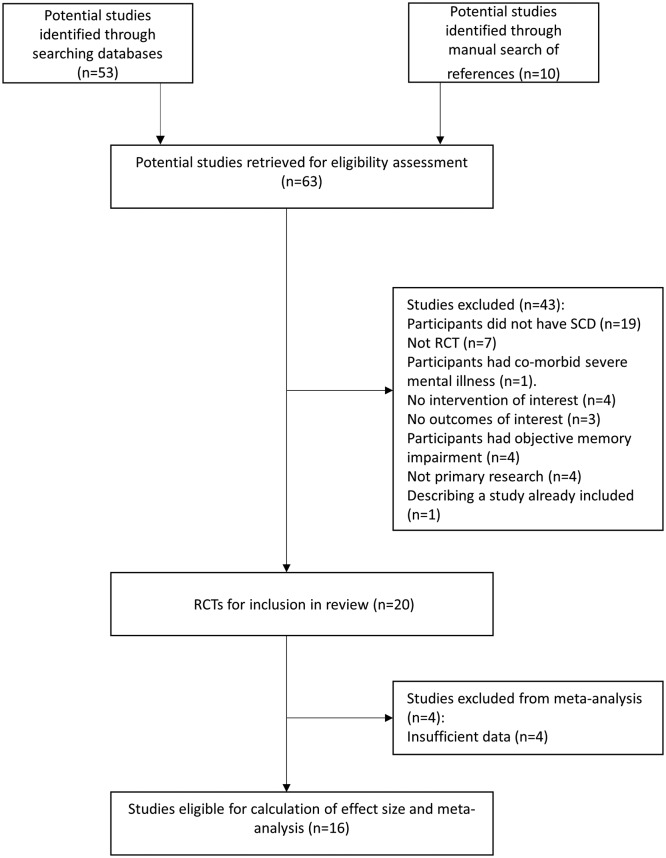
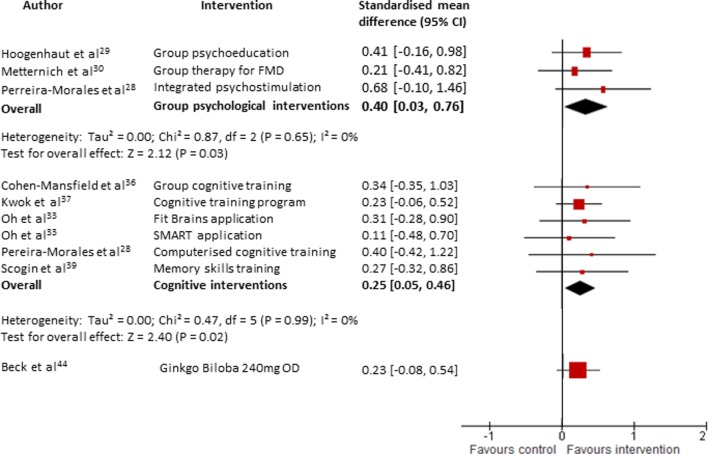
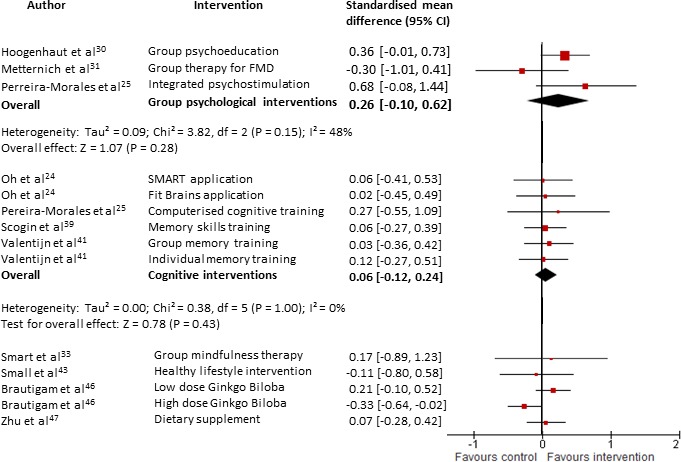
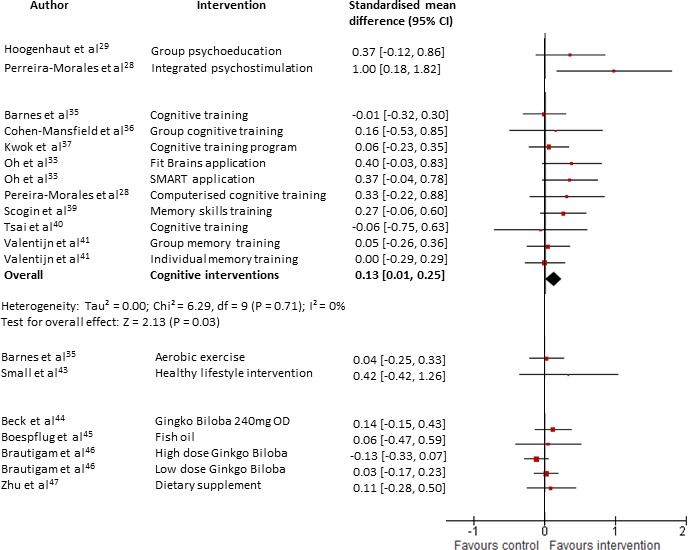
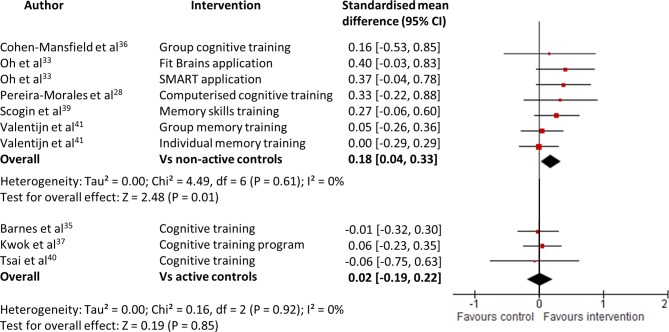
Objectives: This review provides a broad overview of the effectiveness of interventions for subjective cognitive decline (SCD) in improving psychological well-being, metacognition and objective cognitive performance. Methods: Databases including PubMed, Web of Science and Cochrane Systematic Reviews were searched up to August 2017 to identify randomised controlled trials evaluating interventions for SCD. Interventions were categorised as psychological, cognitive, lifestyle or pharmacological. Outcomes of interest included psychological well-being, metacognitive ability and objective cognitive performance. To assess the risk of bias, three authors independently rated study validity using criteria based on the Critical Appraisal Skills Programme. Random-effects meta-analyses were undertaken where three or more studies investigated similar interventions and reported comparable outcomes. Results: Twenty studies met inclusion criteria and 16 had sufficient data for inclusion in the meta-analyses. Of these, only seven were rated as being high quality. Group psychological interventions significantly improved psychological well-being (g=0.40, 95% CI 0.03 to 0.76; p=0.03) but the improvement they conferred on metacognitive ability was not statistically significant (g=0.26, 95% CI −0.22 to 0.73; p=0.28). Overall, cognitive training interventions led to a small, statistically significant improvement in objective cognitive performance (g=0.13, 95% CI 0.01 to 0.25; p=0.03). However, the pooled effect sizes of studies using active control groups (g=0.02, 95% CI −0.19 to 0.22; p=0.85) or reporting global cognitive measures (g=0.06, 95% CI –0.19 to 0.31; p=0.66) were non-significant. Conclusions: There is a lack of high-quality research in this field. Group psychological interventions improve psychological well-being and may also improve metacognition. A large, high-quality study is indicated to investigate this further. There is no evidence to suggest that cognitive interventions improve global cognitive performance and the clinical utility of small improvements in specific cognitive domains is questionable. There is a lack of research considering lifestyle interventions and poor quality evidence for pharmacological interventions. PROSPERO registration number: CRD42017079391.
Overview
The claims and statistics of this paper haven’t been checked yet.
Free: it reads the open-access text and checks the first 5 claims that cite a source we can check. Create a free account to check every claim.
Integrity signals
Registry
Cites
Statistics
Figures
Verification
Claims the paper makes
The claims and statistics of this paper haven’t been checked yet.
Free: it reads the open-access text and checks the first 5 claims that cite a source we can check. Create a free account to check every claim.
Claims other papers make about this one
Each is checked against this paper’s own text: does it say what the citing paper says it does?
The source backs part of the claim, not all of it — or backs it for a different population, condition or comparison.
In the citing paper
“There is now preliminary evidence that strategies focused on expectations, cognitive restructuring and psychoeducation can be helpful.10 11”
From Feasibility randomised controlled trial of online group Acceptance and Commitment Therapy for Functional Cognitive Disorder (ACT4FCD) (2023) · cites this paper as [11]
Experimental — accuracy not yet measuredThe source backs part of the claim, not all of it — or backs it for a different population, condition or comparison.
In the citing paper
“A recent meta-analysis of treatment studies to date found that group interventions involving both cognitive-training and expectancy-modification significantly improved psychological well-being.”
From Feasibility randomised controlled trial of online group Acceptance and Commitment Therapy for Functional Cognitive Disorder (ACT4FCD) (2023) · cites this paper as [11]
Experimental — accuracy not yet measuredThe source backs part of the claim, not all of it — or backs it for a different population, condition or comparison.
In the citing paper
“cognitive training was associated with small, clinically insignificant improvements in tasks related to the training ones, with no generalisation to daily life.11”
From Feasibility randomised controlled trial of online group Acceptance and Commitment Therapy for Functional Cognitive Disorder (ACT4FCD) (2023) · cites this paper as [11]
Experimental — accuracy not yet measuredThe cited source says what the claim attributes to it.
In the citing paper
“While expectancy-change interventions had little effect on objective measures of cognitive functioning,”
From Feasibility randomised controlled trial of online group Acceptance and Commitment Therapy for Functional Cognitive Disorder (ACT4FCD) (2023) · cites this paper as [11]
The check wasn’t confident either way, so it gives no verdict — never disputed.
In the citing paper
“No adverse events (AEs) were described.”
From Feasibility randomised controlled trial of online group Acceptance and Commitment Therapy for Functional Cognitive Disorder (ACT4FCD) (2023) · cites this paper as [11]
Experimental — accuracy not yet measured
Self-check
Percentages, sums and reported differences re-computed from the paper’s own numbers.
The self-check needs the paper’s full text.
Citations
Cites
Borenstein, M., Hedges, L. V., Higgins, J. P. T., & Rothstein, H. R. (2009) · doi:10.1002/9780470743386 · Cited by 14,225 · cited 1×
“27 For example, if a study reported two relevant outcomes, expressed as two effect sizes (y 1 and y 2 ) the overall mean effect size for the composite measure will be: The variance of the composite effect size is calculated as follows: √ √ where r is the correlation coefficient describing the…”
BackgroundStatistical Methods for Meta-Analysis
Wasserman, S., Hedges, L. V., & Olkin, I. (1988) · Journal of Educational Statistics · doi:10.2307/1164953 · Cited by 10,326
Borenstein, M., Hedges, L. V., Higgins, J. P. T., & Rothstein, H. R. (2021) · doi:10.1002/9781119558378 · Cited by 9,799
Using Effect Size—or Why the P Value Is Not Enough
Sullivan, G. M., & Feinn, R. (2012) · Journal of Graduate Medical Education · doi:10.4300/jgme-d-12-00156.1 · Cited by 5,553 · cited 1×
“40).(48) The studies, two of which were of high quality,”
Jessen, F., Amariglio, R. E., van Boxtel, M., Breteler, M., Ceccaldi, M., Chételat, G., Dubois, B., Dufouil, C., Ellis, K. A., van der Flier, W. M., et al. (2014) · Alzheimer's & Dementia · doi:10.1016/j.jalz.2014.01.001 · Cited by 3,014 · cited 2×
“IntrOduCtIOn Subjective cognitive decline (SCD) describes self-reported acquired difficulties with cognitive functioning, in the presence of normal performance on objective measures of cognition and no impairment of daily functioning.(1) SCD has attracted alternative names, including subjective memory impairment and s…”
BackgroundMitchell, A. J., Beaumont, H., Ferguson, D., Yadegarfar, M., & Stubbs, B. (2014) · Acta Psychiatrica Scandinavica · doi:10.1111/acps.12336 · Cited by 1,162 · cited 1×
“There is accumulating evidence for the former with Mitchell’s meta-analysis 7 finding that older people with SCD were twice as likely to subsequently develop dementia.”
The neural basis of metacognitive ability
Fleming, S. M., & Dolan, R. J. (2012) · Philosophical Transactions of the Royal Society B: Biological Sciences · doi:10.1098/rstb.2011.0417 · Cited by 747 · cited 2×
“Metacognition, an individual’s insight into their own cognitive functioning, 20 may be of relevance as a therapeutic target because, by definition, SCD involves an individual’s underestimation of their cognitive ability relative to objective testing.”
BackgroundImplementation of subjective cognitive decline criteria in research studies
Molinuevo, J. L., Rabin, L. A., Amariglio, R., Buckley, R., Dubois, B., Ellis, K. A., Ewers, M., Hampel, H., Klöppel, S., Rami, L., et al. (2017) · Alzheimer's & Dementia · doi:10.1016/j.jalz.2016.09.012 · Cited by 575 · cited 13×
“Self-perception of cognitive difficulties can lead to anger, increased stress and fear of dementia,(18) while there is growing evidence that features of anxiety and depression are common in patients with SCD.(19) Therefore, patients with SCD, regardless of aetiology, would benefit from interventions that improve psych…”
BackgroundInfluentialSubjective cognitive complaints and amyloid burden in cognitively normal older individuals
Amariglio, R. E., Becker, J. A., Carmasin, J., Wadsworth, L. P., Lorius, N., Sullivan, C., Maye, J. E., Gidicsin, C., Pepin, L. C., Sperling, R. A., et al. (2012) · Neuropsychologia · doi:10.1016/j.neuropsychologia.2012.08.011 · Cited by 472 · cited 1×
“Research into cerebrospinal fluid (CSF) 15 and neuro-imaging biomarkers 9 10 16 suggest they hold promise for distinguishing between preclinical and non-preclinical AD in patients with SCD but they are not routinely used in clinical practice.”
BackgroundRabin, L. A., Initiative, T. A. D. N., Smart, C. M., Crane, P. K., Amariglio, R. E., Berman, L. M., Boada, M., Buckley, R. F., Chételat, G., Dubois, B., et al. (2015) · Journal of Alzheimer's Disease · doi:10.3233/jad-150154 · Cited by 462 · cited 1×
“All the authors had access to all the data in the study and can take responsibility for the integrity of the reported findings.”
Background
Cited by
Items 101–123 of 123
Withdrawn: 3D Virtual Reality Motionless Imagery Exercise through Avatar in Older PeoplePreprint
Lee, M. C., Chang Hoon, P. A. R. K., & Han, K. H. (2024) · Preprints.org · doi:10.20944/preprints202403.1114.v1
Gasquoine, P. G. (2024) · Applied Neuropsychology Adult · doi:10.1080/23279095.2024.2341801
“The efficacy of these treatment approaches has yet to be demonstrated (Bhome et al., 2018).”
Yeh, A.-Y., Chao, Y., Strauss, S. M., & Chou, C. (2025) · Western Journal of Nursing Research · doi:10.1177/01939459251350812
“18 The currently identified risk factors of SCD are diverse, including neurodegeneration with aging, cardiovascular diseases, neurological diseases, cerebrovascular disease, inflammatory brain diseases, psychiatric disorders, metabolic diseases, endocrine diseases, anemia, liver diseases, kidney…”
Cognitive Training amongst Older Adults - An Intervention
Singh, D. (2025) · International Journal of Social Science Research and Review · doi:10.47814/ijssrr.v8i8.2900
Zarich, S., Cole, R. M., Fairchild, K., Spakowicz, D. J., Sparagna, G. C., Madison, A. A., Ni, A., & Belury, M. A. (2025) · JMIR Research Protocols · doi:10.2196/82032 · Cited by 1
“There are currently no treatments available for dementia; therefore, focusing on prevention strategies at the earliest sign of increased risk—when subjective complaints are present—is important [6].”
Zuschnegg, J., Schoberer, D., Häussl, A., Herzog, S. A., Russegger, S., Ploder, K., Fellner, M., Hofmarcher-Holzhacker, M. M., Roller-Wirnsberger, R., Paletta, L., et al. (2024) · Figshare · doi:10.6084/m9.figshare.26581721
Zuschnegg, J., Schoberer, D., Häussl, A., Herzog, S. A., Russegger, S., Ploder, K., Fellner, M., Hofmarcher-Holzhacker, M. M., Roller-Wirnsberger, R., Paletta, L., et al. (2024) · Figshare · doi:10.6084/m9.figshare.26581718
Zuschnegg, J., Schoberer, D., Häussl, A., Herzog, S. A., Russegger, S., Ploder, K., Fellner, M., Hofmarcher-Holzhacker, M. M., Roller-Wirnsberger, R., Paletta, L., et al. (2024) · Figshare · doi:10.6084/m9.figshare.26581715
Röhr, S., Pabst, A., Riedel-Heller, S. G., Jessen, F., Turana, Y., Handajani, Y. S., Brayne, C., Matthews, F. E., Stephan, B. C. M., Lipton, R. B., et al. (2020) · Figshare · doi:10.6084/m9.figshare.13467567
Whitfield, T. J., Demnitz‐King, H., Schlosser, M., Barnhofer, T., Frison, É., Coll‐Padrós, N., Dautricourt, S., Requier, F., Delarue, M., Gonneaud, J., et al. (2022) · Figshare · doi:10.6084/m9.figshare.21009578
Zuschnegg, J., Schoberer, D., Häussl, A., Herzog, S. A., Russegger, S., Ploder, K., Fellner, M., Hofmarcher-Holzhacker, M. M., Roller-Wirnsberger, R., Paletta, L., et al. (2024) · Figshare · doi:10.6084/m9.figshare.26581712
Brioschi Guevara, A., Bieler, M., Altomare, D., Berthier, M. L., Csajka, C., Dautricourt, S., Démonet, J., Dodich, A., Frisoni, G. B., Miniussi, C., et al. (2021) · Figshare · doi:10.6084/m9.figshare.16786938
Mohan, A., Hayes, C. J., & Krishnan, A. V. (2026) · Current Opinion in Psychiatry · doi:10.1097/yco.0000000000001062 · Cited by 1
Chen, H., Li, X., Fei, Y., Yu, X., Li, C., Zhao, Y., Wang, J., Yin, Y., Xing, Y., Shan, E., et al. (2026) · Geriatric Nursing · doi:10.1016/j.gerinurse.2026.103887
Simone, M. S. D., Costa, A., Zabberoni, S., & Tieri, G. (2026) · Journal of Clinical Medicine · doi:10.3390/jcm15051700
Yahyavi, S., Nami, M., Masjoodi, S., Kamali, A., Yalmeh, R., & Namavar, M. R. (2026) · BMC Neurology · doi:10.1186/s12883-026-04806-8
“This condition is also referred to in the literature as Sub-jective Memory Impairment (SMI) or Subjective Memory Decline (SMD) [1].”
Lee, M. C., Park, C.-H., & Han, K. H. (2026) · Digital Health · doi:10.1177/20552076261461053
Siddiqui, H. A., Sundus, H., Khan, S. A., Azharuddin, M., & Fatima, N. (2026) · Journal of Bodywork and Movement Therapies · doi:10.1016/j.jbmt.2026.07.016
Su, T.-S., Su, K., Hsueh, P. R., Lai, Z.-L., Chen, C., Lai, Y.-C., Chen, C.-S., Nian, X., Chang, Y.-W., & Tsai, S.-T. (2026) · Frontiers in Aging Neuroscience · doi:10.3389/fnagi.2026.1830299
“A meta-analysis of 16 randomized controlled trials reported that cognitive training interventions were associated with improvements in individuals with SCD, with no significant statistical heterogeneity detected across studies (Bhome et al., 2018).”
InfluentialDao, D. P., Moller, C. I., Bryant, C., Ellis, K. A., & Pike, K. E. (2026) · Journal of Aging Research · doi:10.1155/jare/1022137
Ali, A. M. S., Gorter, M., Zakaria, R., Jenkinson, M. D., Frank, B., Klein, M., Hamer, P. C. D. W., & Douw, L. (2026) · Brain stimulation · doi:10.1016/j.brs.2026.103226
Zhang, Q., Wang, S.-W., Tu, H., Zeng, L.-S., Ma, M.-H., Ou, W., Lv, G.-Y., Qin, X., Zhao, X.-T., Deng, A., et al. (2026) · Journal of Affective Disorders · doi:10.1016/j.jad.2026.122642
Metadata
- Authors
- Bhome, R., Berry, A. J., Huntley, J. D., & Howard, R. J.
- Affiliations
- University College London (GB)
- Camden and Islington NHS Foundation Trust (GB)
- Corresponding author
- Bhome, Rohan
- Venue
- BMJ Open
- Publisher
- BMJ
- Published
- 2018-07
- Volume
- 8
- Issue
- 7
- Pages
- e021610
- ISSN
- 2044-6055 (ISSN-L)
- PMC
- PMC6059327
- OpenAlex
- W2884340471
- Cited by
- 123
- References
- 55
- Citations by year
- 2026: 12 · 2025: 15 · 2024: 15 · 2023: 21 · 2022: 11 · 2021: 18 · 2020: 18 · 2019: 10 · 2018: 2
- FWCI
- 1.83
- Type
- journal article
- Language
- en
- Open access
- gold
- doi.org
- Licence
- cc-by
- Locations
- BMJ Open (publishedVersion, cc-by)
- Europe PMC (PubMed Central) (publishedVersion, cc-by)
- PubMed Central (publishedVersion, cc-by)
- PubMed (publishedVersion)
- UCL Discovery (University College London) (submittedVersion)
- HighWire Press Open Archive (submittedVersion)
- Funders
- Research Trainees Coordinating Centre
- Topics
- Health Sciences › Medicine › Psychiatry and Mental health › Dementia and Cognitive Impairment Research
- Social Sciences › Psychology › Experimental and Cognitive Psychology › Cognitive Functions and Memory
- Social Sciences › Psychology › Experimental and Cognitive Psychology › Cognitive Abilities and Testing
- Keywords
- subjective cognitive decline, intervention, psychological intervention, group intervention, cognitive training, metacognition, psychological well-being, objective cognitive performance, lifestyle intervention, pharmacological interventions, active control groups
- MeSH terms
- Cognition, Humans, Learning, Quality of Life, Exercise, Randomized Controlled Trials as Topic, Dietary Supplements, Independent Living, Cognitive Dysfunction
About these checks
Registry, retraction, Cites and statistics results are computed, not judged, with one exception: a printed reference that no index lists is read once by a model before it counts as a citation error. Claims are extracted by a model and kept only when their quote appears verbatim in the text; each cited source is then checked, with a model’s help, for whether it says what the claim relies on. Those verdicts can be wrong — read the claim’s quote and the cited source before relying on one.
Statistics and arithmetic are recomputed, not judged.
Confidence bands are shown only for fields calibrated on our annotated test set. None is calibrated yet, so no band is shown.
What counts as a claim ›How we measure confidence ›How we check this ›
Are you an author, or do you see a problem with this page? Request a review
Data sources
Bibliographic data: Semantic Scholar, OpenAlex, Crossref.
Contains information from the Semantic Scholar Academic Graph Datasets, made available under the ODC Attribution License (ODC-BY 1.0).
Semantic Scholar’s data is described in: Kinney, R., et al. (2023). The Semantic Scholar Open Data Platform. arXiv:2301.10140.
