

Interventions for subjective cognitive decline: systematic review and meta-analysis
Open accessThe DOI matches its Crossref record; 55 of the 55 references it cites were found in a registry or an index.
Abstract
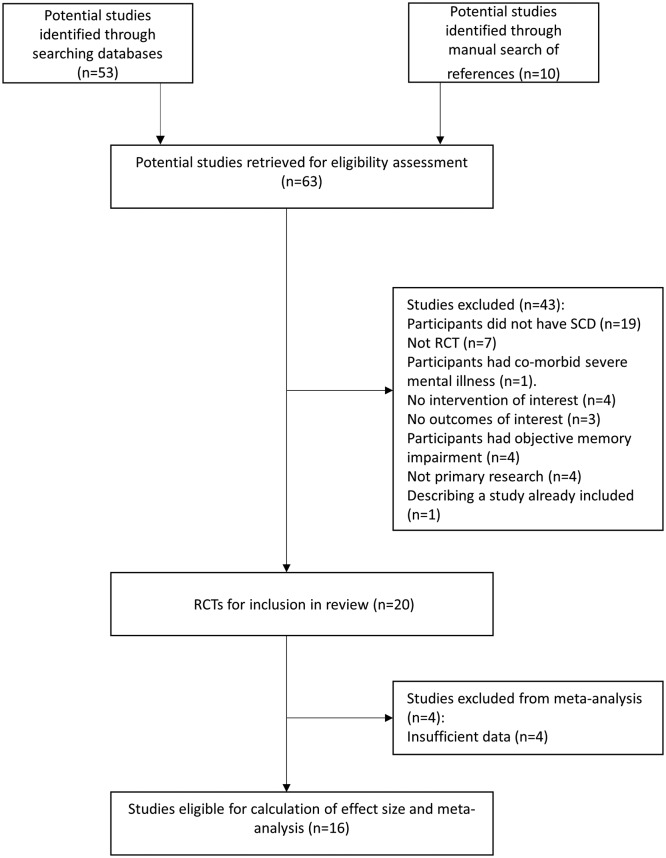
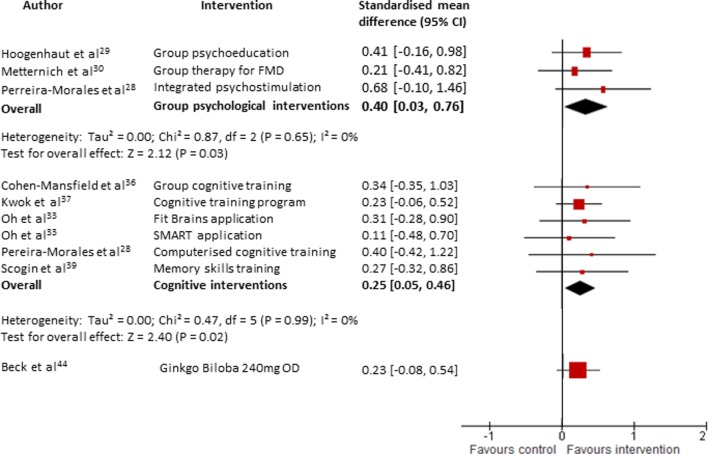
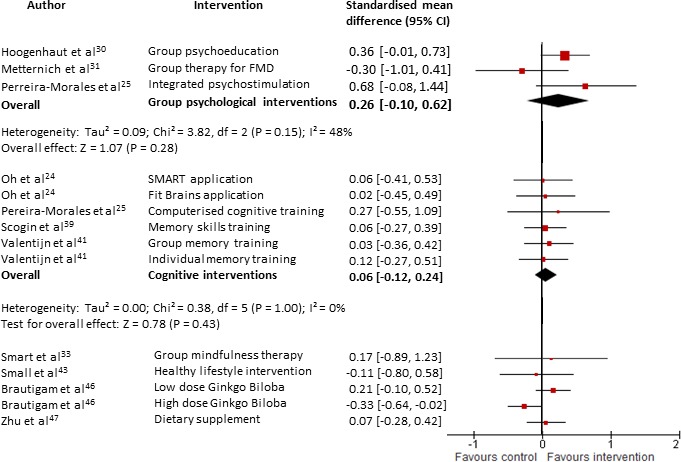
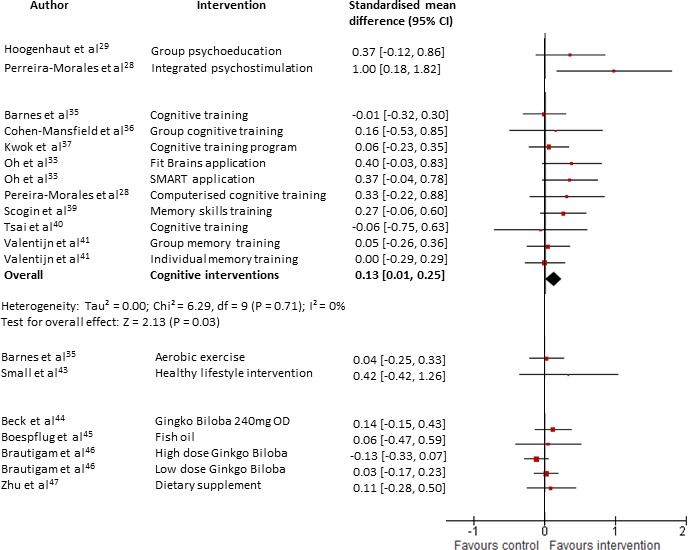
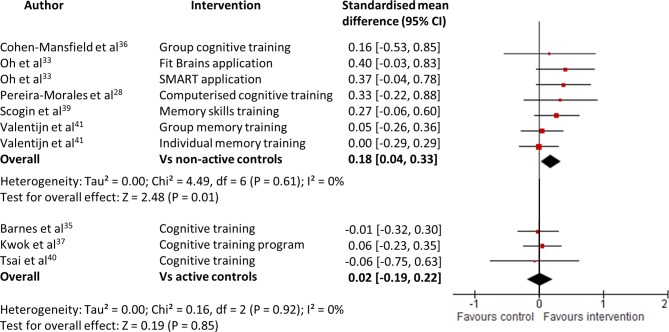
Objectives: This review provides a broad overview of the effectiveness of interventions for subjective cognitive decline (SCD) in improving psychological well-being, metacognition and objective cognitive performance. Methods: Databases including PubMed, Web of Science and Cochrane Systematic Reviews were searched up to August 2017 to identify randomised controlled trials evaluating interventions for SCD. Interventions were categorised as psychological, cognitive, lifestyle or pharmacological. Outcomes of interest included psychological well-being, metacognitive ability and objective cognitive performance. To assess the risk of bias, three authors independently rated study validity using criteria based on the Critical Appraisal Skills Programme. Random-effects meta-analyses were undertaken where three or more studies investigated similar interventions and reported comparable outcomes. Results: Twenty studies met inclusion criteria and 16 had sufficient data for inclusion in the meta-analyses. Of these, only seven were rated as being high quality. Group psychological interventions significantly improved psychological well-being (g=0.40, 95% CI 0.03 to 0.76; p=0.03) but the improvement they conferred on metacognitive ability was not statistically significant (g=0.26, 95% CI −0.22 to 0.73; p=0.28). Overall, cognitive training interventions led to a small, statistically significant improvement in objective cognitive performance (g=0.13, 95% CI 0.01 to 0.25; p=0.03). However, the pooled effect sizes of studies using active control groups (g=0.02, 95% CI −0.19 to 0.22; p=0.85) or reporting global cognitive measures (g=0.06, 95% CI –0.19 to 0.31; p=0.66) were non-significant. Conclusions: There is a lack of high-quality research in this field. Group psychological interventions improve psychological well-being and may also improve metacognition. A large, high-quality study is indicated to investigate this further. There is no evidence to suggest that cognitive interventions improve global cognitive performance and the clinical utility of small improvements in specific cognitive domains is questionable. There is a lack of research considering lifestyle interventions and poor quality evidence for pharmacological interventions. PROSPERO registration number: CRD42017079391.
Overview
The claims and statistics of this paper haven’t been checked yet.
Free: it reads the open-access text and checks the first 5 claims that cite a source we can check. Create a free account to check every claim.
Integrity signals
Registry
Cites
Statistics
Figures
Verification
Claims the paper makes
The claims and statistics of this paper haven’t been checked yet.
Free: it reads the open-access text and checks the first 5 claims that cite a source we can check. Create a free account to check every claim.
Claims other papers make about this one
Each is checked against this paper’s own text: does it say what the citing paper says it does?
The source backs part of the claim, not all of it — or backs it for a different population, condition or comparison.
In the citing paper
“There is now preliminary evidence that strategies focused on expectations, cognitive restructuring and psychoeducation can be helpful.10 11”
From Feasibility randomised controlled trial of online group Acceptance and Commitment Therapy for Functional Cognitive Disorder (ACT4FCD) (2023) · cites this paper as [11]
Experimental — accuracy not yet measuredThe source backs part of the claim, not all of it — or backs it for a different population, condition or comparison.
In the citing paper
“A recent meta-analysis of treatment studies to date found that group interventions involving both cognitive-training and expectancy-modification significantly improved psychological well-being.”
From Feasibility randomised controlled trial of online group Acceptance and Commitment Therapy for Functional Cognitive Disorder (ACT4FCD) (2023) · cites this paper as [11]
Experimental — accuracy not yet measuredThe source backs part of the claim, not all of it — or backs it for a different population, condition or comparison.
In the citing paper
“cognitive training was associated with small, clinically insignificant improvements in tasks related to the training ones, with no generalisation to daily life.11”
From Feasibility randomised controlled trial of online group Acceptance and Commitment Therapy for Functional Cognitive Disorder (ACT4FCD) (2023) · cites this paper as [11]
Experimental — accuracy not yet measuredThe cited source says what the claim attributes to it.
In the citing paper
“While expectancy-change interventions had little effect on objective measures of cognitive functioning,”
From Feasibility randomised controlled trial of online group Acceptance and Commitment Therapy for Functional Cognitive Disorder (ACT4FCD) (2023) · cites this paper as [11]
The check wasn’t confident either way, so it gives no verdict — never disputed.
In the citing paper
“No adverse events (AEs) were described.”
From Feasibility randomised controlled trial of online group Acceptance and Commitment Therapy for Functional Cognitive Disorder (ACT4FCD) (2023) · cites this paper as [11]
Experimental — accuracy not yet measured
Self-check
Percentages, sums and reported differences re-computed from the paper’s own numbers.
The self-check needs the paper’s full text.
Citations
Cites
Borenstein, M., Hedges, L. V., Higgins, J. P. T., & Rothstein, H. R. (2009) · doi:10.1002/9780470743386 · Cited by 14,225 · cited 1×
“27 For example, if a study reported two relevant outcomes, expressed as two effect sizes (y 1 and y 2 ) the overall mean effect size for the composite measure will be: The variance of the composite effect size is calculated as follows: √ √ where r is the correlation coefficient describing the…”
BackgroundStatistical Methods for Meta-Analysis
Wasserman, S., Hedges, L. V., & Olkin, I. (1988) · Journal of Educational Statistics · doi:10.2307/1164953 · Cited by 10,326
Borenstein, M., Hedges, L. V., Higgins, J. P. T., & Rothstein, H. R. (2021) · doi:10.1002/9781119558378 · Cited by 9,799
Using Effect Size—or Why the P Value Is Not Enough
Sullivan, G. M., & Feinn, R. (2012) · Journal of Graduate Medical Education · doi:10.4300/jgme-d-12-00156.1 · Cited by 5,553 · cited 1×
“40).(48) The studies, two of which were of high quality,”
Jessen, F., Amariglio, R. E., van Boxtel, M., Breteler, M., Ceccaldi, M., Chételat, G., Dubois, B., Dufouil, C., Ellis, K. A., van der Flier, W. M., et al. (2014) · Alzheimer's & Dementia · doi:10.1016/j.jalz.2014.01.001 · Cited by 3,014 · cited 2×
“IntrOduCtIOn Subjective cognitive decline (SCD) describes self-reported acquired difficulties with cognitive functioning, in the presence of normal performance on objective measures of cognition and no impairment of daily functioning.(1) SCD has attracted alternative names, including subjective memory impairment and s…”
BackgroundMitchell, A. J., Beaumont, H., Ferguson, D., Yadegarfar, M., & Stubbs, B. (2014) · Acta Psychiatrica Scandinavica · doi:10.1111/acps.12336 · Cited by 1,162 · cited 1×
“There is accumulating evidence for the former with Mitchell’s meta-analysis 7 finding that older people with SCD were twice as likely to subsequently develop dementia.”
The neural basis of metacognitive ability
Fleming, S. M., & Dolan, R. J. (2012) · Philosophical Transactions of the Royal Society B: Biological Sciences · doi:10.1098/rstb.2011.0417 · Cited by 747 · cited 2×
“Metacognition, an individual’s insight into their own cognitive functioning, 20 may be of relevance as a therapeutic target because, by definition, SCD involves an individual’s underestimation of their cognitive ability relative to objective testing.”
BackgroundImplementation of subjective cognitive decline criteria in research studies
Molinuevo, J. L., Rabin, L. A., Amariglio, R., Buckley, R., Dubois, B., Ellis, K. A., Ewers, M., Hampel, H., Klöppel, S., Rami, L., et al. (2017) · Alzheimer's & Dementia · doi:10.1016/j.jalz.2016.09.012 · Cited by 575 · cited 13×
“Self-perception of cognitive difficulties can lead to anger, increased stress and fear of dementia,(18) while there is growing evidence that features of anxiety and depression are common in patients with SCD.(19) Therefore, patients with SCD, regardless of aetiology, would benefit from interventions that improve psych…”
BackgroundInfluentialSubjective cognitive complaints and amyloid burden in cognitively normal older individuals
Amariglio, R. E., Becker, J. A., Carmasin, J., Wadsworth, L. P., Lorius, N., Sullivan, C., Maye, J. E., Gidicsin, C., Pepin, L. C., Sperling, R. A., et al. (2012) · Neuropsychologia · doi:10.1016/j.neuropsychologia.2012.08.011 · Cited by 472 · cited 1×
“Research into cerebrospinal fluid (CSF) 15 and neuro-imaging biomarkers 9 10 16 suggest they hold promise for distinguishing between preclinical and non-preclinical AD in patients with SCD but they are not routinely used in clinical practice.”
BackgroundRabin, L. A., Initiative, T. A. D. N., Smart, C. M., Crane, P. K., Amariglio, R. E., Berman, L. M., Boada, M., Buckley, R. F., Chételat, G., Dubois, B., et al. (2015) · Journal of Alzheimer's Disease · doi:10.3233/jad-150154 · Cited by 462 · cited 1×
“All the authors had access to all the data in the study and can take responsibility for the integrity of the reported findings.”
BackgroundBarnes, D. E., Santos-Modesitt, W., Poelke, G., Kramer, A. F., Castro, C., Middleton, L. E., & Yaffe, K. (2013) · JAMA Internal Medicine · doi:10.1001/jamainternmed.2013.189 · Cited by 377
Perrotin, A. (2012) · Archives of Neurology · doi:10.1001/archneurol.2011.666 · Cited by 300
From Subjective Cognitive Complaints to Dementia: Who Is at Risk?: A Systematic Review
Mendonça, M. D., Alves, L., & Bugalho, P. (2016) · American Journal of Alzheimer's Disease & Other Dementias® · doi:10.1177/1533317515592331 · Cited by 278
Treatment for mild cognitive impairment: systematic review
Cooper, C., Li, R., Lyketsos, C., & Livingston, G. (2013) · British Journal of Psychiatry · doi:10.1192/bjp.bp.113.127811 · Cited by 229 · cited 1×
“pdf) and have been used previously.(24) 25 Five criteria evaluating quality and bias were assessed and based on whether studies reported the following: 1.”
MethodImproved quality of life and cognitive stimulation therapy in dementia
Woods, B., Thorgrimsen, L., Spector, A., Royan, L., & Orrell, M. (2006) · Aging & Mental Health · doi:10.1080/13607860500431652 · Cited by 185 · cited 1×
“The effects of cognitive training on psychological well-being have been poorly researched(49) and there is sometimes an unproven assumption that cognitive training enhances a patient’s overall well-being by preserving cognitive function.(50) This would not explain our findings given patients were evaluated within a sh…”
ResultEffects of a 14-Day Healthy Longevity Lifestyle Program on Cognition and Brain Function
Small, G. W., Silverman, D. H. S., Siddarth, P., Ercoli, L. M., Miller, K. J., Lavretsky, H., Wright, B. C., Bookheimer, S. Y., Barrio, J. R., & Phelps, M. E. (2006) · The American Journal of Geriatric Psychiatry · doi:10.1097/01.jgp.0000219279.72210.ca · Cited by 176 · cited 1×
“32 Eleven studies were classified as cognitive or memory training, 28 33–42 two as lifestyle 35 43 and four as pharmacological 44–47 interventions.”
BackgroundCognitive performance before and after the onset of subjective cognitive decline in old age
Koppara, A., Wagner, M., Lange, C., Ernst, A., Wiese, B., König, H., Brettschneider, C., Riedel‐Heller, S., Luppa, M., Weyerer, S., et al. (2015) · Alzheimer's & Dementia: Diagnosis, Assessment & Disease Monitoring · doi:10.1016/j.dadm.2015.02.005 · Cited by 167
Gray matter atrophy pattern in elderly with subjective memory impairment
Peter, J., Scheef, L., Abdulkadir, A., Boecker, H., Heneka, M., Wagner, M., Koppara, A., Klöppel, S., Jessen, F., & Initiative, A. D. N. (2014) · Alzheimer's & Dementia · doi:10.1016/j.jalz.2013.05.1764 · Cited by 165 · cited 1×
“8 Furthermore, there is a positive correlation between subjective cognitive complaints and amyloid deposition 9 10 Open access with SCD. 11 12 However, SCD represents a heterogenous patient group and patients without preclinical AD are less likely to demonstrate these changes.”
Backgroundand the Subjective Cognitive Decline Initiative (SCD-I) Working Group, Smart, C. M., Karr, J. E., Areshenkoff, C. N., Rabin, L. A., Hudon, C., Gates, N., Ali, J. I., Arenaza-Urquijo, E. M., Buckley, R. F., et al. (2017) · Neuropsychology Review · doi:10.1007/s11065-017-9342-8 · Cited by 145 · cited 1×
“tive outcomes which is in keeping with Smart’s earlier review.(23) However, the clinical relevance of such a small”
ResultALLADI, S., ARNOLD, R., MITCHELL, J., NESTOR, P. J., & HODGES, J. R. (2006) · Psychological Medicine · doi:10.1017/s0033291705006744 · Cited by 137
Smart, C. M., Segalowitz, S. J., Mulligan, B. P., Koudys, J., & Gawryluk, J. R. (2016) · Journal of Alzheimer's Disease · doi:10.3233/jad-150992 · Cited by 123 · cited 2×
“Of the RCTs included in the meta-analyses, 12 had a non-active control 33 36 39 41 43–47 while four had an active control.(32) 35 37 40 The studies included a range of outcomes and only five RCTs(29) 30 35 37 44 clearly stated their primary outcome a priori.”
BackgroundMemory-Skills Training, Memory Complaints, and Depression in Older Adults
Scogin, F., Storandt, M., & Lott, L. (1985) · Journal of Gerontology · doi:10.1093/geronj/40.5.562 · Cited by 119
Hippocampal Subfield Volumetry and 3D Surface Mapping in Subjective Cognitive Decline
Perrotin, A., de Flores, R., Lamberton, F., Poisnel, G., La Joie, R., de la Sayette, V., Mézenge, F., Tomadesso, C., Landeau, B., Desgranges, B., et al. (2015) · Journal of Alzheimer's Disease · doi:10.3233/jad-150087 · Cited by 119 · cited 13×
“8 Furthermore, there is a positive correlation between subjective cognitive complaints and amyloid deposition 9 10 Open access with SCD. 11 12 However, SCD represents a heterogenous patient group and patients without preclinical AD are less likely to demonstrate these changes.”
BackgroundInfluentialWolfsgruber, S., Polcher, A., Koppara, A., Kleineidam, L., Frölich, L., Peters, O., Hüll, M., Rüther, E., Wiltfang, J., Maier, W., et al. (2017) · Journal of Alzheimer's Disease · doi:10.3233/jad-161252 · Cited by 114 · cited 2×
“Therefore, this review is a pragmatic analysis of which treatment, if any, should be offered to patients presenting with SCD in clinical settings when CSF and neuroimaging biomarker investigations are not routinely available.”
Backgroundvan Hooren, S., Valentijn, S. A. M., Bosma, H., Ponds, R., van Boxtel, M. P. J., Levine, B., Robertson, I. H., & Jolles, J. (2006) · Patient Education and Counseling · doi:10.1016/j.pec.2006.07.010 · Cited by 113
Valentijn, S. A. M., van Hooren, S., Bosma, H., Touw, D. M., Jolles, J., van Boxtel, M. P. J., & Ponds, R. (2005) · Patient Education and Counseling · doi:10.1016/j.pec.2004.05.002 · Cited by 112
Functional (Psychogenic) Cognitive Disorders: A Perspective from the Neurology Clinic
Stone, J., Pal, S., Blackburn, D., Reuber, M., Thekkumpurath, P., & Carson, A. (2015) · Journal of Alzheimer's Disease · doi:10.3233/jad-150430 · Cited by 107 · cited 1×
“However, there is no evidencebased consensus on best management for SCD and the priority of memory services is on treating patients with cognitive difficulties arising from established neurodegenerative disorders.(6) The difficulty in treating patients with SCD stems from its aetiological heterogeneity.”
BackgroundElfgren, C., Gustafson, L., Vestberg, S., & Passant, U. (2010) · Archives of Gerontology and Geriatrics · doi:10.1016/j.archger.2010.02.009 · Cited by 100
Di Lorito, C., Vӧllm, B., & Dening, T. (2018) · Aging & Mental Health · doi:10.1080/13607863.2017.1286453 · Cited by 96
Mild cognitive impairment: experience from a memory clinic: MCI: experience from a memory clinic
Wahlund, L.-O., Pihlstrand, E., & Jönhagen, M. E. (2003) · Acta Neurologica Scandinavica · doi:10.1034/j.1600-0404.107.s179.3.x · Cited by 94
Metternich, B., Schmidtke, K., & Hüll, M. (2009) · Journal of Psychosomatic Research · doi:10.1016/j.jpsychores.2008.07.005 · Cited by 87 · cited 1×
“Metacognitive deficits are relevant in subjective cognitive disorders.(21) Psychoeducation delivered in group settings did not lead to a significant improvement in metacognitive ability immediately after the intervention but this finding was influenced by Metternich and colleagues’(30) study which found less improveme…”
ResultRapaport, P., Livingston, G., Murray, J., Mulla, A., & Cooper, C. (2017) · BMJ Open · doi:10.1136/bmjopen-2016-014177 · Cited by 84
Oh, S. J., Seo, S., Lee, J. H., Song, M. J., & Shin, M.-S. (2018) · Aging & Mental Health · doi:10.1080/13607863.2016.1274373 · Cited by 79 · cited 1×
“32 Eleven studies were classified as cognitive or memory training, 28 33–42 two as lifestyle 35 43 and four as pharmacological 44–47 interventions.”
BackgroundBoespflug, E. L., McNamara, R. K., Eliassen, J. C., Schidler, M. D., & Krikorian, R. (2016) · The Journal of nutrition, health and aging · doi:10.1007/s12603-015-0609-6 · Cited by 71 · cited 2×
“One small, low-quality trial by Boespflug et al 45 found that 2.4 g fish oil daily had no effect on working memory.”
BackgroundInfluentialSubjective cognitive decline and β-amyloid burden predict cognitive change in healthy elderly
Vogel, J. W., Varga Doležalová, M., La Joie, R., Marks, S. M., Schwimmer, H. D., Landau, S. M., & Jagust, W. J. (2017) · Neurology · doi:10.1212/wnl.0000000000004627 · Cited by 71 · cited 1×
“Research into cerebrospinal fluid (CSF) 15 and neuro-imaging biomarkers 9 10 16 suggest they hold promise for distinguishing between preclinical and non-preclinical AD in patients with SCD but they are not routinely used in clinical practice.”
BackgroundMetternich, B., Kosch, D., Kriston, L., Härter, M., & Hüll, M. (2010) · Psychotherapy and Psychosomatics · doi:10.1159/000254901 · Cited by 62 · cited 14×
“8 Furthermore, there is a positive correlation between subjective cognitive complaints and amyloid deposition 9 10 Open access with SCD. 11 12 However, SCD represents a heterogenous patient group and patients without preclinical AD are less likely to demonstrate these changes.”
BackgroundInfluentialHessen, E., Eckerström, M., Nordlund, A., Selseth Almdahl, I., Stålhammar, J., Bjerke, M., Eckerström, C., Göthlin, M., Fladby, T., Reinvang, I., et al. (2017) · Dementia and Geriatric Cognitive Disorders Extra · doi:10.1159/000454676 · Cited by 61 · cited 2×
“Therefore, currently, for the vast majority of patients with SCD, it is not possible to make this important distinction in a timely manner and, often, only regular follow-up, over a number of years, 13 17 will reveal the underlying aetiology.”
BackgroundLai, R., Albala, B., Kaplow, J. M., Aluri, J., Yen, M., & Satlin, A. (2012) · Alzheimer's & Dementia · doi:10.1016/j.jalz.2012.05.237 · Cited by 56
Interventions for older persons reporting memory difficulties: a randomized controlled pilot study
Cohen‐Mansfield, J., Cohen, R., Buettner, L., Eyal, N., Jakobovits, H., Rebok, G., Rotenberg‐Shpigelman, S., & Sternberg, S. (2015) · International Journal of Geriatric Psychiatry · doi:10.1002/gps.4164 · Cited by 55 · cited 1×
“included in the meta-analyses included objective cognitive performance among their outcomes but only three of these used an assessment of global cognitive function.(36) 37 40 Ten studies(28) 30–34 38 39 41 43 46 47 reported metacognitive outcomes, of which three provided a global measure of metacognition.”
MethodBeck, S. M., Ruge, H., Schindler, C., Burkart, M., Miller, R. E., Kirschbaum, C., & Goschke, T. (2016) · Human Psychopharmacology Clinical and Experimental · doi:10.1002/hup.2534 · Cited by 51 · cited 3×
“32 Eleven studies were classified as cognitive or memory training, 28 33–42 two as lifestyle 35 43 and four as pharmacological 44–47 interventions.”
BackgroundMethodPereira‐Morales, A. J., Cruz-Salinas, A. F., Aponte, J., & Pereira-Manrique, F. (2017) · International Journal of Neuroscience · doi:10.1080/00207454.2017.1308930 · Cited by 51 · cited 1×
“Three studies(31) 33 46 examined two differing interventions from the same category while two studies investigated interventions from different categories.(28) 35 Participants were community dwelling in all of the studies although the source of recruitment varied— memory clinics in two studies,(30) 42 community centre…”
BackgroundEckerström, M., Göthlin, M., Rolstad, S., Hessen, E., Eckerström, C., Nordlund, A., Johansson, B., Svensson, J., Jonsson, M., Sacuiu, S., et al. (2017) · Alzheimer's & Dementia: Diagnosis, Assessment & Disease Monitoring · doi:10.1016/j.dadm.2017.04.006 · Cited by 48
Hoogenhout, E. M., de Groot, R. H. M., van der Elst, W., & Jolles, J. (2012) · Aging & Mental Health · doi:10.1080/13607863.2011.598846 · Cited by 43 · cited 2×
“…be inversely linked to subjective cognitive complaints 21 especially in non-preclinical dementia SCD and objective cognitive performance as this has previously been identified as the main outcome in intervention studies in SCD 23 and may reflect the subtle impairment found in this patient group.”
BackgroundMethodKwok, T. C., Bai, X., Li, J. C., Ho, F. K., & Lee, T. M. (2013) · International Journal of Geriatric Psychiatry · doi:10.1002/gps.3812 · Cited by 41 · cited 1×
“28 35 Participants were community dwelling in all of the studies although the source of recruitment varied— memory clinics in two studies, 30 42 community centres in three studies 28 37 38 and the remainder through more widespread advertisement.”
BackgroundBräutigam, M., Blommaert, F. A., Verleye, G., Castermans, J., Steur, E. N. H. J., & Kleijnen, J. (1998) · Phytomedicine · doi:10.1016/s0944-7113(98)80038-x · Cited by 40 · cited 3×
“Three studies 31 33 46 examined two differing interventions from the same category while two studies investigated interventions from different categories.”
BackgroundAndrewes, D. G., Kinsella, G., & Murphy, M. (1996) · Experimental Aging Research · doi:10.1080/03610739608254013 · Cited by 40
Multistrategic Memory Training with the Metamemory Concept in Healthy Older Adults
Youn, J.-H., Lee, J.-Y., Kim, S., & Ryu, S.-H. (2011) · Psychiatry Investigation · doi:10.4306/pi.2011.8.4.354 · Cited by 40
Diagnostic profile of young and middle-aged memory clinic patients
Vraamark Elberling, T., Stokholm, J., Høgh, P., & Waldemar, G. (2002) · Neurology · doi:10.1212/wnl.59.8.1259 · Cited by 39 · cited 1×
“Therefore, this review is a pragmatic analysis of which treatment, if any, should be offered to patients presenting with SCD in clinical settings when CSF and neuroimaging biomarker investigations are not routinely available.”
BackgroundTsai, A. Y., Yang, M., Lan, C., & Chen, C. (2008) · International Journal of Geriatric Psychiatry · doi:10.1002/gps.2050 · Cited by 38
Cognitive Interventions Targeting Subjective Cognitive Complaints
Canevelli, M., Adali, N., Tainturier, C., Bruno, G., Cesari, M., & Vellas, B. J. (2013) · American Journal of Alzheimer s Disease & Other Dementias® · doi:10.1177/1533317513494441 · Cited by 31 · cited 3×
“A limitation of this systematic review was that 9 of the 14 studies included involved participants who were healthy volunteers and did not necessarily have SCD. Cavenelli 22 reviewed six studies of cognitive interventions for SCD and found improvements in objective cognitive performance, often limited to the cognitive…”
BackgroundThe effect of cognitive training on the subjective perception of well-being in older adults
Bureš, V., Čech, P., Mikulecká, J., Ponce, D., & Kuča, K. (2016) · PeerJ · doi:10.7717/peerj.2785 · Cited by 29
Pike, K. E., Ong, B., Clare, L., & Kinsella, G. (2017) · Aging Neuropsychology and Cognition · doi:10.1080/13825585.2017.1366971 · Cited by 18 · cited 1×
“28 35 Participants were community dwelling in all of the studies although the source of recruitment varied— memory clinics in two studies, 30 42 community centres in three studies 28 37 38 and the remainder through more widespread advertisement.”
BackgroundMetternich, B., Schmidtke, K., Härter, M. C., Dykierek, P., & Hüll, M. (2009) · PPmP - Psychotherapie · Psychosomatik · Medizinische Psychologie · doi:10.1055/s-0028-1103281 · Cited by 15 · cited 3×
“Interestingly, Metternich and coworkers 30 found that their group-based therapy did not improve memory self-efficacy (MSE) immediately post-intervention but there was a significant improvement in MSE at 3 months follow-up (p=0.04).”
BackgroundMethodInfluentialZhu, J., Shi, R., Su, C., Dai, L., Tian, S., Feng, Y., Gu, P., Shariff, M., Nguyen, T., Ye, Y., et al. (2016) · Evidence-based Complementary and Alternative Medicine · doi:10.1155/2016/7898093 · Cited by 8 · cited 3×
“32 Eleven studies were classified as cognitive or memory training, 28 33–42 two as lifestyle 35 43 and four as pharmacological 44–47 interventions.”
Background(1985)
Cited by
Functional neurological disorder: new subtypes and shared mechanisms
Hallett, M., Aybek, S., Dworetzky, B. A., McWhirter, L., Staab, J. P., & Stone, J. (2022) · The Lancet Neurology · doi:10.1016/s1474-4422(21)00422-1 · Cited by 538
Pike, K. E., Cavuoto, M. G., Li, L., Wright, B. J., & Kinsella, G. J. (2022) · Neuropsychology Review · doi:10.1007/s11065-021-09522-3 · Cited by 259
“SCD thus represents an important marker of cognitive health in older age, and an ideal phase for early intervention, including risk reduction, and cognitive-behavioural interventions (Bhome et al., 2018; Pike et al., 2018, 2021; Livingston et al., 2020).”
BackgroundWhitfield, T., Barnhofer, T., Acabchuk, R., Cohen, A., Lee, M., Schlosser, M., Arenaza-Urquijo, E. M., Böttcher, A., Britton, W., Coll-Padros, N., et al. (2022) · Neuropsychology Review · doi:10.1007/s11065-021-09519-y · Cited by 195
(2020) · doi:10.1186/s13195-020-00734-y · Cited by 172
“SCD targeting well-being, meta-cognition, and/or objective cognitive performance reported a lack of high-quality research, but nevertheless found that psychological interventions may be beneficial for well-being and metacognition in SCD, though not for cognitive performance [52].”
BackgroundCognition-Oriented Treatments for Older Adults: a Systematic Overview of Systematic Reviews
Gavelin, H. M., Lampit, A., Hallock, H., Sabatés, J., & Bahar-Fuchs, A. (2020) · Neuropsychology Review · doi:10.1007/s11065-020-09434-8 · Cited by 117
Metadata
- Authors
- Bhome, R., Berry, A. J., Huntley, J. D., & Howard, R. J.
- Affiliations
- University College London (GB)
- Camden and Islington NHS Foundation Trust (GB)
- Corresponding author
- Bhome, Rohan
- Venue
- BMJ Open
- Publisher
- BMJ
- Published
- 2018-07
- Volume
- 8
- Issue
- 7
- Pages
- e021610
- ISSN
- 2044-6055 (ISSN-L)
- PMC
- PMC6059327
- OpenAlex
- W2884340471
- Cited by
- 123
- References
- 55
- Citations by year
- 2026: 12 · 2025: 15 · 2024: 15 · 2023: 21 · 2022: 11 · 2021: 18 · 2020: 18 · 2019: 10 · 2018: 2
- FWCI
- 1.83
- Type
- journal article
- Language
- en
- Open access
- gold
- doi.org
- Licence
- cc-by
- Locations
- BMJ Open (publishedVersion, cc-by)
- Europe PMC (PubMed Central) (publishedVersion, cc-by)
- PubMed Central (publishedVersion, cc-by)
- PubMed (publishedVersion)
- UCL Discovery (University College London) (submittedVersion)
- HighWire Press Open Archive (submittedVersion)
- Funders
- Research Trainees Coordinating Centre
- Topics
- Health Sciences › Medicine › Psychiatry and Mental health › Dementia and Cognitive Impairment Research
- Social Sciences › Psychology › Experimental and Cognitive Psychology › Cognitive Functions and Memory
- Social Sciences › Psychology › Experimental and Cognitive Psychology › Cognitive Abilities and Testing
- Keywords
- subjective cognitive decline, intervention, psychological intervention, group intervention, cognitive training, metacognition, psychological well-being, objective cognitive performance, lifestyle intervention, pharmacological interventions, active control groups
- MeSH terms
- Cognition, Humans, Learning, Quality of Life, Exercise, Randomized Controlled Trials as Topic, Dietary Supplements, Independent Living, Cognitive Dysfunction
About these checks
Registry, retraction, Cites and statistics results are computed, not judged, with one exception: a printed reference that no index lists is read once by a model before it counts as a citation error. Claims are extracted by a model and kept only when their quote appears verbatim in the text; each cited source is then checked, with a model’s help, for whether it says what the claim relies on. Those verdicts can be wrong — read the claim’s quote and the cited source before relying on one.
Statistics and arithmetic are recomputed, not judged.
Confidence bands are shown only for fields calibrated on our annotated test set. None is calibrated yet, so no band is shown.
What counts as a claim ›How we measure confidence ›How we check this ›
Are you an author, or do you see a problem with this page? Request a review
Data sources
Bibliographic data: Semantic Scholar, OpenAlex, Crossref.
Contains information from the Semantic Scholar Academic Graph Datasets, made available under the ODC Attribution License (ODC-BY 1.0).
Semantic Scholar’s data is described in: Kinney, R., et al. (2023). The Semantic Scholar Open Data Platform. arXiv:2301.10140.
