

The DOI matches its Crossref record; 135 of the 135 references it cites were found in a registry or an index.
Combining modifiable risk factors and risk of dementia: a systematic review and meta-analysis
Open accessAbstract
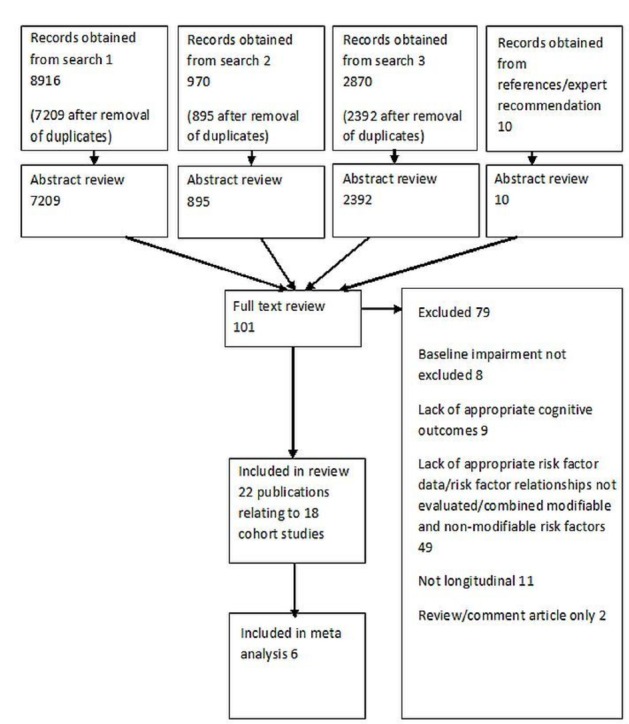
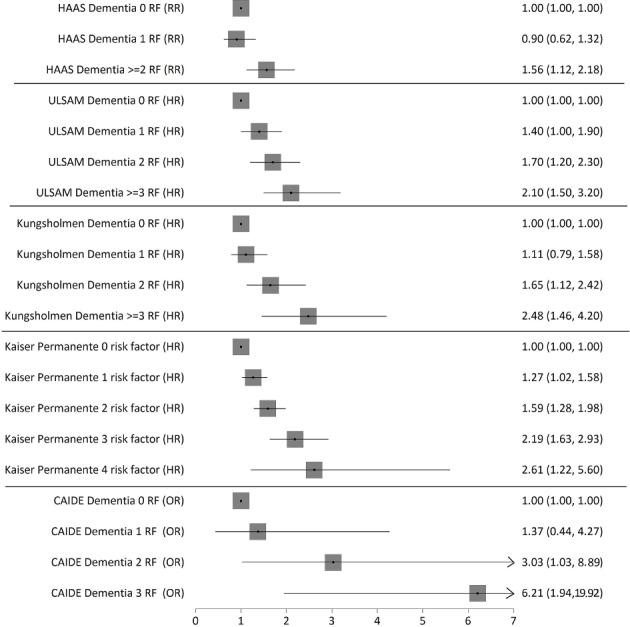
Objective: To systematically review the literature relating to the impact of multiple co-occurring modifiable risk factors for cognitive decline and dementia. Design: A systematic review and meta-analysis of the literature relating to the impact of co-occurring key risk factors for incident cognitive decline and dementia. All abstracts and full text were screened independently by two reviewers and each article assessed for bias using a standard checklist. A fixed effects meta-analysis was undertaken. Data sources: Databases Medline, Embase and PsycINFO were searched from 1999 to 2017. Eligibility criteria: For inclusion articles were required to report longitudinal data from participants free of cognitive decline at baseline, with formal assessment of cognitive function or dementia during follow-up, and an aim to examine the impact of additive or clustered comorbid risk factor burden in with two or more core modifiable risk factors. Results: Seventy-nine full-text articles were examined. Twenty-two articles (18 studies) were included reporting data on >40 000 participants. Included studies consistently reported an increased risk associated with greater numbers of intraindividual risk factors or unhealthy behaviours and the opposite for healthy or protective behaviours. A meta-analysis of studies with dementia outcomes resulted in a pooled relative risk for dementia of 1.20 (95% CI 1.04 to 1.39) for one risk factor, 1.65 (95% CI 1.40 to 1.94) for two and 2.21 (95% CI 1.78 to 2.73) for three or more, relative to no risk factors. Limitations include dependence on published results and variations in study outcome, cognitive assessment, length of follow-up and definition of risk factor exposure. Conclusions: The strength of the reported associations, the consistency across studies and the suggestion of a dose response supports a need to keep modifiable risk factor exposure to a minimum and to avoid exposure to additional modifiable risks. Further research is needed to establish whether particular combinations of risk factors confer greater risk than others. PROSPERO registration number: 42016052914.
Overview
The claims and statistics of this paper haven’t been checked yet.
Run the check — free, no account needed. It reads the open-access text and checks the sources it cites.
Integrity signals
Registry
Cites
Statistics
Figures
Verification
Claims the paper makes
The claims and statistics of this paper haven’t been checked yet.
Run the check — free, no account needed. It reads the open-access text and checks the sources it cites.
Claims other papers make about this one
Each is checked against this paper’s own text: does it say what the citing paper says it does?
The source backs part of the claim, not all of it — or backs it for a different population, condition or comparison.
In the citing paper
“Increasing evidence also points to air pollution as an emerging risk factor for dementia, heart and cardiovascular disease and lung cancer.1,14”
From Common risk factors for major noncommunicable disease, a systematic overview of reviews and commentary: the implied potential for targeted risk reduction (2019) · cites this paper as [14]
Experimental — accuracy not yet measured
Self-check
Percentages, sums and reported differences re-computed from the paper’s own numbers.
The self-check needs the paper’s full text.
Citations
Cites
López-Otín, C., Blasco, M. A., Partridge, L., Serrano, M., & Kroemer, G. (2013) · Cell · doi:10.1016/j.cell.2013.05.039 · Cited by 14,982
Child abuse: Adolescent records vs. adult recall
Femina, D. D., Yeager, C. A., & Lewis, D. O. (1990) · Child Abuse & Neglect · doi:10.1016/0145-2134(90)90033-p · Cited by 8,820
Ngandu, T., Lehtisalo, J., Solomon, A., Levälahti, E., Ahtiluoto, S., Antikainen, R., Bäckman, L., Hänninen, T., Jula, A., Laatikainen, T., et al. (2015) · The Lancet · doi:10.1016/s0140-6736(15)60461-5 · Cited by 3,689
Methods for Trend Estimation from Summarized Dose-Response Data, with Applications to Meta-Analysis
Greenland, S., & Longnecker, M. P. (1992) · American Journal of Epidemiology · doi:10.1093/oxfordjournals.aje.a116237 · Cited by 2,353
Obesity and Vascular Risk Factors at Midlife and the Risk of Dementia and Alzheimer Disease
Kivipelto, M., Ngandu, T., Fratiglioni, L., Viitanen, M., Kåreholt, I., Winblad, B., Helkala, E.-L., Tuomilehto, J., Soininen, H., & Nissinen, A. (2005) · Archives of Neurology · doi:10.1001/archneur.62.10.1556 · Cited by 1,291
Midlife cardiovascular risk factors and risk of dementia in late life
Whitmer, R. A., Sidney, S., Selby, J., Johnston, S. C., & Yaffe, K. (2005) · Neurology · doi:10.1212/01.wnl.0000149519.47454.f2 · Cited by 1,238 · cited 2×
“Study sample sizes ranged from 322(102) to 8845.(93) Two studies recruited only men(88) 98 and for five articles, >50% of the participants were male.”
BackgroundKivipelto, M., Ngandu, T., Laatikainen, T. K., Winblad, B. G., Soininen, H. S., & Tuomilehto, J. (2006) · The Lancet Neurology · doi:10.1016/s1474-4422(06)70537-3 · Cited by 1,170
Prediction models for cardiovascular disease risk in the general population: systematic review
Damen, J. A. A. G., Hooft, L., Schuit, E., Debray, T. P. A., Collins, G. S., Tzoulaki, I., Lassale, C. M., Siontis, G. C. M., Chiocchia, V., Roberts, C., et al. (2016) · BMJ · doi:10.1136/bmj.i2416 · Cited by 935
Physical Activity, Diet, and Risk of Alzheimer Disease
Scarmeas, N. (2009) · JAMA · doi:10.1001/jama.2009.1144 · Cited by 916 · cited 1×
“The Whitehall study found a relationship between increased risk factor exposure and different measures of cognitive decline using both latent growth curve(106) and logistic regression analyses(107); the Washington Heights study reported an increased risk of incident AD(89) with greater numbers of risk factors and a lo…”
MethodAggregation of vascular risk factors and risk of incident Alzheimer disease
Luchsinger, J. A., Reitz, C., Honig, L. S., Tang, M. X., Shea, S., & Mayeux, R. (2005) · Neurology · doi:10.1212/01.wnl.0000172914.08967.dc · Cited by 790 · cited 3×
“90 93 96 101 There were 12 articles where baseline measures were taken in midlife (>40 and ≤65 years)(88) 93 96 98 99 101–103 105–108 and 9 articles where the baseline was in late life (>65 years).(89) 91 92 94 95 97 100 104 109 One study included those in earlier adult life with baseline age ~26 years.”
BackgroundResultInfluential
Cited by
Sorted by citations
Licher, S., Ahmad, S., Karamujić‐Čomić, H., Voortman, T., Leening, M. J. G., Ikram, M. A., & Ikram, M. K. (2019) · Nature Medicine · doi:10.1038/s41591-019-0547-7 · Cited by 242
Peters, R., Ee, N., Peters, J., Beckett, N., Booth, A., Rockwood, K., & Anstey, K. J. (2019) · Therapeutic Advances in Chronic Disease · doi:10.1177/2040622319880392 · Cited by 213
Self-citationHypertension and the Risk of Dementia
Sierra, C. (2020) · Frontiers in Cardiovascular Medicine · doi:10.3389/fcvm.2020.00005 · Cited by 212
Lisko, I., Kulmala, J., Annetorp, M., Ngandu, T., Mangialasche, F., & Kivipelto, M. (2020) · Journal of Internal Medicine · doi:10.1111/joim.13227 · Cited by 190
Biological and environmental predictors of heterogeneity in neurocognitive ageing
Nyberg, L. H., Boraxbekk, C., Sörman, D. E., Hansson, P., Herlitz, A., Kauppi, K., Ljungberg, J. K., Lövheim, H., Lundquist, A., Adolfsson, A. N., et al. (2020) · Ageing Research Reviews · doi:10.1016/j.arr.2020.101184 · Cited by 156
“Evidence is increasing for air pollution to be risk factor for cognitive decline, Alzheimer’s disease and other cognitive disorders, as stated in several literature reviews (Block and Calderón-Garcidueñas, 2009; Block et al., 2012; Clifford et al., 2016; Kilian and Kitazawa, 2018; Peters et al., 2019; Power et al., 20…”
Metadata
- Authors
- Peters, R., Booth, A., Rockwood, K., Peters, J., D’Este, C., & Anstey, K. J.
- Affiliations
- UNSW Sydney (AU)
- University of Sheffield (GB)
- Dalhousie University (CA)
- Australian National University (AU)
- Corresponding author
- Peters, Ruth
- Venue
- BMJ Open
- Publisher
- BMJ
- Published
- 2019-01
- Volume
- 9
- Issue
- 1
- Pages
- e022846
- ISSN
- 2044-6055 (ISSN-L)
- PMC
- PMC6352772
- OpenAlex
- W2912629063
- Cited by
- 255
- References
- 135
- Citations by year
- 2026: 32 · 2025: 42 · 2024: 37 · 2023: 32 · 2022: 36 · 2021: 42 · 2020: 30 · 2019: 4
- FWCI
- 4.73
- Type
- journal article
- Language
- en
- Open access
- gold
- doi.org
- Licence
- cc-by-nc
- Locations
- BMJ Open (publishedVersion, cc-by-nc)
- Europe PMC (PubMed Central) (publishedVersion, other-oa)
- PubMed Central (publishedVersion, cc-by-nc)
- PubMed (publishedVersion)
- White Rose Research Online (University of Leeds, The University of Sheffield, University of York) (acceptedVersion)
- UNSWorks (UNSW Sydney) (submittedVersion, cc-by-nc-nd)
- ANU Open Research (Australian National University) (submittedVersion, cc-by-nc)
- Spiral (Imperial College London) (submittedVersion, cc-by-nc)
- NOVA (University of Newcastle Australia) (submittedVersion, cc-by-nc)
- Funders
- Dalhousie Medical Research Foundation
- Dalhousie University
- Canadian Institutes of Health Research
- Topics
- Health Sciences › Medicine › Psychiatry and Mental health › Dementia and Cognitive Impairment Research
- Health Sciences › Medicine › Endocrinology, Diabetes and Metabolism › Menopause: Health Impacts and Treatments
- Health Sciences › Medicine › Cardiology and Cardiovascular Medicine › Cardiovascular Health and Risk Factors
- Keywords
- dementia risk, cognitive decline, modifiable risk factors, comorbidities, risk factor burden, protective behavior, unhealthy behaviours, dose-response relationship
- MeSH terms
- Dementia, Humans, Risk Factors, Incidence, Cognitive Dysfunction
About these checks
Registry, retraction, Cites and statistics results are computed, not judged, with one exception: a printed reference that no index lists is read once by a model before it counts as a citation error. Claims are extracted by a model and kept only when their quote appears verbatim in the text; each cited source is then checked, with a model’s help, for whether it says what the claim relies on. Those verdicts can be wrong — read the claim’s quote and the cited source before relying on one.
Statistics and arithmetic are recomputed, not judged.
Confidence bands are shown only for fields calibrated on our annotated test set. None is calibrated yet, so no band is shown.
What counts as a claim ›How we measure confidence ›How we check this ›
Are you an author, or do you see a problem with this page? Request a review
