

Examining the effectiveness of a web-based intervention for symptoms of depression and anxiety in college students: study protocol of a randomised controlled trial
Open accessThe DOI matches its Crossref record; 62 of the 64 references it cites were found in a registry or an index.
Abstract
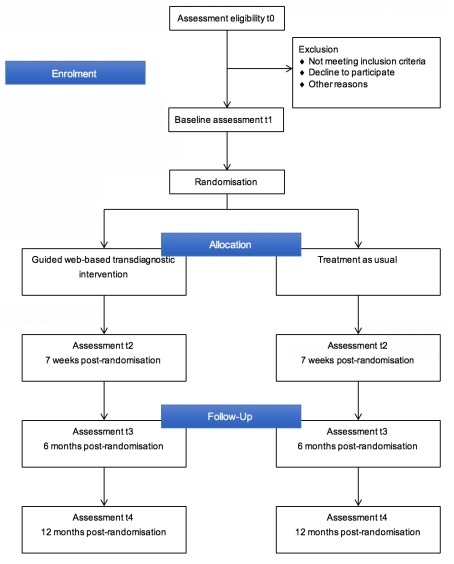
Introduction: The college years are a peak period for the onset of common mental disorders. Poor mental health is associated with low academic attainment, physical, interpersonal and cognitive impairments. Universities can use online approaches to screen students for mental disorders and treat those in need. The present study aims to assess the effectiveness of a guided web-based transdiagnostic individually tailored intervention to treat students with symptoms of depression and/or anxiety. Methods and analysis: The present study is a randomised controlled trial. Participants are Dutch college students (≥18 years) with mild to moderate depression and/or anxiety symptoms. The intervention is a guided web-based transdiagnostic individually tailored intervention that targets symptoms of depression and/or anxiety. The intervention consists of seven online sessions with a duration ranging from 4 to 7 weeks depending on individual progress. A booster session is administered 4 weeks after the completion of the seventh session. Primary outcome measures are the Patient Health Questionnaire for depression and the Generalised Anxiety Disorder 7-item scale for anxiety. These scales are administered at screening, post-treatment and follow-up assessments (6 and 12 months post-randomisation). E thics and dissemination: The Medical Ethics Committee of the Vrije Universiteit Medical Centre has approved the protocol (registration number 2016.583, A2017.362andA2018.421). Results of the trial will be published in a peer-reviewed journal. Trial registration number: NTR6797; Pre-results.
Overview
The claims and statistics of this paper haven’t been checked yet.
Free: it reads the open-access text and checks the first 5 claims that cite a source we can check. Create a free account to check every claim.
Integrity signals
Registry
Cites
Statistics
Figures
Verification
Claims the paper makes
The claims and statistics of this paper haven’t been checked yet.
Free: it reads the open-access text and checks the first 5 claims that cite a source we can check. Create a free account to check every claim.
Claims other papers make about this one
Each is checked against this paper’s own text: does it say what the citing paper says it does?
The cited source doesn’t support the claim as written.
In the citing paper
“and results have so far shown minor effects.”
From Transdiagnostic and tailored internet intervention to improve mental health among university students: Research protocol for a randomized controlled trial (2024) · cites this paper as [18]
Checked by a reasoning model — may be wrong.
Experimental — accuracy not yet measuredThe source backs part of the claim, not all of it — or backs it for a different population, condition or comparison.
In the citing paper
“Transdiagnostic interventions for mild to moderate depression and anxiety among university students have been developed and tested in Australia, Canada, Indonesia, the Netherlands, and the UK, [14–20]”
From Transdiagnostic and tailored internet intervention to improve mental health among university students: Research protocol for a randomized controlled trial (2024) · cites this paper as [18]
Experimental — accuracy not yet measured
Self-check
Percentages, sums and reported differences re-computed from the paper’s own numbers.
The self-check needs the paper’s full text.
Citations
Cites
The PHQ-9: Validity of a brief depression severity measure
Kroenke, K., Spitzer, R. L., & Williams, J. B. W. (2001) · Journal of General Internal Medicine · doi:10.1046/j.1525-1497.2001.016009606.x · Cited by 44,910
A Brief Measure for Assessing Generalized Anxiety Disorder: The GAD-7
Spitzer, R. L., Kroenke, K., Williams, J. B. W., & Löwe, B. (2006) · Archives of Internal Medicine · doi:10.1001/archinte.166.10.1092 · Cited by 31,765
Kessler, R. C., Berglund, P., Demler, O., Jin, R., Merikangas, K. R., & Walters, E. E. (2005) · Archives of General Psychiatry · doi:10.1001/archpsyc.62.6.593 · Cited by 20,391
Self-citation(1998) · The Journal of Clinical Psychiatry · Cited by 19,139
EuroQol: a new facility for the measurement of health-related quality of life
(1990) · Health Policy · doi:10.1016/0168-8510(90)90421-9 · Cited by 15,736
SAUNDERS, J. B., AASLAND, O. G., BABOR, T. F., DE LA FUENTE, J. R., & GRANT, M. (1993) · Addiction · doi:10.1111/j.1360-0443.1993.tb02093.x · Cited by 13,597
(1998) · PubMed · Cited by 10,216
Jacobson, N. S., & Truax, P. (1991) · Journal of Consulting and Clinical Psychology · doi:10.1037/0022-006x.59.1.12 · Cited by 7,770 · cited 2×
“To measure clinical significance, we will calculate response and symptom deterioration rates according to the Reliable Change Index.57 The reliable change will be calculated using the pretreatment SD, and the test–retest reliability coefficient of PHQ-9 (0.76)31 and GAD-7 (0.83).39 Analogously, Cohen’s d and clinicall…”
InfluentialThe PHQ-9: A New Depression Diagnostic and Severity Measure
Kroenke, K., & Spitzer, R. L. (2002) · Psychiatric Annals · doi:10.3928/0048-5713-20020901-06 · Cited by 5,898
Kessler, R. C., & Üstün, T. B. (2004) · International Journal of Methods in Psychiatric Research · doi:10.1002/mpr.168 · Cited by 4,771
Self-citation
Cited by
Karyotaki, E., Cuijpers, P., Albor, Y., Alonso, J., Auerbach, R. P., Bantjes, J., Bruffaerts, R., Ebert, D. D., Hasking, P., Kiekens, G., et al. (2020) · Frontiers in Psychology · doi:10.3389/fpsyg.2020.01759 · Cited by 389
Self-citationPsychological Counseling among University Students Worldwide: A Systematic Review
Cerolini, S., Zagaria, A., Franchini, C., Maniaci, V. G., Fortunato, A., Petrocchi, C., Speranza, A. M., & Lombardo, C. (2023) · European Journal of Investigation in Health Psychology and Education · doi:10.3390/ejihpe13090133 · Cited by 136
“Among them, seven presented RCT protocols (e.g., [96,112,113], one introduced a new technology-based counseling environment (a virtual reality platform; [114]), and two presented psychological intervention program protocols.”
Forbes, A., Keleher, M. R., Venditto, M., & DiBiasi, F. (2023) · Journal of Medical Internet Research · doi:10.2196/43727 · Cited by 94
“Many studies provided coach feedback to participants after each lesson [72,75,77,99,106,108,111,122,124,130,135,141,144,145,154,155,157,158].”
Liu, X., Guo, Y.-X., & Xu, Y. (2023) · World Journal of Clinical Cases · doi:10.12998/wjcc.v11.i7.1442 · Cited by 115
Bourion-Bédès, S., Tarquinio, C., Batt, M., Tarquinio, P., Lebreuilly, R., Sorsana, C., Legrand, K., Rousseau, H., & Baumann, C. (2021) · Psychiatry Research · doi:10.1016/j.psychres.2020.113559 · Cited by 90
Metadata
- Authors
- Karyotaki, E., Klein, A. M., Riper, H., Wit, L. D., Krijnen, L., Bol, E., Bolinski, F., Burger, S., Ebert, D. D., Auerbach, R. P., Kessler, R. C., Bruffaerts, R., Batelaan, N., van der Heijde, C. M., Vonk, P., Kleiboer, A., Wiers, R. W., & Cuijpers, P.
- Affiliations
- Amsterdam Public Health (NL)
- University of Amsterdam (NL)
- Department of Clinical, Neuro, and Developmental Psychology, Vrije Universiteit Amsterdam, Amsterdam, The Netherlands
- Vrije Universiteit Amsterdam (NL)
- Friedrich-Alexander-Universität Erlangen-Nürnberg (DE)
- Columbia University (US)
- Harvard University (US)
- KU Leuven (BE)
- Department of Research, Development and Prevention, Student Health Service University of Amsterdam, Amsterdam, The Netherlands
- Corresponding author
- Karyotaki, Eirini
- ORCID
- Venue
- BMJ Open
- Publisher
- BMJ
- Published
- 2019-05
- Volume
- 9
- Issue
- 5
- Pages
- e028739
- ISSN
- 2044-6055 (ISSN-L)
- PMC
- PMC6530301
- OpenAlex
- W2944915918
- Cited by
- 28
- References
- 64
- Citations by year
- 2025: 2 · 2024: 4 · 2023: 8 · 2022: 3 · 2021: 7 · 2020: 4
- FWCI
- 3.96
- Type
- journal article
- Language
- en
- Open access
- gold
- doi.org
- Licence
- cc-by-nc
- Locations
- BMJ Open (publishedVersion, cc-by-nc)
- PubMed Central (publishedVersion, cc-by-nc)
- PubMed (publishedVersion)
- HighWire Press Open Archive (acceptedVersion)
- UvA-DARE (University of Amsterdam) (submittedVersion, cc-by-nc)
- Lirias (KU Leuven) (submittedVersion, cc-by-nc)
- Pure Amsterdam UMC (submittedVersion, cc-by)
- VU Research Portal (submittedVersion, cc-by-nc)
- Data Archiving and Networked Services (DANS) (submittedVersion, other-oa)
- Funders
- ZonMw
- Topics
- Social Sciences › Psychology › Applied Psychology › Digital Mental Health Interventions
- Social Sciences › Psychology › Experimental and Cognitive Psychology › Anxiety, Depression, Psychometrics, Treatment, Cognitive Processes
- Health Sciences › Medicine › Psychiatry and Mental health › Mental Health Treatment and Access
- Keywords
- depression, anxiety, university students, online intervention, transdiagnostic treatment, mental health screening, university mental health, booster sessions, PHQ-9, GAD-7
- MeSH terms
- Patient Health Questionnaire, Internet-Based Intervention, Adolescent, Anxiety, Depression, Female, Follow-Up Studies, Humans, Male, Students, Universities, Cognitive Behavioral Therapy, Randomized Controlled Trials as Topic, Treatment Outcome
About these checks
Registry, retraction, Cites and statistics results are computed, not judged, with one exception: a printed reference that no index lists is read once by a model before it counts as a citation error. Claims are extracted by a model and kept only when their quote appears verbatim in the text; each cited source is then checked, with a model’s help, for whether it says what the claim relies on. Those verdicts can be wrong — read the claim’s quote and the cited source before relying on one.
Statistics and arithmetic are recomputed, not judged.
Confidence bands are shown only for fields calibrated on our annotated test set. None is calibrated yet, so no band is shown.
What counts as a claim ›How we measure confidence ›How we check this ›
Are you an author, or do you see a problem with this page? Request a review
Data sources
Bibliographic data: Semantic Scholar, OpenAlex, Crossref.
Contains information from the Semantic Scholar Academic Graph Datasets, made available under the ODC Attribution License (ODC-BY 1.0).
Semantic Scholar’s data is described in: Kinney, R., et al. (2023). The Semantic Scholar Open Data Platform. arXiv:2301.10140.
